 findclout.com
Fraud Detection with Machine Learning: A Practical Guide
You opened the campaign report this morning and the fraud model looked brilliant. Accuracy sat near the ceiling, almost every view was labeled clean, and the American sports pages were already booked for the weekend slate. Then finance asked a quieter question. How many of those views were real people in the geographies you paid for, and how many were bots that learned to look ordinary?
That gap is where fraud detection with machine learning either protects a brand or burns the budget. A high score is not the same thing as a good decision. On rare fraud, a system that never flags anything can look excellent while you still pay for junk traffic, damage a creator who did nothing wrong, or let a coordinated ring through.
The useful question is the cost of each mistake, set against how many cases your reviewers can touch before a post goes live.
Table of Contents
- How Machine Learning Separates Fraud From Normal Activity
- Common Techniques and Where Each One Fits
- Features That Give Fraud Models Their Signal
- Why Accuracy Misleads on Rare Fraud
- Thresholds, False Positives and the Cost of Errors
- Catching Coordinated Fraud in Ad and Creator Networks
- Confirm These Gates Before You Deploy a Fraud Model
How Machine Learning Separates Fraud From Normal Activity
A good nightclub bouncer does not work from a laminated list of banned names. The bouncer watches who arrives in a pack, who pays with a card that was declined ten minutes ago, and who keeps circling the door. Regulars get a nod. Trouble gets a longer look. Fraud detection with machine learning works the same way. The model learns what ordinary behavior looks like from labeled history, then flags events that drift away from that pattern.
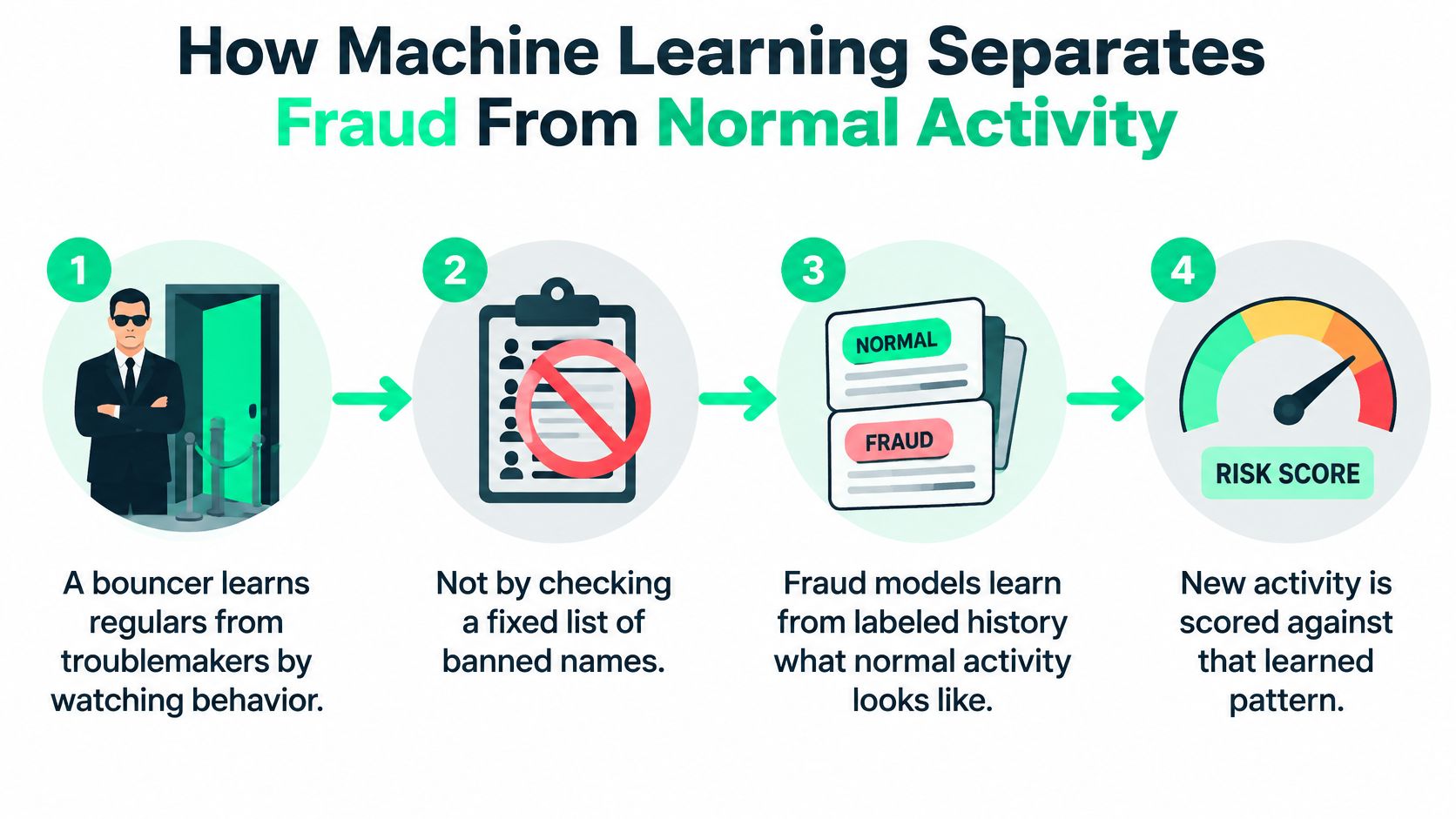
Say a U.S. sports meme page is about to carry a sponsored clip. You want the view to come from a real fan in a high quality geography, not a script hitting the same post from a warehouse of phones. The pipeline has six stages, and each one has a job.
- Collect the raw event. A login, a payment, a device fingerprint, or a view with a timestamp and a page id lands in the stream. Nothing is judged yet.
- Build features over time. Forty views from one device in a few minutes, or a long quiet gap followed by a burst, becomes a number the model can use.
- Train on labeled history. Past events marked fraud or legitimate teach the classifier the boundary. A human confirmed some of those labels after review.
- Score the new event. The model returns a probability, not a verdict. A 0.91 and a 0.12 are very different kinds of uncertainty.
- Apply a threshold. That probability becomes allow, review, or block. The cutoff is a business choice tied to reviewer capacity and brand risk, not a default of 0.5.
- Feed confirmed outcomes back. Reviewers and later chargebacks, refunds, or invalid-traffic rulings update the training set so the model is not stuck on last quarter's trick.
Why a fixed list falls behind
A rule can say "block this device" or "hold any account younger than a day." That catches only the pattern someone already wrote down. The next ring changes the device, the hour, and the caption, and the rule goes quiet. A model generalizes from examples, so a new combination of velocity, geography, and account age can still score high.
Automation is not a luxury at this volume. The Federal Trade Commission reported that U.S. consumers lost more than $12.5 billion to fraud in 2024, a 25% increase from 2023, across about 2.6 million fraud reports. Those are reported losses, not every dollar stolen, and many victims never file. The same pressure shows up in advertising. You cannot hand-check a billion views, and you also cannot treat every delivered view as legitimate attention. The same screening logic that payment teams use on cards is what a serious ad fraud program applies to views, clicks, and creator payouts.
Map your own event stream onto those six stages before you pick a model. If you cannot name the label, the score, and the person who reviews the middle band, you do not have a detector yet. You have a dashboard.
Common Techniques and Where Each One Fits
Model families are tools, not a ranking of intelligence. Pick the simplest one that hits your recall target inside the review queue you can staff. Feature design and the cutoff often move the result more than swapping algorithms.
| Technique | Strength | Limitation | Typical Fit |
|---|---|---|---|
| Logistic regression | Simple, fast and easy to explain | Misses nonlinear interactions | Transparent baseline and audit trail |
| Random forest | Handles mixed features with little tuning | Slower to score at very high volume | Mid-size tabular fraud data |
| Gradient-boosted trees (XGBoost, CatBoost) | Captures nonlinear interactions with a strong accuracy-to-latency trade-off | Needs careful threshold and calibration work | Real-time transaction and engagement scoring |
| Neural networks | Learns complex patterns from raw behavioral sequences | Costly to run and harder to explain | Large sequence data with abundant labels |
| Graph models | Reveals linked accounts, devices and IP addresses | Requires relationship data and engineering effort | Detecting coordinated fraud rings |
Logistic regression is the audit trail. Each feature has a weight you can show a brand manager or a compliance reviewer. It is fast enough to score every submission as it arrives. It fails when the signal is a combination, such as a new device plus unusual speed plus a geography that does not match the page's usual U.S. audience. Use it as the baseline you must beat, and as the explanation layer beside a stronger model.
Random forests handle mixed tabular fields with little tuning. Device age, follower count, hour of day, and a prior invalid rate can sit in one table. They are a solid fit for mid-size creator or payment data. At very high volume, scoring a large forest on every view can lag behind the moment you need a decision.
The usual default for live scoring
Gradient-boosted trees such as XGBoost and CatBoost are the practical default for real-time transaction and engagement scoring. They capture nonlinear interactions, including unusual velocity with a new device, synchronized engagement, or odd geography, without the feature scaling that linear models want. An IEEE-CIS fraud benchmark that paired engineered temporal and behavioral features with XGBoost reported recall of 0.807, precision of 0.891, an F1 of 0.847, and an area under the precision-recall curve of 0.863, with a false-positive rate below 0.4%. That last number is the operational one. At low fraud prevalence, even a small false-positive rate fills a review queue. CatBoost is often kinder when many of your fields are categories, such as platform, state, or traffic source. Deeper tabular networks can win a leaderboard and still miss a latency budget.
Neural networks earn their place on long behavioral sequences when labels are plentiful, such as a full session of scrolls, pauses, and repeats. They cost more to train and serve, and a brand-safety reviewer cannot easily see why a score moved. If you cannot explain a block to a creator, do not put a network alone on the payout decision.
Graph models are for rings, not lone anomalies. They link users, devices, IPs, and destinations so a cluster of pages posting the same clip from shared infrastructure shows up even when each page looks normal alone. They need relationship data and engineering time. They are the wrong first model if you only have a flat table of view counts.
Practical rule: Choose the simplest model that reaches your recall target at the review capacity you can staff this month, then spend the next sprint on features and the threshold.
Features That Give Fraud Models Their Signal
A model is only as good as the behavior it can see at the moment of the decision. Raw view totals hide the pattern. Summaries of recent behavior carry the signal, and each one should be computable before you allow, hold, or pay.
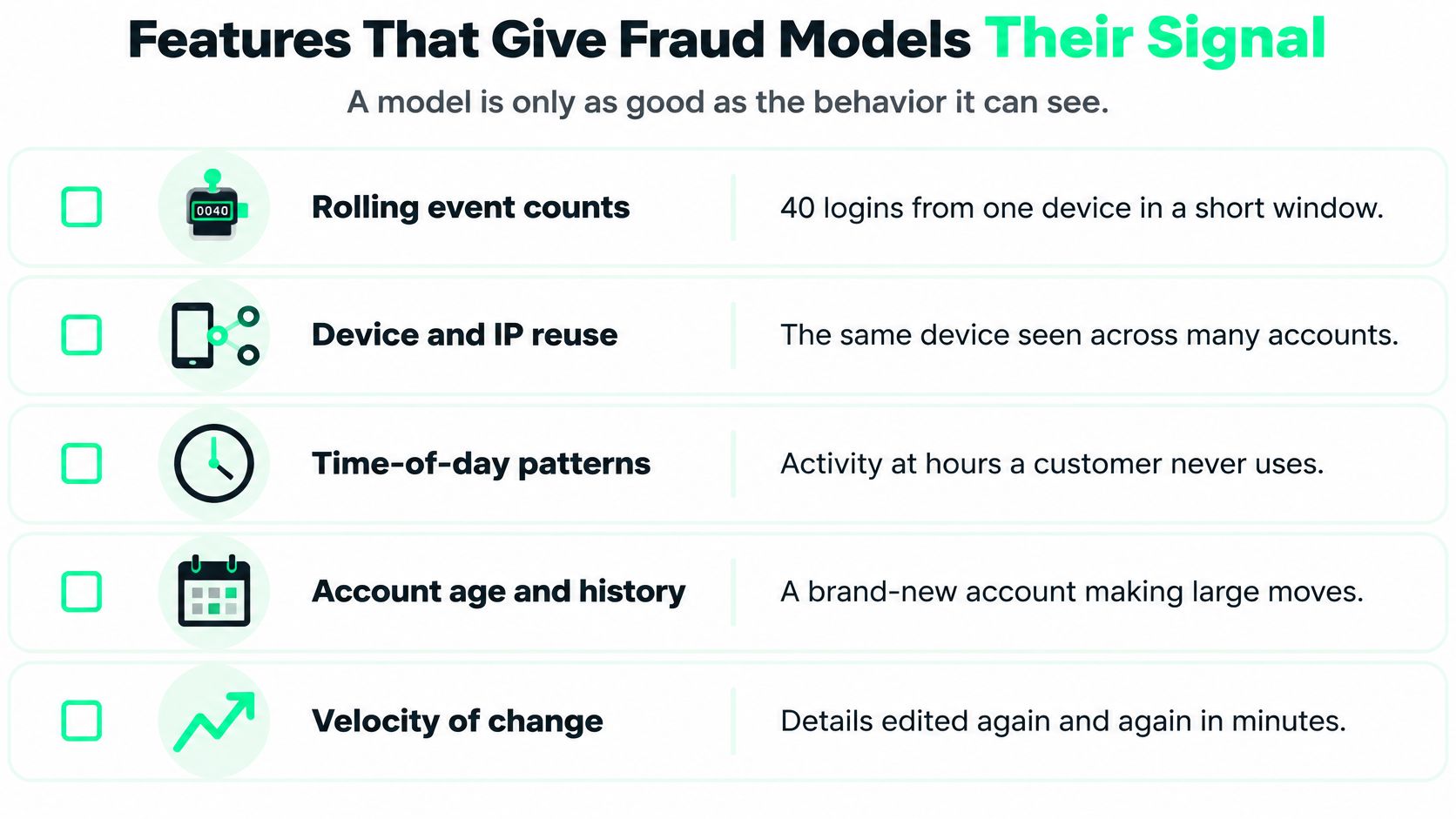
| Feature | Concrete example | Signal it adds |
|---|---|---|
| Rolling event counts | 40 logins from one device in five minutes | Sudden velocity |
| Inter-event timing | Clicks arriving at machine-regular intervals | Automation |
| Account and device age | Payout account opened yesterday | New-identity risk |
| Repeated identity or payment patterns | One card used across many accounts | Shared instruments |
| Burst similarity across accounts | Many profiles acting in the same seconds | Coordination |
| Creator or page historical validity | Page with a high prior invalid rate | Source reputation |
| Graph links | Shared users, devices, IPs and destinations | Hidden infrastructure |
Rolling counts answer "how much, how fast." Forty logins from one device in five minutes is not a fan catching up on a game thread. Inter-event timing answers "how regular." Humans are messy. Clicks that land on a metronome usually are not. Account and device age catches the payout wallet opened yesterday and already attached to a page that just went viral. Repeated instruments catch one card, one email pattern, or one tax profile spread across many creator accounts. Burst similarity is the tell for coordination. Many profiles acting in the same seconds, on the same clip, is a ring even when no single profile looks extreme. Historical validity is reputation. A page with a high prior invalid rate should not start each campaign with a clean slate. Graph links tie the rest together when the same device or destination sits under several "independent" pages.
The leakage check
Every feature must use only data available at decision time. If your "historical validity" field includes invalid traffic that was labeled next week, the test score will look brilliant and production will disappoint. The same leak happens when you compute a rolling count with events that had not happened yet, or when you join a chargeback that arrived after the view.
Run this checklist against your feature list before the next training job.
- Timestamp the feature. For a view at 2:14 p.m., could you have computed this number at 2:14 p.m.?
- Freeze labels out of inputs. Confirmed fraud, refunds, and later human rulings stay on the label side.
- Split by time, not by shuffle. Later events must not inform earlier rows.
- Segment the U.S. line. Tier-1 American traffic should have its own validity rate, not a global average that hides a weak geography.
- Drop anything you cannot explain. If a reviewer cannot say what the feature means, it does not belong on a brand-safety hold.
Why Accuracy Misleads on Rare Fraud
When fraud is rare, a model that labels everything legitimate looks excellent and catches nothing. That is the trap behind most "our detector is 99% accurate" slides.
A widely used European credit-card benchmark, described in a Stanford CS229 project report, contains 284,807 transactions collected over two days, of which only 492 were fraudulent, about 0.17%. The other 99.83% were legitimate. A classifier that predicts every transaction as legitimate would reach roughly 99.83% accuracy and detect no fraud at all. The set has 28 anonymized numerical variables plus amount and time, and it became a standard benchmark after its release in 2013. View verification has the same shape. Authentic fraud signals are a small minority inside a huge stream of ordinary traffic, so quality is judged by how much invalid activity you catch and how many good viewers you spare.
| Metric | What It Tells You | When to Use It |
|---|---|---|
| Accuracy | Share of all predictions that were correct | Rarely useful for fraud because rare classes barely move it |
| Precision | Share of flagged events that are truly fraud | When review capacity is limited |
| Recall | Share of all fraud that gets caught | When a missed fraud case is expensive |
| F1 score | Balance of precision and recall in one number | Comparing models at one chosen threshold |
| Area under the precision-recall curve | Ranking quality across all thresholds | Comparing models before picking a threshold |
| Financial loss from errors | Money lost to fraud versus money lost to blocked good users | Final model and threshold decision |
Precision is the reviewer's metric. If you flag 100 views and 80 are invalid, precision is high and the queue is worth staffing. Recall is the brand's metric. If a missed bot view means you pay for it and show a sponsor a polluted audience, recall matters more than a tidy accuracy line. F1 is a convenient tie-break once you have already picked a threshold. The area under the precision-recall curve compares models before that choice, which is why it beats accuracy on rare events. Financial loss is the decision. A false block that kills a genuine U.S. creator's payout has a dollar cost, and so does a false pass that bills a brand for automated views.
Test the way time actually moves
Random train-test splits overstate performance because devices, merchants, pages, and attack campaigns change. A forward-chaining evaluation matches production. Train on earlier events, validate on a later window, and test on the newest period. Generate any synthetic minority examples only inside training folds, or the model will peek at the future.
Report every metric by segment, not as one overall number. Geography, platform, creator tier, and traffic source can hide a weak spot. A model that looks strong overall can still fail on tier-1 American sports pages, which is exactly where a brand expected protection.
If the only number in the model review is accuracy, send it back. Ask for precision at the queue you can staff, recall on the fraud you cannot afford to miss, and the dollar cost of both errors.
Thresholds, False Positives and the Cost of Errors
The threshold is a business decision wearing a technical costume. Recent reporting summarized by the Thomson Reuters Institute indicates that false-positive rates for machine-learning fraud systems can range from 2% to 15%. That spread changes conversion, creator payouts, campaign delivery, and advertiser trust. The same reporting notes that AI and machine-learning adoption in anti-fraud analytics rose from 18% of organizations in 2024 to 25% in 2026, while another 28% expected to adopt it within two years. More models will not fix a cutoff that ignores the cost of a wrong call.
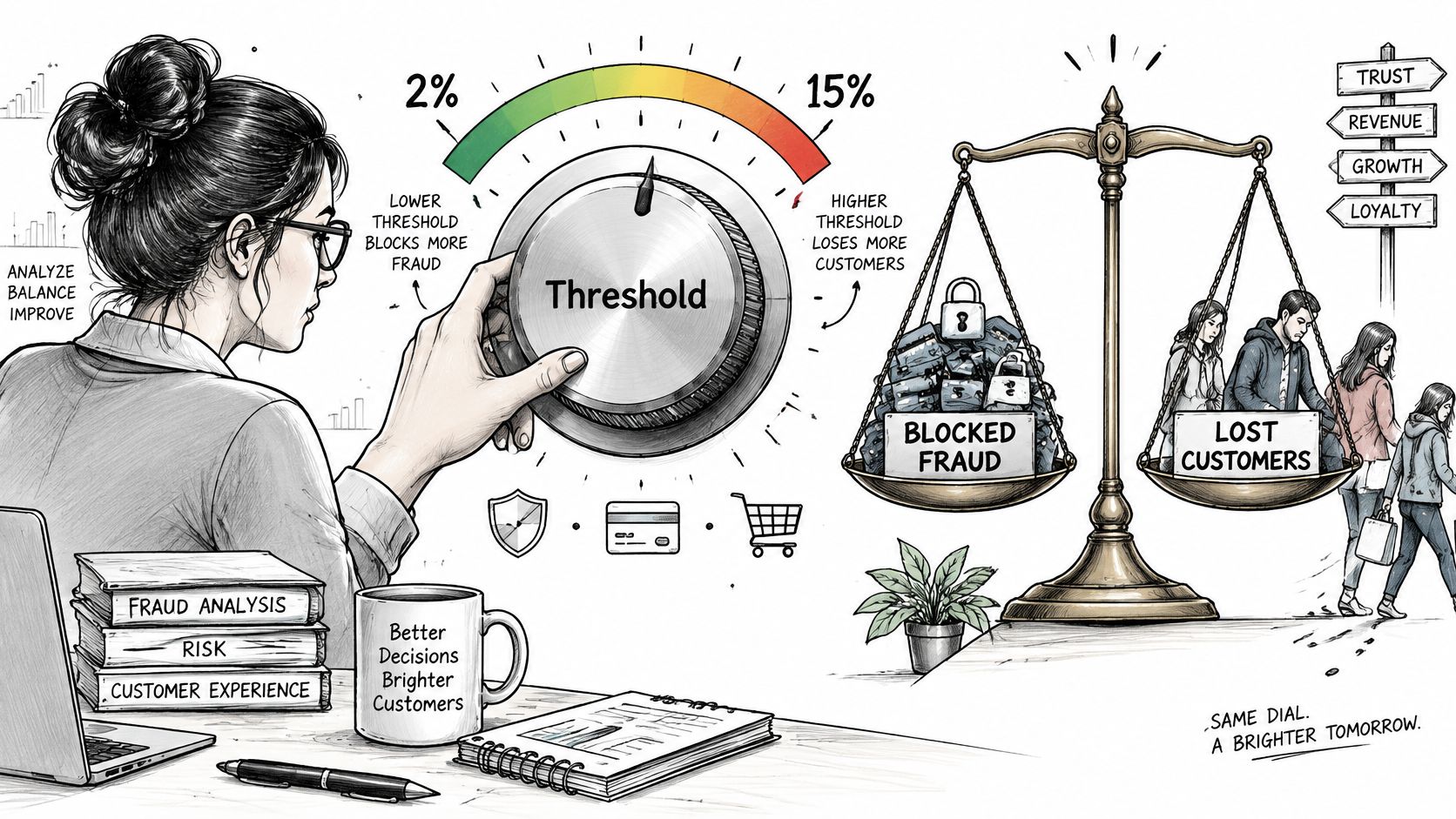
What each wrong call actually does
A false positive is not an abstract rate. It is a genuine creator pulled from a U.S. sports page the night before a playoff game, a valid audience segment suppressed because a shared ISP looked noisy, or a high-performing post labeled invalid after the brand already liked the comments. A false negative is the other invoice. You pay for automated views or coordinated engagement, then discover the geography was never the American audience you bought.
Each workflow needs its own band.
- Acquisition can tolerate more "review" outcomes, because a delayed post is cheaper than a public brand-safety miss.
- Billing and payouts need a stricter hold. Money should not move while the score is still ambiguous.
- Brand-safety exclusions should stay explicit rules. A banned topic, a prohibited claim, or a non-U.S. geo filter is not something you want a probability to negotiate.
- Post-campaign audit can use a lower threshold, because you are sampling for learning rather than blocking a live viewer.
Use three outcomes, not a binary authentic-or-fraud label. Allow when the score is low and the page already has a clean history in the target geography. Review when the score sits in the middle and a person can still look before publish or pay. Hold when the score is high, the cluster looks coordinated, or the submission fails a hard rule. Report the uncertainty. A 0.62 is not the same evidence as a 0.97.
On our side, unverified, unscraped, or suspicious posts are quarantined and accrue nothing unless and until they are approved. A creator who wants a person to look at an automated decision, including withheld earnings tied to a fraud score, can request that human review by contacting FindClout. Fraud, bot, view-authenticity, and earnings-eligibility determinations are final within our internal review processes. That pairing matters. People get a route to a reviewer, and the company still has a last word so a ring cannot stall payouts forever.
The same relationship check shows up when creators are paid in crypto. Before you release a batch of wallets that all appeared in the same hour, a Solana bundle checker from Solana Tracker can show whether those addresses were funded together. Shared funding is a clue, not a conviction, and it belongs in the review band beside device and timing links.
A short walkthrough of how teams set that dial, and why a single cutoff keeps failing them, is worth fifteen minutes before you lock the bands.
Ask any vendor, including an internal team, one question. What does each error cost in this workflow, in dollars and in trust, at the volume we will review?
Catching Coordinated Fraud in Ad and Creator Networks
Three hundred pages post the same clip within a few minutes. They share a handful of devices, a narrow set of IP ranges, and a posting schedule that lines up to the second. Each page, scored alone, looks like a small creator having a normal afternoon. Together they are a ring selling attention that never belonged to American sports fans.
Most write-ups stop at the single event. Unusual device, odd hour, high frequency. That misses collusion across accounts, pages, devices, traffic sources, and resellers. Advanced invalid traffic can imitate normal behavior on every account while sharing hidden infrastructure. Coverage from DataVisor also flags the next shift. Surveyed respondents expected document fraud, deepfake social engineering, and digital injection attacks to grow significantly, at 55%, 55%, and 54% respectively. Fraudsters change behavior after they see what you enforce. A harder model is not automatically a fairer one. Accountability, auditing, and behavior the model has never seen still get less attention than benchmark scores.
Work the ring in four moves, and keep legitimate creators off the punishment list.
- Link what is shared. Devices, IP ranges, near-identical timing, and reused captions connect pages that claim to be independent.
- Score the cluster and the account. A mild score on each page can still be a severe score on the group.
- Compare peers. Judge a creator against others on the same platform, in the same geography, at a similar tier. A packed NFL Sunday looks different from a random Tuesday.
- Hold the linked entities for a person. Shared infrastructure is common. Fans on one ISP, or creators in one city, should not be banned because a neighbor cheated.
What unfiltered U.S. inventory costs
The dollar case for screening is not theoretical. A 2024 TAG report, using data from four MRC-accredited vendors, estimated that unfiltered U.S. display and video inventory would have carried a 9.96% invalid-traffic rate in 2023, about $11.78 billion in potential losses. Industry anti-fraud standards cut estimated losses to $979 million, roughly a 92% reduction and about $10.8 billion saved, according to TAG's U.S. fraud savings report.
MRC invalid-traffic standards treat this as more than simple bot blocking. Measurement organizations must filter traffic that fails ad-serving quality or completeness checks, or that is not legitimate ad traffic, including traffic from compromised machines, while trying to keep valid activity. Advanced invalid traffic has to be segregated in reported metrics, and it should not be enriched or attributed when that is technically feasible. An older IAB and EY study put 2015 ecosystem cost at $4.6 billion, with 70% tied to performance pricing such as cost-per-click and 30% tied to CPM, covering bots, data-center traffic, hidden ads, and invalid proxies. The mix of tricks changes. The need for explicit categories does not.
Brand safety sits beside traffic quality. The FTC's native advertising guidance says promotional messages must stay identifiable as advertising, including in social video and other native formats, and disclosures should remain when a post is republished. For meme distribution, that means captions, logos, and placements are checked before anything goes live, then watched again if the clip is edited or reshared. We build inferences such as bot scores, selection probabilities, and audience analysis so a reviewer sees the cluster, not just a single view count. Content is checked before payment, and a brief can rule out whole topics. Fraud rings are banned. The same checks are what a clipping network has to show if you care about how clipping platforms detect fake views.
Judge a network by controls you can audit. Real-time review of every submission, separation of invalid traffic, and delivery concentrated in high quality U.S. geographies matter more than a reported view total.
Confirm These Gates Before You Deploy a Fraud Model
You already chose the metrics and the cost of each error. These seven gates confirm the system can run without surprising a brand or a creator. Skip one and the model will still produce a score. It just will not produce a decision you can defend.
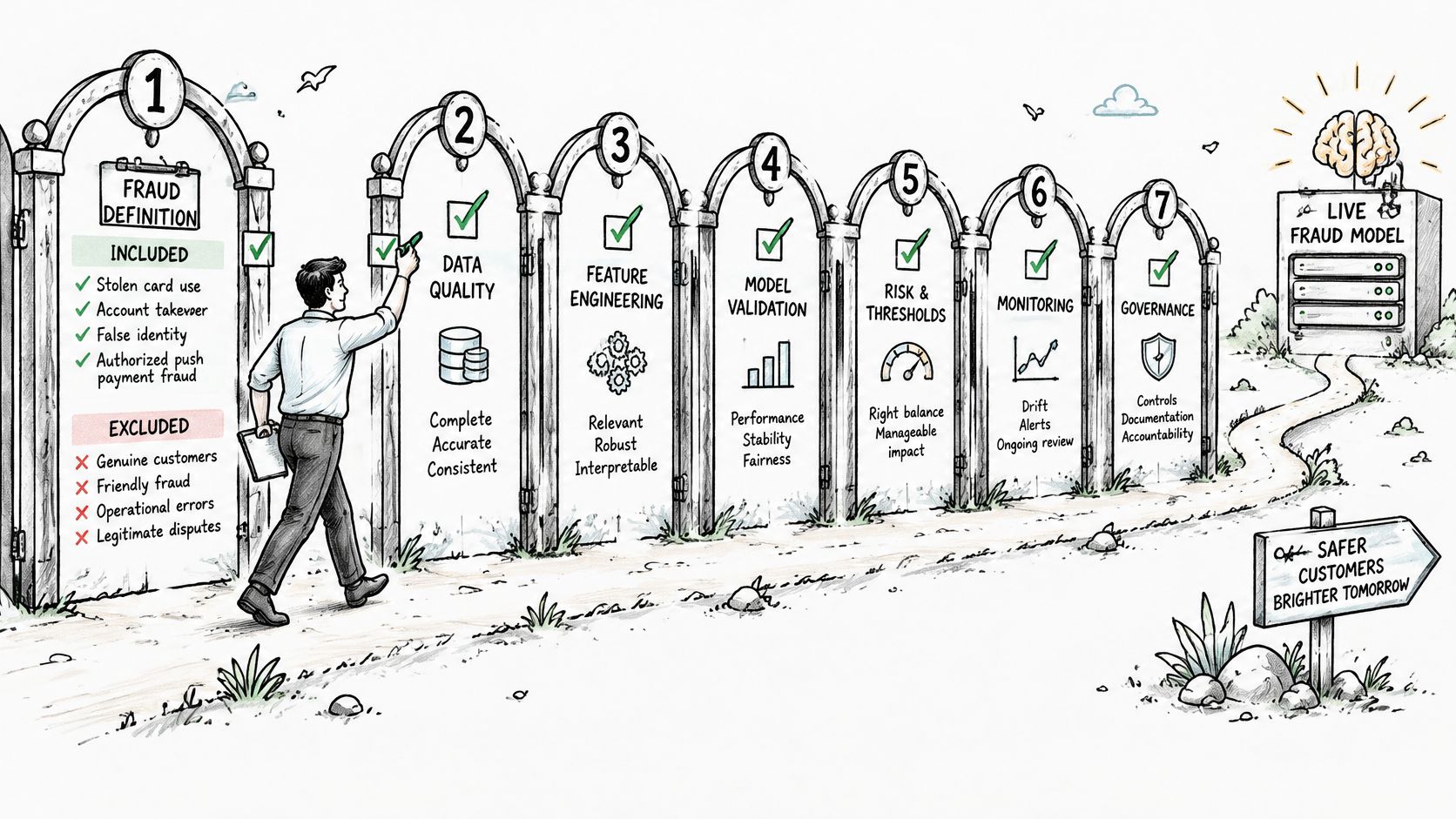
- Write the fraud definition with examples on both sides. Coordinated views from shared devices are in. A real fan spike during a playoff is out. So is a creator whose audience is outside the geos you bought. If two reviewers would label the same clip differently, the definition is not done.
- Label a historical sample and record how rare the positive class is before any split. That rate stops someone from celebrating accuracy later.
- File precision and recall from the forward-chaining backtest at the review capacity you can staff. If the queue needs forty reviewers and you have four, the threshold is fantasy.
- Lock allow, review, and hold bands, and attach a dollar cost to a false block and a missed fraud case. Acquisition, billing, and brand safety do not share one cutoff.
- Break results by geography, platform, creator tier, and traffic source, with U.S. tier-1 traffic on its own line. A global average will hide a weak American sports segment.
- Name who can reverse an automated hold and the deadline for that appeal. A score is not proof. A named reviewer with a clock is a control.
- Watch feature distributions and fraud rates after launch, and retrain when they shift. Rings adapt once they see what you block.
Teams in regulated categories should keep this packet. Prediction markets, crypto, fintech, AI, and health can run on FindClout, and those advertisers will ask for the same evidence a card issuer would. Real-time review, pre-approval of captions and placements, and brand-safe delivery to American tier-1 audiences are the bars, not optional extras. If you are comparing distribution partners, ask for that packet the way you would ask for ad verification on any other buy. We would rather show the gates than show a single accuracy number.
FindClout distributes branded content across vetted creator pages and screens every submission in real time so scale does not come at the cost of fake views or off-brand placements. If you are buying attention from American audiences, especially in sports and other high-reach niches, the same discipline you would apply to fraud detection with machine learning is already how we separate quality geography and authentic engagement from traffic you should never pay for. See how that review works on your next campaign at FindClout.
Want this audience for your brand?
FindClout puts your brand in front of verified American audiences across every major US page — brand-safe, at scale.
Start Your Campaign