 findclout.com
Ad Verification Guide: Fraud, Viewability and Brand Safety
Your campaign dashboard shows a low CPM and a growing view count. The creative looks right, but your team still can't say whether the audience was American, whether the posts ran beside suitable content, or whether anyone had a meaningful chance to see the brand. That's where ad verification needs to become an operating system, not a badge on a report.
For US tier-1 creator campaigns, the buying decision should rest on separate evidence for traffic quality, exposure, audience geography, and brand safety. Cheap reach isn't efficient if you can't explain what you bought or stop unsuitable placements before they go live.
Table of Contents
- Five Evidence Layers Beyond a Real-or-Fake Label
- Fraud Types Behind Inflated Delivery Numbers
- Checking Seller Authorization Before Counting Delivery
- Viewability Thresholds Every Verified View Needs
- Verification Vendors and the Evidence Each One Supplies
- Build the Verification Workflow and Launch Checklist
Five Evidence Layers Beyond a Real-or-Fake Label
Say a campaign reports 2 million views at an attractive CPM. This is a hypothetical dashboard, but the problem is familiar: nobody can explain whether those views came from people, met a visibility threshold, or reached the intended American audience.
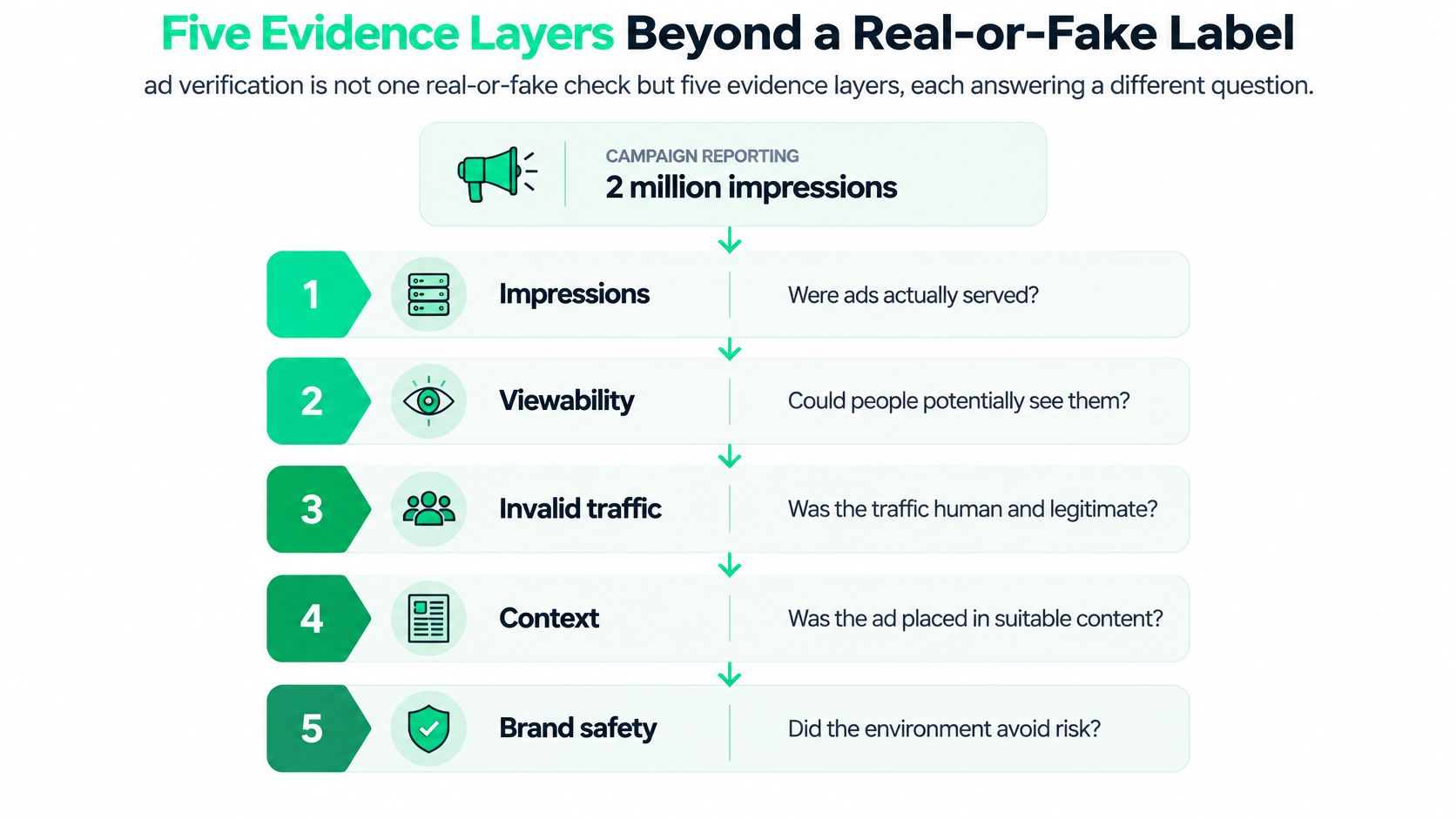
Ad verification is not one real-or-fake check but five evidence layers, each answering a different question. A platform-native view, a fraud-filtered impression, and a remembered brand message aren't interchangeable.
Five evidence layers and what each proves
| Layer | Question It Answers | Example Signal | What It Cannot Prove |
|---|---|---|---|
| Invalid traffic | Did a non-human or spoofed source generate this? | Bot and data-center patterns, filtered sessions | Whether a person saw the ad |
| Viewability | Was the ad technically visible? | Required pixel share in focus for the required time | Whether the viewer paid attention |
| Device authenticity | Did a genuine device produce the activity? | Device attestation signals | Audience geography or follower authenticity |
| Placement suitability | Did the ad run in an approved context? | Brand-safety category, adjacency, page ownership | Whether the message was understood |
| Human attention | Did anyone notice, understand or act? | Attention time, recall, downstream action | Whether the traffic was genuine on its own |
The IAB Tech Lab's Open Measurement SDK addresses inconsistent measurement methods for on-screen exposure, overlays, and video completion signals. Consistent signal collection helps comparison, but it doesn't turn every measurement into proof of effectiveness.
The evidence needs to remain visible rather than disappear inside a single score.
A genuine device isn't a qualified audience
In November 2025, IAB Tech Lab added device-attestation support to the Open Measurement SDK using the IETF Privacy Pass Protocol, according to IAB Australia's summary of the updates. Manufacturer-backed device signals make device identity harder to forge. They don't establish audience geography, follower authenticity, content adjacency, or sponsorship disclosure quality.
Think of a stadium ticket check. It confirms that the ticket is genuine, not that the fan is watching the game.
For a hypothetical campaign with 1 million verified views, suppose 40% came from within the US, while most exposures had short watch time. A blended attention score could conceal both the geography shortfall and weak exposure. Neither problem disappears because the devices were genuine.
Use audience diagnostics to investigate, not to issue automatic verdicts. Social Cloud's resource to compare Instagram engagement benchmarks can help identify accounts worth examining, while a documented brand-safety policy for digital advertising defines which environments are acceptable.
Reporting rule: Give each evidence layer its own column. Keep attested, probabilistically verified, and unverified traffic separate.
Recall surveys belong beside exposure evidence, not inside it. Downstream clicks and sign-ups belong beside recall, with their attribution limitations stated. No single column settles whether the ad worked.
Fraud Types Behind Inflated Delivery Numbers
In 2025, DoubleVerify reported that bot fraud in North America increased 101% year over year, including a 106% increase in the United States. For buyers targeting American audiences, geography filtering alone clearly isn't a fraud strategy.
The main tactics attack different parts of delivery, so they need different checks.
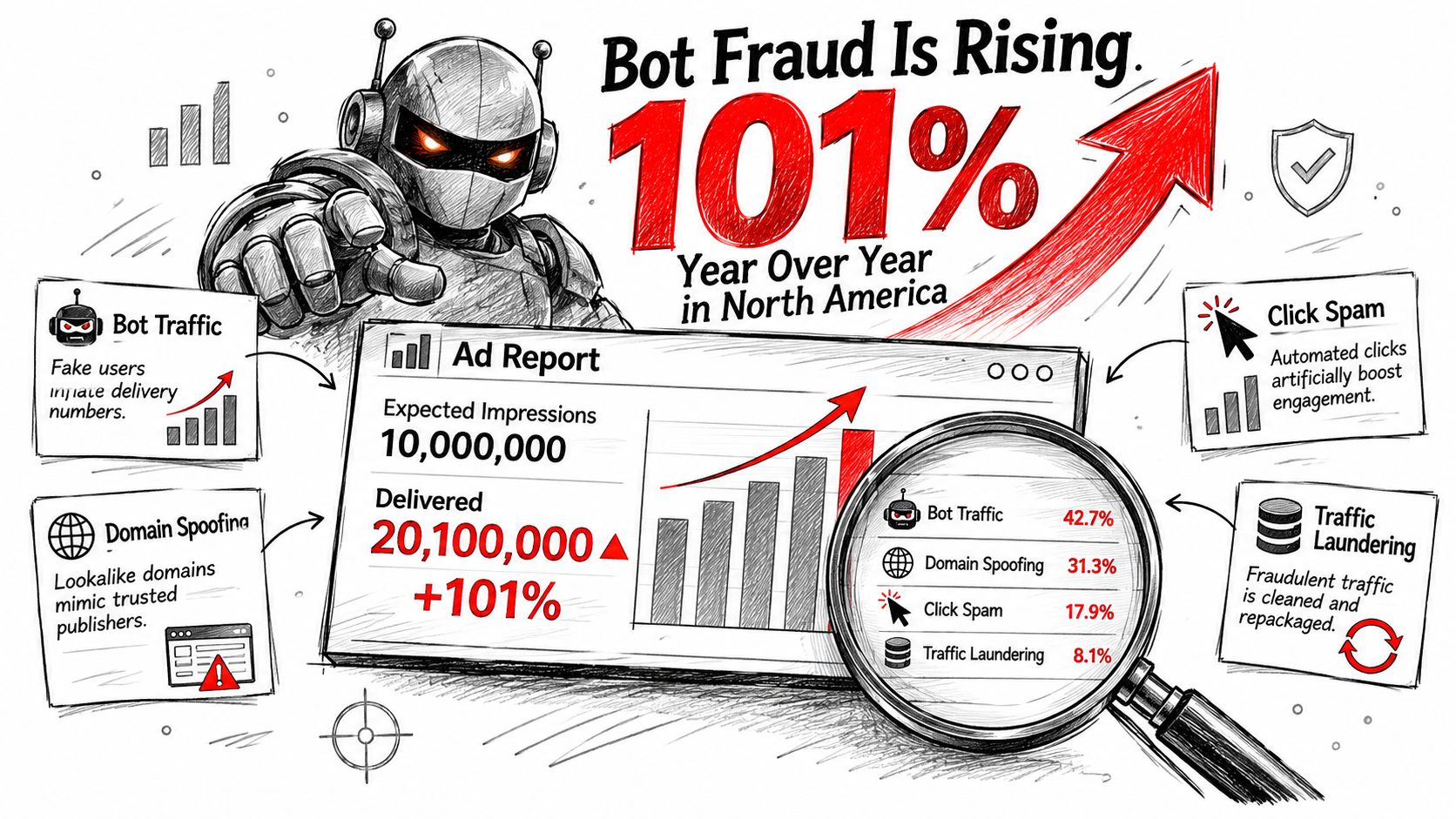
Common fraud types and the signal that exposes them
| Fraud Type | How It Inflates Delivery | Signal to Check |
|---|---|---|
| Bot traffic | Automated scripts load ads and count as viewers | Sessions with no scroll, identical timing, data-center addresses |
| Device spoofing | Fake device identities mimic real phones or browsers | Attestation failures, inconsistent device IDs |
| Seller spoofing | Unauthorized sellers resell a publisher's inventory | Seller ID missing from the authorized file or conflicting with sellers.json |
| Pixel stuffing | Ads rendered in hidden or tiny frames | Ad size or viewability far below page norms |
| Ad stacking | Several ads placed on top of one another | Multiple ads in the same pixel area each reporting a view |
| Creator-page inflation | Purchased followers or engagement pods inflate audience claims | Engagement far above follower-size norms, audience mismatch |
Investigate combinations, not isolated signals
A quiet session isn't automatically a bot. An unusually successful post isn't automatically purchased engagement. Treat these signals as reasons to inspect the placement, device evidence, audience distribution, and timing together.
Say a meme page reports 500,000 views in a day in a hypothetical campaign. Most associated sessions arrive from data-center addresses, repeat the same timing, and contain no scroll events. Those views should fail traffic-quality screening before the buyer considers them eligible delivery.
For creator-page inflation, check the audience's location and the relationship between content, followers, and engagement. A sports page with strong interaction may still be unsuitable for a US campaign if the audience evidence doesn't support American reach.
This video provides additional context for the fraud discussion.
A 2025 analysis reported by Business Standard found that 30% to 45% of programmatic traffic initially classified as valid failed deeper validation checks, according to its coverage of the mFilterIt report. That finding concerns the analyzed programmatic traffic, not a universal fraud rate for creator campaigns.
Screen before counting delivery. Quarantine flagged placements, keep their views outside billable totals, and release them only after the evidence supports approval. A first-pass filter is a screening stage, not a final guarantee.
Checking Seller Authorization Before Counting Delivery
Authorization establishes who may sell inventory. It's distinct from whether that inventory attracted legitimate attention.
The IAB Tech Lab's ads.txt framework lets publishers publicly declare authorized advertising systems and seller identifiers. app-ads.txt extends the mechanism to application environments, including mobile and connected TV.
sellers.json identifies the entities acting as direct sellers or intermediaries. The OpenRTB SupplyChain object describes the sequence of parties involved in selling or reselling an impression. Together, these records let a buyer test whether the declared commercial path makes sense.
In the second quarter of 2025, Pixalate found that 35% of global open programmatic mobile-app impressions with supply-chain objects failed seller-authorization verification because of an unauthorized seller. That scope matters: it's a finding about a defined programmatic mobile-app supply, not all advertising.
A seller-check procedure buyers can copy
- Map the inventory. Assign each creator page a stable identifier and record its owner, commercial representative, and account receiving campaign instructions.
- Check the authorization file. For applicable programmatic inventory, compare the seller identifier against the publisher's ads.txt or app-ads.txt declaration.
- Reconcile the seller identity. Confirm that sellers.json describes the expected selling entity and role.
- Inspect the complete path. Check that the declared SupplyChain sequence contains the expected parties without unexplained gaps.
- Quarantine discrepancies. Save the placement, seller identifier, check timestamp, and reason for failure so another operator can reconstruct the decision.
Consider a hypothetical app placement offered through a reseller. The app's authorization file names a different seller account from the one in the bid. Even if the reseller's company name looks familiar, the transaction fails until the identifier discrepancy is resolved.
For direct creator sponsorships, don't pretend every social post has a programmatic supply chain. Verify account ownership and commercial authority through the available account and campaign records instead. Mark programmatic-file checks not applicable, rather than recording a pass that never happened.
An authorized seller can still deliver poor traffic. Passing the commercial-path check doesn't establish that a human saw the ad.
Viewability Thresholds Every Verified View Needs
Viewability thresholds by format
| Format | Pixels In View | Continuous Duration | Polling Interval |
|---|---|---|---|
| Desktop display | 50% | 1 second | At least every 100 ms |
| Desktop video | 50% | 2 seconds | At least every 200 ms |
| Mobile display | 50% | 1 second | Every 200 ms |
| Mobile video | 50% | 2 seconds | Every 200 ms |
The MRC viewable-impression guidance and accompanying mobile guidance establish the pixel, continuous-duration, and measurement-cadence requirements summarized above. Desktop measurement also requires an in-focus browser tab. A rendered ad isn't automatically a viewable impression.
The word continuous matters. Exposure separated by hidden periods shouldn't be joined together to manufacture a qualifying interval. Video visibility also shouldn't be mistaken for completed playback.
Store the observations behind the label
A measurement system needs a sequence of positive observations, not one screenshot showing that an ad appeared on screen. Polling cadence determines whether the system has enough observations to substantiate the exposure interval.
Store raw or reconstructable evidence for:
- Placement identity: The post, ad unit, page, and campaign associated with the observation.
- Timestamp and exposure: When measurement occurred and how much of the creative was visible.
- Focus and playback: Whether the environment was active and whether video was playing.
- Measurement cadence: How often the system sampled visibility and where measurement failed.
For creator and meme distribution, this creates a practical boundary. Native platform analytics may substantiate a platform-defined view count without exposing pixel-level visibility or browser-focus evidence. Label that result accurately; don't rename it MRC-viewable delivery.
Make the dashboard explain the denominator
Separate served impressions, viewable impressions, qualified video exposure, and invalid-traffic exclusions. Show how the categories relate so a buyer doesn't add overlapping figures together or mistake exclusions for incremental reach.
A meme post that loads in an inactive tab or disappears before the applicable exposure interval shouldn't improve a viewable CPM calculation. Calculate efficiency using the qualifying denominator, while keeping the platform-native count available for reconciliation.
Practical rule: If the measurement environment can't support the claimed threshold, report the limitation instead of filling the gap with a platform view count.
Write the format-specific pixel share, continuous duration, polling cadence, and unsupported-environment treatment into the campaign brief. Agree on the definition before buying delivery, not after the invoice arrives.
Verification Vendors and the Evidence Each One Supplies
Verification sources and the layer each one covers
| Source | Layer Covered | Published Finding |
|---|---|---|
| IAB Tech Lab | Seller authorization and device authenticity | Publisher declarations, seller-identity records, supply-chain signals, and OM SDK device attestation |
| DoubleVerify | Invalid traffic and bot fraud | Regional bot-fraud growth, with separate North American and US findings |
| Pixalate | Seller authorization | Unauthorized sellers identified within global open programmatic mobile-app impressions carrying supply-chain objects |
| TrafficGuard | Invalid clicks on ad platforms | In 2026, TrafficGuard analyzed 40,021 ChatGPT ad clicks from 47 advertisers, identifying 1,592 invalid clicks; advertiser-level rates ranged from 0.1% to 34% |
Standards bodies and verification vendors do different jobs. IAB Tech Lab supplies shared technical mechanisms. Measurement providers collect signals, classify activity, and issue reports within their supported environments.
Published findings aren't interchangeable vendor scores. A seller-authorization failure, an invalid click, and regional bot-fraud growth have different denominators and answer different questions. None establishes a universal market-wide rate.
Compare methods before comparing percentages
Use a buying worksheet that records each provider's evidence layer, measurement environment, collection method, sampling rules, and exclusions. A useful comparison of fraud-detection software companies starts with that coverage map rather than a ranking detached from the campaign.
Then test the reporting mechanics:
- Coverage gaps: Does the report distinguish unsupported traffic from traffic that passed?
- Decision evidence: Can operations retrieve the reason a placement or session failed?
- Exposure methodology: How does the provider handle overlays, visibility, and video completion?
- Reconciliation: Can its records be joined to the campaign's placement identifiers?
Click measurement needs its own discipline. LinkShip's explanation of click tracking versus engagement measurement is useful when deciding whether a tracked action supports a delivery claim, an engagement claim, or an outcome claim.
Don't assume an invalid-click provider also verifies creator ownership, sponsorship disclosure, or American audience composition. Equally, a page audit can assess context without proving that every reported view was legitimate.
No single source establishes all the evidence needed for this buying decision. Choose complementary coverage, and retain the ability to investigate disagreements rather than averaging incompatible scores.
Build the Verification Workflow and Launch Checklist
Verification only protects a campaign when the result changes what can publish, count, or receive payment. A dashboard warning that nobody acts on is documentation, not a control.
For a curated American creator network, tier-1 audience quality and brand safety must be launch conditions. Real-time review needs to inspect every submission without letting distribution outrun approval. Scaling attention to billions of views makes consistent identifiers, enforceable statuses, and exception handling more important, not less.
The workflow needs both a fast routine path and a deliberate escalation path.
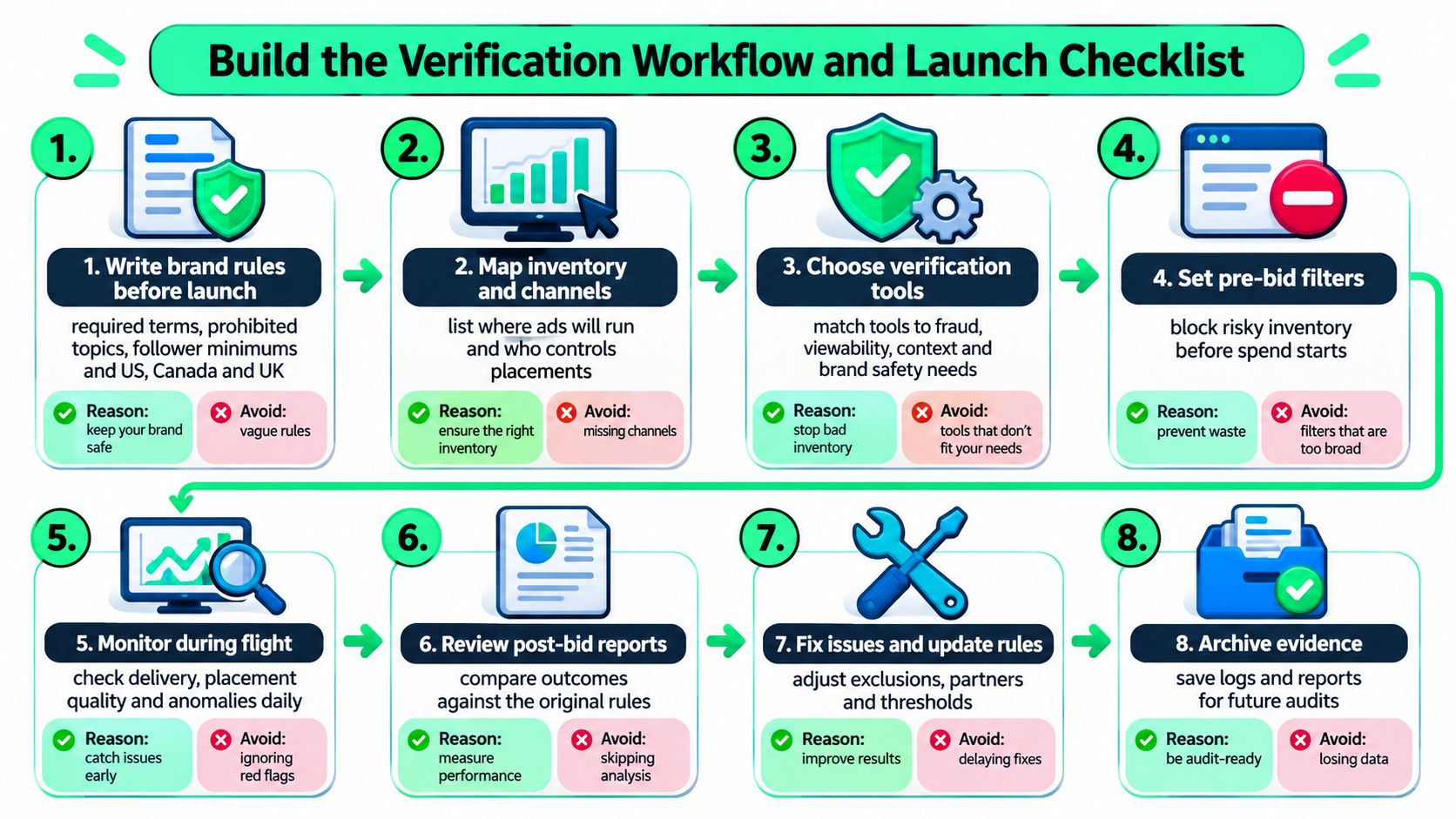
Put approval and measurement into the operating process
Write brand rules before launch.
Record required terms, prohibited topics, follower minimums, and permitted geography. Set US, Canada, and UK filters explicitly, with American delivery treated separately when that's the objective. Don't let a combined tier-1 total conceal a US shortfall.
For sensitive categories, specify acceptable claims, audience restrictions, and escalation ownership. The slip to avoid is relying on a broad instruction such as keep it brand-safe when reviewers need an enforceable decision rule.
Pre-approve every caption, logo, and creator page.
Track each submission as under review, eligible, or disapproved. Google's ad-review framework connects those statuses to delivery eligibility, providing a useful operating model: rejected or unresolved creative doesn't enter distribution.
Our process reviews every submission in real time, with attention to captions, logo treatment, placement context, and audience suitability. Escalate sensitive creative before publication, and require renewed approval when a material edit changes the original decision. Skipping pre-approval to meet a launch deadline removes the control precisely when publishing pressure is highest.
Run seller and page checks.
Attach ownership evidence, commercial authority, and applicable supply-chain results to the placement record. Confirm that the approved handle is the account publishing the content, not a similarly named account or an unapproved substitute.
Creator applications at FindClout include screen recordings and screenshots of audience-analytics dashboards. Use that evidence to assess audience composition instead of inferring American reach from English-language captions or sports subject matter.
Screen invalid activity and quarantine suspicious posts.
Define the release conditions and assign a reviewer before the campaign begins. At FindClout, unverified, unscraped, or suspicious posts are quarantined and accrue nothing unless and until they are approved.
Keep quarantined activity outside delivered totals and payable balances. The operational mistake is counting uncertain views toward a campaign commitment while the investigation remains open.
Collect evidence that can be reconciled.
Creators submit screen recordings and screenshots to verify view counts. Our measurement may use automated scraping, manual proof submission, or both, and the company chooses the method.
Preserve the handle, post reference, capture time, reporting window, and relevant audience evidence with the count. Screenshots support reconciliation, but they don't independently establish continuous pixel exposure. Our view-authenticity checker can support investigation without replacing the underlying evidence record.
Apply the agreed exposure definitions.
Classify delivery into the dashboard's separate reporting buckets and record measurement limitations. Keep platform-native views distinguishable from independently measured viewable impressions.
Include geography beside the qualifying delivery count so the buyer can assess high-quality markets directly. The slip to avoid is publishing one headline total that mixes unsupported exposure, excluded traffic, and approved US delivery.
Provide human review of automated decisions.
Automation can flag patterns and route exceptions, but the affected creator needs a usable review path. Human review of an automated decision, such as withheld earnings due to a fraud score, can be requested by contacting FindClout.
Save the decision reason and supporting records so a reviewer can assess the case. Don't imply that requesting review guarantees reversal or that an automated score explains itself.
Review weekly and remove off-brand pages.
Check audience shifts, creative deviations, unexplained count changes, and unresolved exceptions. Remove pages that no longer meet the approved rules, and update exclusions before further distribution.
Assign an owner to each corrective action. A weekly meeting without documented decisions leaves the same questionable inventory eligible for the next campaign.
Confirm readiness before spend starts
Campaign planning and verification should share the same brief. A resource on planning paid media campaigns with AdCrunch can help connect the commercial objective, channel plan, creative requirements, and measurement decisions before launch.
Use this sign-off checklist:
- Rules approved: Required language, prohibited subjects, sensitive-category escalation, and creative ownership are documented.
- Geography set: US tier-1 targeting is explicit, with Canada and UK delivery separated where permitted.
- Pages authorized: Each handle has ownership and commercial-authority evidence.
- Measurement documented: Exposure thresholds, polling, unsupported environments, and denominators are agreed.
- Quarantine enforced: Unapproved activity can't enter billable delivery.
- Reporting separated: Delivery buckets and evidence layers remain distinct.
- Review booked: A named owner will assess exceptions and remove unsuitable pages.
FindClout offers a curated US creator network with real-time submission review, centralized attention to captions, logos, and placements, and verified views delivered at a ceiling set before launch. The important distinction is controlled distribution into high-quality geographies, not reach without conditions.
Before signing with any provider, require separate reporting for the evidence layers it can substantiate. A candid unsupported label is more useful than an impressive verification score nobody can audit.
FindClout combines American creator distribution with brand controls, fraud screening, and real-time review of every submission. Visit FindClout to plan a campaign with explicit audience geography, approved creative rules, and a verified-view ceiling agreed before launch.
Want this audience for your brand?
FindClout puts your brand in front of verified American audiences across every major US page — brand-safe, at scale.
Start Your Campaign