 findclout.com
10 Fraud Detection Software Companies Compared for 2026
You open a campaign report expecting efficient reach. The impression count looks strong, but engagement is weak, and several placements belong to pages nobody approved. The problem usually isn't one missing filter. Invalid traffic, bots, click spam, app-install abuse, transaction fraud, and brand-safety risk appear at different points in the buying chain.
That makes vendor selection a layer problem. Some fraud detection software companies work before a bid enters the auction. Others verify delivery after the fact. Mobile attribution tools protect app installs, PPC products filter paid clicks, and transaction platforms score accounts, payments, and disputes.
For creator networks, the standard is stricter. Brands need verified tier-one American audiences, enforceable exclusions, high-quality geographies, and human review before a post goes live. The following ten platforms are compared by the fraud layer they cover, not by generic claims about artificial intelligence.
Table of Contents
- 1. DoubleVerify DV
- 2. Integral Ad Science IAS
- 3. HUMAN Security formerly White Ops
- 4. Pixalate
- 5. AppsFlyer Protect360
- 6. Adjust Fraud Prevention Suite
- 7. CHEQ and ClickCease PPC
- 8. Sift
- 9. Forter
- 10. SEON
- Top 10 Fraud Detection Software Comparison
- Matching Fraud Controls to Creator Network Campaigns
1. DoubleVerify DV
DoubleVerify is built for large advertisers and agencies that need third-party verification across display, video, in-app, and connected TV. Its strength is breadth. Buyers can combine pre-bid avoidance segments with post-bid verification, then review invalid traffic, viewability, and brand suitability in one reporting environment.
The Authentic Ad metric gives media teams a common way to assess whether an ad reached a legitimate, viewable audience in a suitable environment. That makes DV a practical choice for open-exchange buying and mature CTV programs where supply quality differs sharply by publisher, app, or bundle.
The trade-off is operational. Enterprise onboarding, contracts, integrations, and brand-safety tuning can take work. Aggressive suitability settings may remove legitimate inventory if the buyer doesn't review categories and exclusions carefully.
Practical rule: Use DV when independent verification across several buying environments matters more than a fast, lightweight setup.
For a creator network, DV can validate media quality, but it won't replace page approval, creative review, or direct control over which handles publish. Those controls belong in the distribution workflow. Teams evaluating the wider fraud traffic detection process should separate third-party measurement from the operational decision to approve or reject a placement.
2. Integral Ad Science IAS
Integral Ad Science combines fraud prevention, brand safety, suitability, and viewability for programmatic buyers. It supports pre-bid and post-bid workflows across major buying platforms, with meaningful coverage for CTV and in-app environments.
IAS is useful when brand suitability carries as much weight as invalid-traffic reduction. Its context controls and taxonomies help buyers avoid content categories that create reputational exposure, while its Threat Lab work and malware analysis add a security layer beyond simple bot filtering.

IAS also holds TAG Platinum status for anti-fraud, transparency, and brand safety. That accreditation is useful for procurement teams that need an established verification partner, although it shouldn't end the buyer's own validation. Channel performance can differ depending on the integration, data available, and inventory type.
Where IAS fits best
IAS suits brands buying through several DSPs that want consistent quality signals in those platforms. Its dashboards can help media teams optimize toward viewable, suitable inventory instead of relying on the lowest available CPM.
It isn't a complete creator-network operating system. IAS can help assess delivery, but it won't independently decide whether a meme page has an authentic American audience, whether a caption is approved, or whether a human reviewed the post before publication. Those decisions require a separate approval process.
For teams comparing broader automated fraud detection, the important question is whether the tool prevents exposure before delivery or merely explains a problem after the campaign has spent. IAS can support both stages, but the exact control depends on the buying integration.
3. HUMAN Security formerly White Ops
HUMAN Security is built for bot activity across advertising, web, and app environments. Its MediaGuard product uses pre-bid signals from OpenRTB workflows, while FraudSensor supports post-bid measurement and forensic analysis.
That split gives buyers two different controls. Pre-bid screening can keep suspicious supply out of the auction. Post-bid analysis can investigate delivery, reveal patterns across placements, and guide future exclusions. HUMAN also offers bot mitigation products, allowing advertising, security, and fraud teams to share intelligence when their workflows are connected.
Implementation is the trade-off. Pre-bid integrations may need engineering support, latency controls, and clear rules for exposing prediction signals to buying platforms. A fast detection decision still has to become an actionable exclusion or review rule.
A bot score is not a campaign strategy. Someone must decide which inventory to exclude, which cases need review, and how to protect legitimate high-engagement users.
HUMAN suits large programmatic operations that need low-latency decisions and ecosystem-level bot intelligence. It is less complete as the operating layer for a curated creator network, where approval must happen before publication. In that setting, the buyer needs machine screening and a human reviewer, as explained in this bot views detection guide, to assess the page, creative, audience, and context before the post appears. HUMAN can supply signals, but the network still needs enforceable American-audience criteria and a documented approval process.
4. Pixalate
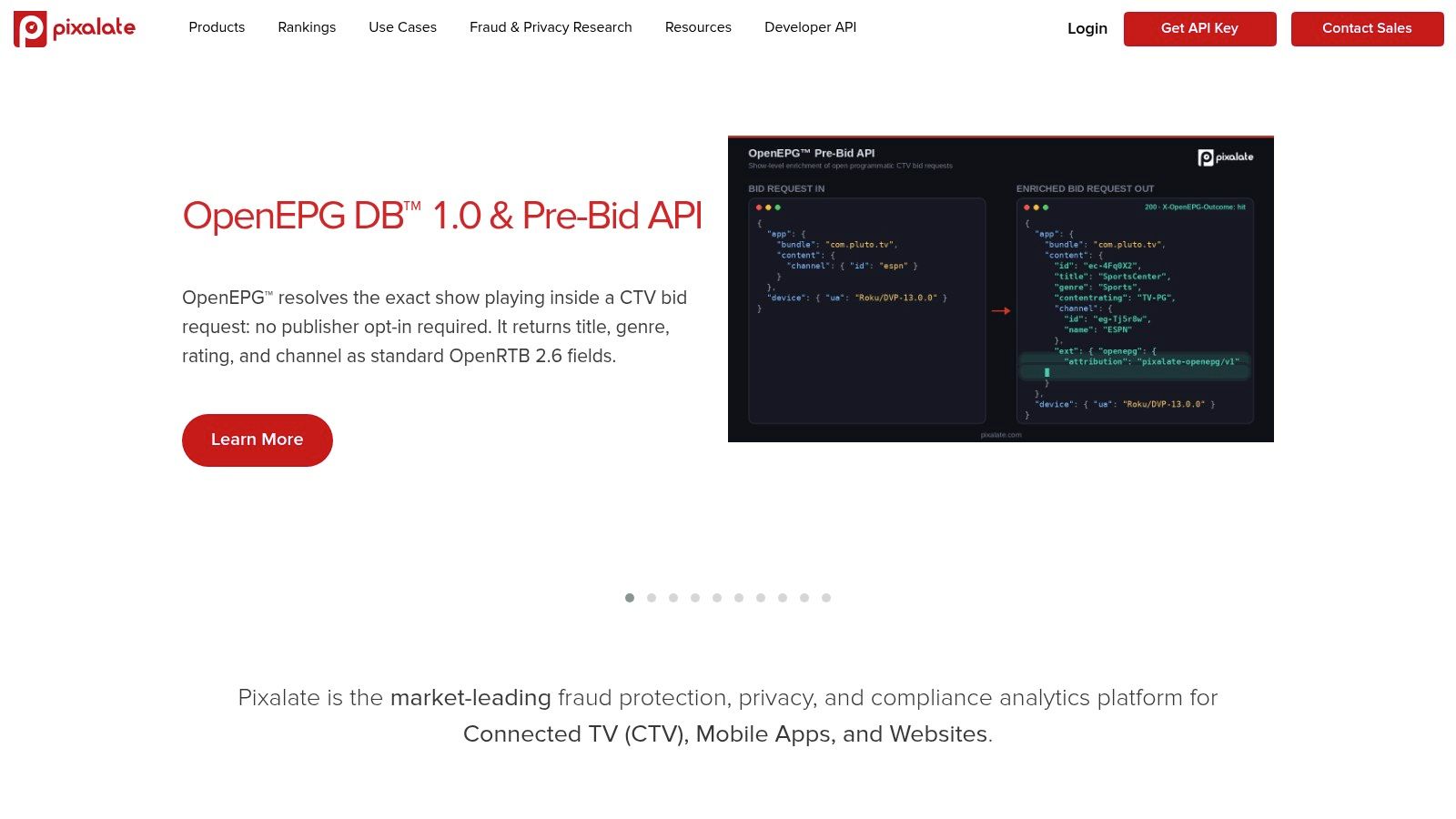
Pixalate focuses heavily on CTV, OTT, mobile apps, privacy, and supply-chain quality. Its tools address pre-bid blocking, post-bid analytics, app and CTV supply mapping, and fraud reason codes through its OpenEPG database.
That makes Pixalate particularly useful when supply transparency is the challenge. CTV and app inventory can be difficult to assess from a simple placement report, especially where spoofed bundle IDs, server-side ad insertion, or opaque reseller paths obscure the original source. Pixalate helps buyers investigate those paths and build quality controls around them.
The operational trade-off
Pixalate's breadth comes with data and workflow requirements. Enterprise teams need people who can interpret reason codes, validate methodologies, connect supply ratings to buying decisions, and maintain exclusions. Market debates around measurement methods also make internal validation important.
For a creator campaign, Pixalate is better at supply quality and inventory intelligence than at creative approval. It can help answer whether a source looks suspicious, but it won't by itself enforce the brand's caption rules or confirm that every page reaches a high-quality American audience.
The broader supply-chain lesson is clear. Keep placement records, preserve source-level evidence, and connect each exclusion to a reason. A brand should also document external risks, including security risks in agentic browsing, when automated systems interact with campaign environments.
5. AppsFlyer Protect360
AppsFlyer Protect360 is a mobile acquisition product, not a general programmatic verification suite. It protects the install and in-app event layer inside the AppsFlyer attribution workflow, with real-time blocking for known fraud patterns and post-attribution analysis.
The fit is straightforward for app marketers already using AppsFlyer. Protect360 can apply validation rules, support Fraud Protection Studio, and expose raw data for deeper investigation. Event-level controls are valuable when the problem isn't just a fraudulent install, but also an invalid registration, purchase, or other downstream action.
ProtectLITE and Protect360 provide different levels of coverage, so teams should map the product to their acquisition risk rather than assume the advanced suite is necessary for every campaign. The platform's documentation and attribution integration are practical advantages for UA teams that want fraud decisions close to campaign measurement.
What it doesn't solve
Protect360 isn't designed to validate a creator page's audience, review branded creative, or enforce a pre-publication approval process. It can tell an app team that acquisition activity looks suspicious, but it doesn't govern the content distribution layer that generated awareness or traffic.
The main commercial constraint is dependency. You need to use AppsFlyer's attribution stack, and pricing scales with app volume and decision activity. Switching from another mobile measurement provider solely for fraud controls may create unnecessary migration work.
Use Protect360 when mobile install or in-app event fraud is the exposure. Don't select it as a substitute for post-bid media verification or human brand-safety review.
6. Adjust Fraud Prevention Suite
Adjust takes a similar mobile measurement approach, with fraud prevention integrated into its attribution and analytics environment. It focuses on rejecting spoofed installs, click spam, install farms, and SDK spoofing before fraudulent activity contaminates attribution.
The preventive emphasis is the important distinction. A UA team wants to stop a bad install from becoming a credited install, not merely receive a report after the budget has been allocated. Adjust combines heuristics and rules with reporting dashboards, automation hooks, and workflows that can align fraud decisions with business intelligence systems.
That makes the suite a sensible alternative for teams already committed to Adjust as their mobile measurement provider. Integration is simpler when attribution, fraud decisions, and reporting live in the same operating environment.
A direct comparison with Protect360
AppsFlyer Protect360 and Adjust Fraud Prevention Suite solve closely related problems. The better choice usually follows the MMP already embedded in the app's acquisition stack. Switching platforms for a single feature can create more operational risk than it removes.
Adjust's feature depth should be evaluated against the exact use case. Ask how it handles click spam, spoofed installs, event validation, retransmissions, and source-level reporting in the channels you buy. A tool that blocks installs effectively may still offer limited help with creator traffic or brand suitability.
Neither platform is intended to manage verified American audiences across a creator network. Mobile attribution fraud and creator-media fraud can overlap, but they are not the same measurement problem.
7. CHEQ and ClickCease PPC
CHEQ and ClickCease target paid-search and paid-social teams that need click-fraud and invalid-visit controls. Their coverage sits at the paid-click layer, not enterprise ad verification or transaction risk. The tools audit visits, apply IP and device rules, and support blocking lists for platforms such as Google Ads and Microsoft Ads. For related evidence requirements, compare Grou's fraud blocker page.
A PPC manager or agency can usually deploy this type of control without building a large fraud operation. Teams can inspect suspicious visits and connect exclusions with campaign workflows. Plan tiers and trial availability may also make testing simpler than enterprise procurement.
The trade-off is limited coverage. ClickCease does not replace CTV supply controls, app-install attribution, creator-page authenticity checks, transaction screening, or content provenance review. Results also depend on the traffic mix, account configuration, and how the team acts on detected patterns.
Buying test: Require evidence for each exclusion, including the traffic signal behind it, rather than accepting only a total blocked-visit count.
That evidence can support agency billing reviews and paid-media budget decisions. It cannot establish that a creator post reached a legitimate American audience. Programmatic creator networks need handle-level reporting, geographic eligibility checks, enforceable exclusions, and human review before a post goes live, followed by post-campaign reconciliation. These tools fit the paid-click control layer, not the full creator verification process.
8. Sift
Sift works at the digital trust and safety layer. It scores risk across account creation, login, account takeover, payment, content, disputes, and related customer activity. That breadth makes it a strong fit for marketplaces, subscription services, apps, and other businesses where fraud follows the user across the customer lifecycle.
Sift's policy engine and case-management workflows allow risk teams to combine machine scoring with operational decisions. Networked signals can reveal relationships between accounts, devices, and behaviors that look ordinary when assessed one at a time.
A marketplace might use Sift to review a new account, protect a login, evaluate a payment, and manage an abuse case. That is a different problem from invalid media delivery, even though both require behavioral signals and calibrated decisions.
Where Sift stops
Sift requires integration work to produce useful signal quality. Pricing is custom and usage-based, so decision volume matters. Teams also need policies for escalation, review, and appeals. A score without a well-run operating process can create unnecessary declines or unresolved cases.
Sift isn't the right first tool for a brand buying creator inventory. It won't replace pre-bid verification, page-level audience review, or a human creative approval queue. It becomes relevant when a campaign sends users into an account, marketplace, or payment workflow and the advertiser needs to manage the resulting customer risk.
That boundary is important. Fraud detection software companies often sound interchangeable in search results, but a transaction-risk platform and a media-quality platform protect different points in the funnel.
9. Forter
Forter is a real-time commerce decisioning platform. It makes approve or decline decisions for digital transactions and supports account protection, payment fraud, returns abuse, promotion abuse, disputes, and chargeback management.
The platform is designed for retailers and marketplaces that want automated decisions without sending every uncertain customer to manual review. Its payment optimization capabilities, including issuer routing and support for 3DS workflows, connect fraud decisions with conversion management rather than treating them as a separate back-office task.
Forter also offers an optional chargeback guarantee. That can change the commercial calculation for an enterprise buyer, especially when internal teams want greater predictability around dispute exposure. The guarantee isn't mandatory, so teams can evaluate the decisioning product separately from the risk-transfer model.
The practical trade-off
Forter performs best when it receives rich customer, device, payment, and account context. Integration and data sharing therefore matter. Pricing can also be premium, particularly when guarantee models are included.
This is a transaction platform, not a campaign verification suite. Forter can protect the checkout after a creator or paid-media campaign sends someone to a site. It won't tell a buyer whether the original placement came from an approved page or whether the audience was geographically eligible.
Use Forter when the loss appears at checkout, account creation, returns, or disputes. Keep media-quality controls upstream so transaction software isn't forced to compensate for weak traffic sources.
10. SEON
SEON takes a modular, API-first approach to fraud prevention. Its device intelligence and digital-footprint enrichment cover signals from email, phone, IP, social activity, and device behavior. Teams can combine those signals in a scoring engine, apply custom rules, and use one Fraud API endpoint across different workflows.
The product is a good fit for fintech, crypto, iGaming, and other businesses dealing with multi-accounting, bonus abuse, and account takeover. SDKs for web and mobile can shorten the path from proof of concept to production, while device fingerprinting and integrity checks help connect activity across sessions.
SEON gives risk teams flexibility. They can define policies around a specific offer, account type, geography, or customer journey instead of accepting a fixed decision model. That flexibility is useful, but it means the customer owns more of the rule design and tuning.
The part buyers underestimate
A modular tool doesn't remove the need for governance. Teams must decide when to approve, challenge, review, or decline. They also need to measure whether a rule blocks bad activity without creating unnecessary friction for legitimate users.
SEON isn't a guarantee model, and it isn't a substitute for media verification. It can help protect the account or transaction created by a campaign, but it won't independently approve a creator page or confirm that every delivered view came from a qualified American audience.
For campaign operators, the best use is downstream enrichment. Pass qualified traffic into the customer journey, then use device, behavioral, and account signals to protect registration, promotion, and payment events.
Top 10 Fraud Detection Software Comparison
| Provider | Core capability ✨ | Fraud & Brand‑Safety ★ | Target audience 👥 | Integration & Onboarding | Price/value 💰 / USP 🏆 |
|---|---|---|---|---|---|
| DoubleVerify (DV) | Cross‑channel IVT, viewability, suitability | ★★★★☆, enterprise‑grade verification | 👥 Large brands & agencies, programmatic buyers | Broad DSP/CTV integrations; enterprise onboarding | 💰Quote/enterprise • 🏆Widely trusted 3rd‑party |
| Integral Ad Science (IAS) | Context control, IVT & CTV verification | ★★★★☆, TAG Platinum accreditation | 👥 Brand advertisers, programmatic teams | Strong DSP/CTV coverage; enterprise sales cycle | 💰Quote/enterprise • 🏆Industry accreditations |
| HUMAN Security | Real‑time bot/IVT defense (pre & post‑bid) | ★★★★☆, low‑latency bot intelligence | 👥 Buyers needing pre‑bid bot mitigation | Engineering required for pre‑bid; real‑time decisions | 💰Quote/enterprise • 🏆Fast, bid‑optimized blocking |
| Pixalate | CTV/OTT supply quality & spoofing detection | ★★★★, CTV/SSAI focus | 👥 CTV/OTT buyers, QA teams | Pre/post‑bid APIs; supply mapping & ratings | 💰Quote/enterprise • 🏆CTV/OTT specialization |
| AppsFlyer Protect360 | Attribution + install/event fraud blocking | ★★★★, deep attribution‑layer protection | 👥 App marketers on AppsFlyer | Requires AppsFlyer stack; tight attribution ties | 💰Usage/tiers • 🏆SKAN & attribution integration |
| Adjust Fraud Prevention | Preventive mobile fraud (installs/events) | ★★★☆, pre‑attribution blocking | 👥 Teams using Adjust MMP for UA | Best when core MMP is Adjust; integrated flows | 💰Usage/quote • 🏆Preventive blocking before attribution |
| CHEQ / ClickCease (PPC) | Click‑fraud blocking & IP/device filtering | ★★★☆, PPC‑focused IVT control | 👥 In‑house PPC teams, SMBs & agencies | Rapid setup; plug‑and‑play for search/social | 💰Volume plans + trials • 🏆Fast deployment for PPC |
| Sift | Real‑time risk scoring across user lifecycle | ★★★★, transaction & account risk at scale | 👥 Marketplaces, commerce, subscription services | Integration effort for decisioning; rich APIs | 💰Usage/quote • 🏆Broad lifecycle fraud coverage |
| Forter | Instant approve/decline + dispute management | ★★★★, commerce decisioning, guarantee option | 👥 Retail & marketplaces (mid→enterprise) | Enterprise integration; RTP & chargeback routing | 💰Premium/quote • 🏆Optional chargeback guarantee |
| SEON | Device fingerprinting & footprint enrichment | ★★★★, strong anti‑multi‑account & ATO | 👥 Fintech, crypto, iGaming, iGaming & promo‑abuse teams | API‑first, SDKs; quick POCs and tuning required | 💰Modular/pricing • 🏆API‑first, fast POC delivery |
Matching Fraud Controls to Creator Network Campaigns
Start with the layer where waste appears. Pre-bid tools suit open-exchange buying. Post-bid verification helps reconcile delivery and investigate suspicious placements. App-install products belong with mobile acquisition. Click filters address paid-search and paid-social visits. Risk platforms protect signups, accounts, payments, disputes, and promotions.
Run a short pilot before scaling. Review reason codes every week, compare excluded inventory with accepted inventory, and confirm how the vendor handles threshold changes. Don't judge a system only by its fraud rate. Ask how it defines a valid view, whether it can identify a human audience, what evidence supports an exclusion, and whether aggressive filtering removes legitimate high-engagement users.
For creator networks, the questions shift toward placement control. Which pages can post? Are the audiences verified as tier-one American? Can the buyer enforce geography, prohibited topics, minimum audience requirements, and page exclusions? Does a human review the creative before it goes live? Can the team see handle-level delivery instead of receiving one blended reach number?
The measurement contract should separate gross views, eligible views after fraud filtering, and billable verified views. The IAB and MRC framework offers a useful reference point for visible digital advertising, with at least 50% of display pixels visible continuously for one second and at least 50% of video pixels visible for two continuous seconds. It also calls for removing general invalid traffic and encourages filtering invalid traffic with automated activity. See the IAB and MRC measurement guidance for the underlying definitions.
The wider market need is measurable. In 2024, U.S. consumers reported losing more than $12.5 billion to fraud, up 25% from 2023, according to the Federal Trade Commission's 2024 fraud data. That doesn't mean every media impression is fraudulent, but it does show why brands need controls across identity, behavior, traffic, and transactions.
FindClout is built around the creator-distribution controls that general verification platforms don't provide on their own. It uses pre-approval before publishing, AI scoring with an average response time of approximately 1.2 seconds, 24/7 human review, and geographic filters for the US, Canada, and the UK. Its operating model focuses on curated pages, American audiences, brand-safety rules, real-time campaign orchestration, and the ability to remove off-brand sources as campaigns run.
That matters for sports, gaming, iGaming, prediction-market, finance, and AI advertisers that need high-quality American reach. FindClout works with creator pages rather than asking a media buyer to coordinate each seller independently, with particular strength in American sports niches and audiences interested in sports betting and related products.
Use the same standard for every vendor on this list. Require auditable source handles, timestamps, geography, engagement velocity, duplicate or bot-pattern screening, exclusion logic, and post-campaign reconciliation. The best fraud control is not necessarily the platform with the biggest feature list. It's the one that protects the exact point where your campaign can lose money or damage the brand.
Check your Instagram comments with StreamGen when comment authenticity is part of the campaign review, then connect that signal to the broader placement and traffic decision.
FindClout gives brands programmatic access to curated creator pages, pre-approval, tier-one American audience targeting, fraud screening, and AI scoring backed by 24/7 human review. If your campaign depends on verified attention, brand-safe creative, and high-quality U.S. sports or consumer audiences, visit FindClout to discuss a controlled pilot and review the available distribution options.
Want this audience for your brand?
FindClout puts your brand in front of verified American audiences across every major US page — brand-safe, at scale.
Start Your Campaign