 findclout.com
Fraud Detection and Prevention: A Practical Guide for 2026
Nearly 60% of U.S. businesses surveyed by Experian in 2025 reported higher fraud losses, while 72% expected AI-generated fraud to be a leading challenge. For advertisers, that makes fraud detection and prevention more than a question of blocking obvious bots. It means proving that the attention you buy came from eligible people, in the American and other tier-one markets you selected, alongside content that protects your brand.
Table of Contents
- Why Fraud Losses Keep Rising
- Common Fraud Types and the Signals That Expose Them
- How Layered Detection Turns Signals Into Decisions
- How to Verify Views Against Viewability Standards
- Measuring Attention Quality, Not Just Bot Traffic
- Governing AI-Generated Traffic
- Prevention Controls and a Pre-Launch Routine
Why Fraud Losses Keep Rising
U.S. consumers reported losing more than $12.5 billion to fraud in 2024, a 25% increase from 2023, according to the Federal Trade Commission. Those are reported losses, not a complete accounting of fraud: people may stay silent because they're embarrassed, unsure what happened, or unfamiliar with reporting channels.
Say someone receives a convincing message claiming their investment account needs urgent verification. They transfer money, see a plausible dashboard, and only discover the deception when they try to withdraw. The apparent legitimacy delays the moment they recognize the loss.
Why visible losses are only part of the problem
Fraud can resemble a slow leak in a building. A person sees a small stain and postpones investigating, while water continues collecting behind the wall. In a business, teams can make the same mistake when they dismiss suspicious transactions individually instead of examining the connected pattern.
Practical rule: A successful-looking dashboard isn't evidence that the underlying activity is legitimate.
Advertising creates a similar blind spot. A campaign can display growing reach while the buyer pays for invalid activity, ineligible locations, or exposure that never meets the agreed quality standard. The immediate cost is wasted budget; the longer-term cost is misleading performance data that influences the next purchase.
That doesn't mean consumer scam losses measure advertising fraud. They don't. The useful connection is operational: verify the underlying event before treating the reported outcome as trustworthy. Advertisers need clear fraud definitions, layered detection, preventive controls, auditable view verification, and someone accountable when a decision goes wrong.
Common Fraud Types and the Signals That Expose Them
A typical sign is something a person notices. A detection signal is the measurable feature software uses to flag that observation consistently. Neither is automatically proof of wrongdoing.
Use this reference to separate the problem you're investigating from the evidence you need.
Fraud types, typical signs and detection signals
| Fraud type | Typical sign | Main detection signal |
|---|---|---|
| Account takeover | Login from a new device right after a password reset | Device and location mismatch on login |
| Payment fraud | Mismatched billing and shipping details, quick card retries | Velocity of failed transactions per card or device |
| Imposter scam | Urgent request claiming to be a trusted party | Contact originating from a spoofed or unverified identity |
| Investment scam | Promised returns and pressure to deposit quickly | Unusual payment destinations linked to known scam accounts |
| Invalid ad traffic (bots) | Clicks with no dwell time, traffic from data-center IPs | Non-human user agents and data-center network origin |
| Fake engagement and click farms | Views with near-zero watch time, synchronized likes | Engagement-to-view ratio anomalies |
| Occupational fraud | Altered records, approvals bypassed by senior staff | Tips and hotline reports, plus control override logs |
Consumer, traffic and internal risks
Consumer fraud often starts with a change that doesn't fit the account's history. A password reset followed by an unfamiliar-device login deserves investigation, but it could also be a legitimate customer replacing a phone. Quick card retries are similarly useful evidence, not a verdict by themselves.
Traffic fraud concerns manufactured or deceptive activity. Look for clicks without meaningful sessions, engagement arriving in synchronized bursts, or repeated interactions that don't fit normal audience behavior. Human-operated click farms are a useful reminder that fraudulent activity doesn't have to come from a bot.
For crypto advertisers evaluating apparent trading interest, MemeAssist's guide to Solana wash trading red flags provides related context on recognizing activity that may manufacture an appearance of demand. Trading activity and advertising traffic require different checks, but both deserve scrutiny when volume appears disconnected from genuine interest.
Internal fraud requires a different lens. A senior employee bypassing approval or editing records may leave no suspicious visitor session to inspect. The useful evidence sits in permissions, change histories, and reports from people who understand the process.
Before choosing a tool, match patterns in your own records against these rows. A single incident can produce several signals, and a legitimate event can trigger an isolated warning.
How Layered Detection Turns Signals Into Decisions
An airport doesn't rely on a single checkpoint for every risk. Fraud screening should work similarly: each layer examines something the previous layer couldn't establish, and a reviewer can resolve uncertainty that software leaves behind.
The process begins with collecting evidence, then scoring and combining it before making a decision.
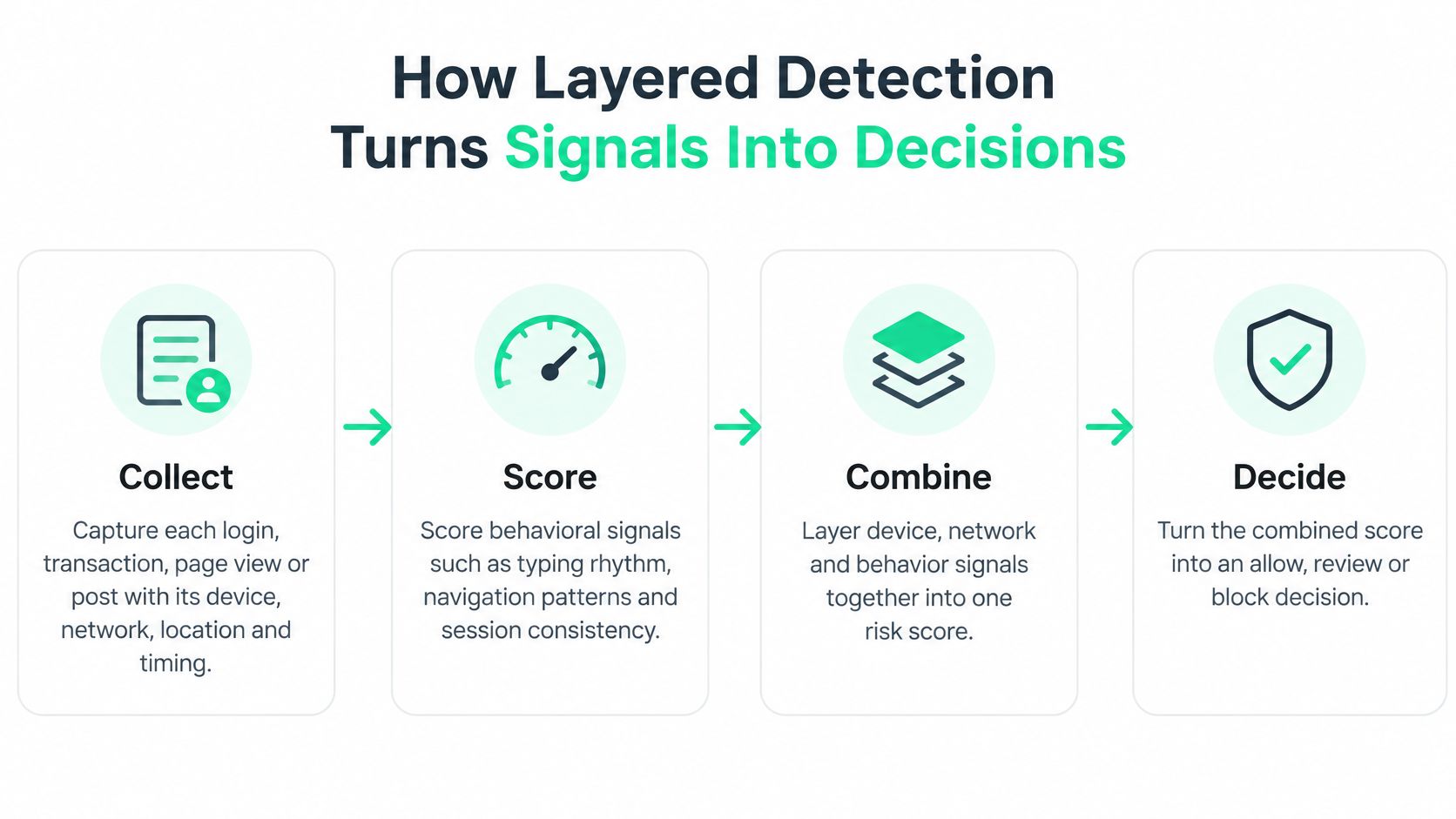
Collect the event and its context. Record the login, transaction, page view, or post alongside available device, network, location, and timing information. Without this context, an analyst may see a suspicious total but have no way to investigate its source.
Score behavior and relationships. Examine abnormal view velocity, repeated device or network identifiers, geographic inconsistency, engagement-to-view anomalies, and synchronized activity across accounts. This catches patterns that individual event records don't reveal.
Apply decision thresholds. Allow low-risk activity, quarantine high-risk activity, and route borderline cases for review. Separate risk thresholds from commercial pressure so a delivery target doesn't become a reason to approve questionable traffic.
Give reviewers the underlying evidence. A person should see why the event was flagged, not just a colored risk label. A viral sports moment can produce a legitimate burst of American viewers, so reviewers need timing, placement context, and account history before deciding whether the burst is suspicious.
Human reports are a detection layer
Keep a confidential reporting channel open. The ACFE's 2024 report examined 1,921 occupational-fraud cases across 138 countries and territories and found that tips detected 43% of cases, more than three times the next method, with employees supplying more than half of tips, according to the Australian Government's report digest. That evidence concerns occupational fraud, not advertising traffic, but it supports giving people a direct route to report manipulation that automated monitoring may miss.
Record the decision and its reason. Preserve the triggering signals, applicable rule, reviewer action, and eventual outcome. That record lets the team investigate a mistake and adjust the control instead of repeatedly arguing over screenshots.
For additional context on automated evaluation, see our AI scoring system explanation. A score should help organize investigation, not replace evidence.
The following video offers additional context for thinking about fraud screening.
How to Verify Views Against Viewability Standards
Viewability thresholds by ad format
| Ad format | Pixels visible | Continuous time |
|---|---|---|
| Display ad | At least 50% | 1 second |
| Video ad | At least 50% | 2 seconds |
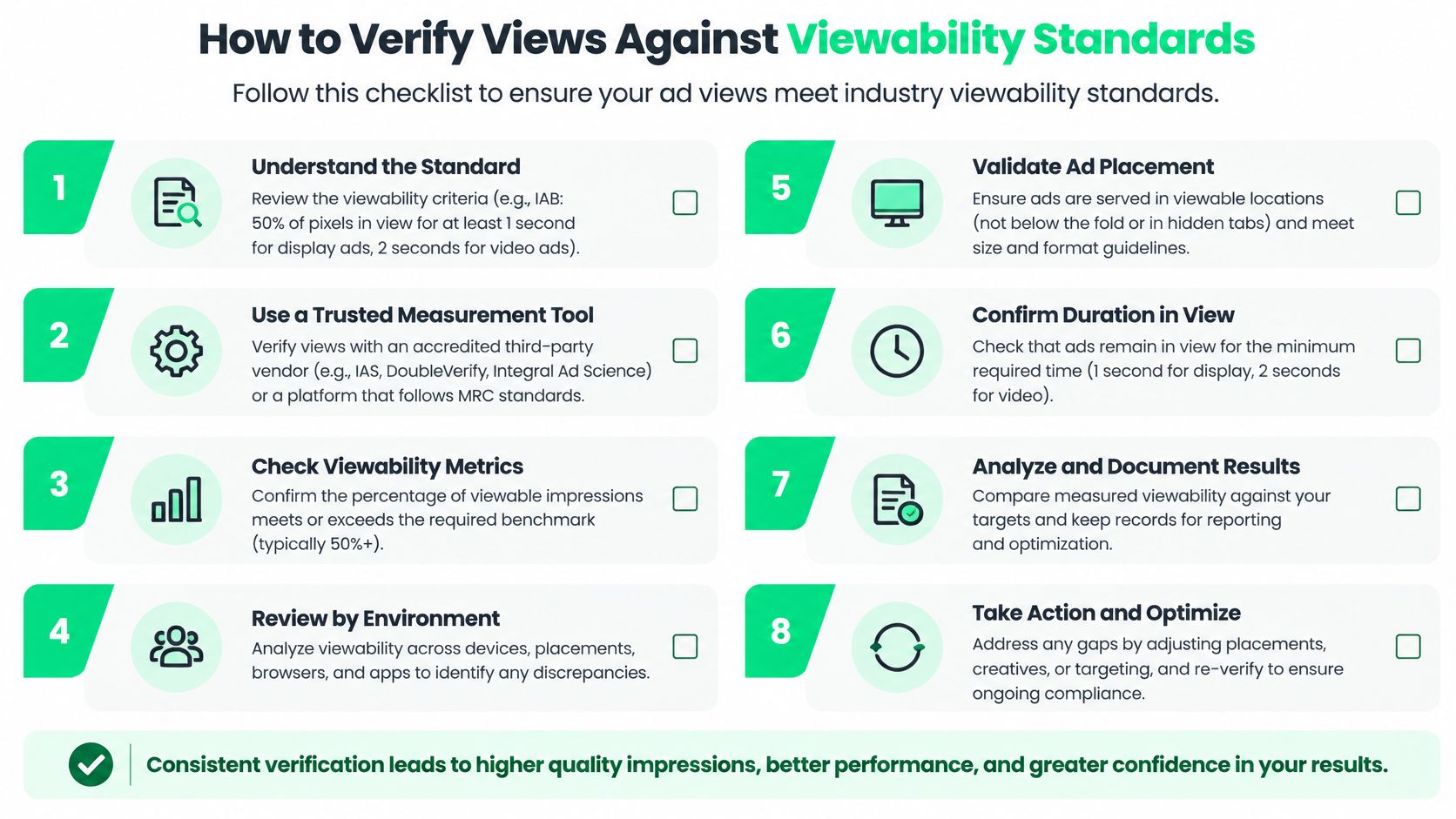
The IAB and MRC retail-media measurement guidelines set these minimums at 50% of pixels visible for one continuous second for display and two continuous seconds for video, alongside invalid-traffic filtration, deduplication, and granular placement reporting. These are viewability thresholds, not proof of full attention, a completed video, or purchase intent.
The MRC's viewable-impression guidelines distinguish fraudulent impressions from invalid impressions: every fraudulent impression is invalid, but not every invalid impression is fraudulent, and fraudulent impressions cannot qualify as viewable. Intentional deception is the distinguishing issue, so don't label every filtered event a proven fraud attempt.
Run the approval checklist
Use the following checklist to connect measurement requirements with brand suitability and audience eligibility.
Define safe and unsafe content explicitly. Name excluded themes, unacceptable claims, and sensitive contexts. The IAB Ad Quality Checklist recommends aligning those definitions with supplier controls, including allowlists, blocklists, keyword filters, content exclusions, comment controls, and age or regulatory restrictions.
Map each definition to an enforceable rule. For example, an approved sports page shouldn't become automatically eligible for every caption or topic. Page eligibility and post eligibility are separate decisions.
Choose monitoring or blocking deliberately. A borderline contextual mention may need observation; a prohibited placement needs exclusion. Assign an owner to resolve ambiguous cases.
Confirm channel coverage. Check whether the same restrictions apply across every publishing surface being purchased. A filter on one channel doesn't establish coverage elsewhere.
Separate delivery categories. Request delivered, viewable, non-viewable, completed, duplicated, and invalid counts rather than accepting a single total labeled views.
Reconcile placements with geography. Match individual pages and posts against the contracted American or other tier-one audience. A creator's location doesn't prove where viewers live.
The IAB anti-fraud principles also call for identifying hijacked devices, masquerading crawlers, data-center traffic, and incentivized browsing, and state that illegitimate traffic shouldn't be sold.
Our ad verification guide provides further context for organizing these checks. Where placement-level viewability can't be measured directly, label the limitation and agree on acceptable evidence before billing rather than presenting platform-reported plays as independently verified viewable impressions.
Measuring Attention Quality, Not Just Bot Traffic
The common shortcut is to filter bots and assume everything remaining is valuable attention. That confuses an authenticity question with an advertising-quality question. A person can be real and still swipe past before absorbing the message.
Invalid traffic rates by measurement unit
| Measurement unit | Reported invalid rate | Source basis |
|---|---|---|
| Impressions | 20.64% | Analysis of 105.7 billion ad impressions, 2025 global |
| Paid clicks | 8.51% | Click-focused analysis across major platforms and countries |
The Fraudlogix statistics compilation presents a 20.64% global invalid-traffic rate from 105.7 billion ad impressions in 2025, alongside click-focused analysis reporting 8.51% invalid paid traffic across major platforms and countries. These aren't interchangeable estimates or a controlled comparison: the units and underlying analyses differ, so the gap doesn't establish that one platform or buying method is safer.
A fraud rate without its measurement unit and denominator isn't a useful purchasing benchmark.
Measure what the buyer actually needs
The visual below separates basic bot screening from broader attention measurement.
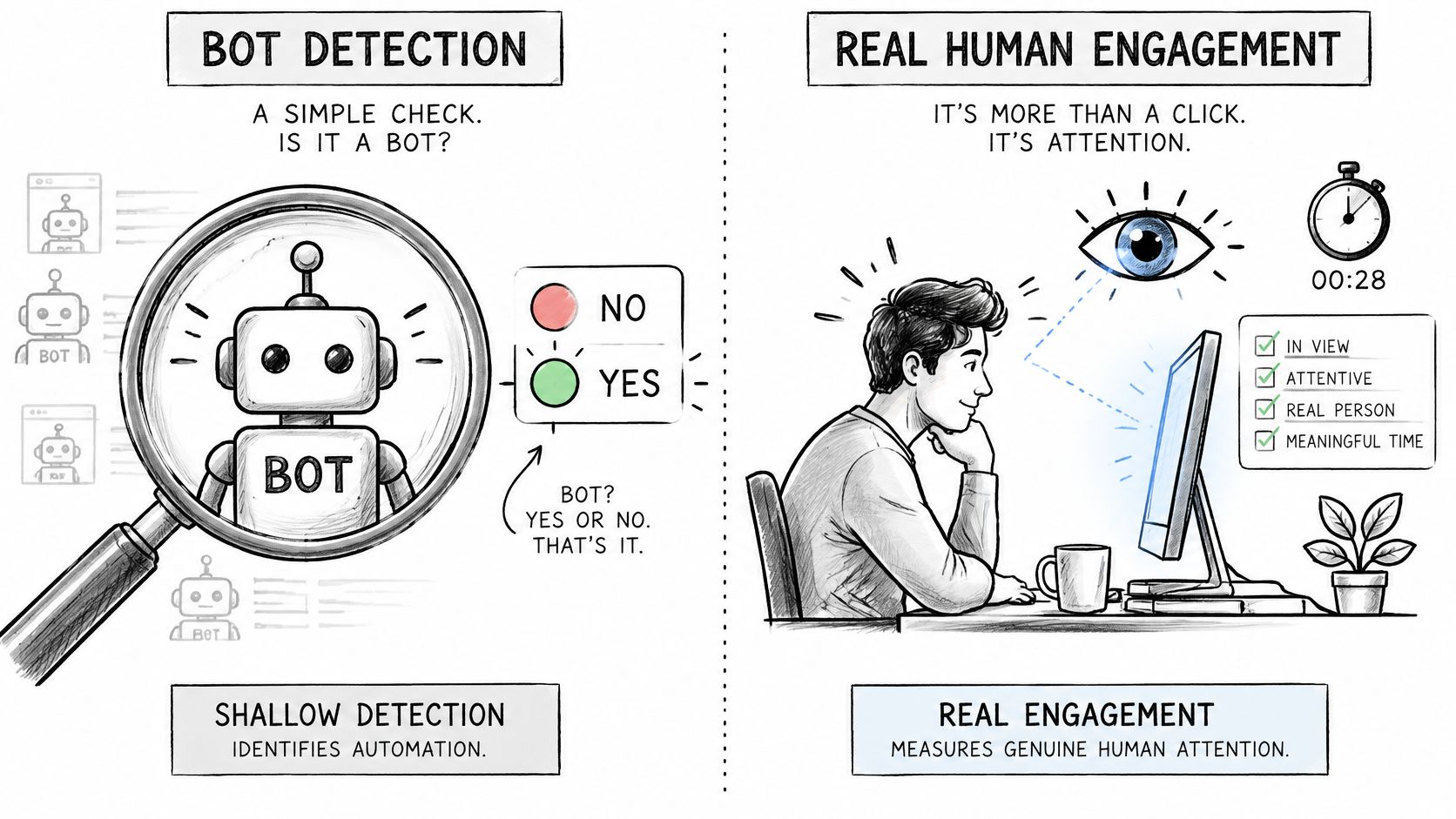
Say a U.S. sports page has authentic followers and publishes an approved brand post. Some viewers may watch closely, others may swipe immediately, and others may encounter the same creative through reposts. None of those outcomes alone proves fraud, but they offer different value at the contracted CPM.
Use separate measures rather than compressing everything into a quality score:
- Verified views: Events that satisfy the campaign's documented eligibility and measurement rules.
- Unique reach: Distinct people reached, with the identification method and its limitations disclosed.
- Watch duration: Time spent watching, not just whether playback started.
- Repeat exposure: Frequency within a page and across participating pages.
- Geographic fit: Delivery from the American or other explicitly eligible markets purchased.
- Post-view action: Subsequent visits, signups, or purchases, with attribution limitations stated.
For American audience buying, don't let a favorable country breakdown hide repeated exposure to the same people. Likewise, strong completion doesn't establish incremental reach if overlapping pages repeatedly serve the same audience.
Before approving payment, inspect placement-level anomalies, cross-page audience overlap, view-quality thresholds, and invalid-traffic treatment. If overlap can only be estimated, report it as an estimate. If subsequent action can't be attributed confidently, don't turn correlation into a conversion claim.
The practical objective is credible attention from eligible audiences, not the largest possible unqualified total.
Governing AI-Generated Traffic
AI-generated traffic creates an accountability problem when a supplier can produce a confident authenticity label but can't explain the evidence behind it. Behavior that resembles human activity deserves evaluation, not automatic acceptance because it passes a familiar script.
A changing attack pattern can also make a static blocklist less useful. Adding another opaque model doesn't resolve that weakness unless someone can inspect its decisions and challenge mistakes.
Require an explainable operating process
Define what an authenticity decision establishes. Document which evidence supports approval and which risks remain unmeasured. An automated score shouldn't imply that identity, attention, geography, and brand suitability have all been proven.
Maintain source-level screening records. Record how each source is evaluated for compromised devices, disguised automation, network origin, and manipulated human participation. Keep the screening description specific enough that an analyst can test whether the process runs.
Attach reason codes to outcomes. Blocked activity needs an explanation, but approved and billed activity also needs traceable supporting evidence. A reviewer should be able to distinguish a policy exclusion from a behavioral warning or missing measurement.
Sample both approved and quarantined placements weekly. Reviewing only blocked traffic reveals mistaken exclusions but misses bad activity that passed. Re-test screening rules against newly observed patterns instead of assuming an old rule remains effective.
Name the accountable person and reversal deadline. Assign responsibility for investigating missed fraud, correcting wrongful blocks, and communicating billing adjustments. Record escalation ownership before an incident creates competing interpretations.
Accountability test: Could a reviewer reconstruct why this activity was approved without asking the model to explain itself after the fact?
Check false positives and false negatives separately. The former wrongly penalize legitimate participants; the latter let harmful activity through. Neither a low review rate nor a high approval rate proves that the system is accurate.
A defensible decision is one a person can explain using preserved evidence, not one delivered with the most confidence.
Prevention Controls and a Pre-Launch Routine
Prevention starts before budget release or payout. Detection identifies suspicious activity; a preventive control determines what can happen while uncertainty remains. Write that consequence into the workflow rather than leaving it to whoever is handling the campaign that day.
Set the controls before money moves
Verify identity and account ownership. Confirm that the participant controls the account receiving campaign work or earnings, and check age, tax status, and residency where relevant. We may require these checks and may suspend an account, withhold payouts, or freeze balances while verification is pending.
Pre-approve creative, captions, and placements. Record the approved version and authorized publishing context. Our pre-approval process preserves brand sign-off before posting, and we check content before payment.
Enforce topic and geographic rules. Translate the brief into required terms, prohibited subjects, page exclusions, and eligible countries. A broad label such as tier one isn't enough unless the campaign explicitly identifies its permitted markets.
Require dual approval for overrides. More than half of occupational-fraud cases involved missing internal controls or management override, according to the ACFE's discussion of its 2024 findings. Require a separate authorized approver when someone wants to bypass a risk hold or change an eligibility decision.
Keep an immutable change history. Preserve who changed rates, budgets, caps, and permissions, along with the previous value and reason. At FindClout, rates, budgets, and caps are audited internally, and every money change is logged.
Before accepting a traffic decision, answer these accountability questions:
- Decision owner: Which person, rule, or model made the decision?
- Triggering evidence: Which observed signal justified the outcome?
- Correction process: How can an incorrect decision be challenged and reversed?
- Financial remedy: What happens to billing or earnings when delivery is rejected?
These questions matter because automation can look more authoritative than its evidence warrants. ClickFortify's fraud statistics report describes AI-agent traffic growing 7,851% during 2025 and advanced invalid-traffic attacks capable of bypassing traditional JavaScript-based detection. That reported growth is not a measure of fraudulent advertising impressions, so don't use it to estimate a campaign's fraud exposure.
Separate authenticity from brand safety
A fully human-viewed post can still expose a brand to inappropriate claims, unsuitable captions, or prohibited targeting. Fraud controls establish whether activity qualifies; brand-safety controls establish whether the content and context are acceptable.
For sports betting, prediction markets, crypto, fintech, and AI advertisers, review jurisdictional eligibility, age-sensitive targeting, prohibited topics, and removal procedures. American sports interest isn't a substitute for eligibility checks, and a U.S. audience label doesn't establish that every viewer is an appropriate recipient.
Our operational focus is American and other tier-one audiences, brand safety, and detailed review of every submission in real time. We apply pre-approval and geographic filters for the U.S., Canada, and the U.K., with the objective of scaling attention to billions of views while protecting the brand and maintaining eligible-market delivery. Scale doesn't excuse weaker placement checks.
Run the final release check
Before spending, assemble a campaign evidence packet containing the approved assets, placement list, eligible-country definitions, screening method, reporting fields, and dispute owner. Reconcile a sample placement against that packet so the team tests the workflow rather than merely confirming that documents exist.
Confirm that viewable, completed, duplicated, and invalid activity can be distinguished wherever the measurement supports it. Use our view authenticity checker as a supplementary check, not a replacement for placement evidence or contractual measurement definitions.
Unverified, unscraped, or suspicious posts are quarantined and accrue nothing unless and until approved. We can decline or withhold any payment or payout, in whole or in part, for any reason, including suspected bad-faith participation.
A participant can request human review of an automated decision, including withheld earnings associated with a fraud score, by contacting FindClout. Fraud, bot, view-authenticity, and earnings-eligibility determinations remain final within our internal review processes, so review availability shouldn't be confused with a guaranteed reversal.
FindClout offers branded meme distribution focused on American and other tier-one audiences, with verified-view billing, fraud screening, and brand controls. Visit FindClout to discuss your eligible markets, placement exclusions, and approval requirements before launching your next campaign.
Want this audience for your brand?
FindClout puts your brand in front of verified American audiences across every major US page — brand-safe, at scale.
Start Your Campaign