 findclout.com
7 Best Native Ad Networks for U.S. Reach in 2026
Most roundups of the best native ad networks still tell you to buy the cheapest click. That advice is wrong for a U.S. performance marketer. A low CPC can be a weak placement, an accidental tap, or traffic you would never put next to a regulated brand. The comparison that matters is cost per verified American view or click, fraud exposure, and how much control you keep before a post goes live.
Affiliate Landscape's performance marketing overview is the right frame. You pay for an outcome you can audit, not a served impression that only looks busy. A University of Georgia study of 242 viewers found that only 17 people, 7%, recognized a native article as advertising. If readers cannot tell the ad from the story, cheap scale is a trust problem, not a bargain.
This list judges seven networks on CPM, targeting depth, fraud protection, audience quality, and brand controls. American tier-1 audiences and brand safety are the lens on every pick. Widget click buyers and creator-page view buyers are different products. Match the model to the goal before you compare prices.
Table of Contents
- 1. FindClout
- 2. Taboola Realize
- 3. Teads
- 4. MGID
- 5. Revcontent
- 6. Dianomi
- 7. Nativo
- How the seven native ad networks compare on pricing model, stated minimums, and best fit
- Match the Network to the Goal, Then Prove It on a Small Test
1. FindClout
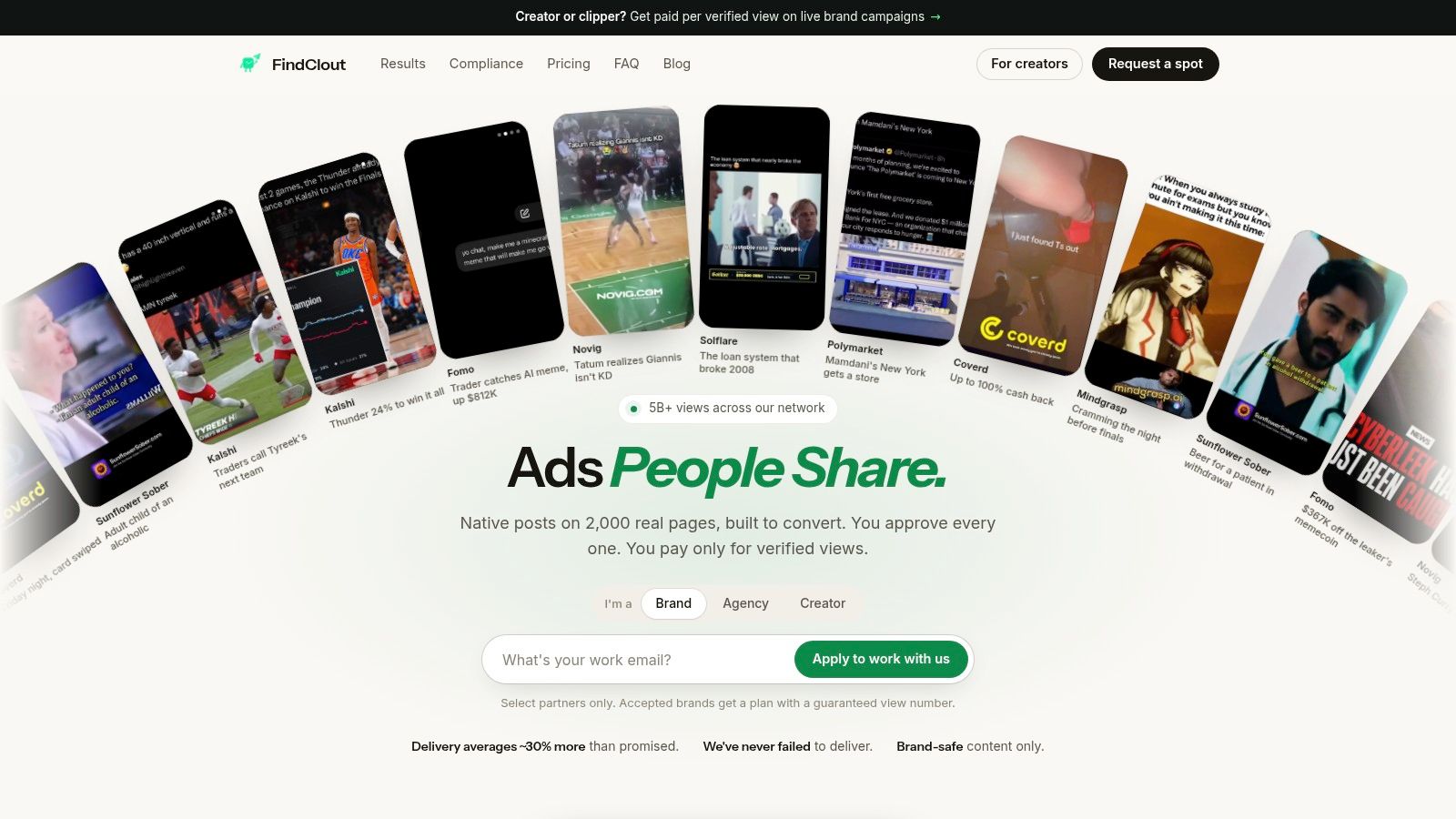
FindClout sells verified views on branded posts across a curated network of 2,000 real pages. That makes it a creator-page view buy, not a publisher-widget click buy. Pages are hand-picked for each brand, and creators apply to campaigns with audience-analytics screenshots and screen recordings. Each page is run by the people who built it.
What the CPM actually covers
Brands pay per view at a CPM set upfront. Product placement on meme, news, and sports clips has a $0.20 CPM ceiling and can run network-wide. Sports or finance placements have a $0.25 CPM ceiling and stay within one vertical. Content campaigns turn brand video or static assets into meme variations at $1.50–$3.00 CPM.
Effective CPM is total spend divided by tracked views on approved posts. Views beyond each post's cap are free. At higher spend, effective CPMs have been reported as low as $0.05. A typical pilot costs $20,000–$30,000 and guarantees 100 million views, so this is a poor fit for a tiny test.
Brands do not make the campaign content. FindClout selects pages, writes posts, and runs them until the contracted view count is reached. Nothing goes live before brand sign-off on the format, which can be a clip, caption, tweet card, or carousel. Pending and rejected posts are not billed; only approved posts count toward spend.
Controls that protect a U.S. brand
FindClout reports 5B+ views across its network. Its controls include AI scoring, human review before posting, rules for required terms and prohibited topics, follower thresholds, and U.S., Canadian, and U.K. geo filters. Brands can also remove off-brand pages with one click.
Every campaign brief tells creators to disclose paid promotion, such as with #ad. Creators are contractually responsible for that disclosure. Brand sign-off and page-level controls help reduce risk, but they do not guarantee clicks or brand lift.
FindClout runs campaigns across sports, finance, crypto, AI tools, and consumer apps, including regulated categories such as prediction markets and sports-betting-adjacent services. Choose it when the goal is planned reach through creator pages and billing tied to approved views. The trade-off is the pilot size: the stated minimum commitment is too large for a low-cost exploratory test.
2. Taboola Realize
Taboola Realize is the open-web auction. You buy native, display, and vertical video across publisher sites, apps, and device partners. Reach and cost move with your bid, your targeting, and whatever inventory is eligible that hour. It is not a creator-page product, and it will not behave like one.
The IAB Native Advertising Playbook splits the category into in-feed units, content-recommendation ads, and branded content. Realize sits mostly on the recommendation and in-feed side, with display and video mixed in. Do not benchmark that mix against a sports-page view buy. A content discovery platform breakdown shows why those two inventories should never share one KPI.
What you actually control
- Formats: Native tiles, display, and vertical video in one setup.
- Optimization: Audience targeting, AI bidding, and tools that adapt assets you already have.
- Inventory: Publishers, apps, and OEM placements, with campaign-level controls rather than a named-page approval queue.
Auction pricing is the trade-off. A U.S. finance audience will not clear at the same price as broad content arbitrage. The buy is not exclusively native, so brand safety depends on placement reports and block lists you use in practice. Keep testing headlines and landing pages, or the algorithm spends into weak creative.
Verdict: Use Realize when you need measurable open-web clicks at U.S. scale and someone is watching placements daily. Skip it when the brief is verified American views on named creator pages. Start at Taboola Realize.
3. Teads
Outbrain acquired Teads, and the combined company took the Teads name. Treat them as one vendor. Teads combines native, video, and CTV advertising with publisher inventory, contextual targeting, and performance optimization. That is a broader buy than a recommendation widget.
Recommendation units remain one format to assess. PMarketResearch projects a 14.5% compound annual growth rate for recommendation units through 2035, citing short-form video, interactive sponsored content, and contextual targeting as drivers. Use that forecast as a reason to test contextual targeting against behavioral targeting, not as a reason to sign with Teads.
Before committing, confirm which legacy Outbrain workflows are available and whether the inventory you need is accessible in the United States. Teads is a broader, sales-led platform, not a lightweight self-serve click tool. Pricing and inventory depend on market and format. A premium publisher name alone does not confirm U.S. geography, viewability, or suitability beside a betting brand.
For a different pricing model, compare how CPM advertising networks charge for attention.
A publisher logo is not proof of U.S. reach. Ask which placements target tier-one U.S. audiences and how Teads handles underdelivery.
Verdict: Choose Teads when you want brand storytelling and video alongside content recommendations. Skip it for a low-cost American meme test. Visit Teads.
4. MGID
MGID is a self-serve option for buying publisher traffic. Its help center lists a $100 minimum deposit and a $50 minimum campaign budget. Formats include native, push, rich media, video, and programmatic display. CPC is typical, with other pricing available for some formats. You can request onboarding and account-management support.
Osmos benchmark notes put open-web native CTR broadly around 0.20%–0.60%, compared with 0.05%–0.10% for standard display. Treat roughly 0.40% as a strong native CTR, then judge results by post-click engagement and conversions. A cheap click that does not produce either is wasted spend.
- Targeting: Set audience, demographic, interest, and geographic parameters, including U.S.-only targeting.
- Optimization: Use conversion tracking and source-level controls. MGID's international reach can bring in low-cost traffic outside tier-one markets, so check where clicks come from.
- Reality check: A small budget may not generate enough data to guide decisions. CPCs vary with competition, device, and bid strategy.
Review traffic quality by placement and set invalid-traffic standards you can explain to a brand reviewer. MGID gives you controls; you still have to use them.
Verdict: Use MGID for a controlled U.S. test if you can review and block weak sources promptly. Skip it as a set-and-forget brand channel. Open an account at MGID.
5. Revcontent
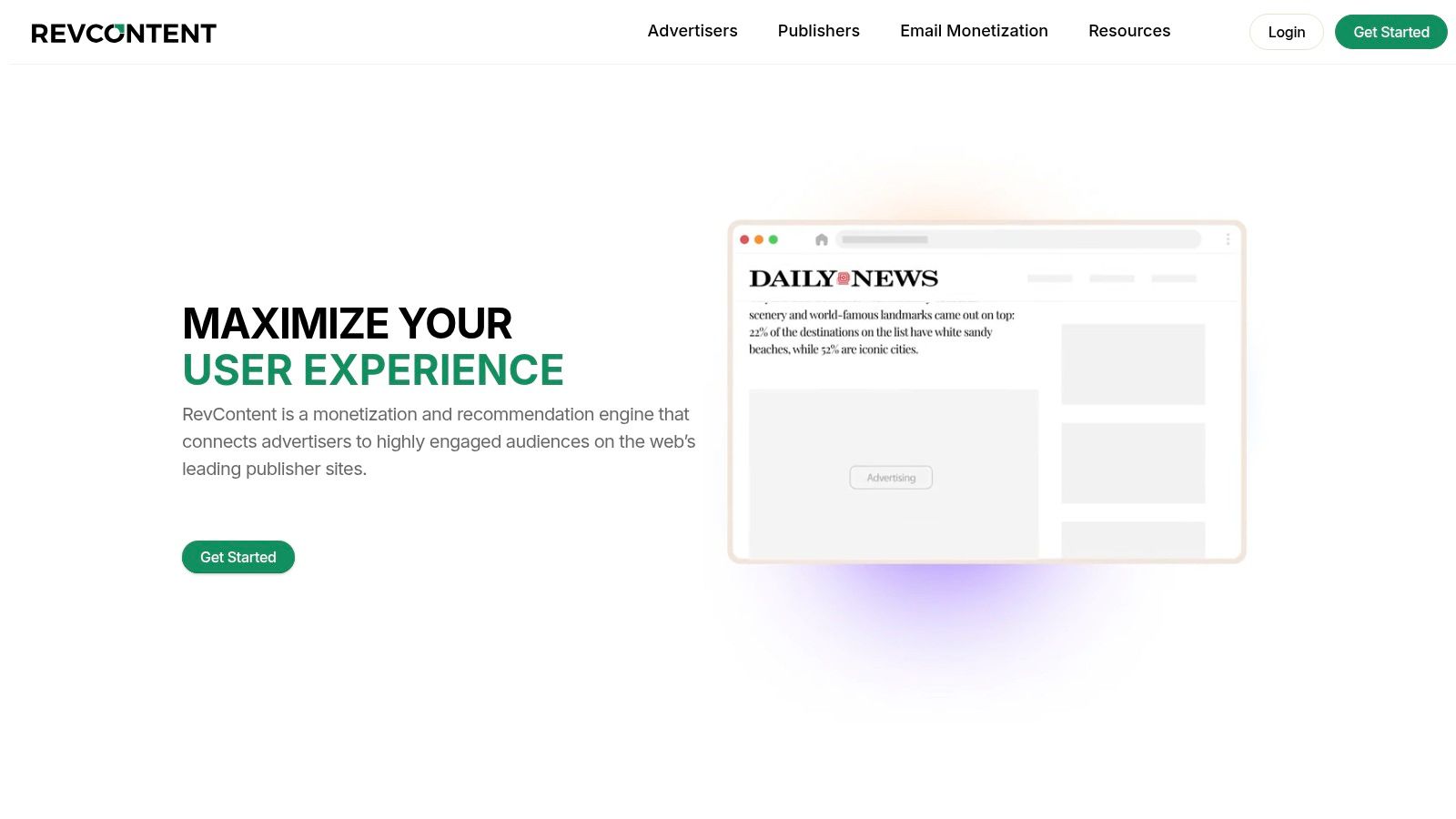
Revcontent sells native placements through publisher widgets, Apple News, and email newsletters. Campaigns can run on CPC or viewable CPM, with geographic targeting, conversion tracking including server-to-server, and bids set at the widget level. Revcontent sets its own campaign minimums at signup, so check its current terms before setting a test budget.
A viewable display impression, under the Media Rating Council guideline, requires at least 50% of the ad's pixels to be in an in-focus tab for one continuous second. For video, the threshold is two continuous seconds. Choose viewable CPM only if Revcontent's reporting matches that standard. A rendered impression alone does not prove a person saw the ad.
Plan to manage bids, placements, and creative yourself. Widget-level bids give you control over individual placements, but they do not guarantee signups or American audience quality. Review the domains receiving spend and cut placements that fail your brand-safety standards.
Verdict: Choose Revcontent for hands-on publisher-widget control and viewability bidding. Skip it if you need creator-page distribution or managed disclosure. Start at Revcontent.
6. Dianomi
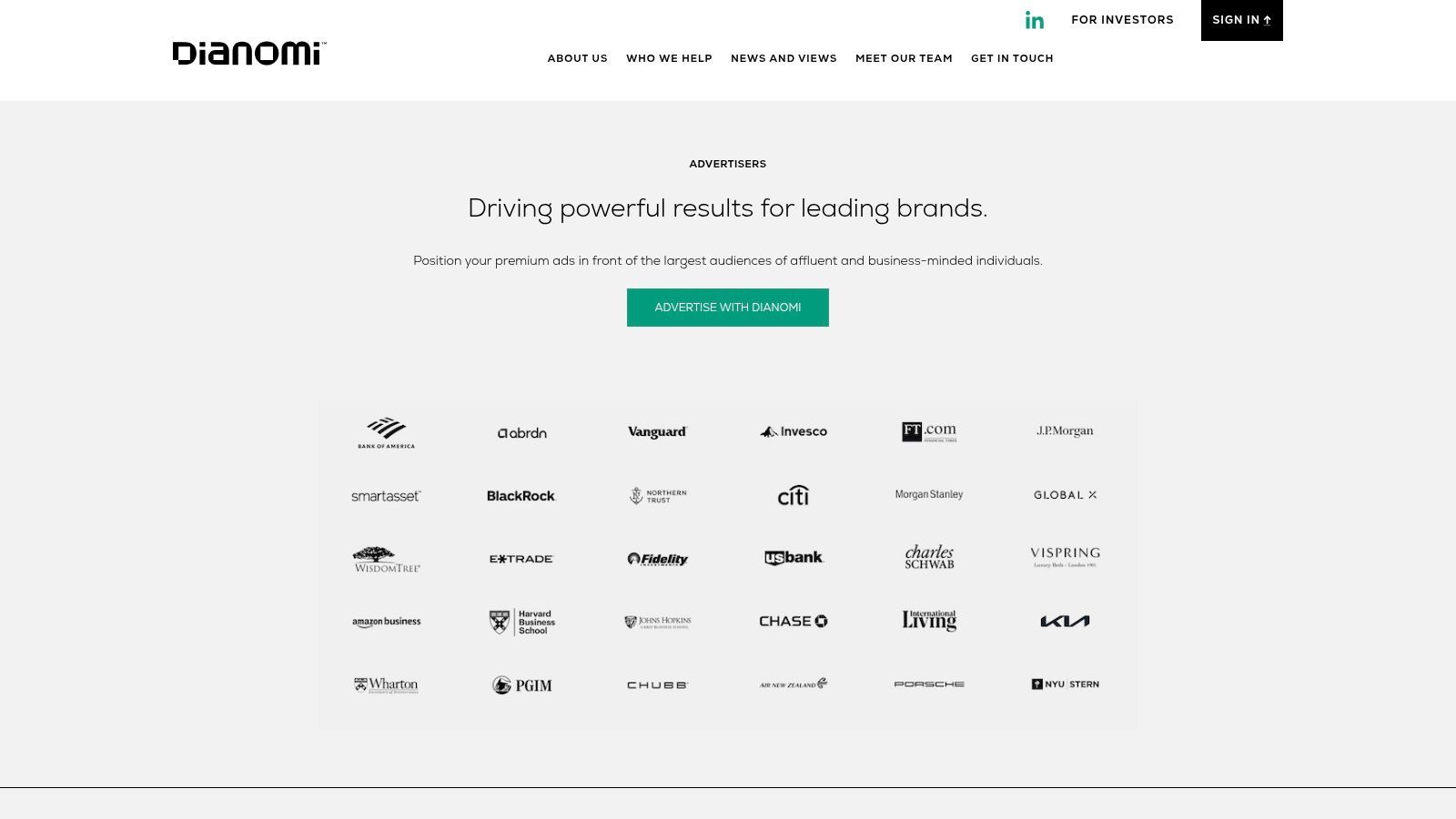
Dianomi is the finance and business specialist. Placements sit beside relevant publisher content for business-minded and affluent readers. Formats cover native, video, podcast, app download, and display. You can run self-serve or fully managed. There is no simple public rate card. Price is whatever that campaign clears.
The FTC enforcement policy from December 22, 2015 still sets the bar. An ad can be deceptive when its presentation misleads people about its commercial nature, including when it looks like it comes from someone other than the sponsor. That policy also cited estimates that U.S. native-ad spending could rise from $4.7 billion in 2013 to as much as $21 billion in 2018. Growth did not create an exemption. On a premium finance page, the label still has to be obvious, especially for fintech and markets brands.
This is the wrong network for broad cheap reach or meme-page distribution. It is the right one when the reader should already be in a business context and you will pay for fit instead of volume. Get third-party verification and placement logs before you treat the audience as affluent Americans.
Verdict: Use Dianomi for finance and business storytelling on premium pages. Do not use it to manufacture mass U.S. sports reach. Advertiser details are on Dianomi.
7. Nativo
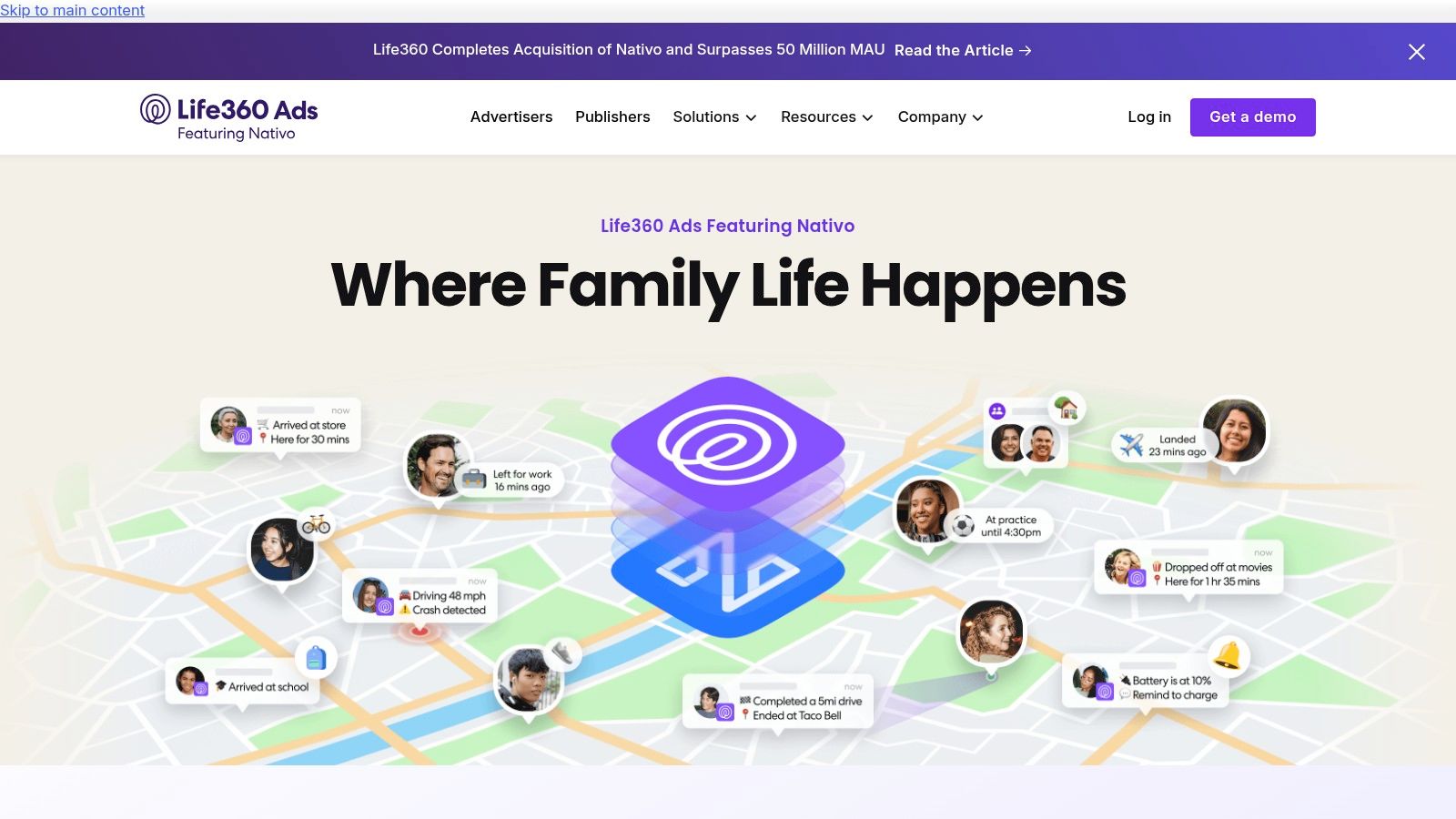
Nativo is a sponsored-content platform for premium publisher environments. You get native display and longer storytelling units, self-serve setup, budget scheduling, creative tests, and measurement for engagement and conversion. The help center says self-service campaigns have no minimum spend. You still need enough impressions per creative for a test to mean anything.
There is no public rate card. Cost depends on format and setup. Confirm inventory and measurement for each campaign, and confirm the U.S. publisher list before you assume tier-1 reach. This is a poor tool for high-volume click acquisition. It is a strong one when the asset is a story people will finish.
Disclosure has to survive the layout. If the sponsored label truncates on mobile, the placement fails even when the publisher is premium. That is the brand-safety check for storytelling buys, not a design nit. For how native network types differ before you brief one, use this native advertising network guide.
Verdict: Choose Nativo for content-led U.S. publisher campaigns when you want to start without a minimum. Do not choose it when the KPI is cheap clicks or a guaranteed creator-view count. The platform is Nativo.
How the seven native ad networks compare on pricing model, stated minimums, and best fit
| Item | Pricing model | Stated minimum | Best for |
|---|---|---|---|
| FindClout | CPM with verified views and pre-agreed ceiling; custom pricing may apply | $20,000–$30,000 first campaign | Managed creator-page campaigns with guaranteed view delivery |
| Taboola Realize | Auction-based | Not stated | Open-web reach across native, display, and video |
| Teads | Campaign-specific; confirm current pricing | Not stated | Premium publisher, video, and CTV campaigns |
| MGID | Generally CPC; other models available for some formats | $100 deposit; $50 campaign budget | Self-serve campaigns with accessible starting requirements |
| Revcontent | CPC or viewable CPM | $50 daily budget | Advertisers seeking placement-level bidding and optimization |
| Dianomi | Campaign-specific pricing | Not stated | Reaching business-minded and affluent audiences |
| Nativo | Campaign-specific pricing | No minimum spend for self-service campaigns | Storytelling-led campaigns in premium publisher environments |
Match the Network to the Goal, Then Prove It on a Small Test
Pick the buying model before you pick a logo.
Choose a click-driven publisher network, Taboola Realize, MGID, or Revcontent, when you want cheap, measurable traffic and you will audit every placement. Choose a creator-page, view-based model when you want verified U.S. reach at a low cost per view, with pre-approval and the ability to pull a post. Choose Teads, Dianomi, or Nativo when the job is contextual or premium storytelling, not a distribution test on sports and culture pages.
Research and Markets estimated the global native advertising market at $105.88 billion in 2024. Scale is not the scarce part. Proof is. EZMob's advertiser comparison puts the useful question in plain language. How do you verify that a cheap native campaign produced real, brand-safe attention rather than inexpensive clicks from weak inventory?
Ask every vendor for placement-level reporting, the fraud-screening method, geo verification, and what happens to underperforming posts. For prediction markets and sports betting, pre-approval is not optional. American tier-1 audiences are the point, and a review has to hit every submission in real time before those views scale into the billions. We bill on approved posts only. Effective CPM is total spend divided by every tracked view, so you can run that same math against any network's invoice.
Size the pilot to the budget and name one success metric before you scale. That might be a view guarantee, a U.S. engagement floor, or a cost per qualified signup. Then cut whatever fails it. A wider look at supply is here if you want to compare leading advertising networks.
FindClout places branded native posts across vetted creator pages and bills on verified views, with real-time review so American tier-1 audiences stay brand-safe as reach scales. If you want creator-page distribution instead of another widget click, start with a pilot built around a view guarantee and placement control. Visit FindClout to plan that U.S. campaign.
Want this audience for your brand?
FindClout puts your brand in front of verified American audiences across every major US page — brand-safe, at scale.
Start Your Campaign