 findclout.com
Content Discovery Platform: A Practical Guide for Marketers
A content discovery platform that delivers cheap views can still be a poor media buy. The key question isn't how many impressions a network can serve, but whether it can put verified attention in front of suitable American audiences without forcing your brand to accept uncontrolled creator risk.
That distinction matters because discovery has moved beyond deliberate visits to publisher sites. Pew Research Center found that 50% of U.S. adult internet users get news from social media at least sometimes, while Facebook, Instagram, TikTok, and X all expose users to content during ordinary browsing rather than only through direct searches or brand channels (Pew Research Center's survey of social news use). Globally, the Reuters Institute found that six online networks each reached at least 10% of respondents in its 2024 sample, compared with two a decade earlier, reinforcing how fragmented discovery has become (Reuters Institute's 2024 analysis).
For marketers, the practical answer is a routing system. A modern content discovery platform selects eligible creator inventory, ranks placements by likely qualified attention, distributes approved content, and feeds verified performance back into buying decisions. The sections below explain what that means for tier-1 U.S. reach, brand safety, paid social, creator distribution, and measurement.
Table of Contents
- What a Content Discovery Platform Actually Does in 2026
- The Core Capabilities Behind Every Modern Content Discovery Platform
- How Discovery Platforms Plug Into Paid and Organic Strategies
- Programmatic Meme Distribution Versus Meta, TikTok, and Influencer Outreach
- A Regulated Brand Scenario Across American Sports Audiences
- How to Evaluate and Select a Content Discovery Platform
- Measuring Success, Common Misconceptions, and Quick Answers
What a Content Discovery Platform Actually Does in 2026
A content discovery platform in 2026 is a media operations system. Its job is to get branded content onto vetted third-party creator pages, keep that distribution inside brand and geographic rules, and prove that the delivery was real. If a platform cannot control where content appears, who sees it, and what happens after launch, it is not solving the buying problem that matters.
That matters most for advertisers chasing tier-1 U.S. reach at scale. Buying teams do not struggle because they lack places to post. They struggle because creator inventory is scattered across too many pages, standards vary by publisher, and manual outreach breaks the moment a campaign needs approvals, caption controls, removals, audience checks, and reporting across a large set of placements. The platform has to turn that messy work into a repeatable operating system.
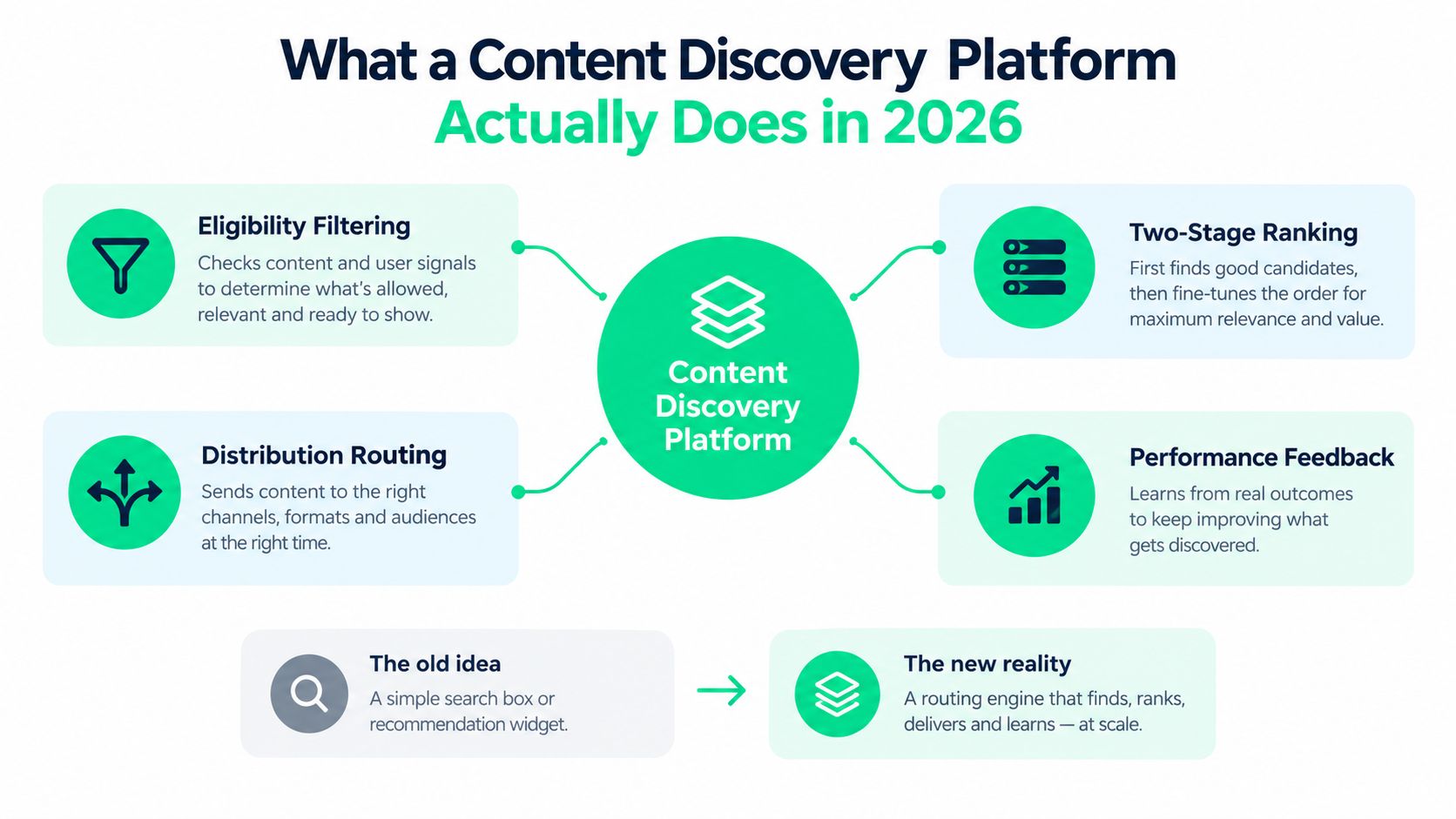
The old definition versus the buying reality
The common definition still points to search, recommendation widgets, or SEO workflows. That is too narrow. In paid media, discovery is about distribution. The question is not what article a user should read next. The question is which approved creator pages can carry your content, reach the audience you bought, and do it without exposing the brand to unnecessary risk.
That shift changes how you evaluate platforms. Raw CPM savings are not the point if the inventory is globally blended, lightly screened, or impossible to audit after the fact. Serious buyers should look for four operating functions:
- Verify geography: prove the inventory can reach tier-1 American audiences instead of packaging mixed international traffic as one audience.
- Control suitability: apply topic exclusions, creator exclusions, caption requirements, and placement rules before anything goes live.
- Verify attention: filter out suspicious or invalid exposure so reported delivery reflects real human viewing.
- Operate at scale: manage approvals, trafficking, edits, removals, and reporting in one system instead of scattered inboxes and spreadsheets.
The mechanics are straightforward. A platform takes campaign rules, screens available inventory against those rules, prioritizes the eligible options, routes approved creative into live placements, and returns performance signals that buyers can use for the next decision cycle. Google's published recommendation architecture helps illustrate the logic. Large systems work by narrowing candidates first, then ranking the smaller qualified set with richer signals.
For media buyers, the takeaway is simple. Choose a platform that combines deterministic eligibility rules with predictive ranking and real distribution controls. A search tool, a feed widget, or a spreadsheet of influencers may help with research, but none of them gives you the operational control required for brand-safe creator-page buying.
The Core Capabilities Behind Every Modern Content Discovery Platform
A modern content discovery platform lives or dies on four jobs: eligibility, prioritization, distribution, and feedback. In creator-page buying, that stack matters more than a cheap CPM. If the system cannot screen for tier-1 U.S. reach, rank for real attention, control where assets appear, and prove what ran, you do not have an operating platform. You have a sourcing tool with a reporting layer.
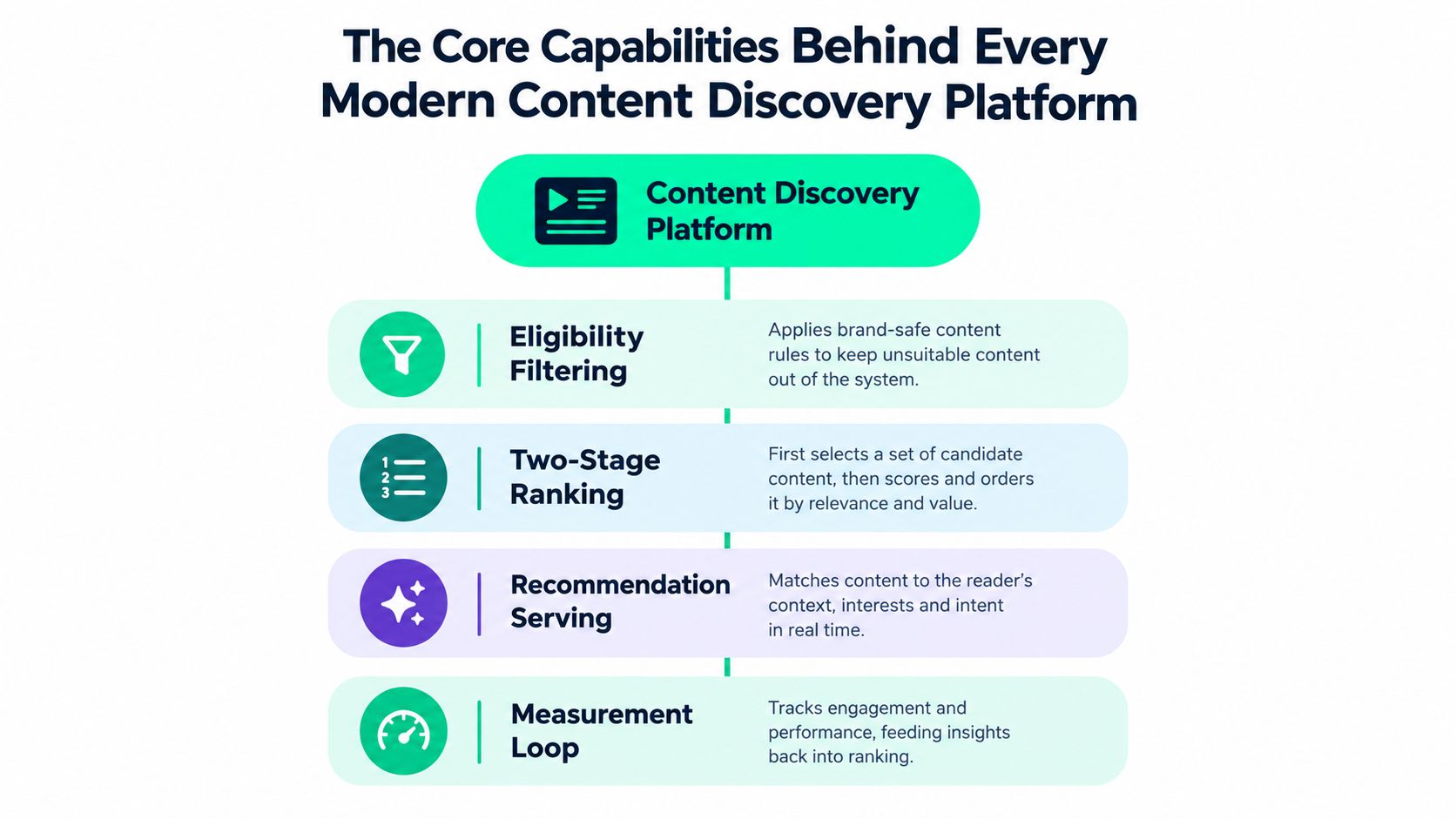
Start with eligibility filtering
Filtering comes first. Geography, niche, follower thresholds, prohibited topics, campaign keywords, inventory availability, and creator history belong in a hard-rule layer that runs before any optimization. If a page fails a mandatory rule, it should be removed immediately. A model should not push it back into consideration because it looks cheap or likely to spike clicks.
That matters most for regulated brands and for buyers who actually need American reach instead of blended global traffic packaged as one audience. Ask direct questions. Can the vendor document audience geography? Can it enforce exclusion lists before launch? Can it pull one unsafe placement fast without freezing the rest of the campaign?
Rank qualified candidates for attention
Once the candidate pool is clean, ranking decides where budget should go. The right target is not raw click-through rate. In creator environments, CTR often favors curiosity, controversy, or low-quality bait. Better systems rank for signals tied to actual consumption and cleaner delivery, such as qualified-view duration, completion likelihood, downstream click propensity, creator authenticity, and safety penalties.
Buyers also need visibility into the logic. You should be able to see why one page outranked another, especially when both clear the same eligibility rules. If the ranking layer is a black box, you cannot defend the buy to legal, brand, or performance teams.
Keep human judgment in the loop
Automation helps with intake screening, caption checks, topic labeling, and anomaly detection. It does not understand context well enough to handle satire, breaking sports news, comment-section chaos, reused clips, or adjacency issues that only become obvious once a post is live.
IAB's definitions and verification guidance supports a layered approach that combines analytics, human review, inclusion lists, exclusion lists, editorial adjacency rules, and continuous monitoring. That is the right standard. If a vendor cannot show the path from automated screening to human escalation and post-publication review, its brand-safety controls are incomplete.
Measurement closes the loop. Track verified views, watch duration, completion, shares, saves, negative feedback, logo or caption visibility, and post-click behavior. Use competitor monitoring to turn competitor moves into decisions, but never let competitor signals stand in for placement-level proof of delivery.
How Discovery Platforms Plug Into Paid and Organic Strategies
Discovery platforms sit between your paid social stack and your organic engine. Used well, they turn creator pages into a controlled distribution layer that extends reach beyond Meta, TikTok, search, and owned channels. That matters because the job is not just buying cheap impressions. It is getting branded content into vetted, relevant environments where it feels native, can keep circulating after launch, and can still meet brand-safety and verification standards.
That is why smart buyers treat creator-page distribution as an operating layer, not a side tactic.
At the top of the funnel, logo and caption distribution puts the brand marker inside approved creator content. Vertical targeting adds category rules and exclusions for sports, gaming, finance, or crypto. Content campaigns distribute brand video or static assets through meme variations and creator-page placements, which gives creative teams more control when the asset itself needs to stay intact.
Each format has a clear job:
- Logo and caption distribution: Listed at $0.20 CPM in FindClout's offering. Best for broad awareness when the placement should blend into creator content without looking like a standard ad.
- Vertical-targeted campaigns: Listed at $0.25 CPM. Useful when the buy needs keyword requirements, exclusions, and tighter niche placement rules.
- Content campaigns: Listed at $1.50 to $3.00 CPM. Built for brands that want their own assets distributed through a more structured workflow.
Price only matters after quality control. Low CPMs mean very little if the page is weak, the audience is off-target, or the post never earns real attention. ANA's programmatic supply-chain transparency study makes the point clearly. Buyers have to weigh cost against viewability, fraud prevention, and brand safety. In practice, that means verified views, vetted creator pages, and tier-1 U.S. relevance should outrank raw inventory volume every time.
Use paid distribution to create organic-adjacent value
Strong creator placements can keep producing value after the media spend ends. Posts may remain live, keep getting shared, show up in creator archives, and create a searchable path through captions, comments, and follow-up posts. Post lifespan is a buying variable. Treat it that way.
The operational upside is just as important. Real-time caption management lets a buyer update approved wording across a creator network, preserve required language, and keep the click path aligned with the intended funnel. One system can handle outreach, trafficking, approvals, revisions, and reporting instead of forcing the team to manage separate creator relationships one by one. If you need the broader paid-social context, review programmatic social media advertising.
To maximize your content marketing reach, connect creator distribution to owned landing pages, search-friendly brand identifiers, retargeting pools, and post-campaign analysis. Paid discovery should generate attention. Your site, CRM, and organic channels should capture and develop that attention.
Keep channel roles clear. Meta and TikTok are still useful for controlled testing, retargeting, and conversion objectives inside platform auctions. Creator distribution adds reach inside third-party pages and communities, especially when the campaign needs American sports, gaming, finance, or other interest-led audiences. The winning setup is simple: use paid social to find messages that convert, use creator-page distribution to expand qualified discovery, and use owned pages to turn that attention into consideration.
Programmatic Meme Distribution Versus Meta, TikTok, and Influencer Outreach
CPM is the wrong first comparison. A cheap impression on an unsuitable page, a skipped ad, and a creator post with verified attention are not equivalent units of media.
Programmatic creator distribution sits between paid social and traditional influencer buying. It offers more centralized control than one-off creator deals, while preserving some of the native feel that makes meme content shareable. Meta and TikTok offer powerful auction systems and conversion tooling, but brands accept platform-level placement environments and creative fatigue. Traditional influencer outreach can deliver authenticity, but execution becomes manual as the creator list grows.
| Channel | Typical CPM | Brand-Safety Controls | Post Lifespan | Authenticity |
|---|---|---|---|---|
| Programmatic creator distribution | $0.20 to $3.00 listed formats | Pre-approval, rules, exclusions, AI triage, human review, removal | Can remain live after the buy | Native creator-page context |
| Meta | Varies by auction and objective | Strong account and placement controls, platform-dependent context | Usually tied to the campaign or post | Branded paid-social environment |
| TikTok ads | Varies by auction and objective | Platform controls and advertiser settings | Usually tied to the campaign or post | Short-form, platform-native ad context |
| Traditional influencer buying | Negotiated per creator | Contractual approval and manual review | Often determined by creator agreement | High creator association, uneven consistency |
Programmatic distribution becomes attractive when you need many placements but still want one set of rules. Pre-approval can protect captions, logos, targeting, and exclusions before content reaches a page. Real-time monitoring can then catch changes in context, suspicious traffic, or an off-brand post that wasn't visible at the initial review.
The trade-off is that scale can flatten nuance. A meme page may be authentic to its audience, but the same joke won't suit every brand. That's why suitability review needs to examine the post, the page history, the comments, the audience, and the campaign category rather than relying on a prohibited-keyword list.
Choose the channel by the job
Use Meta when you need mature conversion objectives, retargeting, and granular campaign experimentation. Use TikTok when short-form creative and platform-native behavior are central to the brief. Use direct influencer buying when a small number of creators carry unique authority or when the campaign requires deep collaboration.
Use programmatic creator distribution when the requirement is repeatable, brand-safe reach across many high-reach pages, especially for American sports, gaming, finance, crypto, and consumer brands that need both scale and centralized operations.
The reported effective CPM can become extremely low at higher spend, but that figure only means something if the platform verifies attention, screens fraud, and reports placement-level quality. TAG's U.S. Fraud Benchmark recorded 0.86% invalid traffic in TAG Certified Channels, below its cited 1% industry benchmark, providing a useful reference point for why traffic validation belongs in the buying decision (TAG's U.S. Fraud Benchmark).
A Regulated Brand Scenario Across American Sports Audiences
Consider a fictional prediction-market advertiser launching a campaign around American sports. The brand wants access to fans who already follow sports commentary, highlights, humor, and breaking news, but it can't accept uncontrolled claims, restricted geography, or creator posts that place the message beside unsuitable material.
The first step is to encode the rules. Required terms, prohibited topics, minimum follower thresholds, campaign keywords, and geographic filters for the U.S., Canada, and the U.K. become eligibility conditions. Pages that fail those conditions never enter the ranking pool.

Review happens before distribution
The creative then passes through automated scoring and human review. AI can flag prohibited language, detect obvious mismatches, and prioritize submissions for inspection. Human reviewers assess the context, humor, comments, creator history, and whether the post could create a misleading association for a regulated advertiser.
A caption that looks compliant in isolation may still be wrong beside a controversial clip. A sports joke may be harmless in one community and damaging in another. Real-time review gives the buyer a path to approve, revise, reject, or remove the placement instead of discovering the problem in a weekly report.
Launch speed needs delivery protection
Once the advertiser approves the pages and creative, the campaign can launch in roughly 10 minutes, with wraps configured for 7 to 21 days in FindClout's described operating model. If posts underperform, guaranteed delivery terms provide a defined remedy rather than leaving the buyer to absorb the shortfall.
That structure matters in sports because attention shifts quickly. A campaign can start around a matchup, move to a live result, and then require caption changes after the event. Real-time updates allow the brand to preserve relevance without restarting every creator negotiation.
The same model applies to sportsbook, iGaming, crypto, and AI advertisers, but the controls must remain category-specific. FindClout describes a network focused on tier-1 American sports pages and audiences, with creator inventory capable of generating billions of monthly views. That scale is useful only when the platform can show which pages delivered, where the audiences came from, and whether the attention was legitimate.
The operating principle is straightforward: brand safety doesn't merely reduce downside. It protects the quality of the audience you paid to reach, which can improve the usefulness of every view and every downstream action.
How to Evaluate and Select a Content Discovery Platform
Start with geography, not inventory volume. A vendor claiming broad reach should show documented viewership for tier-1 American audiences, page-level or creator-level evidence, and a clear explanation of how it filters low-quality or irrelevant traffic.
Then inspect the review process. Automated scoring should handle speed, while human reviewers handle context and edge cases. Ask how quickly an off-brand page can be removed, whether captions can be changed in real time, and whether post-publication monitoring continues after approval.
The quality of the traffic deserves its own test. TAG's benchmark gives buyers a U.S.-specific reference point, while IAB guidance makes clear that complex invalid traffic requires advanced analytics, human review, and continuous monitoring. Don't accept a single aggregate reach number when a vendor can provide placement-level delivery, completed-view rates, variance, and suspicious-traffic treatment.
A five-filter buying framework
Audience verification: Require proof that inventory reaches high-quality American geographies, with separate visibility into sports, gaming, finance, crypto, or other verticals.
Layered safety: Look for prohibited-topic rules, inclusion and exclusion lists, creator history, AI triage, human escalation, pre-approval, and post-publication checks.
Transparent reporting: Demand handle-level or placement-level reporting, verified views, quality signals, one-click removal, and evidence that delivery isn't concentrated in a small set of pages.
Commercial flexibility: Compare rolling monthly terms, management fees, pilot requirements, guaranteed delivery, and the ability to scale budgets without weakening review standards. FindClout describes 0% management fees, pilots from $20,000 to $30,000 guaranteeing 100 million views, and budgets scaling to $100,000 to $1 million or more.
Proof of operating scale: Ask for evidence of cumulative delivery, active creator coverage, and current brand campaigns. FindClout describes 3.3 billion cumulative views, 600 million or more views sold to brands in 2026, and 500 or more vetted tier-1 creators. Treat those as vendor-stated figures and request supporting reporting before committing budget.
For teams comparing distribution infrastructure with broader demand tools, a practical demand generation software guide can help separate audience creation, orchestration, and measurement requirements. The key is to score vendors against the same evidence standard instead of accepting the lowest quoted CPM.
A platform such as FindClout offers programmatic branded meme distribution across a curated creator network, with verified views, brand controls, fraud screening, and campaign orchestration in one workflow. Buyers evaluating the campaign orchestration platform category should still validate audience quality, placement controls, and delivery data independently.
Measuring Success, Common Misconceptions, and Quick Answers
The lowest CPM doesn't automatically produce the best return. It can buy reach in the wrong geography, weak attention, unsafe context, or traffic that fails quality checks. The buyer's job is to measure whether the campaign produced suitable, verified, qualified attention, not whether the platform served a large number of impressions.
YouTube's recommendation guidance emphasizes signals such as whether viewers choose, watch, ignore, or dismiss content, alongside longer-term satisfaction. That logic applies to branded creator distribution. Verified views are the delivery metric, but watch duration, completion, shares, saves, negative feedback, caption or logo visibility, and post-click behavior tell you whether the content earned attention (YouTube's recommendation signals).
A view is a delivery event. Qualified attention is a media outcome.
Use a measurement loop that compares placement quality, creator concentration, completed-view behavior, downstream visits, and incremental performance against a holdout or pre-campaign baseline where practical. A single delivery report can't tell you whether the campaign created new demand or just captured people who were already likely to act.
For an implementation checklist, use this guide on how to measure campaign performance and make sure the reporting includes both media quality and business intent.
Quick answers for buyers
What budget should a first test use?
Start with a budget large enough to create meaningful placement coverage and compare creators, formats, and audience segments. The right amount depends on the category, geography, creative volume, and delivery guarantee, not on a universal threshold.
How quickly can a campaign launch?
A platform with pre-vetted pages, predefined rules, and an approval workflow can launch quickly. The critical question is whether speed comes from preparation or from skipping review.
What happens when posts underperform?
Require a written delivery remedy. Options can include replacement placements, additional distribution, caption changes, or reallocation toward pages that meet the campaign's quality requirements.
Can regulated categories use creator distribution?
Yes, but only with category-specific restrictions, geographic controls, required disclosures and terms, prohibited-topic rules, human review, and ongoing monitoring. Sports betting, prediction markets, crypto, and AI advertisers should treat suitability as part of performance management, not as paperwork added after buying.
The right content discovery platform is therefore not the one promising the cheapest exposure. It's the one that can prove who saw the content, where the content appeared, whether the placement was suitable, and what the audience did next.
FindClout programmatically distributes branded meme content across curated creator pages, with tier-1 American audience targeting, pre-approval, fraud screening, real-time orchestration, and verified views. If your next campaign needs scalable sports or vertical reach without surrendering brand control, visit FindClout to evaluate the network and campaign workflow.
Want this audience for your brand?
FindClout puts your brand in front of verified American audiences across every major US page — brand-safe, at scale.
Start Your Campaign