 findclout.com
Vertical Marketing Plan: How to Execute at Scale
The most popular advice about a vertical marketing plan is also the least useful: choose a niche, change a few keywords, and buy enough reach. That approach fails regulated advertisers because distribution isn't just an audience-selection problem. It's an attention-routing and governance problem.
A sports page can attract the right fans and still publish unsuitable content. A finance audience can generate clicks while exposing a brand to prohibited claims. A large view count can look efficient while containing low-quality geography, invalid traffic, or placements that compliance teams would reject. Tier 1 American audiences, brand safety, real-time review, and verified attention have to be designed into the operating system before scale arrives.
Table of Contents
- Why Generic Reach Fails Regulated Verticals
- Building Your Vertical Marketing Plan
- Vertical Messaging and Audience Fit
- Activation Infrastructure and Brand Safety
- Measurement and Budget Reallocation
- Vertical Plan Rollout Sequence
- Conclusion - Vertical Plans as Attention Infrastructure
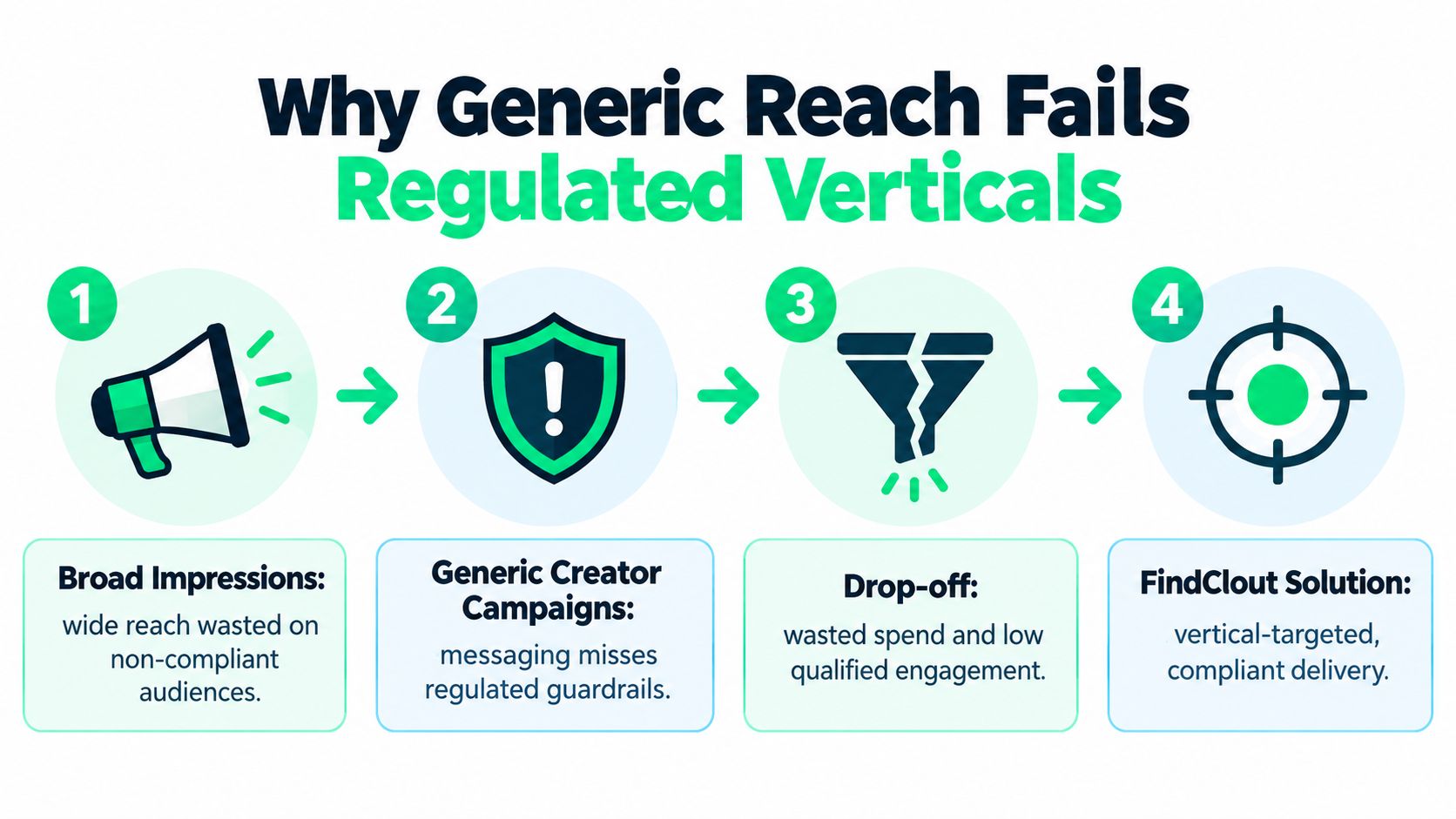
Why Generic Reach Fails Regulated Verticals
Broad reach feels efficient because it produces a clean headline number. A media buyer sees impressions, a creator reports views, and the campaign appears to be moving. The problem emerges when the advertiser asks harder questions: Were those views from American users? Were the placements suitable? Did the creative meet the product's rules? Did qualified people take the next step?
Manual influencer buying usually breaks at that point. A team searches for pages, negotiates separately, sends assets through scattered messages, checks screenshots, and tries to reconcile inconsistent reporting. That process can work for a small brand campaign. It becomes fragile when a regulated advertiser needs consistent captions, exclusions, geographic controls, post-level approvals, and live removal across a large creator network.
FindClout's relevant distinction is not just access to meme pages. Its model treats distribution as a programmatic placement system across vetted accounts, with vertical rules applied before content goes live. A campaign focused on American sports audiences can use different requirements from a crypto campaign, even when both use creator-led meme formats.
Practical rule: A cheap view isn't a valuable view until you can verify its geography, visibility, traffic quality, placement context, and relationship to the approved creative.
The same principle applies outside advertising. Teams building building predictable inbound for service firms also need a defined audience, relevant messaging, and a repeatable distribution process rather than a pile of disconnected tactics. Regulated media buying exposes the cost of weak process more clearly.
A vertical plan therefore separates sports, gaming, finance, crypto, prediction markets, and consumer applications into distinct operating environments. Each environment needs its own keywords, exclusions, creator requirements, approval logic, and conversion goals. Broad network delivery may create volume, but it can't tell you whether the volume is appropriate for the advertiser.
The trade-off is straightforward. Generic reach is easier to launch, but it transfers review and quality risk to the end of the funnel. Vertical distribution takes more preparation, yet it gives the buyer a way to route attention deliberately and protect the brand while scaling.
Building Your Vertical Marketing Plan
A useful vertical marketing plan connects segmentation to activation. It shouldn't stop at an audience description. Build it as a sequence in which every decision creates the inputs for the next one.
Start with the vertical ICP
Define the ideal customer profile separately for each market. Record the industry, company or consumer characteristics, use case, regulatory exposure, buying trigger, and economic value. For a prediction-market advertiser, the profile might prioritize American sports interest and product eligibility. For a fintech product, the trigger and proof requirements may be completely different.
Then map the buying committee. In B2B campaigns, that can include a marketing owner, compliance reviewer, finance stakeholder, and product lead. In consumer campaigns, the committee may be less formal, but the creative still has to satisfy legal, brand, and performance requirements.
Document the language each group uses, the objections it raises, the proof it requires, and the channels where it pays attention. A vertical strategy works when these details influence execution, not when they sit in a research document.
Turn positioning into rules
Create a value proposition for the vertical, then define explicit inclusion and exclusion rules. Inclusion rules might specify sports keywords, approved leagues, eligible geographies, or acceptable page themes. Exclusions should cover prohibited adjacency topics, unsuitable claims, and pages that don't meet audience-quality requirements.
A useful reference point is a focused crypto affiliate program for traders, where the audience, offer, and conversion intent need to align closely. The lesson isn't to copy the offer. It's to make the vertical promise specific enough that the placement team knows what belongs in the campaign and what doesn't.
Test one clean variable at a time
Launch controlled tests with one primary audience, message, offer, and conversion event. Don't compare a sports meme with a finance explainer, a broad network with a handpicked cohort, and a view objective with a funded-account objective all at once. You won't know which change caused the result.
Measure qualified reach, engagement quality, funnel progression, CAC, pipeline velocity, win rate, and revenue by vertical. Compare each cohort with a generic-message control before reallocating budget. A vertical campaign shouldn't earn more spend merely because it generated inexpensive views.
Govern the taxonomy
Data governance is the part many teams underestimate. FindClout classifications should be standardized by sport, league, betting or gaming relevance, audience geography, age eligibility where applicable, engagement authenticity, and brand-safety status. Without a shared taxonomy, two buyers can label the same page differently and produce incompatible reports.
Only 14% of B2B marketers report segmentation granular enough to support campaign-level personalization, according to a secondary benchmark compilation from B2B market segmentation benchmarks. Treat that figure as directional, but take the operational lesson seriously. A vertical marketing plan needs clean labels, ownership, review dates, and a scorecard for every market.
For a broader explanation of how the concept works in practice, see FindClout's guide to vertical marketing. The objective is simple: make each vertical measurable, governable, and repeatable.
Vertical Messaging and Audience Fit
Changing a caption from “sports” to “sports betting” isn't personalization. It's labeling. Real vertical messaging changes the promise, evidence, vocabulary, creative format, exclusions, and conversion path for the audience receiving it.
That distinction matters because fit is becoming more important than reach in creator selection. Creator or content suitability ranked above performance, demographics, and follower count in the cited creator-marketing research, while 74% of enterprise marketers said brand safety had become more critical during the previous year, according to CreatorIQ's creator marketing report. Those figures describe survey findings, not a guarantee of campaign performance, but they point to the right operating priority.
A sports page may be excellent for an approved, age-appropriate sports application and unsuitable for a financial product if it frequently posts risky financial jokes, political material, or misleading claims. A gaming page may have strong engagement but poor suitability for a family-oriented consumer brand. A crypto page may be relevant to traders yet fail a compliance review because of neighboring content.
Evaluate fit at four levels
| Dimension | Evaluation Criteria |
|---|---|
| Page | Vertical identity, recurring topics, audience geography, authenticity, and brand-safety history |
| Post | Caption, image, video, claims, adjacent topics, and required disclosures |
| Audience | American reach, relevant interests, age eligibility where applicable, and engagement quality |
| Campaign policy | Approved claims, prohibited language, exclusions, approval ownership, and stop conditions |
This framework prevents the common mistake of treating a page as permanently safe because it passed one review. Suitability changes at the post level, and regulated campaigns need live controls.
Match creative to the buying context
Sports creative can use the language of fixtures, rivalries, leagues, and fan identity, but that doesn't make every betting claim acceptable. Gaming creative may emphasize participation and entertainment while avoiding language that implies guaranteed outcomes. Finance and crypto messaging needs a different proof standard, especially when the creative could be interpreted as a promise of returns.
Industry-specific campaigns have been associated with approximately 47% higher engagement, while referencing a company or industry in an email subject line has been associated with about an 11% increase in open rates, according to the vertical marketing framework from SalesHive. The same source reports that 73% of B2B buyers avoid suppliers that send irrelevant outreach. These are directional benchmarks, not universal outcomes, and creative quality still determines whether relevance turns into action.
A suitability system should include approved verticals, prohibited adjacency topics, minimum audience-quality thresholds, recurring review intervals, escalation rules, and measurable stop conditions. It should also record why a page was approved, not merely whether someone clicked an approval button. That record becomes valuable when a campaign scales and multiple teams need to make consistent decisions.
Activation Infrastructure and Brand Safety
A vertical plan becomes credible when the operating controls can handle volume without reducing review quality. The infrastructure needs to control the creative, the page, the audience, the pacing, and the evidence of delivery.
Control the creative centrally
Real-time caption management lets a brand update approved language across a network instead of asking individual creators to edit posts manually. A brand rules engine should enforce required terms, prohibited topics, minimum follower thresholds, and geographic filters such as US, Canada, and the UK.
Pre-approval is the critical gate. Nothing should go live until the brand has signed off on the caption, logo treatment, targeting, and exclusions. For a sports-betting or prediction-market campaign, that means compliance rules must apply to the post itself, not only to the media plan.
The review layer should combine automated scoring with human judgment. FindClout describes AI scoring with an average processing time of approximately 1.2 seconds, alongside 24/7 human review, according to the platform information provided for this article. Treat automation as a triage and consistency tool, not a replacement for accountable human approval.
Design for live intervention
A safe activation system assumes that a page or post can become unsuitable after approval. Give reviewers the ability to pause delivery, reject a submission, remove an off-brand page, and preserve a record of what changed. The system should expose top-creator performance and placement context without forcing the media buyer to reconcile separate creator reports.
This matters in high-volume categories. An igaming creative may be approved for a specific audience and then need immediate adjustment when the product, market, or policy changes. A prediction-market campaign may require different creative rules from a conventional sportsbook campaign. The operational answer is not slower manual buying. It's centralized control with clear escalation ownership.
For buyers evaluating the wider technology category, an Advisor Momentum guide to ad platforms offers useful context on how programmatic systems differ. The selection criteria should include governance, reporting, controls, and suitability workflows, not only buying efficiency.
The safest scalable workflow is pre-approval before launch, automated checks during trafficking, human review before posting, and live removal after delivery begins.
American audience quality must sit inside the activation layer. Nielsen reports that 76% of U.S. sports fans are Millennials or Gen Z, 22% are Hispanic, and 34% live in households earning at least $100,000 annually in its 2025 sports audience report. The same report says 79.5% of U.S. soccer fans use social media for sports news and content, compared with 61.9% of the general population. Those figures support the value of sports communities, but audience verification still determines whether a campaign reaches the intended American users.
A campaign-orchestration workflow should centralize approvals, page classifications, captions, pacing, removals, and delivery logs. FindClout's material on campaign orchestration describes that operating model, where one platform coordinates distribution across a network rather than leaving the buyer to manage each creator independently.
Measurement and Budget Reallocation
A broad network and a vertical-targeted cohort should not share one headline metric. Broad distribution can deliver more impressions, while a focused cohort may generate more qualified attention. Compare both against the same downstream path, then separate delivery quality from business results.
Start with verified views. Add qualified clicks, landing-page completion, funded accounts, deposits, or approved leads according to the product. Report each stage separately. Cheap views can look efficient while producing little valuable traffic and increasing compliance exposure.
Viewability rules give the first quality threshold. The Media Rating Council defines a viewable display impression as one with at least 50% of the ad's pixels visible for at least one continuous second. For video, at least 50% must remain visible for two continuous seconds, according to the MRC and IAB measurement explainer. MRC-aligned reporting also filters general invalid traffic and advanced invalid traffic. Report visibility, duration, completion, and filtration at a level that lets buyers identify weak inventory.
Compare cohorts, not anecdotes
One academic analysis reported click-through rate rising from 2.1% to 3.8%, an 81% relative lift, and conversion rate rising from 3.4% to 6.7%, a 97% relative lift, for segmented campaigns compared with generic campaigns. It also reported machine-learning classification accuracy of up to 88%, as summarized in the marketing segmentation analysis. Treat those findings as test rationale, not a forecast for meme distribution. Creator effects, sharing, repeated exposure, and viewability can distort attribution.
Set minimum cell sizes so one creator cannot define the benchmark. Cap frequency where possible, log rejected posts and removals, and report results by:
- Vertical: Sports, gaming, finance, crypto, prediction markets, or another defined category.
- Creator tier: Separate high-volume pages from smaller placements.
- Geography: Isolate intended American audiences from other traffic.
- Creative variant: Connect captions, formats, and claims to outcomes.
The MRC's digital audience measurement standards require greater precision for audience and person-level measurement than ordinary monetized-traffic reporting. Apply that standard when a campaign claims to deliver genuine American attention, especially where invalid traffic could inflate results.
Use a vertical scorecard beside a generic-message control. Reallocate budget only after the difference survives quality checks across creators, geographies, and creative variants. For a practical framework for selecting indicators, see this guide to measuring campaign performance.
Vertical Plan Rollout Sequence
A rollout should move from governance to delivery, not from creative production straight to scale. The sequence below works for a sports-focused campaign, a prediction-market launch, or another regulated vertical.
Configure the pilot
Define the market, approved audience, product rules, exclusions, conversion event, and ownership for final approval. Build the page taxonomy before selecting placements. If the campaign requires Tier 1 American audiences, make geography and audience quality mandatory fields rather than post-campaign analysis.
Create the scorecard
Set up separate reporting for verified views, qualified engagement, clicks, funnel completion, and business outcomes. Add dimensions for creator, geography, and creative variant. Record rejected posts and removed pages so the report shows the cost of governance as well as the cost of delivery.
Launch a controlled test
Use a primary audience and one central message. Keep a generic-message control where practical. Programmatic coordination reduces the overhead of contacting and trafficking individual creators, while centralized approvals keep the campaign consistent across the network.
Monitor and decide
Review submissions in real time, pause questionable placements, and update captions or exclusions when the policy requires it. Reallocate only after comparing the vertical cohort with the control and checking that the result isn't being driven by one creator, one geography, or a delivery anomaly.
A plan is ready to scale when approvals remain consistent, verified delivery matches the intended audience, rejected content is documented, and downstream outcomes are visible by vertical. Scale should increase the volume of a working system, not compensate for missing controls.
Conclusion - Vertical Plans as Attention Infrastructure
A vertical marketing plan is attention infrastructure. It determines where attention goes, which message appears, which pages can carry it, who approves each asset, and how the advertiser proves that delivery created value.
That operating system matters most for regulated brands. Sports betting, igaming, prediction markets, finance, and crypto advertisers need brand safety inside distribution, not added during a final inspection. Compliance-by-creative should govern captions, visuals, creator selection, adjacent topics, geography, age eligibility where applicable, and removal decisions. A page suitable yesterday may be unsuitable for today's post.
Tier 1 American audiences raise the standard further. Nielsen audience data helps establish the commercial relevance of American sports communities, but relevance does not verify traffic. Buyers still need viewability rules, invalid-traffic filtration, authentic engagement checks, and reporting that separates genuine exposure from platform-reported delivery. The MRC Digital Audience-Based Measurement Standards offer a useful foundation by distinguishing viewable, valid attention from raw impressions.
Real-time review earns its budget line. Automated scoring accelerates the queue, human reviewers resolve context, and one-click removal limits the damage when a placement changes. Together, those controls support higher volume while keeping decisions accountable.
The trade-off is practical. A generic campaign may launch with less preparation, yet it can leave the advertiser unable to explain poor-quality reach, irrelevant engagement, or compliance failures. A vertical campaign requires taxonomy work, approval rules, controlled testing, and separate scorecards. In return, the team can compare cohorts, protect the brand, and move budget toward qualified outcomes instead of cheap delivery.
Vertical marketing is deliberate routing of attention. Scale comes after the routing, review, and measurement system works.
For regulated advertisers, verified views carry more decision value than impressions served, and American audience quality matters more than undifferentiated global reach. The advantage comes from making brand safety and operational detail part of distribution itself. That approach lets a campaign pursue billions of views without treating governance as an afterthought.
FindClout programmatically distributes branded meme content across curated creator pages, with vertical targeting, approved captions, brand controls, fraud screening, and real-time campaign orchestration. Advertisers seeking verified attention from high-quality American sports and other Tier 1 audiences can visit FindClout to discuss a controlled vertical campaign.
Want this audience for your brand?
FindClout puts your brand in front of verified American audiences across every major US page — brand-safe, at scale.
Start Your Campaign