 findclout.com
Vertical in Marketing: A 2026 Playbook for Brands
Vertical in marketing means organizing campaigns around specific industry audiences and niches rather than broad undifferentiated reach, so creative, controls, and measurement line up with sector-specific commercial intent. 73% of B2B buyers expect a consumer-like, personalized experience, while only 19% of surveyed B2B companies have advanced personalization capabilities, which is why broad reach alone keeps underperforming for serious buyers.
The popular advice says to buy as much attention as possible and let the algorithm sort it out. That works until the audience is too loose, the language is wrong, the compliance bar is off, and the clicks don't turn into registrations, deposits, or other real outcomes.
Table of Contents
- Why Vertical Targeting Changes the Reach Game
- What Vertical in Marketing Actually Means
- The Economics of Niche Audiences
- Vertical Targeting in Practice Across Key Industries
- Brand Safety as a Vertical Strategy
- How to Build Vertical Campaigns at Scale
- The Future of Vertical Attention Distribution
Why Vertical Targeting Changes the Reach Game
Broad distribution looks efficient on paper because it promises scale fast. In practice, it often produces a pile of views with weak commercial intent, especially when the audience does not share the same buying context, vocabulary, or risk tolerance.
A sports fan scrolling a meme page is not the same as a finance buyer scanning for trust signals, and a crypto user does not read a caption the same way a gaming audience does. The message has to match the vertical, not just the platform. That is what turns attention into something usable.

Practical rule: fewer people with the right commercial context usually beat a wider audience that only looks similar on a dashboard.
Vertical targeting reduces wasted attention by matching what people see with what they already care about. A gaming audience reacts to different cues than a fintech audience, even when both groups are young and mobile-first. That difference shows up in whether they tap, sign up, or bounce.
For measurement discipline, a roundup of AI analytics platforms worth knowing is a useful reference point for the kind of tracking that makes vertical work more accountable. The point is not just collecting more data. It is using cleaner signals to see which audiences convert.
If you are buying social traffic, FindClout's guide to buying social media traffic is relevant because traffic quality and placement quality affect the same outcome. A bigger reach number means little if the audience is not commercially relevant, brand-safe, and likely to move down-funnel. That trade-off is the whole game.
What Vertical in Marketing Actually Means
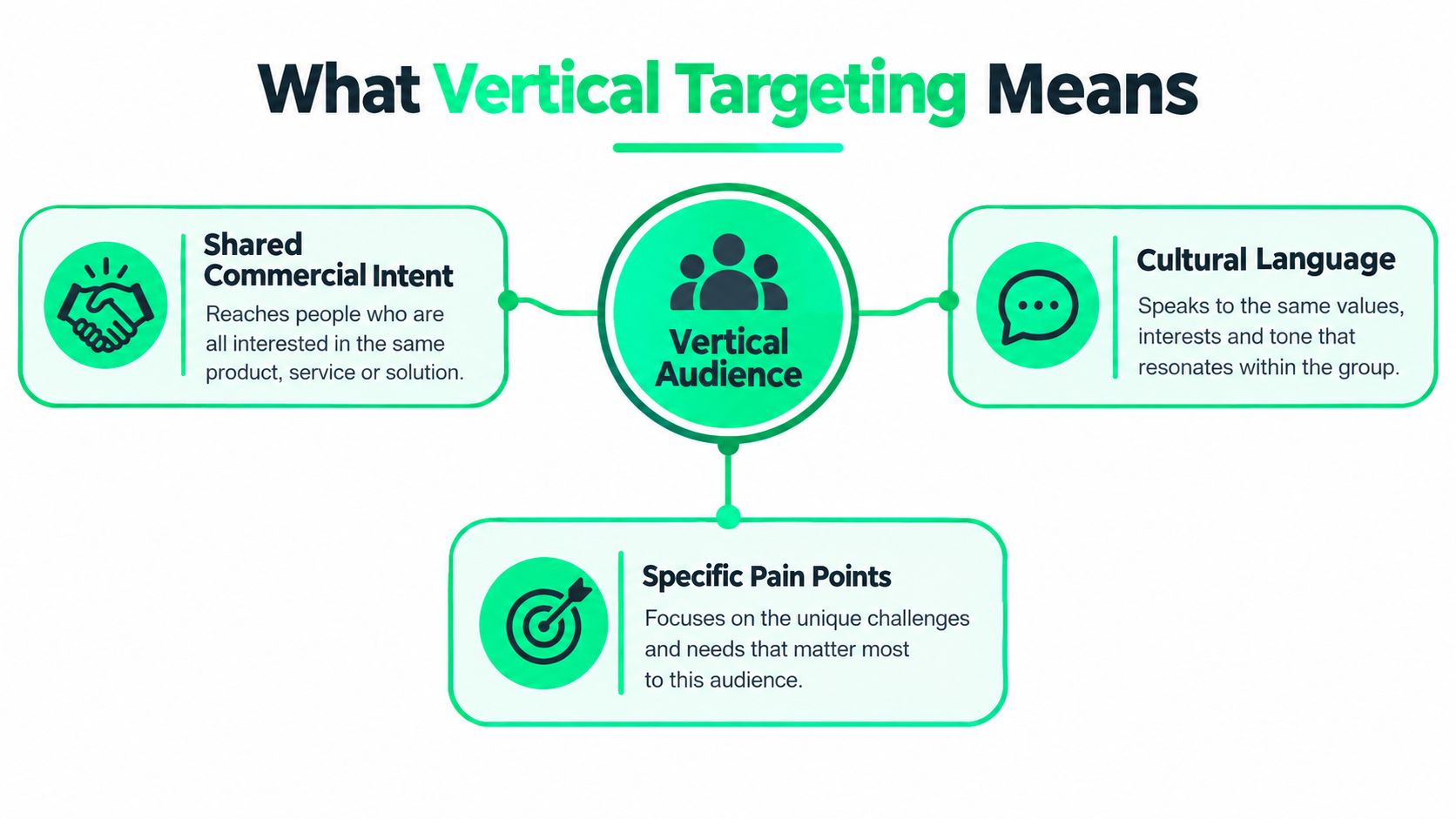
A vertical is a commercial-attentiveness cohort, not just an industry tag. Shared intent, cultural language, and response patterns are what make the targeting work.
Audience context comes first
The first layer is commercial context. A finance audience, a sports-betting audience, and an AI buyer can share the same platform, but they are not buying for the same reason or responding to the same proof points.
That matters because context shapes credibility. A compliance-heavy message can work in finance, while a momentum-driven message can work better in sports. The audience is not merely interested, it is operating inside a specific decision environment.
Language and proof points are vertical signals
The second layer is language. Vertical campaigns need terminology, examples, and offers that sound native to the niche, not like generic ad copy that could be sent to anyone.
Deloitte Digital's framing of the broader personalization gap makes the point clearly, because vertical relevance closes the distance between generic targeting and actual business fit. 73% of B2B buyers want personalized experiences, and personalization leaders are roughly three times as likely to exceed 2023 revenue goals by at least 10% according to Deloitte Digital's research. That is why language and proof points matter when the audience already expects specificity. Deloitte Digital's personalization research
Action signals separate curiosity from intent
The third layer is behavior. Judge a vertical by what people do after exposure, not by exposure alone.
The narrowest audience is not always the best one. Adjacent communities can convert better when the cultural overlap is explicit and the offer matches the action you want.
A useful operating model is simple. Segment by expected downstream action first, registrations for gaming, funded accounts for fintech, deposits for sports. Then choose reporting layers that can attribute each action to a single placement. That keeps the measurement tied to business outcome instead of audience theory, and the same discipline shows up when teams browse AI analytics platforms for cleaner attribution setups.
The Economics of Niche Audiences
Vertical targeting changes the math because cheap inventory is not the same as efficient inventory. A campaign can buy impressions at a low rate and still waste spend if those impressions never turn into qualified clicks, sign-ups, or funded accounts.
Independent benchmark data shows median click-through rates ranging from 1.75% to 7.52% and conversion rates from 2.61% to 13.90% across industries. Sports, fitness, and recreation sit at a 2.81% median CTR, which is a clear reminder that audience context shapes response economics. Industry benchmark data
CPM is not the decision metric that matters
Media pricing shifts by vertical. A benchmark compilation puts median Meta CPMs above $20 for finance and SaaS, while retail and entertainment sit closer to $6–$8, and it says CPM and CPA can vary by roughly threefold across verticals. Benchmark compilation
That spread comes from different buyer economics. Some advertisers can pay more for the same inventory because lifetime value is higher, acquisition rules are tighter, and demand is concentrated in a narrow niche. If every campaign is judged against one CPM target, the vertical signal gets lost.
Qualified attention beats cheap reach
The better lens is cost per qualified action. A sports campaign can justify higher acquisition costs if the audience is likely to register or deposit, while an entertainment campaign may be built more around sharing and repeat exposure. Those are different business models, and they should not be forced into the same benchmark.
Tracking how competitors price and position per niche, using competitor price monitoring software, helps teams see which verticals can carry premium bids. The internal win still comes from matching the offer to the vertical instead of pushing one message across every segment.
Media-buyer rule: if the creative misses the commercial intent, cheap inventory only gives you cheaper failure.
The practical move is to set vertical-specific guardrails, then compare each cohort against its own baseline. Sports, gaming, finance, and crypto need separate scorecards, not one blended average.
Vertical Targeting in Practice Across Key Industries
Sports creative works when it feels tied to the moment. Fans notice timing, rivalry, and event context fast, so generic brand copy usually misses what makes them act. A campaign built around a live fixture or a familiar fan ritual can outperform broader entertainment inventory because it matches how that audience already consumes content.
Gaming needs a different approach. These users test fast and dismiss faster, especially when the tone feels scripted. A meme format, a direct CTA, or a sharper visual cue usually fits better than a polished brand story that asks for too much patience.
Finance and fintech ask for more discipline. Trust cues carry more weight, and the explanation has to be clear because people are reading for risk, legitimacy, and utility. Crypto behaves in a similar way, but the creative also has to fit identity and community language or it will feel off immediately.
For teams comparing offers across niches, Competitor price monitoring software can still inform market read, but it does not replace vertical-specific creative review or compliance checks. Fintech and crypto teams should pre-clear compliance language before testing, because a meme that reads like a claim can stall a campaign.
One reason meme and creator buying works differently by sector is that the audience judges context before it taps. FindClout's verticals for meme advertising guide is useful here because it shows where humor, tone, and audience fit turn into action. The same rule applies across sports, gaming, fintech, crypto, and AI, a niche only works when the audience recognizes itself in the message.
Brand Safety as a Vertical Strategy
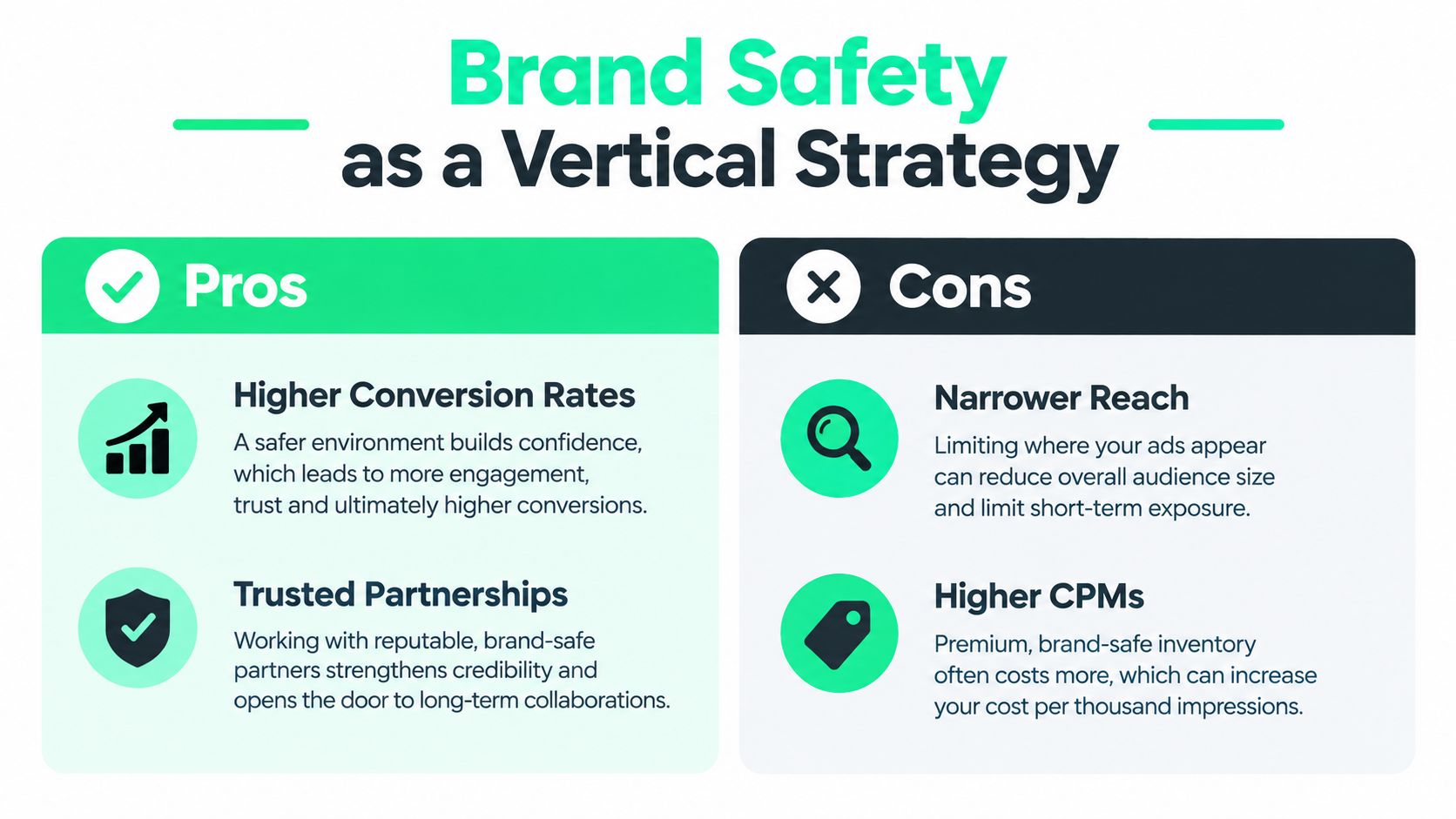
Brand safety isn't just a defensive checklist. In vertical marketing, it's a growth system because it lets you scale without handing the whole program over to chance.
The distinction between brand safety and brand suitability matters here. The IAB defines brand safety as controls that prevent negative effects from harmful or inappropriate content, while brand suitability reflects a brand's own risk tolerance and targeting requirements. It also points to two mechanics, avoidance and allowance, which together make it possible to block what you never want and permit what you specifically do. IAB brand safety and suitability guide
Safety floors and suitability ceilings
A safety floor keeps out legally, reputationally, or commercially unacceptable content. A suitability ceiling defines the tone, humor, creator history, and audience context that make a placement credible enough to scale.
Tier-1 American distribution becomes valuable, because the audience quality is only part of the equation. The other part is control. If you're buying across creator pages, you need review systems that can evaluate the placement before it goes live and catch changes after it's live.
Automation makes the inventory usable
Google's public ad traffic documentation is a good model here. It describes multilayered invalid-traffic protection with automated filters, machine learning, policy enforcement, and manual investigation, including more than 200 advanced filters and more than 100 complex algorithms to detect bad traffic as it occurs. Google's ad traffic quality system
Google also says real-time filters assess impressions and clicks as they happen, and if activity is identified as invalid, advertisers aren't charged and publishers don't receive revenue for it. Google's invalid traffic policy
That's the standard vertical marketers should want: event-level screening, human review for ambiguous cases, and account-level consequences for repeated failures. FindClout's campaign model fits that logic with AI scoring and human review before posting, which matters when a brand is buying large-scale creator distribution and wants tight control over what goes live.
Operational insight: brand safety doesn't reduce scale when the review system is fast enough to protect the inventory you actually want to buy.
If you're formalizing your own rules, FindClout's brand safety guidelines is a useful reference point for the kind of structure that keeps vertical campaigns usable instead of chaotic.
How to Build Vertical Campaigns at Scale
Start with one vertical and define it by commercial behavior, not just an audience label. Sports, gaming, finance, crypto, and AI each need their own keywords, exclusions, and success metrics, because a page can look relevant and still send the wrong kind of traffic.
Write the creative for the niche. A vertical campaign should use the vocabulary, timing, and proof points that audience already trusts, not a generic brand script. If you are buying American sports fans, the language should sound native to that environment. The same applies to fintech or prediction-market buyers.
Use a stepwise operating model
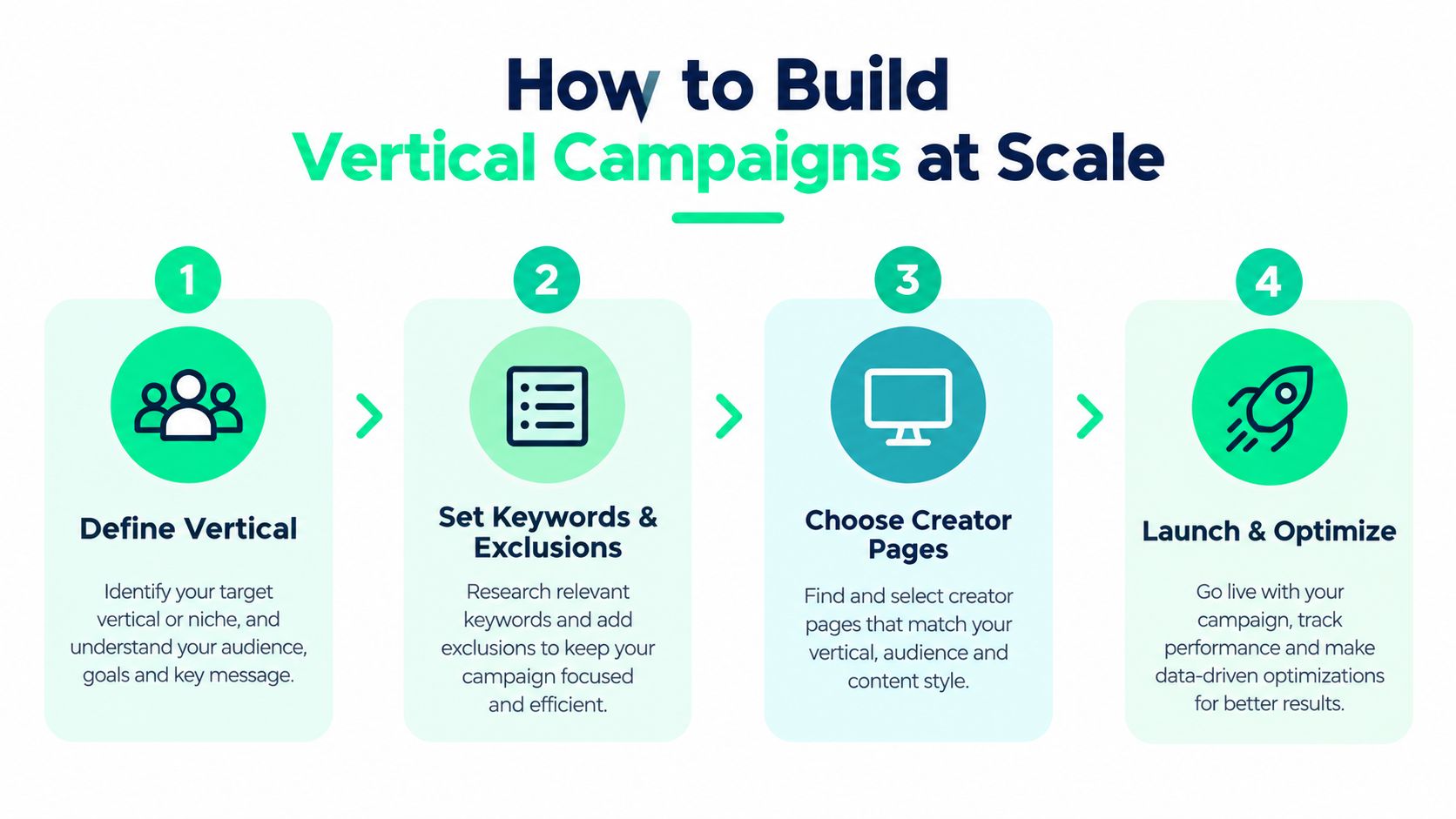
- Define the vertical. Pick the niche and the audience behavior you want to move, not just the category you want to reach.
- Set keywords and exclusions. Keep the campaign inside the right cultural and commercial lane.
- Choose creator pages carefully. Prioritize pages whose audience and tone match the offer.
- Launch and optimize. Run the first 7 to 21 days against a single vertical baseline before adding a second cohort, so you can accurately attribute lift.
That launch window matters more than a blended benchmark. Early tests are noisy, and adding too many cohorts too fast makes it hard to tell whether the problem is the vertical, the offer, or the page selection. Keep the first pass narrow, then expand only after the qualified-action rate is clear.
If you need a structured way to run this at scale, FindClout is one option for distribution across vetted creator pages with brand rules, review workflows, and vertical targeting built into the campaign setup. The point is not to buy more impressions, it is to buy better-qualified attention and keep the controls tight enough to trust the result.
The Future of Vertical Attention Distribution
The next phase of marketing maturity favors niche distribution over broad reach, especially for regulated or high-value categories. The brands that win will treat verticals like audience ecosystems, not ad slots.
That shift is already visible in how platforms talk about vertical video and unified measurement. If you're thinking about creative format as part of the vertical stack, best vertical video resolutions is a useful reference for the media-side execution choices that support cleaner delivery.
Vertical marketing is becoming infrastructure because the commercial problems are getting harder, not easier. Brands need relevance, they need controls, and they need a way to scale without losing confidence in what they bought.
FindClout helps brands distribute vertical campaigns across vetted creator pages with brand controls, real-time review, and audience targeting built for American niches. If you're buying for sports, gaming, fintech, crypto, or AI, visit FindClout to see how vertical distribution can support qualified reach without giving up control.
Want this audience for your brand?
FindClout puts your brand in front of verified American audiences across every major US page — brand-safe, at scale.
Start Your Campaign