 findclout.com
10 Programmatic Marketing Examples That Scale
The strongest programmatic marketing examples aren't cheap placements. They're distribution systems that route attention through relevant audiences, apply controls before content goes live, and use live signals to improve the campaign while it's running. Adobe's fully programmatic campaign cut CPM from $25 to $12 in six months, a reduction of more than 50%, while improving viewability, brand safety, fraud-free performance, and customer visits. Adobe's case study shows what matters: efficiency only counts when quality and business outcomes improve with it.
This article evaluates ten systems for reaching tier-1 American audiences: vertical audience selection, authentic views, creator-native execution, real-time controls, measurable outcomes, and safeguards that protect the brand as distribution scales toward billions of views. The examples range from sports betting and fintech to ecommerce, gaming, B2B SaaS, sponsorships, testing, analytics, and creator verification.
FindClout provides a practical illustration of this operating model. Its centralized meme-page distribution combines pre-approval, AI scoring, verified views, caption controls, geo-filters, and 24/7 human review. The relevant lesson isn't that every brand should use meme pages. It's that scalable reach needs an operating layer capable of reviewing every submission in real time, prioritizing high-quality American geographies, and stopping unsafe or low-quality placements before they damage performance.
Table of Contents
- 1. Sports Betting Brand Meme Distribution to Tier-1 Sports Fan Networks
- 2. Fintech and Crypto Brand Awareness via Niche Vertical-Targeted Meme Campaigns
- 3. DTC E-Commerce Product Launch Campaigns with Real-Time Caption Customization
- 4. Gaming and Mobile App User Acquisition via Genre-Specific Meme Page Networks
- 5. B2B SaaS Brand Awareness Campaigns Targeting Professional Niches via LinkedIn-Adjacent Creator Pages
- 6. Logo and Caption Distribution Campaigns for Rapid Brand Awareness at Scale
- 7. Event and Sponsorship Activation via Coordinated Multi-Creator Meme Campaigns
- 8. Audience Segment Testing and Optimization via Real-Time Caption A/B Testing at Scale
- 9. Measurement and Analytics for Campaign Performance and Brand Lift
- 10. Creator Network Vetting, Verification, and Brand Safety Controls
- Programmatic Marketing: 10-Point Comparison
- Build the Operating System Behind the Reach
1. Sports Betting Brand Meme Distribution to Tier-1 Sports Fan Networks
Sports betting campaigns need more than sports reach. They need American sports audiences with authentic engagement, careful state-level controls, and messaging that doesn't drift into irresponsible gambling promotion. A verified network of sports meme pages and commentary accounts can give DraftKings or FanDuel a native way to appear around game-day conversation, provided the campaign separates audiences by league, niche, and legal market.
A playoff campaign might place approved memes across NFL, NBA, MLB, soccer, fantasy sports, betting tips, and prop-odds pages. The creative can stay culturally relevant while captions change for game-day promotions, odds, or results. That makes real-time orchestration more valuable than a fixed influencer post, because operators can update the message without rebuilding the distribution plan.
FindClout's sports betting advertising approach is relevant here because the operating system matters as much as the page list. It can support pre-approval, creator-level review, state-specific disclaimers, exclusion rules, and one-click removal. For high-risk verticals, page eligibility should include minimum follower and authentic engagement requirements, while underage-adjacent content and pages that fail responsible-gambling standards should be excluded before posting.
Practical rule: Treat every state, league, and creator cluster as a separate compliance decision, not as one national audience.
The repeatable sequence is straightforward:
- Select the vertical: Separate NFL, NBA, MLB, soccer, fantasy sports, and betting education audiences.
- Control the caption: Maintain approved language for odds, promotions, disclaimers, and responsible gambling.
- Review continuously: Use AI signals and human reviewers to catch unsafe context, anomalous engagement, or unsuitable pages.
- Optimize by niche: Compare sports segments qualitatively, then shift budget toward the audiences producing higher-quality attention and conversions.
The trade-off is operational complexity. More granular targeting creates more review work, but that work is what makes American scale defensible.
2. Fintech and Crypto Brand Awareness via Niche Vertical-Targeted Meme Campaigns
Fintech and crypto brands need context. A crypto meme shown beside speculative claims or pump-and-dump language can create reputational risk even when the placement delivers engagement. A safer programmatic example uses finance, blockchain, trading, and developer pages, then applies strict keyword inclusions and exclusions before a caption reaches the audience.
A Coinbase or Kraken campaign could use educational “DeFi 101” creative across crypto finance pages. Stripe or Square might promote payment functionality to audiences interested in blockchain infrastructure. Robinhood or Public could use retail-investor pages for compliance-approved messages, while a developer-focused blockchain company could distribute technical memes through crypto technology communities.
The difference between niche targeting and indiscriminate reach is the rules engine. Terms such as “Bitcoin,” “Ethereum,” and “DeFi” can define the intended context, while speculative language such as “guaranteed returns” should be excluded. Compliance teams should approve claims, disclaimers, and landing-page language before launch, then retain approval logs for later review.
FindClout's crypto advertising platform model fits this use case because it combines vertical targeting with caption management and page-level controls. The broader creative strategy can also borrow from fintech video ad examples, especially when a meme distribution campaign needs to turn a complex financial product into a short, understandable explanation.
The operating system for volatile categories
Crypto guidance can change quickly. A campaign therefore needs a process for updating captions, pausing risky variants, and escalating uncertain pages to human review. AI can identify suspicious language or unusual page behavior, but a compliance reviewer should decide whether the placement is suitable for a regulated American audience.
The main trade-off is reach versus message freedom. Loose language may earn attention, but controlled language protects credibility and reduces the chance that the brand becomes associated with misleading financial promises.
3. DTC E-Commerce Product Launch Campaigns with Real-Time Caption Customization
A product launch needs speed, but speed without inventory awareness creates waste. A DTC brand can distribute meme-native versions of product images or video across lifestyle, humor, beauty, fashion, wellness, and tech pages, then alter captions as demand, stock, or promotion changes.
Consider Glossier testing beauty-oriented captions against broader lifestyle pages, or Warby Parker introducing a new frame collection through humor and fashion communities. A brand can compare “New drop,” “Limited edition,” and “Shop now” without assuming that one message will work equally well across every creator cluster. Promo codes and UTM links can isolate which pages generate useful traffic, not merely views.
The internal meme engine described by FindClout can convert approved product assets into native variations, while real-time campaign optimization provides the operational logic for caption updates, removal rules, and live performance decisions. Pre-approval remains essential. A post promoting an unavailable product, an unverified claim, or an expired offer can undermine trust quickly.
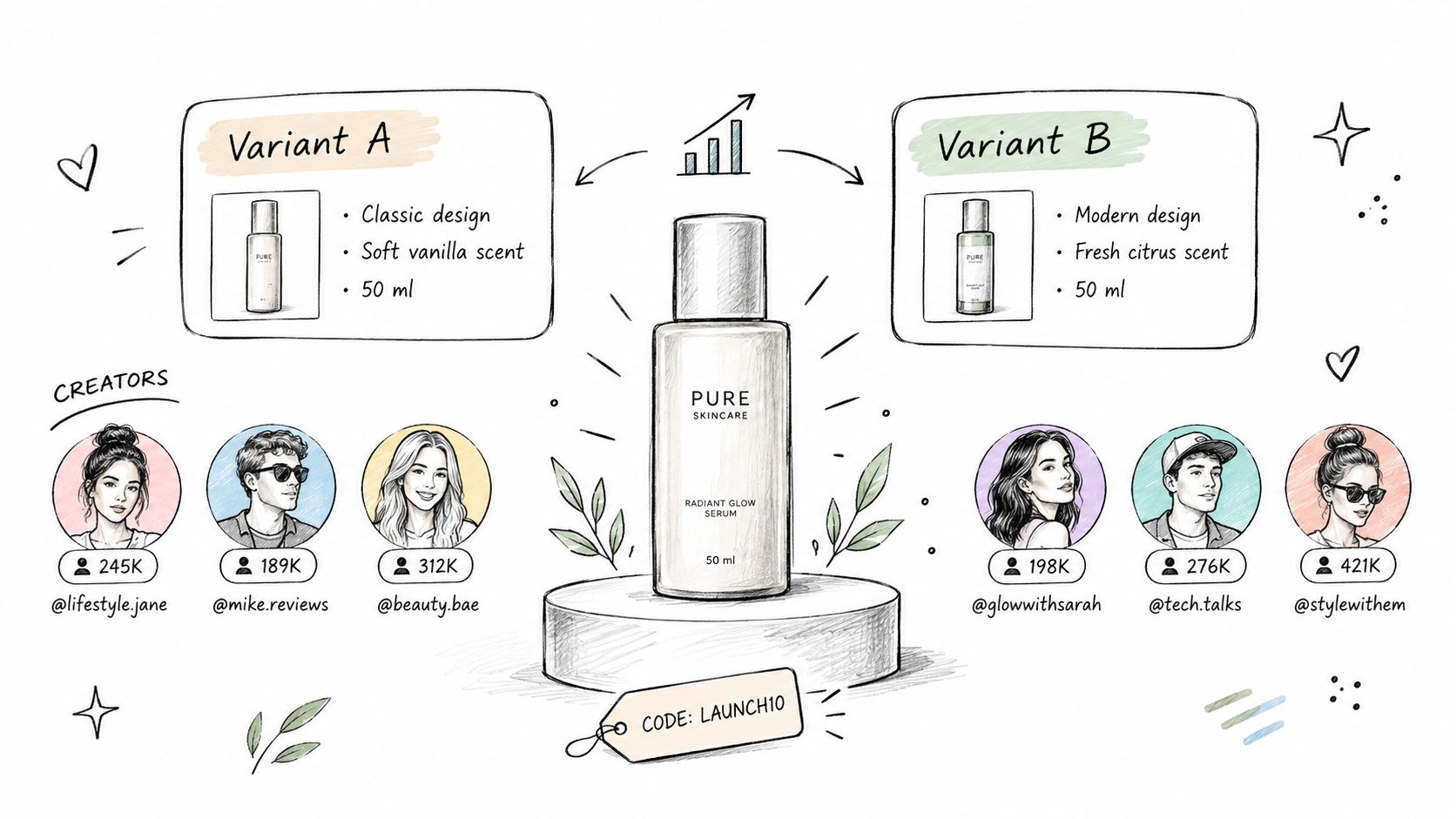
A strong launch process includes:
- Creative variation: Prepare several visual and caption directions before distribution.
- Inventory rules: Remove or update posts when products sell out or availability changes.
- Audience separation: Compare beauty, fashion, lifestyle, wellness, and tech communities independently.
- Attribution: Assign distinct promo codes or UTM parameters to creator groups.
- Attention quality: Review whether engagement comes from the intended American market rather than relying on aggregate views.
The trade-off is creative consistency versus testing breadth. More variants can reveal stronger positioning, but every variant needs brand approval and monitoring.
4. Gaming and Mobile App User Acquisition via Genre-Specific Meme Page Networks
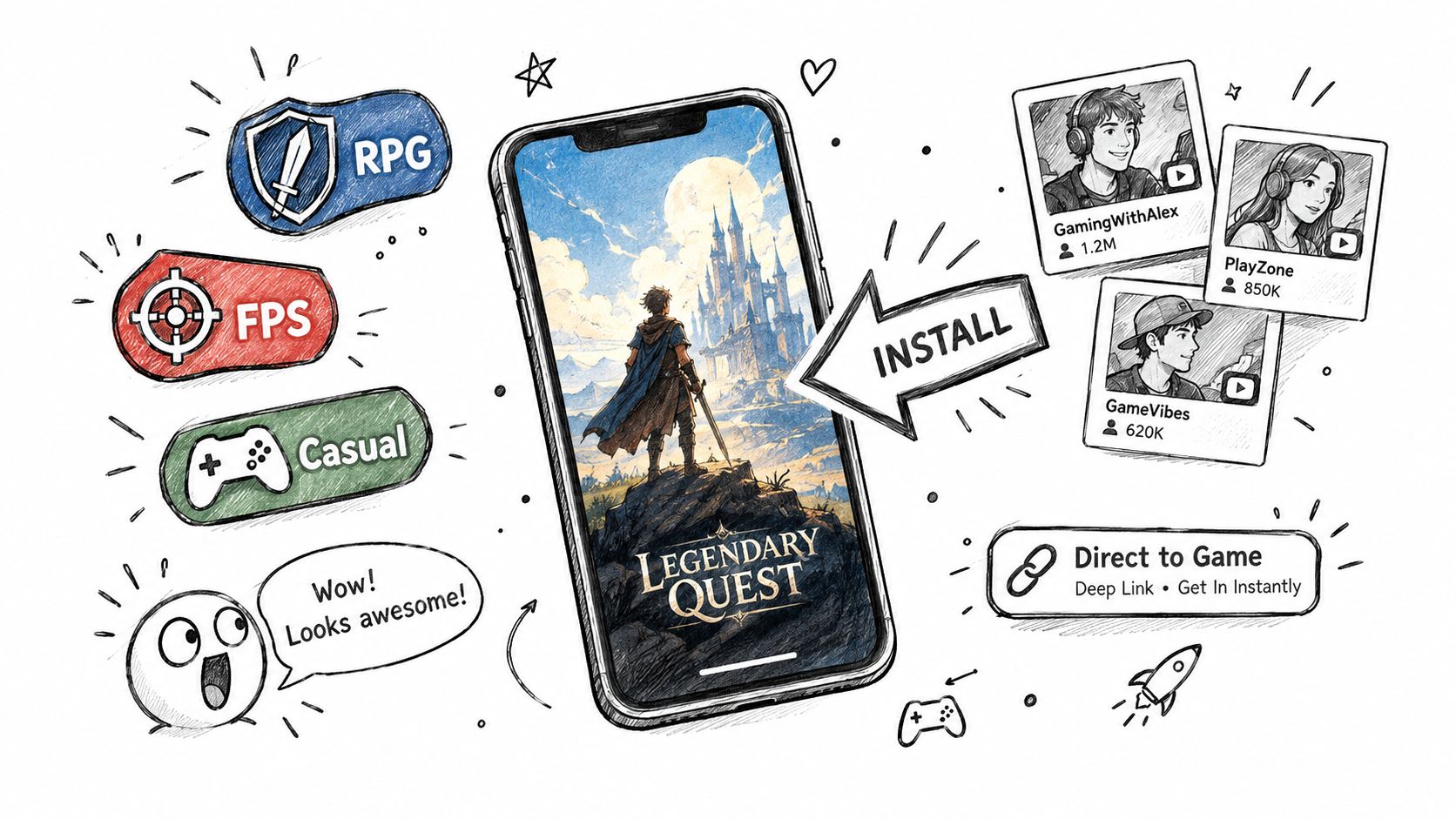
Gaming acquisition works best when the creative matches the player's identity. A mobile puzzle game shouldn't be evaluated against an esports FPS campaign as if both were buying the same attention. Genre-specific distribution lets publishers separate mobile casual, competitive esports, strategy, RPG, console, and streaming audiences.
Supercell could use seasonal memes for Clash of Clans or Brawl Stars across mobile gaming pages. Activision could promote a Warzone season or battle pass through FPS and esports communities. Riot Games could distribute League of Legends or Valorant tournament creative where competitive gaming conversation already exists.
The campaign should align captions with live product moments, such as a new season, limited-time event, tournament, or in-game content release. If a page repeatedly mocks pay-to-win mechanics or attracts negative “uninstall” discussion, a brand rules system should route it out rather than treating the engagement as a positive signal.
Optimize for player quality, not install volume alone
A gaming team should connect creator-level traffic with deep links, first-session events, retention, and downstream monetization. The page that drives the most installs may not drive the most valuable players. Separate promo codes or tracking links can expose that difference.
High-quality American reach also requires audience authentication. Follower totals alone don't prove that a page reaches real players. AI anomaly detection, engagement review, and human approval help identify pages with sudden audience changes or suspicious activity before the publisher pays for distribution.
The trade-off is between broad gaming reach and genre precision. Broad reach can accelerate awareness, but genre-level testing produces clearer evidence about who is likely to install and continue playing.
5. B2B SaaS Brand Awareness Campaigns Targeting Professional Niches via LinkedIn-Adjacent Creator Pages
Professional audiences don't stop consuming informal content after work. Startup, sales, accounting, finance, and tech-humor pages can create a creator-native route to professionals who may ignore conventional B2B advertising. The important distinction is relevance. A general humor page may generate attention, but a sales meme page is more likely to make a CRM message feel recognizable.
Slack or Microsoft Teams could use remote-work creative across startup and technology communities. HubSpot or Salesforce might distribute sales-process memes, while Notion or Asana could focus on productivity and collaboration. Stripe or Square could target accounting and finance pages with payment-focused content.
The creative should stay simple, but product claims need strict approval. A brand rules engine can require sign-off for pricing, comparative language, customer claims, and feature announcements. UTM-tagged links then connect each creator cluster to qualified traffic, demo requests, or other agreed business outcomes.
A useful test compares message frames rather than merely changing words:
- Product announcement: Lead with a new feature or release.
- Founder story: Build relevance through the problem that created the product.
- Customer outcome: Present a specific use case without inventing performance claims.
- Workflow humor: Show the professional problem before introducing the solution.
The trade-off is brand familiarity versus immediate lead generation. Meme distribution may strengthen recall before a buyer is ready to convert, so teams should pair behavioral reporting with brand-lift research instead of judging every professional placement by last-click results.
6. Logo and Caption Distribution Campaigns for Rapid Brand Awareness at Scale
A logo and caption campaign is the simplest of these systems, but simplicity makes governance more important. The brand isn't asking creators to explain a complicated product. It's asking hundreds of pages to deliver a consistent visual cue and approved message across relevant American communities.
Nike or Adidas could use sports and lifestyle pages for seasonal brand activity. Coca-Cola or PepsiCo could coordinate event-related creative across culture and lifestyle communities. Apple or Samsung could distribute product-launch awareness through technology and culture pages, while a luxury brand could test high-follower lifestyle placements with tightly controlled imagery.
FindClout describes a logo and caption format priced at $0.20 CPM, with watermarking, approved captions, and rule-based distribution. The figure comes from the publisher's supplied platform information, so it should be treated as a stated commercial term rather than a universal market benchmark. The operational value is centralization: one approval workflow can govern page selection, logo treatment, caption rotation, and removals.
Consistency is the product
This format works when the brand has a clear recognition objective. Captions can vary between “Learn more,” “Shop now,” and event-specific language, but the visual identity should remain stable enough to reinforce memory.
The safeguards should include:
- Geo-filters: Keep distribution focused on the intended American markets.
- Niche alignment: Match sports creative to sports pages and beauty creative to lifestyle pages.
- Engagement review: Exclude pages whose activity looks inflated or irrelevant.
- Event timing: Concentrate delivery around launches, seasons, and cultural moments.
- Creator analytics: Rebook pages that consistently produce relevant attention.
The trade-off is depth versus breadth. Logo distribution can create broad awareness, but it rarely explains a complex value proposition. Use it as an upper-funnel system, then connect interested audiences to richer product, video, or conversion campaigns.
7. Event and Sponsorship Activation via Coordinated Multi-Creator Meme Campaigns
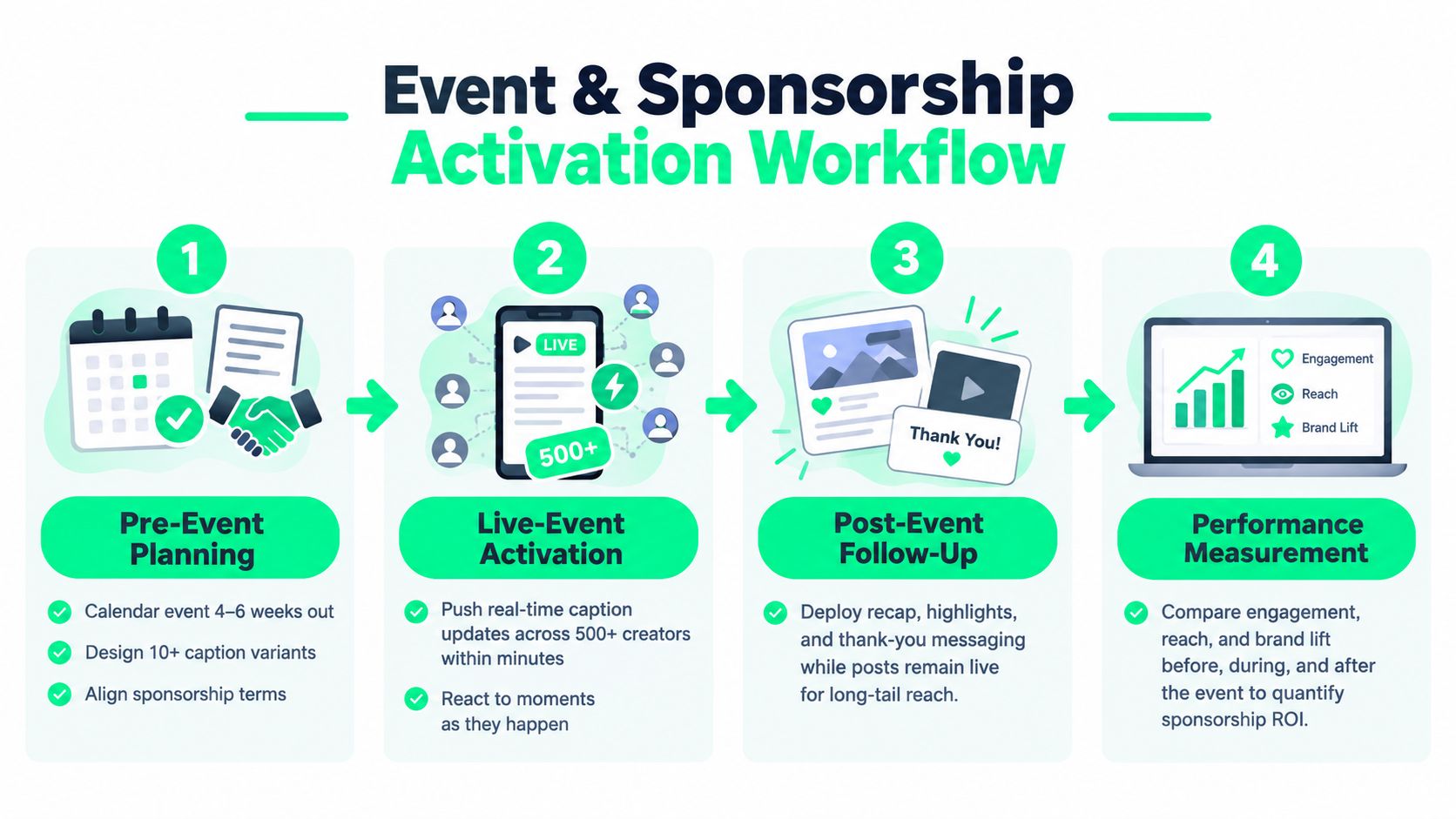
Sponsorships often end when the event ends. Programmatic creator distribution can extend the activation by coordinating pre-event anticipation, live commentary, and post-event discussion across relevant pages. That turns a logo placement into a sequence of content moments, while keeping captions and sponsorship rules under centralized control.
For a Super Bowl activation, a brand such as Pepsi, Nike, or Ford could prepare pre-game sports memes, approved reactions to major moments, and post-game creative. A music sponsor could distribute artist and festival content through music and lifestyle communities. An esports sponsor could coordinate tournament predictions, match reactions, and championship moments across gaming pages.
The operational requirement is preparation. Event teams should develop a calendar, approved caption variants, competitor exclusions, required sponsor language, and escalation rules before the event. Live updates can then be selected from an approved library instead of being written under pressure.
Live campaigns need a pre-approved decision tree. Speed is safe only when the permitted actions are clear before the moment arrives.
Measurement should separate pre-event, live-event, and post-event performance. Track creator-level engagement, traffic, and attention quality, then compare the event window with the surrounding campaign period. A sudden spike in views isn't enough if the audience is outside the intended geography or the content appears beside unsafe commentary.
The trade-off is responsiveness versus control. Live culture rewards fast participation, but every reactive caption increases legal, sponsorship, and reputational exposure. Human review remains necessary for unexpected moments, especially in sports and entertainment environments.
8. Audience Segment Testing and Optimization via Real-Time Caption A/B Testing at Scale
The most useful testing system changes one decision at a time. A brand can distribute the same underlying meme across different creator groups while testing captions built around benefit, scarcity, price, social proof, or simplicity. The result is not merely a winning line. It's evidence about which message works for which American audience segment.
A SaaS company might compare “Free trial,” “No credit card required,” and a product-benefit message across startup, productivity, and technology pages. An ecommerce brand could compare free shipping, a discount, and limited-stock framing across lifestyle and deal communities. A consumer app could test “Try for free” against “Start now” to learn whether a lower-friction or urgency-led message earns stronger action.
Segmentation is a vital discipline. A caption that performs well in a gaming community may fail in finance or professional audiences. Reporting should therefore separate creator cluster, niche, geography, traffic quality, and downstream conversion rather than collapsing every placement into one average.
A repeatable testing loop
- Write hypotheses: Define what each caption is expected to change.
- Hold creative constant: Avoid confusing a caption effect with a visual effect.
- Set pause rules: Remove clearly unsuitable variants without waiting for the campaign to end.
- Read creator patterns: Identify whether the winner is broad or limited to a specific niche.
- Feed the next test: Turn useful language into new visual and landing-page variants.
The trade-off is speed versus statistical confidence. Rapid signals can guide allocation, but they shouldn't be treated as conclusive evidence without enough qualified traffic and consistent measurement.
9. Measurement and Analytics for Campaign Performance and Brand Lift
Measurement makes programmatic execution accountable. A useful dashboard connects creator, caption, audience vertical, geography, traffic quality, and business action, allowing marketers to separate distribution from valuable attention.
An ecommerce brand can use creator-specific promo codes and UTM links to trace revenue to page clusters. A mobile game can connect deep links with SDK events, then compare first-session behavior and retention by source. A SaaS company can combine behavioral data with a brand-lift survey to assess changes in awareness and consideration among exposed audiences.
Adobe's campaign shows why outcome breadth matters. Its programmatic effort reduced CPM from $25 to $12, brought viewability and fraud-free performance to or above industry benchmarks, increased customer visit rates by 1.5x versus the prior two quarters, and raised unaided awareness by 13 percentage points. The Adobe campaign cited in the introduction shows that efficient buying should be judged alongside attention quality and brand outcomes.
Define primary and secondary KPIs before launch:
- Awareness: Reach, qualified views, viewability, and aided or unaided recall.
- Consideration: Clicks, site visits, engaged sessions, and branded search behavior.
- Conversion: Signups, purchases, installs, deposits, or qualified leads.
- Quality: Geography, fraud screening, creator authenticity, and placement suitability.
- Value: Retention, repeat purchase, lifetime value, or sales contribution where available.
Measurement also needs a clear attribution rule. Creator content can influence people before they click, so last-click reporting may understate awareness effects. Combine behavioral attribution with lift measurement, then compare results by vertical, creator cluster, and supply quality. That view shows which executions produce reach and which produce commercially useful attention.
10. Creator Network Vetting, Verification, and Brand Safety Controls
Vetting is not a preliminary task. It's the system that determines whether every other programmatic marketing example is credible. A large creator network can scale reach, but without continuous review it can also scale fraud, unsuitable content, and low-quality geography.
The American National Advertisers' 2024 Programmatic Benchmark found that 43.9% of every $1,000 entering a DSP reached consumers, up 7.9 percentage points year over year. The study measured $235 million in spend across 38.5 billion impressions from 21 advertisers, and reported that open-market and private-market shares shifted from 59/41 in 2023 to 41/59 in 2024. The commercial lesson is direct: supply-path quality and control deserve as much attention as audience targeting.
Independent Pixalate ad-fraud benchmarks measured invalid traffic rates of 19% on web, 29% on mobile app, and 18% on CTV in one benchmark set, with another analysis covering more than 106 billion impressions. Those figures aren't a reason to abandon programmatic buying. They're a reason to verify whether reported attention represents real users in suitable environments.
Hybrid review beats blind automation
The 4A's Brand Safety Playbook recommends TAG Certified channels where possible, fourth-party verification tags from vendors such as DoubleVerify, Integral Ad Science, and Oracle Data Cloud, and IAB Tech Lab Content Taxonomy signals in OpenRTB requests. IAB Europe's brand-safety guide recommends pre-bid targeting to avoid illegal or dangerous content before an impression is won.
IAS guidance describes real-time page crawling, scoring, rating, and blocking, while GroupM's playbook advises advertisers to prefer direct buys or inventory enabled with app-ads.txt and to consider location verification for tightly geo-fenced campaigns.
A credible network should combine automated AI signals with human review, maintain allowlists and blocklists, log approvals, verify geography, and support one-click removal. That system protects brands as they scale attention across high-quality American audiences.
Programmatic Marketing: 10-Point Comparison
| Use Case | 🔄 Implementation Complexity | ⚡ Resource Requirements | 📊 Expected Outcomes | 💡 Ideal Use Cases | ⭐ Key Advantages |
|---|---|---|---|---|---|
| Sports Betting Brand Meme Distribution to Tier-1 Sports Fan Networks | High, complex state-level regulatory rules and real-time captioning | High, legal/compliance, daily monitoring, creator ops | Strong targeted reach to high-intent bettors; measurable authentic views | Game-day promos, playoffs, state-by-state launches | 1/50th Meta CPMs, dynamic odds updates, strict brand safety |
| Fintech and Crypto Brand Awareness via Niche Vertical-Targeted Meme Campaigns | High, SEC/FTC constraints and strict topic exclusions | High, continuous human review, rigorous vetting, compliance resources | Ultra-low CPM awareness to crypto-native US audiences with controlled messaging | Crypto/DeFi launches, regulated fintech awareness campaigns | Ultra-low CPMs, strong brand-safety controls, rapid compliance pivots |
| DTC E-Commerce Product Launchs with Real-Time Caption Customization | Medium, meme engine + A/B workflows and fast iteration | Medium, creative variants, analytics, inventory hooks | Faster product-market fit, lower CPMs, improved conversion tracking | New product drops, promo-code tests, rapid A/B launches | Rapid A/B testing, low CPMs, centralized creator orchestration |
| Gaming and Mobile App User Acquisition via Genre-Specific Meme Page Networks | Medium, deep-linking, ATT compliance, genre coordination | Medium, dev integration, creator ops, promo code setup | Cost-effective installs from pre-qualified gamers; improved CPI benchmarking | Game launches, seasonal events, battle pass promotions | Low CPM UA, genre-targeting, long-tail organic installs |
| B2B SaaS Brand Awareness Targeting Professional Niches via LinkedIn-Adjacent Creator Pages | Medium–High, legal pre-approval and professional messaging rules | Medium, legal/comms coordination, niche targeting | Improved brand recall among professionals at far lower CPM than LinkedIn | Product announcements, thought leadership, professional recruiting | Cost-efficient vs. LinkedIn; humanizes SaaS; targeted professional reach |
| Logo and Caption Distribution Campaigns for Rapid Brand Awareness at Scale | Low, simple watermark + caption rotations, fast launch | Low, minimal creative overhead, quick trafficking | Massive impressions and fast awareness lifts at ultra-low CPM | Broad seasonal campaigns, brand presence windows, quick-response marketing | Ultra-low CPM ($0.20), ~10-min launch, network-wide consistency |
| Event and Sponsorship Activation via Coordinated Multi-Creator Meme Campaigns | High, real-time synchronization and 24/7 moment monitoring | High, dedicated live team, many caption variants, tight approvals | Amplified live reach and engagement; extended post-event visibility | Sports/music festivals, conferences, sponsorship activations | Coordinated live messaging, rapid updates, sponsorship compliance |
| Audience Segment Testing & Optimization via Real-Time Caption A/B Testing at Scale | Medium, multivariate setup, analytics integration and rules | Medium, budget for large impressions, analytics staff | Rapid identification of winning messages; compressed test cycles from weeks to hours | Messaging validation, CAC/LTV optimization, cross-niche learning | Fast statistically-powered insights, automatic scaling of winners |
| Measurement & Analytics for Campaign Performance and Brand Lift | Medium–High, instrumentation, SDKs, and experimental design | High, analytics engineers, surveys, SDK/deep-link setup | Clear CAC/LTV attribution, cohort LTV, and brand lift measurement | Performance-driven UA, multi-channel attribution, post-campaign analysis | End-to-end attribution, cohort analysis, exportable audit reports |
| Creator Network Vetting, Verification, and Brand Safety Controls | Medium, hybrid AI + human review with ongoing monitoring | Medium–High, moderation team, AI tooling, audit logs | Reduced fraud, safer placements, faster remediation for risky pages | Regulated verticals (finance, gaming, health), high-risk campaigns | Fraud reduction via pay-per-verified-view, one-click removal, auditability |
Build the Operating System Behind the Reach
The ten examples point to one conclusion. Programmatic marketing is not a placement type. It's an operating system for controlled distribution. The strongest campaigns connect audience selection, creative approvals, live orchestration, measurement, and brand safety in one repeatable process.
Start with the vertical, not the format. A sports betting brand should begin with relevant American sports communities and state-level compliance requirements. A crypto company should define acceptable financial language and exclude speculative contexts. A game publisher should separate casual, competitive, strategy, and RPG audiences. A B2B SaaS brand should identify the professional communities where its buyers already recognize the problem.
Then define geography and quality requirements before buying reach. Tier-1 American audiences should be a delivery condition, not a reporting surprise. Require evidence that creators attract genuine viewers in the intended markets, and review engagement patterns instead of treating follower totals as proof of authenticity. Where inventory is supplied through broader programmatic paths, use pre-bid controls, verification, private or direct supply where appropriate, and location checks for narrowly defined campaigns.
Choose the format according to the job. Logo and caption distribution supports recognition. Vertical targeting adds topical relevance. Content campaigns provide more room for product education. Event activation needs synchronized publishing and rapid approvals. Caption testing needs consistent creative and clean segmentation. Measurement requires tracking links, promo codes, deep links, survey design, and a clear definition of what counts as a qualified outcome.
Pre-approval should cover the full execution, not just the original asset. Review the image, caption, creator page, neighboring content, required disclosures, landing page, and geographic rule. Build removal triggers for unsafe content, inventory changes, anomalous traffic, and regulatory updates. AI can score submissions quickly, but human reviewers should handle ambiguity and high-risk categories.
Finally, scale from creator-level evidence. Don't increase distribution because the aggregate view count looks impressive. Increase it when the right American audiences are receiving authentic attention, the pages remain brand-safe, the message performs in the relevant niche, and the downstream behavior supports the next investment. The ANA benchmark's shift toward more controlled supply paths reinforces the commercial value of this discipline, while the fraud benchmarks show why delivery volume alone cannot define success.
FindClout is one practical option for this model. It centralizes branded meme distribution across vetted creator pages, supports vertical targeting, pre-approval, caption management, geo-filters, fraud screening, AI scoring, human review, and creator-level analytics. Whether a brand uses that platform or another buying system, the transferable advantage is the same: controlled orchestration that scales verified attention without surrendering brand protection.
To build a campaign, map the audience vertical, American geography, compliance rules, creative variants, attribution plan, and removal process before launch. Then test a focused creator group, review the evidence at page level, and expand only when the system shows that reach is both real and commercially useful.
FindClout offers programmatic branded meme distribution across curated creator pages, with vertical targeting, pre-approval, real-time caption control, fraud screening, and AI-plus-human brand-safety review. Visit FindClout to explore a controlled way to reach high-quality American audiences while measuring and protecting attention as your campaign scales.
Want this audience for your brand?
FindClout puts your brand in front of verified American audiences across every major US page — brand-safe, at scale.
Start Your Campaign