 findclout.com
Gaming Marketing Strategy: How to Scale in 2026
The counterintuitive reality of gaming acquisition in 2026 is that more paid distribution doesn't automatically mean better growth. Mobile games spent $25 billion on user acquisition in 2025, up 3.8% from the previous year, while paid install share and ad impressions both increased, according to AppsFlyer's 2026 gaming app marketing report. Demand hasn't disappeared. The problem is that marketers still buy delivery volume when they need verified attention from the right people, in the right places, under rules their brands can enforce.
That distinction matters most in tier-1 American media buying. A gaming marketing strategy built around cheap impressions can produce attractive dashboards while sending weak traffic through unsafe or low-value inventory. A stronger approach treats distribution as infrastructure, with audience filters, creative approvals, fraud controls, live optimization, and conversion measurement connected from the first placement to the final player action.
Table of Contents
- The Shift From Impressions to Verified Attention
- Why Tier-1 American Audiences Dictate Your Strategy
- Choosing the Right Campaign Format and CPM
- Running Real-Time Creative With Brand Safety Controls
- Measuring Performance Beyond Click-Through Rates
- Launching Your First Verified Distribution Pilot
The Shift From Impressions to Verified Attention
The old gaming UA playbook was simple. Buy impressions, optimize toward clicks or installs, refresh creative when performance drops, and let the platforms decide where delivery happens. That model still has a place, but the economics are becoming harder to control. AppsFlyer reports that paid install share increased 10% year over year on both Android and iOS in 2025, while ad impressions rose 20% during the same period. iOS acquisition spending increased 6%, and Android spending increased 2%.
Those figures don't indicate a dead market. They show a market with intense competition for attention and increasingly automated delivery. More advertisers are competing for the same high-value users, so a low CPM can be meaningless if the resulting audience isn't American, engaged, authentic, or likely to convert.
Delivery volume isn't the same as attention
Impressions are a platform event. A verified view is a business-controlled event. The difference is whether the buyer can establish that the content reached a qualifying audience in an approved environment and remained connected to a measurable action.
Programmable meme distribution changes the operating model. Instead of negotiating with individual creators or accepting opaque social placement, a marketer can route approved content across a curated network of pages, apply geographic and contextual rules, and monitor which handles produce useful attention. The asset becomes programmable. It can be captioned, restricted, removed, and reallocated without rebuilding the entire campaign.
Practical rule: Don't optimize the first dashboard you receive. Define what a valuable American view means before buying the view.
For a sportsbook, that might mean sports-relevant context, approved language, U.S. geography, and a path to a compliant landing page. For a game publisher, it might mean authentic gameplay interest rather than broad entertainment reach. For a prediction market, it could mean culturally relevant content that creates curiosity without attracting low-intent clicks.
Brand safety belongs before distribution
Post-campaign reporting can't repair an unsafe placement or fraudulent traffic. The operational system has to screen submissions and pages before they go live, then continue monitoring after launch. A useful automated fraud detection workflow should sit alongside human review, geographic filtering, and clear exclusion rules.
The shift is straightforward. Stop treating attention as a byproduct of media buying. Treat it as an asset that must be sourced, verified, routed, and measured. That infrastructure gives tier-1 brands more control than a bidding strategy based only on served impressions.
Why Tier-1 American Audiences Dictate Your Strategy
Gaming reaches far beyond a youth niche. Marketing Dive, citing 2026 Entertainment Software Association data, reported that roughly two-thirds of Americans ages 5 to 90 play games for at least one hour per week, while about 62% of mobile gamers are Gen Z or millennials. The same reporting says 82% of mobile gamers are heads of household and 54% are parents, based on industry gaming audience data.
That audience structure changes the media brief. A gaming campaign aimed at American consumers isn't just buying access to teenagers or dedicated players. It can reach purchasing households, younger working adults, parents, and multigenerational audiences, provided the distribution system can distinguish quality inventory from broad, unverified reach.
Sports and gaming create a sharper audience
Sports betting and prediction markets require more precision than a general gaming campaign. U.S. sports bettors skew younger and more male than the overall population. One survey found that 43% were under 35, while 68% were men, compared with 46% men in the overall survey, according to S&P Global Market Intelligence's analysis of American sports bettors.
That doesn't mean every young male sports fan is a qualified customer. It means the intersection of American sports interest, gaming behavior, financial intent, and regulated-market eligibility deserves its own campaign logic. A sports page may be valuable during a live conversation, but the creative still needs approved language, responsible messaging, and a landing experience that matches the audience's expectations.
Tier-1 is a quality filter, not just a location
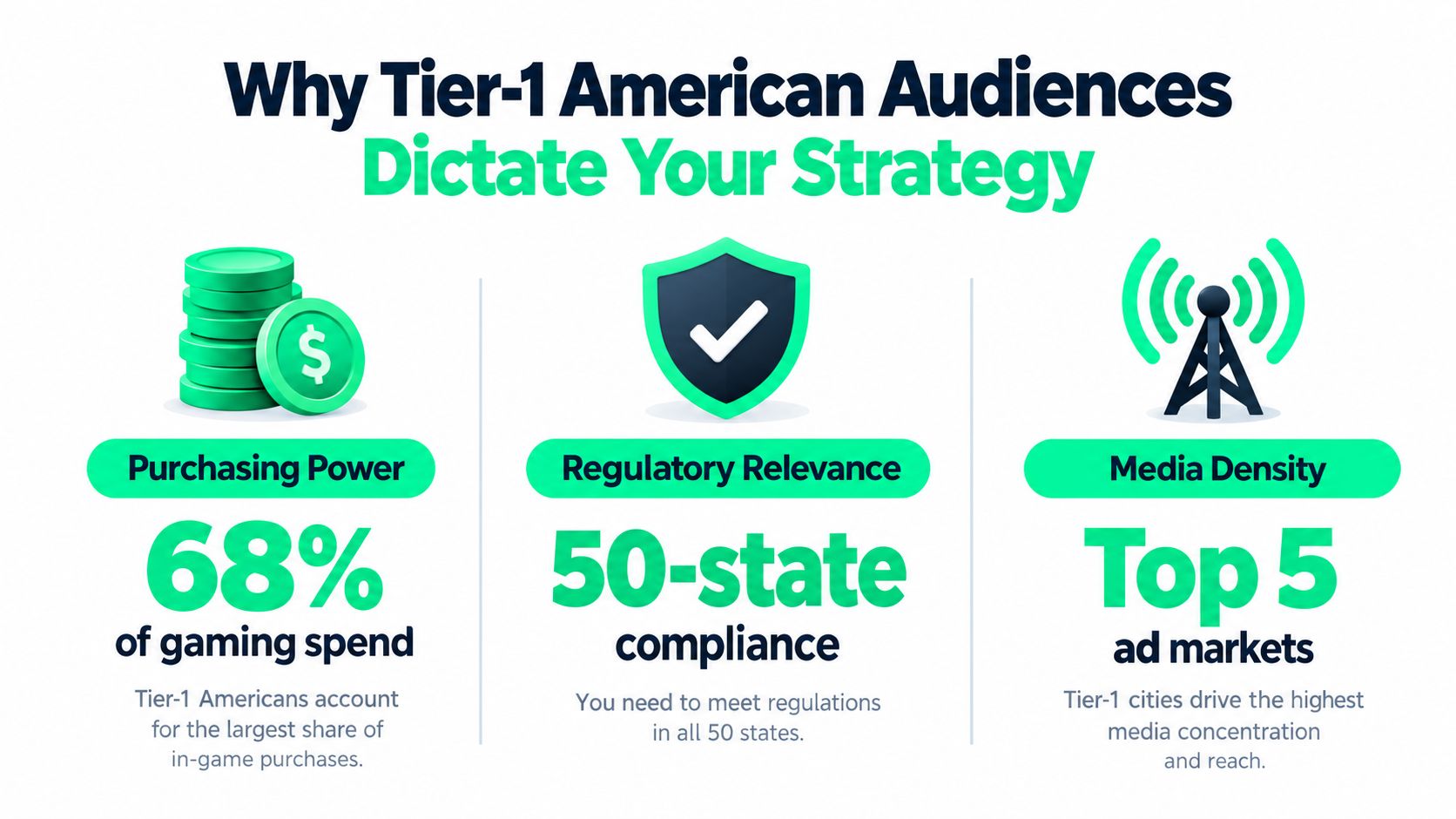
Tier-1 markets carry higher purchasing power, greater regulatory scrutiny, and denser competition. U.S. campaigns therefore need geographic enforcement, not a reporting tab that reveals location after spend has already occurred. Geo filters should operate at the page and placement level, with exclusions applied before content is published.
A practical gaming marketing strategy also maps context. Weekly gamers use mobile, console, and PC, and many use more than one platform. Morning mobile discovery, evening console sessions, and short-form creator browsing are different attention states. The creative, caption, and call to action should reflect that context instead of treating “gamers” as one uniform audience.
For brands that need qualified reach, the objective isn't maximum volume. It's verified American attention that can survive compliance review and still move a measurable business outcome.
A practical gaming ad network framework should make that segmentation operational, with page selection, keyword controls, exclusions, and live performance data connected in one workflow.
Choosing the Right Campaign Format and CPM
Campaign format should follow the business problem, not the platform menu. A logo placement, a vertical campaign, and a full content adaptation solve different problems. Treating them as interchangeable is how brands either overspend on simple awareness or push unfinished creative into a high-volume campaign.
Use logo and caption distribution for presence
Logo and caption placement at $0.20 CPM is designed for repeated brand presence. The brand watermark and approved caption appear across the network under defined rules, making this format useful when the creative already exists and the objective is recognition, reminder value, or broad category visibility.
It isn't the right choice when the audience needs a detailed product explanation. The format works best when the brand can communicate its role quickly and consistently, especially across sports, gaming, or culture pages where the surrounding content already earns attention.
Use vertical targeting when context matters
Vertical-targeted campaigns at $0.25 CPM add keyword requirements, exclusions, and scoped placements across areas such as sports, gaming, finance, and crypto. This is the logical starting point for a sportsbook entering a major NFL window or a prediction market that needs cultural relevance without appearing beside unrelated content.
The trade-off is narrower inventory. You gain contextual control, but you can't expect every broad-reach placement to remain available. Build the campaign around required terms and prohibited topics before deciding how much volume you want.
Use content campaigns when the asset needs adaptation
Content campaigns at $1.50 to $3.00 CPM convert brand video or static assets into meme variations through an automated creative engine. This format suits a game launch, a new feature, or a prediction product that needs creative flexibility rather than a fixed watermark.
The creative engine shouldn't replace strategy. Give it a clear hook, approved claims, visual boundaries, and a landing-page destination. Then review the variations before distribution. At higher volumes, effective CPMs can fall to $0.05 when the campaign is billed around verified views rather than impressions served, which creates a structural cost advantage over conventional social buying.
| Campaign need | Format | Best use |
|---|---|---|
| Brand presence | Logo and caption | Consistent awareness across approved pages |
| Context control | Vertical targeting | Sports, gaming, finance, or crypto audiences |
| Creative adaptation | Content campaign | Gameplay, launch, or culture-led storytelling |
The right sequence is often hybrid. Start with a context-controlled campaign to validate audience fit, then expand with adapted content once the creative earns attention. Don't buy the cheapest format just because its CPM looks efficient. Buy the format that gives the campaign the control it needs.
Running Real-Time Creative With Brand Safety Controls
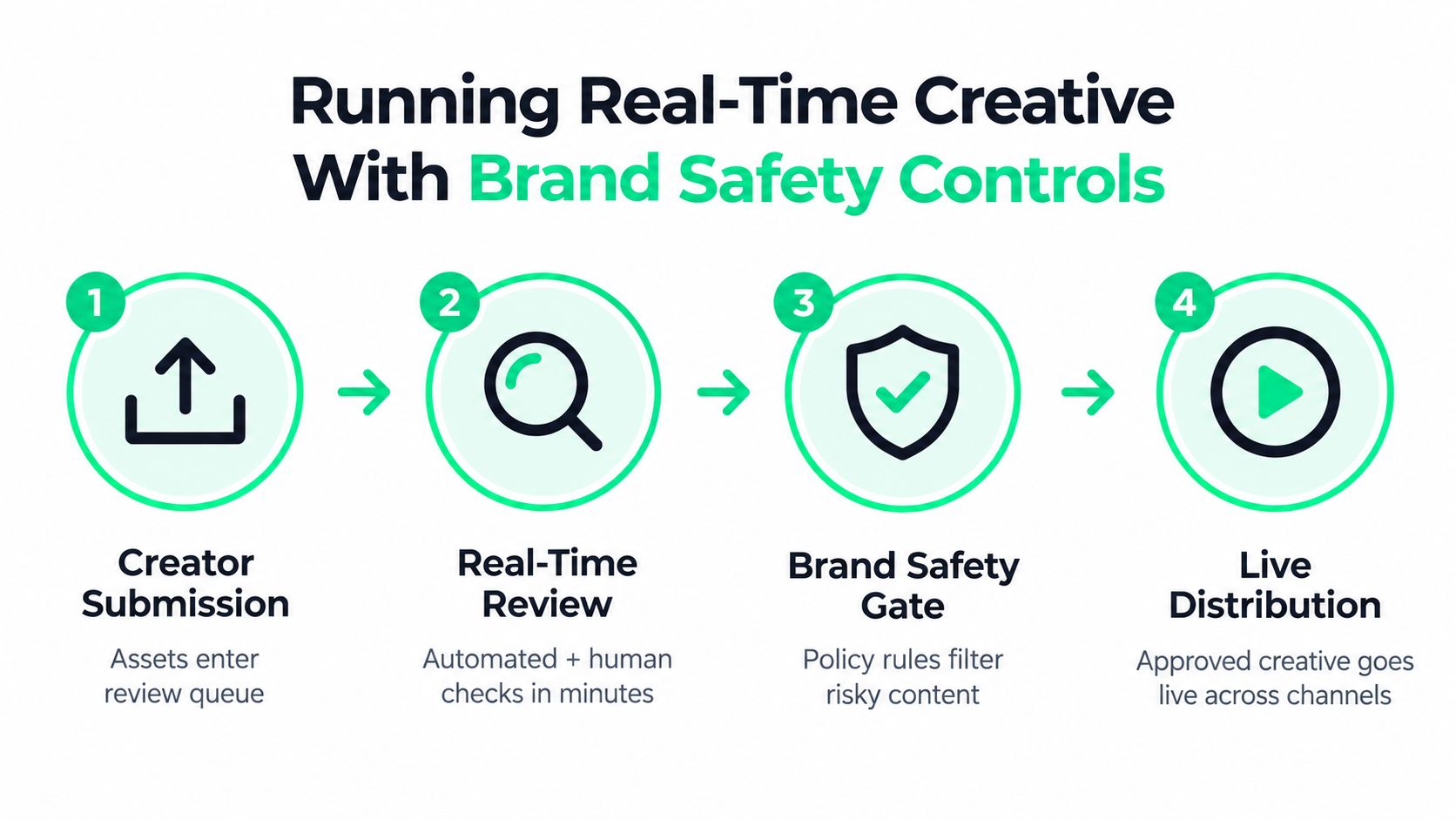
Scale creates a review problem before it creates a media problem. A campaign can have strong creative and a clear audience, yet still fail if submissions move faster than the approval process. The answer is a layered system that reviews every asset in real time without pretending that automation can replace judgment.
Start with automated screening
AI scoring completes an initial review in approximately 1.2 seconds, checking signals such as content risk, authenticity, and likely brand fit. That speed matters when a campaign responds to a live sports conversation or a fast-moving gaming trend, but the score is only a first filter.
A 24/7 human review layer then validates the asset and its context before publication. Reviewers check whether the page is authentic, whether the caption matches the approved brief, whether the surrounding content is suitable, and whether the post creates an avoidable compliance problem.
Automation handles the queue. Human reviewers make the publishing decision.
Enforce rules before the post goes live
The brand rules engine should include:
- Required terms: Specify language that must appear in approved captions or calls to action.
- Prohibited topics: Block themes, claims, or contexts that create regulatory or reputational risk.
- Follower thresholds: Exclude pages that don't meet the campaign's minimum audience standard.
- Geo filters: Restrict delivery to approved markets, including the U.S., Canada, and the U.K.
- Page-level controls: Remove an off-brand page immediately rather than waiting for the wrap report.
Brand safety frameworks increasingly distinguish between broad category exclusion, brand suitability, and contextual targeting. That layered approach is more useful than a single yes-or-no safety label because a regulated gaming advertiser may allow sports content while excluding specific topics or contexts.
Real-time caption management adds another control point. If a caption underperforms, needs clarification, or no longer fits the conversation, the update can roll out across the network immediately. Viewers stay one click from the funnel, while the brand retains control over what that click represents.
Teams evaluating this model should also review practical guidance on how to protect ad spend for performance marketers. The central lesson is operational: brand protection isn't a final report. It's a publishing gate, a monitoring process, and a removal mechanism that work continuously.
Measuring Performance Beyond Click-Through Rates
CTR is useful for diagnosing creative response, but it isn't a profitability metric. A high click rate can hide weak landing-page conversion, poor audience quality, or users who never complete the next meaningful action. Gaming marketers should treat CTR as an early signal and CPA, conversion rate, ROAS, retention, and player value as the decision layer.
Independent benchmark data across a Q1 2023 to Q4 2024 cohort reports a median Google Ads CTR of 3.28%, a 3.7% conversion rate, and a $72 CPA. The same benchmark reports Meta Ads CTR of 1.46% and 2.8x ROAS, with a median landing-page conversion rate of 3.4%, according to gaming and esports advertising benchmarks.
Give each channel a specific job
Search captures existing intent. Social and meme distribution create reach, stimulate discovery, and support remarketing. That doesn't mean every campaign should split budget evenly. It means the measurement model should recognize that a channel can be valuable without producing the highest CTR.
| Measurement question | What to inspect |
|---|---|
| Did the creative earn attention? | Verified views, view quality, engagement, and qualified clicks |
| Did the landing experience work? | Conversion rate, drop-off, and completed registration |
| Did the acquisition pay back? | CPA, ROAS, deposit or purchase quality |
| Did the player remain valuable? | Retention, repeat activity, and lifecycle value |
Creative volume creates a similar trap. Top gaming advertisers now produce 2,400 to 2,600 creative assets per quarter, around 30% higher year over year, while global UA spend reached $25 billion in 2025, as reported in industry coverage of AI and gaming marketing. More variants can improve testing, but production volume alone doesn't create a competitive advantage when audience growth and player quality aren't keeping pace.
Set the floor before launch
Before buying distribution, define the minimum acceptable landing-page conversion rate and maximum CPA. Then connect those thresholds to downstream events, such as a completed install, account registration, first deposit, purchase, or retained session. A campaign that looks efficient at the click level may be unprofitable if those later events remain weak.
For betting and prediction products, lifecycle value deserves special attention. A useful retention system may include segmentation, rewards, and responsible re-engagement. Marketers looking to connect acquisition with retention can use this resource on how to build iGaming loyalty programs as a planning reference.
The practical measurement rule is simple: compare verified attention with qualified outcomes, not with vanity metrics in isolation. A campaign earns more budget when it produces the right users at a sustainable CPA and keeps those users active beyond the first click.
Teams can use a structured campaign performance measurement process to connect placement data with conversion and lifecycle reporting rather than treating distribution and product analytics as separate systems.
Launching Your First Verified Distribution Pilot
A tier-1 gaming brand shouldn't begin by attempting to coordinate hundreds of creators manually. Start with a controlled pilot that tests audience quality, creative fit, approval speed, and downstream conversion in one operating cycle.
The commercial structure is designed around a $20,000 to $30,000 commitment that guarantees 100 million verified views, with rolling monthly agreements and no management fees. Once performance validates the model, budgets can scale toward $100,000 to $1 million or more. Those terms make the pilot an operations decision, not just another media test.
Build the pilot around five decisions
- Write the brief: Define the American audience, approved verticals, prohibited contexts, required terms, landing page, and success metrics.
- Prepare the creative: Use existing gameplay footage for a simple distribution test, or create meme variations when the campaign needs stronger cultural adaptation.
- Set the approval gate: Require brand sign-off before any asset or caption goes live.
- Monitor the network: Review page-level results, audience quality, verified views, clicks, and conversion signals as delivery accumulates.
- Remove and iterate: Use one-click removal for off-brand pages and update captions network-wide when the message needs adjustment.
A typical launch can move from approved brief to live distribution in approximately 10 minutes, while underperforming posts receive built-in delivery support. The advantage over manual influencer outreach isn't that creators become irrelevant. It's that outreach, trafficking, approvals, reporting, and replacement inventory operate through one system instead of scattered messages and spreadsheets.

Consider a sports-focused gaming brand preparing for an American launch. The team can begin with a narrow page set, approve a small group of captions, verify the first wave of traffic, and expand only when the audience and conversion data support it. That sequence protects the brand while preserving the speed required for live sports and gaming culture.
The broader strategy is an operations upgrade. Instead of purchasing isolated creator posts, the brand builds a repeatable distribution pipeline with tier-1 targeting, real-time review, measurable views, and enforceable controls.
FindClout offers programmatic branded meme distribution across vetted creator pages, with verified-view buying, U.S. audience targeting, fraud screening, pre-approval, and real-time campaign orchestration. Visit FindClout to structure a controlled gaming marketing pilot around high-quality American attention and brand-safe scale.
Want this audience for your brand?
FindClout puts your brand in front of verified American audiences across every major US page — brand-safe, at scale.
Start Your Campaign