 findclout.com
Sports Prediction Markets Explained for US Brands
Sports prediction markets let people buy and sell contracts on games, player milestones, and tournament questions. The moving price works like a live crowd estimate of the chance an outcome happens. If you have 60 seconds, that is the idea. The rest is why that number matters to American audiences and how brands can reach them without stepping on rakes.
Table of Contents
- What Sports Prediction Markets Actually Are
- Why US Rules Changed the Market
- Reaching American Sports Fans Safely
- Compare Placement Scope Before Buying
- Confirm Delivery Limits Before Launch
- What Is the Difference Between a Prediction Market and a Sportsbook?
- Are Sports Event Contracts Legal in Every US State?
- Which Sports See the Most Trading?
- How Can a Brand Advertise Around Sports Prediction Markets Without Brand-Safety Risk?
What Sports Prediction Markets Actually Are
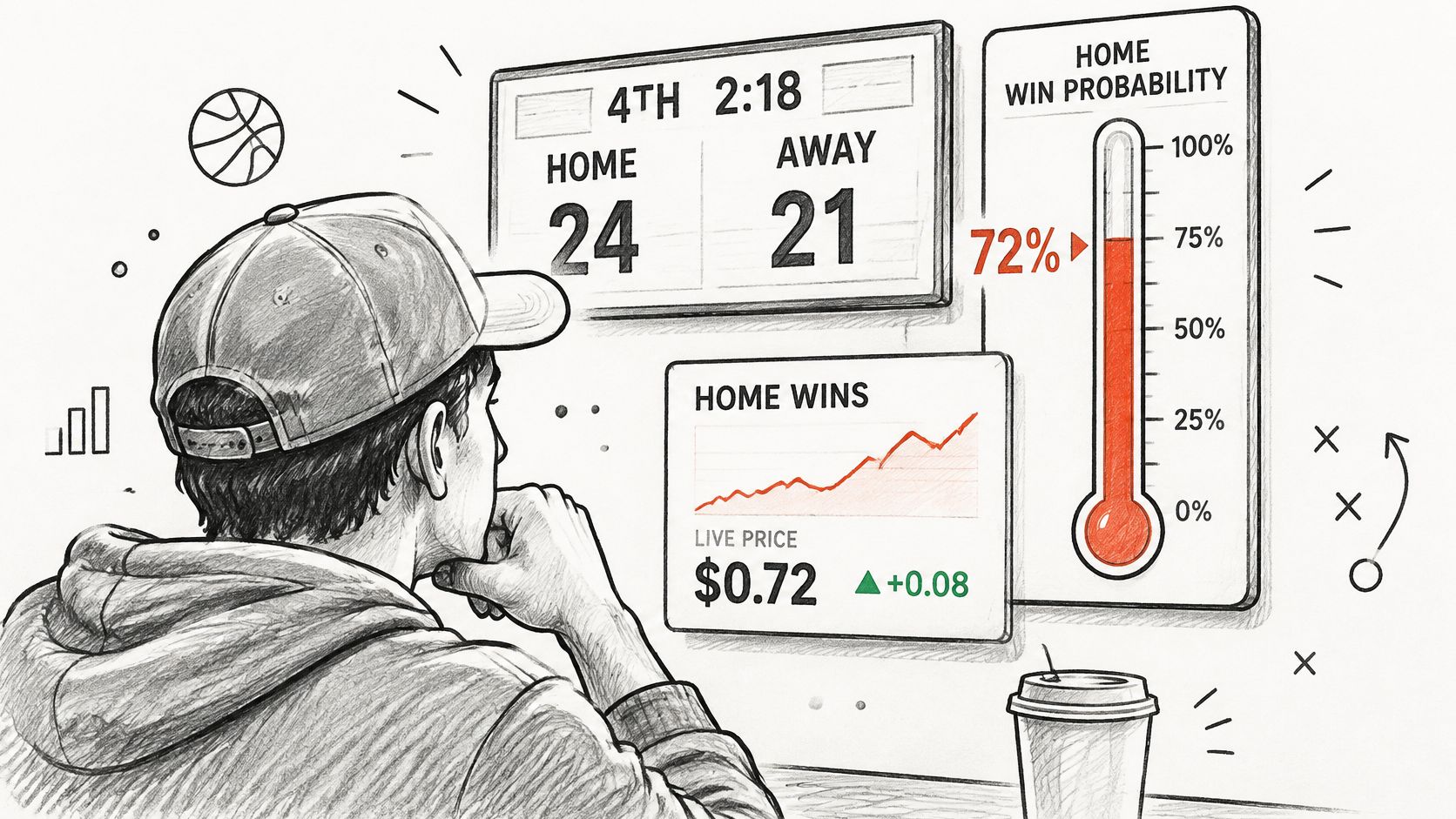
Treat the price as a thermometer for belief. The reading climbs when confidence in an outcome heats up, and it falls when belief cools. A contract near $0.62 is the crowd saying, roughly, “we think this happens about 62 percent of the time.” That is an interpretation of the price, with no profit guarantee baked in.
A traditional sportsbook ticket is a different animal. You place it once, then sweat it out until settlement. No mid-game sale. No reacting to an injury report. No exit when the third quarter starts feeling cursed.
Sportsbook Wagers Versus Sports Event Contracts
The cleanest way to see the difference is side by side: one is a fixed ticket, the other is a live market you can enter and leave.
| Feature | Sportsbook Wager | Sports Event Contract |
|---|---|---|
| Price | Fixed odds set by the book | Moves live as traders buy and sell |
| Timing | Placed once, held to settlement | Can be bought or sold any time |
| What the number means | Payout ratio | Crowd-implied probability of the outcome |
The takeaway is simple: a sportsbook number tells you what you get paid if you are right. An event-contract price keeps asking what the crowd thinks right now.
Who Shows Up in This Market
Several groups matter to American audiences:
- Traders, from casual fans to sharp speculators who can move prices
- Exchanges, some regulated and some operating on disputed legal footing
- Sports media, which turns the live price into a storyline
- Growth teams at consumer apps and marketplaces, chasing the same fans
For background on how online gambling platforms operate and what to check before engaging with one, CryptoGameRank's crypto casino explainer offers useful context on the mechanics that sports prediction-market platforms borrow and remix.
Why Tier-1 US Attention Is the Prize
The commercial value concentrates in tier-1 American audiences. The biggest leagues and the largest regulated betting states pack fan interest into a small set of high-value geographies. Views from those regions are worth far more than scattered global impressions.
Tier-1 US reach and brand safety set FindClout apart. Attention to detail, combined with systems that review every submission in real time, helps campaigns scale toward billions of views while protecting the brand and keeping delivery within high-quality geographies.
That operating model is the difference between buying broad exposure and acquiring useful attention. Every placement should meet the same standard: a relevant American audience, an approved creative message, and a verified location. Scale matters only when those controls remain intact.
From there, the story moves in order: how contracts work, why US rules shifted, how large the surrounding wagering economy is, which sports pull the most trading, and how brands can show up without paying for low-quality traffic.
Every contract opens with one plain question. Will the Chiefs win the AFC title? Will a pitcher clear 7.5 strikeouts? No sprawling menu of exotic bets, just a yes-or-no question carrying a price.
The lifecycle is short and simple:
- Buy the side you believe in at the going market price
- Hold while the game, or the season, plays out
- Sell whenever you want out before resolution
- Settle at $1 for winners and $0 for losers
That exit option is the whole trick. A sportsbook ticket locks you in, but a contract acts more like a stock you can unload the second the news turns against you.
Reading the Price
When a contract trades at $0.62, the crowd is implying roughly a 62 percent chance the outcome happens, before fees and liquidity effects. Read it as an interpretation, not a promise of profit. It is the same logic behind converting tennis odds into probability, where settlement rules and market mechanics play out in familiar ways.
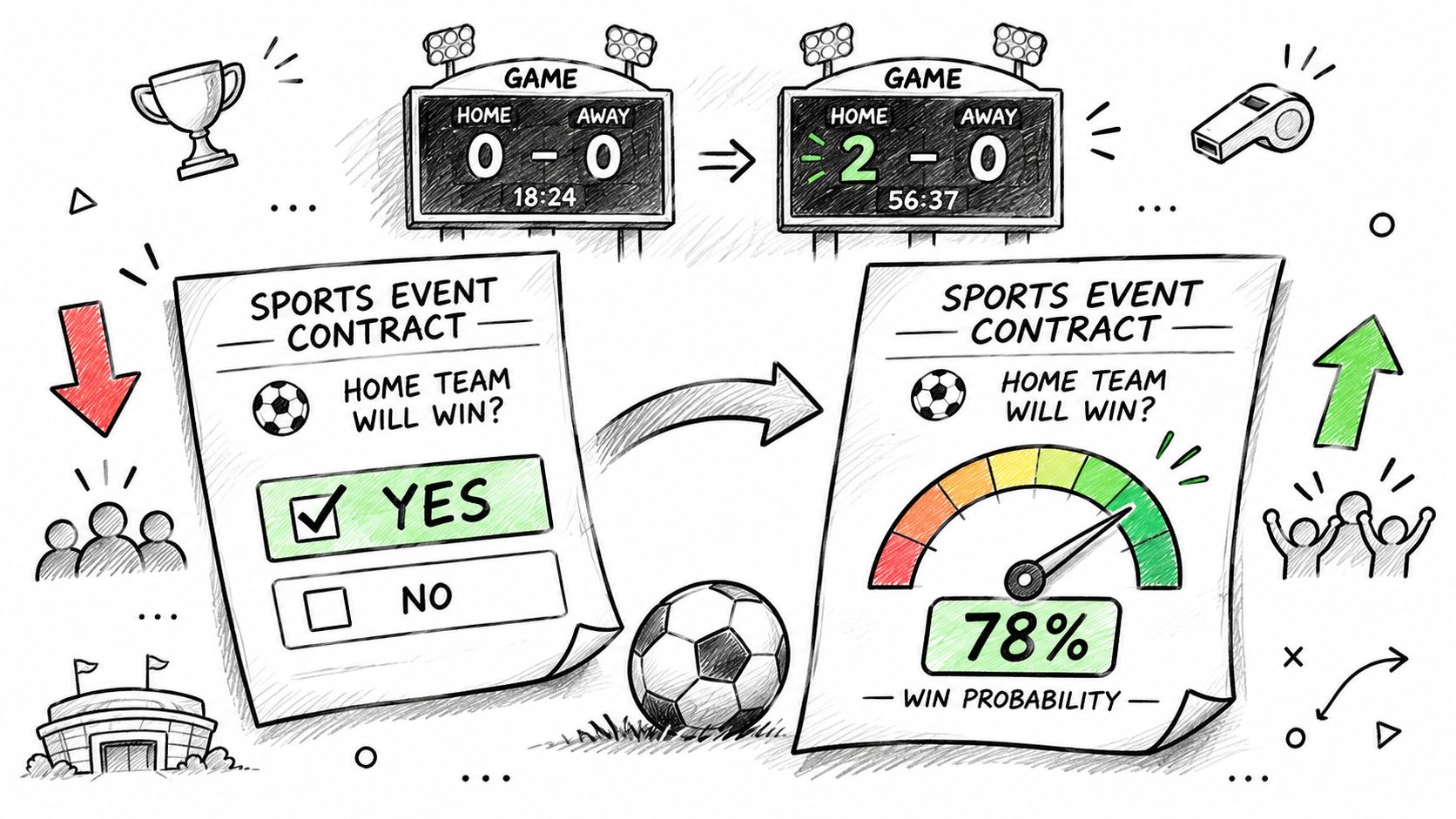
The price is a scoreboard for belief. It updates the moment an injury, a lineup change, or a late swing shifts what the crowd expects.
Picture a live game. The score moves, the crowd roars, and the contract price moves right along with it. A star quarterback limping off the field does not wait for halftime to show up in the number.
Terms That Get Mixed Up
Later sections quote big dollar figures, so it helps to pull apart four things people tend to blur into one:
- Traded value: the dollars that actually changed hands in transactions
- Notional volume: can count the face value of contracts rather than real money moving
- Fees: what the platform charges to facilitate trades
- Operator revenue: what the venue keeps once payouts and adjustments settle
None of those are the same number, and none of them equal consumer spending.
Who Sits on Each Side
Individual traders, market makers, and the exchange listing the contract all share one book. Media and advertisers watch it too, since a price still moving after the pregame window hands them a live storyline instead of one static message.
That is where fan behavior comes in. American sports audiences already talk through games in real time, and a shifting probability gives creators a fresh hook at every swing. For brands chasing tier-1 US attention, that rolling conversation beats a single pregame placement, as long as every submission gets reviewed in real time so scale never outruns brand safety.
Late 2024, a new question reached American sports screens: could a game outcome trade under financial market rules instead of the familiar sportsbook model? The answer opened a commercial opportunity, but it also triggered a legal fight.
Why US Rules Changed the Market
A Kalshi competitor began offering sports event contracts in December 2024. Kalshi followed roughly a month later, adding sports to a business whose regulatory foundation was already in place.
That foundation was the important part. In 2020, after approximately nine months of review, the Commodity Futures Trading Commission designated Kalshi a designated contract market.
Federal exchange status supported Kalshi’s position. It did not settle every question surrounding sports contracts.
Kalshi’s argument was that these products were financial event contracts rather than standard sportsbook wagers. Picture it as entering through a separate regulatory doorway, not receiving permission from every office inside the building.
- Federal derivatives rules provided the framework Kalshi relied on.
- State gambling laws supported a competing view of sports contracts.
The disagreement surfaced in Nevada and New Jersey, two major states with regulated sports betting markets. For advertisers, that distinction matters: federal designation should not be treated as blanket state approval, unrestricted marketing rights, or a guarantee that future challenges will leave distribution plans untouched.
Read Demand Without Mistaking It for Certainty
Commercial interest grew despite the uncertainty. A company spokesperson told ESPN that more than $1 billion traded across 3.4 million sports propositions during the first five months after Kalshi introduced sports contracts.
Divide the rounded billion-dollar figure by those propositions, and you get approximately $294 per proposition. That is a calculation based on reported totals, not an average stake per person, and it says nothing about operator revenue.
- Keep the denominator visible. Propositions are not individual customers.
- Separate demand from permission. Trading activity does not resolve legal disputes.
Classification reaches beyond licensing. The Tax Law Center’s analysis of sports contracts concludes that they appear subject to federal gambling tax rules, illustrating why presenting a product as a financial contract does not settle every legal consequence.
For marketers, each contract can turn a game or player question into an ongoing conversation about shifting probabilities. That creates more opportunities than a single pregame placement.
Build that conversation around tier-1 American audiences, rather than chasing indiscriminate global reach. Before launching with FindClout, establish approved captions, geographic filters, and real-time review for every submission. That makes it possible to scale attention toward billions of views without letting volume outrun brand safety.
Sports prediction markets do not have to invent a fan culture from scratch. They are entering an American wagering market powered by major professional leagues, college football, basketball, baseball, and international sporting events.
That distinction matters for media planning. The audience interested in sports contracts may be narrower than the overall betting market, but it gathers around moments fans already care about—from preseason speculation to live reactions and postgame arguments.
Revenue and Handle Tell Different Stories
Statista projected US online sports betting revenue of $9.65 billion in 2024. It also forecast a 13.03 percent compound annual growth rate through 2028, when revenue would reach $15.75 billion.
A separate industry estimate put US sports-betting handle at $149.67 billion in 2024, up 24.9 percent from 2023.
Handle is the total amount wagered before payouts and adjustments. Revenue is what operators retain afterward. Treating them as interchangeable makes every audience estimate look inflated.
| Measure | What It Represents | What It Does Not Represent |
|---|---|---|
| Handle | Total dollars wagered | Operator earnings |
| Revenue | Money retained after payouts and adjustments | Total customer activity |
| Trading volume | Value exchanged in prediction-market transactions | Notional contract value |
| Notional value | Face value of contracts | Cash that necessarily changed hands |
Fees and operator revenue create further separation. A sports prediction market can show heavy trading while producing a very different result after fees and settlement costs.
Follow the Sports Calendar
The wagering calendar provides a dependable rhythm of attention. A football season begins with expectations, turns into weekly matchup conversations, and ends with postgame debate. Baseball offers one series after another, while basketball and major international events generate concentrated bursts of interest.
A contract price adds a probability layer to those moments. When a price moves after an injury, lineup change, or scoring run, it creates a timely creative hook for sports media and advertisers.
For fintech, gaming, and sports prediction-market advertisers, that creates a recurring buying opportunity rather than a one-weekend seasonal purchase. The strongest approach centers on tier-1 American audiences, where fan attention is concentrated and measurable.
Build Campaigns Around Verified Attention
Scale only works when quality and safety grow alongside it. Real-time review of every submission, careful geographic filtering, and brand approval for every placement can protect a campaign as it expands toward billions of views.
That discipline keeps attention in high-quality geographies while reducing the risk of off-brand captions or low-quality traffic entering the campaign.
For broader context on online gaming and sports betting, read FindClout’s guide to igaming and sports betting.
These figures describe the surrounding wagering economy. They do not represent FindClout delivery, brand earnings, or any guaranteed financial outcome.
Before buying, align the metric, define the intended American audience, and confirm that review systems support the campaign. Brand safety is not an extra layer added after scale. It is the system that makes scale usable.
Sports prediction markets are not dominated by one league. Activity is spread across sports with different seasons, audiences, and fan rituals, which matters for brands trying to reach American sports fans without treating every viewer as the same person.
One dataset reported $10.2 billion in US-dollar sports turnover during the 30 days ending November 19, 2026, equal to 57 percent of all series with available statistics.
The same source recorded 1,390,665,537 trades and $56.3 billion in total turnover across 2,875 series since tracking began on July 8, 2026. Its sports-specific records covered 553,768,951 trades and $34.5 billion across 1,553 sports series.
A separate winner-market analysis estimated $34.93 billion in notional volume from June 29 through September 30, 2026. The chart shows how that notional volume was distributed across five sports groups.
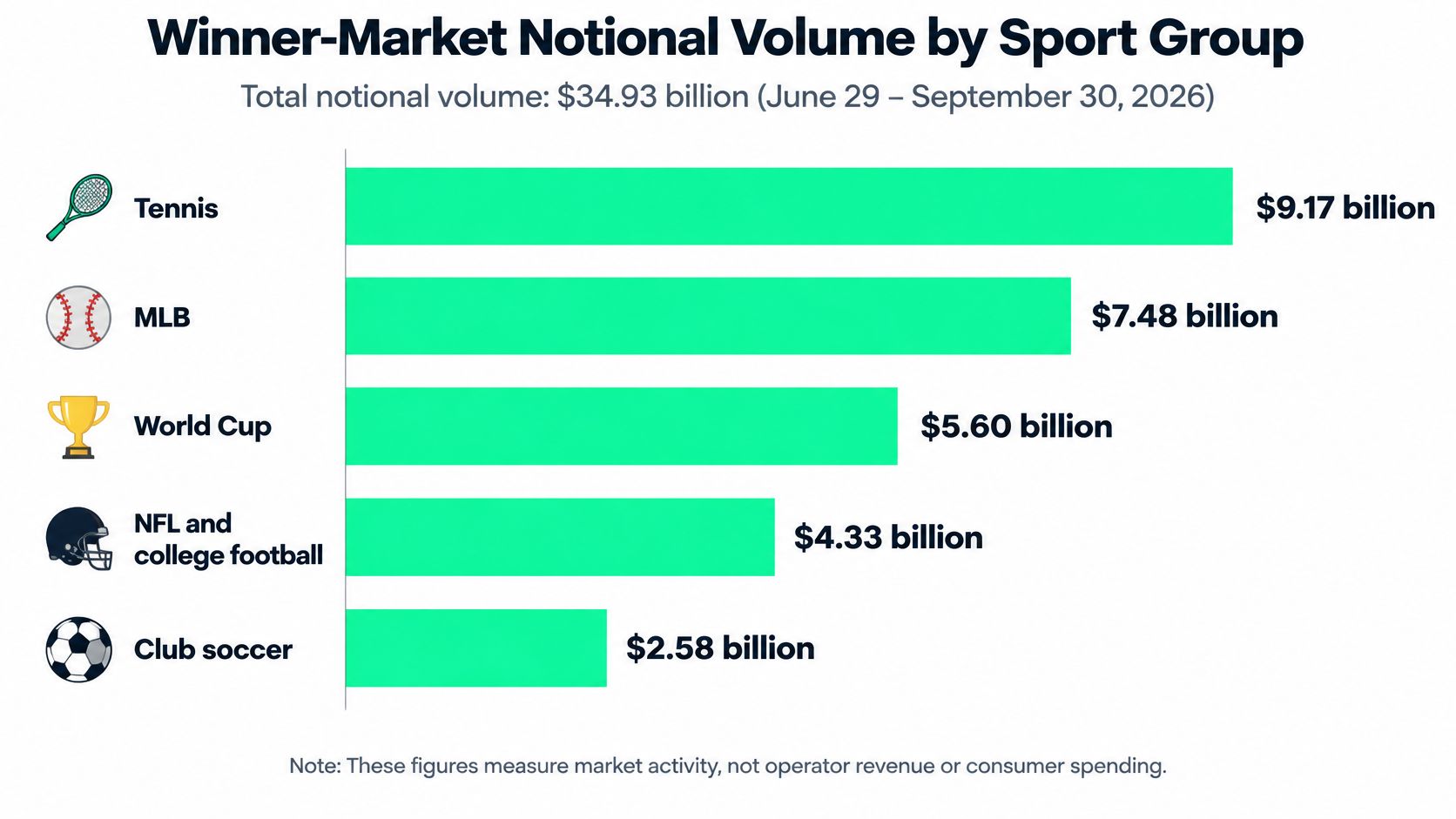
Winner-Market Notional Volume by Sport Group
The following table breaks down estimated notional volume for listed sports groups during winner-market activity from June 29 through September 30, 2026. These figures indicate market activity, not operator revenue.
| Sports Group | Notional Volume | Reading Note |
|---|---|---|
| Tennis | $9.17 billion | Led the measured sports groups |
| MLB | $7.48 billion | Strong activity across baseball markets |
| World Cup | $5.60 billion | Concentrated around the international tournament |
| NFL and college football | $4.33 billion | Combined American football activity |
| Club soccer | $2.58 billion | Measured club soccer markets |
Tennis led the period, followed by MLB. The World Cup also drew substantial activity, while NFL and college football together formed another large group.
These figures need careful labels. Notional volume can count face value, while turnover counts dollars changing hands. Neither represents operator revenue or consumer spending, so neither should be presented as what an exchange earned or what fans spent.
The useful lesson is distribution. Sports interest is not only the NFL, and a single national buy may miss the strongest pockets of demand.
Tennis, baseball, soccer, football, basketball, combat sports, and esports each have distinct fans and calendars. A tennis audience may respond to a changing match probability, while MLB fans may arrive through series, innings, and late-game swings.
For a brand, that difference calls for matching sports prediction-market activity to the right American fan culture. A football campaign should not assume tennis viewers share the same intent, and baseball placements should reflect baseball seasonality rather than a generic sports audience.
The approach also demands attention to detail and systems in place to review every submission in real time. That process protects the brand while allowing scale toward billions of views, but only if delivery stays within approved rules and high-quality geographies.
Brands working with sports prediction markets can learn more about reaching American sports fans through targeted placements. The strongest plan starts with the sport’s actual audience, then applies tier-1 US targeting and real-time brand review rather than treating volume as the only goal.
Buying attention for a sports prediction market means knowing who actually saw you, where they were sitting, and what ran next to your name. Cheap reach turns into wasted spend fast when the traffic is fake, the caption is off-brief, or the views land outside the geographies you're cleared to touch.
Reaching American Sports Fans Safely

Tier-1 American audiences and brand safety should set the buying standard, full stop. Nothing posts until the brand signs off, and every submission gets reviewed in real time so distribution never outruns the controls.
Scale is only useful when audience quality and approval standards hold.
FindClout runs campaigns for regulated categories, including prediction markets and sportsbook-adjacent services. Polymarket and Novig are current partners.
The control stack pairs AI scoring averaging about 1.2 seconds with 24/7 human review and geographic filters that cover the US. Audience vetting and fraud screening support that process; they do not replace brand approval.
- Approve creative first — captions, logos, required language, exclusions, all of it.
- Check the geography — verified American attention beats a big global total every time.
- Match the fan culture — a headline follower count tells you almost nothing on its own.
Compare Placement Scope Before Buying
Brands pay per view at a CPM set up front. The placement choice decides whether distribution stays inside one vertical or spreads across the network.
| Placement | CPM Ceiling | Scope |
|---|---|---|
| Sports or finance pages | $0.25 | One vertical |
| Meme, news, and sports clips | $0.20 | Network-wide |
Say you're placing a baseball product. That calls for relevant sports pages and approved baseball captions, never your logo bolted onto an unrelated viral clip. For the adjacent category, read FindClout's sports betting advertising guide.
Fan culture can shape creative context too. These football shirt draft party games show how people engage socially around football; they say nothing about American audience composition or trading intent.
For scale context: FindClout reports 3.3 billion cumulative views, more than 600 million views sold to brands in 2026, and 500-plus vetted tier-1 creators. That's the size of the network, not a forecast for your campaign.
- Separate reach from outcomes. Views don't prove conversions, customer quality, or profitability.
- Read the delivery terms. Replacement distribution is a different thing from guaranteeing one specific post.
- Keep checking quality. Re-verify approved geography and creative as volume grows.
Confirm Delivery Limits Before Launch
If a post underperforms, FindClout runs more posts until the purchased view count lands. What it doesn't do is guarantee that any individual post publishes, stays published, stays visible, or gets measured — a dashboard reports delivery, it doesn't promise earnings.
Before you book, match the sport, approve every caption, and name the geographies that matter. Then have FindClout confirm those controls and verification standards before you buy attention at scale.
What Is the Difference Between a Prediction Market and a Sportsbook?
A sportsbook gives you a ticket at fixed odds. You hold it until the game settles. A sports prediction market gives you a contract you can buy or sell while the event is still live, with the current price reflecting what traders collectively think is likely to happen.
Think of the sportsbook as a locked-in quote and the sports prediction market as an open marketplace. A price near $0.62 suggests the market sees roughly a 62% chance of that outcome, although fees, spreads, and thin liquidity can affect the final interpretation.
A prediction-market price is a market signal, not a guaranteed payout.
Are Sports Event Contracts Legal in Every US State?
No. The regulatory mismatch is the issue. Federal derivatives treatment and state gambling laws have not always agreed on how these contracts should be classified, leading to disputes in Nevada and New Jersey, two of the country’s largest regulated betting markets.
That does not mean every platform or venue is approved everywhere. Federal designation may open one regulatory path, but it does not replace state-by-state approval or determine legality across all 50 states.
This guide is for general information, not legal advice.
Which Sports See the Most Trading?
In the winner-market period covered earlier, trading volume was led by:
- Tennis: $9.17 billion
- MLB: $7.48 billion
- World Cup: $5.60 billion
- NFL and college football: $4.33 billion
- Club soccer: $2.58 billion
These figures represent notional volume, which means they measure the face value of contracts traded. They are not operator revenue, customer deposits, or actual consumer spending.
How Can a Brand Advertise Around Sports Prediction Markets Without Brand-Safety Risk?
The same standards used throughout this guide apply:
- Focus on tier-1 American audiences in strong, relevant markets
- Pre-approve every caption, logo, and exclusion before publication
- Review submissions in real time, combining AI scoring with 24/7 human checks
- Stick with one vertical so the placement fits the sport and its fan culture
- Pay per verified view at a CPM agreed upfront, with replacement posts for underperformers
View counts and past performance do not guarantee future earnings. No individual post is assured of publication, continued visibility, or measurement. Brand safety comes from the system, not chance.
If you are planning a campaign around sports prediction markets, FindClout offers regulated-category placements across a broad network of vetted American sports pages, with real-time review and tier-1 US targeting built in. Start your campaign at FindClout.
Want this audience for your brand?
FindClout puts your brand in front of verified American audiences across every major US page — brand-safe, at scale.
Start Your Campaign