 findclout.com
iGaming and Sports Betting: Market Data for Marketers
U.S. sports-betting handle reached $166.9 billion in 2025, compared with about $6.6 billion in 2018, according to Gambling.com's revenue compilation. That expansion changes the marketing opportunity, but it doesn't make every sports fan an eligible customer. For American campaigns, the useful market is narrower: adults in authorized jurisdictions, reached through compliant creative, without exploiting financial distress.
For iGaming and sports betting marketers, audience quality and brand safety belong in the buying model, not just the final approval. A large creator network is valuable only when the team can verify geography, review every submission, and distinguish billable attention from suspicious traffic.
Table of Contents
- iGaming and Sports Betting Market Size and Audience
- iGaming and State-by-State Rules
- Prediction Markets Versus Licensed Sportsbooks
- Ad Rules Every Creative Version Must Pass
- Live Betting Moments That Drive Sports Audiences
- Financial Harm Signals to Screen Out
- How to Verify Views Before You Pay
- Running a Meme Distribution Campaign for US Sports Fans
- Lock Campaign Controls and Request Vendor Terms
iGaming and Sports Betting Market Size and Audience
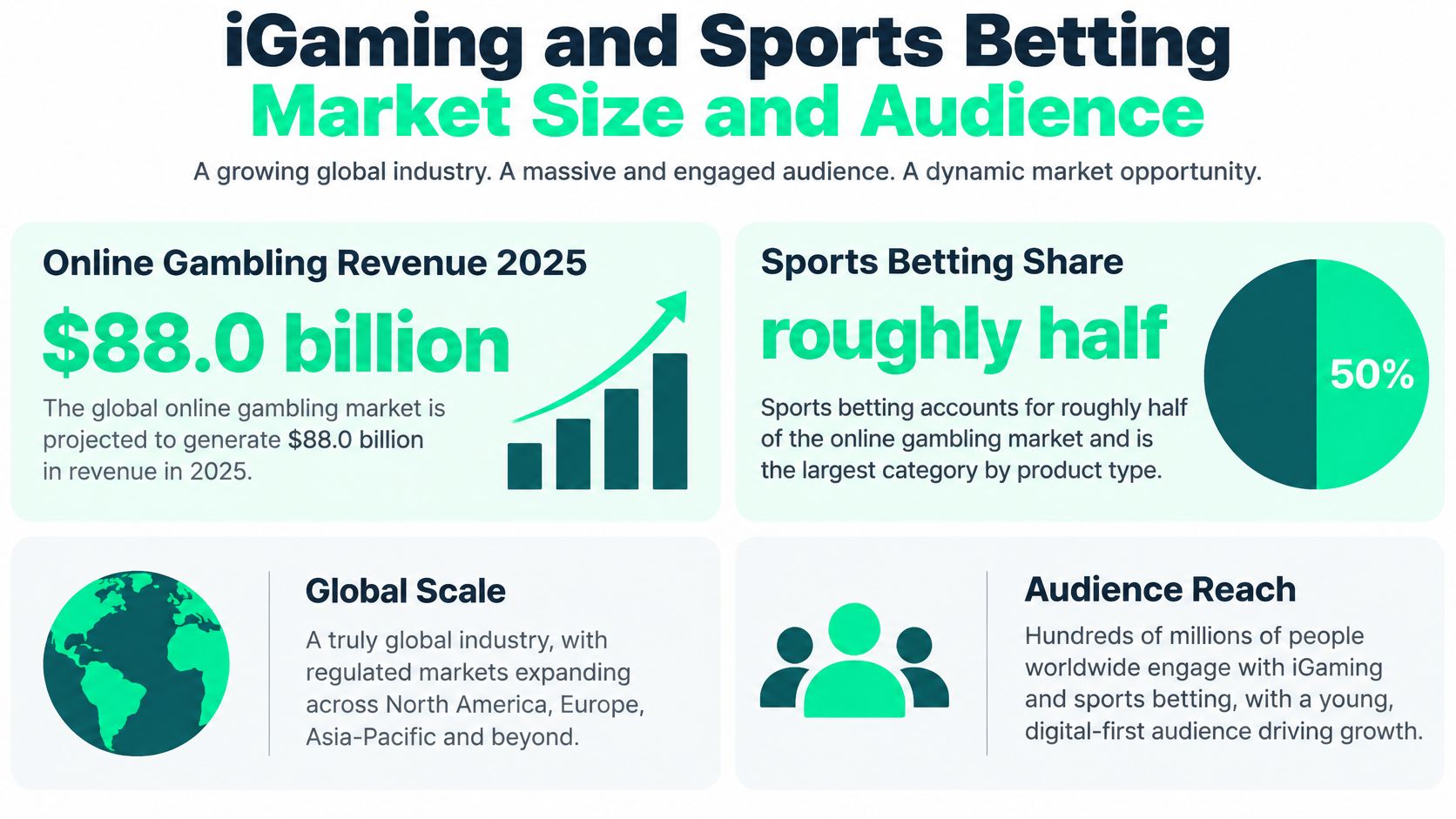
Global online gambling generated approximately $88.0 billion in revenue in 2025, with sports betting contributing roughly half and ranking as the largest product category, according to Grand View Research's online gambling market overview. Its broader market context places online sports betting ahead of in-person betting by market size in 2021 and above half of total sports-betting revenue in 2024.
The shift matters because marketers aren't just buying digital substitutes for casino visits. They're reaching people through apps, live sports content, payment flows, and personalized offers. Each touchpoint needs its own eligibility and disclosure controls.
Read the metrics before setting the budget
Handle means the total amount wagered. Gross sports-betting revenue means operator winnings after payouts, not profit after operating expenses.
The U.S. series below comes from Gambling.com's compilation, which connects market expansion to the Supreme Court's invalidation of PASPA in May 2018, regulated access, and mobile distribution. The global measures come from Grand View Research; participation and live-betting estimates are attributed separately.
Key iGaming and sports betting figures
| Metric | Figure | Context |
|---|---|---|
| Global online gambling revenue, 2025 | About $88.0 billion | Sports betting about 50% of it |
| U.S. sports-betting handle, 2018 | About $6.6 billion | Year of the Supreme Court ruling on PASPA |
| U.S. sports-betting handle, 2021 | $57.7 billion | Reported handle in an intermediate year |
| U.S. sports-betting handle, 2025 | $166.9 billion | New record year |
| U.S. gross sports-betting revenue, 2018 | About $430 million | Starting point for the U.S. market |
| U.S. gross sports-betting revenue, 2025 | $16.69 billion | Growth tied to regulated access and mobile distribution |
| U.S. adults who bet on sports, prior 12 months, 2026 | 36.4% | 37.0% in 2025, according to the Sacred Heart University nationwide poll |
| Live and in-play share of sports-betting revenue, 2025 | 65.78% | Mordor Intelligence estimate |
| Global soccer wagers | More than $779 billion | About half of worldwide sports-betting handle, in Grand View Research's market context |
Convert market size into an American audience plan
Stable participation means marketers shouldn't assume that rising wagering volume represents a proportionate increase in new customers. Plan around regulated access, relevant sports moments, and sustainable customer value instead.
Global demand also isn't a proxy for American reach. Asia accounted for more than 60% of global sports-betting handle in 2024 in Grand View Research's market context. Use U.S. audience evidence for U.S. media buying.
Build audience segments around eligibility and intent, rather than treating every sports follower alike. For educational creative explaining odds, ScanOdds' betting payout guide for odds comparisons can help teams distinguish payout calculations from promotional claims. A payout illustration must never imply a guaranteed return.
iGaming and State-by-State Rules
Product classification comes before targeting. In campaign planning, distinguish online casino products, such as slots, table games, and live-dealer play, from sports wagers on outcomes and in-play markets. Don't transfer a sportsbook audience or promotion into a casino campaign without a fresh review.
The same discipline applies to prediction-market contracts. A sports-themed interface doesn't establish which legal framework governs the product, and an operator's presence in a state doesn't automatically authorize every product it offers.
Build an authorization record
Use a state-by-product register rather than a general approved-states list. Each entry should identify the product, operating entity, authorization basis, advertising restrictions, destination, reviewer, and approval status.
- Authorized: Legal has approved the specific product and proposed promotion for that jurisdiction.
- Restricted: Distribution is permitted only with documented placement, audience, or offer limitations.
- Unresolved: Publication remains blocked pending legal review.
- Excluded: The campaign must not solicit customers in that market.
Keep supporting documents attached to the decision. Reviewers should be able to explain why a casino offer was rejected while a different sports product was approved for the same audience.
Match distribution to authorization
Geofence landing pages and offers where required, and apply corresponding audience restrictions to paid distribution. Don't rely on the destination alone: an ineligible viewer may still encounter the advertisement before reaching the eligibility check.
Creator pages need particular attention because followers can live outside the page owner's location. A U.S.-based sports account isn't proof that its audience falls inside an authorized state.
Planning rule: Treat unresolved legality as a blocked placement, not an opportunity to test demand.
Separate casino and sportsbook briefs, exclusion lists, and approval records. That gives legal reviewers a specific decision to make instead of asking them to approve iGaming as an undifferentiated category.
Prediction Markets Versus Licensed Sportsbooks
Licensed sportsbooks versus prediction-market sports contracts
| Factor | Licensed sportsbook | Prediction-market sports contract |
|---|---|---|
| Geographic reach | State-authorized, state by state | Potential national reach, including California and Texas, subject to current legal restrictions |
| Tax position | Pays applicable state sports-betting taxes | Reportedly diverted more than $500 million in potential sportsbook tax revenue in 2025 |
| Regulatory framing | Gambling under state rules | Contested: state regulators may treat contracts as sports bets; federal oversight may treat them differently |
| Ad creative standard | AGA code and applicable state rules | No settled cross-market standard; assess both gambling and financial-promotion concerns with counsel |
| Age and geofence controls | State-required verification | Confirm current requirements per platform, product, and state before launch |
The scale makes the distinction commercially important. ESPN's report on the sports-betting market puts U.S. legal sports wagers at $166.94 billion in 2025 and reports that sports-event prediction contracts diverted more than $500 million in potential sportsbook tax revenue that year.
That tax figure is an estimate of potential revenue displaced, not a declaration that prediction-market operators failed to pay taxes they owed. Marketers should preserve that distinction when discussing competitive advantages.
National reach isn't blanket advertising permission
ESPN's account describes platforms reaching markets including California and Texas, where traditional sports betting remains unauthorized. It also identifies the unresolved conflict: state regulators may view sports contracts as wagers, while federal oversight can place them within a different framework.
For acquisition teams, the central question isn't whether a contract looks like a bet. It's which rules apply to the specific platform and offer at the time of publication.
A financial framing can introduce its own consumer misunderstanding. Calling participation trading doesn't make losses harmless, and calling a platform regulated doesn't explain which regulator oversees which activity.
Test the message before writing the campaign
Require counsel to resolve the product framework before creative production. The approval record should name the operating entity, contract type, permitted geography, eligibility checks, required disclosures, and prohibited claims.
Then test the consumer takeaway:
- Product understanding: Would an ordinary viewer understand what they're buying and how they can lose money?
- Regulatory meaning: Does the ad imply state sportsbook authorization when the platform relies on another framework?
- Risk language: Could references to investing, skill, or sports knowledge imply dependable returns?
- Eligibility: Can the team substantiate that the intended audience may access the advertised contract?
Applying both gambling and financial-risk concerns is a conservative review approach, not a claim that every rule from both systems automatically governs every contract. Where requirements remain contested, legal review should determine the actual standard.
The growth implication is uncomfortable but useful: broader nominal distribution can create a larger compliance workload, not a simpler acquisition model. Price the campaign against the audience the brand can responsibly solicit, not the audience a platform technically reaches.
Ad Rules Every Creative Version Must Pass
Ad rules to check before any post goes live
| Rule | Source | Check before posting |
|---|---|---|
| No “risk free” claims | AGA Responsible Marketing Code | Scan captions, overlays, and voiceover for the phrase |
| People featured must be at least 21 | AGA Responsible Marketing Code | Verify the age of every creator or athlete shown |
| No sportsbook NIL deals with amateur or college athletes | AGA Responsible Marketing Code | Flag college references and athlete likeness |
| Problem-gambling hotline number on every ad | New York Gaming Commission | Confirm the number appears on every version |
| Licensee or sports-pool vendor identified | New York Gaming Commission | Name the licensed operator in the ad |
| Material conditions stated clearly | New York Gaming Commission | Keep promotional terms visible, not buried in a link |
| Opt-out explained for direct advertising | New York Gaming Commission | Include the opt-out path in direct messages |
The American Gaming Association's Responsible Marketing Code covers traditional and digital media, prohibits “risk free” advertising, requires featured people to be at least 21, prohibits sportsbook NIL deals involving amateur or college athletes, and restricts college partnerships promoting sports wagering. It also requires responsible-gaming messaging.
The AGA code is an industry standard, not a substitute for binding law. The New York rows represent jurisdiction-specific requirements that must be evaluated alongside the applicable product and placement rules.
Review the complete advertisement
A caption check alone won't catch a prohibited claim embedded in video. Review the overlay, spoken audio, creator identity, background imagery, offer terms, destination, and placement context as a single submission.
The age check applies to people featured in the advertisement, not merely the account holder. A creator can meet the eligibility standard while submitting a clip featuring someone who doesn't.
College references also need judgment. Flagging a logo or athlete likeness should trigger review of the proposed relationship and context; it shouldn't become an automated declaration that every college-sports reference violates the code.
Make approval version-specific
Give each approved asset a version identifier. Record the caption, media file, disclosure package, authorized markets, and approval owner together.
- Before scheduling: Confirm that the submitted asset matches the approved version.
- Before publication: Recheck dynamic terms, featured people, and placement eligibility.
- After an edit: Reopen approval if the offer, meaning, disclosure, or audience changes.
A compliant master file doesn't protect a campaign if creators crop out the hotline or shorten a caption until its conditions disappear. Review the rendered advertisement as viewers will encounter it.
Use a documented gambling advertising laws review workflow to connect legal decisions with publishing permissions. The useful output is a clear publish, revise, or reject decision, with a reason attached.
Approval standard: No submission inherits approval merely because it resembles an approved post.
That principle allows creative variety without allowing uncontrolled legal variation. Creators can change the joke within approved boundaries; they can't improvise the offer.
Live Betting Moments That Drive Sports Audiences
The live and in-play revenue estimate signals why marketers need event-aware creative, but it doesn't prove that every live impression converts. Treat the game state as context for the message, not permission to intensify pressure.
Consider an illustrative Sunday NFL campaign. Before kickoff, a sports page publishes a rivalry meme with an approved brand treatment. The creative invites recognition and conversation rather than demanding an immediate wager.
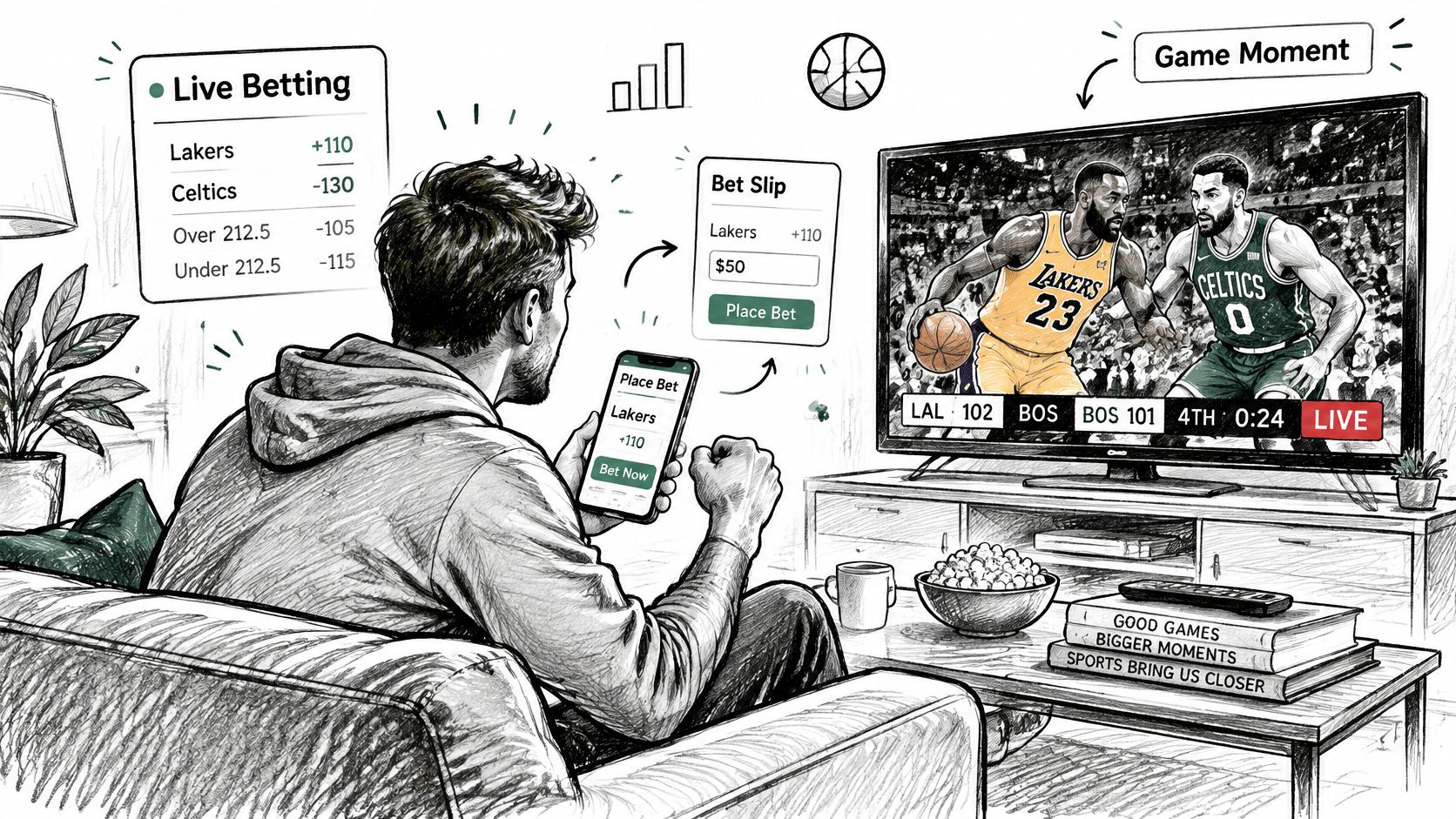
A disputed call changes the conversation during play. The team selects a pre-approved reaction format, checks the current context, and submits the variation for review rather than publishing an improvised betting claim.
After the final whistle, the same audience needs a different tone. A recap can reference the result, but it shouldn't encourage disappointed fans to recover losses through another wager.
Plan different creative for different moments
- Scheduled games: Prepare rivalry, lineup, and viewing-context material in advance, with approved alternatives if circumstances change.
- In-play swings: Use reactions that remain understandable without stale prices or unsupported outcome claims.
- Recurring weekly content: Build recaps, fan debates, and fantasy reactions that don't depend on an immediate betting offer.
Soccer's global scale doesn't justify treating worldwide sports engagement as American buying intent. For a U.S. brief, validate the page's audience geography and relevance to the competition before using its headline reach.
Editorial context matters too. A sports publisher may carry unrelated lifestyle material, such as Fubo News buying advice for GTs. That automotive page illustrates why a publisher's sports identity alone doesn't establish that every placement reaches an appropriate betting audience.
Match the creative to what fans are discussing, but keep the offer governed by eligibility and risk controls.
A live reaction should be brief and context-sensitive. A recap can be more reflective. Neither format should turn a fan's frustration into an instruction to spend.
Financial Harm Signals to Screen Out
A Stanford summary of recent research described online sports betting as associated with an average 12-point decline in credit scores and approximately one additional bankruptcy per 10,000 at-risk adults per quarter, as summarized in the Sacred Heart University poll report. The same report discusses reduced household saving after legalization.
These are population-level findings, not a diagnosis of an individual customer. They do, however, undermine the assumption that high wagering volume necessarily represents healthy customer value.
Screen for escalation, not just conversion
Financial harm signals and responsible responses
| Signal | Why it matters | Responsible response |
|---|---|---|
| Bet frequency rising sharply | Escalating play can precede loss chasing | Pause live-event creative for that cohort |
| Loss chasing or “recoup losses” messages | Signals financial pressure | Remove recoup language and exclude the cohort from retargeting |
| Use of credit to fund bets | Debt-funded wagering raises concern about financial vulnerability and bankruptcy exposure | Exclude these users from acquisition audiences |
| Rapid deposit escalation | Spending may outpace available resources | Review the account and reduce high-pressure offers |
Treat these as review and suppression signals, not automatic proof of gambling disorder. A change in activity needs context, but marketing pressure can be paused while specialists assess that context.
Use only information the organization may lawfully process. Don't build invasive credit profiles or attempt to infer sensitive financial circumstances from unrelated browsing behavior.
Put customer protection inside campaign measurement
The same nationwide poll found 58.0% support for limits on live-event advertising and 68.9% support for at least some restrictions on prop betting. Those findings support a practical reputational concern: a campaign can meet its acquisition target while making the brand less acceptable to the wider audience.
Marketers should therefore give suppression decisions operational priority. A vulnerable cohort shouldn't receive another offer merely because the campaign algorithm predicts a strong response.
- Creative action: Remove promises or suggestions about recovering previous losses.
- Audience action: Prevent suppressed users from re-entering through lookalikes, refreshed lists, or overlapping campaigns.
- Measurement action: Display retention alongside escalation flags, exclusions, and responsible-gaming interventions.
Keep detailed account-level signals within authorized teams. Growth teams generally need a usable eligibility or suppression instruction, not unrestricted access to a customer's financial history.
The decision standard is straightforward: retention is valuable only within responsible boundaries. A dashboard that celebrates repeat deposits while hiding escalating-risk indicators gives executives an incomplete account of campaign performance.
How to Verify Views Before You Pay
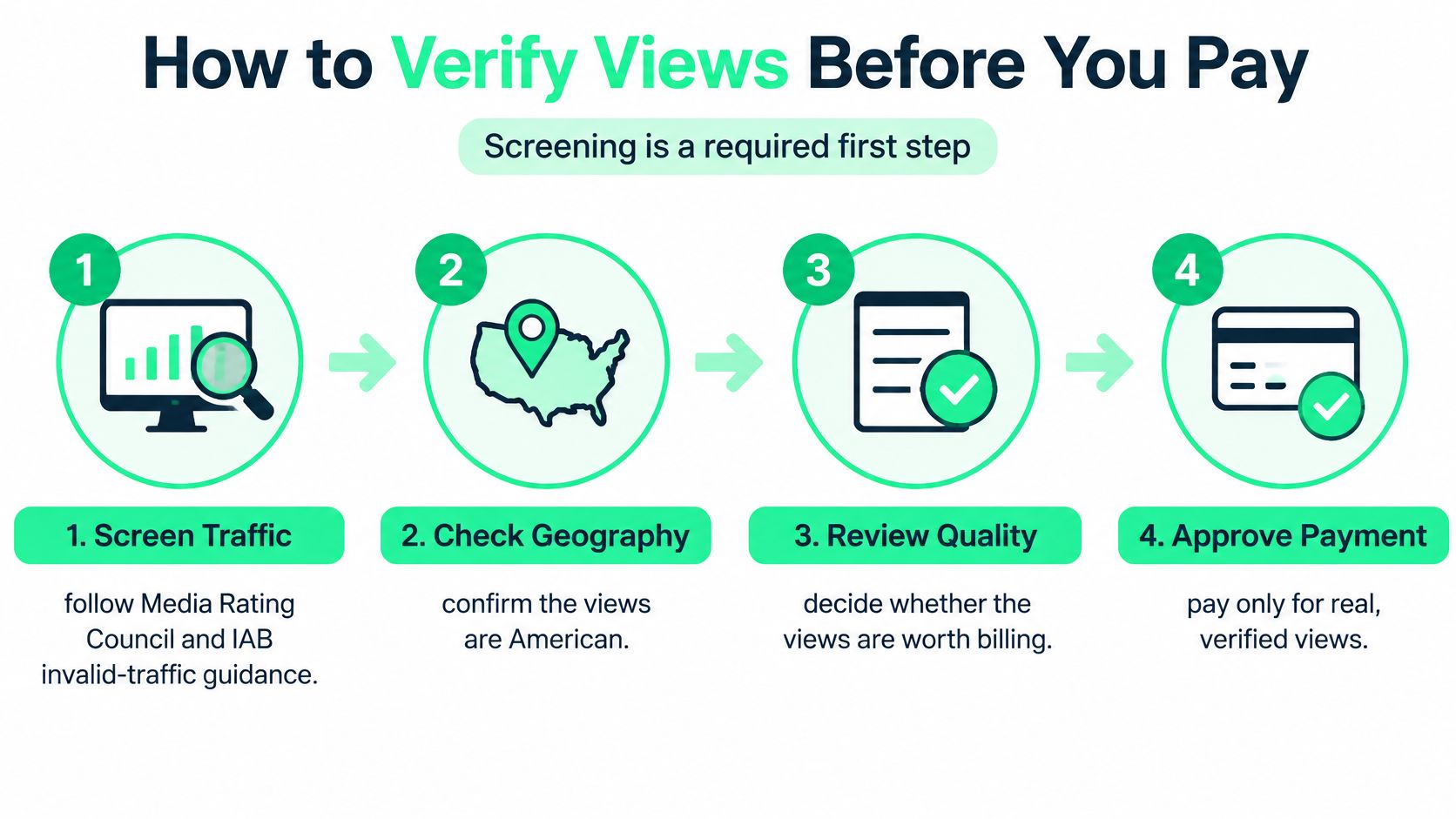
The Media Rating Council and IAB invalid-traffic guidance establishes detection and filtration expectations for accredited or certified digital measurers. It supports a clear buying principle: raw view counts aren't equivalent to verified, billable attention.
For American campaigns, authenticity and geography are separate tests. A genuine viewer outside the authorized target market can still be commercially ineligible.
Apply layered screening
- Vet accounts before onboarding. Examine follower history, audience-location evidence, and posting consistency. An account's biography isn't sufficient evidence of audience quality.
- Analyze engagement patterns. Flag unexplained bursts, repeated comments, and suspiciously uniform activity. Treat them as investigation triggers rather than conclusive fraud findings.
- Check geography. Compare observed audience locations with the campaign's authorized American markets, not merely a broad tier-1 label.
- Score each post automatically. Use consistent criteria to identify outliers and preserve the reason for each flag.
- Escalate before billing. Hold questionable delivery outside payable totals until a human reviewer resolves it.
- Continue monitoring. Reconcile late spikes, disappearing engagement, and revised platform counts before closing the reporting period.
A documented automated fraud-detection process should make these decisions traceable. A score without supporting evidence is difficult to audit.
Use analysts to interpret anomalies
The relevant integrity lesson comes from a different measurement problem. Sportradar's integrity review reported a 0.21% suspected manipulation rate among monitored matches and said AI contributed to detecting 73% of suspicious cases.
Those aren't advertising-fraud rates. They show why automated detection still needs expert interpretation: unusual activity may reflect manipulation, legitimate information, or ordinary volatility.
For creator campaigns, account-level evidence can reveal coordination that a network-wide total conceals. Keep page, post, geography, and review outcomes available rather than reporting only an aggregate view count.
Remove unresolved flagged delivery from the payable pool before invoicing. If review confirms legitimate delivery, reconcile it through the agreed process rather than arguing over an unexplained total afterward.
Our fraud, bot, view-authenticity, and earnings-eligibility determinations are final within the company's internal review processes. Obtain those criteria before committing spend, and distinguish internal review finality from any contractual rights or legal remedies.
Running a Meme Distribution Campaign for US Sports Fans
Consider an illustrative week-long campaign for a hypothetical prediction-market brand during the sports season. The brand wants American sports audiences, excludes college-related content, and needs a promotional term changed while the campaign is live.
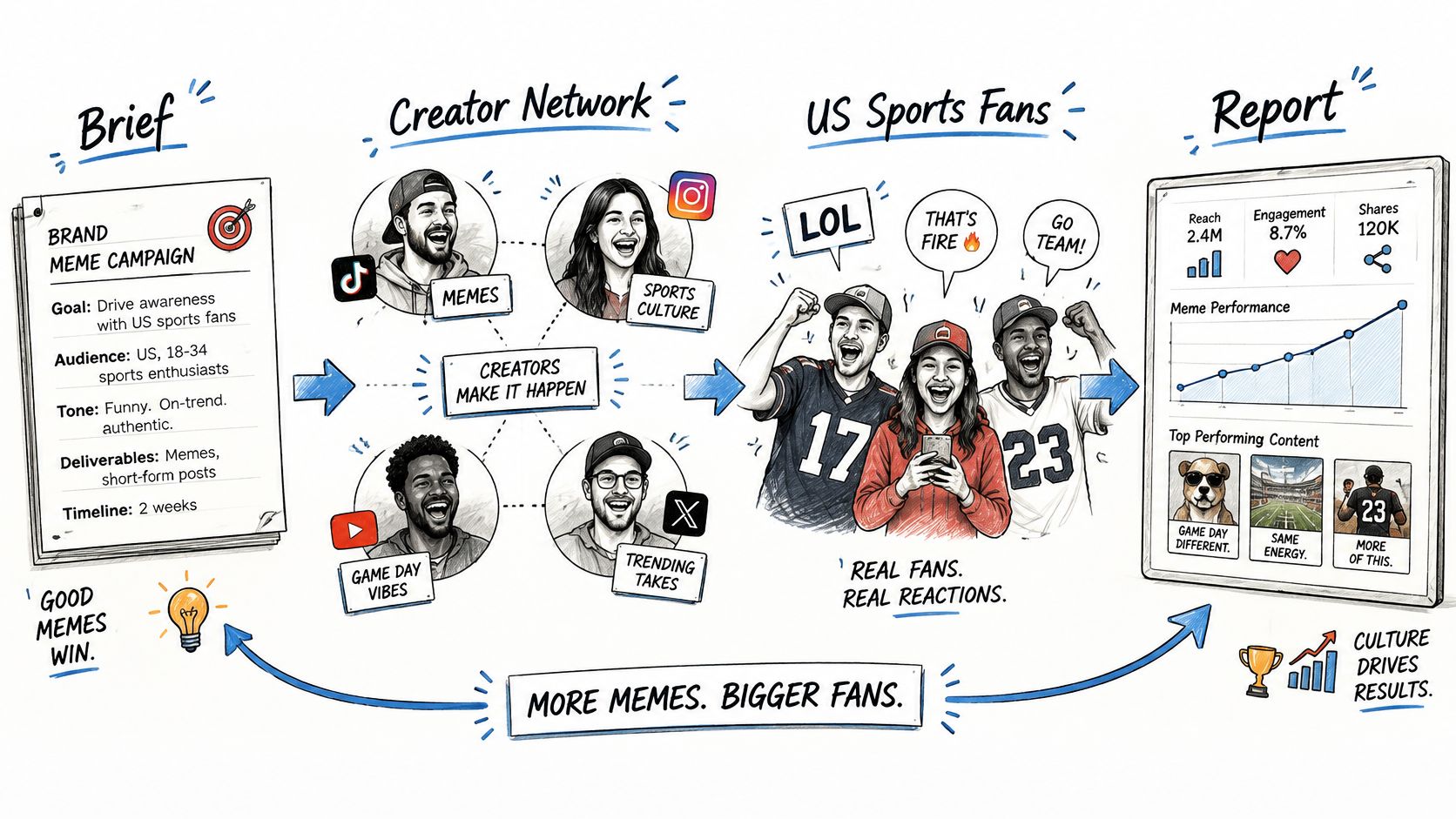
The campaign begins with a legal decision, not a meme. Counsel identifies the eligible contract, approved jurisdictions, consumer disclosures, and unresolved restrictions; the media team translates that decision into publishing permissions.
From brief to approved submissions
At setup, the team enters required terms, prohibited topics, minimum-follower requirements, geographic filters, and exclusions into the rules engine. The audience brief specifies American viewers in eligible markets, rather than accepting a generic premium-geography label.
The brand supplies its logo, watermark, approved captions, and source assets. Creative variations can differ in humor and presentation while retaining the approved advertiser identity and offer meaning.
At FindClout, our programmatic creator-network process combines brand rules, geographic filters, AI scoring, round-the-clock human review, and brand sign-off before publication. Live page-and-handle analytics, network-wide caption management, and removal controls support campaign oversight; any delivery guarantee should be defined in the agreement.
The distinction we emphasize is tier-1 American audiences and brand safety, backed by attention to each submission. The operating objective is to scale attention to billions of views without treating reach as an excuse to relax geography or review standards.
Handle the mid-campaign change
During the hypothetical campaign, the brand changes a promotional condition. The team freezes affected submissions, revises the approved caption, and routes the replacement through review before distributing the update.
The New York Gaming Commission's advertising restrictions show why this matters: advertisements must be factual and not misleading, with material conditions stated clearly and conspicuously. Its rules also require a problem-gambling hotline on each advertisement, operator identification for sports-wagering promotions, and an opt-out explanation for direct advertising.
These obligations make synchronization a consumer-protection task. A corrected master caption doesn't fix a stale live version unless the change reaches that placement.
- Editable caption: Update the live text through the network workflow and verify the result without reposting where the platform supports it.
- Embedded term: Replace or withdraw the asset if the outdated condition appears inside the image or video.
- Unavailable correction: Pause the placement rather than leaving a misleading offer live.
Real-time editing isn't unlimited. Platform permissions and asset format determine what can be changed.
Close with an auditable report
At campaign close, the team reconciles delivery by handle, audience geography, creative version, and verification status. Off-brand pages are removed from further distribution, and suspicious traffic remains outside the payable total pending review.
Report both reach and control performance:
- Audience fit: Did verified delivery reach the intended American markets?
- Creative integrity: Did live placements retain their approved terms and disclosures?
- Intervention record: Which posts were revised, rejected, paused, or removed?
- Commercial reconciliation: What verified delivery qualifies under the billing and guarantee terms?
This makes scale inspectable. A network can produce substantial attention, but the defensible result is the portion delivered to eligible audiences through approved placements.
The differentiator isn't access to sports pages alone. It's the ability to preserve high-quality geography, submission-level review, and a documented correction path as distribution expands.
Lock Campaign Controls and Request Vendor Terms
Authorize launch only when the product's regulatory framework is named and unresolved questions have an assigned legal owner. Require version-specific creative approval, harm-based exclusions, and human resolution of suspicious delivery before payment.
Start with a bounded budget. Evaluate retained customers alongside harm indicators, and judge distribution against eligible American reach rather than a headline view total.
Put the operating promises in writing
Our regulated-category work includes prediction markets and sports-betting-adjacent services. Categories such as crypto, fintech, AI, and health can also run, but category acceptance doesn't replace product-specific legal approval.
The right operating fit is a network that can preserve American audience quality while reviewing every submission in real time. Geographic filters, brand rules, and correction controls should be contractual commitments where material, not merely presentation slides.
Before signing, obtain the review criteria, rules-engine settings, approval responsibilities, fraud-determination criteria, and delivery-guarantee terms in writing. Specify how rejected delivery affects billing and what happens when a published offer needs correction.
Buy verified, eligible attention with enforceable controls. Don't buy an impressive total and negotiate its meaning afterward.
FindClout offers programmatic branded-meme distribution across vetted creator pages, with American audience targeting, brand controls, fraud screening, and verified-view reporting. Visit FindClout to discuss an iGaming or sports-adjacent campaign with defined geographic exclusions, submission approvals, and written delivery terms.
Want this audience for your brand?
FindClout puts your brand in front of verified American audiences across every major US page — brand-safe, at scale.
Start Your Campaign