 findclout.com
10 Prediction Market Sites: A Practical 2026 Guide
Most guides tell you to compare market counts and fee schedules first. That's backwards. The ten prediction market sites below look interchangeable on a homepage and are not interchangeable for a user in Texas versus one in New York, and no amount of feature comparison fixes that.
Three things separate them. The regulatory wrapper comes first: a CFTC-designated exchange, a brokerage add-on, an offshore-adjacent product, or a play-money forecasting site each carry different legal exposure, different settlement guarantees, and different recourse when something goes wrong. Contract mechanics come second, because a contract priced between $0.01 and $0.99 and a share bought at 40 cents and redeemed for $1 are not the same instrument, even when both display a percentage. Topic depth comes third: a platform built for politics behaves nothing like one built for same-day sports markets.
A site can be excellent and still be unusable for you. Kalshi can be the best-run exchange in the category and still be closed to you because of where you file taxes. That's not a flaw in the product. It's the product.
The honest comparison starts with eligibility, not features. Work out which legal operator you can open an account with, then what the contract pays, then whether the topics match how you think about events. If you want the underlying mechanics before you commit, this explainer on how prediction markets work covers pricing and settlement from the ground up.
Table of Contents
- 1. Kalshi
- 2. Polymarket US
- 3. Robinhood Event Contracts
- 4. DraftKings Predictions
- 5. FanDuel Predicts
- 6. Crypto.com Prediction
- 7. PredictIt
- 8. Interactive Brokers Prediction Markets / ForecastEx
- 9. Manifold
- 10. Metaculus
- Access model, market coverage, and payout mechanics at a glance
- Pick on Eligibility First, Then on Mechanics
1. Kalshi
Kalshi is the reference point for a U.S. event-contract exchange rather than a sportsbook with a probability screen. It operates as a CFTC-regulated Designated Contract Market, and that wrapper decides everything downstream: which contracts can be listed, how contract terms get enforced, and how trading is monitored for manipulation and price distortion, as the CFTC's prediction-markets rulemaking sets out.
What you get: binary Yes/No contracts across sports, politics, economics, finance, culture, and climate, with live prices, charts, a rules page on every market, and the ability to sell a position before settlement in most markets.
What it costs you: fees vary by market, and a losing position loses the full amount you put in. Availability shifts by state, so confirm yours before you plan around it.
Practical rule: read the resolution criteria before you size a position. Ambiguous wording is where disputes start, and the exchange enforces the terms as written, not as you assumed.
If the format is new to you, our explainer on what prediction markets are is the shortest path from pricing to payout. Kalshi suits people who want one U.S. venue across many categories and will read the contract rules.
2. Polymarket US
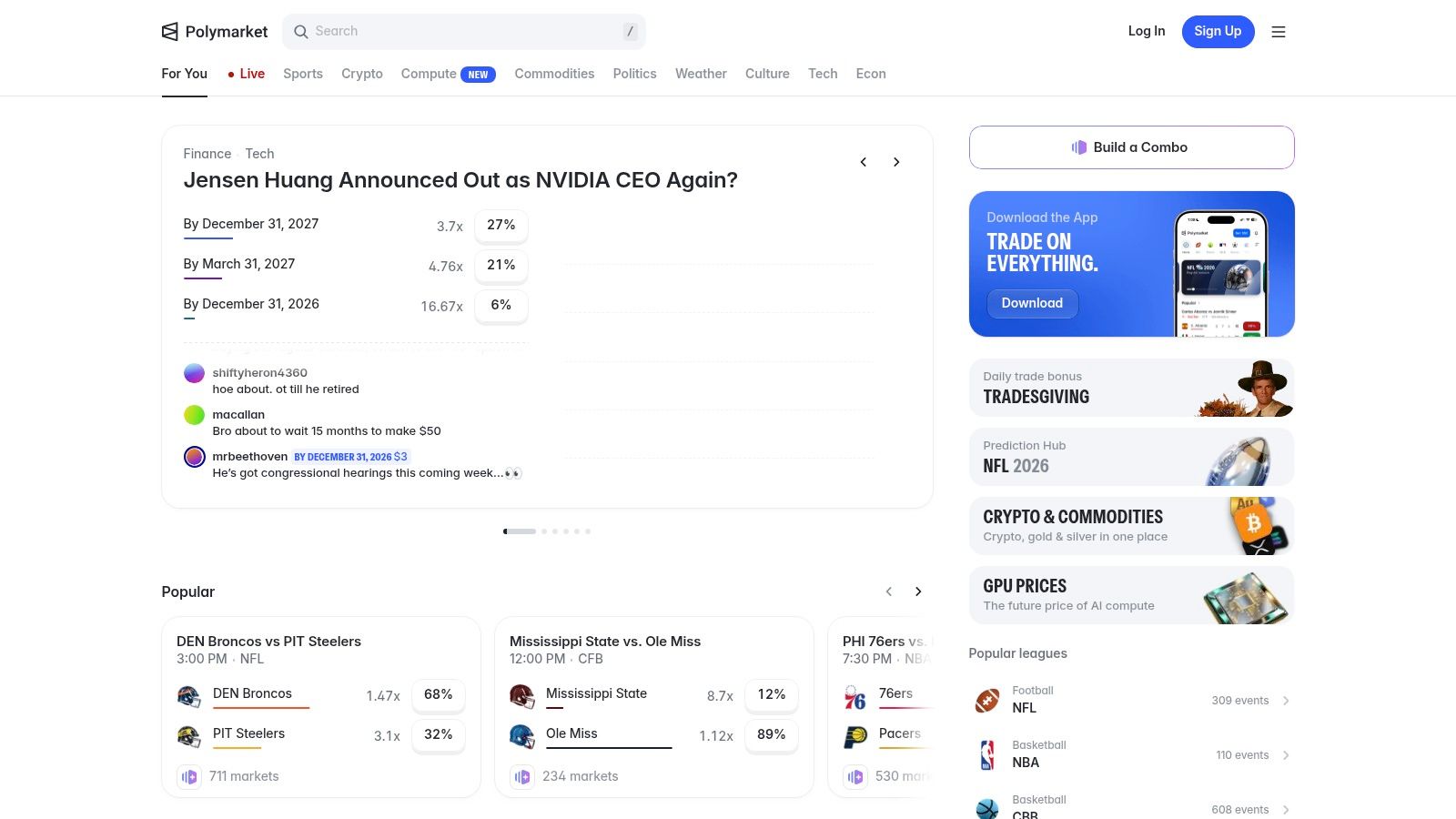
Polymarket's U.S. product is operated by QCX LLC, which the site identifies as a CFTC-regulated Designated Contract Market. Treat it as its own platform. Terms, fees, and market lists on the U.S. product don't automatically match the global Polymarket site, and assuming they do is how people get surprised at settlement.
Scale is the argument for it. An analysis of Polymarket's on-chain settlement ledger recorded roughly $3.6 billion in displayed trading volume on its presidential-winner market during the 2024 cycle, per this academic study of the platform's ledger. That depth is what you trade on. A thick book means tight spreads and the option to exit before resolution instead of holding a contract to the end. On a thin exchange, the price you see and the price you get filled at are two different numbers.
Categories: sports, esports, crypto, commodities, politics, weather, technology, culture, economics.
The catch: legal access and market availability vary by state, and a separate U.S. product means separate paperwork from the global site. The odds-style presentation is easy to read and easy to over-trust. A quoted price is a price, the level where a buyer and seller last agreed, and it carries no promise about the outcome itself.
That distinction matters beyond trading. Prediction market prices get quoted in ads, headlines, and campaign creative as if they were settled fact, and the audience-quality question follows the money. Volume on a ledger is verifiable; whether the humans behind the screens are real U.S. users or inflated reach is a question advertisers in this category have to ask separately, because contracts pay on outcomes while marketing budgets pay on eyeballs.
Who can trade it: U.S. users in eligible states, through the regulated entity. The contract pays a fixed amount on a correct outcome and zero on a wrong one, so your maximum loss is known the moment you enter. Confirm your state's eligibility before you plan around any specific market, because the list shifts.
3. Robinhood Event Contracts
Robinhood's version reaches people who never set out to trade event contracts. They sit inside the brokerage app, priced $0.01 to $0.99, across sports, politics, weather, commodities, and entertainment, with combo products on some sports.
Eligibility is the gate. You need an approved derivatives account, and state restrictions apply on top of that. If the account already exists, friction is near zero. If it doesn't, you're completing an options-style application before you can place a single contract.
The mechanics are regulated upstream of the app. A designated contract market can introduce a new event contract through written self-certification or voluntary prior Commission approval, and it must submit the contract's terms and conditions either way, according to the CFTC's March 2026 advisory. Robinhood is the storefront; the exchange behind it carries the rulebook.
Costs: Robinhood commissions plus exchange charges can both apply, so a cheap-looking contract isn't automatically a cheap round trip. The app-only experience is the trade-off, because convenience pulls in casual users, and casual users are the ones most likely to trade a market they haven't read. For a wider view of where event contracts sit next to brokerage products, see our trading apps coverage.
4. DraftKings Predictions
DraftKings launched this as a standalone product for trading contracts on real-world outcomes, starting with sports and finance and signaling more categories later. It exists because the audience already does. A U.S. consumer survey cited in a Congressional Research Service report on prediction markets found that 70% of prediction-market users traded sports outcomes, and estimated that 23% of internet adults used either sportsbooks or prediction markets.
That overlap is the whole story of the product. Sports fans arrive expecting sportsbook conventions, and event contracts don't always deliver them: different settlement, different collateral treatment, different exit mechanics.
Where it fits: you already follow DraftKings, you want sports and finance in one place, and you're clear that a predictions product isn't a sportsbook.
Where it doesn't: your state restricts the contract type, or you want deep non-sports coverage. Market coverage and eligibility vary enough that a launch announcement tells you very little about what you can trade today.
Getting that distinction right before funding an account is the whole game here. Our comparison of prediction markets vs sportsbooks walks through pricing, settlement, and what happens when a market's wording turns out to be ambiguous.
5. FanDuel Predicts
FanDuel built its event-contract product in partnership with CME Group, and the pairing tells you what it is: a consumer brand sitting on top of a derivatives venue. Markets have covered financial benchmarks, economic indicators, sports, and other topics.
The category it sits in is growing quickly. Aggregate annual trading volume reportedly rose from $15.8 billion in 2024 to $63.5 billion in 2025, according to the 2025 Skynet prediction markets report. Treat that as directional rather than audited, because platforms define contracts, count volume, and restrict geography differently.
For a sports-heavy product, the practical consequence is seasonality. Volume concentrates around major leagues and tournaments, then falls away. If you trade for entertainment, that's fine. If you're building anything systematic, an off-season baseline matters more than a playoff-week peak.
Access: sports contracts aren't available everywhere, and state-level legal changes can alter the product on short notice. Check the current terms for your state rather than relying on a launch announcement. Cost: the mechanics differ from a standard sportsbook bet, so compare fee and settlement structure, not just the displayed probability.
6. Crypto.com Prediction
Crypto.com puts event contracts inside an app many users already have for other reasons. The contracts are binary Yes/No on global events and pay $1 if correct and $0 if incorrect, which is the cleanest payout structure on this list to reason about.
Who can trade it: existing Crypto.com users in eligible jurisdictions. Access depends on app availability and account eligibility, and the market categories on offer change over time.
What it costs: whatever the app charges for event-contract trading, plus the ordinary risk of a position going to zero. A fixed $1 maximum payout makes position sizing easy, and it caps your upside in a way share-based markets don't.
The honest assessment is that this is a convenience product, not a destination for someone who wants hundreds of markets and deep books. If you already hold assets in the app, it's one less login. If you don't, the prediction feature alone isn't a reason to open an account. Check current categories, fees, and eligibility inside the app before you trade, since all three move.
7. PredictIt
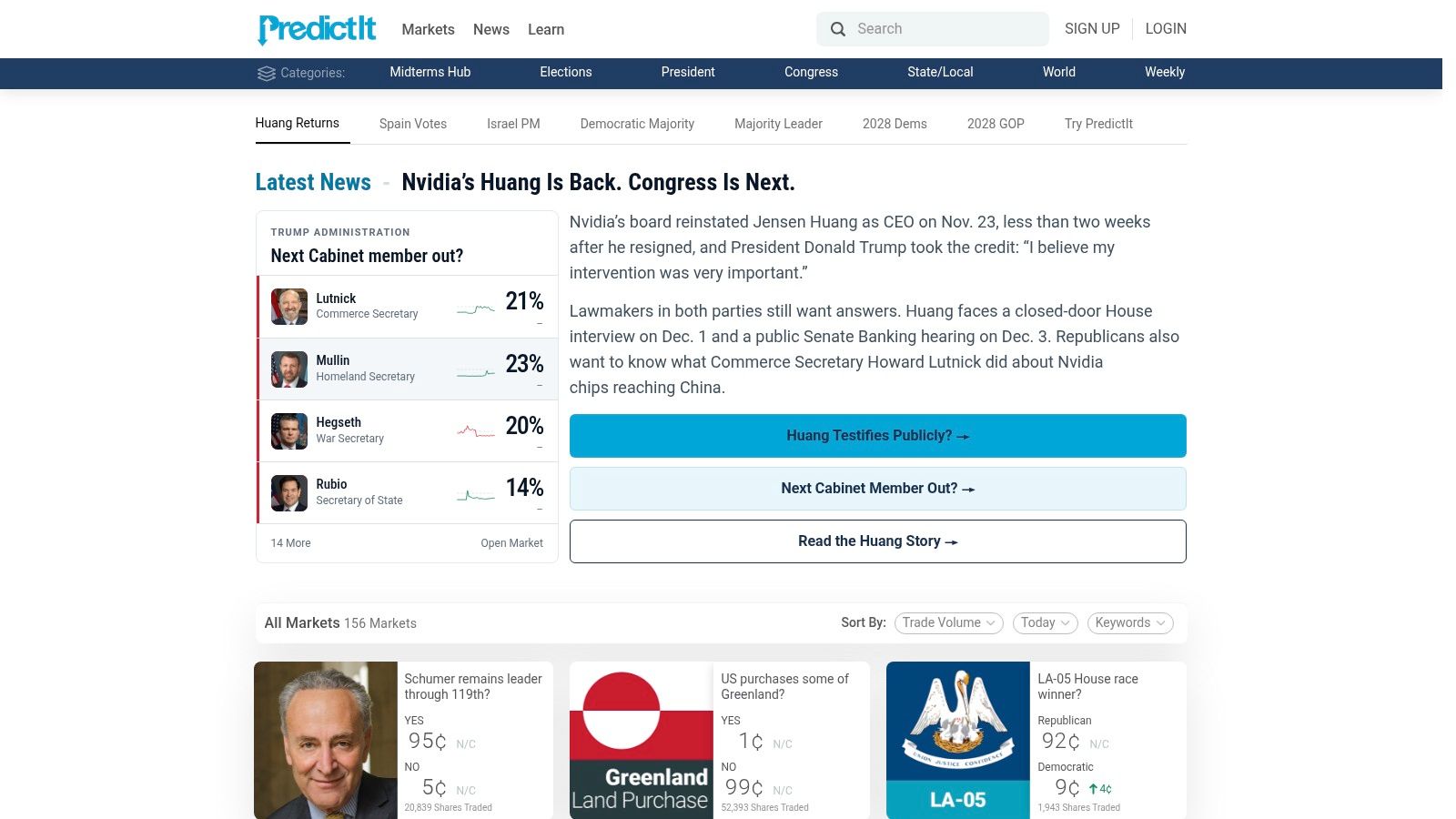
PredictIt is the oldest model here and the narrowest. Politics and public affairs only, shares priced 1 to 99 cents, winning shares redeemed for $1, and positions you can sell before a market closes. A 10% fee on trading profits is the cost of doing business.
The lineage explains the design. The modern prediction-market industry traces to the Iowa Electronic Markets, launched by the University of Iowa in 1988 as an experimental political stock market, where active participation ranged from 155 traders in 1988 to 790 in 2000 and trading expanded from 15,826 contracts valued at $8,123 in the 1988 market to 339,222 contracts worth $46,237 in 2004, per this long-run accuracy research on the IEM. The CFTC dates modern prediction markets to 1988 and federal oversight of relevant event contracts to 2004.
That history is the pitch: prices as continuously updated probability signals rather than polling products.
The limitation: contract limits and market availability constrain how much you can put to work. If you want sports or macro exposure, this isn't the venue.
8. Interactive Brokers Prediction Markets / ForecastEx
This is the one for people who already think in brokerage terms. Eligible Interactive Brokers clients get ForecastEx Yes/No forecast contracts, weighted toward economic, climate, and other forecast questions rather than sports.
Accuracy data in this corner of the category is useful. An ETH Zurich analysis of more than 2 million Polymarket transactions reported an average Brier score of about 0.15, found that transactions involving several thousand dollars were generally more accurate than smaller trades, and observed that markets could become more biased and less accurate as they approached resolution and liquidity declined.
What that means practically: market quality varies inside a single platform, and the final hours before resolution are often the worst time to trust a thin book.
Access: account eligibility is a real barrier, and the market list is narrow next to consumer platforms. Cost: published fees are comparatively simple to compare, which is unusual in this category. Best fit: you want macro and climate questions inside a technical trading environment and you'll read the contract specs before you size anything.
9. Manifold
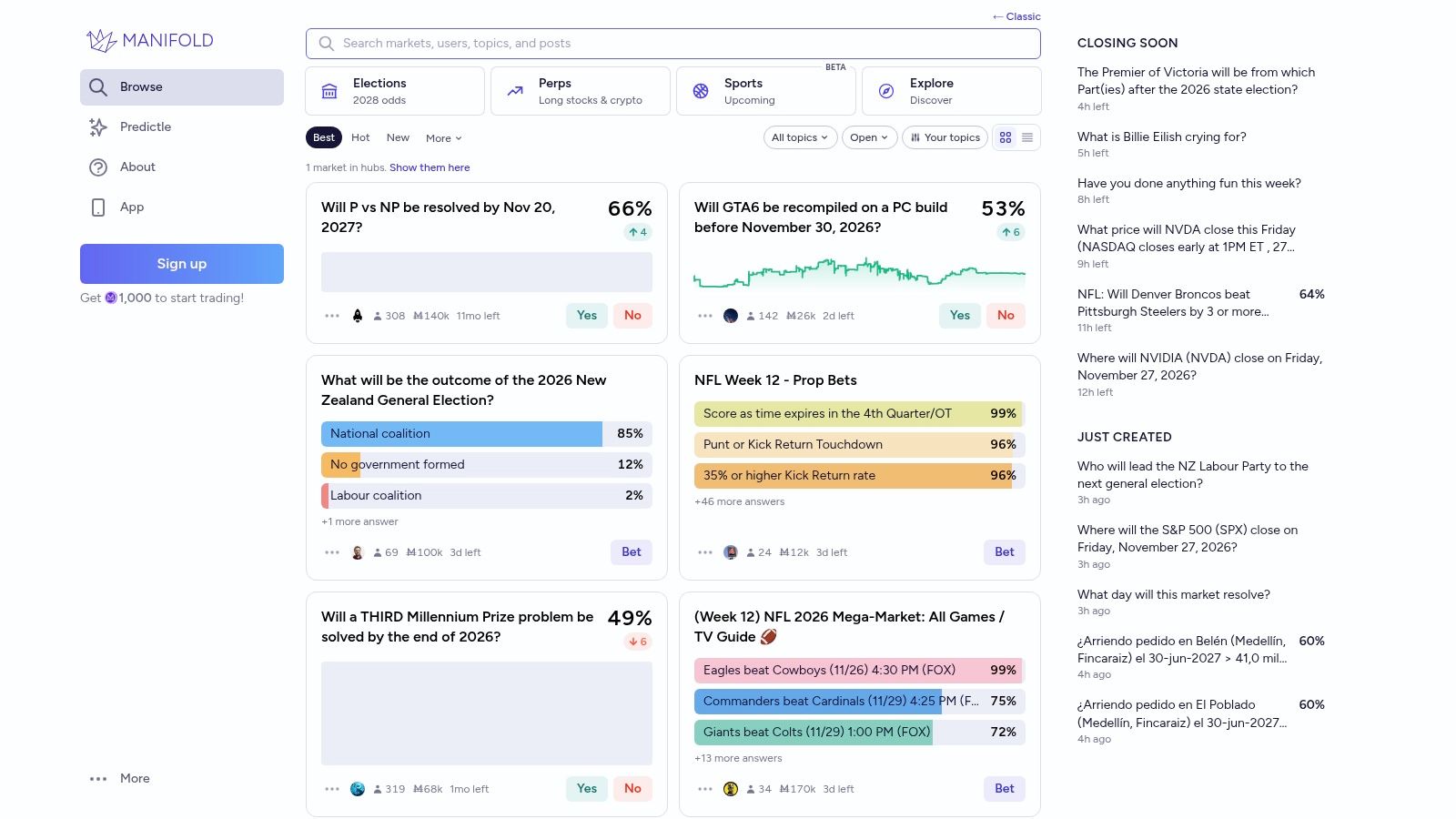
Manifold is a social forecasting platform, not an exchange. Users create markets, argue about them in the comments, and trade with Mana, free play-money that cannot be converted to cash.
That one design choice changes how you should use it. No funding, no withdrawal, no KYC queue, and no financial consequence to being wrong. What you get instead is breadth: community questions on sports, elections, technology, markets, and entertainment, including niche subjects no regulated venue would bother listing.
Best use: testing whether you have an edge before you stake money anywhere. Create a market on something you think you understand, forecast it for a month, and compare your calibration against the community aggregate.
Weakness: user-created markets vary in quality and resolution rules, and a badly worded question resolves badly. On a real-money exchange that costs someone money and gets argued about. Here it just sits there.
Play money removes the financial risk and most of the signal. Use it to learn the format, not to prove a strategy.
If you want forecasting practice with zero capital at risk, this is the least intimidating entry point on the list.
10. Metaculus
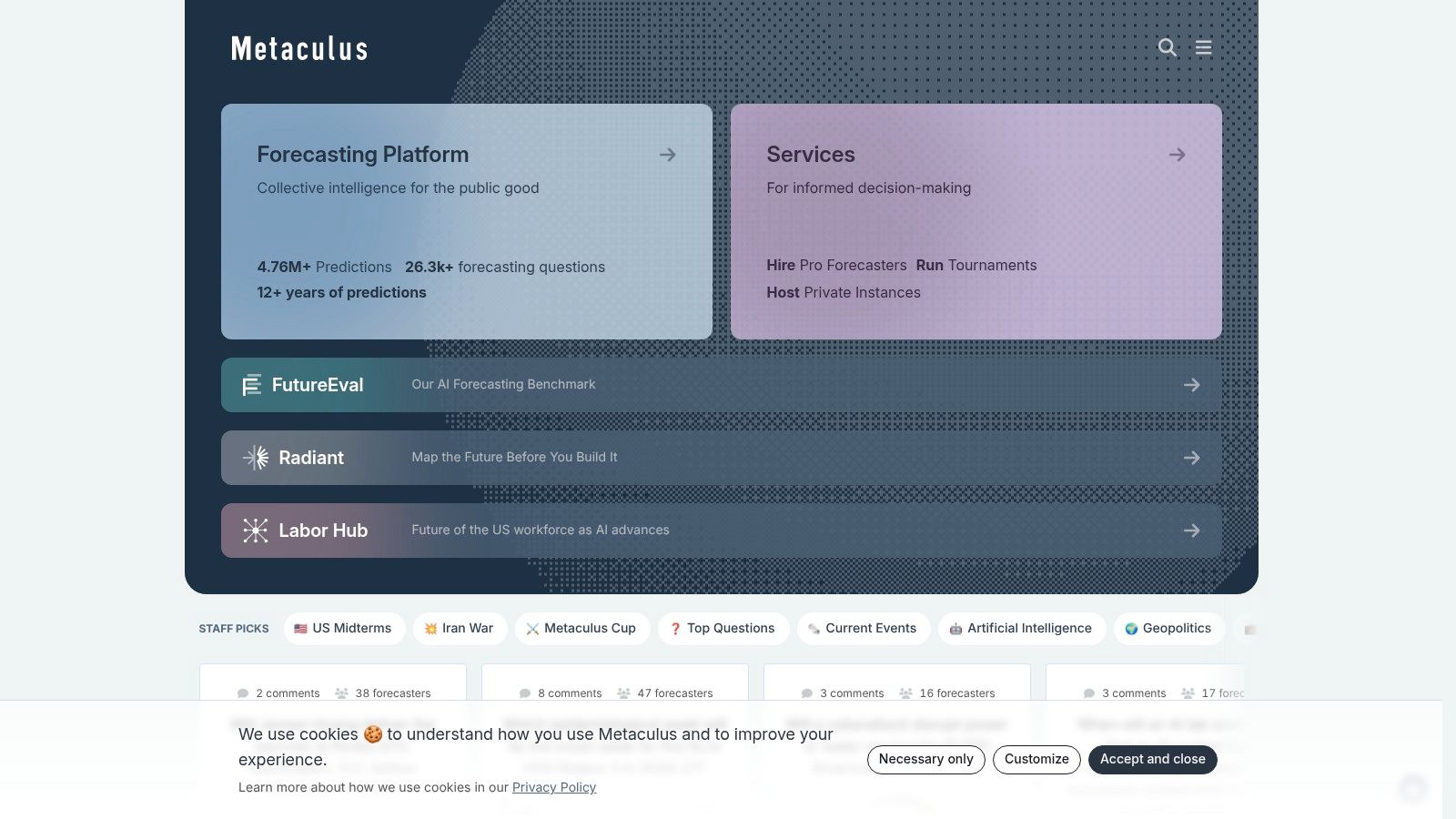
Metaculus isn't a prediction market at all, and it belongs in a comparison of prediction market sites because people keep confusing the two. Users submit probability forecasts. Nobody buys or sells a contract, and nothing cashes out.
Questions run across AI, science, geopolitics, climate, health, and public policy, written to reward reasoning rather than speed. Community aggregate predictions sit alongside individual forecasts, so you can see where you diverge from the crowd and why.
Tournaments offer prizes under competition-specific rules. Those rules matter: prize eligibility, question selection, and scoring differ by competition, and a prize structure is not a guaranteed return.
Who should use it: analysts who want a public track record of calibrated forecasts, and anyone who wants to think in probabilities without a bankroll.
Who shouldn't: anyone looking for event contracts to trade, exit early, or hedge a position. There's no order book and no settlement payment.
The trade-off is honest. You give up liquidity and payout, and you get structured questions and a visible record of how well you think. For a lot of people evaluating this category for the first time, that's the more useful first step.
Access model, market coverage, and payout mechanics at a glance
| Platform | Access model | Market coverage | Real money | Best for |
|---|---|---|---|---|
| Kalshi | Dedicated event-contract exchange | Sports, politics, economics, finance, culture, climate | Yes | Broad U.S.-focused event markets |
| Polymarket US | Dedicated U.S. event-contract product | Sports, esports, crypto, commodities, politics, weather, technology, culture, economics | Yes | Wide-ranging event markets in a U.S. product |
| Robinhood Event Contracts | Integrated into Robinhood brokerage app | Sports, politics, weather, commodities, entertainment | Yes | Existing Robinhood customers |
| DraftKings Predictions | Standalone mobile and web product | Sports and finance | Yes | DraftKings users and sports fans |
| FanDuel Predicts | FanDuel product partnered with CME Group | Sports, financial benchmarks, economic indicators, other topics | Yes | FanDuel users comparing sports and non-sports contracts |
| Crypto.com Prediction | Feature within the Crypto.com app | Global events; categories may vary | Yes | Existing Crypto.com users |
| PredictIt | Web-based share trading | Politics and public affairs | Yes | Users focused on political markets |
| Interactive Brokers Prediction Markets / ForecastEx | ForecastEx contracts through Interactive Brokers | Economic, climate, and other forecast questions | Yes | Brokerage users seeking technical, non-sports forecasts |
| Manifold | Social forecasting platform using Mana | Community-created markets across varied topics | No; Mana cannot be converted to cash | Informal forecasting without cash stakes |
| Metaculus | Forecasting platform with probability submissions | AI, science, geopolitics, climate, health, public policy | No contract trading; some tournaments offer prizes | Analytical forecasting and competitions |
Pick on Eligibility First, Then on Mechanics
Five minutes is enough to narrow this list to two or three real options, if you run the checks in the right order.
Step one, the legal operator. Identify the entity you'd be trading with and confirm your state allows it. A CFTC-designated exchange, a brokerage add-on, and a play-money site are three different things wearing similar interfaces. If you can't name the operator and the regulator, stop there.
Step two, the contract mechanics. Work out what the contract pays, what happens if you want out early, and what the fee is on both entry and exit. Markets priced near the extremes look cheap and often aren't, because the spread eats whatever edge you thought you had.
Step three, the topic mix. Match the platform to how you think about events. If you have opinions about elections and macro, a politics-heavy venue serves you better than a sports-first one with ten times the volume.
For advertisers, the same ordering applies under different labels. Eligibility becomes permitted topics and compliance controls, which is why the FTC's Endorsement Guides matter as much as the exchange rulebook. A material connection between an endorser and a marketer has to be disclosed when it could affect how people evaluate the endorsement, and paid placements on creator pages can't bury that relationship in an ambiguous caption.
A prediction-market brand buying growth in this category is buying verified U.S. attention, not raw impressions. Bot-heavy reach doesn't fund accounts.
That's the standard the distribution layer gets held to as well. Regulated prediction-market advertisers route spend through vetted U.S. sports and finance pages with pre-approval, exclusions, and human-plus-AI screening rather than open programmatic placement, because a single inaccurate caption replicated across hundreds of pages is a regulatory problem, not a creative one. FindClout runs campaigns for regulated categories including prediction markets, and the review work is the part that decides whether the spend was worth it.
The honest limit: no platform on this list removes the risk of losing a position. Availability also changes faster than any article can track, since state-level legal action and product changes move month to month. Verify current terms directly with the operator before you fund an account, and re-check them if you come back to this list in six months.
FindClout distributes branded content across a curated network of high-reach creator pages, with tier-1 American audiences concentrated in sports, finance, and gaming, and single-vertical placements on sports or finance pages capped at a $0.25 CPM. Every submission is scored by AI and reviewed by a human team around the clock before it posts, so captions, logos, prohibited topics, and geo exclusions are checked before your brand appears next to a live market. If you're buying attention in this category, start at FindClout.
Want this audience for your brand?
FindClout puts your brand in front of verified American audiences across every major US page — brand-safe, at scale.
Start Your Campaign