 findclout.com
Prediction Markets vs Sportsbooks: Growth Playbook
The most popular advice about prediction markets vs sportsbooks is also the least useful for marketers: compare the odds, pick the cheaper product, and push the largest available audience into a conversion funnel. That approach ignores the actual competition. These platforms compete for attention rituals, cultural relevance, trust, and repeat engagement, then convert that attention differently.
Sportsbooks remain the mature, high-volume channel. Prediction markets are the newer challenger, built around event contracts, probability pricing, and a broader set of moments users can follow. For growth teams targeting American audiences, the distinction changes media buying, creative formats, compliance controls, and creator selection. A sportsbook campaign can optimize around transactional intent. A prediction-market campaign often needs to earn a place inside the user's daily conversation.
The operational standard is higher in regulated categories. Brands need tier 1 American audiences, real-time review, accurate geo controls, and an auditable system for every submission. Scaling attention toward billions of views only works when the campaign protects the brand as carefully as it pursues reach.
Table of Contents
- The Battle for American Sports Attention
- Structural Differences in Pricing and Liquidity
- Navigating the Fragmented US Regulatory Map
- Decoding User Behavior and Migration Triggers
- Engineering Brand Safety in Creator Networks
- Scaling Verified Attention Across Sports Niches
- Orchestrating High-Volume Campaign Execution
The Battle for American Sports Attention
Sportsbooks and prediction markets aren't competing on the same playing field, even when they feature the same game. A sportsbook user typically arrives with a wagering decision in mind. The operator publishes lines, accepts bets, manages exposure, and settles the result. A prediction-market user may be responding to a headline, a political development, a league event, or a rapidly changing sports narrative. The product turns an outcome into a tradable contract.
That difference creates two distinct attention rituals. Sportsbooks benefit from habitual, high-volume transactional behavior. Prediction markets attach themselves to the cultural moment. A major election, injury report, playoff series, or news cycle can generate a fresh market and a new reason to return.
The category's growth illustrates that shift. The history of prediction markets reaches back to 1988, when the Iowa Electronic Markets launched at the University of Iowa as an enduring online-style market for event contracts. Industry coverage in 2025 reported that Polymarket had processed more than $3 billion in lifetime volume, while individual political-event markets could exceed $100 million during major elections. Reporting in 2026 put combined monthly trading volume on Kalshi and Polymarket at about $24 billion in May 2026, compared with $5 billion a year earlier.
Practical rule: Don't buy inventory until you understand what the audience returns to the platform to do.
For advertisers, the implication is straightforward. A standard sportsbook banner usually communicates a line, a promotion, or a sign-up incentive. That can work when the audience already has strong betting intent. It often fails with prediction-market users because it treats a culturally engaged trader like a passive bettor.
Why creator-native distribution matters
Younger American users are more likely to encounter prediction markets through discussion, clips, memes, social commentary, and creator-led interpretation. That doesn't mean every campaign should become entertainment for its own sake. It means the creative needs to enter the conversation naturally, with clear disclosures and claims that survive compliance review.
A useful sports fan marketing framework starts with the audience's ritual, not the advertiser's product sheet. Which sports pages already command attention? Which creators can explain a market without overstating certainty? Which formats make the event understandable in a few seconds?
The best media plan separates reach from intent. Use culturally relevant creator placements to create recognition, then retarget or route qualified users into a product experience that explains pricing, eligibility, fees, and risk. That structure is more durable than relying on a generic “bet now” message across every channel.
Structural Differences in Pricing and Liquidity
The commercial mechanics determine what users feel after the click. Sportsbooks publish house-set odds and include a built-in margin. Prediction markets use an order book, where users trade event contracts against one another and prices move with supply, demand, and implied probability.
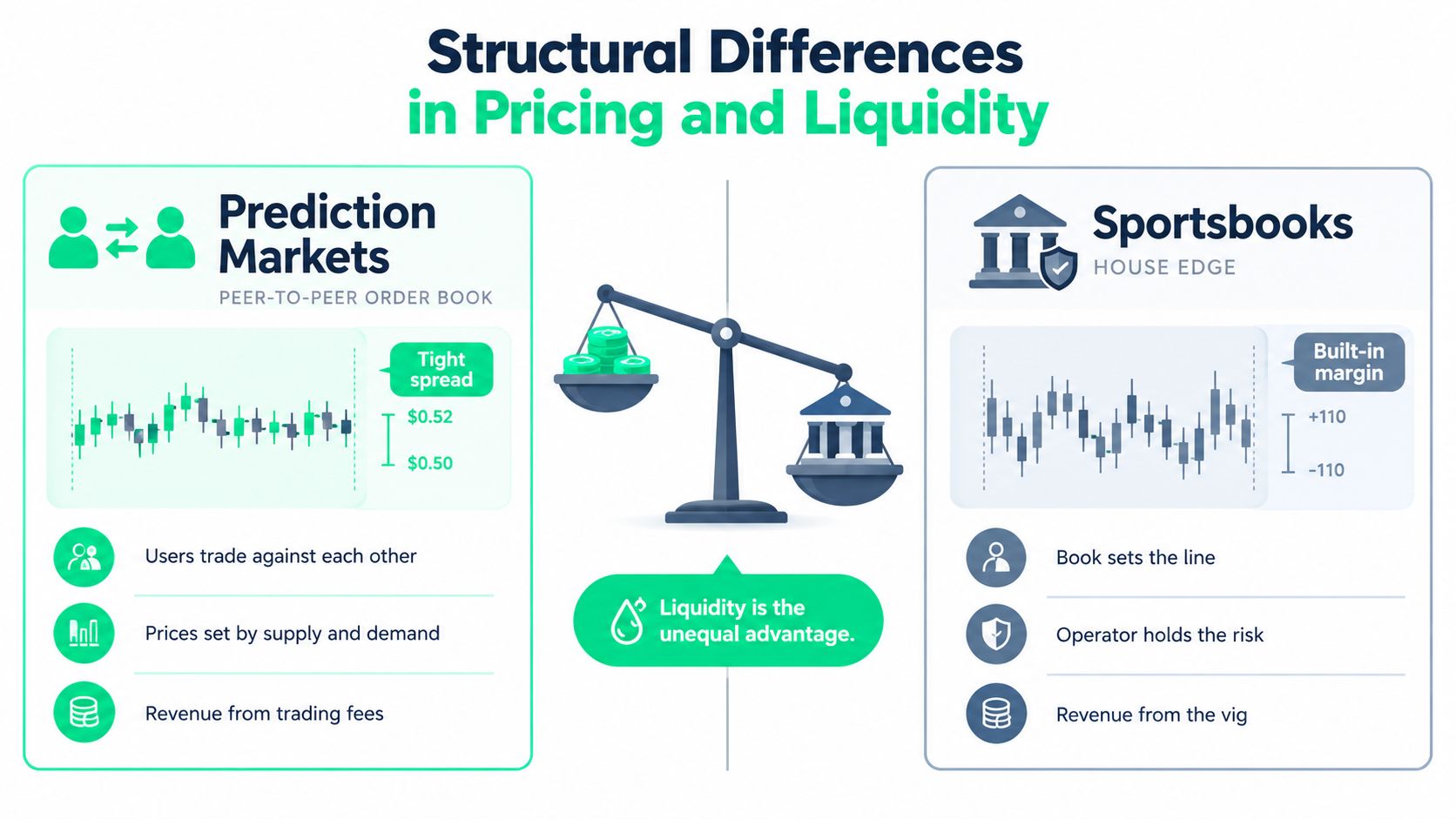
A sportsbook can show one price to every customer and generally accept the wager immediately at the posted line. That convenience comes with the operator's embedded vig. A prediction market can show bid and ask prices, available depth, and a probability that changes as participants trade. The user gets more transparency, but execution depends on whether enough counterparties are present.
| Operating feature | Prediction markets | Sportsbooks |
|---|---|---|
| Price formation | Order book, supply, demand, implied probability | House-set odds |
| Primary cost | Explicit trading fee, plus possible spread and slippage | Embedded margin or vig |
| Execution | Depends on liquidity and available orders | Usually immediate at the posted line |
| Core user experience | Trading an event contract | Placing a wager against the house |
| Marketing implication | Explain probability, liquidity, and execution | Explain line, offer, and settlement |
The cheaper price isn't always the cheaper trade
Industry comparisons commonly place sportsbook margins around 4% to 8%, while some regulated prediction-market comparisons cite trading fees of about 2%. Those figures come from the industry comparison of prediction-market apps, and they describe different cost structures rather than a guaranteed user outcome.
A thinner stated fee can help prediction markets attract users who care about transparent price discovery. The advantage narrows when the order book is shallow, the spread widens, or a large order moves the displayed price. Liquidity isn't a technical footnote. It decides whether the user can enter or exit at the price the creative promised.
That execution sensitivity should shape acquisition messaging. Don't advertise a probability as if it were a guaranteed payout. Show users what the contract represents, explain that available liquidity affects fills, and avoid language that implies certainty.
The acquisition funnel should set the same execution expectations that the trading interface delivers.
Liquidity changes the media strategy
Sportsbooks still operate at a much larger commercial scale. One 2026 estimate valued the global sports betting and lotteries sector at $402.2 billion in revenue for 2026, with a 9.4% CAGR, while another report estimated the global sports betting market at $100.9 billion in 2024 and projected it to reach $187.39 billion by 2030. These figures are reported in the global sports betting and lotteries estimate and the referenced market outlook.
Prediction markets can still win strategically in concentrated niches. A campaign doesn't need to imply that every contract has sportsbook-level liquidity. It should target markets with enough activity to support a credible product experience, then use creative that makes the market's mechanics legible before the user deposits or trades.
Navigating the Fragmented US Regulatory Map
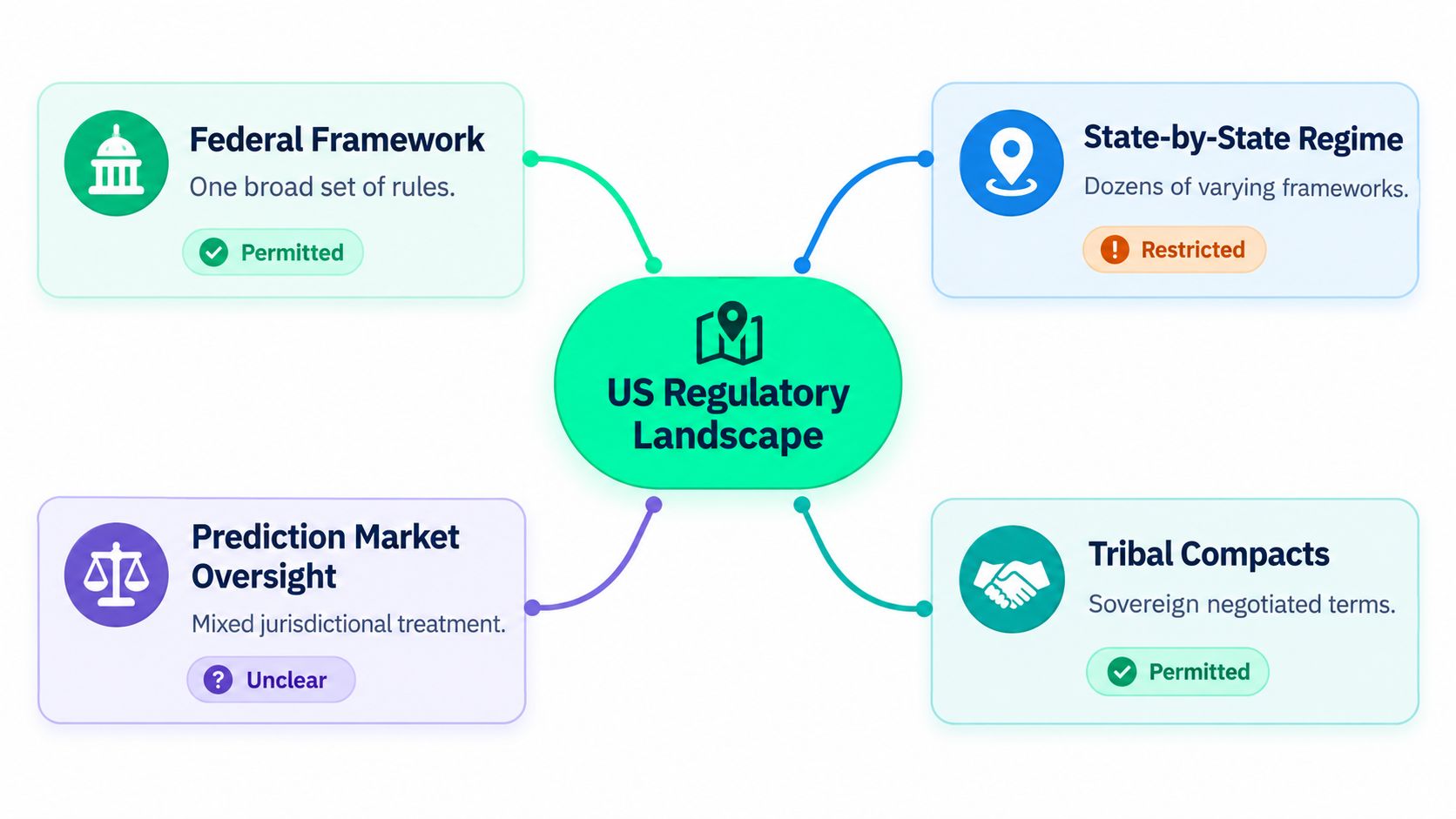
Sportsbook media plans cannot be national. Sports betting is legal in 39 states, while California and Texas remain illegal, and sportsbooks are typically state-regulated with an age threshold of 21 or older, according to the US access and regulation survey. The same survey states that prediction markets are available to users 18 and older in all 50 states, although operators still need current legal and compliance review for each campaign and contract type.
For advertisers, the difference affects inventory eligibility, age gates, landing-page language, creator instructions, state exclusions, and budget allocation. A sportsbook buyer can waste spend in restricted states when a buying system relies on broad national segments. A prediction-market advertiser may have wider reach, but that reach does not remove review of the product, market, claims, or audience treatment.
Build the campaign around jurisdictional states
Start with a campaign matrix that connects each product and creative execution to its intended geography. Maintain separate audience pools for permitted, restricted, and unclear placements. A creator's stated location is not enough. Verify the page's audience geography and apply platform-level filters before approval.
The matrix should include:
- Audience eligibility: Confirm the permitted age and location for the specific product.
- Creative claims: Remove language suggesting guaranteed profits, risk-free participation, or certainty.
- Placement exclusions: Block pages, keywords, topics, and states rejected during legal review.
- Landing-page consistency: Ensure the destination applies the same eligibility rules as the ad.
- Audit evidence: Preserve the approved creative, reviewer decision, timestamp, and distribution record.
The practical guide to gambling advertising laws provides background for media and creator teams, but it does not replace counsel or an operator's compliance policy. Regulations and enforcement positions change, particularly around sports event contracts.
The federal framework also affects campaign approval. The CFTC's 2026 materials on event contracts describe these products as derivatives settled by an underlying occurrence or event. Congress's CRS explains that the CFTC views sports event contracts as potentially falling within the Commodity Exchange Act's definition of a swap, giving the agency exclusive jurisdiction over registered exchanges.
Plan for the contract, not just the state
A 2026 CFTC proposal reported by Reuters said sports-score, win-loss, spread, and tournament-advancement contracts may support price discovery and provide meaningful information. It also said contracts tied to player injuries, officiating decisions, discrete in-game actions, fights, or below-collegiate games would likely conflict with the public interest.
Media buyers should approve the contract itself, not just the state list. “Sports prediction” is too broad for a safe creative rule. Review the underlying event, wording, audience, and distribution context before a campaign goes live.
Decoding User Behavior and Migration Triggers
Users don't switch platforms only for a better payout. Recent survey data puts trust and reputation at 60% and ease of use at 59%, ahead of potential payouts or odds at 51%. The same source reports that 77% of respondents switched gaming platforms entirely because of user experience. Those findings come from the survey coverage of sportsbook and prediction-market migration.
That changes the acquisition brief. A campaign that leads with “best odds” may attract price-sensitive clicks, but it won't necessarily build confidence in settlement, identity checks, withdrawals, or market interpretation. A campaign that explains the product clearly can reduce uncertainty before the user reaches the account wall.
Trust is a creative requirement
Trust isn't created by adding a compliance footer to a loud promotion. It comes from consistent signals across the ad and the product experience:
- Transparent mechanics: Explain whether the user is trading a contract or betting against a sportsbook.
- Clear outcomes: State what event resolves the contract and how settlement works.
- Honest friction: Don't hide verification, jurisdiction checks, or order-book limitations.
- Responsible framing: Avoid presenting participation as income, investing certainty, or a guaranteed result.
- Recognizable voices: Use creators who can explain the market without turning uncertainty into hype.
The younger audience deserves specific attention. A 2026 behavioral survey found that 5% of adults said they use prediction markets for sports, while 11% of men ages 18 to 34 reported usage. The Sports Illustrated guide to prediction markets also highlights the importance of liquidity and execution quality, which makes creator education more important than simple product mentions.
Translate behavior into buying decisions
For younger American men, cultural context can outperform a generic display placement. A creator who already discusses trades, matchups, injuries, or sports narratives can introduce an event contract in a way that feels relevant. That doesn't justify targeting minors or blurring advertising disclosures. It means adult, eligible audiences receive an explanation from a source they already follow.
Use a three-part funnel:
- Recognition: Native sports commentary establishes relevance.
- Understanding: A short clip or carousel explains the event, price, and resolution.
- Action: The landing page handles eligibility, account creation, and product education.
The prediction-market user acquisition guide can support campaign planning, but the central test remains behavioral. Measure qualified activation and retained use, not just cheap clicks. If users arrive expecting a sportsbook-style instant bet and encounter an unfilled order, the creative created the wrong expectation.
A high-quality acquisition message doesn't promise certainty. It makes the product understandable enough for the right user to choose it.
Engineering Brand Safety in Creator Networks
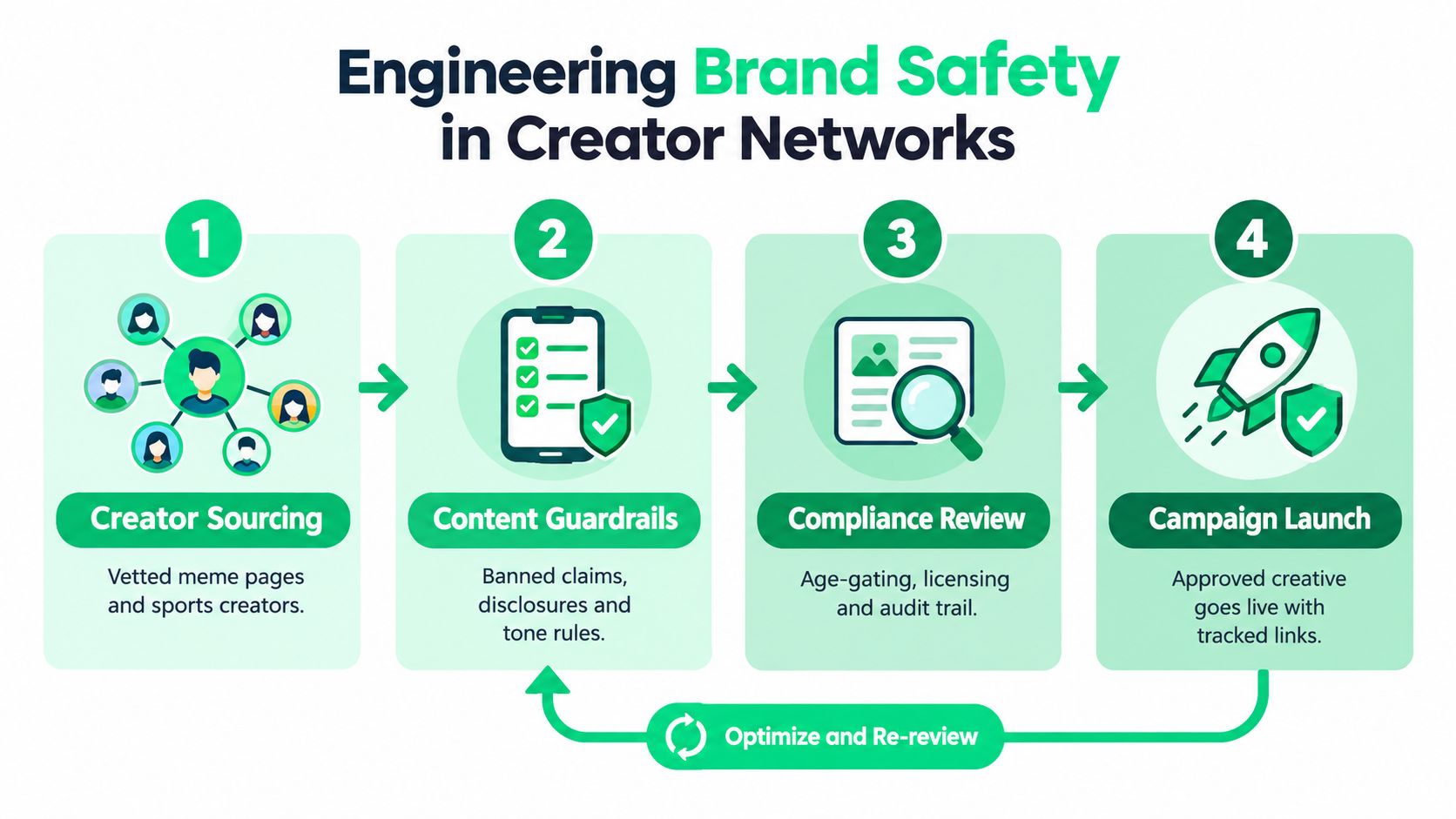
Creator distribution can reach American sports fans at cultural speed, but regulated advertisers can't manage it with a spreadsheet and a hope that every page follows the brief. A creator network needs a real-time, human-in-the-loop operating system that screens the page, the audience, the copy, the visual, the destination, and the timing of the post.
Source creators with evidence
Begin with audience quality rather than follower count. Review geography, engagement authenticity, content history, adjacent advertisers, prohibited topics, and the page's ability to remove or amend a post. A large audience outside the approved market can be less useful, and more risky, than a smaller page with verified tier 1 American reach.
Set minimum thresholds and exclusions before outreach begins. Require a defined source of audience data, retain page-level records, and reject creators whose previous content uses misleading financial language, unapproved gambling claims, or targeting that conflicts with the campaign.
Turn brand rules into enforceable controls
A written brief isn't enough when hundreds of pages publish at different speeds. Encode the rules so the system can block or route content for review:
- Required terms: Include approved product names, disclosures, and calls to action.
- Prohibited claims: Block guaranteed returns, risk-free language, unlimited-payout framing, and misleading odds statements.
- Topic exclusions: Reject content involving minors, violence, player injury speculation, officiating manipulation, or other restricted subjects.
- Geo filters: Apply US targeting and exclude locations or audiences that the legal review doesn't permit.
- Version control: Keep a record of every caption, creative variation, approval, and later edit.
A useful external reference is FLYP LTD's collection of brand safety tag resources, particularly for teams formalizing content-risk workflows.
Review every submission before it goes live
AI scoring can prioritize risk, identify prohibited terms, and flag unusual content quickly. It shouldn't replace human judgment in a regulated campaign. The reviewer needs enough context to inspect the creator, audience, caption, image, offer, disclosure, and destination together.
Require a timestamped approval for every submission. If a page changes its caption, adds a new frame, or posts beside unsafe content, send it back through review. Network-wide caption management is valuable because the operator can update approved language without renegotiating with each creator.
This standard is especially important when a campaign aims to scale attention toward billions of views. Scale multiplies both reach and exposure to mistakes. The answer isn't to avoid creator networks. It's to make review, removal, geo-fencing, and audit trails part of the distribution infrastructure.
Scaling Verified Attention Across Sports Niches
Legacy paid social gives buyers familiar controls, but it also encourages teams to treat impressions as interchangeable. They aren't. An impression from an irrelevant geography, a low-quality placement, or a page with weak engagement doesn't carry the same acquisition value as verified attention from an American sports audience already discussing the category.
Programmatic meme distribution works when it preserves the native behavior of the page while adding operational control. The advertiser can target a sports vertical, supply approved creative, require exclusions, and route distribution through a single coordination layer instead of negotiating with every creator individually.
Pay for attention you can verify
The argument for pay-per-view distribution isn't that every view converts. It's that the buyer has a clearer unit of delivery than a vague promise of influence. FindClout, for example, offers logo and caption distribution, vertical-targeted placements, and content campaigns that adapt brand assets into meme variations. Its stated commercial model includes $0.20 CPM for logo and caption distribution, $0.25 CPM for vertical targeting, and $1.50 to $3.00 CPM for content campaigns, as described in the publisher information.
Those rates shouldn't be compared with sportsbook handle or treated as a guaranteed acquisition cost. The useful comparison is operational: can the buyer verify the audience, control the message, remove unsafe pages, and see which placements generated meaningful downstream behavior?
Organize around sports intent
A national sports campaign should be split into meaningful verticals rather than one undifferentiated “sports fans” pool. Basketball, football, baseball, combat sports, and college audiences have different language, timing, creators, and compliance risks. The campaign needs separate keyword requirements, exclusions, creative templates, and post-review rules for each.
A practical structure looks like this:
- Vertical test: Launch approved creative against a defined sports niche.
- Quality review: Check audience geography, engagement, page context, and compliance.
- Creative iteration: Adapt the hook without changing the approved claim or contract explanation.
- Placement control: Remove pages that underperform or create brand-safety risk.
- Budget expansion: Increase spend only when verified attention and qualified downstream activity support it.
This model is stronger than buying the biggest available creator. A single high-reach page can create concentration risk. A curated group of pages lets the advertiser learn which communities produce the right kind of attention, while rules prevent a successful placement from drifting outside the approved audience.
Orchestrating High-Volume Campaign Execution
A campaign for a prediction platform can look simple from the outside. A sports meme page posts a market card, viewers click, and the platform measures activity. The operating reality is more demanding. The team has to coordinate creator eligibility, product claims, audience geography, approval records, live performance, removals, and reporting without losing control of the message.
Consider a monthly launch around an American football event. The growth team starts with a defined set of tier 1 sports pages, excludes creators with unsafe historical content, and separates pages by audience and niche. Each caption explains the event contract accurately, includes the required disclosure, avoids certainty language, and sends users to a destination that matches the creative.
Run the campaign as a controlled system
The first release should be treated as a pilot, not a national verdict. Review early placements for:
- Audience fit: Are views coming from the intended American geographies and eligible adults?
- Message integrity: Did the creator preserve the approved wording and disclosure?
- Product expectation: Do users understand whether they're placing a sportsbook wager or trading a contract?
- Traffic quality: Are clicks producing qualified registrations and meaningful activation?
- Page behavior: Does the creator respond quickly to edits, removals, or updated instructions?
A rolling agreement gives the operator room to keep reliable pages and remove unsafe ones. One-click removal is more than a convenience. It limits the time a questionable post remains associated with a regulated brand.
Scale only after the evidence holds
Use live analytics to rank creators by verified attention and downstream quality, not by raw follower count. A page that produces fewer clicks but better-qualified users may deserve more budget than a page with louder reach and weak retention.
The platform information for FindClout describes 0% management fee, rolling monthly agreements, pilot guarantees of 100 million views for budgets of $20,000 to $30,000, and budgets that can scale from $100,000 to more than $1 million. Those commercial terms should be assessed against the operator's own legal review, tracking design, conversion definitions, and risk tolerance. A view guarantee doesn't replace audience verification or a clear definition of what counts as a qualified user.
The strongest execution loop is simple: approve, publish, monitor, remove or revise, then re-review. Every asset should have an owner, every decision should leave an audit trail, and every budget increase should follow verified attention rather than excitement around a single viral post.
That discipline protects the brand while allowing the campaign to move at the pace of sports culture. The objective isn't merely to buy more views. It's to route high-quality American attention into a compliant product experience that can support acquisition, activation, and long-term trust.
FindClout helps prediction markets, sportsbooks, and other regulated platforms distribute branded meme content across curated American sports and creator pages with audience controls, fraud screening, real-time review, and centralized campaign management. Visit FindClout to evaluate a brand-safe way to scale verified attention across tier 1 US sports audiences.
Want this audience for your brand?
FindClout puts your brand in front of verified American audiences across every major US page — brand-safe, at scale.
Start Your Campaign