 findclout.com
Brand Safety in Digital Advertising: A Practical Guide
Most advice on brand safety in digital advertising is stuck in 2019. It treats the job like real estate triage: avoid bad neighborhoods, blacklist ugly keywords, call it done. That's not enough anymore.
In 2026, the bigger mistake is buying cheap, technically safe impressions that nobody should value. AI slop, made-for-advertising inventory, fake depth, low-attention pages, and over-filtered campaigns are where brands lose money. If you care about tier 1 American audiences, brand safety isn't just about preventing reputational damage. It's about attention to detail and systems in place to review every submission in real time to scale attention to billions of views while protecting your brand and ensuring these views are in high quality geographies.
The old question was, “Did my ad appear next to something offensive?” The better question now is, “Did I buy a high-quality chance to influence a real person in the U.S., or did I buy a cheap line item that passed a weak filter?”
Table of Contents
- Why Brand Safety Is Really About Reach Quality Now
- What Brand Safety and Brand Suitability Actually Mean
- The Risk Categories Marketers Must Map
- AI, Rules Engines, and Human Review Compared
- Building the Executable Control Layer
- AI Slop, MFA Sites, and the Performance Tradeoff
- Measurement and Governance That Actually Sticks
- A 30-Day Brand Safety Starter Plan
Why Brand Safety Is Really About Reach Quality Now
Tighter exclusions do not make a campaign safer by default. In mature accounts, they often cut off the exact inventory you want and leave you with cheap impressions that pass filters but fail every real business test.
That is the mistake. Brand safety used to center on adjacency. In 2026, the bigger threat is low-grade reach disguised as verified media.
Buyers still treat this like a blacklist contest. They add blocked terms, strip out news, trim domains, and watch reported risk fall. Then delivery shifts into inventory with weak attention, weak trust, and weak buying power. CPM efficiency looks fine. Business results do not.
The market has taken brand safety seriously for years. MediaPost's coverage of a widely cited survey reported that 93% of CMOs had overhauled their digital strategy because of brand safety concerns, 78% were more concerned than in the prior year, 98% said they would choose agencies or suppliers based on provable brand safety and transparency, and 30% had boycotted or reduced spend on channels that could not guarantee it (MediaPost coverage of the survey). The unresolved issue now is not whether safety matters. It is whether your controls protect reputation without wasting scarce tier 1 U.S. reach.
Three forces changed the job.
- Signal loss: Privacy changes weakened lazy targeting and pushed more responsibility onto context, supply quality, and verification.
- Content inflation: Generative publishing flooded the open web with pages that are technically safe and commercially worthless.
- Over-filtering: Buyers chasing perfect cleanliness often block credible publishers, suppress scale, and funnel spend toward inventory that is easier to clear than it is to value.
That last point gets ignored too often.
If your campaign excludes half of premium news, narrows access to verified U.S. audiences, and increases exposure to MFA pages with no real attention, you did not improve brand safety. You traded visible risk for hidden waste.
The operating goal should be simple. Optimize for quality reach delivered.
That means asking harder questions than “what did we block?” Ask whether the impression had a real chance to influence a real person, in a market you care about, inside content that a human would choose to read or watch. Buyers who only celebrate block rates usually miss the bigger loss. They stop some bad placements and still overpay for weak ones.
The same logic applies in creator programs. Context is not just the absence of unsafe content. It is audience quality, fit, and credibility. This piece on selecting creators for gen z brands gets that part right.
Good brand safety protects the brand and preserves access to inventory worth buying. If your controls cannot do both, the control layer needs work.
What Brand Safety and Brand Suitability Actually Mean
Marketers blur these terms and create their own problem. They set blunt exclusions, call it safety, then wonder why reach gets tighter while weak inventory slips through.
Brand safety is the baseline. Brand suitability is the buying strategy built on top of that baseline.
Safety is the floor
The IAB defines brand safety as the controls used across the supply chain to protect brands from negative consumer-opinion effects tied to content and related ROI loss, and its framework includes named categories such as adult content, hate speech, terrorism, illegal drugs, tobacco, vaping, alcohol, spam, harmful content, and sensitive social issues (IAB Brand Safety and Suitability Guide).
Use that as your minimum standard. If content falls into prohibited or clearly harmful categories, the campaign should not fund it.
The IAB Tech Lab's implementation guide matters because it turns policy into something buyers can execute. It treats suitability as a graded decision, not a single pass-fail label, using Floor, High Risk, Medium Risk, and Low Risk content attributes that can be applied through pre-bid and post-bid controls (IAB Tech Lab implementation guide).
That distinction matters in practice.
A page can clear the safety floor and still be a bad buy.
Suitability is the strategy layer
Brand suitability is your brand's rule set for deciding which acceptable environments are worth buying.
A lot of teams get lazy. They treat suitability as reputation management only. In real campaigns, it is also a reach and efficiency decision. A finance advertiser, a kids brand, and a streaming service can all inherit the same safety baseline and still make different suitability calls based on audience intent, context, and tolerance for news, commentary, or user-generated content.
That judgment needs to reflect how media quality has changed. The hard problem in 2026 is not just avoiding obvious harm. It is avoiding cheap, low-trust environments that look safe in a classifier and still do nothing for the brand. If your suitability model cannot separate credible journalism from sensational junk, or original content from AI slop, it is incomplete.
If you want a practical sense of how safety systems are documented in modern products, the safety docs for NotFair are a useful example of how teams turn policy into enforceable rules. For campaign-side scenarios, this guide on brand safety examples in digital advertising is worth reviewing.
Brand Safety vs. Brand Suitability Comparison
| Dimension | Brand Safety | Brand Suitability |
|---|---|---|
| Scope | Universal baseline | Brand-specific interpretation |
| Decision type | Contractual and mandatory | Strategic and campaign-dependent |
| Main goal | Keep ads away from harmful or prohibited environments | Match context to brand tone, audience, and objectives |
| Control style | Hard exclusions | Graduated risk tolerance |
| Example | Block explicit adult content or hate speech | Decide whether conflict reporting is acceptable for this campaign |
Practical rule: Safety asks, “Should any brand buy this?” Suitability asks, “Should our brand buy this in this context, for this audience, at this price?”
Get this split right and your controls become usable. Get it wrong and you either expose the brand to obvious problems or choke off verified reach you wanted.
The Risk Categories Marketers Must Map
Brand risk mapping is not a keyword exercise anymore. The job is to protect reach quality without choking off inventory you want to buy, especially verified tier-1 US supply that gets filtered out by blunt settings.
A usable map starts with categories that change buying decisions, ownership, and enforcement. If a category does not trigger a clear control, it does not belong in the policy.
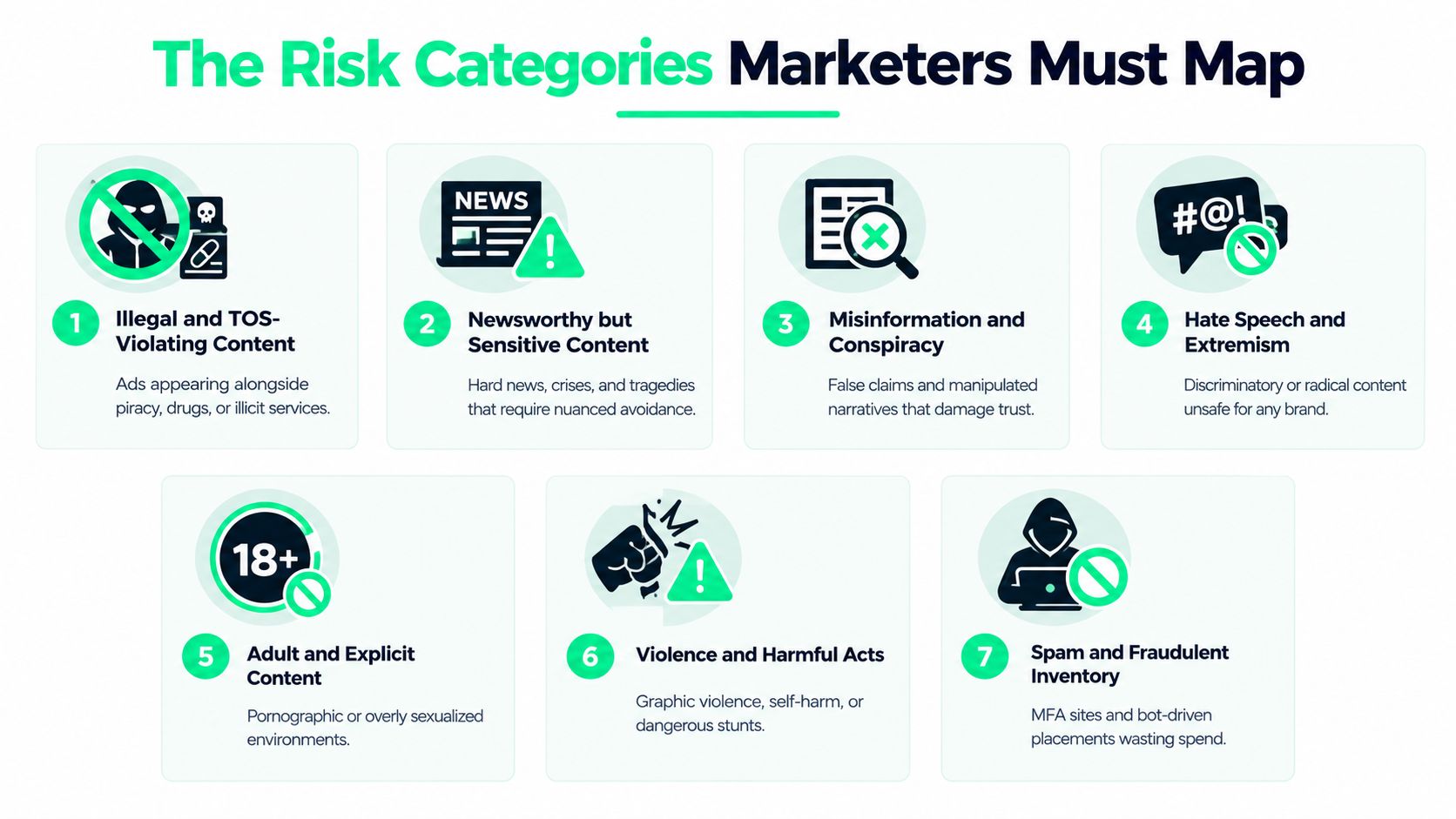
The seven categories that deserve explicit controls
Illegal and TOS-violating content
Start with the hard floor. Piracy, illicit services, illegal drug sales, and direct platform or exchange policy violations should be blocked with deterministic rules, exchange exclusions, and verified supply paths.Newsworthy but brand-damaging adjacency
Legitimate journalism can still be the wrong environment for a campaign. Conflict coverage, violent crime, disasters, and crisis reporting usually call for suitability settings by campaign, not blanket publisher bans.Made-for-advertising sites
MFA inventory drains budget because it looks cheap, clean, and scalable in the bidstream. In practice, it often soaks up spend after aggressive safety filters push you out of better inventory.AI-generated content farms
Outdated safety models break. A page can clear adult, hate, and violence checks and still be low-trust junk built from stitched summaries, synthetic listicles, and mass-produced rewrites.Misinformation and health fraud
Credibility belongs on the risk map. TAG reported that 87% of respondents said it was very or somewhat important that ads not appear near dangerous, offensive, or inappropriate content (TAG survey release). That baseline concern now shows up in a harder form. Buyers need controls for false claims, fake experts, manipulated medical advice, and sensational content that borrows the look of reporting without the standards.Data leakage and redirect chains
Some inventory creates risk after the impression fires. Redirect-heavy paths, reseller clutter, and opaque landing flows can create compliance issues, break measurement, and degrade user experience.Platform-specific creator risk
On social, video, and creator inventory, the publisher is the product. Review repost habits, comment culture, audience geography, prior controversies, and whether the creator's incentives push them toward outrage or low-quality volume.
The control that is most often left undefined: detection signal and owner
Map each category to a detection signal, an action, and an owner.
For example, MFA might be flagged by a supply-path review, a third-party classification feed, or a curated domain list. The action might be block, bid down, or isolate into a test line item. The owner might be programmatic, ad ops, or the agency trading desk. If those three fields are missing, the policy will sit in a deck while the campaign keeps spending.
Good brand safety in digital advertising is an operating model. The strongest setups block harmful environments, score gray areas for suitability, and protect verified reach from getting thrown out with the junk.
AI, Rules Engines, and Human Review Compared
Don't buy the slogan that one layer solves this. It doesn't.
The stack that works in real campaigns uses all three: rules engines for hard floors, AI for context, and humans for judgment. The mistake is trying to force one method to do every job.
Where each layer helps
AI is strongest when the content is ambiguous. It can score sentiment, read surrounding text, interpret topic combinations, and catch contextual nuance that a keyword list misses. That's useful when a word like “shooting” means either sports coverage or a violent incident.
Rules engines are better when you want certainty. They're fast, auditable, and easy to explain to legal, procurement, and agencies. If a domain, category, or phrase always violates policy, a rule is cleaner than a probabilistic score.
Human review is the calibration layer. People handle edge cases, publisher disputes, category tuning, policy drift, and incident forensics. Without that layer, your AI and your rules both decay.
AI vs Rules Engines vs Human Review for Brand Safety
| Method | Strengths | Weaknesses | Best Use Case |
|---|---|---|---|
| AI scoring | Understands context, adapts to emerging topics, catches nuance beyond keywords | Can over-block, misclassify, and create opaque decisions | Suitability scoring and gray-area content analysis |
| Rules engines | Deterministic, fast, easy to audit, consistent | Brittle against euphemisms and new formats | Non-negotiable exclusions and exchange-level controls |
| Human review | Best for judgment, escalation, and calibration | Slower, more expensive, harder to scale alone | Governance, exceptions, and post-incident analysis |
The stack I'd defend to a CMO
Use rules for firm restrictions. Adult content, piracy, explicit hate, and obvious prohibited categories shouldn't depend on model confidence scores.
Use AI for suitability scoring. That's where modern campaigns win or lose. AI can sort a credible article about a sensitive event from manipulative sludge that just happens to dodge your blocked terms.
Use humans for governance. They should review disputes, tune sensitivity, and sample what the automation lets through.
A lot of creator-first media environments follow the same logic. For example, FindClout uses AI scoring with human review before posts go live, alongside geo filters, prohibited-topic rules, and creator eligibility checks. That's the right pattern. Not because it sounds advanced, but because it matches how real risk shows up.
Building the Executable Control Layer
Policy decks don't protect brands. Configuration does.
If your DSP, exchange, SSP deals, and verification settings aren't aligned, the strategy isn't real. Brand safety in digital advertising turns into something campaign managers can run.
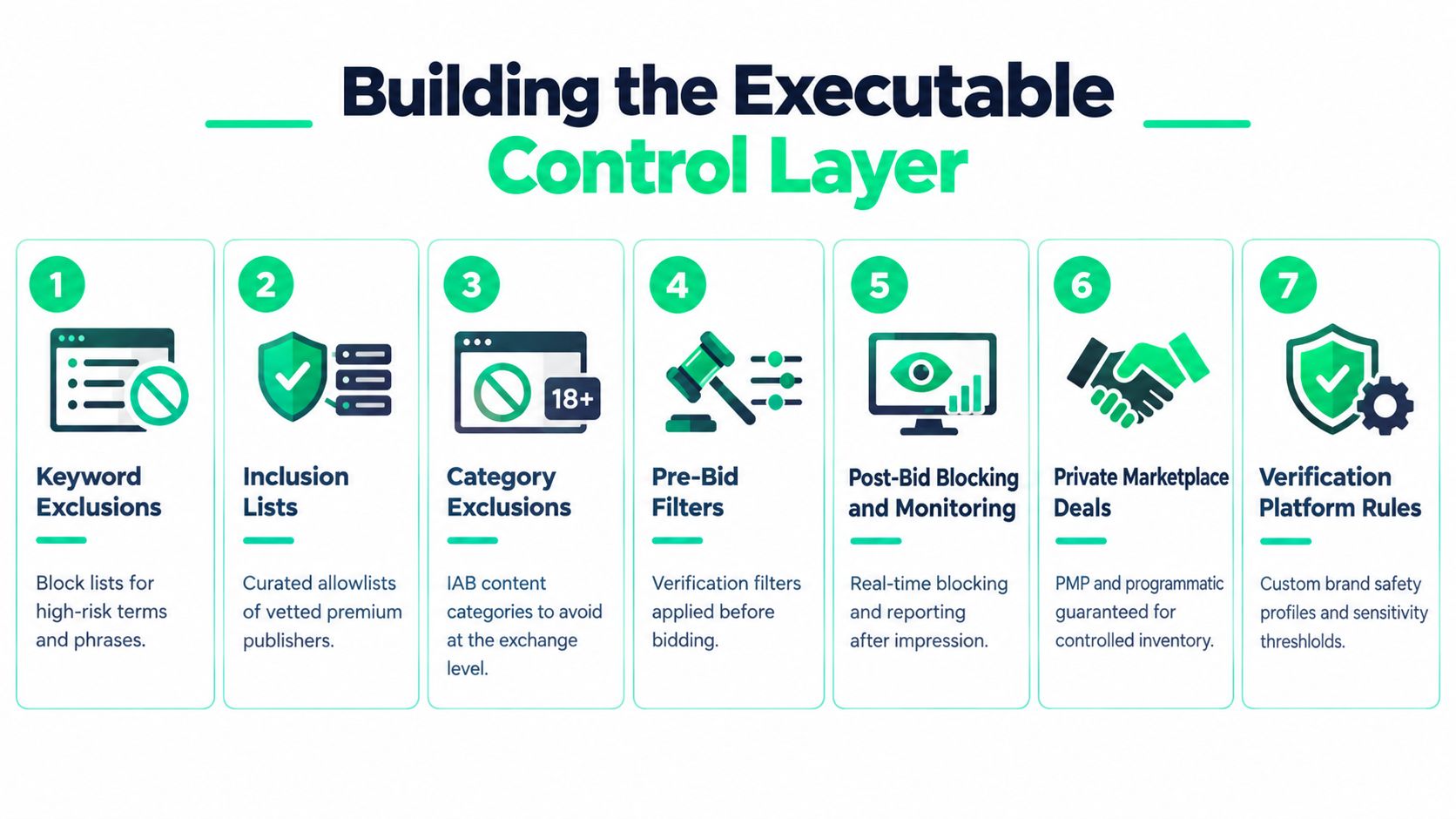
Start with fewer, sharper controls
Most keyword lists are bloated and lazy. A dump of thousands of terms usually blocks more legitimate inventory than dangerous inventory.
A good list includes:
- Core roots and variants such as singulars, plurals, and common misspellings
- Context-sensitive terms separated by campaign type, not one global file
- Language coverage if you buy multilingual inventory
- Review dates and owners so stale terms don't linger forever
Then build outward with stronger structural controls:
- Category exclusions using IAB taxonomies and verification partner segments
- Inclusion lists for vetted publishers and premium video suppliers
- Geo filters to keep delivery concentrated in high-quality geographies, especially tier 1 U.S. audiences
- Device and environment controls if certain placements underperform or create quality issues
- Pre-bid filters to stop low-quality supply before you pay for it
What a sensible setup looks like
At minimum, I'd configure hard exclusions at the exchange or DSP level for universally prohibited environments, then layer a suitability profile on top through a verification vendor. Premium publishers should sit in separate inclusion pathways when possible, especially if the campaign needs stable, quality reach.
If your channel mix includes culturally fast-moving social formats, this piece on brand-safe meme campaigns without losing control is useful because it translates brand rules into creator execution, which is where a lot of teams get sloppy.
A control layer should be narrow where risk is universal and flexible where context matters.
Quick audit for campaign managers
- Check duplication between DSP exclusions and verifier settings
- Review inclusion lists for actual recent delivery, not historical favorites
- Trim keyword bloat that blocks broad, credible editorial inventory
- Confirm geo enforcement if the brief prioritizes American reach
- Separate social creator rules from open-web rules, because the signals differ
Good systems don't just block unsafe media. They preserve access to the inventory worth buying.
AI Slop, MFA Sites, and the Performance Tradeoff
The old brand safety model focused on avoiding obviously unsafe content. That is no longer enough. A lot of waste now sits inside inventory that passes basic safety checks and still drags down brand perception, attention, and conversion quality.
Projection-year coverage says nearly 60% of U.S. digital advertising professionals actively avoid placements next to inaccurate or hallucinated content, and ANA-linked benchmark commentary noted made-for-advertising exposure stayed around 0.4% to 0.6% through 2025 before rising to 1.1% in Q1 2026 (eMarketer coverage). That is the shift. The risk is not just adjacency to offensive content. It is adjacency to thin, synthetic, low-trust content that makes the impression technically valid and commercially weak.
Here's the visual version of that tradeoff.
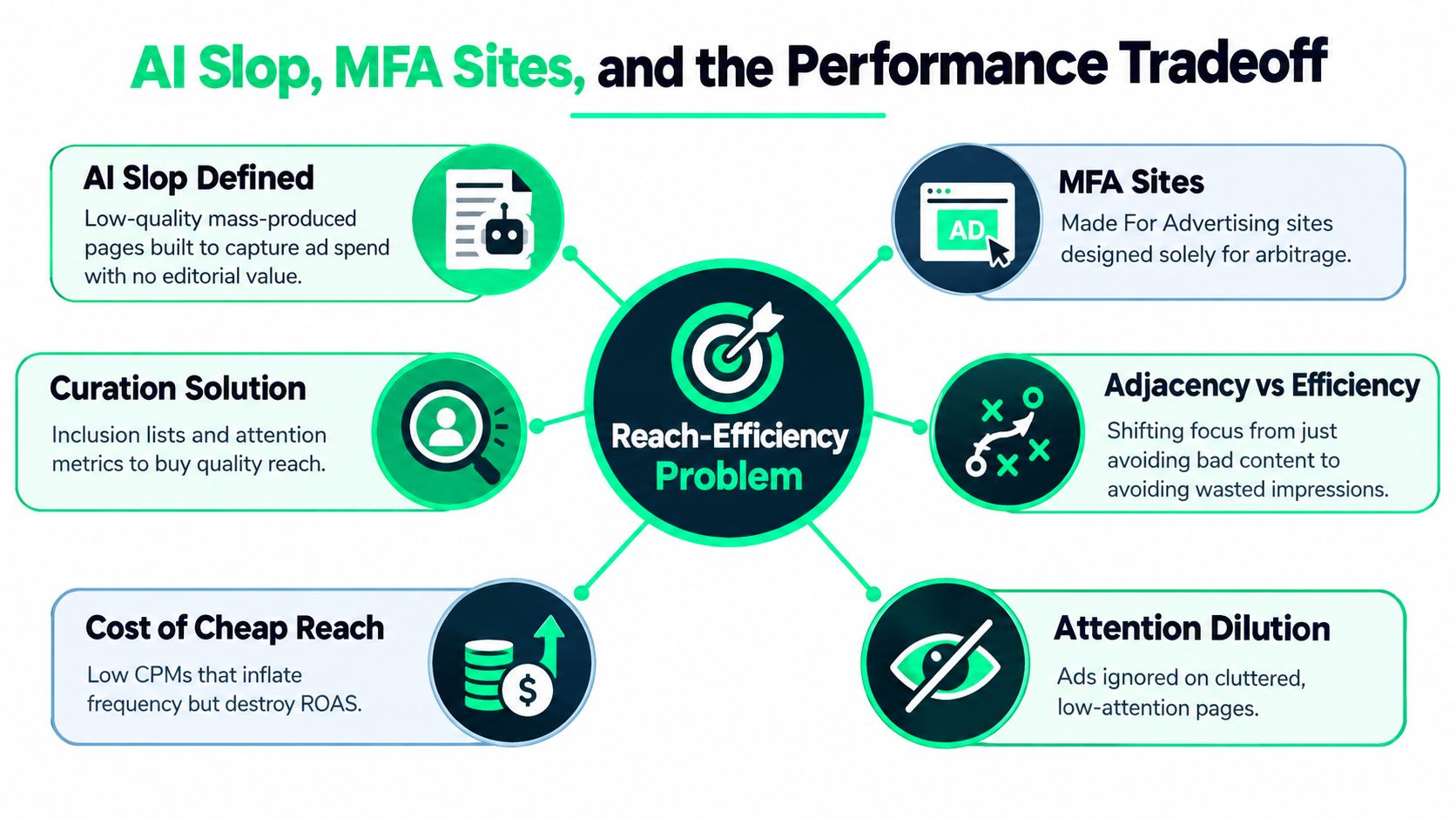
Why strict exclusions can backfire
Over-filtering creates its own waste.
Premium supply runs out first, especially against tier-1 U.S. audiences. The budget still has to clear. So the buy shifts into cheap inventory that survives your rules but does not deliver meaningful attention or brand lift. That is how teams end up congratulating themselves for low incident rates while quality impressions collapse.
Recent benchmark coverage found only 43.3% of programmatic ad spend reached a quality impression in Q1 2026, defined as viewable, measurable, fraud-free, and free of MFA inventory, while the lower-performing half of advertisers saw that figure drop to 32.1%. The same analysis cited advertisers wasting significant spend on MFA sites, with some estimates reaching 55% and one survey averaging 15.3% (Basis benchmark summary).
That points to a supply-path and buying-discipline problem, not just a keyword list problem.
This video gives a broader context for how buyers think about platform-level controls and media quality.
The KPI I'd put on the dashboard
Track verified reach efficiency. Measure how many qualified impressions you buy per dollar after suitability filters, MFA suppression, and geo requirements are applied.
Use a small set of metrics that expose the trade-off clearly:
- Viewability
- Attention quality
- Tier 1 traffic share
- MFA avoidance
- Post-filter delivery efficiency
If blocks go up while qualified reach and business outcomes go down, the setup is failing. Cleaner waste is still waste.
Measurement and Governance That Actually Sticks
If no one owns the thresholds, the incidents, and the exception process, your brand safety policy is just a PDF.
The Media Rating Council defines brand safety as practices and tools that ensure an ad won't appear in a context that can damage the advertiser's brand. The IAB's ad-quality guidance groups brand safety, viewability, and fraud-free delivery as the three core ad-quality metrics advertisers should expect from digital media (MRC ad verification supplement.pdf)).
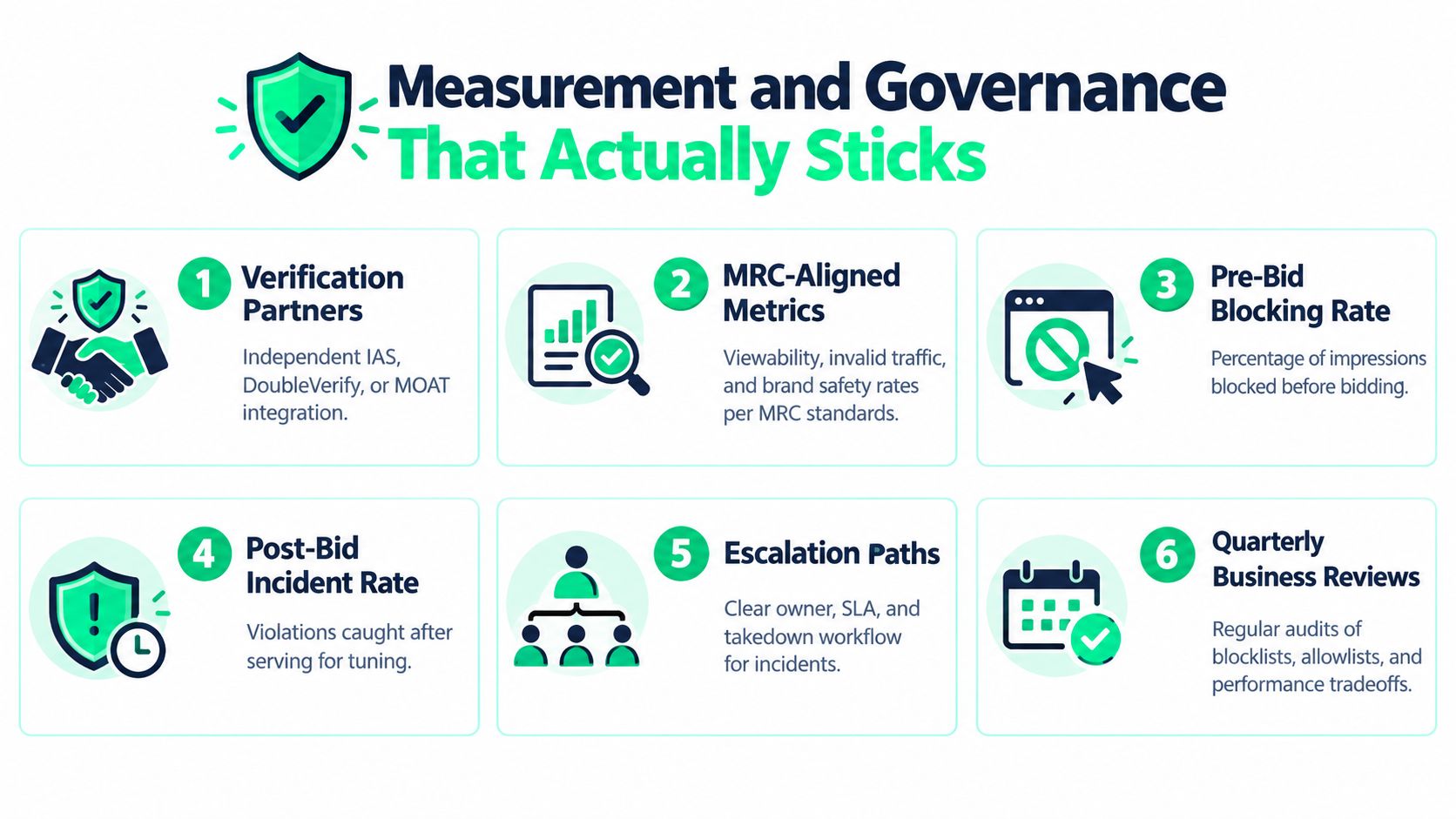
Measure execution separately from governance
These are not the same thing.
Execution metrics are campaign outputs:
- Viewability
- Invalid traffic
- Brand safety incident rate
- Suitability tier distribution
- Time-to-block for newly flagged domains
- Verified reach against target geographies
Governance controls are operating rules:
- Policy owner
- Exception workflow
- Vendor review cadence
- Escalation SLA
- Quarterly audit process
- Documented approvals
If you work in heavily automated environments, it helps to think about policy like data infrastructure. This overview of governance for data movement is relevant because the operational challenge is similar. Clear ownership, traceability, and enforcement matter more than pretty diagrams.
What should be on file
I'd insist on these artifacts for any serious advertiser:
- Written brand safety policy with baseline exclusions
- Suitability tier definitions for each major campaign type
- Pre-bid and post-bid control documentation
- Incident log with disposition and follow-up action
- Quarterly review notes covering list changes, delivery drift, and vendor findings
For reporting discipline, especially in creator or social-heavy programs, this guide to reading meme campaign analytics and CSV exports is a good reminder that governance only works if the underlying reporting is understandable enough for teams to act on.
Governance works when a flagged placement triggers a named person, a deadline, and a specific platform action.
One more rule that saves trouble
Cross-check high-spend campaigns with more than one verification view when possible. Not because every vendor is wrong, but because no single detection model sees everything the same way.
A 30-Day Brand Safety Starter Plan
If your current setup is messy, don't redesign the whole media operation at once. Fix it in four weeks with clear ownership.
Week 1 audit the last 90 days
Pull recent delivery by domain, app, creator page, exchange path, geo, and verifier status. Score it against your risk map. Then isolate where you lost the most money through either avoidable exclusions or weak-quality placements that technically passed.
Look closely at tier 1 American reach. If your business depends on U.S. customers, don't accept aggregate “safe delivery” as a success metric when too much of that reach sits outside high-quality geographies.
Week 2 write the suitability policy
Draft a one-page policy with four levels: Floor, Low, Medium, High. Tie each level to campaign types, creative sensitivities, and approved environments.
Keep it readable enough that an agency trader, an in-house buyer, and legal can all interpret it the same way. If the policy needs a live meeting to decode, it's too vague.
Week 3 tighten controls in platforms
Clean up keyword lists. Build or refresh inclusion lists for priority publishers and premium placements. Switch on pre-bid brand safety filters in every DSP seat that can spend money, not just the flagship account.
Also separate open-web settings from creator and social settings. Those channels need different rules because the content signal and reputational exposure work differently.
Week 4 install governance
Create a measurement table with owner, threshold, cadence, and action. Decide who approves exceptions, who uploads exclusions, and who reviews incidents. Schedule the first quarterly business review before the month ends so the process doesn't die after setup.
The final decision is the one that matters next week: which vendor or stack gets audited first, on what date, and against which budget line. If you can't answer that immediately, the policy still isn't operational.
Brand safety in digital advertising isn't about building the biggest blacklist. It's about buying real attention from real people, in credible environments, with enough precision to protect the brand without choking off reach.
FindClout helps marketers run branded meme and creator distribution with enforceable safety controls, including page vetting, geo filters, approval workflows, fraud screening, and real-time campaign orchestration aimed at high-quality American audiences. If you need brand-safe scale in social environments without giving up operational control, visit FindClout.
Want this audience for your brand?
FindClout puts your brand in front of verified American audiences across every major US page — brand-safe, at scale.
Start Your Campaign