 findclout.com
8 Brand Safety Examples That Scale
Brand safety is a distribution problem, not a policy document. Buying attention at scale without controlling context, audience quality, and review creates avoidable exposure, especially when campaigns run across fast-moving creator networks. The late-2010s platform crises made that clear. After major brands appeared beside extremist and unsafe videos, independent research reported that 75% of brands had experienced at least one unsafe exposure in the prior year (GumGum's history of brand safety). The risk wasn't limited to headlines. Among affected brands, 47% reported social-media blowback and 25% reported negative press (GumGum's brand-safety overview).
Modern brand safety therefore needs an operating loop: vet the page, detect the signal, block or remove the risk, and verify the result. The standard has to hold across tier-1 American audiences, high-quality geographies, and campaigns designed to scale toward billions of views. A placement that merely delivers views isn't enough. The valuable placement protects the brand, reaches authentic people, and gives operators the evidence to improve the next deployment.
The following brand safety examples focus on real-time review, geographic verification, fraud detection, enforceable exclusions, live remediation, and post-campaign learning. That infrastructure is also central to scalable video distribution in 2026.
Table of Contents
- 1. Real-Time AI and Human Hybrid Review System
- 2. Geo-Fencing and Demographic Verification for Tier-1 U.S. Audiences
- 3. Brand Rules Engine with Enforceable Exclusions
- 4. Post-Campaign Audience Authenticity Audits
- 5. Real-Time Caption and Creative Management Across Distributed Networks
- 6. Fraud Detection via Engagement Pattern Anomalies and Behavioral Verification
- 7. Tier-1 Creator Vetting and Continuous Quality Scoring
- 8. Centralized Campaign Orchestration with One-Click Creator Removal
- 8-Point Brand Safety Comparison
- Turn Brand Safety Into a Control Loop
1. Real-Time AI and Human Hybrid Review System
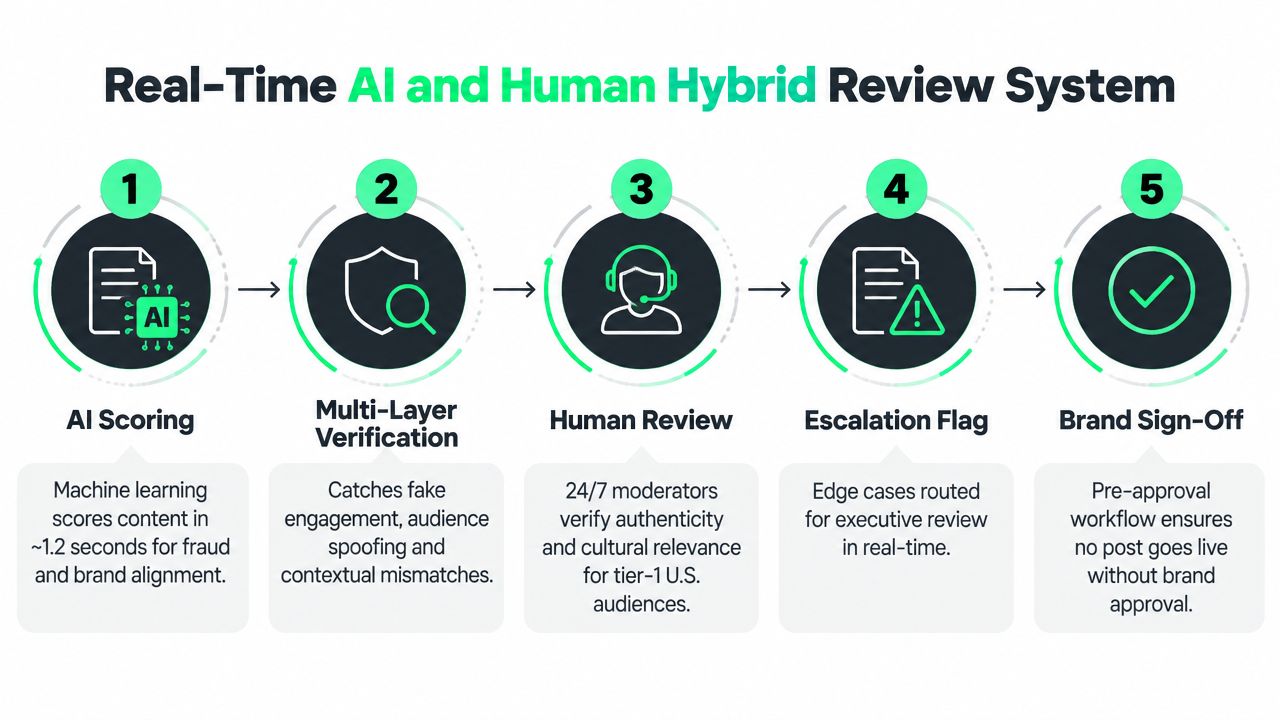
A review system should stop unsafe content before publication, not explain the problem after a brand has already appeared beside it. Automated screening can inspect captions, hashtags, visual context, account history, and engagement signals quickly. Human reviewers then resolve ambiguity, particularly where sarcasm, cultural references, politics, gambling, or controversial humor could produce different interpretations for a tier-1 U.S. audience.
FindClout combines AI scoring with 24/7 human review before posts go live. Its stated average AI scoring time is approximately 1.2 seconds, based on the platform's published service information. The machine layer can flag fraud, inappropriate context, and brand misalignment, while human reviewers verify authenticity and cultural relevance before approval.
That hybrid model matters because keyword systems miss context. A sports betting reference may be commercially relevant for one campaign and unacceptable for another. A harmless-looking meme may contain a visual or caption association that conflicts with a fintech brand's compliance rules.
The control loop
- Vet the page: Confirm the creator belongs to the approved network and has a credible audience profile.
- Detect the signal: Scan captions, hashtags, visuals, engagement patterns, and prohibited topics.
- Block or escalate: Reject clear violations and send borderline material to a human reviewer.
- Verify the result: Record why the post passed or failed, then use audit findings to refine future rules.
A crypto exchange promoting sports betting content should require verified U.S. sports pages and an explicit exclusion list for off-brand subjects. A fintech app entering gaming communities should review every caption for compliant wording and inappropriate claims. The important operational detail is not the campaign story. It's the approval record attached to every submission.
Practical rule: If a reviewer can't explain why a post passed, the system hasn't created enough evidence to scale it safely.
Publish daily audit reports showing the page, content, rule result, reviewer decision, and escalation reason. That record turns brand safety from a promise into an accountable workflow.
2. Geo-Fencing and Demographic Verification for Tier-1 U.S. Audiences
A campaign can be brand-safe in context and still fail commercially if the audience isn't where the buyer expects. For brands prioritizing American consumers, geographic quality needs its own verification layer. A page may look domestic because of its language, theme, or creator identity while its actual engagement comes from international viewers, VPN users, data centers, or automated accounts.
The strongest approach combines IP geolocation, device signals, and engagement authenticity rather than trusting a single indicator. Impression-level checks can identify traffic that doesn't match the campaign's geographic requirements. Known VPN services, data-center IP ranges, and suspicious carrier patterns should feed exclusion lists before delivery begins.
Tier-1 criteria also need to be explicit. A practical operating definition can combine a minimum follower threshold, engagement quality, audience geography, and account history. Those inputs should be treated as qualification signals, not as proof on their own. A large following doesn't guarantee an American audience, and a high engagement rate can be manufactured.
What to verify before activation
- Geography: Confirm that the audience is concentrated in the intended markets, with special attention to the United States.
- Device consistency: Compare IP location with device and account behavior over time.
- Authenticity: Separate human engagement from bot-like activity and coordinated traffic.
- Drift: Continue checking delivery after launch because audience composition can change.
A detailed tier-1 audience clipping framework can support campaign planning. FindClout focuses on American audiences and high-quality geographies, with controls designed to keep distribution aligned with the buyer's intended market.
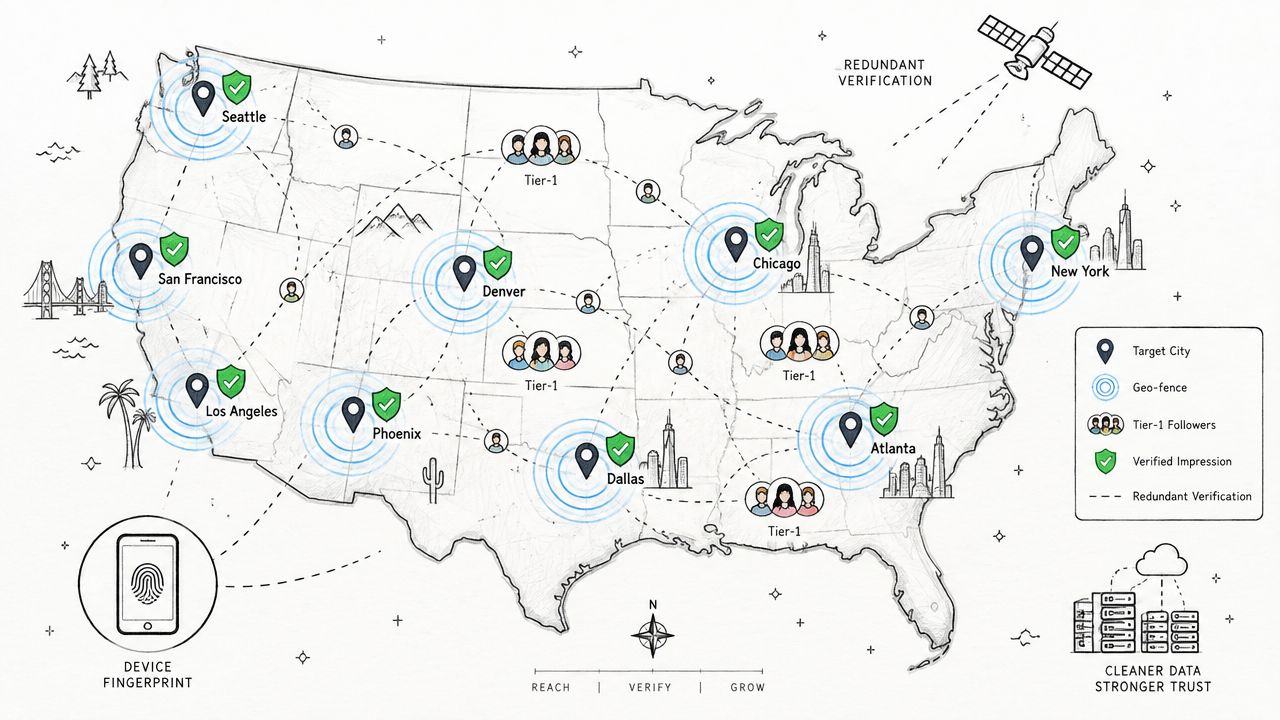
Don't treat geography as a reporting detail. Require verification during delivery, then use third-party checks on a defined sample after the campaign. If the result shows drift, pause the affected pages, investigate the cause, and preserve the evidence for the next allowlist update.
3. Brand Rules Engine with Enforceable Exclusions
A brand rule that lives in a PDF isn't a control. The rule has to enter the distribution path, evaluate the proposed content, and produce an enforceable decision before publication.
A configurable rules engine can check required terms, prohibited topics, follower thresholds, geography, captions, hashtags, and placements. That's more reliable than asking each creator to interpret a loosely written brief. It also creates consistency across hundreds of pages, where manual coordination tends to introduce omissions and inconsistent judgment.
Consider a prediction market brand that requires sports-related language while excluding political pages. The rule should be machine-readable, applied across every creator, and re-verified when the caption changes. A fintech campaign might require U.S. pages and a minimum audience threshold while excluding crypto references. A gaming advertiser could block pages associated with gambling addiction content or controversial streamers without excluding the entire gaming category.
Build rules in layers
Start with broad controls for geography, account eligibility, and audience authenticity. Add topic and keyword rules based on actual campaign findings. This sequence reduces the chance that an overbroad exclusion list will remove safe inventory before the team understands the trade-off.
Create separate rule sets for different risk profiles:
- Awareness campaigns: Use wider suitability settings when the brand can tolerate more contextual variation.
- Sensitive products: Apply stricter controls for crypto, fintech, gaming, and regulated offers.
- Creative variants: Scan every caption and asset version, not just the original brief.
- False-positive review: Inspect legitimate pages that were rejected and adjust the rule where appropriate.
Brand safety and brand suitability aren't identical. Safety establishes the baseline of environments the brand can't support. Suitability determines which acceptable environments fit the brand's audience, tone, and commercial objective. If the engine treats both as one blunt blocklist, it may protect the brand while unnecessarily destroying reach.
Audit the rules monthly. The best engine is not the one with the most exclusions. It's the one that makes the brand's actual risk tolerance executable.
4. Post-Campaign Audience Authenticity Audits
Pre-launch screening prevents known risks. It can't prove that every delivered view came from a genuine, intended audience. Post-campaign auditing closes that gap by comparing delivery with downstream behavior, page-level patterns, and authenticity benchmarks.
An audit should examine more than total views. Review shares, clicks, conversions, repeat behavior, audience geography, and unusual concentration by page. A creator that delivers volume but no meaningful downstream action may be attracting low-quality or artificial engagement. That doesn't automatically prove fraud, but it does justify investigation.
For sports betting, fintech, and gaming campaigns, establish separate baselines. Each niche has different natural behavior, and a single engagement benchmark can create misleading conclusions. Compare each page against relevant network averages, then investigate pages that sit far outside the normal range.
What the audit should produce
- Page-level quality findings: Identify which pages delivered authentic engagement and which showed fraud markers.
- Conversion evidence: Connect views to clicks, registrations, purchases, or other agreed outcomes.
- Exception records: Document pages removed from future rotation and the reason for removal.
- Commercial resolution: Request credits or make-goods when delivery fails contractual requirements.
- Allowlist updates: Feed verified performers into future campaign planning.
The post-campaign report should answer a practical question: which pages deserve more trust next time? Impression counts alone can't answer it. A page with fewer views but stronger verified actions may be more valuable than a high-volume page that attracts suspicious traffic.
This audit also protects the relationship between brand and network. A buyer can challenge non-compliant delivery with evidence, while the network can distinguish a real quality issue from an isolated statistical anomaly. The result is a tighter allowlist, more defensible budget allocation, and less dependence on headline delivery numbers.
5. Real-Time Caption and Creative Management Across Distributed Networks
Distributed campaigns create a brand-safety problem when operators can't update messaging quickly. A promotion changes, a product claim needs revision, a sports matchup ends, or a compliance team rejects a phrase. If the brand must contact every creator individually, the old caption may remain live long after the decision.
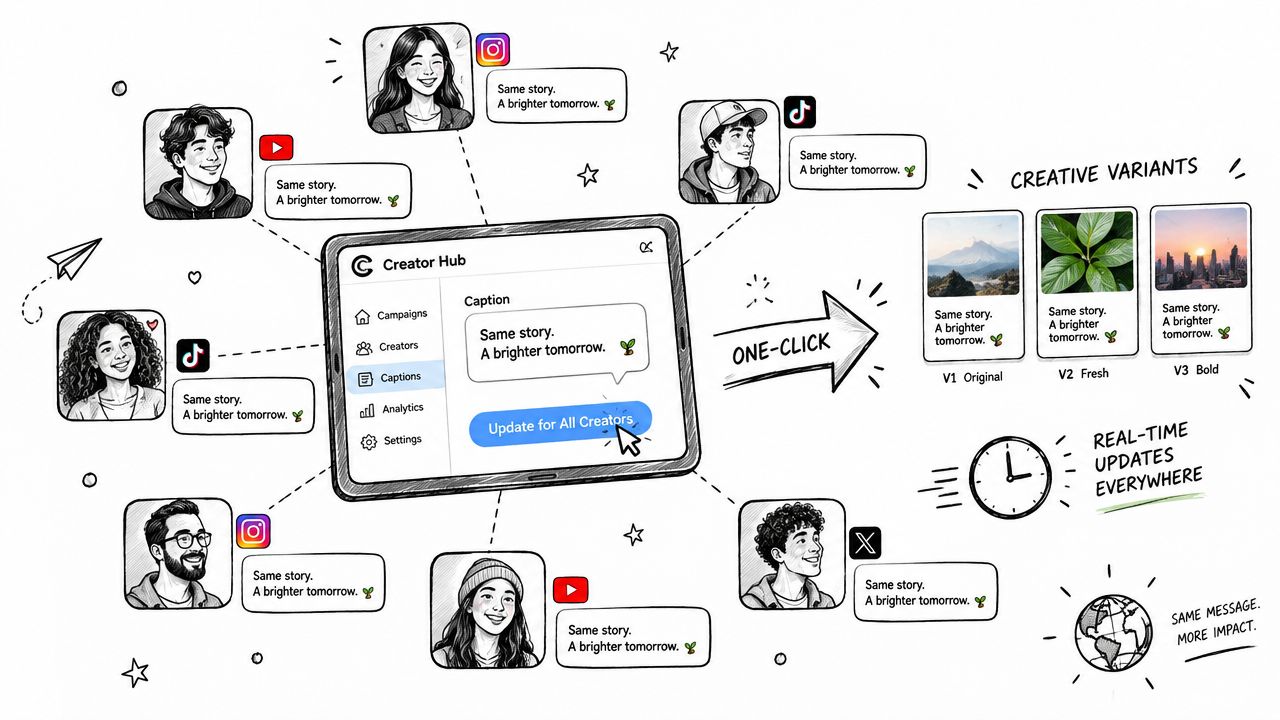
A centralized content management system turns caption and creative control into an operational function. Approved updates can propagate across a network, while each version remains tied to a campaign, page, reviewer, and timestamp. That record matters when the brand needs to show which message was active at a particular moment.
The system should support templates for dynamic content such as scores, odds, promotional codes, or matchup references. It should also support a staged rollout. Test a change on a subset of pages, inspect unintended effects, then deploy the approved version across the wider network.
Speed still needs governance
Real-time editing doesn't mean changing copy continuously without evidence. Use A/B testing to measure whether a new caption improves the intended outcome. Archive each version with its approval status and performance results so future teams don't repeat failed experiments.
FindClout's real-time caption management is designed to update distributed creator content from a centralized workflow. That's especially useful for American sports campaigns, where the relevance of a caption can change during the day and the brand may need to respond without losing control of the network.
A safe process looks like this:
- Draft: Build the new caption from an approved template.
- Scan: Check required terms, exclusions, claims, and tone.
- Review: Route borderline language to human approval.
- Pilot: Release the change to a controlled page group.
- Deploy: Roll out the approved version and monitor results.
- Archive: Preserve the version history and performance evidence.
Creative ownership also includes rights management. Teams distributing editorial or creator-supplied assets should follow a clear guide to editorial image licensing before publication.
6. Fraud Detection via Engagement Pattern Anomalies and Behavioral Verification
Fraud rarely announces itself through one obvious signal. A suspicious page may show normal follower growth but abnormal engagement timing. Another may have credible comments but an implausible conversion-to-view pattern. Effective detection compares multiple behavioral signals and watches for coordinated activity across pages.
Build a baseline for each niche. Sports pages behave differently from gaming or fintech pages, particularly during major events or seasonal peaks. Use percentile-based thresholds instead of rigid universal rules, then re-baseline as audience behavior changes.
The system should monitor:
- Temporal patterns: Look for engagement arriving in unnatural bursts or repeated intervals.
- Growth trajectories: Compare follower growth with content output and historical behavior.
- Cross-page coordination: Identify identical engagement timing, repeated accounts, or shared activity patterns.
- Conversion relationships: Flag pages whose downstream actions don't align with their reported views.
- Account quality: Inspect suspicious follower clusters, device signals, and location inconsistencies.
One detected anomaly may be noise. Multiple correlated anomalies deserve escalation. The operator should pause the page, preserve the relevant logs, and determine whether the problem comes from low-quality traffic, coordinated manipulation, or a measurement error.
FindClout describes fraud screening as part of its brand-safety process, combining AI scoring and human review. Marketers evaluating bot view detection methods should ask whether the system can explain why it flagged a page, not merely assign a risk label.
A fraud model earns trust when its alerts lead to decisions, not when it produces a large volume of unexplained warnings.
The same principle applies to financial advertisers. Traffic verification supports broader efforts to stop card fraud, but media fraud and payment fraud remain separate control problems. Don't use one as a substitute for the other.
7. Tier-1 Creator Vetting and Continuous Quality Scoring
Creator vetting should determine eligibility before a page enters a campaign, then continue after activation. A static approval is weak because audience composition, content themes, ownership, and engagement patterns can change.
A quality score can combine audience geography, authenticity, content safety, consistency, engagement quality, and campaign outcomes. The score should influence campaign eligibility, not just reporting. High-quality creators may qualify for sensitive products and premium placements, while lower-scoring pages can remain restricted until they address the identified weaknesses.
The score must be explainable. Creators need to know whether they're losing eligibility because of geographic drift, suspicious engagement, unsafe content, inconsistent posting, or weak downstream performance. Transparent criteria give legitimate creators a path to improve and make manipulation harder to hide.
Qualification should be continuous
Use a clear review cadence, but trigger additional checks when the page changes materially. A sudden audience shift, unusual follower growth, new content category, or brand-safety incident should reopen the review immediately.
A strong vetting process includes:
- Pre-activation checks: Review ownership, content history, audience geography, and authenticity.
- Vertical criteria: Apply standards suited to sports, gaming, finance, crypto, or other niches.
- Quality scoring: Use relative performance and risk signals rather than one universal threshold.
- Sensitive-campaign restrictions: Require stronger evidence for regulated or reputation-sensitive products.
- Periodic audits: Recheck pages and adjust the scoring model when creators learn how to optimize for it.
FindClout's creator vetting process reflects the principle that a curated network needs ongoing qualification, not a one-time signup review. The objective is a dependable pool of American pages that can support scale without turning volume into the only selection criterion.
8. Centralized Campaign Orchestration with One-Click Creator Removal
A campaign spread across hundreds of pages needs a command center. Without one, the brand is forced to coordinate approvals, captions, reporting, budget shifts, and removals through fragmented conversations. That delay creates risk because the team may know a page is off-brand but lack a fast way to stop delivery.
Centralized orchestration consolidates creator relationships, campaign deployments, live performance, and review status in one dashboard. Operators can launch approved content, monitor page-level outcomes, reallocate budget, and disable a placement without waiting for separate creator responses.
The one-click removal function is particularly important. A brand-safety incident can involve a page, a caption, a visual, or a sudden change in surrounding content. The right control is immediate suspension, followed by investigation and documentation. Leaving the content live while the team debates ownership turns a manageable exception into unnecessary exposure.
Make removal rules operational
Define thresholds before launch. Decide which events trigger an automatic pause, which require human confirmation, and who has authority to remove a creator. Include escalation timing in the campaign plan, not just the postmortem.
Track downstream results per creator, not only aggregate views. A centralized system can identify pages that generate meaningful actions, pages that consume delivery without producing outcomes, and pages that introduce risk disproportionate to their value. Budget should move toward verified performance, but only within the brand's safety and suitability boundaries.
FindClout operates as a single coordination layer for a curated network of creator pages, with brand controls, fraud screening, real-time campaign orchestration, and one-click removal capabilities described in its platform information. For brands focused on tier-1 American audiences, especially sports, gaming, prediction markets, and fintech, that consolidation reduces the operational gap between detecting a problem and stopping it.
8-Point Brand Safety Comparison
| Solution | 🔄 Implementation Complexity | 💡 Resource Requirements | ⭐📊 Expected Outcomes | ⚡ Ideal Use Cases | ⭐ Key Advantages |
|---|---|---|---|---|---|
| Real-Time AI and Human Hybrid Review System | High, ML pipeline + 24/7 human ops, multi-step workflows | Very high, AI infra, trained moderator teams, continuous training | Very high brand safety & authenticity; near-elimination of fake traffic; sub-10-min launch capability | Regulated/high-risk campaigns (fintech, crypto, igaming); enterprise brand protection | Eliminates ≈99% fake traffic; preserves cultural nuance; scalable verification |
| Geo-Fencing and Demographic Verification for Tier-1 U.S. Audiences | Medium–High, impression-level geo + device fingerprinting | High, geolocation, carrier data, pre-verified creator DB | Accurate U.S. impressions; reduced wasted spend; CPMs reflect real value | U.S.-only targeting, sports betting, regional promotions | Precise geo-filtering; 95%+ fraud reduction; improved CPM accuracy |
| Brand Rules Engine with Enforceable Exclusions | Medium, rule encoding, cascading, realtime enforcement | Moderate, rule management UI, keyword lists, testing framework | Prevents policy violations pre-publish; rapid network-wide pivots | Compliance-heavy products (crypto, fintech); campaigns needing strict exclusions | Network-wide guardrails; <2 min rule propagation; reduces legal burden |
| Post-Campaign Audience Authenticity Audits | Medium, data pipelines and forensic analytics | Moderate–High, integration with CDN/analytics and data science teams | Forensic verification of impressions; identifies fraudulent creators; informs future buys | High-spend reviews, ROI validation, creator performance assessment | 100% retroactive confidence; identifies top performers; justifies spend |
| Real-Time Caption and Creative Management Across Distributed Networks | Medium, centralized CMS + API integrations, staged rollouts | Moderate, dashboard, templates, version control, A/B tools | Rapid messaging updates; quicker optimization; higher CTRs from timely changes | Time-sensitive campaigns (sports lines, promos); large distributed creator networks | One-click updates; rapid A/B testing; network-wide consistency |
| Fraud Detection via Engagement Pattern Anomalies & Behavioral Verification | High, advanced ML baselining and continuous monitoring | High, 6+ months historical data, modeling, anomaly infrastructure | Detects sophisticated fraud; early warning signals; >99% common-attack detection | Large networks, high-fraud verticals, pre-emptive monitoring | Sophisticated anomaly detection; cross-page correlation; scalable alerts |
| Tier-1 Creator Vetting and Continuous Quality Scoring | Medium, vetting workflows + monthly re-scoring automation | Moderate, API integrations, scorecards, onboarding processes | Higher average creator quality; pricing tied to quality; fewer fraud incidents | Building curated creator pools; sensitive campaign eligibility control | Incentivizes quality; transparent scorecards; scalable vetting |
| Centralized Campaign Orchestration with One-Click Creator Removal | Medium–High, unified dashboard, API controls, audit trails | High, data warehouse, realtime metrics, integration with publishers | Faster incident response; dynamic budget reallocation; operational efficiency | Large-scale performance campaigns; rapid remediation needs | One-click removal; dynamic budget shifting; consolidated control |
Turn Brand Safety Into a Control Loop
The strongest brand safety programs don't ask whether a campaign is safe once. They create repeated decisions before, during, and after delivery. That matters because the industry has already learned that awareness alone doesn't produce protection. One study found that 70% of companies said they had faced brand-safety issues in the previous year, while only 26% had taken action (GumGum's brand-safety history). The gap is operational. Teams need ownership, rules, evidence, and authority to act.
Start by vetting creators before activation. Confirm content history, audience geography, engagement quality, and suitability for the specific product. A sports page may be appropriate for one campaign and unsuitable for another if its surrounding content changes. Treat tier-1 American reach as a qualification requirement, not an assumption based on page language or apparent popularity.
Next, define enforceable rules. Separate universal safety exclusions from brand-specific suitability controls. Required terms, prohibited topics, minimum page standards, geographic filters, and caption rules should feed directly into the approval process. Keyword blocking alone won't resolve sarcasm, visual context, synthetic media, or coordinated manipulation, so pair automated classification with human review.
Monitor continuously after approval. Verify audience geography, inspect engagement anomalies, review live captions, and keep a clear removal owner available. YouTube's post-2017 approach illustrates how platforms moved toward automated brand-safety analysis for monetized videos, while independent moderation systems increasingly support real-time checks across text, images, live video, and AI-generated content (platform governance analysis, real-time content moderation mechanics). These controls don't eliminate judgment. They make judgment faster and more consistent.
Consumer expectations justify the investment. In a 2025 study, 82% of consumers said appropriate surrounding content matters, 75% said they feel less favorable toward brands advertising near misinformation, and 51% said they're likely to stop using a product or service when an ad appears near inappropriate content (Integral Ad Science's brand-safety research). Brand safety therefore protects more than reputation. It supports trust, purchase intent, and the quality of the attention being purchased.
Use FindClout as an example of centralized orchestration for brands seeking tier-1 American audiences, real-time review across a curated creator network, and scalable attention without surrendering control. Its workflow combines creator qualification, brand rules, AI scoring, human pre-approval, fraud screening, live caption management, and page-level campaign controls.
Keep the operating checklist short:
- Audience quality: Confirm authentic tier-1 American geography and meaningful engagement.
- Subject-matter exclusions: Document prohibited topics, competitors, claims, and contextual risks.
- Approval ownership: Name the person or team responsible for final sign-off.
- Escalation timing: Define when borderline content moves from automation to human review.
- Removal authority: Give an authorized operator the ability to pause a page immediately.
- Delivery evidence: Require page-level results, audit findings, exception records, and rule outcomes after the campaign.
Brand safety works when every control produces a decision and every decision leaves evidence.
FindClout offers programmatic branded meme distribution across a curated network of high-reach creator pages, with tier-1 American audience focus, AI scoring, human review, fraud screening, enforceable exclusions, and real-time campaign orchestration. Visit FindClout to evaluate a controlled path to scalable attention that protects your brand while your campaigns grow.
Want this audience for your brand?
FindClout puts your brand in front of verified American audiences across every major US page — brand-safe, at scale.
Start Your Campaign