 findclout.com
Fraud Detection Rules for Distributed Brand Content
Blocking more bots doesn't automatically save a budget. A 2025 fraud intelligence report found 30–45% of programmatic traffic initially classified as valid failed deeper validation, while 9–18% of activity inside walled gardens showed indications of invalid traffic, according to the 2025 fraud intelligence report on validation failures. That's the uncomfortable reality behind modern fraud detection rules. Traffic can pass a technical bot check and still deliver no real attention, no tier 1 American viewer, and no plausible path to a customer. Operators who only count platform-reported views are grading the easiest part of the problem.
Table of Contents
- Why Fraud Detection Rules Are the Routing Layer
- The GIVT and SIVT Spine Behind Every Rule
- Deterministic Event-Level Rules That Block Obvious Fraud
- Behavioral Scoring for Traffic That Looks Human
- The Human Review Queue Behind Every Borderline Decision
- AI Scoring in Real Time and Why Speed Matters
- Geo, Engagement, and Audience Filters That Tighten the Funnel
- Brand-Safety Rules That Run Before Anything Goes Live
- Setting Thresholds by Environment Instead of One Universal Cutoff
- A Representative Rule Set and Enforcement Workflow
- Operator and Buyer Checklist for Fraud Detection Rules
Why Fraud Detection Rules Are the Routing Layer
Teams describe fraud detection rules as a filter they apply after buying media. That framing is backwards. On a distributed meme and creator network, every submission is a routing request. The content wants entry into a brand's funnel, across hundreds of pages, in front of American audiences who'll judge the brand by what sits next to it. The rules engine decides whether that request proceeds, waits, or stops.
Post-campaign filtration can't undo that decision. Once a post is live, screenshots travel, captions get copied, and invalid views have already shaped optimization. You can claw back money in reconciliation, but you can't claw back exposure. That's why enforcement has to happen in real time, before publication and before a view becomes billable, not in a monthly spreadsheet review.
What Routing Changes in Practice
A routing layer evaluates three questions at once. Is this traffic real? Is this audience the tier 1, primarily American audience the brand paid for? Is this content safe to carry the brand's name? A post can fail any one of those tests while passing the other two, and each failure needs a different action.
Scale makes manual judgment alone impossible, and automation alone careless. The working model pairs AI scoring on every submission with 24/7 human review for anything borderline, so attention can scale to very large view volumes without lowering the bar for what counts. Reviewers see the same signals the model used, and their decisions feed back into rule weights.
A filter cleans up after a bad buy. A routing layer prevents the bad buy from reaching the audience at all.
That distinction drives everything that follows. Rules aren't a compliance artifact you show auditors once a year. They're the live control system that protects brand safety, geography quality, and billing integrity on every single view.
The GIVT and SIVT Spine Behind Every Rule
Every durable rules engine rests on one distinction. The Media Rating Council released its Invalid Traffic Detection and Filtration Guidelines, Version 1.0, on October 27, 2015, establishing General Invalid Traffic (GIVT) and Invalid Traffic (SIVT), as documented in the MRC interim updates to the IVT guidelines. In June 2020, IVT 2.0 updated that framework for evolving techniques, data centers, purchased traffic, upfront filtration, and decision rate.
GIVT is the routine layer. It covers activity detectable through standardized checks, including known data-center traffic, recognized bots and crawlers, non-browser user-agent headers, pre-fetch traffic, technically invalid sizes such as 0×0 or 1×1 pixels, and sessions that can't render images. These cases don't need debate. They need fast, deterministic handling.
SIVT is the investigative layer. It resembles legitimate behavior closely enough that a single signal won't settle it. Detection requires multiple signals, behavioral analysis, or human investigation. Coordinated accounts, human-like automation, and manipulated engagement live here, and they routinely defeat list-based defenses.
Why One Bot Score Fails
A single score collapses two different problems into one number. It can't tell you whether traffic failed a known crawler check or merely behaved oddly during a genuine viral spike. Those situations demand opposite responses, one an automatic exclusion, the other a careful hold.
- Deterministic rules handle known crawlers, user-agent validation, and data-center screening instantly.
- Behavioral controls evaluate ambiguous patterns across accounts, devices, and time.
- Human investigation resolves cases where context matters more than any threshold.
Filtration is also a commercial act, not just a measurement preference. When traffic fails validity checks, that result should change reporting, optimization, partner review, and settlement in real time. If invalid views still get billed and still train your targeting, your rules are decoration.
Deterministic Event-Level Rules That Block Obvious Fraud
The first layer runs on every event, before any view can become billable. There's no sampling here and no waiting for a campaign to finish. Either an event passes the deterministic checks or it doesn't, and the original event is retained either way so the decision stays auditable.
Start by normalizing a fixed field set. Every event should carry a timestamp, creator handle, post identifier, pseudonymous viewer or device ID, geography, user agent, referrer, and view duration in consistent formats. Teams building streaming pipelines for this kind of event processing will find useful architecture patterns in the Streamkap streaming fraud resources, particularly around evaluating events as they arrive rather than in batches.
Hard Exclusions That Fire First
- Known crawlers and bot identifiers: Reject matches against maintained lists without further scoring.
- Data-center traffic: Exclude known invalid data-center sources that don't correspond to real audience access.
- Malformed user agents: Block non-browser or malformed strings and protocol inconsistencies.
- Duplicate event IDs: Drop repeat transactions so one view can't be counted twice.
- Impossible intervals and excessive speed: Flag transaction timing no human session could produce.
This structure follows the approach described in the IAB summary of the MRC IVT detection and filtration guidelines, which identifies routine list and parameter filtering alongside transaction-level activity analysis as core controls, plus continuous coverage, activity-based thresholds, repeat-transaction analysis, interval testing, and outlier identification.
False positives are the honest cost of this layer, and they're manageable. Shared infrastructure, mobile carrier NAT, VPNs, accessibility tools, and legitimate prefetching can all resemble abuse at event level. Good rules distinguish them explicitly, for example by treating a known carrier gateway differently from an anonymous data-center range, instead of widening exclusions until real American mobile traffic starts disappearing from reports.
Behavioral Scoring for Traffic That Looks Human
The expensive fraud is patient. It runs on real devices, carries plausible user agents, and scrolls through sports highlights at a pace indistinguishable from a person on a lunch break. The deterministic layer waves it through because no single event looks wrong.
The wrongness only shows up in aggregate, so scoring has to work on clusters rather than events. Group traffic by account, IP or network, device signature, timestamp, referrer, and content placement. One view means nothing. Fifty thousand views arriving in synchronized bursts from accounts that never share, never comment, and never return organically mean a great deal.
| Signal in the cluster | What it usually indicates |
|---|---|
| Synchronized bursts | Engagement timed to coordination rather than organic discovery |
| Abnormal repeat-view rates | The same viewers cycling content far past real audience behavior |
| Rapid page switching | Sessions moving through placements faster than reading allows |
| Engagement inconsistency | View volume unsupported by shares, dwell, or downstream actions |
Google describes a comparable layered model using automated filters, machine learning, and manual review, with examples including denylisted user agents or IP addresses, suspiciously high click-through rates, and traffic concentrated from a single user, in its documentation on invalid traffic detection methods.
Scores should trigger graduated actions. Clear traffic passes, ambiguous sessions go to the review queue, confirmed abuse gets invalidated, and repeat-offending sources get quarantined. Binary blocking punishes legitimate spikes, and legitimate spikes are the entire point of meme distribution.
Calibrate thresholds by category, because distributions differ. American sports content surges around live games in ways that would look fraudulent on a finance page. Viral entertainment spreads differently from paid campaign traffic. A risk score means nothing except against the baseline of the audience that produced it.
The Human Review Queue Behind Every Borderline Decision
Automation is excellent at saying no. It is much worse at recognizing when a no would be wrong. I have watched deterministic checks flag a genuine meme surge while a coordinated cluster slipped through with clean user agents, polite pacing, and viewers that behaved just badly enough to pass.
The queue should not be a dumping ground for everything the model dislikes. Clear traffic passes automatically, confirmed GIVT is excluded automatically, and the borderline band goes to a 24/7 team of brand-safety and authenticity analysts with enough context to make a defensible call. The discipline resembles a customer risk assessment for ecommerce: review depth follows assessed risk, and the cases nearest the money get the most scrutiny.
A reviewer opens one screen and sees the normalized event fields, every rule that fired, the reason codes, related accounts and networks, timing overlap, prior holds on the creator, and whether the audience matches the claimed tier-1 US footprint. The post itself stays in view, caption and disclosure included, because a technically clean session can still be unsafe to run.
The decision menu stays small on purpose. Clear releases the submission. Hold for revision sends back fixable problems such as weak disclosure. Reject stops the post. Escalate moves suspected coordinated abuse to a deeper investigation.
Overturns are the health check. If analysts keep clearing the same fired rule, the rule is miscalibrated. If they keep upholding decisions against one source, that source belongs in quarantine before the next campaign.
AI Scoring in Real Time and Why Speed Matters
A correct decision delivered after publication is worth very little. When content distributes across hundreds of pages, the window between submission and audience exposure is short, and fraud operators exploit slow review precisely because they know batch processes check yesterday's traffic tomorrow.
The scoring model ingests the normalized event fields, evaluates deterministic matches and behavioral features together, and returns a risk score fast enough to act before the post goes live or the view is counted. That speed isn't a vanity metric. It's what makes graduated actions possible, because a hold only works if it lands while holding still means something.
The flow below shows how scoring sits between upload and enforcement.
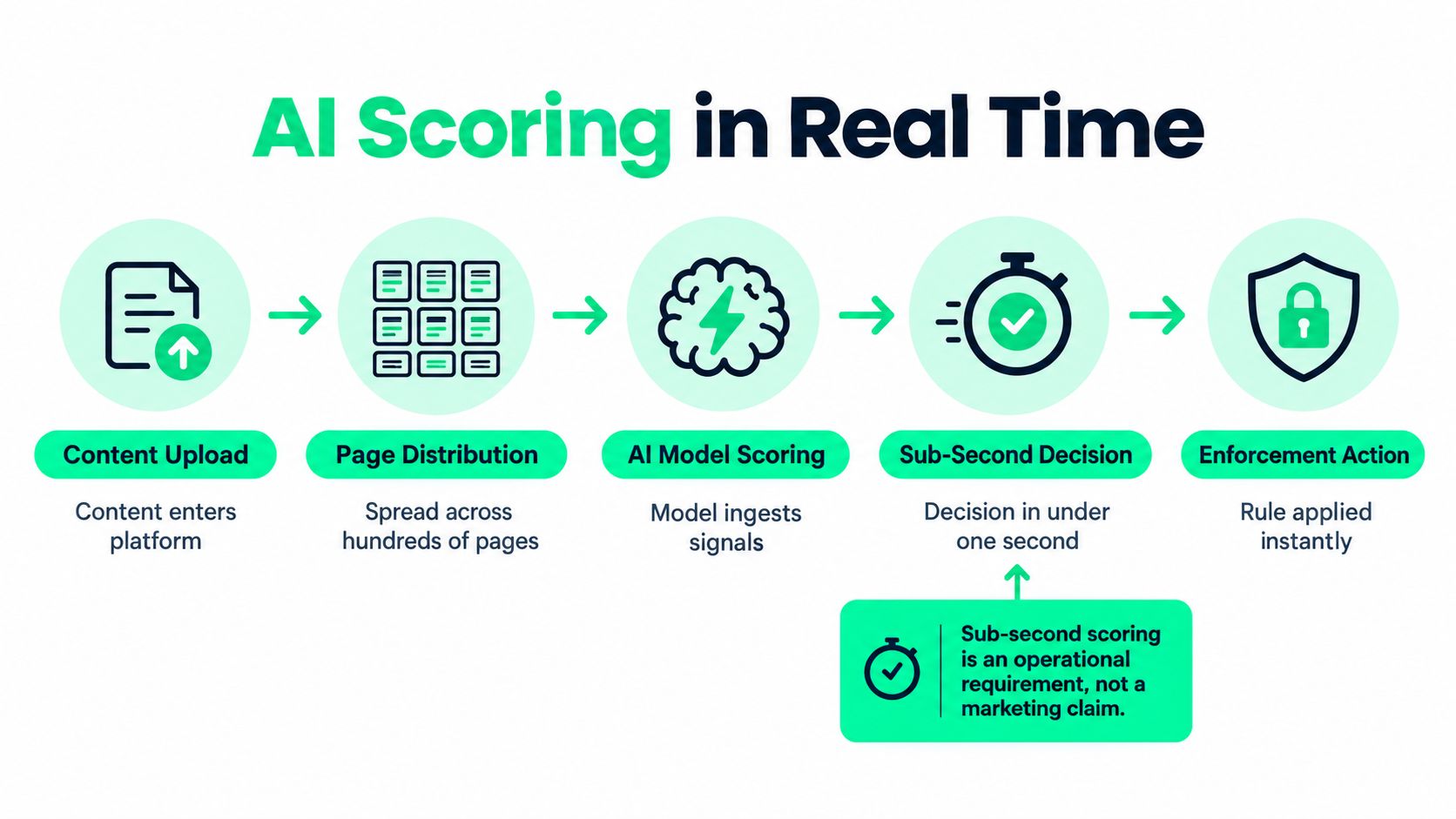
The Loop That Replaces Batch Review
Score, review, update weights, retrain. Each cycle sharpens the next, and human decisions on borderline cases become labeled evidence instead of lost arguments in a chat thread. Compare that with post-billed review, where the advertiser has already paid, the creator has already been credited, and the argument is about refunds rather than prevention.
Speed without records creates its own disputes, so keep immutable decision logs, reason codes, and model versions for every scored event. When an advertiser questions billed views, you should be able to reprocess the original events, show which model version decided, and reconcile the outcome cleanly. If you can't replay a decision, you can't defend it.
Geo, Engagement, and Audience Filters That Tighten the Funnel
Some rejected views are perfectly human. They're in the wrong country, from the wrong audience, or too shallow to represent real attention, and billing them anyway is how platforms end up in refund disputes they can't win. Audience-quality filters handle that problem inside the same engine as the fraud rules, often firing on the same event, but they answer a commercial question: is this verified human attention worth paying for?
Geography carries the most weight for brands buying American reach. Enforce US, CA, and UK geo filters at event level, verify that a page's actual audience matches its claimed tier 1 American composition, and reject traffic from disallowed geographies before it enters reporting. A page with huge raw reach and the wrong map is a mislabeled product at any price. The mechanics of building those audience definitions are covered in this guide to demographic filtering for creator campaigns.
Location is only the first cut. Four checks catch most of what slips past it:
| Signal | What it catches |
|---|---|
| Follower-threshold floor | Pages below a minimum audience size never enter premium distribution |
| Engagement-to-view ratio | View counts with no shares or comments behind them, a sign of inflated or recycled audiences |
| Repeat exposure cap | The same audience served endlessly and billed as incremental reach |
| View depth check | Dwell patterns that don't match the content format being claimed |
Post-impression quality belongs in the ruleset alongside all of this. Meaningful dwell time, human-like sharing, downstream brand searches, and conversion quality over time separate authentic attention from autoplay drift and low-attention scrolling. Assign confidence levels to views and require independent evidence of attention before billing or optimization, especially for meme and creator campaigns where a platform-reported view is the weakest evidence available.
Practical rule: Treat technically valid but commercially worthless traffic as a billing problem, not a rounding error.
Brand-Safety Rules That Run Before Anything Goes Live
A creator post can clear every fraud check in the pipeline and still be unusable. Verified human views, right geography, clean engagement, real dwell. Then legal sees the paid-partnership tag buried under a "link in bio" joke, or missing entirely, and the placement gets pulled hours before launch.
That is why brand safety runs inside the same engine as fraud detection instead of on a separate team's calendar. A verified human view of an undisclosed ad still damages the advertiser, and splitting the checks across teams guarantees one of them gets skipped under deadline pressure.
Disclosure is the clearest pre-publication rule because the standard is explicit. The FTC requires endorsers to disclose material connections, including payment, employment, family relationships, or free or discounted products, and places responsibility on both influencer and brand, as set out in the FTC guidance on disclosures for social media influencers. A platform disclosure toggle doesn't discharge that duty by itself.
In practice, the review gate checks five things in sequence: whether a clear disclosure exists at all, whether it sits as close as possible to the branded message under the principles in the FTC native advertising guide for businesses, whether the language, font, and contrast hold up on a phone screen, whether video disclosures stay on screen long enough to read, and whether the label survives resharing into other formats and surfaces. Any single failure routes the post back to the creator before it ever reaches paid distribution.
The FTC also states that a promotional message shouldn't suggest it's something other than an advertisement, a principle detailed in its native advertising guidance on avoiding deceptive formats. Meme creative is intentionally informal, which makes this test stricter. Automated screening catches missing labels and unapproved claims; human reviewers judge whether the overall presentation still misleads.
Prohibited topics, required terms, and page exclusions fold into the same pass, giving reviewers one checklist instead of three, as described in this walkthrough of the brand approval process for distributed content. Nothing goes live on partial compliance.
Setting Thresholds by Environment Instead of One Universal Cutoff
A universal invalid-traffic cutoff sounds disciplined and performs badly. Fraud exposure differs sharply by environment, so a threshold tuned for web traffic will miss mobile-app abuse or reject legitimate app behavior. Pixalate analyzed more than 106 billion programmatic impressions in Q3 2025 and reported global IVT rates of 21% for desktop and mobile web, 33% for mobile apps, and 19% for connected TV, with earlier North American benchmarks of 18% web, 31% mobile app, and 18% CTV in Q1 2025, according to the Pixalate Q3 2025 global ad fraud benchmarks.
Invalid Traffic Rate by Environment
| Environment | Global IVT (Q3 2025) | North America IVT (Q1 2025) |
|---|---|---|
| Desktop and mobile web | 21% | 18% |
| Mobile apps | 33% | 31% |
| Connected TV | 19% | 18% |
Maintain separate baselines per inventory class for viewability, session depth, repeat exposure, engagement velocity, and conversion lag, then flag deviations from each baseline rather than breaches of one fixed percentage. Placement type, audience geography, campaign objective, and billing model all change what normal looks like.
Document the false-positive cost while you're at it. Aggressive filtering on high-volume American sports traffic during a live game can delete exactly the genuine surge the advertiser wanted to buy. Permissive rules pay for duplicated automation. Neither error is free, and threshold reviews should weigh both on a documented cadence as human-like automation keeps improving.
A Representative Rule Set and Enforcement Workflow
Consolidating the layers produces a rule set any operator can adapt. The diagram below maps the four rule families and the workflow that enforces them.
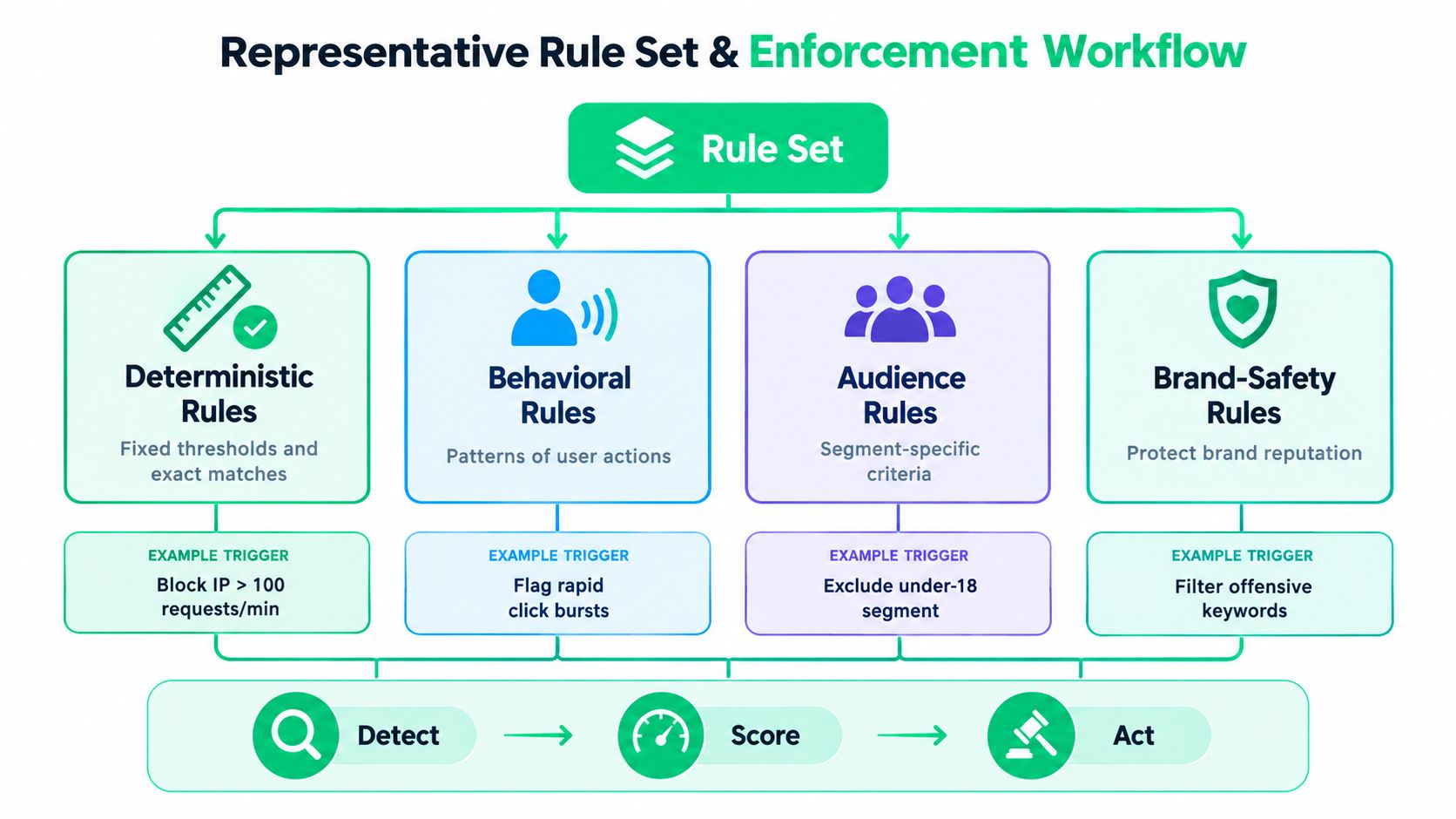
Deterministic layer. Known bot or crawler identifier, data-center source, malformed user agent, duplicate event ID, or impossible interval triggers immediate invalidation. No score, no queue.
Behavioral layer. Synchronized bursts, abnormal repeat-view frequency, or engagement inconsistent with the category baseline raises the risk score. Actions graduate from accept to hold, invalidate, or quarantine the source.
Audience layer. Disallowed geography, failed tier 1 audience verification, or engagement-to-view ratios below the placement baseline removes the view from billable reporting even when the viewer is human.
Brand-safety layer. Missing or inconspicuous disclosure, prohibited topic, or missing required term holds the submission for revision or rejection before publication.
The enforcement workflow runs in one direction. Events are ingested and normalized, deterministic rules fire, behavioral scoring and audience filters evaluate what remains, borderline cases enter human review, and every outcome lands in an immutable decision log with reason codes. Settlement then reconciles against verified views only, which advertisers can inspect through the reporting approach described in this overview of a campaign performance dashboard for distributed campaigns.
The short walkthrough below shows how these enforcement stages connect in practice.
Operator and Buyer Checklist for Fraud Detection Rules
Fraud detection rules only matter if someone verifies they're running. The checklist below splits that verification by role, because operators and buyers control different levers. The infographic summarizes both sides for quick reference during vendor reviews.
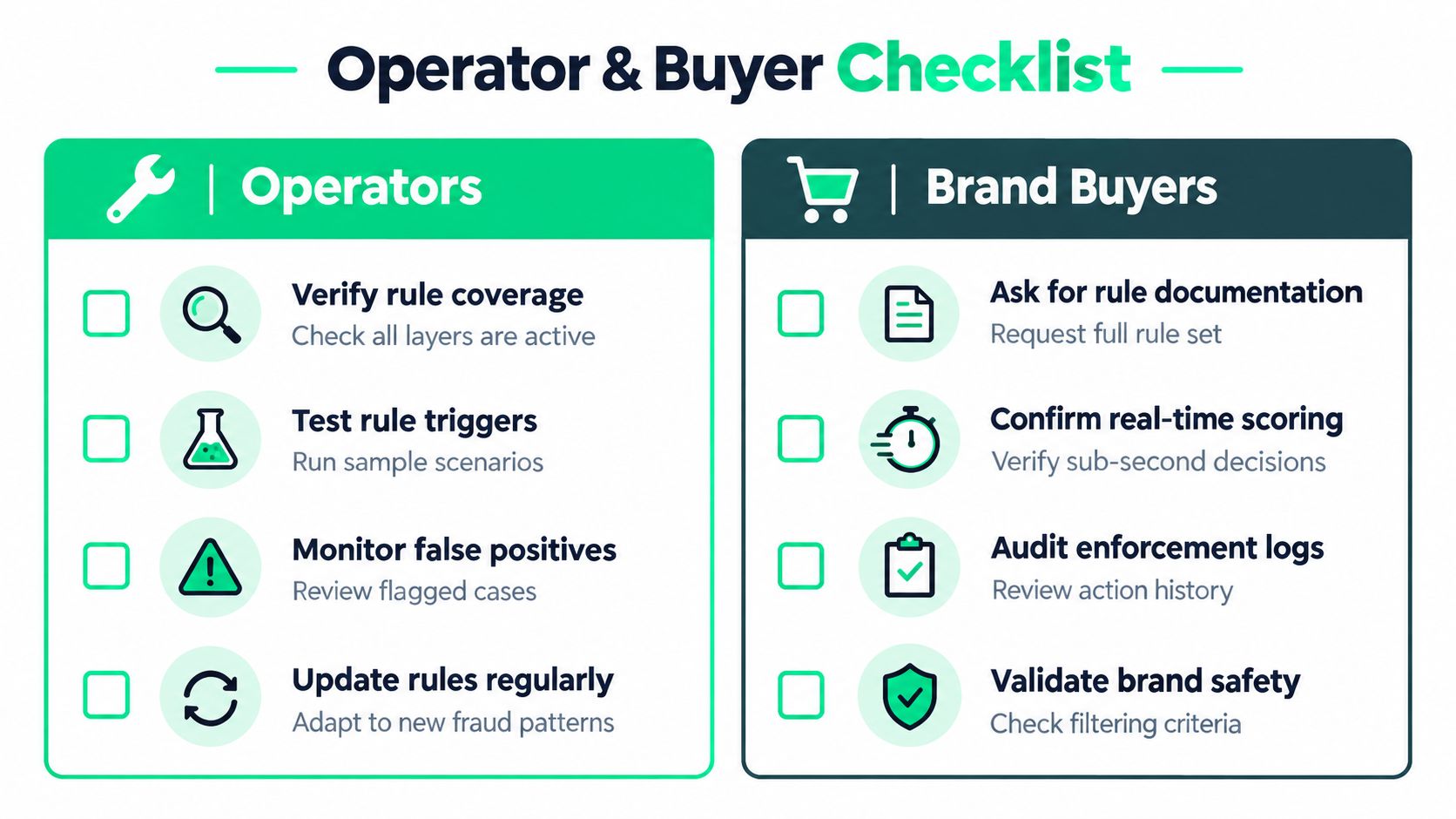
Operators Verify the System
- Deterministic coverage: Confirm GIVT rules run on every event before billing.
- Behavioral scoring: Test cluster signals and graduated actions against known patterns.
- Review coverage: Confirm borderline scores reach human analysts around the clock.
- Versioning and logs: Check model versions, reason codes, and reprocessing procedures.
Buyers Verify the Evidence
- Tier 1 audience proof: Ask how American audience composition is verified per page.
- Geo enforcement: Confirm disallowed geographies are excluded before reporting.
- Disclosure mechanics: Inspect placement, contrast, timing, and reshare persistence.
- Billing reconciliation: Require settlement on verified views with auditable logs.
- Page removal: Confirm off-brand pages can be removed quickly, in one action.
History argues against treating any of this as finished. The ANA and White Ops Bot Baseline study from December 2014 measured 5.5 billion impressions across 181 campaigns from 36 member companies and projected global bot losses could reach $6.3 billion during 2015, as recounted in this history of invalid traffic measurement. Fraud has evolved continuously since that benchmark, so rerun this checklist on a documented cadence and update thresholds as behavior shifts.
If you're buying distributed creator or meme inventory and want every submission scored in real time, reviewed for brand safety and disclosure before it goes live, and billed only on verified views from tier 1 American audiences, that's exactly the control system FindClout is built to run. Bring your geo targets, exclusions, and required terms, and see how the routing layer handles your next campaign before a single post reaches the public.
Want this audience for your brand?
FindClout puts your brand in front of verified American audiences across every major US page — brand-safe, at scale.
Start Your Campaign