 findclout.com
Crypto Marketing: Channels, Compliance and Brand Safety
67% of people who recalled crypto advertising said it didn't change their attitude, according to the FCA's 2025 consumer research. That finding concerns people aware of cryptoassets in the UK, not American conversion rates, but it poses the right question for U.S. operators: are you changing anyone's mind, or just buying attention from people already interested?
Effective crypto marketing connects a defensible product claim to a qualified audience, then measures what those people do. For U.S. campaigns, the channel decision is inseparable from licensing, disclosure, audience geography and brand safety. Cheap reach is useful only when those controls survive distribution.
Table of Contents
- What Crypto Marketing Covers and Why Budgets Swing
- Core Channels Compared at a Glance
- Grow a Community That Holds Attention
- Compliance Rules for U.S. Campaigns
- Working With Creators and Meme Pages
- Verify Views and Protect Brand Safety
- Measure Conversions Instead of Impressions
- Launch a Small, Compliant Test This Quarter
What Crypto Marketing Covers and Why Budgets Swing
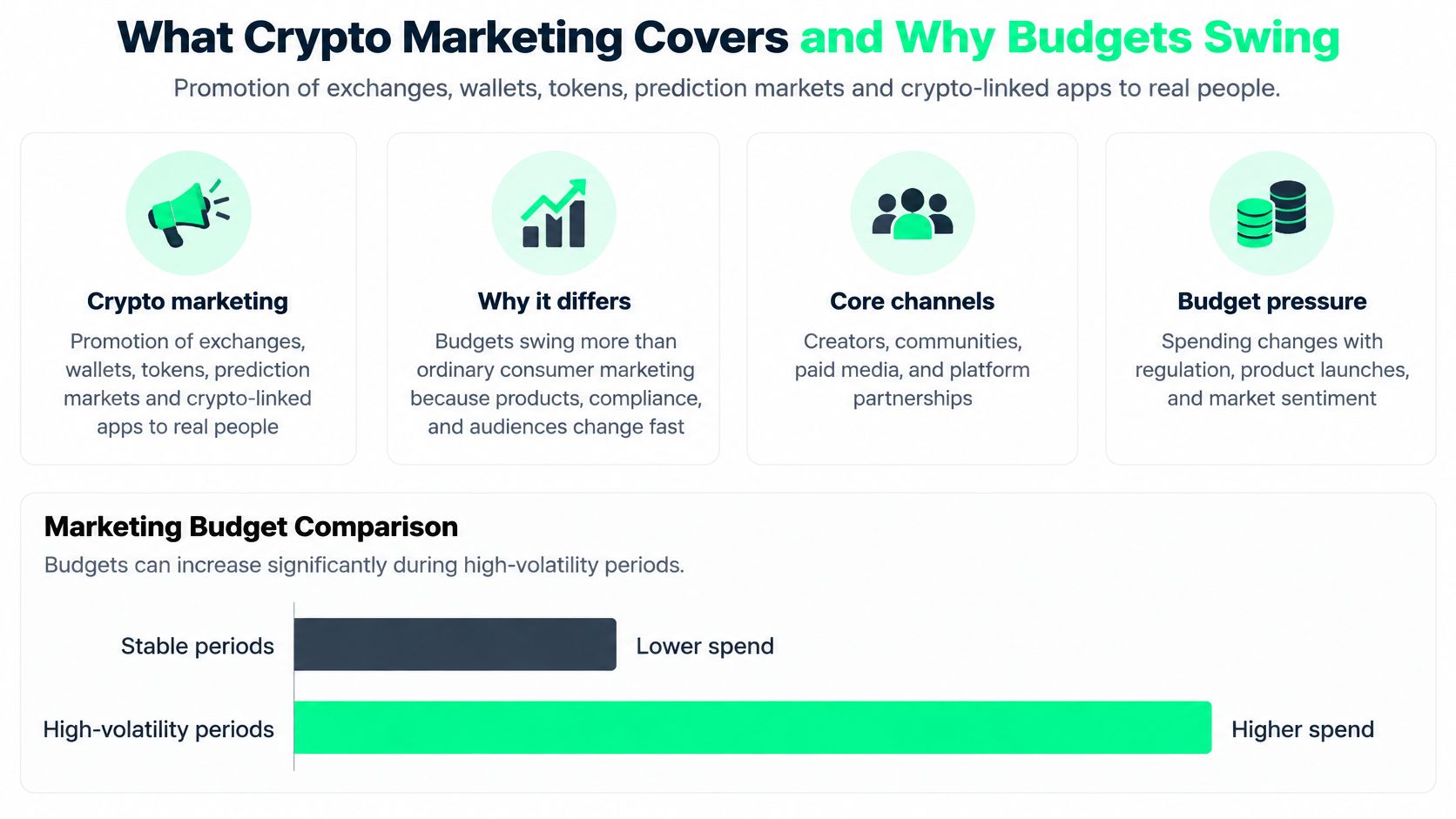
U.S. crypto advertising fell 75%, from approximately $160 million in the first half of 2022 to about $40 million in the first half of 2024, according to Digiday's reporting on crypto media budgets. The same reporting put Coinbase's marketing and advertising spending at $99 million in Q1 2024, against $200 million in Q1 2022.
Crypto marketing promotes exchanges, wallets, tokens, prediction markets and crypto-linked apps to real people. It includes positioning, education, community operations, creator distribution, advertising and the onboarding experience after a click.
The difference from ordinary consumer marketing is not just the subject matter. Teams must check the product, audience, jurisdiction and claim before distributing an offer. A wallet tutorial, a token promotion and an event-contract advertisement shouldn't enter the same publishing workflow with identical rules.
Plan for changing demand
Crypto budgets move like a tide. During expansionary periods, operators can mistake enthusiastic demand for excellent acquisition work; during downturns, the same creative can attract attention without producing users willing to fund an account.
Don't build a spending plan around the assumption that last month's conversion rate will hold. Separate the money required to maintain customer education and support from discretionary acquisition spend.
The budget picture is easier to understand when product scope and distribution sit together.
Budget against a business outcome
Start with the action that makes someone a useful customer, not the largest view count you can afford. A funded exchange account, an activated wallet and a returning app user represent different acquisition goals.
Allocate spending across distinct jobs:
- Maintain understanding: Keep product documentation, community support and security explanations available.
- Test acquisition: Reserve a controlled budget for audience and message experiments.
- Expand proven delivery: Increase spend only when qualified actions remain economical.
Brand building still matters, particularly when users need reassurance before sharing identity documents or moving assets. It just can't substitute for evidence that your distribution reaches eligible American customers.
The practical channel families are owned community, creators and paid placements. Each gives you a different balance of control, speed and measurable intent.
Core Channels Compared at a Glance
Crypto marketing channels compared
| Channel | Pricing basis | Best for | Main risk |
|---|---|---|---|
| Owned community (Discord, Telegram, X) | Staff time and member rewards | Trust and long-term retention | Slow growth and moderation load |
| Creator partnerships | Flat fee per post or CPM on verified views | Fast reach to a named audience | Undisclosed sponsorship and unsupported claims |
| Meme and clip pages | CPM or per-view payment | Cheap, shareable attention | Off-brand pages and unverified audience location |
| Paid social ads | CPM or CPC set by the platform | Precise targeting and retargeting | Platform rejection and licensing requirements |
| Search ads | CPC, with platform certification required | High-intent searchers | Certification denied and restricted keywords |
| Affiliate and referral programs | Commission per signup or funded user | Paying only for outcomes | Commission fraud and unclear attribution |
Pricing basis tells you what triggers cost, not whether that cost produces value. Best for identifies the channel's job. Main risk tells you which operational control must exist before launch.
Owned community consumes staff time even when there's no media invoice. Paid social and search introduce substantial platform review requirements, while creator and affiliate programs require closer supervision of what other people publish on your behalf.
Choose the channel for its job
Use community when prospective customers need to ask questions, understand custody or learn an unfamiliar workflow. It's a poor substitute for acquisition if nobody on the team can maintain useful conversations.
Choose creators when a recognizable voice can explain the product to an appropriate audience. Buy audience fit, not a follower count detached from location and subject matter.
Use meme and clip pages when the message is simple enough to survive short-form distribution. A recognizable product benefit travels better than a complicated financial explanation squeezed beneath an unrelated joke.
Choose paid social when the offer already meets platform eligibility requirements and you have a landing page worth sending people to. Use search when people actively seek the problem your product solves, rather than assuming every crypto-related query signals purchase intent.
Use affiliates when you can define a legitimate conversion, detect self-referrals and reconcile commissions. Paying for outcomes doesn't eliminate waste if the outcome is easy to manufacture.
Match the control to the channel
For a U.S.-focused campaign, audience geography belongs in the buying decision, not just the final report. An English-language page isn't automatically an American audience, and a sports following doesn't establish eligibility for a prediction-market offer.
Buying rule: Start with the channel whose main risk you can control. Add another only when your funnel shows what it contributes.
A narrower, well-controlled channel mix is easier to improve than simultaneous distribution across communities, creators, search and affiliates with incompatible tracking.
Grow a Community That Holds Attention
An owned community gives people somewhere to resolve uncertainty before they become customers. Members can ask about fees, withdrawal procedures or wallet permissions, and moderators can correct misunderstandings where other members can see the answer.
Give each destination a specific role. A Discord server can organize onboarding and feature feedback; a Telegram group can handle focused discussion; an X reply strategy can answer public questions; a newsletter can summarize product changes without requiring members to monitor a chat continuously.
Establish useful participation
Publish rules before recruiting. Prohibit price predictions and return promises, pin a plain-language risk notice, and distinguish official support from unsolicited direct messages.
Moderators shouldn't request seed phrases, private keys or transfers to personal wallets. Publish the official support route and explain how members can recognize impersonation.
For practical techniques on replies, participation and member recognition, HarvestMyData's guide to foster meaningful connections on Instagram offers ideas that can inform broader community operations. Apply those techniques to product understanding, not engagement for its own sake.
Use this launch sequence:
- Write the rules page. Explain acceptable discussion, support boundaries, sponsorship disclosure and how moderators handle misleading claims.
- Recruit the first 20 founding members. As an illustrative starting plan, build toward a group of 20 to 50 people who will test features and give specific feedback, rather than immediately opening an unstaffed public chat.
- Run a weekly product quest. Ask members to complete a custody tutorial, identify a fee in the interface or try a clearly explained product feature.
- Reward verified actions. Offer recognition, feedback access or community roles rather than suggesting participation will produce investment returns.
- Review the moderation log every week. Group recurring questions, identify impersonators and turn confusing product explanations into documentation fixes.
Make quests teach something
A quest should help someone use the product safely. Don't ask people to connect a wallet without explaining permissions, and never require unnecessary exposure of funds just to earn a badge.
Say a wallet runs a 30-day quest that teaches recovery procedures and transaction review. The team could then compare how many quest completers start verification with the rest of the community, while recognizing that more motivated members may have selected themselves into the quest.
That comparison is a diagnostic, not proof that the quest caused the behavior. Read the support conversations alongside the conversion report to understand what participants learned.
Track a compact set of community measures:
- Weekly active members: Count meaningful participation, not merely account presence.
- Member-written share of posts: Check whether members contribute or only react to staff announcements.
- Quest completers who start verification: Connect participation to a relevant next action without treating every participant as purchase-ready.
A community that produces useful questions is more valuable than a busy channel moderators can't safely supervise.
Compliance Rules for U.S. Campaigns
Required controls by crypto product category
| Product category | Typical U.S. exposure | Required control |
|---|---|---|
| Exchange or wallet | Securities and consumer-protection rules; endorsement disclosure | Licensing evidence and risk language in every post |
| Token or memecoin | Securities and fraud claims; price-promise language | Remove price and return claims; pre-approve every caption |
| Prediction market | Gaming and event-contract rules; state-level limits | Geo-fencing, age gating and state-by-state review |
| Fintech or neobank | Consumer-finance and advertising rules | Verified license and fee and eligibility disclosure |
| Crypto-linked AI or health app | Claim substantiation under FTC rules | Evidence file for each performance or health claim |
Use this as an operational screening table, not a legal determination that every product falls under every listed regime. Find your category, establish the applicable controls with qualified counsel and complete them before drafting promotional copy.
Disclosure and claims
The FTC's social-media endorsement guidance requires clear disclosure of material connections, including payment or free products, when an unexpected relationship could affect how consumers evaluate an endorsement; it also requires advertising claims to be truthful, nondeceptive and evidence-based.
Put the disclosure where someone encounters the endorsement. A relationship mentioned only in a creator's bio doesn't reliably inform someone viewing an individual post.
Use plain language such as Ad or Sponsored, with presentation appropriate to the format. Video needs disclosure viewers can notice in the video, rather than depending entirely on a collapsed description.
Maintain a claim register containing the approved wording, supporting evidence, owner and limitations. A claim about custody must describe the actual custody arrangement; a fee claim must reflect the applicable transaction and exclusions.
Remove unsupported return promises. Don't treat a risk disclaimer as permission to make an exaggerated headline.
Product eligibility and distribution
The applicable U.S. scrutiny can involve securities, commodities, consumer-protection and endorsement rules, depending on the asset and claim; platform certification and local licensing add separate eligibility requirements, as outlined in Coinbound's crypto marketing overview.
Approval to advertise on a platform doesn't establish that the underlying offer is lawful everywhere. Keep product eligibility, advertiser identity, licensing evidence and permitted locations in the campaign record.
For event-contract campaigns, the CoinStats prediction market legal tracker can help organize jurisdictional questions for counsel. Don't use a tracker as a replacement for reviewing the particular operator, contract and audience.
Regulated categories such as prediction markets, crypto, fintech, AI and health can run on FindClout. Advertisers still need to supply the relevant licensing evidence and substantiate their claims; access to distribution isn't a legal exemption.
Our guide to crypto advertising restrictions provides additional context for planning channel eligibility.
Keep these records accessible to the people running delivery:
- Eligibility file: Legal entity, product category, permitted geography and licensing documentation.
- Evidence file: Support for product, performance, security and health statements.
- Disclosure specification: Required wording and placement for each format.
- Escalation owner: A named person authorized to pause distribution when eligibility changes.
A compliant-looking caption can still advertise an ineligible product. Check the offer before polishing the wording.
Working With Creators and Meme Pages
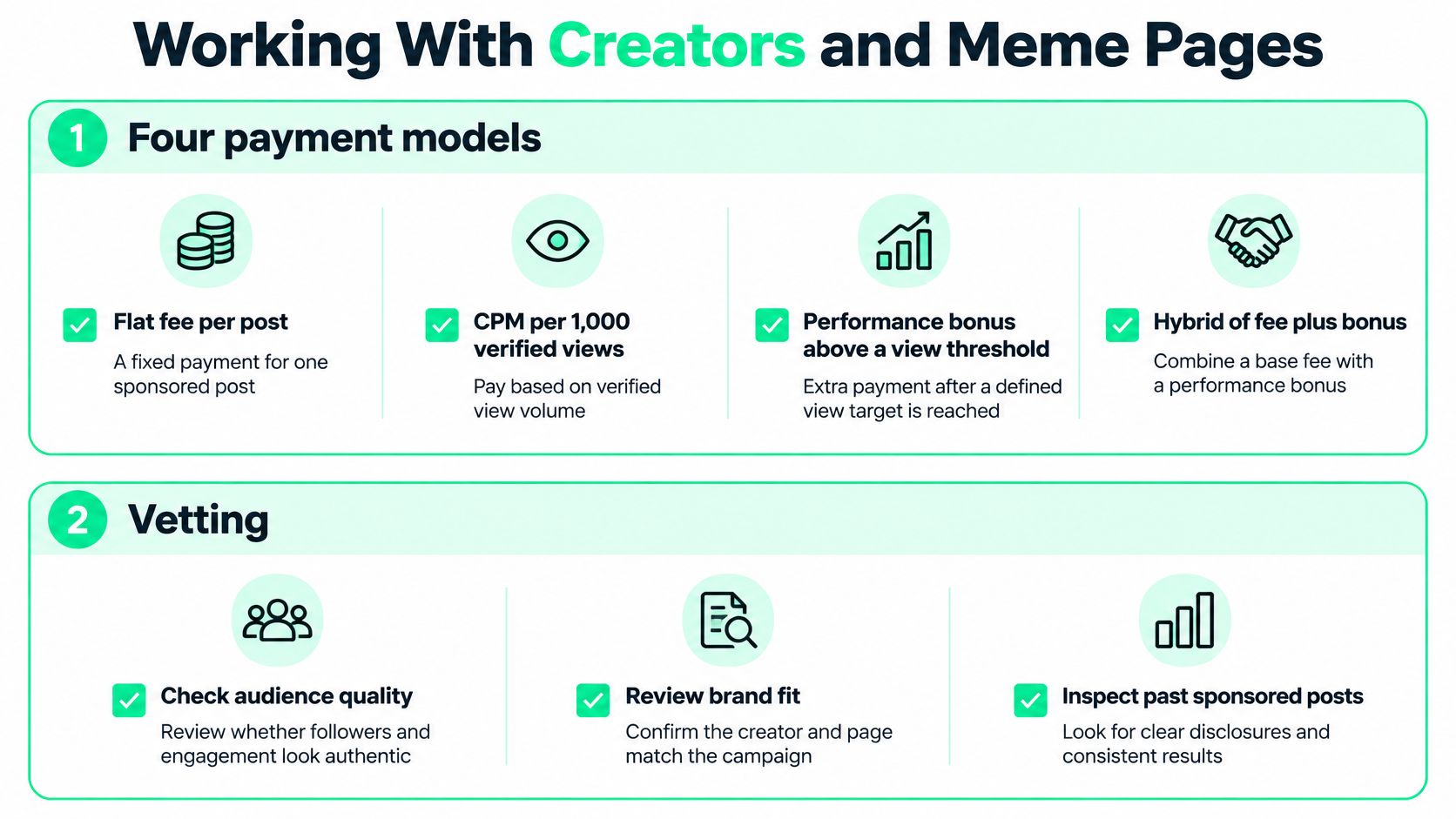
Creator compensation usually fits one of these models: flat fee per post, CPM per 1,000 verified views, a performance bonus above a view threshold, or a hybrid of fee plus bonus. Set the qualifying content, measurement method and payment conditions before anyone produces a draft.
A flat fee gives production certainty but leaves the advertiser carrying delivery risk. View-based payment aligns compensation with attention, while bonuses need explicit thresholds so creators don't interpret an incentive as permission to exaggerate.
This checklist separates payment design from account vetting.
Vet the audience and the voice
Check the share of followers in the target country using account analytics, then inspect comment quality against apparent engagement. Look for sudden follower spikes, repetitive replies, previous sponsorships and a publishing history compatible with your brand.
For American acquisition, reject the shortcut of treating English captions as proof of U.S. reach. Examine the page's audience evidence and whether its regular subject matter attracts eligible prospective users.
If you're deciding between managed sourcing and direct relationships, JoinBrands' overview of crypto influencer marketing agencies offers useful comparison context. Keep audience evidence and editorial controls in your evaluation, not just access to recognizable names.
Keep approval ownership explicit
The brief must carry the approved claims list and disclosure rules, prohibited wording, destination URL and required first-line sponsorship disclosure. Put the product benefit immediately after that disclosure rather than allowing an advertising hook to hide the relationship.
Draft. The creator submits the actual caption, creative, watermark and destination, not merely a concept.
Review. The brand checks the complete submission against the claim register and placement rules. No post goes live without brand sign-off.
Publish. Record the live URL and confirm the published version matches the signed-off version.
Monitor. In an illustrative workflow, monitor closely for 72 hours, removing or reporting scam links, impersonation and abusive off-brand comments where you have the ability. Don't suppress legitimate product criticism.
For planning distributed execution, our creator marketplace campaign guide for fintech and crypto brands addresses coordination across participating accounts.
The video below provides another reference point for creator-led distribution.
Give meme pages tighter production boundaries
Meme and clip pages reshare short-form material, so watermark position, caption fidelity and permitted source footage matter more than a long narrative brief. A remix shouldn't remove the disclosure or imply an investment endorsement.
Consider a hypothetical fintech campaign briefing 40 pages with the same three approved claims. If six pages publish off-brand captions, the team needs a removal workflow capable of addressing those posts within a day, rather than negotiating separately with every account.
Copy these fields into the brief:
- Audience: Eligible U.S. users and excluded locations.
- Message: Approved claim, evidence reference and prohibited language.
- Execution: Disclosure, watermark, source-footage rights and destination.
- Control: Sign-off owner, monitoring responsibility and removal contact.
Verify Views and Protect Brand Safety
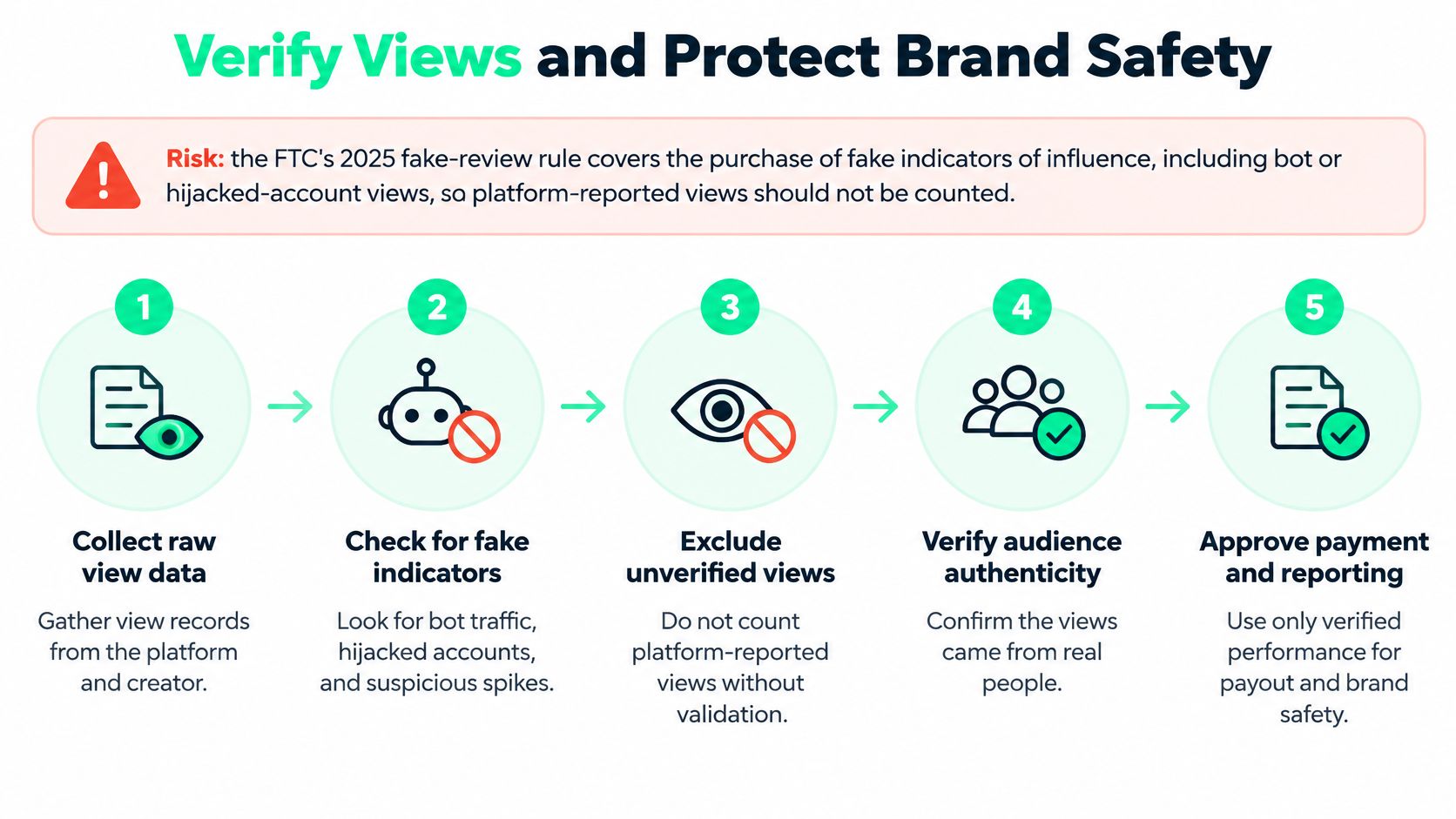
The FTC's 2025 fake-review warning addresses buying or selling fake indicators of social influence, including bot- or hijacked-account-generated views, when the buyer knew or should have known they were fake and they misrepresented influence or importance. Platform-reported totals therefore shouldn't automatically become accepted campaign delivery.
Authenticity and geography are separate checks. A real viewer outside the permitted market may still be commercially irrelevant or ineligible for the offer.
Follow a verifiable delivery sequence
- Screen accounts. Inspect bot signals, suspicious engagement changes and possible account hijacking before accepting delivery.
- Validate location. Compare available audience and delivery signals instead of relying on a page's self-description.
- Remove duplicate records. Deduplicate overlapping reports and measurement events without pretending that every legitimate repeat view represents a new person.
- Exclude invalid traffic before billing. Reconcile accepted delivery against the agreed measurement definition.
- Enforce the publication gate. Verify that the caption and creative version match the authorized asset before posting.
- Keep a post-level audit log. Store account identity, asset version, placement, timestamps, geography evidence and accepted view totals.
The IAB's measurement guidance describes bot detection, signal deduplication, anomaly detection and independent verification, and warns that spoofed location signals can misrepresent delivery geography. Although that document concerns digital out-of-home measurement, those principles are useful when designing creator verification controls; they aren't proof of any creator campaign's accuracy.
The process below shows why collecting a view count is only the beginning.
Make review repeatable at scale
Build the exclusion list before distribution. Include prohibited topics, competitor names and sensitive news events, with enough context that reviewers can distinguish an incidental reference from an unsuitable placement.
At FindClout, our focus is tier-1 American audiences and brand safety. Our systems combine AI scoring with around-the-clock human review, examine every submission in real time and support one-click removal of off-brand pages.
That attention to detail matters when scaling attention to billions of views. Review must remain attached to each submission, while geography checks and U.S. audience-share reporting keep high-quality American reach visible rather than burying it inside a global total.
Use our ad verification guide to frame the evidence trail behind accepted delivery.
Measurement boundary: If geography can't be validated, classify it as unknown. Don't quietly count it as American reach.
Separate rejected traffic, accepted views and unattributed geography in reporting. That makes the difference between a large delivery number and an auditable media purchase clear.
Measure Conversions Instead of Impressions
Track the acquisition path as verified views → outbound clicks → landing-page engagement → KYC start → KYC completion → funded or transacting user. Each stage answers a different question, from whether someone encountered the message to whether they became a usable customer.
A 2025 cryptocurrency marketing analysis identifies a benchmark of more than 40% retail-user drop-off between landing-page arrival and KYC completion. Treat that as context for investigating friction, not a target or a guaranteed prediction for your product.
Funnel symptoms, causes and next actions
| Symptom | Likely cause | Next action |
|---|---|---|
| Cheap clicks, few KYC starts | Message does not match buyer intent | Rewrite the caption around one verifiable claim |
| KYC starts strong, completions fall | Friction or missing trust signals | Shorten documents; show custody, fee and licensing proof |
| High views, few outbound clicks | Creative never explains the product | Put the product benefit in the first line |
| One creator converts, others do not | Audience fit, not creative | Shift budget toward that creator's audience |
| Low CPM, high cost per funded user | Cheap reach from the wrong audience | Judge channels by cost per funded user |
Diagnose before changing spend
These are starting hypotheses, not automatic conclusions. A creator may appear stronger because their audience had more time to convert, their link worked correctly or they received a different offer.
Compare cohorts with consistent conversion windows and eligibility rules. When simplifying onboarding, shorten instructions and remove redundant steps, not legally required identity checks or necessary documentation.
Say a meme placement generates engaged visitors but almost no verification starts. Check whether the caption attracts entertainment seekers while the landing page immediately demands identity documents without explaining the product.
If verification starts are healthy but completions weaken, inspect device errors, document-upload failures and unclear privacy explanations. Buying more traffic won't resolve a broken upload flow.
Report at the level you can change
Record creator handle and creative variant with each attributable visit. Use tagged URLs and first-party events, then connect account milestones through an internal identifier without passing sensitive identity information into public links.
Your dashboard should expose:
- Audience quality: Accepted U.S. views and traffic excluded from delivery.
- Progression: Movement between funnel stages by handle and asset.
- Economics: Spend against funded or transacting users.
- Attribution limits: Missing identifiers, repeat visitors and conversions that can't be assigned confidently.
Keep an aggregate business view alongside attributed results. Otherwise, teams can overvalue placements that claim credit for customers who were already arriving through another route.
For incremental impact, compare eligible exposed and unexposed groups where practical, and examine product understanding as well as account actions. A deposit alone doesn't tell you which message changed someone's decision.
Build the six-stage dashboard before launch. Judge channel economics by cost per funded user, not CPM alone, and check that acquired users continue to use the product.
Launch a Small, Compliant Test This Quarter
Use this illustrative test plan to make the launch decision concrete.
- Pick one product and one verifiable claim. Choose something supportable, such as fee transparency or custody safeguards, and put the benefit in the first substantive caption line after the disclosure.
- Confirm licensing and geography. Apply the product-category controls to the actual offer. If it needs a license you don't hold, stop.
- Choose two creators and one meme page. Verify their U.S. audiences, follower geography, comment quality and contextual fit.
- Lock the publishing controls. Set caption pre-approval, brand exclusions and disclosure requirements before supplying assets.
- Run a 30-day test. Track the six-stage funnel by creator handle and creative variant, with a named owner for delivery exceptions.
- Set the next budget at day 30. Use cost per funded user and onboarding quality, not the cheapest CPM, to decide what deserves expansion.
Launch only when the essentials are ready
Delay if the claim, licensing check or funnel dashboard is missing. When comparing an agency or platform, require evidence of pre-approval, verified U.S. views and actionable funnel reporting before accepting audience-size claims.
We run campaigns in regulated verticals, including prediction markets and sports-betting-adjacent services. Current partners include Polymarket, Novig, Solflare, Fomo, Coverd, Venice AI, Mindgrasp and Sunflower Sober, and FindClout has 5B+ views across its network.
Those credentials don't replace product-specific review. Your launch decision should still rest on the eligibility of your offer and the evidence behind the delivery.
FindClout offers programmatic creator and meme-page distribution built around verified views, tier-1 American audiences and brand-safety controls. Visit FindClout to discuss a crypto campaign with submission review, geography requirements and measurement tied to your acquisition funnel.
Want this audience for your brand?
FindClout puts your brand in front of verified American audiences across every major US page — brand-safe, at scale.
Start Your Campaign