 findclout.com
Brand Safety YouTube: Controls, Risks and How to Verify
YouTube's advertiser boycott threatened far more than reputation: contemporary analysts estimated it could reduce Google's 2017 revenue by as much as $750 million, approximately 7.5% of projected YouTube revenue of $10.2 billion, according to Streaming Media's account of the disruption. For advertisers, that's the right starting point for brand safety on YouTube. The question isn't just whether a platform permits an ad. It's whether you can defend the placement, verify the audience, and stop unsuitable distribution before it consumes more budget.
Table of Contents
- Why Brand Safety Became a Budget Decision
- Brand Safety Controls and What Each One Blocks
- Reading YouTube's Brand Safety Rate Correctly
- Risk Tiers by Category
- Spotting AI-Generated and Made-for-Advertising Content
- Vetting Creators and Verifying Real Views
- Confirm Your Brand Safety Rules Before Launch
Why Brand Safety Became a Budget Decision
In March 2017, major advertisers began pulling campaigns after automated placements put their messages beside extremist, racist and otherwise offensive videos. Google Preferred, the premium inventory at the center of the story, took the hit; ad-tracking coverage at the time recorded advertiser pullback that April.
The response wasn't uniform. Starbucks, Dish Network and Pepsi stopped buying abruptly, while GM, Johnson & Johnson and Walmart continued advertising even as the boycott dominated headlines. The crisis started with U.K. advertisers and agencies, then spread to American and global brands including AT&T, Verizon and Volkswagen.
Verizon's suspension ran for months and ended later that year. After YouTube added stronger controls and more granular exclusions, Google Preferred spending rose again. That recovery matters less than the lesson: platform eligibility is not advertiser suitability. A video can meet YouTube's rules and still fail your brand's standards, your audience test or your legal team's tolerance.
What a suspension means for a media plan
Take an American consumer app buying YouTube for acquisition. A bad placement doesn't just trigger a communications review. The buyer may have to freeze delivery, find replacement inventory, reconcile commitments and explain whether the original approval process worked.
Budget rule: Allocate money and ownership to placement verification before launch, not after a screenshot reaches your legal team.
A relatively small group of withdrawing advertisers can change procurement requirements and platform trust. Put suitability into the buying decision: which creators, videos, topics and audience geographies are allowed; who can suspend delivery; and what evidence supports continued spend. Verified U.S. audience data should be the standard before you scale. A low CPM is no bargain if the brand can't accept the context.
Brand Safety Controls and What Each One Blocks
YouTube brand-suitability controls by layer
| Control | What it blocks | Where you set it | Main limit |
|---|---|---|---|
| Video Ad Safety Promise | Terrorist acts, nudity, recent sensitive events | Automatic on YouTube campaigns | Platform-defined categories only |
| Suitability levels | Profanity, sexual suggestiveness, violence | Campaign inventory settings | Covers only the themes Google lists |
| Manual placement exclusions | Specific videos, channels, URLs, apps, video IDs | Campaign placement exclusion list | Only as complete as the list you keep updated |
| Category and label exclusions | Sensitive or violent content, gambling or alcohol labels | Account level, carried into new campaigns | Relies on accurate content labelling |
| Title and thumbnail rules | Profanity in titles or thumbnails, sexual thumbnails, drug-related content, terrorism-related material | Built into listed inventory categories | These signals don't establish full contextual fit |
| Third-party verification | Unsuitable or invalid impressions reported after delivery | Separate measurement account | Reports exposure, doesn't prevent it on its own |
Start with the automatic protections
Google's brand-suitability documentation describes its Video Ad Safety Promise, inventory settings, and placement exclusions. The automatic layer establishes a baseline; inventory settings let the advertiser make additional choices around themes such as profanity, sexual suggestiveness, and violence.
Choose settings against a written brief, not an instinctive preference for the most restrictive option. A gaming advertiser may accept fictional combat while rejecting real-world injury footage. Blocking both can remove useful inventory without expressing the actual requirement.
Title and thumbnail restrictions are helpful signals, but they aren't a complete assessment of a video. A neutral thumbnail can lead into unsuitable commentary, while an alarming headline might introduce responsible reporting.
Add rules your buyer can maintain
Manual exclusions are the precise tool for a known problem. Record the channel or video identifier, the reason for exclusion, and the person responsible for maintaining the list. Avoid a spreadsheet that nobody owns.
Google's placement-exclusion guidance also describes account-level suitability preferences that carry into future campaigns. Use these for enduring brand requirements rather than rebuilding the same restrictions whenever a buyer launches new activity.
For repeatable enforcement, automated content moderation should translate the brief into explicit checks, not replace the brief with a generic safety score.
- Automatic protection establishes the platform baseline.
- Advertiser exclusions express your own limits.
- Verification checks what happened.
None of these layers provides complete protection alone. Pair them with approval before publication and monitoring after delivery, with a named operator authorized to act.
Reading YouTube's Brand Safety Rate Correctly
The advertiser-safety error rate measures unsafe exposure, not universal suitability. Its numerator is impressions served on content classified as unsafe; its denominator is total measured impressions. Under Google's published measurement methodology, advertisers default to content meeting its Advertiser-Friendly Guidelines, mapped to the Global Alliance for Responsible Media Brand Safety Floor, and YouTube is reported as 99% brand safe, with an advertiser-safety error rate below 1%.
That average sets a baseline for the platform, not a verdict on the next creator you buy. Use it to calibrate review effort, then apply your own exclusions at creator, video, topic and audience level. A platform label cannot tell you whether a channel meets a compliance rule or a specific audience standard.
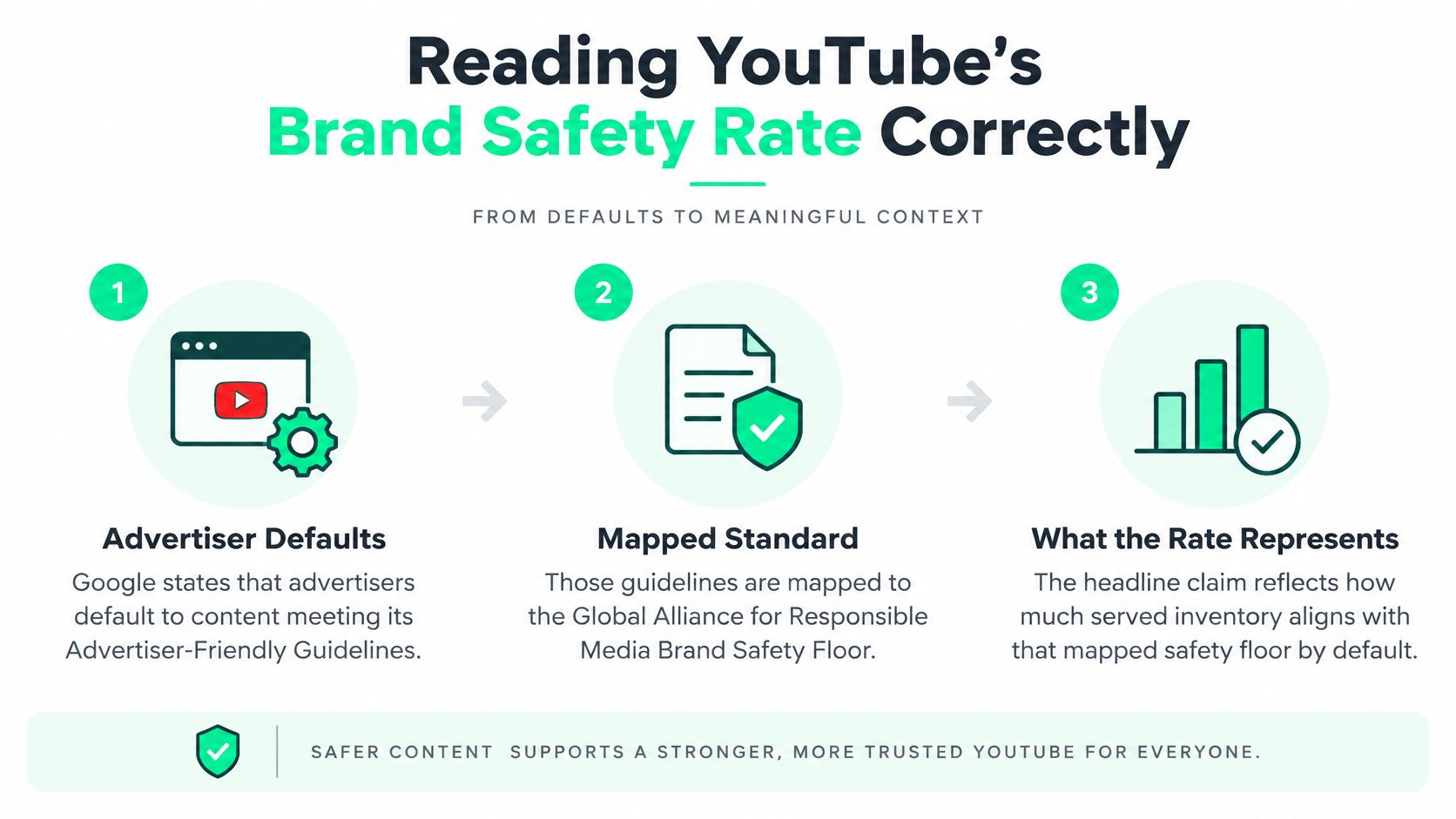
Read the denominator before approving scale
At very large delivery volumes, a small error rate can still mean meaningful exposure to unsuitable material. That matters particularly for finance, crypto, gaming, sports betting and prediction markets, where context can change the meaning of an otherwise acceptable message.
The methodology incorporates general invalid traffic, advanced invalid traffic and brand-unsafe content across supported advertising environments. Those dimensions matter, but they do not answer every buying question.
A platform average does not tell you whether a particular creator reaches American adults, whether a video contains advice your compliance team rejects, or whether a joke undermines your approved creative. Do not convert an aggregate measurement into a creator endorsement.
A platform safety rate belongs beside your buying criteria. It doesn't replace them.
Translate the rate into a reporting requirement
Require reporting that distinguishes brand safety, brand suitability, viewability and traffic validity. Combining everything into a single pass score makes it harder to identify why a placement failed.
Your ad verification process should connect an exception to an action: exclude a placement, investigate traffic, change the suitability profile or request human review. Record the measurement period and covered inventory alongside the result. That record lets the next campaign start from evidence rather than a reset.
For American audience campaigns, keep geography verification separate. Content classification can support a suitability decision, but it cannot establish that the attention came from the United States.
Risk Tiers by Category
A building permit says a shop may open on a street. It doesn't tell you whether that street suits your brand.
YouTube's monetization states, fully monetized, limited ads, and no ads, describe eligibility rather than contextual fit. A monetized video can still conflict with an advertiser's values, intended audience, regulatory obligations, or reputation.
Agency research summarized by Net Influencer found that 73% of respondents wanted to avoid content unsuitable for specific advertisers, while 90% identified completely unsafe content as a concern; agencies also estimated that 30% of campaign impressions could appear beside unsuitable content without third-party suitability controls. These are agency findings and estimates, not a measured failure rate for your campaign.
Set review levels around the actual exposure
The following are advertiser planning categories, not YouTube labels. Use them to decide who approves inventory and which risks require escalation.
Risk tiers and review levels by category
| Category | Typical risk | Review level | Exclusions to consider |
|---|---|---|---|
| Finance and investing | Unverified return claims and advice | Human review of every creator | Hype-driven channels, guaranteed-return language |
| Crypto | Scam-adjacent content and price hype | Human review plus creator history check | Token promotion, giveaway content |
| Gaming | Mature themes and gambling-style mechanics | Automated classification with spot checks | Mature-rated titles, loot-box and gambling-style content |
| Sports betting and prediction markets | Age-sensitive audience exposure and odds promotion | Strict audience age and geography checks | Content aimed at minors, unlicensed odds claims |
| Health | Unlicensed treatments and unverified medical claims | Expert or policy review | Miracle cures, unverified dosage or treatment claims |
| Education and general news | Lower risk for routine material, ambiguous humor and breaking news | Automated classification, escalate ambiguous items | Live coverage of violent events, misleading thumbnails |
Treat the final row carefully. An educational channel isn't automatically low risk when it changes topics, and a news publisher's routine coverage doesn't pre-approve its live reporting.
Enforce rules at the right level
A creator-level exclusion fits a persistent editorial pattern. A video-level exclusion fits an isolated item on an otherwise acceptable channel. A topic exclusion fits a defined subject the brand won't fund.
Audience requirements need a separate gate. For a U.S. sports-betting campaign, an approved sports topic isn't enough: the buyer also needs acceptable age and geographic evidence. Language alone cannot establish either.
Write ambiguous cases into the escalation policy:
- Humor and satire: Have a person assess the target of the joke, not just the presence of a prohibited word.
- Breaking news: Review the current event and surrounding imagery before approving a scheduled placement.
- Comments and creator conduct: Treat scam promotion, repeated misleading claims, or a material editorial change as triggers for investigation.
Comments can provide warning signals even when they aren't an exclusion field in the buying interface. Route those observations to the person who controls creator approval.
Broad blocklists are tempting because they're easy to demonstrate. They can also remove responsible financial education, legitimate health reporting, and useful sports commentary while missing euphemisms or visual context. Narrow, maintained rules are more defensible than an expanding list of words nobody can explain.
Spotting AI-Generated and Made-for-Advertising Content
AI-generated content isn't automatically unsafe. Educational explainers, entertainment, and creator-assisted production can be suitable inventory; deception and low editorial value are the problems to identify.
Digiday's reporting on AI content and YouTube suitability cites an analysis estimating that 21%–33% of YouTube feeds are AI-generated, while 53% of U.S. media experts identify adjacency to generative-AI content as a major 2026 challenge. Those findings describe feed composition and expert concern, not the share of your campaign that will reach unacceptable content.
The review should examine how the content was produced and presented:
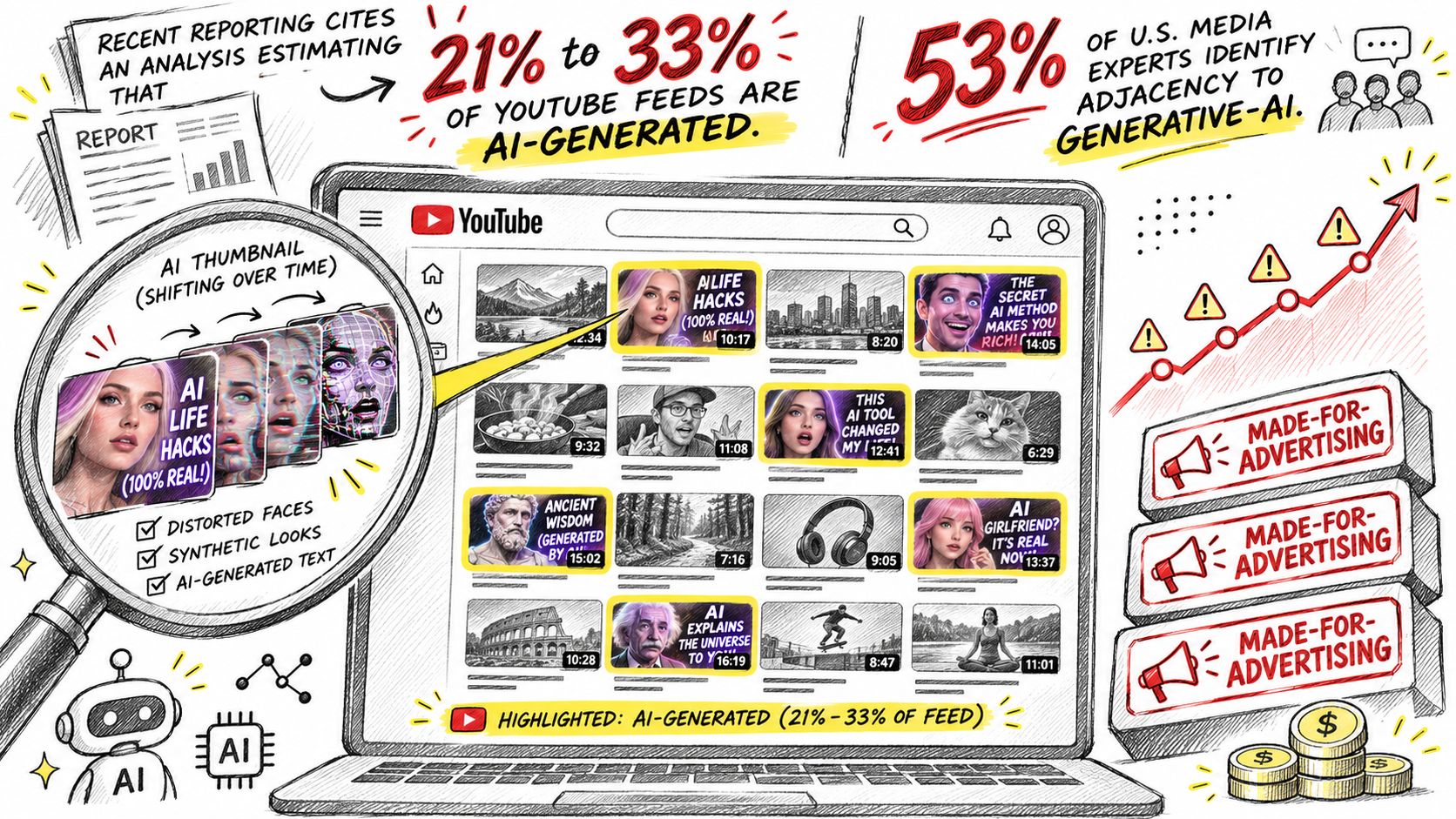
Score deception and originality, not the production tool
Use a review sheet covering disclosure, originality, posting velocity, audience authenticity, factual claims, reuse across channels, and comment quality. Keep the AI-specific judgement focused on provenance and editorial choices; audience and engagement checks should apply to every creator.
For disclosure, ask whether synthetic testimonials or altered demonstrations could mislead a viewer. For originality, distinguish a useful explanation with original analysis from a clip farm that changes a voiceover and republishes the same material.
Factual claims deserve the strictest treatment in finance and health. A polished synthetic presenter doesn't make a return claim credible, and a generated medical illustration doesn't substantiate a treatment. Require a reviewer to identify the basis for the claim before accepting the placement.
Cross-channel reuse needs context too. A creator distributing their own work is different from a network copying unrelated creators' footage with misleading thumbnails.
Keep that distinction in mind when reviewing video examples:
Document an approve, restrict, or reject decision with the evidence and reviewer's reason. High posting velocity can trigger inspection, but it shouldn't establish deception by itself.
A useful audit record explains why a creator remained eligible despite AI assistance, or why fabricated testimonials made another unacceptable. That's stronger than a blanket AI ban that excludes legitimate production without addressing misleading human-made content.
Vetting Creators and Verifying Real Views
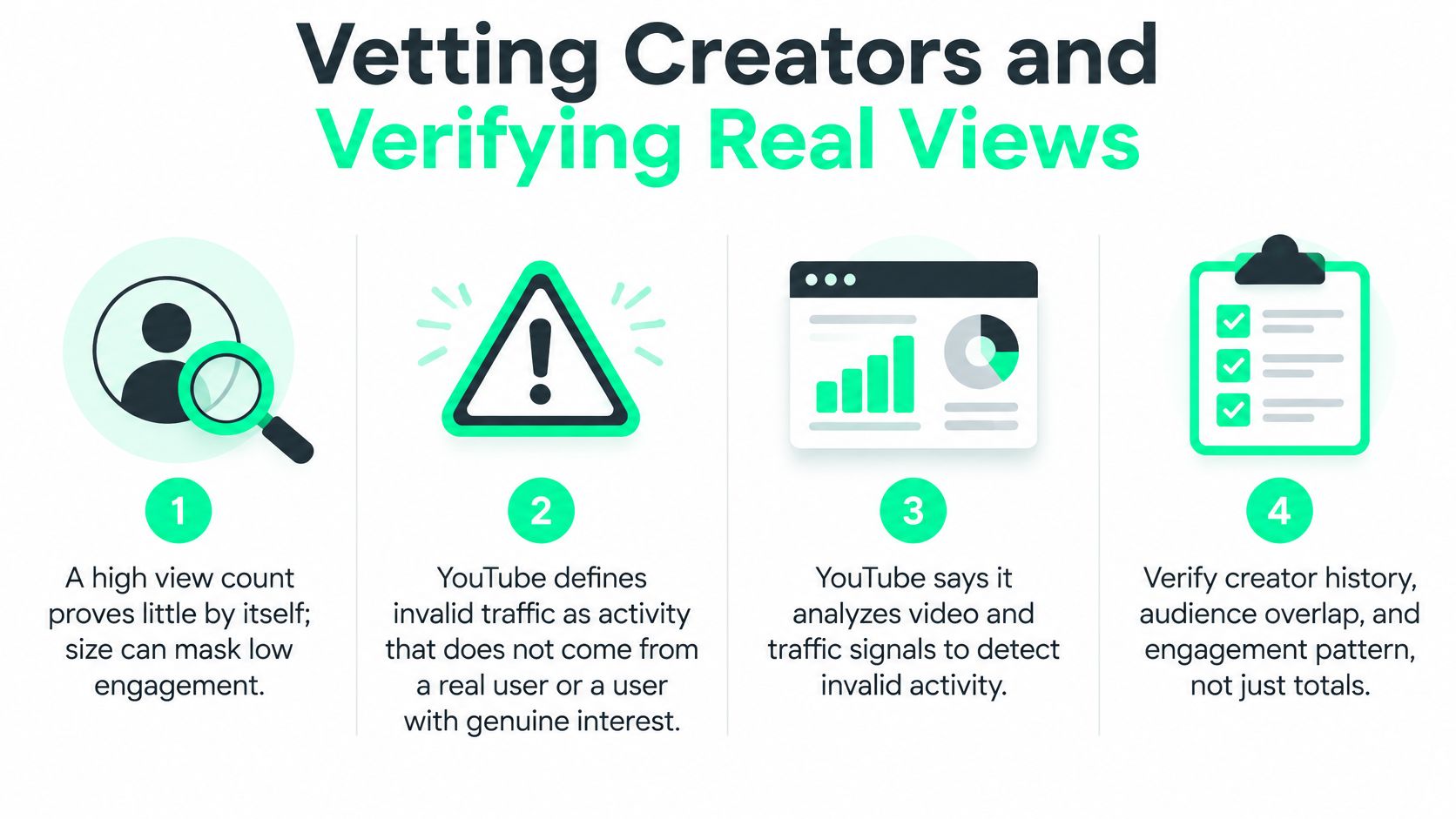
A high view count proves little by itself. The buyer needs to know who watched, whether the attention was genuine, and whether the delivered audience matches the campaign.
YouTube's invalid-traffic guidance defines invalid traffic as activity that doesn't come from a real user or a user with genuine interest, and says its systems assess validity regardless of where or how traffic originated. When it detects invalid traffic, YouTube may temporarily limit ad serving until the risk falls.
Creator vetting signals
| Signal | Healthy sign | Red flag |
|---|---|---|
| Audience geography | Most viewers in the campaign's target country | Views concentrated in unrelated regions |
| Engagement quality | Comments refer to the specific content | Generic emoji comments, repeated wording, bot-like patterns |
| Posting history | Steady cadence and consistent topics | Sudden spikes, frequent reuse of other creators' clips |
| Sponsorship disclosure | Paid posts labelled, such as with #ad | Undisclosed promotions or missing labels |
| Audience-analytics proof | Screen recording or screenshot matching the handle | Screenshots that cannot be matched to the account |
| Views delivered versus claimed | Delivered views in line with the creator's audience size | Large gap between claimed reach and verified views |
Verify the account behind the claim
For a U.S. campaign, set the target to the United States. Treat delivered views outside that target as a red flag requiring explanation, not as equivalent value bundled into a global total.
Tier-one American audiences are our focus, but that description must be supported by account evidence. At FindClout, creators applying to campaigns submit screen recordings and screenshots of their audience-analytics dashboards, such as Instagram audience insights.
Match that evidence to the handle, reporting window, and relevant platform. Instagram insights can support review of an Instagram account; they don't prove a YouTube channel's audience geography.
Use the following verification sequence to keep totals from substituting for evidence:
Investigate patterns without declaring every anomaly fraudulent
Generic comments, sudden growth, and unusually weak engagement justify investigation. None proves invalid traffic alone. A viral upload can reach far beyond an established subscriber base, so compare the explanation with the actual delivery evidence.
An AI scoring system can prioritize suspicious accounts for review, but the approval record should identify the underlying signals rather than merely storing a score.
Verification standard: If the evidence doesn't match the account or the delivered audience, pause the creator and request fresh analytics.
Compare claimed reach with verified delivery, examine country distribution, and check whether paid-promotion labels remain present. Repeat these checks mid-campaign, not only at signing. Audience composition and publishing behavior can change while an agreement remains active.
Confirm Your Brand Safety Rules Before Launch
Write the rules before committing the distribution budget. Assign an owner to each approval and exception.
Set account-level suitability and category exclusions. Carry enduring restrictions into future campaigns so a new launch doesn't reset the brand's baseline.
Load manual exclusions for known channels and videos, then configure topic restrictions where supported. Convert the category review into enforceable settings rather than leaving it in a presentation.
Require approval of captions, visuals, and placements. Google's YouTube advertising requirements include content-policy and creative-quality rules, including restrictions on exaggerated or inaccurate claims. For brands using FindClout, we hand-pick pages to fit each brand rather than distribute across the whole network, and nothing goes live until the brand signs off on the look, whether that's a native clip, caption, tweet card, or carousel.
Verify delivery with independent measurement. Marketing Dive's coverage of YouTube Shorts verification describes video-level suitability, invalid-traffic, and viewability measurement. Compare results by creator, language, and placement, not just aggregate CPM.
Monitor and remove risky inventory. Review placement reports weekly against exclusions, act immediately on identified risks, and log each removal and reason. In our campaign dashboard, brands can remove a post or creator in one click.
Our stated process combines AI scoring with around-the-clock human review before posting, focused on tier-one American audiences. Reviewing every submission with consistent rules supports the ambition to scale attention to billions of views in high-quality U.S. geographies; it isn't a guarantee that every future placement or view will qualify. Write the rules first, then choose an operator that can enforce and document them.
FindClout offers hand-picked creator distribution, brand sign-off before publication, and dashboard controls for removing unsuitable posts or creators. Visit FindClout with your U.S. audience requirements, prohibited topics, and approval criteria to build a campaign plan around verified attention and brand suitability.
Want this audience for your brand?
FindClout puts your brand in front of verified American audiences across every major US page — brand-safe, at scale.
Start Your Campaign