 findclout.com
How to Block Invalid Traffic Without Losing Real Viewers
You pull last week's report and the numbers look fine. Four million views, a CPM well under target, engagement above the benchmark your agency set. Then you open the revenue dashboard and the line is flat. Something between a view and a sale is leaking, and "bots" doesn't fully explain it, because the fraud report came back clean.
That gap is where most media buyers get stuck. Detection tools tell you what they blocked. They rarely tell you what got through, and they never tell you whether the views that survived were worth paying for. Sorting traffic into the right buckets, running a layered filter, sanity-checking your rates against real benchmarks, and then demanding evidence before you accept a verified-view guarantee is the full job. Skip the last step and you're buying filtered numbers, not attention.
Table of Contents
- Sort Invalid Traffic Into GIVT and SIVT
- How to Block Invalid Traffic in Five Steps
- What Invalid Traffic Rates Look Like by Channel
- Diagnose Spikes Without Blocking Real Fans
- Monitor Campaigns With a Delayed Validation Loop
- Evidence to Demand Before Trusting a Verified View
- Confirm Your Blocking Rules Before Your Next Launch
Sort Invalid Traffic Into GIVT and SIVT
A campaign can report millions of views and still fail commercially, and the reason usually sits in one of two buckets that need completely different responses. The IAB's IVT definitions appendix frames invalid traffic as a measurement-quality problem, not a bot count: it covers traffic or associated media activity, including impressions, viewable impressions, clicks and other metrics, that fails quality or completeness requirements or doesn't represent legitimate activity that should enter measurement counts.
That definition has been rewritten repeatedly because the threat keeps changing. The Media Rating Council issued its first final IVT Detection and Filtration Guidelines on October 27, 2015, then updated them through the IVT 2.0 standards addendum in June 2020, per the same IAB appendix.
General invalid traffic is the cheap half
GIVT is what routine filtration catches: data-center traffic, recognized bots and spiders, non-browser user agents, and ad executions that never render in view. You handle it with standard parameter checks and known lists. It's cheap, fast, and the reason your baseline numbers aren't catastrophic.
Sophisticated invalid traffic is the expensive half
SIVT needs advanced analytics, corroboration across multiple sources, continuous monitoring and a human investigation before anyone can call it. The IAB's list of examples includes hijacked devices or tags, malware, incentivized browsing, falsified viewability signals and cookie stuffing, and a later IAB definitions version adds ad injection, click farms, pixel stuffing and proxy traffic to that set.
| Category | Typical examples | How it is detected | First action |
|---|---|---|---|
| GIVT | Data-center traffic, recognized bots and spiders, non-browser user agents, never-viewable ad executions | Routine filtration, standard parameter checks, known lists | Filter automatically and keep raw logs |
| SIVT | Hijacked devices, malware, incentivized browsing, falsified viewability, cookie stuffing, pixel stuffing, proxy traffic | Advanced analytics, cross-source corroboration, human investigation | Quarantine the events and escalate to review |
A view that exists is not the same thing as a view that counts.
The split decides where you spend your week. Automated rules clear the repeatable threats within hours of a campaign going live. The residue needs something slower: cross-source corroboration, monitoring over several weeks, and a person signing off before a view enters the billing count.
How to Block Invalid Traffic in Five Steps
One bot list is not a control system. Layers matter because each one catches what the previous layer missed, and each needs its own audit trail so you can prove what happened when a client asks.
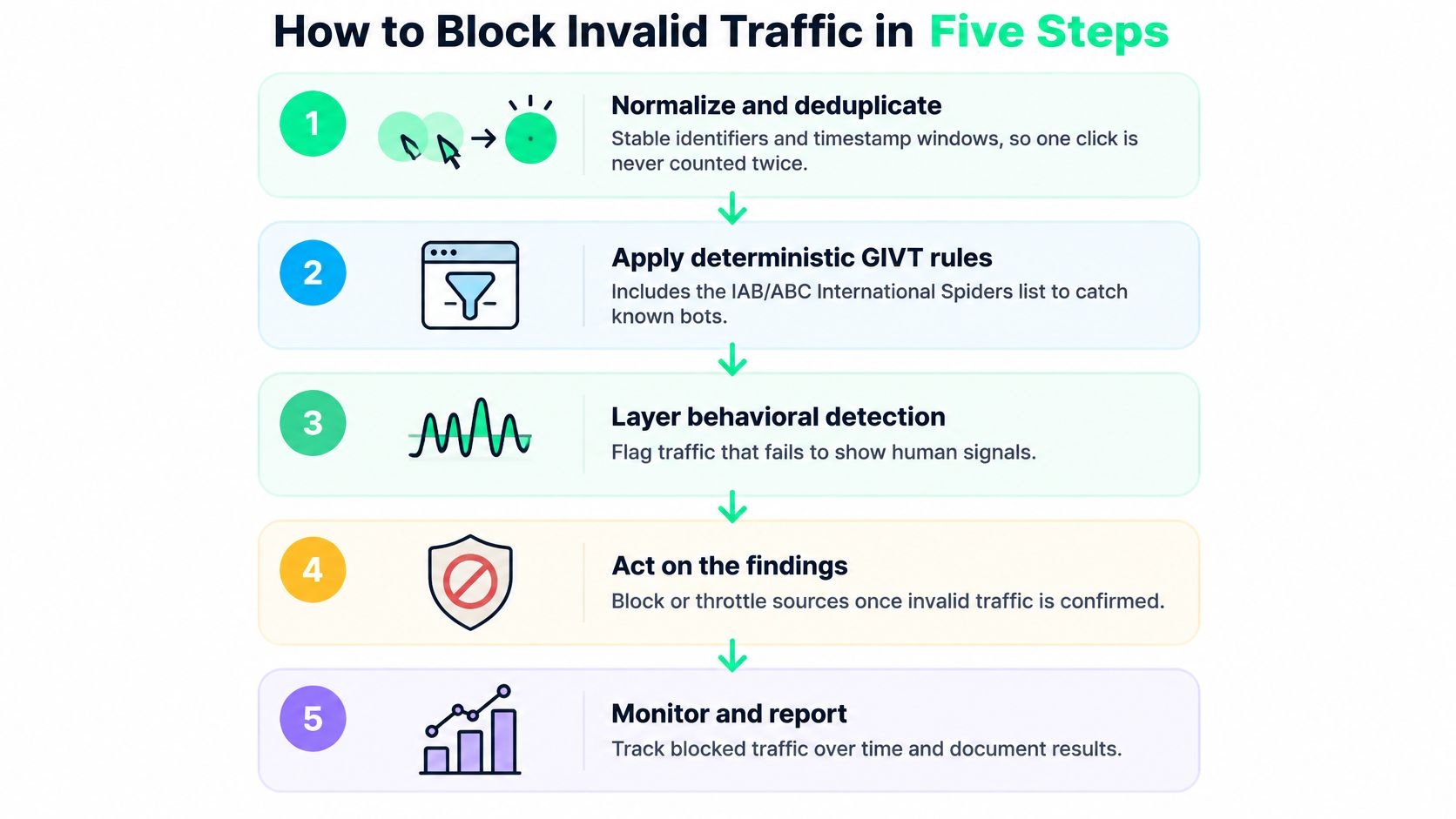
Normalize and deduplicate events. Use stable identifiers and timestamp windows so a single click is never counted twice. Duplicates inflate every downstream metric and make an 8% IVT rate look like 15%. The common mistake is deduplicating on IP address alone, which merges households and carrier NAT ranges into one fake "user."
Apply deterministic GIVT rules. Run the IAB/ABC International Spiders & Bots List, known robotic activity, data-center ranges and malformed user agents as hard exclusions. These are cheap and provable. The mistake is treating the list as a complete filter rather than a floor.
Check the supply path before you blame the creative. The ads.txt 1.1 implementation guidance requires buyers and validators to compare the publisher's OWNERDOMAIN and MANAGERDOMAIN declarations against matching seller-domain entries in sellers.json, and it warns that inventory arriving through sources outside a declared exclusive manager relationship may signal reseller activity. Mistake: assuming a domain's presence in ads.txt means the placement is authorized.
Score the residual traffic on behavior. Layer signals such as click velocity, repeated user-agent or device patterns, abnormal geographic concentration, impossible session sequences and coordinated publisher clusters. The IAB UK's standards guide treats Ads.txt, sellers.json and the SupplyChain object as transparency controls, with buyers.json helping sellers screen which advertisers they accept. Mistake: blocking on a single signal, like one IP range or one country, which is how real buyers disappear.
Quarantine instead of deleting. Set graduated actions: suppress payment for high-confidence events, throttle or hold medium-risk traffic, and route ambiguous cases to a human. Deleting events destroys the audit trail and the evidence you need in a clawback conversation.
Here's the same sequence walked through step by step, which is useful for training a new analyst on the order of operations rather than the tool names.
Over-filtering test: if a rule removes more than a couple of percent of a legitimate publisher's traffic, it needs a labeled sample before it goes live.
The operating rules make the whole thing auditable. Keep separate GIVT and SIVT queues, version every rule so you can roll one back alone, preserve raw events, and report a decision rate, meaning the percentage of intended impressions for which enough information existed to classify validity, rather than presenting filtered totals as complete truth. The Google Ads invalid activity guidance describes combining activity-pattern analysis with supervised classification, logistic regression, neural networks, tree methods and graph methods, while MRC standards require the methodology, data sources, model categories and coverage limits to be disclosed in plain language.
What Invalid Traffic Rates Look Like by Channel
Benchmarks are a baseline for judging your own numbers, not a target and never a guarantee. Pixalate's Q2 2024 desktop and mobile web benchmark report put global invalid traffic in open programmatic mobile web at 11.6%, with North America at 17.5% in the same quarter. That regional gap is the reason a U.S.-only buyer shouldn't judge delivery against a global average.
| Channel | Market | Invalid traffic rate | Period |
|---|---|---|---|
| Open programmatic mobile web | Global | 11.6% | Q2 2024 |
| Open programmatic mobile web | North America | 17.5% | Q2 2024 |
| Open programmatic mobile app | Global | 20% (about $1.28 billion in affected ad spend) | Q2 2024 |
| Desktop web | U.S. (North America) | 21% | Q4 2024 |
| Mobile apps | U.S. (North America) | 21% | Q4 2024 |
| Connected TV | U.S. (North America) | 23% | Q4 2024 |
The money at stake is not theoretical. Pixalate's Q3 2024 ad fraud benchmarks estimated that $1.5 billion of programmatic mobile-app ad spend and $1.4 billion of programmatic connected-TV ad spend was lost to invalid traffic and ad fraud in that quarter alone.
Read the table as a diagnostic, not a scoreboard. If one channel runs well above its row, check the source list and the supply path before you touch the creative, because a spike usually means a new placement or a new reseller, not a sudden drop in ad quality. If a channel sits far below its row, confirm that filtering isn't hiding the problem through over-filtering, since a suspiciously clean number often means a broken tag.
Review habit: write your own measured rate next to each row before every campaign review, and flag any channel that moved more than a few points in either direction.
Diagnose Spikes Without Blocking Real Fans
A sports meme page posts at 7:40pm during a playoff game. Forty thousand clicks land in six minutes, most of them from one mobile carrier range, and the fraud rule you wrote last quarter wants to block the whole source. Hold it. That pattern is also exactly what a genuine viral moment looks like on a phone-heavy, tier-1 U.S. audience, and blocking it costs you the best placement of the month.
| Signal | Likely cause | First response |
|---|---|---|
| Clicks spike within minutes of a post | Real viral sharing or coordinated automation | Hold new placements in quarantine and compare against the creator's baseline |
| Traffic concentrated in one carrier or IP range | Shared mobile carrier or VPN users | Check session and device diversity before adding an IP block |
| Engagement looks normal but conversions stay flat | Human-mimicking bots or compromised sessions | Check dwell time and post-view conversion quality |
| Sudden change after a creative, targeting or tracking update | Tag misfire or duplicated firing | Reconcile pre- and post-filter counts and audit tag firing |
| Share of flagged traffic rises over several months | Adaptive sophisticated invalid traffic | Retrain rules on labeled samples and review false-positive rates by source |
Browser-level checks won't settle it. A 2026 analysis of 62.8 million paid clicks classified as bot traffic found that 75% lacked basic browser-automation indicators, according to reporting on Spider Labs' click analysis, which means checks for Selenium, headless browsers or odd user agents miss most of the advanced layer.
So the answer to "is this viral or coordinated" isn't a blocklist. It's a baseline. Pull the creator's own 30-day history, look at session and device diversity before you add an IP rule, check dwell time and the quality of post-view conversions, and reconcile pre- and post-filter counts against tag firing logs. A 7- and 30-day Insights scorecard is a useful model for that review cadence, because it forces you to look at a channel's trend across two windows instead of reacting to one hour.
Practical rule: score risk at the source and validate delivery over time. Never block everything unusual, and never approve anything unusual without evidence.
That's also how automated fraud detection should behave in practice: detection flags, humans decide, and the held traffic waits rather than disappearing. On our side, unverified, unscraped or suspicious posts are quarantined and accrue nothing unless and until they're approved, so a viral burst gets reviewed instead of removed.
Monitor Campaigns With a Delayed Validation Loop
Fraud rules that fire immediately and never get rechecked drift out of date within a quarter. Build detection on at least seven days of traffic before automatic blocking goes live, then run the same loop every cycle:
- Label a baseline from confirmed bots, manual investigations, known-good users and independent verification signals.
- Evaluate on the baseline, not the filtered totals: precision, recall, alert volume and economic impact.
- Detect at every level, meaning impression, click, account, publisher and network, because coordinated fraud looks normal in isolation and obvious in aggregate.
- Graduate the response, suppressing payment for high-confidence events, throttling medium-risk traffic and sending ambiguous cases to human review.
- Retrain on new labeled samples each cycle, since traffic adapts once a rule is known.
Wire the output into your campaign performance dashboard so each rule change can be traced to the evidence behind it. A block you can't explain to a client is a block you'll eventually have to reverse.
Evidence to Demand Before Trusting a Verified View
A filtered view count is not proof of attention. The IAB/MRC attention measurement guidelines require valid-impression metrics to be based on impressions filtered for invalid traffic, and their outcome guidance goes further, asking for causal linkage between exposure and consumer action plus filtering of fraudulent clicks, installs and purchases. Four different claims hide inside "verified": human traffic, viewable exposure, attentive exposure and incremental outcomes. A campaign can carry almost no detectable fraud and still produce weak commercial value if reporting stops at the second claim.

Before you accept a verified-view guarantee, ask for the evidence package:
- Source-level delivery logs with the deduplication method and the rules behind each exclusion.
- Geography breakdowns that show tier-1 U.S. concentration rather than a global blended number.
- Dwell or view duration and suspicious engagement patterns, not just view counts.
- Post-view conversion quality, so you can see whether clean traffic converted.
- A false-positive route, because aggressive filters remove real people and you need an appeal path.
- A delayed-fraud policy: retained raw logs, make-good rules and clawbacks for views invalidated after billing.
Billing rule to insist on: if the provider won't write "only approved posts count toward spend, and botted views are never billed" into the terms, the guarantee is marketing copy.
We hold ourselves to that line: pending or rejected posts are never billed, only approved posts count toward a brand's spend, and botted views are never billed. Ask any ad verification partner for the same commitment in writing.
Confirm Your Blocking Rules Before Your Next Launch
Run this confirmation list this week, before the next campaign goes live:
- Confirm the GIVT list and deduplication rules are versioned, and that raw logs are retained long enough to audit a disputed invoice.
- Confirm the supply-path check has run for every source, with flagged inventory either cleared or excluded.
- Set quarantine thresholds and name the owner who reviews held traffic, so nothing sits in limbo past a billing cycle.
- Agree the brand rules up front: required terms, prohibited topics, minimum follower thresholds and geo filters limited to the markets you sell in.
- Ask for the evidence package from the section above and read the geography line first.
That last point is where tier-1 focus earns its keep. Traffic from high-quality geographies is worth more per view, and brand safety is a delivery requirement, not a checkbox on a deck. A brief can rule out whole topics before a single post goes live, and content is checked before payment rather than after.
FindClout fits into that picture. We distribute across a curated network of U.S. tier-1 creator pages, with particular depth in American sports audiences, and nothing goes live without brand sign-off. Every submission runs through AI scoring at roughly 1.2 seconds on average plus 24/7 human review, which is the system that lets us scale attention across billions of views while keeping delivery in high-quality geographies and protecting the brand alongside it. Audit those controls against the checklist above rather than taking them on trust.
Then prove it on your own numbers: book a pilot scoped to one channel and compare its decision rate against the benchmark table after two weeks.
If you're buying attention rather than impressions, the difference matters at the invoice. FindClout sells verified views on a CPM basis across a vetted network of U.S. tier-1 creator pages, with pre-approval before anything posts, AI scoring plus round-the-clock human review, and billing that only counts approved posts. Bring your evidence checklist and see how our controls hold up at FindClout.
Want this audience for your brand?
FindClout puts your brand in front of verified American audiences across every major US page — brand-safe, at scale.
Start Your Campaign