 findclout.com
Analytic or Analytics: Which Word to Use and When
Use analytic as the adjective for logic-based specialist fields, analytics as the noun for the study and practice of data, and analytical as the everyday adjective for a person's skill or a careful piece of analysis. Three forms, three jobs, and no overlap once you see the pattern.
So why does the same campaign deck say "analytic dashboard," "analytic skills," and "our analytics are strong" on three consecutive slides? Because every one of those words is a real word, so nothing gets flagged, and the writer assumes they're stylistic variants of one idea. They aren't. Choosing between analytic or analytics is a decision about what you're naming: a field, a practice, or a quality of thinking.
That distinction stops being academic when you write reporting for U.S. advertisers. A buyer reading "verified views" and "served impressions" needs to know which noun means what, and a writer who mixes up the field noun with the adjective usually mixes up the metrics too.
Table of Contents
- Which Word to Use at a Glance
- Analytics as the Name of a Field
- Analytic vs Analytical in Specialist and Everyday Use
- Verb Agreement and Plural Use
- Analytics Vocabulary for U.S. Brand-Safe Campaigns
- Tier-1 Audience Quality and Invalid Traffic
- Analytic and Analytics in Job Posts and Product Names
- Self-Check and Common Fixes Before Publication
Which Word to Use at a Glance
Start with the lookup table, then run the test underneath it on any sentence you're unsure about.
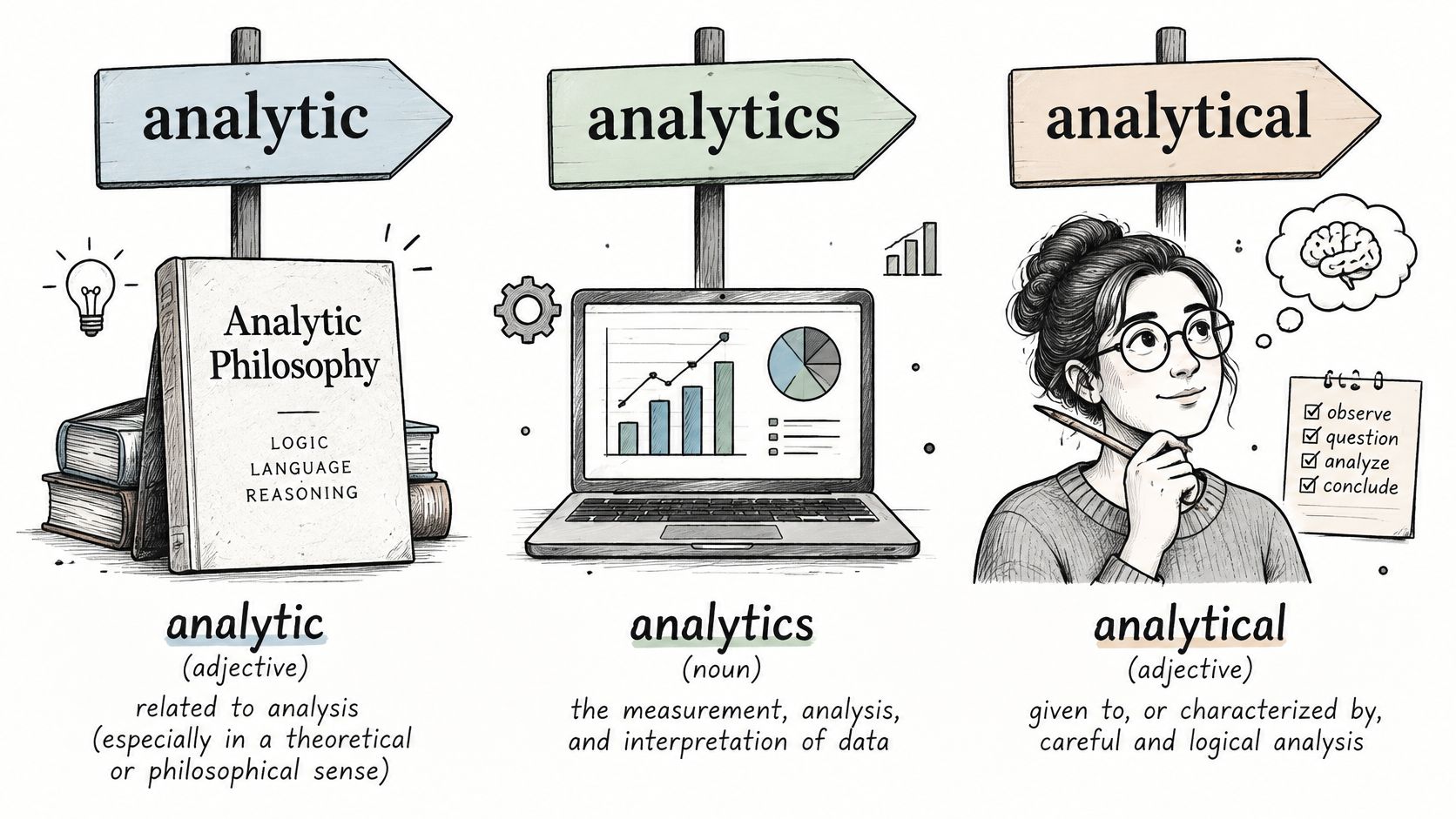
| Word | Part of speech | Core meaning | Example |
|---|---|---|---|
| analytic | adjective | relating to logical analysis in a specialist field | An analytic method separates each variable. |
| analytic | noun | a statement true by its meaning, used in philosophy | Analytic statements need no outside evidence. |
| analytics | noun | the systematic study of data to guide decisions | Our analytics show steady growth. |
| analytical | adjective | good at or using careful analysis | She has strong analytical skills. |
The three-question test
Ask these in order and stop at the first yes.
- Does the word describe a specialist field or theory? Use analytic. Think analytic philosophy, analytic geometry, analytic function.
- Does it name the study of data or the data practice itself? Use analytics. Think web analytics, an analytics team, our analytics.
- Does it describe a person's skill, a way of thinking, or a general report? Use analytical. Think analytical skills, an analytical review.
The order matters because the specialist phrases are fixed names, not descriptions. You can't negotiate them. Everything else is either the data field or ordinary careful thinking, and those two split cleanly.
Each form in a real sentence
- Analytic: "The seminar covers analytic philosophy and the analytic and synthetic distinction."
- Analytics: "Our analytics show that most verified views came from U.S. accounts."
- Analytical: "She brought strong analytical skills to the fraud review."
Practical rule: if you can swap the word for "careful analysis" and the sentence still reads naturally, you want analytical, not analytic.
One more thing worth noticing in the table: analytic as a noun is rare and lives almost entirely in philosophy. Outside that context, if you need a noun, you need analytics.
Analytics as the Name of a Field
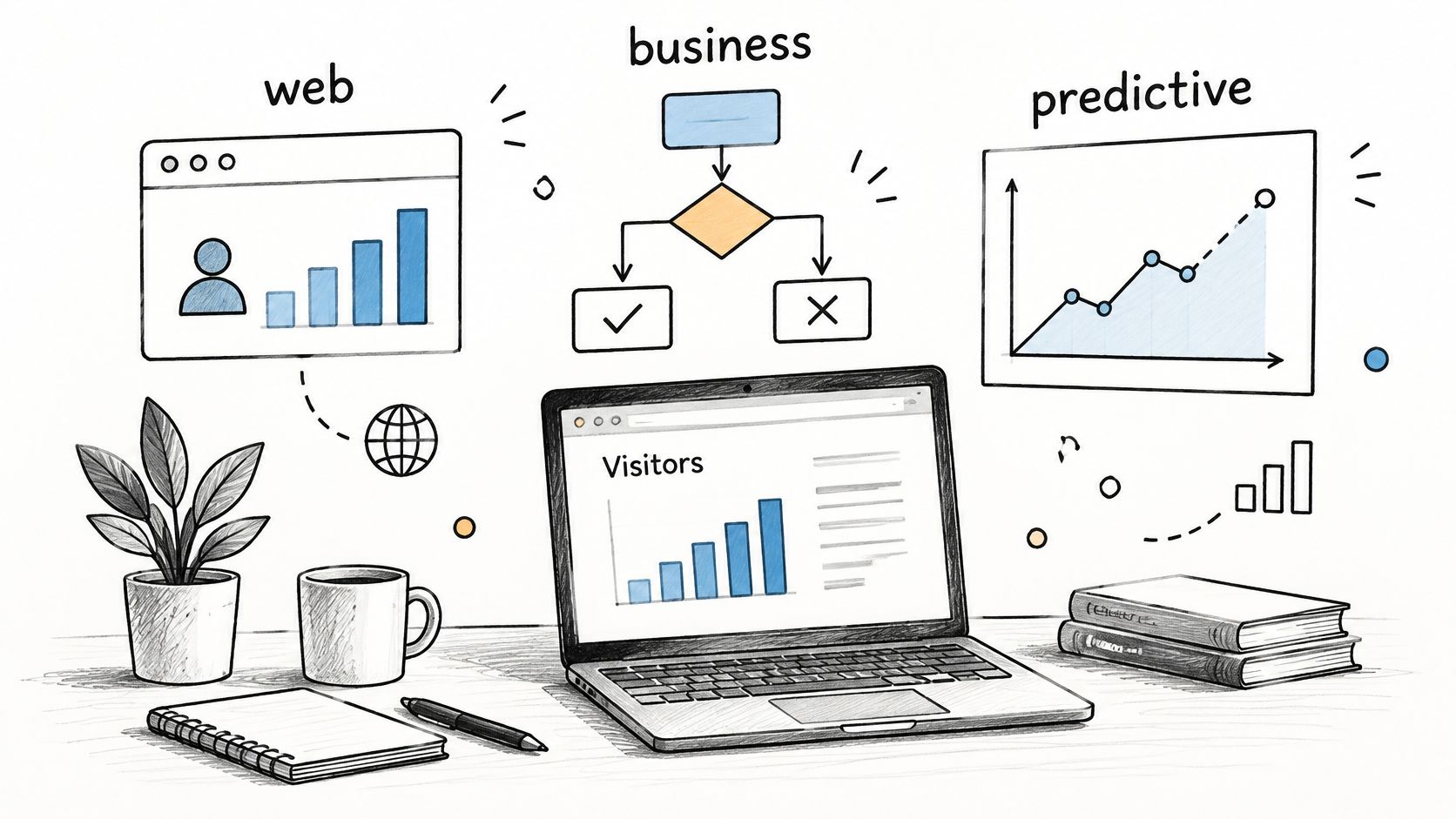
Analytics names a discipline, and the discipline's name travels into compound phrases without changing shape. Here are the ones you'll meet most often in marketing and reporting work.
| Phrase | What it names | Example use |
|---|---|---|
| web analytics | visitor behavior on websites and apps | Reviewing traffic and conversion reports |
| business analytics | company decisions based on data | Forecasting sales by region |
| predictive analytics | statistical models that forecast outcomes | Estimating customer churn |
| learning analytics | student data in education | Tracking course completion |
| sports analytics | performance and betting-market data in sport | Ranking player efficiency |
| Google Analytics | product name, always capitalized | Setting up a website property |
Why the field has one name
The word covers more than counting. A CETIS brief history of analytics traces the practice from Sweden's Tabellverket, which began systematic national population-data collection in 1749, through Ronald Fisher's experimental-design work beginning in 1921 and Jerzy Neyman and Egon Pearson's formalization of hypothesis testing in 1933, describing a disciplined process for collecting evidence, testing explanations, estimating uncertainty and guiding action. That's the scope the noun carries. It names the whole workflow, not a chart.
Because it names a workflow, it also names the teams and tools that run it, which is where the noun-modifier rule comes in.
The noun-modifier rule
Analytics can sit in front of another noun without changing form. Write an analytics dashboard, an analytics team, an analytics platform, an analytics engineer. Don't write an analytic dashboard, and don't write an analytical dashboard unless you mean a dashboard that thinks carefully, which isn't a thing.
Pluralizing the second noun doesn't touch the first. Analytics dashboards is correct when there's more than one dashboard, exactly like "systems analysts" or "sports pages." The modifier stays put.
Data analytics is also standard and correct for the discipline as a whole, so "our data analytics practice" and "our analytics practice" both work. Pick one per document and stay with it. For a working example of how these terms map onto live campaign reporting, our reporting and analytics documentation uses the field noun consistently across post-level and handle-level views.
Copy this line if you want both uses in one sentence: Our analytics team reviews web analytics every Monday.
Analytic vs Analytical in Specialist and Everyday Use
The adjective decision is where most writers stall, so scan the context table first and read the reasoning after.
| Context | Form | Example |
|---|---|---|
| Specialist field with a fixed name | analytic | Teaching analytic philosophy in a seminar |
| Geometry done with coordinates and algebra | analytic | Solving an analytic geometry problem |
| Function locally given by a convergent power series | analytic | Proving a result about an analytic function |
| Identification and measurement of a substance's parts | analytic | Running an analytic chemistry test |
| Claim true by the meaning of its terms | analytic | Explaining the analytic and synthetic divide |
| Journal convention that accepts the variant | analytical | Publishing an analytical chemistry paper |
| General skill or thinking style | analytical | strong analytical skills |
| Report or review of an analysis | analytical | an analytical report on churn |
| Tool, dashboard or team working on data | analytics (noun modifier) | an analytics dashboard |
| Plain-language replacement test | analytical | a careful analysis of the results |
Fixed phrases keep analytic
These are names, not descriptions, so treat them as locked:
- Analytic philosophy: "The seminar teaches analytic philosophy."
- Analytic geometry: "The homework set covers analytic geometry."
- Analytic function: "The exam asks for an analytic function."
- Analytic chemistry: "The lab runs analytic chemistry on every batch."
- Analytic statement: "An analytic statement is true by the meaning of its terms."
Chemistry is the honest edge case. Analytical chemistry is an accepted variant and appears in journal titles and department names, so follow the convention of the field or publication you're writing for rather than overriding it. If a journal calls itself analytical chemistry, don't correct it.
General writing takes analytical
Outside those fixed phrases, the everyday adjective is analytical. Job posts say strong analytical skills, and "analytic skills" reads as an error to most U.S. readers even though it's grammatically parseable. The same goes for documents: an analytical report on churn is safer than "an analytic report," because you're describing the quality of the analysis, not naming a school of thought.
This extends to people and habits. An analytical thinker, an analytical approach to a problem, an analytical review of last quarter's spend. Each one passes the replacement test with "careful analysis."
Data work takes the field noun
When the thing you're describing exists to process data, use analytics as a modifier: an analytics dashboard, an analytics team, an analytics platform. The test is functional, not stylistic. A dashboard doesn't analyze carefully; it delivers the output of a data practice, so it takes the practice's name.
If the word can be replaced by "careful analysis" without losing precision, use analytical. If it names a fixed field, keep analytic. If it names the data practice or a tool built on it, use analytics.
Writers often ask whether "analytical dashboard" could be defended as a dashboard supporting analysis. It could, in the abstract, but it isn't what the industry writes, and unusual phrasing in a client-facing report costs you credibility for no gain.
Verb Agreement and Plural Use
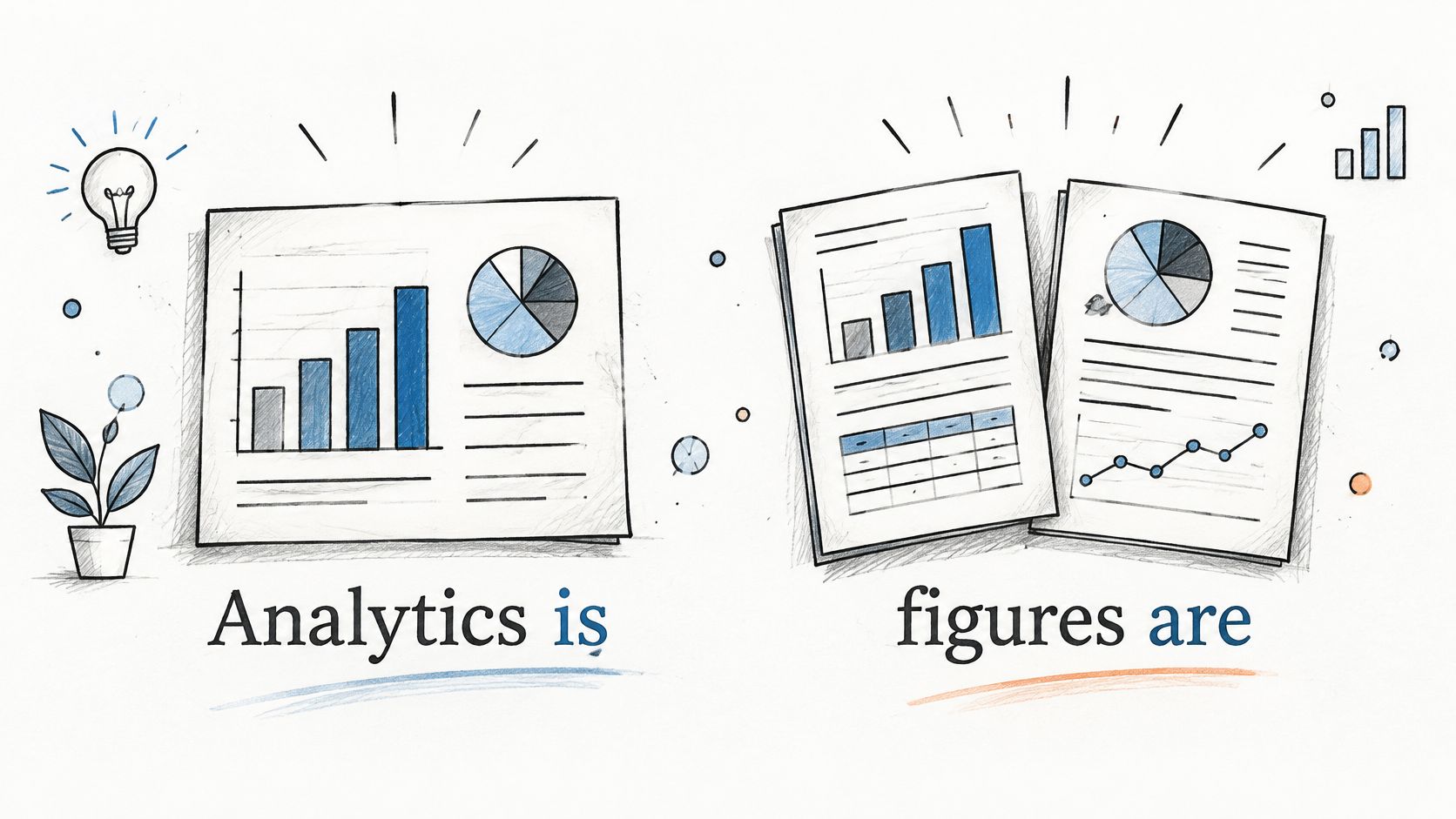
Default to a singular verb when analytics names the field. Analytics is central to our growth plan. The word ends in -s, but so do physics, economics and linguistics, and nobody writes "physics are."
The exception, and how to spot it
When analytics refers to a body of figures or a set of reports rather than the discipline, a plural verb reads naturally: The analytics from last quarter are incomplete. Here the word stands in for "the numbers," and plural agreement follows the meaning.
Three patterns, one sentence each:
- Field, singular: "Analytics is a required input for every media plan."
- Figures, plural: "These analytics are missing the geography breakdown."
- Compound field, singular: "Web analytics is reviewed weekly, and business analytics is reviewed monthly."
That third pattern trips people up. Web analytics is, not "web analytics are," because the compound still names a discipline. The same holds for business analytics, sports analytics and learning analytics.
A quick check you can run
Replace analytics with statistics or data and read the sentence aloud. "Statistics is central to our growth plan" works when you mean the discipline; "the statistics are incomplete" works when you mean the figures. Whichever substitution sounds right tells you which verb to use.
One thing to avoid entirely: an analytics for a single item. Write a piece of analytics, a single report, or a dashboard instead. "She sent me an analytics" isn't idiomatic in any register.
Consistency inside one document matters more than which convention you pick. If your report treats analytics as singular in the summary, don't switch to plural in the appendix.
Analytics Vocabulary for U.S. Brand-Safe Campaigns
Campaign reporting has its own controlled vocabulary, and the analytic or analytics distinction sits on top of it. Analytics names the reporting practice. Analytic describes a method, as in "an analytic approach to viewability."
The core nouns you'll write in any U.S. media report:
- Served impressions: what the platform delivered, counted before any quality check.
- Viewable impressions: the subset that met a visibility threshold.
- Viewability rate: viewable divided by served, expressed as a percentage.
- Verified or filtered impressions: what remains after invalid traffic is removed.
- Unique reach and frequency: distinct accounts, and how often each was exposed.
- Engagement and conversion outcomes: what people did after exposure.
Thresholds make the nouns mean something
Those terms aren't interchangeable labels. The MRC Digital Audience-Based Measurement Standards define a display impression as viewable when at least 50% of the ad's pixels are continuously visible for at least 1 second, and a video impression as viewable at 50% of pixels for 2 continuous seconds. Write "viewable" only when that condition is met, and keep served counts visible for reconciliation rather than replacing them. Our campaign performance dashboard keeps those columns separate for exactly this reason.
Brand safety needs the same precision
Machine scoring alone doesn't settle suitability. MRC's Enhanced Content Level Context and Brand Safety supplement.pdf) states that machine learning should be used together with focused human intervention for user-generated and social-media content, with trained personnel manually classifying context and brand-safety risks, and model weaknesses determining where human review concentrates.
We build to that shape: every submission passes automated scoring and human review before it goes live, with tier-1 U.S. audience checks and brand-safety escalation handled before distribution scales to billions of views. In reporting language, that means analytics is the practice you're buying, an analytic screen is one method inside it, and a trained reviewer's decision is a separate, logged event.
Tier-1 Audience Quality and Invalid Traffic
Traffic-quality reporting is where sloppy nouns cost real money, because "views" can mean four different things in one invoice.
The nouns, defined
Invalid traffic (IVT) is the umbrella noun. General invalid traffic (GIVT) covers activity that's straightforward to identify and filter, and bot fraud is the subset generated by automated agents. MRC's Viewable Ad Impression Guideline distinguishes invalid impressions caused by non-human traffic, such as bots or spiders, from legitimate impressions, which gives you an objective line to draw in a report.
The scale isn't theoretical. A 2025 DoubleVerify North America report found bot fraud increased 101% year over year across the region, with U.S. bot fraud rising 106%, and recorded an 86% year-over-year increase in general invalid traffic during the second half of the year, with 16% of that traffic coming from bots associated with AI tools.
Why the wording carries the claim
Keep three layers distinct in every sentence you write. Invalid-traffic analytics is the practice. An analytic screen is one method inside it. Verified impressions are the outcome after filtration, and they're the only number that should carry a quality claim.
Geography deserves the same discipline. "Tier-1 U.S. views" is a claim about audience location and authenticity, so it needs audience evidence behind it, not a served-impression total. Attention at that scale is available: Nielsen reported that the 2025 Major League Baseball postseason generated 58.2 billion viewing minutes, a 24% increase from the previous year, in its annual Top of Sports report, which is also why placement controls matter in sports niches.
We vet audiences for tier-1 U.S. demographics and review every submission in real time, so the brand-safety and geography claims in our reporting rest on logged decisions rather than raw delivery counts. Our ad verification approach documents which checks run before a post is approved.
Analytic and Analytics in Job Posts and Product Names
Hiring copy and software names are where the three forms collide most often, and both have settled conventions.
People take analyst. Write data analyst, marketing analyst, or performance analyst. The role that builds and maintains data pipelines is an analytics engineer, not an "analytic engineer." Academic titles keep the specialist adjective, so analytic philosopher is right, while analytical chemist is the usual industry title even where the field phrase is analytic chemistry.
Products keep their capitals. It's Google Analytics, not "Google analytics," and Meta Insights when you're naming the connected-account report. Lowercasing a product name in a client deck reads like you've never opened the tool.
Teams and tools take the field noun: the analytics team, the analytics platform, the web analytics dashboard.
Three corrected job-post lines you can lift directly:
- "We need analytical skills," not "analytic skills."
- "Our analytics dashboard tracks sales," not "analytic dashboard."
- "The analytics team reviews web analytics every Monday."
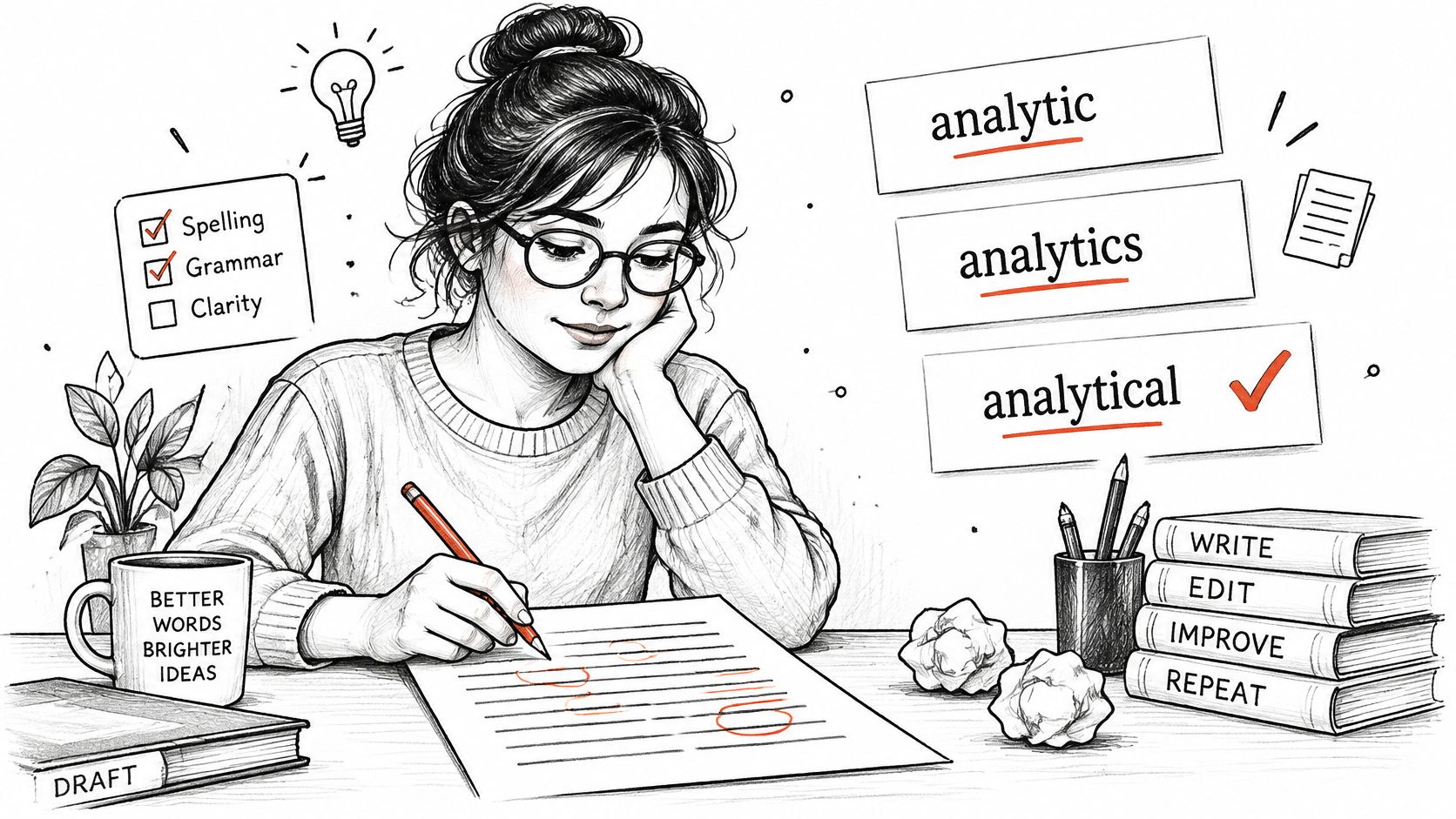
Spell-checkers won't catch any of this, because analytic, analytics and analytical are all real words. Only a human reading for meaning will notice that you've named a philosophy where you meant a dashboard.
Self-Check and Common Fixes Before Publication
Run the fixes in order of damage. Skill language misleads hiring readers about what a role requires, and field-noun errors misname the data practice you're selling, so those go first.
| Incorrect | Correct | Why |
|---|---|---|
| We need analytic skills on the team | We need analytical skills on the team | Skills are general, so use the adjective analytical |
| Our analytic dashboard tracks sales | Our analytics dashboard tracks sales | A dashboard reports data work, so use the field noun |
| Analytics are key to our growth | Analytics is key to our growth | The field takes a singular verb |
| Analyticals tools improve our reports | Analytical tools improve our reports | Analytical is the only correct adjective here |
| The analytics function in the calculus exam | The analytic function in the calculus exam | The calculus term is the adjective analytic |
The four-item checklist
- Classify the sentence. Does the word name a fixed field, a data practice, a skill, or a general report?
- Choose the form. Analytic for the fixed field, analytics for the practice, analytical for the skill or report.
- Check the verb. When analytics names a field, the verb is singular, including in compounds like web analytics.
- Protect the proper nouns. Google Analytics and Meta Insights keep their capitalization wherever they appear.
Set one house glossary
Write the rules down once and apply them to briefs, reports, captions and creator instructions. A shared glossary stops the drift that happens when five people write about the same campaign in the same week, and it makes review faster because reviewers check against a standard rather than a preference.
The glossary should cover metric nouns too, not just the three adjectives. Attribution terms are the clearest example: Google Analytics' attribution documentation describes data-driven attribution, which distributes credit for a key event using observed data for that event, alongside paid-and-organic last-click attribution, and notes that direct visits generally don't receive credit unless the conversion path consists entirely of direct visits. Those are different models with different names, so a report that says "attribution" without specifying which one is as imprecise as saying "analytic dashboard."
Our own counting rule belongs in that glossary in plain words: views are counted from the platform's own numbers, with Meta Insights used for connected accounts. When a team states how views are counted, the metric wording and the analysis term have to match, or a reader can't tell whether a number describes delivery, verified attention, or an attributed outcome.
Before your next review, fix the three terms that appear most often in the current draft. Search for "analytic" and check every hit that isn't a fixed field name, search for "analytics are" and confirm you mean figures rather than the discipline, and confirm every product name is capitalized. That pass takes a few minutes and removes the errors a U.S. buyer notices fastest.
We distribute branded meme content across a curated network of vetted creator pages with American audiences, and every submission clears automated scoring plus human review before it posts, so your analytics report describes verified attention in tier-1 geographies rather than raw served impressions. If you want reporting where the nouns mean exactly what they say, with post-level and handle-level breakdowns you can audit, visit FindClout and see how the dashboard separates served, viewable and verified views before you plan your next campaign.
Want this audience for your brand?
FindClout puts your brand in front of verified American audiences across every major US page — brand-safe, at scale.
Start Your Campaign