 findclout.com
Vertical Marketing System: How to Scale Creator Campaigns
A vertical marketing system is a coordinated distribution model in which a dominant brand or platform owns or governs the rules, review, and placement of creator content to protect audience quality and brand safety. In practice, a vertical marketing system has covered about 70% to 80% of the U.S. consumer-goods market in the historical distribution literature, which is why this model matters when fragmented buying starts to break under scale source material.
That sounds academic until you've watched manual creator buying fall apart in real time. Spreadsheets get stale, DMs disappear, approvals drift, and the audience that looked strong in a pitch deck turns thin in the geo report. A governed distribution system fixes the part that often gets ignored, not just placement, but control.
Table of Contents
- Why Manual Influencer Buying Collapses at Scale
- What a Vertical Marketing System Actually Is
- How Vertical Marketing Systems Govern Creator Networks
- Programmatic Campaign Formats and Distribution Workflow
- Brand Safety, Real-Time Review, and FTC Disclosure Controls
- When a Vertical Marketing System Beats Traditional Buying
- Implementation Checklist and Scale Decisions
Why Manual Influencer Buying Collapses at Scale
Manual creator buying looks simple at first. A media buyer finds pages, negotiates rates, checks a few screenshots, and hopes the post lands with the right audience. Then the workload compounds, because every new creator adds another approval thread, another caption edit, another compliance check, and another chance for the placement to drift away from the target market.
The problem isn't effort, it's coordination. Conventional channels treat manufacturers, wholesalers, and retailers as separate businesses that negotiate through arm's-length transactions, and creator buying inherits that same fragmentation when every page is handled like a one-off deal vertical integration and distribution context. You can buy a lot of placements that way, but you don't get a system. You get a stack of exceptions.

What breaks first
Practical rule: if the team can't answer who approved the caption, who owns the audience data, and who can remove a bad placement, the buying model is already too loose.
That's where a vertical marketing system starts to earn its keep. It replaces favor-based buying with infrastructure, so distribution is governed by rules instead of personal memory. For teams looking for a parallel in creator distribution, an influencer ad network is a useful lens because it treats placement as a managed channel, not a string of isolated transactions.
Manual buying also struggles with brand safety because the review happens too late. By the time a caption is live, the damage is public, and corrections become reputational rather than operational. In regulated categories, or anywhere audience quality matters more than raw reach, that's not a minor flaw. It's a structural one.
What a Vertical Marketing System Actually Is
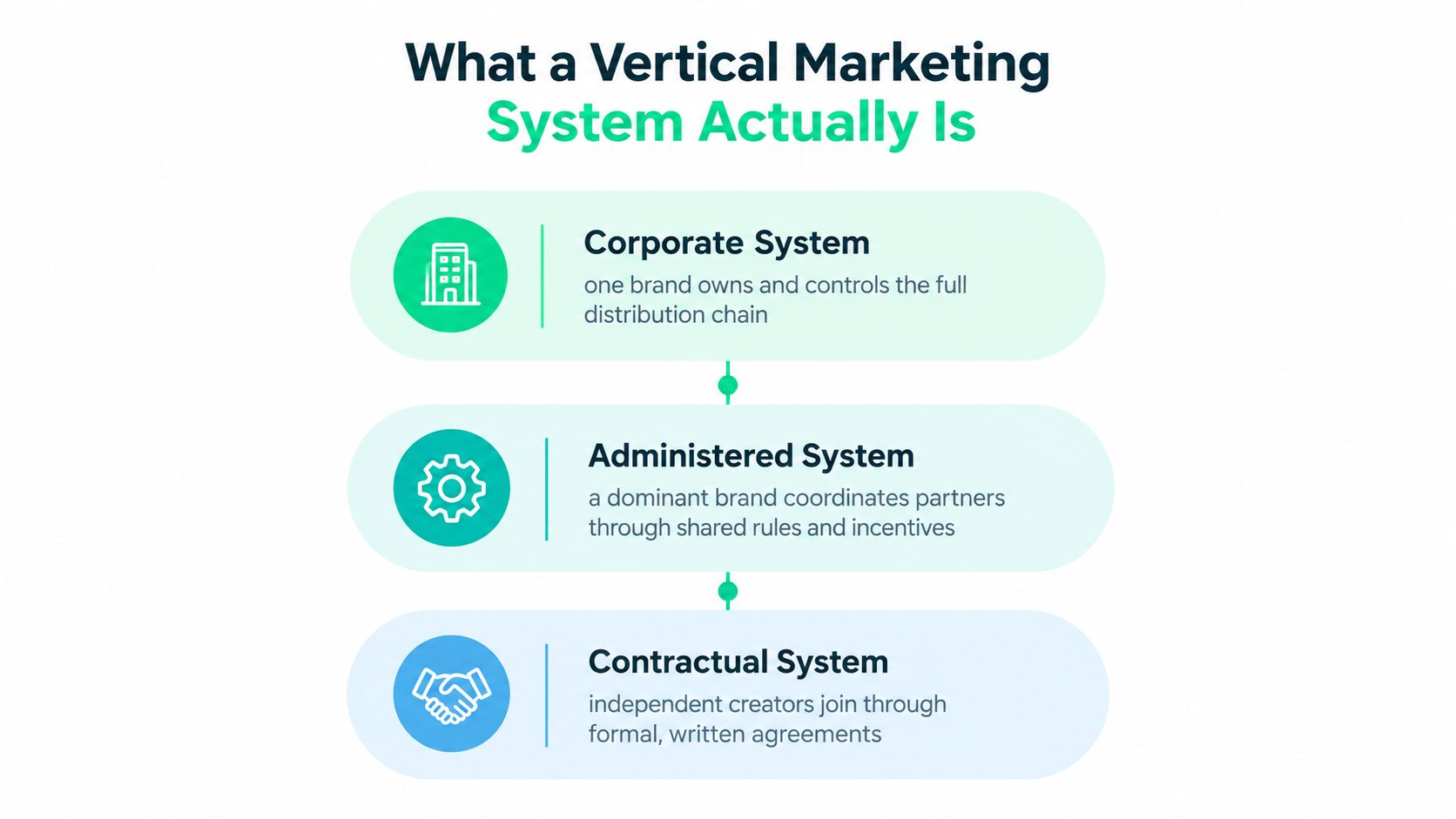
A vertical marketing system coordinates production, distribution, and customer access under one governing structure. The classic model is divided into three forms, and each one maps cleanly to how creator distribution works today.
The three forms
- Corporate VMS: one company owns successive stages of the chain, so the same organization controls creation, placement, and customer access.
- Contractual VMS: independent firms coordinate through formal agreements, such as franchising or retailer cooperatives.
- Administered VMS: a dominant participant coordinates channel activity through influence, even without owning every stage.
That structure became more important as railroads made large-scale, geographically extended distribution practical in the late nineteenth century, and major industrial companies began integrating manufacturing, transportation, storage, and sales to reduce dependence on intermediaries historical vertical integration context. Standard Oil and Carnegie Steel are often cited in that historical movement because they show how control over the channel changes the economics of access.
How the structure maps to creator networks
In creator distribution, corporate control looks like a single operator owning the entire workflow, from asset creation to placement. Contractual control looks like independent pages or publishers operating under written rules, brand standards, and approval workflows. Administered control is what you get when a dominant campaign operator sets the rules, enforces them across many pages, and keeps the network coherent without owning every account.
A useful way to think about it is simple, who decides, who executes, and who can stop a placement if the rules aren't met.
That last question matters more than many teams admit. A creator network feels flexible when it's open-ended, but it only scales when authority is explicit. If your governance isn't clear, you're not running a vertical system, you're running a loose marketplace.
How Vertical Marketing Systems Govern Creator Networks
The core value of a vertical marketing system in creator distribution is governance. A dominant brand or platform can coordinate hundreds of independent pages while preserving native creative expression, but only if authority is split cleanly across the workflow. The hardest part isn't publishing content, it's deciding what must be centralized and what should stay local.
Where control belongs
Centralized control should cover the parts that affect risk at scale. That means brand rules, required disclosures, prohibited topics, geo filters, and the ability to remove off-brand pages fast. Creator-level autonomy should stay in the execution layer, where the page owner knows what feels native to the audience and what content style keeps attention.
The tension is real. Tighter controls improve consistency and safety, but they can flatten the creator voice that makes a placement work in the first place. OpenStax notes that VMS arrangements reduce channel conflict and increase customer value, but the governance problem in digital creator networks is broader, because audience ownership and platform risk sit with independent publishers OpenStax on channel types. That means the authority matrix has to answer four questions without ambiguity.
A practical authority matrix
- Creative approval: centralized for brand claims, local for phrasing and native packaging.
- Audience data: centralized at the platform level, since reporting has to stay consistent.
- Placement removal: centralized, because one off-brand page can damage the whole network.
- Dispute escalation: hybrid, with page-level context first and platform-level resolution second.
Programmatic creator distribution becomes more than media buying. It becomes channel design. Once the rules are written, a platform can apply them consistently, and a creator can still sound like a creator instead of a compliance memo.
Programmatic Campaign Formats and Distribution Workflow
Programmatic distribution works because it replaces ad hoc creator handling with a controlled launch process. A single platform can keep outreach, trafficking, and reporting in one place, with AI scoring and human review before any post goes live. That matters. Speed without review just scales bad placements faster.
The workflow in practice
Asset intake comes first. The brand uploads a logo, caption, video, or static creative, and the system maps it to the campaign format. Some programs only need logo-and-caption distribution, while others require vertical-specific keywords or assets reshaped into meme-style variations.
Rule enforcement comes next. The platform can apply required terms, prohibited topics, geo filters, and min-follower thresholds before a placement reaches a page. Manual buying rarely keeps that level of consistency, because each creator interprets instructions a little differently.
Live management is the third layer. Captions can be updated across the network, and off-brand pages can be removed one by one without stopping the full campaign. That is a real operational advantage when the work has to stay aligned across many placements and audiences.
A campaign orchestration platform makes the difference between centralized trafficking and just buying more inventory. Orchestration keeps one campaign from splintering into dozens of disconnected posts.
The point is control, not just speed. Brand claims stay in one rule set, while creator execution still has room to sound native. That balance matters most when the network mixes logo distribution, niche placements, and asset-to-meme production under one operating system.
When the workflow is tight, a new campaign can launch in about ten minutes instead of waiting on per-creator onboarding.
Brand Safety, Real-Time Review, and FTC Disclosure Controls
A distributed creator network only works if compliance is built into the workflow, not added after the fact. The FTC requires social-media endorsements to disclose a material connection when there's a financial, employment, personal, or family relationship with a brand, and the disclosure has to appear with the endorsement itself in a clear, understandable way FTC disclosure guidance. That makes pre-publication review a brand-safety control, not a nice-to-have.
Why human review still matters
FTC guidance also says paid endorsements must be truthful and not misleading, and endorsers shouldn't discuss products they haven't tried or make claims requiring evidence the advertiser doesn't have FTC endorsement guides. AI can score placement risk and route submissions, but it can't reliably judge implied claims, context, or whether a creator caption feels like an authentic endorsement or a forced one.
That's especially important when campaigns are adapted across many pages. A caption that looks fine in one format can become misleading in another, and a disclosure that's technically present can still fail if it's buried or unclear. The FTC also warned in 2017 that disclosures should be clear and conspicuous, and that on Instagram they should appear above the “more” button rather than hidden below it FTC Instagram disclosure warning. That's a good reminder that placement details matter.
If your workflow needs to inspect page-level HTML or rendered captions before launch, scrape rendered HTML with one API can help teams capture what users see rather than what the backend says is present. That matters when compliance depends on visible placement, not just stored text.
For creator networks, the practical control set is straightforward.
- Caption review: check disclosures, claim language, and forbidden topics before posting.
- Asset review: verify logos, watermarks, and visual framing before approval.
- Removal rights: keep the ability to cut a page fast if it slips outside the rules.
- Geo targeting: keep delivery aligned with the audience you want to reach.
For a parallel framework on review operations, see brand approval process and how pre-approval keeps the network governable. In regulated categories, the review layer isn't overhead. It's the reason the channel can be trusted.
When a Vertical Marketing System Beats Traditional Buying
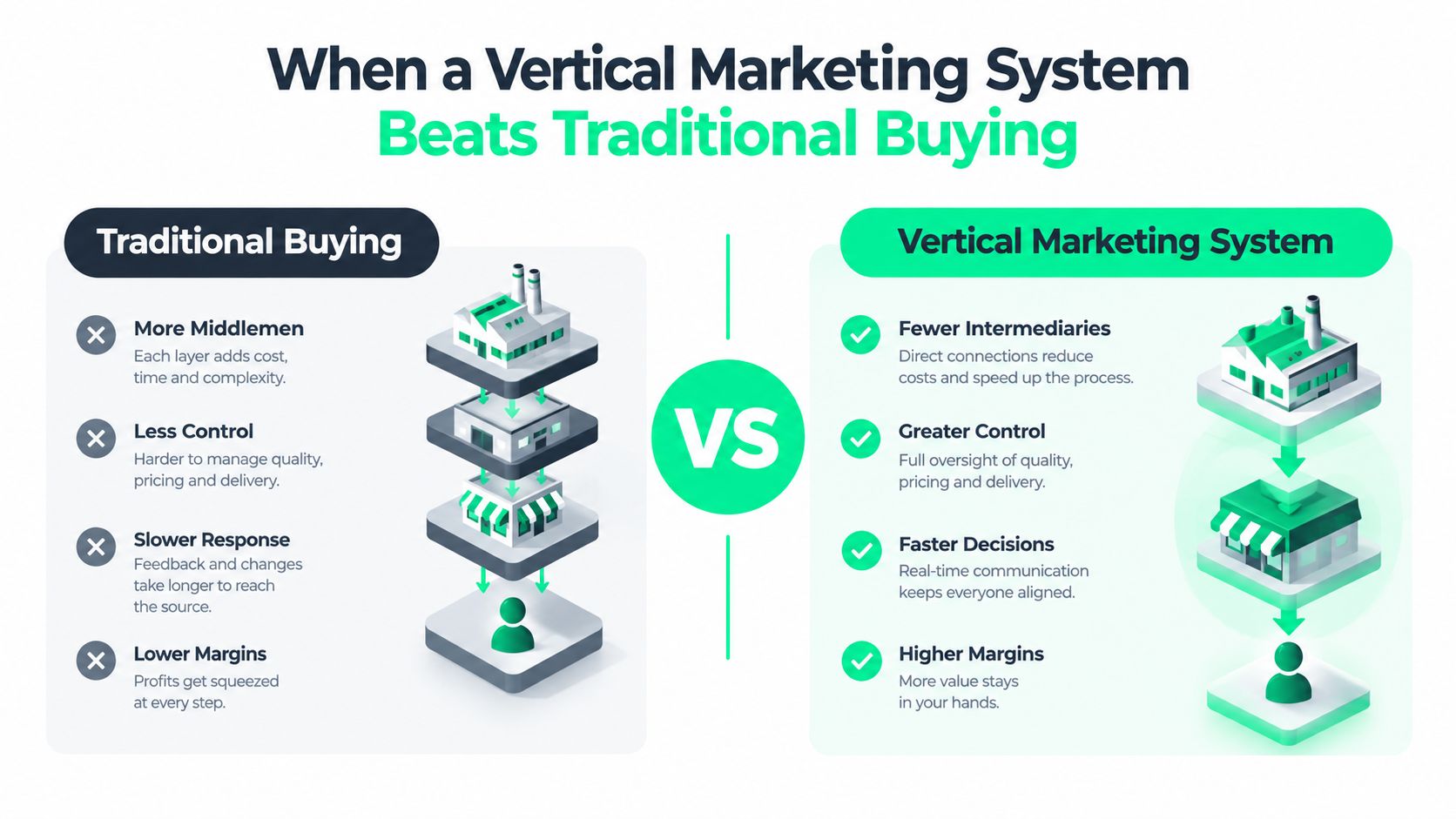
Traditional creator buying works for a small campaign, a broad audience, and low compliance risk. It starts to break when the audience must be precise, the content must stay consistent, and the brand cannot absorb drift across dozens or hundreds of pages.
The better fit
A governed distribution system wins when three pressures show up together. Audience quality matters, especially for tier 1 American audiences where the page mix has to stay tight. Brand safety matters in regulated categories like sports betting, iGaming, and prediction markets, where sloppy disclosure or off-brand placements can create real exposure. Iteration speed matters because creative often changes while the campaign is still live.
Loose creator control does not automatically produce better performance. It often hides waste. If one page runs a clean post and four others drift into weak geos, vague disclosures, or off-message framing, the average can look acceptable while the economics are poor. A vertical system treats the channel like a managed asset, which is the right trade when control is part of the job.
Run the vertical model when one off-brand placement would cost more than the coordination overhead of governing the network.
For teams running creator buys at scale, the decision point is whether the campaign needs coordination more than novelty. If it does, a vertical model is usually the cleaner operating choice. If it does not, a looser buy can stay simpler.
The best signal is operational. If your team spends more time cleaning up placements than scaling them, the buying model is too fragmented.
Implementation Checklist and Scale Decisions
Start with control. If a campaign needs tier 1 American audiences, explicit brand rules, and live removal rights, a vertical marketing system fits the job. If the niche is broad and the risk is low, a lighter creator workflow may be enough.
Run a pilot that tests whether the network can keep captions, disclosures, and geo filters consistent while still sounding native. If it holds up, tighten review and expand orchestration. If it breaks, the system is not ready for regulated spend.
A vertical system makes sense when governance is part of the product, not an afterthought.
Use the pilot phase to check authority, response time, and removal discipline in influencer marketing campaigns before you scale. The point is simple. If the team spends more time cleaning placements than shipping them, the buying model is too fragmented.
If you want a governed creator distribution setup that keeps brand safety, audience quality, and real-time control in the same workflow, FindClout can help you structure it.
Want this audience for your brand?
FindClout puts your brand in front of verified American audiences across every major US page — brand-safe, at scale.
Start Your Campaign