 findclout.com
Vertical Marketing Definition, Key Traits, and Real Examples
The most common advice about vertical marketing is also the most incomplete: pick an industry, define its audience, and tailor your message. That may help you label a segment, but it doesn't make a campaign vertical by itself.
For a sports betting brand, changing a broad ad's keyword to “sports” doesn't address which pages are suitable, what claims the caption can make, whether the audience is in the United States, or how the team will review placements. A useful vertical marketing definition has to cover those operating decisions, not just who might see the ad.
Table of Contents
- Why Most Vertical Marketing Definitions Miss the Point
- The Core Vertical Marketing Definition You Can Actually Use
- What Changes When a Campaign Goes Vertical
- Three Vertical Marketing Examples in Regulated US Niches
- The Specialization vs Scale Trade-Off Most Definitions Skip
- Brand Safety and Tier-1 Audiences as the Operational Backbone
- A Pre-Launch Checklist and Common Misconceptions
Why Most Vertical Marketing Definitions Miss the Point
Vertical marketing is often reduced to targeting an industry instead of trying to reach everyone. That's a reasonable starting point, but it leaves out the work that determines whether a campaign fits the industry. A finance campaign and a sports campaign may both use creator content, but their audiences, vocabulary, placement rules, conversion goals, and review needs won't necessarily match.
Consider a marketer launching a campaign for a sports prediction product. They select sports-related keywords, then run the same creative, approvals, and measurement plan they use for a general consumer app. The campaign has picked a vertical in name only. It hasn't adapted its operating model to sports content, American audience requirements, restricted topics, or the claims that need review.
Audience labels aren't campaign design
Industry context matters because buyers and users often share more than a broad interest. They may use familiar terminology, encounter distinct rules, and judge a product against category-specific expectations. A segmentation framework groups people with similar needs, but the campaign still has to translate those groupings into decisions about creative, distribution, controls, and measurement.
That distinction becomes especially important in regulated or higher-risk US categories such as sports betting, fintech, gaming, and prediction markets. The FTC says paid endorsements must disclose material connections clearly and conspicuously, and endorsers must not make claims the advertiser couldn't substantiate. Those responsibilities make review and disclosure part of campaign design, not an afterthought. The FTC's endorsement guidance is relevant when a brand works with creators or uses paid endorsements.
Practical rule: If only the audience label changes, you've narrowed targeting. If creative, placements, controls, and measurement change too, you're building a vertical campaign.
The more useful question isn't, “Which industry are we targeting?” It's, “What must change across the campaign so that it fits this industry's commercial and compliance realities?”
The Core Vertical Marketing Definition You Can Actually Use
The term vertical marketing has two related meanings. One describes how businesses coordinate along a distribution channel. The other describes how a marketer adapts a go-to-market strategy to a particular industry. Understanding both helps avoid confusing an organizational structure with an advertising tactic.
First, the channel-system meaning
A vertical marketing system, or VMS, coordinates producers, wholesalers, and retailers as parts of a unified system rather than treating each as an entirely independent business. Members align activities and objectives across successive channel levels to create and deliver customer value. OpenStax's overview of marketing channels describes three principal forms:
- Corporate: One organization owns multiple stages of production and distribution.
- Administered: Separate businesses coordinate through the influence or market position of a powerful channel member.
- Contractual: Independent firms coordinate through formal agreements. Franchising is a familiar example, with legally distinct participants following shared standards.
The important point is that coordination doesn't require common ownership. Contracts or channel influence can also align independent participants.
Then, the campaign meaning
In contemporary go-to-market work, vertical marketing means adapting messaging, offers, sales processes, and channel selection to a defined industry or niche rather than addressing the whole market with a generalized approach. The organizing idea is the buyer's professional or industry context, not only demographic traits.
For instance, a sports campaign might specify eligible sports pages, American audience requirements, prohibited topics, creator-quality standards, and captions that fit a sports betting or prediction-market use case. A fintech campaign would need its own language, audience rules, proof points, and review process. The details differ because the industries differ.
Industry segmentation is useful when customers share workflows, terminology, purchasing criteria, or other needs that let a campaign reuse a basic structure while keeping its execution relevant. Teams planning the broader business-to-business search strategy can also consult this B2B SEO playbook for 2026 for a related view of industry-focused marketing.
Working definition: Vertical marketing is the practice of adapting a campaign's audience, creative, distribution, controls, and measurement to one industry's needs and constraints.
What Changes When a Campaign Goes Vertical
A vertical campaign changes more than the audience setting. The useful test is whether the industry context affects what the team says, where the campaign appears, what it excludes, and how it defines success. If those decisions stay generic, the campaign hasn't yet been adapted in a meaningful way.
| Pillar | General Campaign | Vertical Campaign |
|---|---|---|
| Audience | Broad consumer or interest group | Industry-specific audience with relevant geography and eligibility rules |
| Creative | General product benefits | Category-specific language, context, and substantiated proof points |
| Controls | Standard brand guidelines | Industry exclusions, placement rules, claim review, and disclosure checks |
| Distribution | Broad mix of channels | Channels and creator environments suited to the vertical |
| Measurement | General engagement or conversion | Conversion definitions and quality measures tied to the industry |
Audit the campaign, not just its targeting
Start with the audience definition. “Interested in sports” may be too vague for a regulated American sports campaign. The plan may need to distinguish eligible sports pages from unsuitable placements, specify the required geography, and make clear which topics are excluded. Teams looking to refine that first layer can use this guide to segment audiences, then carry the resulting distinctions through the rest of the campaign.
Creative needs the same treatment. A general consumer app might lead with ease of use. A fintech product may need careful wording around features and outcomes, while a sports betting campaign needs captions that fit the context without making unsupported promises. The campaign also needs review rules: who approves claims, where disclosures appear, and what happens when a submission falls outside the brand's requirements.
Measurement should match the business question. A campaign can attract attention without attracting eligible users or qualified buyers. Define the conversion event and quality criteria before launch, then use the same definitions when comparing results. Otherwise, a vertical campaign may appear stronger because it counts different outcomes from the broad campaign.
Useful test: For every industry-specific audience rule, ask what it changes in the creative, placement, compliance process, or success metric. If the answer is “nothing,” the rule may be a label rather than a campaign decision.
Three Vertical Marketing Examples in Regulated US Niches
A vertical strategy becomes easier to recognize when you follow one campaign decision at a time. The examples below are illustrative operating scenarios, not reported case studies. In each, the marketer adapts the audience, caption, controls, and measurement to the category instead of placing generic creative wherever a keyword appears.
Sports betting
A sports betting brand plans placements on American NFL and sports pages. Its audience rule specifies eligible sports content and US geography, while exclusions block unsuitable topics and pages that fail its quality review. The caption can connect a promotion to the relevant sports context, but the team reviews each claim and disclosure before publication.
The measurement lens goes beyond views. The marketer checks whether activity comes from eligible placements and leads to qualified conversions, while tracking brand-safety issues. For advertising considerations specific to the category, teams can review this guide to gambling advertising laws.
Fintech
A fintech app works with creators in finance communities rather than treating every personal-finance page as interchangeable. Its brief defines suitable creators and topics, gives them approved language for describing the app, and rules out unsupported claims about financial outcomes. The campaign measures qualified actions against the app's actual goals, not just reactions to a post.
Because the message itself is part of the risk, approval must cover both the creator and the caption. Teams developing assets for creator-led campaigns can explore these video marketing strategies for 2026 as they decide which formats suit their audience and message.
Gaming and prediction markets
A prediction-market operator might use culturally embedded placements on sports meme pages to reach people already engaging with sports commentary. Its rules would define eligible pages, prohibit unsuitable topics, and ensure that captions describe the product accurately without implying guaranteed outcomes. Measurement would focus on qualified users and downstream activity, alongside fraud and placement-quality checks.
These examples share a pattern: the vertical dictates the placement criteria, message, approvals, and success measures. A sports keyword or finance label can help locate inventory, but it can't replace those decisions.
The Specialization vs Scale Trade-Off Most Definitions Skip
A narrower audience isn't automatically a better audience. Specialization can make a message more relevant, but it can also reduce available inventory, increase review effort, and make results harder to compare with broad-market activity. The right choice depends on whether the extra relevance produces enough business value to justify those costs.
Test the value, not the label
Compare a vertical campaign with a broad control group. Keep creative quality, attribution window, geography, and conversion definition consistent so that the comparison isolates the effect of specialization as much as practical. Then examine qualified conversion rate, downstream revenue, repeat activity, fraud rate, and brand-safety incidents rather than judging the result by cheap impressions alone.
That discipline matters in American sports, gaming, and financial categories, where engagement doesn't automatically mean a user is legally eligible, likely to buy, or valuable over time. A page can generate attention while still being the wrong placement for the brand. Review costs and available inventory matter too, so include them when deciding whether the vertical is commercially worthwhile.
A vertical wins when the quality of the outcomes it adds is worth more than the reach and operating simplicity it gives up.
There's no universal answer. If a broad campaign reaches the right buyers efficiently and meets the brand's controls, narrowing the audience may add complexity without enough return. If a vertical improves fit, qualification, or downstream value by more than it costs to operate, specialization may earn its place.
For creators and brands still deciding which audience focus makes sense, this practical guide on how to find your Instagram niche offers a related starting point. The campaign decision should still come down to measured value, not the assumption that the tightest niche must perform best.
Brand Safety and Tier-1 Audiences as the Operational Backbone
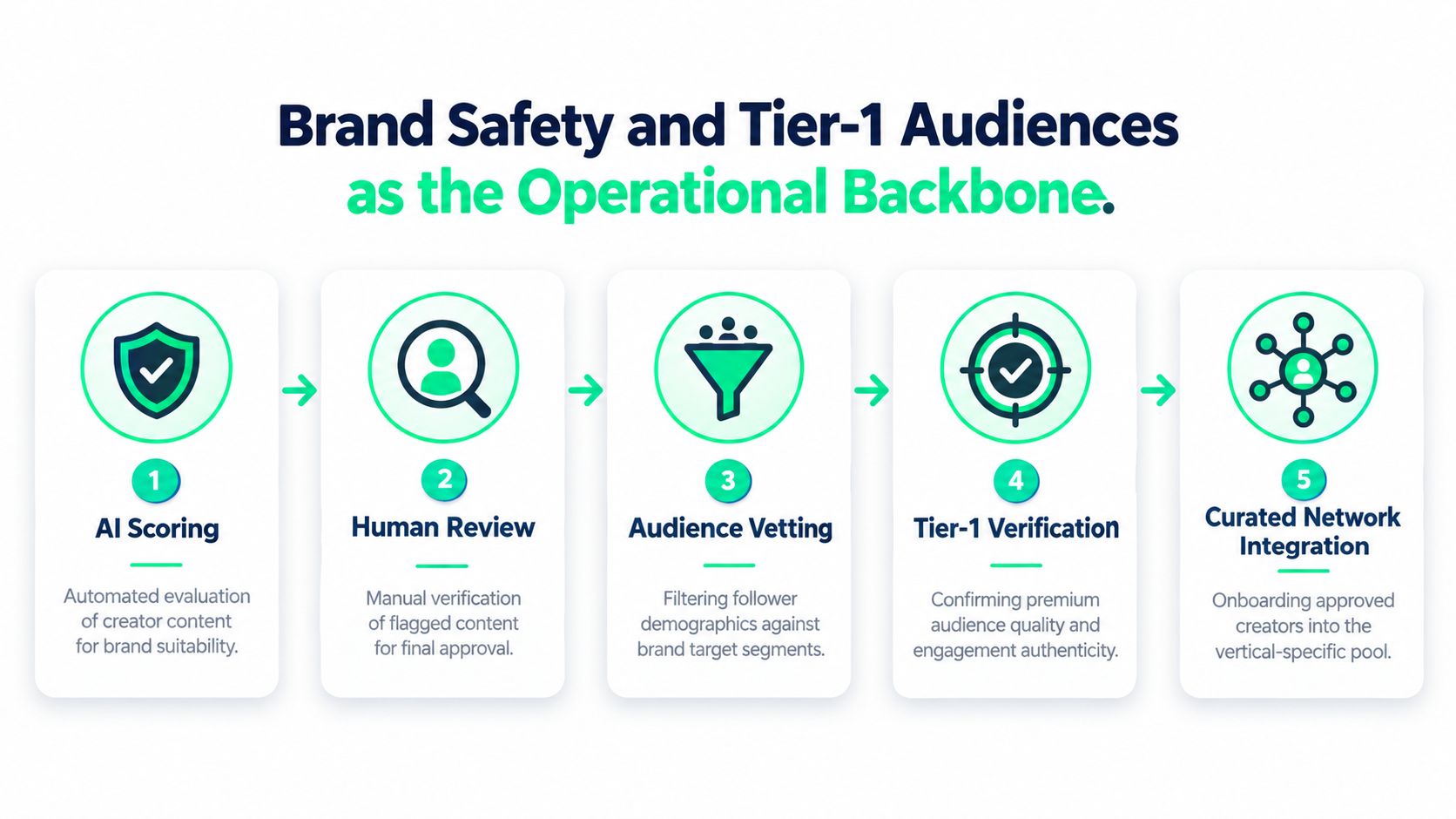
Vertical targeting only works if a marketer can enforce its rules after selecting the audience. A curated creator network can turn a scattered set of pages into a rules-based pool, but that requires clear standards, review processes, and ongoing oversight. For campaigns focused on Tier-1 American audiences, geography, audience authenticity, and suitable placements need to be part of the operating plan from the start.
A workable process connects automated screening to human judgment. AI scoring can flag content for review; a human reviewer can check the context, caption, and brand fit before approval. Audience vetting then checks whether a creator's followers align with the campaign's target, while explicit exclusions and pre-approval workflows help prevent unsuitable content from going live.
For campaign owners, governance also means keeping a clear record of approvals, placement changes, and results. MRC standards define a viewable display impression as at least 50% of an ad's pixels in view for one continuous second, while video measurement generally uses a two-second continuous-view threshold; the standards also require filtering general and invalid traffic. The MRC viewable ad impression measurement guideline helps explain why served impressions shouldn't be treated as equivalent to verified attention.
FindClout is one example of a platform that coordinates branded meme content across a curated creator network, with brand controls, fraud screening, and real-time campaign orchestration. Its stated workflow includes real-time caption management, a brand rules engine, AI scoring with human review before posting, and audience vetting focused on Tier-1 US demographics. Brands assessing any network should ask how it handles exclusions, approvals, audience checks, removal, and reporting. For a deeper look at governance principles, consult these brand safety guidelines.
A Pre-Launch Checklist and Common Misconceptions
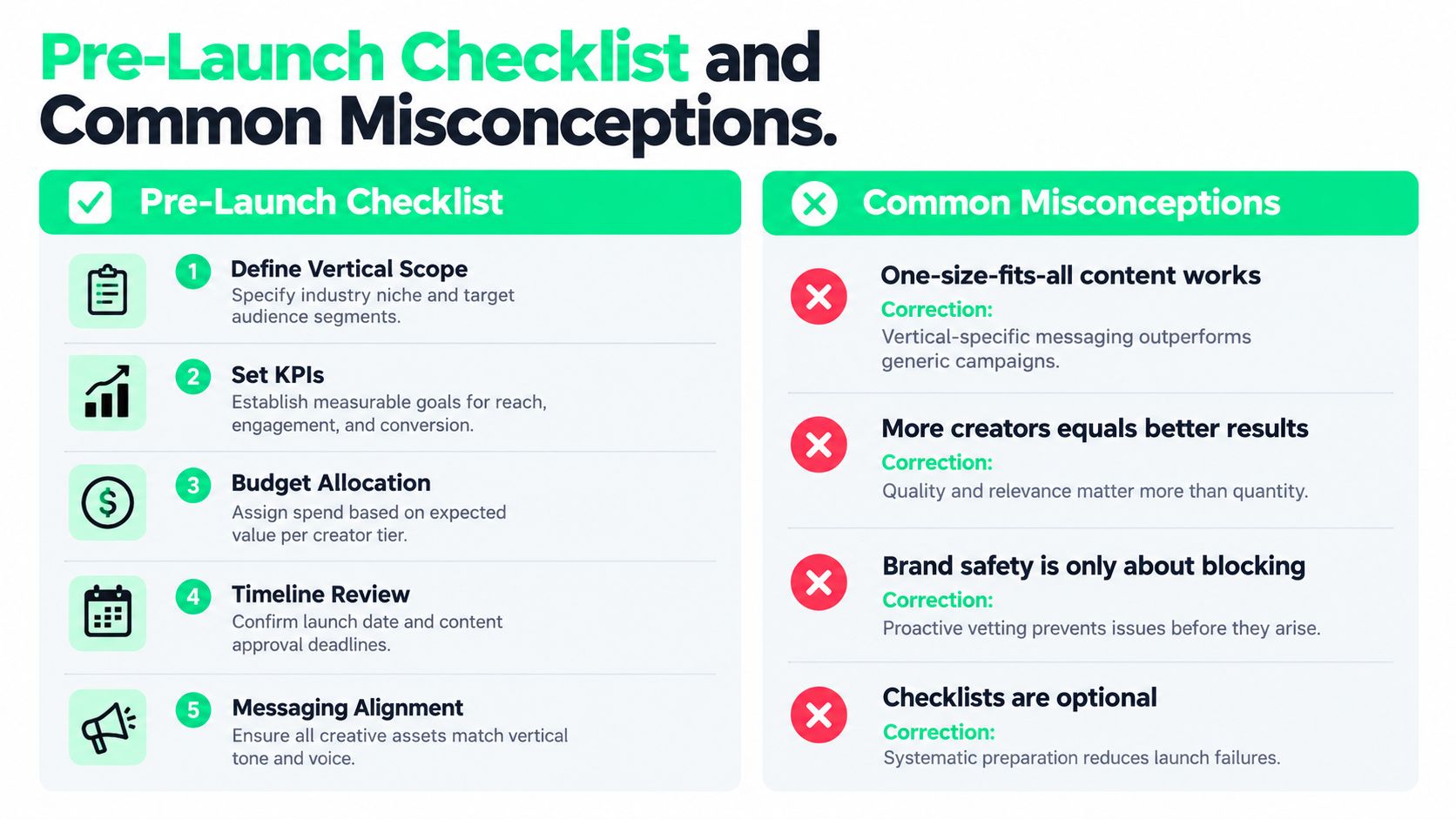
A useful launch review asks whether the team has turned its industry choice into specific operating decisions. Use this checklist before approving a vertical campaign:
- Scope: Have you defined the industry, eligible audience, geography, and placement rules?
- Creative: Do captions, claims, and proof points fit the category and pass review?
- Controls: Are prohibited topics, exclusions, disclosures, and approval responsibilities explicit?
- Conversion: Is the success event relevant to the vertical, rather than a generic engagement signal?
- Comparison: Can you compare the vertical campaign with a broad control using consistent definitions?
Misconceptions that weaken the plan
Vertical means a smaller audience only. It means adapting the campaign to an industry's context, not merely shrinking its reach.
Vertical always beats general. It has to prove its value against the lost scale and added controls.
Any page in the niche is a suitable placement. Industry relevance doesn't guarantee audience quality, brand suitability, or compliance.
Compliance belongs to someone else. Marketers need an approval process that accounts for claims, disclosures, audience restrictions, and placement rules before content goes live.
A checklist is paperwork. It gives teams a repeatable way to catch missing decisions before launch, when changes are easier to make. A vertical campaign is ready when its audience, message, placements, governance, and measurement all reflect the industry it claims to serve.
FindClout helps brands coordinate sponsored content across vetted creator pages, with vertical targeting, audience filters, brand rules, and campaign review workflows. If you're planning a campaign for American sports, gaming, finance, or another defined audience, visit FindClout to explore how its platform can support a controlled creator campaign.
Want this audience for your brand?
FindClout puts your brand in front of verified American audiences across every major US page — brand-safe, at scale.
Start Your Campaign