 findclout.com
Vertical Market vs Horizontal Market: Which Strategy Wins
Pick a niche or go broad. That's the popular advice, and it's bad advice. It treats vertical market vs horizontal market as a permanent identity instead of an operating decision you can sequence.
I've shipped both motions. The winners rarely choose one forever. They specialize where buyers feel pain, then reuse the underlying system wherever that pain looks similar.
Table of Contents
- The False Choice Between Vertical and Horizontal Markets
- What Vertical and Horizontal Markets Actually Mean
- Comparing the Economics Side by Side
- A Decision Matrix for Choosing Your Approach
- Real Use Cases Across Regulated and Mass-Market Categories
- Why Brand Safety and US Audience Verification Decide the Choice
- Combining Horizontal Infrastructure With Vertical Execution
- Implementation Checklist for Picking Your Path
The False Choice Between Vertical and Horizontal Markets
Most advice asks the wrong question. You're not deciding whether you're a vertical company or a horizontal company for life. You're deciding where specialization creates advantage first, what stays reusable, and when broader reach stops diluting fit.
That sequencing view changes the budget conversation. A vertical wedge can earn trust, vocabulary, and repeat buying in a concentrated niche. Horizontal expansion can then monetize the same infrastructure across adjacent categories without rebuilding the core.
Why the binary framing misleads you
Channel strategy has the same trap. If you're weighing breadth against coordination, it helps to choose your Shopify channel approach based on how customers move, not on a label. Market strategy works the same way, your sequencing matters more than your category tag.
Vertical focus isn't automatically superior either. Market commentary estimates vertical SaaS growth at roughly 18 to 22% annually versus about 12 to 15% for horizontal SaaS, but those figures use different methodologies and definitions, so they don't prove vertical always wins, as explained in recent vertical SaaS growth statistics.
My recommendation: Start where you can be obviously better, not merely present. Generalize only after customers repeat, refer, and demand adjacent use cases.
Ask three sequencing questions before you commit. Which capabilities depend on niche knowledge? Which ones transfer intact? And what breaks if you expand before the first niche pays back?
If you can't answer those questions, you don't have a strategy. You have a positioning statement.
What Vertical and Horizontal Markets Actually Mean
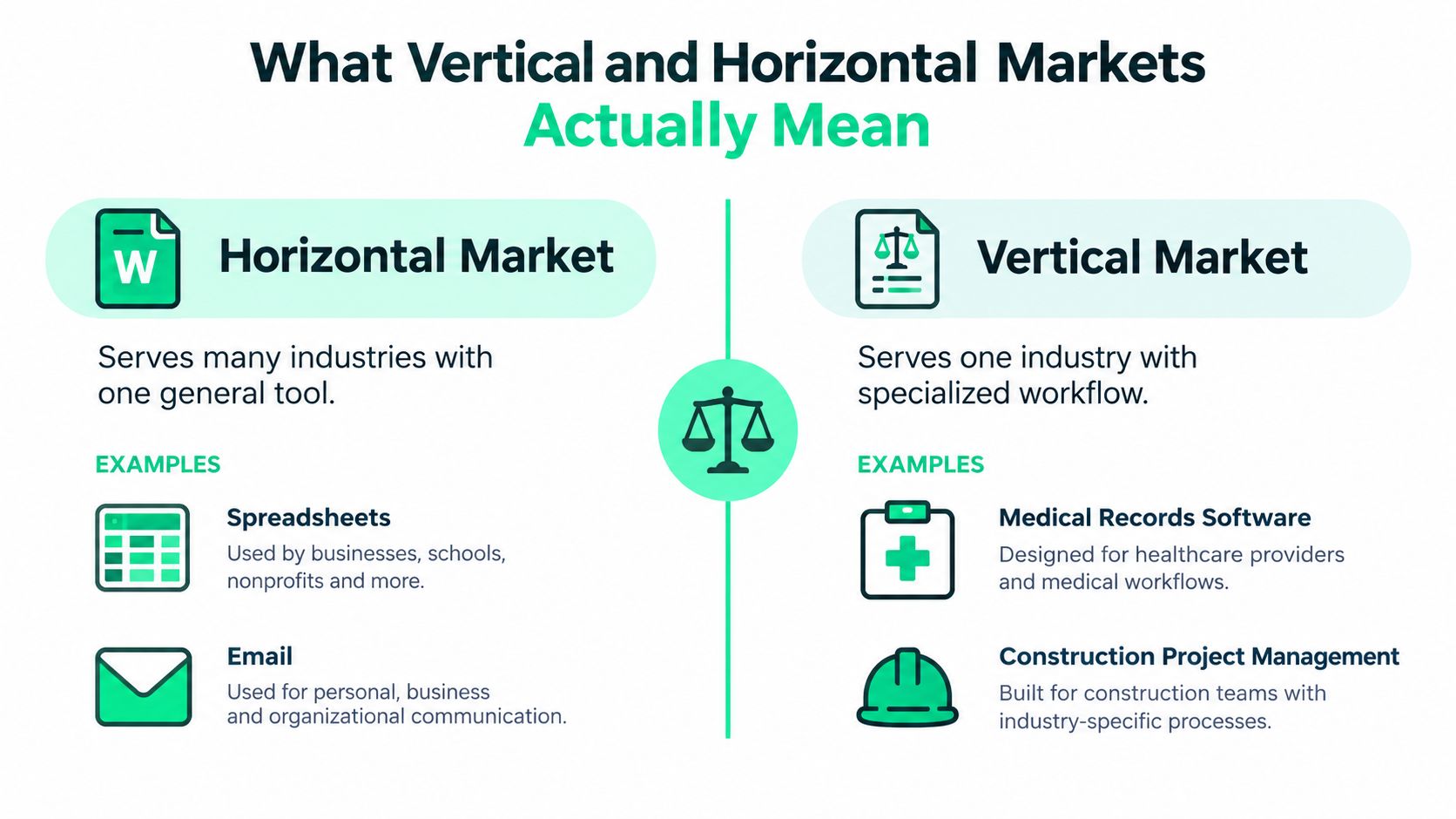
A vertical market concentrates on one identifiable industry or specialized customer group. A horizontal market sells a product or service that works across many industries, as defined in the overview of vertical market software.
That distinction sounds academic until you map it to products people already use. Word processors, spreadsheets, and general productivity tools are horizontal because almost any organization can use them. A legal document system built for personal injury or medical malpractice is vertical because it encodes one field's documents, terminology, and workflow.
The comparison becomes clearer when you see the two models side by side.
The practical trade-off
- Horizontal breadth: You get a larger potential customer universe and one standardized product that's easier to replicate. Customers may need to adapt their process or pay for customization.
- Vertical depth: You get narrower demand but stronger relevance. You can build specialized terminology, regulations, workflows, and purchasing requirements directly into the offer.
Advertising follows the same logic. Broad meme distribution is closer to a horizontal capability. Campaigns built specifically for American sports, sports betting, prediction markets, or gaming are vertical applications because the audience, creative rules, and risk profile are distinct.
A quick classification test
Watch a concrete explanation, then apply a simple test to your own offer.
If swapping the customer industry barely changes your product, you're horizontal. If swapping it forces new compliance rules, vocabulary, integrations, and buyer relationships, you're vertical. Don't classify by your tagline. Classify by what your team has to rebuild.
Comparing the Economics Side by Side
Definitions don't justify a strategy. Economics do.
| Criterion | Vertical | Horizontal |
|---|---|---|
| Market shape | Narrower, deeper demand | Broader, shallower demand |
| Product fit | Domain workflow built in | Configurable, less specialized |
| Retention logic | Higher switching costs | Easier substitution |
| Growth path | Adjacent verticals over time | Scale across sectors immediately |
| Brand controls | Category specific rules | Standardized safeguards |
Market size is not the whole story
Grand View Research estimated the global vertical software market at $150.25 billion in 2024 and projected it to reach $430.12 billion by 2033, with a 12.5% compound annual growth rate from 2025 to 2033, according to Grand View Research's vertical software market report. That's not a tiny niche category. Specialization can support serious scale when generic tools leave requirements unmet.
Still, don't buy a vertical strategy because the category looks large. Buy it when a concentrated group will pay for fit that horizontal competitors can't credibly copy.
Retention and payback favor deep fit
One benchmark compilation reports approximately 91% gross revenue retention for vertical SaaS versus 78 to 85% for horizontal SMB SaaS, attributing the gap to deeper workflow integration and higher switching costs in Orbix Studio's vertical SaaS benchmark summary. Treat that as directional, not universal. Contract size and customer segment still matter.
The operating lesson is clear. When you're embedded in mission critical work, customers don't churn over a minor feature gap.
A separate benchmark summary reports vertical SaaS at roughly 11 months CAC payback versus 18 months for horizontal peers, 6 to 8% annual logo churn versus 12 to 15%, and 125% net revenue retention versus 110%, as summarized in KGT Solutions' vertical SaaS trends analysis. Those aren't guarantees. They're a reason to measure your own payback by segment instead of celebrating blended growth.
Brand safety changes unit economics
Cheap reach isn't cheap if placements damage trust or miss the intended geography. Before you judge either model on price, understand how cost per mille advertising works and separate raw impressions from verified delivery.
A vertical premium only makes sense when specialization removes real work, such as sourcing, vetting, approvals, fraud checks, or remediation.
Measure contribution margin, repeat booking rate, fraud adjusted reach, and delivery reliability by niche. If vertical execution doesn't improve those numbers, it's just narrower targeting at a higher price.
A Decision Matrix for Choosing Your Approach
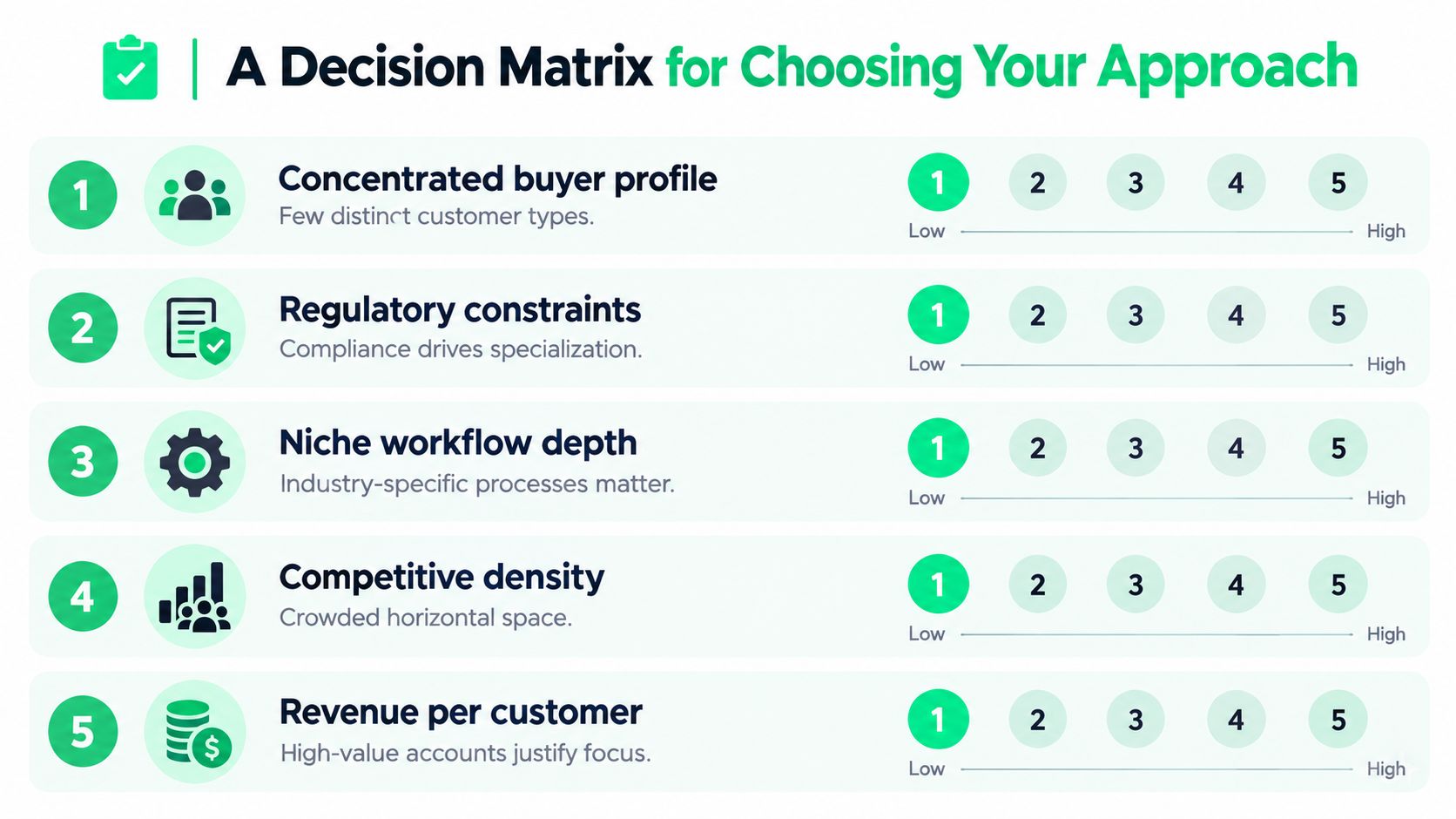
Don't let a consultant crown a winner for you. Score your situation.
Signals that point vertical
- Concentrated buyer profile: A small set of customer types controls most purchasing, so deep relationships beat broad awareness.
- Regulatory constraints: Compliance shapes product design, claims, geography, or reporting, and mistakes carry real consequences.
- Niche vocabulary: Buyers instantly detect outsiders because the work uses specialized terms, rituals, and success metrics.
- Repeatable creative: The same audience responds to recognizable formats, so operators can refine quality instead of reinventing every campaign.
- High switching cost: Your product touches workflow, risk, payments, or data that customers won't casually replace.
Score each signal. Three or more strong signals usually justify a vertical wedge, especially when revenue per account can support specialized service.
Signals that point horizontal
Fragmented buyers point the other way. If no concentrated segment can sustain acquisition, broad utility gives you more shots on goal.
Low integration depth also favors horizontal. If customers can adopt without changing core workflows, standardization wins and customization becomes drag.
Cross vertical reuse is the third major signal. When the same onboarding, interface, reporting, and distribution machinery works across industries, don't artificially narrow the market just to sound focused.
Decision rule: Specialize when fit changes willingness to pay. Stay horizontal when fit only changes your landing page copy.
Mixed scores aren't a failure. They're evidence for a hybrid architecture, with shared infrastructure underneath and vertical packaging on top.
Real Use Cases Across Regulated and Mass-Market Categories
Abstract pros and cons hide operational consequences. Three advertiser scenarios make the choice concrete.

Sports betting needs a true vertical
A sports betting advertiser targeting American fans doesn't just need views. It needs tier 1 U.S. audiences, league or category exclusions, prohibited claim controls, creator quality thresholds, and rapid removal when a placement goes off brand.
That's why sports knowledge becomes product value. The buyer is paying operators to reduce off brand adjacency, avoid unsuitable creators, and review submissions in real time before scale amplifies a mistake. A generic creator marketplace can sell reach, but it leaves the advertiser to rebuild the niche controls manually.
American sports also creates concentration risk. Demand can follow seasons, categories face policy shifts, and one geography can limit diversification. Go vertical, but track concentration as carefully as performance.
Regulated fintech needs hybrid execution
A regulated fintech advertiser may sell across several consumer segments, so a single niche playbook is too narrow. It still can't tolerate sloppy placement, fake traffic, or unverified geography.
The right answer is horizontal infrastructure with vertical controls. Keep one system for creator sourcing, trafficking, fraud screening, caption management, and reporting. Add segment specific exclusions, claim review, and audience rules where regulation demands them.
This is the model most growth teams should copy. You preserve operating benefits while charging for, or internally justifying, the extra control layer.
Mass market DTC can buy horizontal
A mass market DTC brand selling a broadly appealing product has different economics. Its creative travels across audiences, its claims face fewer category specific restrictions, and speed matters more than niche intimacy.
For that buyer, horizontal distribution is usually correct. Standardized buying, broad creator inventory, and simple brand rules can deliver attention efficiently without a vertical service layer.
The same advertiser can rationally choose different models by campaign. Product risk and audience specificity should drive the choice, not brand identity.
Why Brand Safety and US Audience Verification Decide the Choice
Brand safety isn't a slide in your pitch deck. It's an operating system, and it often determines whether a vertical strategy is viable.
The Interactive Advertising Bureau distinguishes brand safety, avoiding broadly unsafe environments, from brand suitability, applying parameters specific to a brand's values, in the IAB Brand Safety and Suitability Guide. That distinction matters. A placement can be technically safe and still wrong for your advertiser.
Safety needs explicit controls
The IAB framework pairs avoidance, which blocks unwanted content, with allowance, which permits selected content that might otherwise be excluded. It also separates suitability risk into high, medium, and low levels.
Vertical operators should encode those choices before launch. Define betting category exclusions, prohibited topics, permitted geographies, creator thresholds, and removal workflows. Then review every submission in real time so attention can scale to billions of views without handing control to the feed.
American reach still needs verification
Integral Ad Science reports North America had the lowest brand suitability failure rate at the report's 1.0x baseline, but the United States recorded a 1.40% invalid traffic rate, the highest among the top ten measured markets, in Integral Ad Science's North America media quality analysis. Premium geography doesn't equal clean delivery.
That's why tier 1 targeting alone is insufficient. You still need fraud screening, human verification, and post delivery checks, a point reinforced by practical guidance on verifying you are reaching real American audiences.
A quality impression should be viewable, seen by a real person, placed in a suitable environment, and delivered in the correct geographic area, with invalid traffic excluded, under Integral Ad Science's quality impressions framework. Use that standard. Follower counts and raw served impressions are vanity inputs.
Exposure thresholds make the point operational. Display viewability requires at least 50% of pixels on screen for at least one second, while video requires at least 50% of pixels on screen for at least two continuous seconds during playback, according to the media quality measurement standards summary.
If your vendor can't define a valid view, don't trust its reach claim.
Combining Horizontal Infrastructure With Vertical Execution
Build one engine. Put several specialized control rooms on top of it.
That's my preferred model for teams debating vertical market vs horizontal market strategy. Keep programmatic buying, reporting, fraud screening, caption management, and creator orchestration horizontal. Make audience filters, category exclusions, claim rules, geography verification, and creative review vertical.
Audit what's reusable
- Reusable infrastructure: Buying workflow, trafficking, dashboards, billing, baseline fraud checks, and a coordinated multi-platform distribution system.
- Niche dependent execution: Sports calendars, betting language, prediction market sensitivities, gaming community norms, and category specific prohibited claims.
- Reusable with adaptation: Creator scoring, caption templates, approval queues, and removal processes that need different thresholds by category.
FindClout illustrates the structure with programmatic meme distribution across vetted creator pages, plus vertical targeted campaigns for categories such as sports and gaming. Evaluate any platform the same way, by separating its shared engine from its niche controls.
Creative production needs the same discipline. If short form assets are part of your stack, a vertical AI video generator guide can help you standardize format decisions while your team keeps category review human and specific.
Sequence the build carefully. Win one vertical where controls and audience knowledge create a defensible wedge, then extend into adjacent finance, gaming, crypto, or consumer categories only when the reusable layer proves it can travel.
Sequencing rule: Specialize first for proof, generalize later for scale, and never duplicate infrastructure just because the packaging changes.
Implementation Checklist for Picking Your Path
Run this diagnostic before your next planning cycle. Don't debate labels in the room.
Answer three questions
- Does your buyer profile concentrate? If a recognizable niche can sustain repeat revenue, start there.
- Do regulations shape creative or delivery? If yes, vertical controls aren't optional, even inside a horizontal platform.
- Do you have repeatable niche vocabulary? If buyers share language, formats, and objections, specialization will compound.
Match the answer to a playbook
- Pure vertical wedge: Pick one niche, codify exclusions and approvals, and watch repeat booking plus contribution margin.
- Horizontal scale with vertical controls: Keep one infrastructure stack, add category rule packs, and watch verified delivery rate plus invalid traffic by segment.
- Horizontal only: Standardize onboarding and creative, avoid custom workflows, and watch acquisition payback plus launch time.
Choose the narrowest model that removes your buyer's expensive problems. Expand when repeat demand proves the infrastructure travels.
Ready to combine horizontal scale with vertical control for American sports, betting, prediction market, or gaming audiences? FindClout offers programmatic meme distribution across vetted creator pages with brand rules, fraud screening, and real time campaign orchestration, so you can buy verified attention without rebuilding creator operations yourself.
Want this audience for your brand?
FindClout puts your brand in front of verified American audiences across every major US page — brand-safe, at scale.
Start Your Campaign