 findclout.com
Vertical Digital Marketing That Actually Scales
The most popular advice about vertical digital marketing is to find a niche, match its humor, and buy access to its audience. For regulated brands, that sequence is backward. Before buying a sports page or approving a trading meme, you need evidence that the placement reaches eligible American viewers, excludes unacceptable contexts, and can survive a compliance review.
Creative fit matters. But a relevant post shown to an unverifiable audience isn't precision marketing. It's an unqualified media buy with a better-looking label.
Table of Contents
- Why Vertical Digital Marketing Is Really a Verification Problem
- What Vertical Digital Marketing Actually Means
- The Three Mechanics That Make Vertical Campaigns Safe at Scale
- Sports, Gaming, and Finance Compared as Verticals
- Running a Vertical Campaign From Brief to Live Post
- Proving the Vertical Actually Worked
- When to Pick Vertical Depth Instead of Broad Reach
- What a Brand Should Demand From Any Vertical Partner
Why Vertical Digital Marketing Is Really a Verification Problem
A sports handle tells you what a publisher posts. It doesn't establish where viewers live, whether engagement is authentic, or whether the audience is appropriate for a sportsbook offer. Those are separate questions, and the media buyer needs separate evidence for each.
For regulated advertisers, tier-1 U.S. audience quality is an acceptance criterion, not a reporting preference. A creator's American identity doesn't prove American delivery. Neither does a comment section full of team names.
The distinction matters commercially. You can negotiate an attractive CPM and still buy attention from people who can't use the product, aren't eligible for the offer, or never watched the content.
Verify the placement before valuing it
Treat every proposed placement as an evidence file. Establish the page's ownership, audience composition, content history, and traffic quality before assigning commercial value to its reach.
A useful verification file includes:
- Audience evidence: Geographic composition, available age information, collection method, and freshness.
- Traffic evidence: Suspicious delivery patterns, invalid-activity exclusions, and the basis for accepting reported views.
- Placement evidence: The actual creative, approved caption, publishing handle, and approval history.
- Exception handling: Who can stop delivery, remove a post, or reject a charge when evidence fails.
An automated fraud-detection process belongs inside this purchasing workflow, not in a presentation after the campaign ends. Automation should help buyers identify questionable inventory before they commit more budget.
Buying rule: A niche label describes content. Verification determines whether that content belongs in the media plan.
For campaigns intended to scale toward billions of views, the standard shouldn't become looser as volume grows. The operating system must review every submission in real time while preserving evidence about audience quality and brand safety. Otherwise, increasing distribution increases the number of unresolved risks.
What Vertical Digital Marketing Actually Means
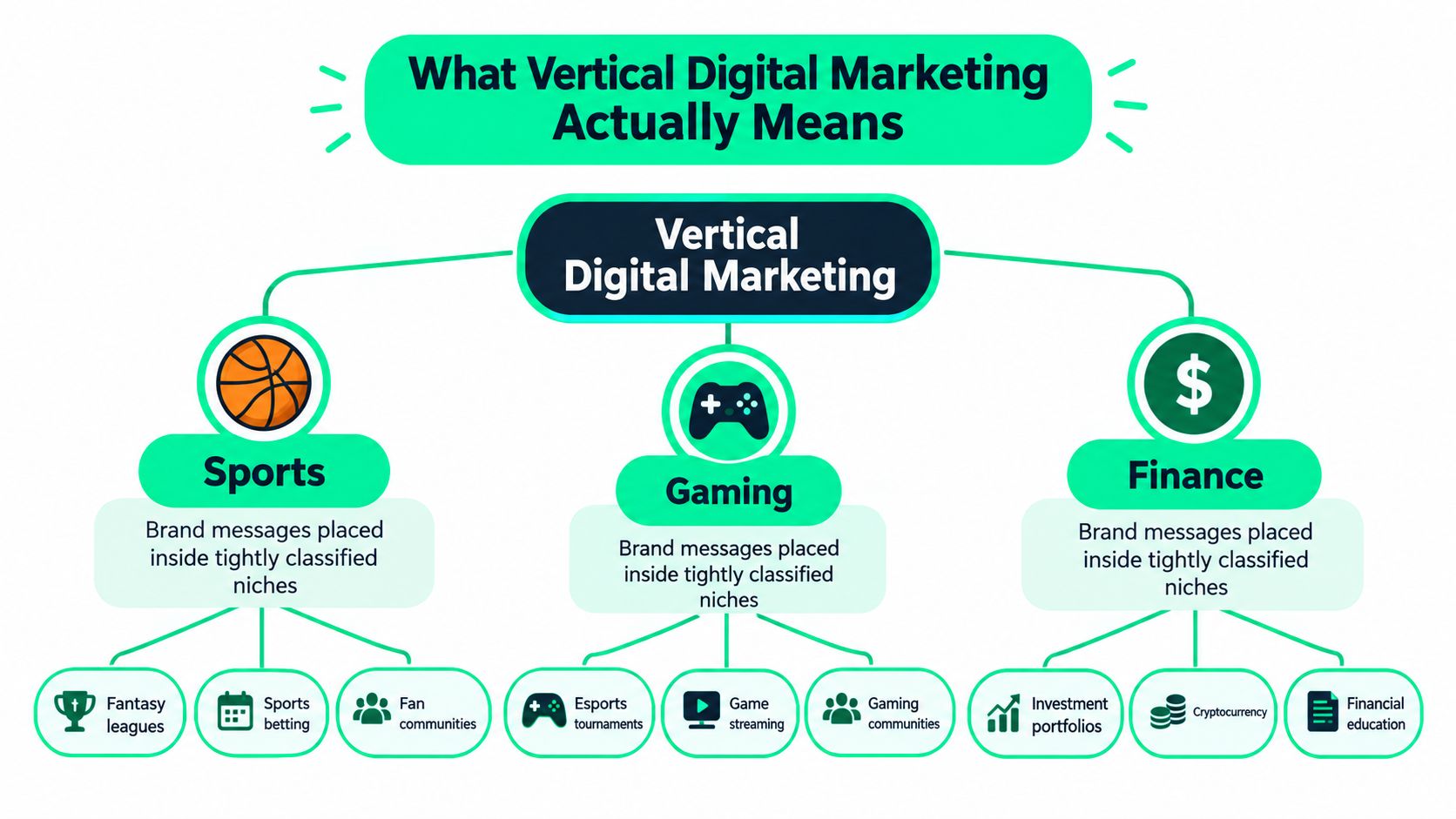
Vertical digital marketing means placing brand messages within deliberately classified subject areas, such as sports, gaming, or finance. It also involves adapting those messages to the mobile-native formats through which audiences encounter them.
Think of broad distribution as radio playing throughout a record store. Vertical distribution is the curated bin where someone is already browsing a particular genre. The context improves the chance of relevance, but it doesn't tell you whether that shopper can buy your product.
Niche and format are different decisions
A vertical can describe an industry or interest category. A vertical video describes a portrait-oriented asset. You can buy the right category with the wrong creative format, just as you can produce a strong portrait video for an unsuitable audience.
The connection became commercially important as viewing moved toward phones. By 2021, mobile devices accounted for 63% of YouTube watch time, compared with 12% on desktop, according to the figures compiled in Kapwing's video marketing statistics.
Short-form video subsequently became central to social consumption. Figures summarized from DataReportal's research put short-form video at 58% of worldwide social-media time, as reported in Vidico's short-form video statistics. That's global context, not evidence that any particular creator delivers qualified American viewers.
For execution, connect the decisions rather than assigning them to disconnected teams:
- Choose the context: Define the relevant subtopic, not just the broad category.
- Build for the screen: Use readable captions, clear branding, and a call to action that works inside a scrolling feed.
- Qualify the audience: Confirm that the placement meets the campaign's geographic and eligibility requirements.
A portrait advertisement isn't automatically mobile-native. Check whether the product, disclosure, and action remain understandable without requiring viewers to rotate their phones or reconstruct a missing sentence.
The Three Mechanics That Make Vertical Campaigns Safe at Scale
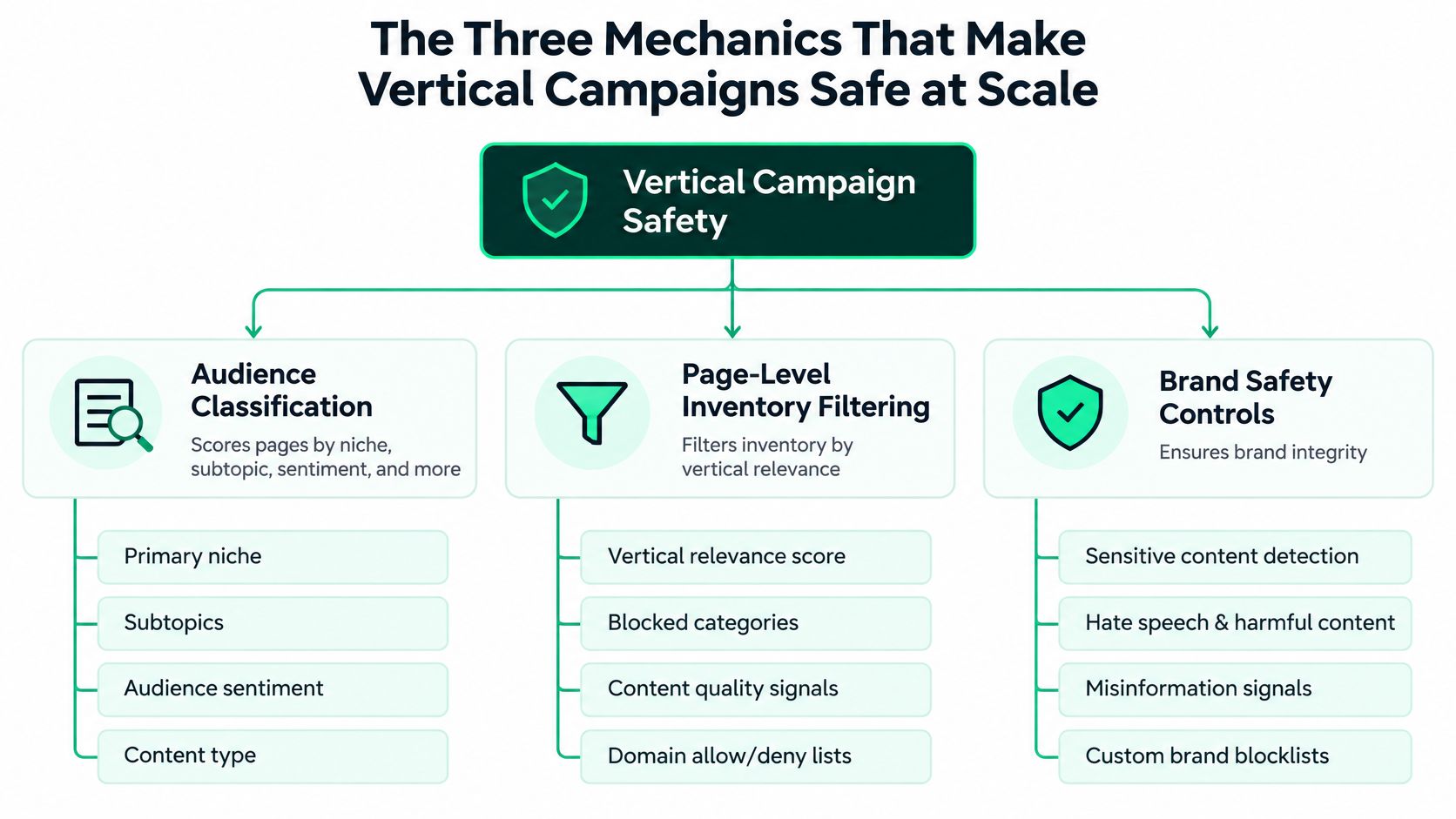
Safe distribution requires more than a list of approved creators. Buyers need classification, enforceable placement rules, and accountable review. Each serves a different purpose, and none substitutes for the others.
Classify meaning, not just keywords
Start with topic, subtopic, sentiment, commercial suitability, and prohibited-context flags. A post mentioning a trading app could be a tutorial, a complaint, satire, or an accusation. A keyword match can't resolve those differences.
Research on AI-enabled contextual advertising describes approaches involving content applicability, affective tone, and consumer involvement. It also identifies transparency and sensitive-inference concerns. Use semantic classification to support judgment, not to claim that contextual targeting removes privacy or suitability risk.
A practical audience-segmentation workflow should therefore keep content relevance separate from geographic eligibility and audience composition. Combining them into an unexplained quality score makes exceptions harder to investigate.
Apply rules before inventory enters the queue
The rules engine should reject incompatible inventory before a creator receives an assignment. Universal exclusions belong alongside campaign-specific restrictions, required terms, geographic filters, and audience thresholds.
The IAB Brand Safety and Suitability Guide distinguishes a baseline safety floor from advertiser-specific suitability. That distinction is operationally useful: content can clear general safety checks and still be wrong for a particular financial product.
For buyers mapping automated inventory selection to video delivery, RemotionAI's guide to programmatic video for marketers is a useful companion resource. Keep the buying mechanism separate from the evidence required to approve a placement.
Review the actual submission
Use AI pre-screening to prioritize risk, then route ambiguous sports-wagering, prediction-market, finance, and crypto submissions to a human reviewer. Don't let a low-risk score override a missing disclosure or unsupported claim.
Record the reviewer, creative version, caption, page, decision, and rejection reason. Every submission needs a real-time review path, with publication blocked until approval is complete.
Automation should reduce the reviewer's search work. It shouldn't erase responsibility for the decision.
That creates a defensible placement record. Without it, a dispute becomes a contest between screenshots and recollection.
Sports, Gaming, and Finance Compared as Verticals
These categories shouldn't share a generic compliance template. The relevant distinctions are the offer, audience eligibility, jurisdiction, and claims in the creative, not whether all the pages use memes.
Sports fandom is not proof of betting eligibility. Likewise, gaming entertainment isn't interchangeable with real-money gambling, and financial education isn't the same proposition as promoting a speculative asset.
Vertical Comparison Across Safety and Execution Dimensions
| Vertical | Primary Audience Quality Risk | Top Compliance Lever | Creative Format That Wins |
|---|---|---|---|
| Sports | Fan relevance mistaken for eligible wagering reach | Offer-specific age and geographic qualification | Event-context creative with a legible offer and restrictions |
| Gaming | Entertainment audiences mixed with gambling prospects | Separate ordinary gaming from real-money offers before approval | Gameplay-native humor that doesn't obscure commercial intent |
| Finance | Interest in a topic mistaken for product suitability | Claim review, transparent endorsements, and product-specific restrictions | Clear demonstrations or educational creative without implied guarantees |
Treat the creative column as a starting hypothesis, not a universal performance ranking. Test it against qualified outcomes.
For sports-wagering advertising, the American Gaming Association's responsible-marketing code says reliable, current audience data should reasonably indicate that at least 73.6% of the audience is 21 or older. That's an industry-code requirement, not a substitute for applicable law or operator policy.
Brief the offer, not just the niche
A sports brief should distinguish ordinary consumer advertising from sportsbook or prediction-market promotion. Don't assume adjacent products face identical rules; have counsel establish the approved jurisdictions, claims, and eligibility conditions.
For gaming, begin by asking whether money or wagering is involved. Younger-skewing entertainment content shouldn't enter a real-money campaign merely because the creator attracts enthusiastic fans.
Finance and crypto need equally careful separation. Don't assume that disclosure is the only obligation, or that age and eligibility restrictions are irrelevant. Review the actual product and the promises viewers could reasonably take from the post.
Across these categories, the FTC's influencer-disclosure guidance requires clear, conspicuous disclosure of material connections, including payment or free products. Familiarity with the creator doesn't excuse missing disclosure.
Build performance-marketing solutions around those differences. A shared reporting interface is useful; a shared approval standard for every regulated offer isn't.
Running a Vertical Campaign From Brief to Live Post
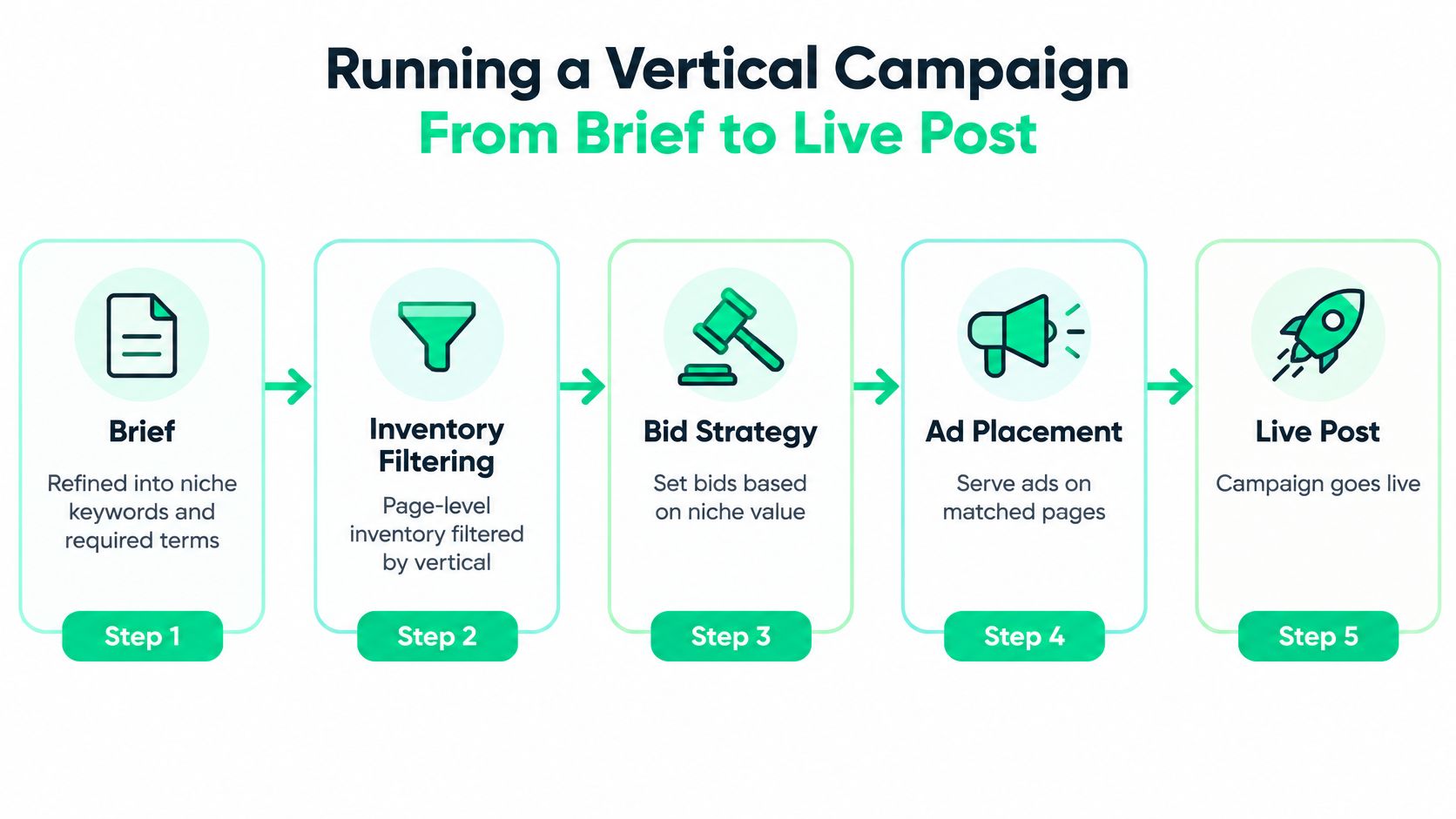
A launch starts with an executable brief, not a category name and a logo folder. The operator needs approved markets, intended audience, prohibited contexts, required language, permitted claims, conversion destination, and an escalation owner.
The workflow should make those requirements enforceable before creators start drafting.
Turn the brief into publishing controls
Translate the commercial objective into inclusion terms and explicit exclusions. For a trading product, distinguish approved educational contexts from prohibited promises of returns. For a sportsbook, specify eligible locations and approved responsible-gambling language rather than leaving creators to improvise.
Then follow an accountable trafficking sequence:
- Filter inventory: Match page-level classification to the brief and inspect the evidence for American audience quality.
- Value eligible placements: Set bids against qualified inventory, not the cheapest unfiltered reach.
- Author centrally: Prepare captions and asset variations under the same claim and disclosure rules.
- Route exceptions: Send ambiguous submissions to the designated human reviewer.
- Authorize publication: Bind approval to the exact page, caption, and creative version.
A caption approval alone isn't enough. The FTC's native-advertising guidance says necessary disclosures should use clear language, appear close to the advertisement, and be readable, with sufficient on-screen duration in video. Review the rendered placement, including contrast and cropping.
Keep control after publication
A fast launch is possible only when commercial and compliance decisions are already settled. Don't turn a launch-speed target into permission to skip audience checks or publish while legal questions remain unresolved.
Centralized trafficking matters when a campaign spans many creator pages. Operators should be able to identify which version each page received, distribute approved caption changes, and stop a problematic placement without chasing separate message threads.
Real-time editing also needs controls. A material caption change should trigger another approval, and the system should retain the previous version rather than overwrite the evidence.
Removal deserves the same discipline. Record why a post was removed, when action was requested, and when the change was verified. Underperformance, brand unsuitability, and regulatory concerns are different events and shouldn't disappear into the same reporting label.
Proving the Vertical Actually Worked
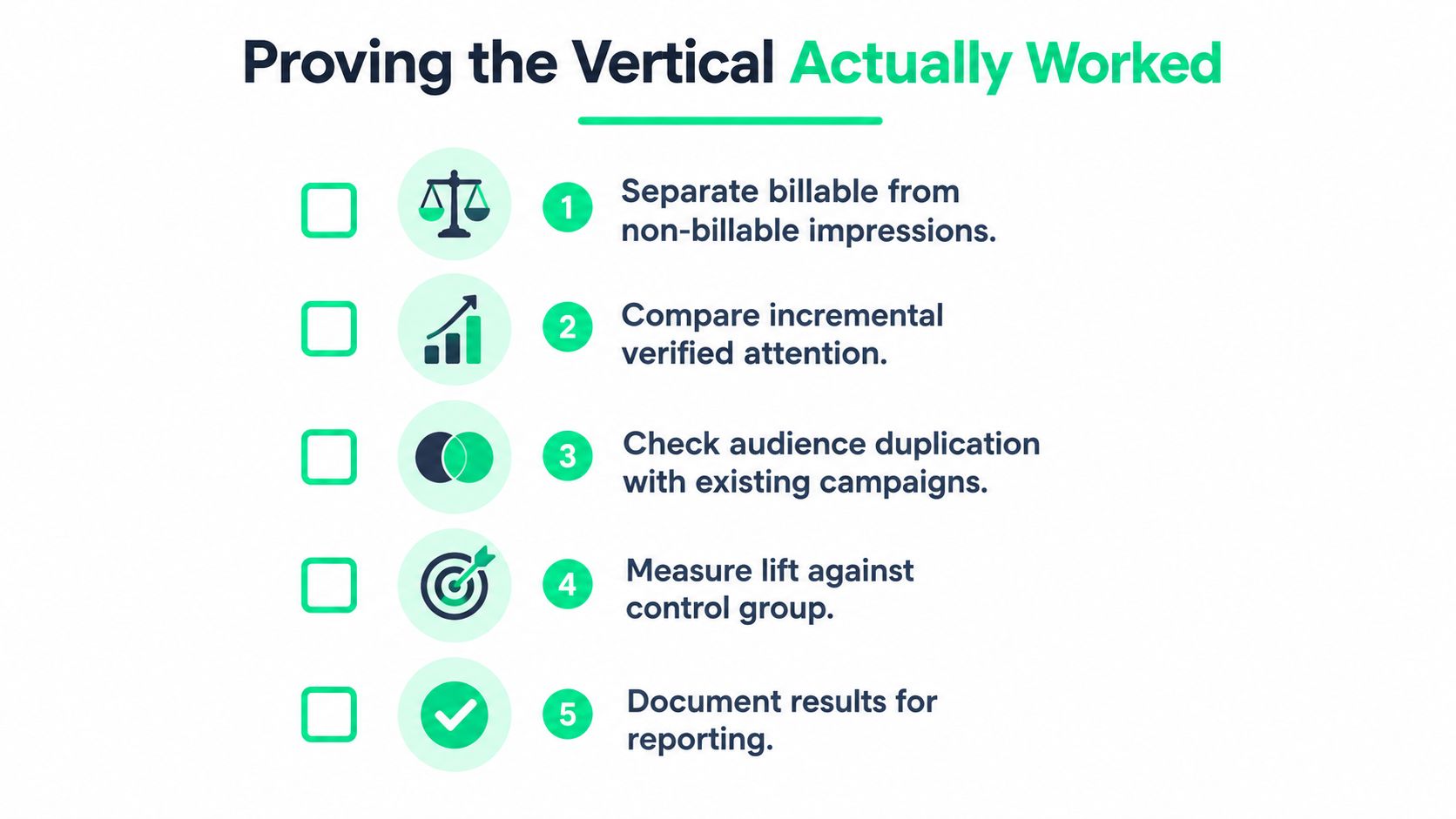
A campaign dashboard can show delivery without proving additional value. The harder question is whether the advertiser gained qualified attention it wouldn't otherwise have bought.
Start by defining the measurement terms. A served impression, a viewable player, a completed video, and a verified billable view aren't interchangeable.
Separate creative performance from commercial impact
Google reports that adding a 9:16 vertical asset to Demand Gen increased Shorts conversions by more than 35% globally in 2024, while also warning that some reporting measures player rather than creative viewability in its vertical-video guidance. That platform result supports testing native assets; it doesn't establish the outcome of a creator-network campaign.
Measurement confidence deserves scrutiny too. A 44.4% influencer-marketing measurement-confidence score, reported from a TransUnion/eMarketer survey in peer-reviewed research on influencer marketing, is a warning about measurement difficulty, not an acceptable verification threshold.
Build the test around an explicit counterfactual:
- Use a holdout: Where feasible, withhold the vertical campaign from comparable audiences or eligible geographic areas.
- Control other activity: Document paid-social changes, promotions, and posting differences that could explain the result.
- Follow qualified behavior: Compare eligible sessions and downstream actions, not just clicks.
- Disclose uncertainty: Label audience overlap and cross-platform attribution gaps rather than presenting modeled estimates as observed facts.
Time-based comparisons can help when holdouts aren't feasible, but event schedules and promotions can confound them. Document those limitations before interpreting a lift.
Remove invalid delivery when identified
The Media Rating Council's viewable-impression guideline requires known fraudulent impressions to be excluded from viewable totals when identified. Contractually specify how those exclusions affect billing rather than assuming the standard itself defines commercial terms.
Reporting standard: Show accepted delivery, excluded activity, and the evidence connecting qualified exposure to business outcomes.
Aggregate network averages can support planning. They can't replace placement-level records when a buyer needs to audit geographic quality or challenge a charge.
When to Pick Vertical Depth Instead of Broad Reach
Choose vertical depth when the buyer's mindset or eligibility materially changes the value of an exposure. A trading app may need an investing context. A niche DTC product may benefit from a specific enthusiast community. A wagering offer needs appropriate qualification before relevance even enters the decision.
Choose broad reach when the product serves a wide audience and the objective is general awareness. Narrowing distribution can exclude useful prospects without improving the business outcome.
Make the decision against the constraint
Ask what would make an otherwise legitimate view commercially useless. If the answer is geography, eligibility, or a prohibited context, keep that restriction even when the campaign needs more scale.
If the answer is only that the viewer hasn't demonstrated a particular interest, test whether the niche premium is justified.
| Campaign condition | Sensible starting approach |
|---|---|
| Eligibility and context are tightly constrained | Deep vertical selection with strict qualification |
| Mass-market product with broad usefulness | Broad distribution under baseline safety controls |
| Wide potential audience but context-sensitive messaging | Broad creator distribution with a selective vertical overlay |
The hybrid option is useful when the advertiser needs both discovery and relevance. Use broadly understandable creative across eligible inventory, then develop specialized messages for contexts where the product needs more explanation.
Don't relax the safety floor to make the hybrid bigger. Relevance can be flexible; prohibited markets and unacceptable content can't.
Compare the buys on a common basis
A broad campaign may reach people who also see the vertical campaign. Separate dashboards won't necessarily reveal that overlap, so adding their reported reach can overstate what the advertiser gained.
Ask each buying team to explain the incremental role of its spend. The vertical team should show why tighter context produces better qualified outcomes; the broad team should show where it adds useful reach beyond the niche buy.
The decision isn't whether niche marketing is superior. It's whether the next allocation buys additional, eligible, verifiable attention at an acceptable cost. Raw CPM leaves too much of that question unanswered.
What a Brand Should Demand From Any Vertical Partner
Procurement should ask for operating evidence, not a montage of viral posts. The partner's presentation may establish creative taste; the approval queue, audience files, and billing rules establish whether the service is suitable for a regulated advertiser.
Require a demonstration using an actual proposed placement, including an exception that the system should reject.
Put these requirements in the scorecard
- Documented U.S. audience vetting: Request composition files, collection methods, freshness, and explicit limitations on viewer-level certainty.
- Enforceable brand rules: Inspect universal exclusions and campaign-specific controls, including how conflicts are resolved.
- Submission-level approval: Require a logged decision tied to the publishing handle and exact creative version.
- Verified-view commercial terms: Define acceptance criteria, geographic treatment, invalid-activity exclusions, and dispute handling.
- Controlled disclosures: Check templates and rendered placements against the requirements applicable to the offer.
- Live intervention: Test caption updates, stop instructions, removal workflows, and the record retained afterward.
Ask who owns exceptions outside normal working hours and what happens when audience evidence becomes stale. A previously approved page shouldn't remain approved indefinitely without re-evaluation.
Scale should mean processing more qualified placements under the same controls, not accepting less evidence per placement.
For a network intended to support billions of views, attention to detail has to be embedded in systems: every submission reviewed, every exception assigned, and every accepted view governed by a documented definition.
Vendor scorecard takeaway: Approve a vertical partner only when it can document qualified American delivery, enforce placement controls before publication, and reconcile billed views to auditable evidence.
FindClout offers programmatic branded-meme distribution across vetted creator pages, with vertical targeting, fraud screening, brand controls, and real-time campaign orchestration focused on American audiences. Visit FindClout to discuss your eligible markets, approval requirements, and verified-view criteria before planning a vertical campaign.
Want this audience for your brand?
FindClout puts your brand in front of verified American audiences across every major US page — brand-safe, at scale.
Start Your Campaign