 findclout.com
Sports Sponsorship Marketing: A Practical Guide for 2026
Here's what is easy to miss about sports sponsorship: the highest-value deals aren't the biggest ones. They're the ones where a brand gets inside a fan's weekly ritual, not just in front of it. Sponsorship isn't buying attention. It's renting a seat inside a moment people already care about, and that distinction changes everything about how you evaluate a deal before you commit budget.
The brands that win in 2026 treat sponsorship as a measurable system. They care less about logo duration and more about whether they can prove a view came from the right audience, in the right geography, on a piece of content that passed brand review before it ever went live. That standard sounds obvious. It isn't. Most sponsorship content still runs on the old logic of reach, impressions, and vague promises about brand lift. This guide is the practitioner's version: what works, what to avoid, and how to hold every dollar of sponsorship spend to the same evidence standard you already use for paid search.
Table of Contents
- Sports Sponsorship Marketing Defined and Why Brands Pay
- Targeting Tier One American Sports Audiences
- Sponsorship Channels and Formats Compared
- How Activation Turns Exposure Into Brand Preference
- Protecting Brand Safety and Compliance in Sports Campaigns
- Measuring Sponsorship and Running a Holdout Test
Sports Sponsorship Marketing Defined and Why Brands Pay
Brands pay for sports sponsorship because a name attached to a live fan ritual can shift preference in a way a standard media buy rarely does. Sports sponsorship marketing is a brand paying to be associated with a team, league, athlete, event, or sports content so that name travels with a moment fans already chose. A roadside billboard interrupts a commute. A jersey, a broadcast bug, or a clip in a fan feed sits inside an experience people opted into. The emotional energy is already there. The sponsor's job is to join it without wrecking it.
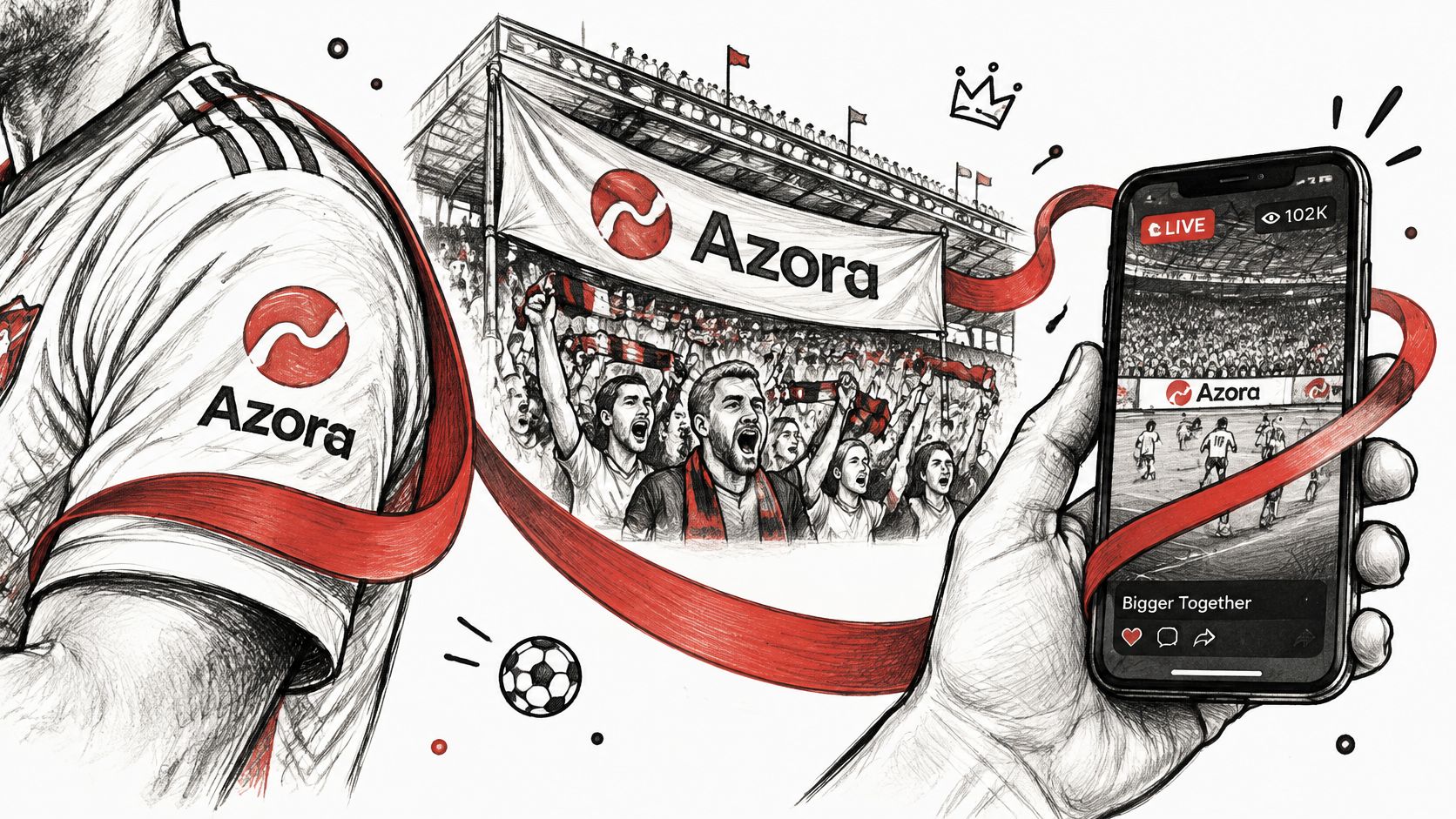
A deal buys three things at once. Exposure is the logo, name, or message placed where fans are already looking. Association is the emotional link fans build between the brand and the sport. Access is hospitality, fan contact, and first-party data where the contract allows it. Reporting usually stops at exposure, because logos and views are easy to count. Association and access are where the commercial value sits, and both stay hard to verify unless you design measurement before anyone signs. I treat a sponsorship as a system of exposure, activation, and incremental outcomes, with brand-safety review on the assets before they run, rather than a tally of marks on screen. That standard matters most when the audience is tier-one U.S. sports fans and every dollar has to survive a budget review.
Football dominates global sponsorship for a reason. Nielsen's 2025 global sports report finds football accounts for 41% of all sports sponsorships, and more than one-third of football fans worldwide consider brand sponsorship appealing rather than annoying (Nielsen's report). The concentration matters because football delivers large, recurring audiences across domestic leagues, international tournaments, club media, athlete channels, and social platforms. Relevance beats raw reach. The strongest deals happen when a brand enters an established passion community with frequent content and high emotional involvement. Sponsorship works best when a brand joins a community fans already care about, so the sponsor gains by sharing in that enthusiasm rather than by interrupting it. That transfer, from attention into preference you can test, is why the invoice is worth paying.
For clubs and properties trying to convert that attention into sponsor revenue, Vanta Sports breaks down how soccer clubs attract sponsors with practical guidance on packaging what a brand receives. The same packaging logic applies across American sports: name the fan, name the experience, and name the proof you will accept.
Before any deal, answer three questions. Which fans are watching, and can you verify their geography and demographics? What does the brand add to their experience that is more than another logo? How will the result be measured against a matched control, not a media-equivalency guess? If you cannot answer all three, the spend is a line item you will have to defend without evidence.
Targeting Tier One American Sports Audiences
Set the audience before you choose the channel. Most sponsorship buyers do it backwards: they pick a property because it's famous, then backfill audience claims. The fix is to write the audience requirements first and let every deal, page, and placement compete against that standard.
Nielsen's U.S. Sports Fan Insights Report covers the NFL, NBA, MLB, NHL, MLS, WNBA, NASCAR, and PGA Tour using a U.S.-only sample of 17,750 respondents surveyed from January through May 2025. The dataset includes age, gender, ethnicity, region, education, marital status, and children in the household. That's enough detail to define geographic and demographic requirements before distribution, rather than settling for aggregate impressions. A brand that wants 25 to 44 year old sports bettors in Texas and Florida doesn't need to guess. It can specify those filters up front and compare delivery against them.
Quality is not the same as volume. Nielsen found 67% of U.S. World Cup fans planned to watch full matches, versus 30% of the U.S. general population, and 37% of the general population expected its interest in soccer to rise over the following 18 months. Asian American fans are 33% more likely than the broader population to subscribe to sports-focused streaming services, and the 2024 World Series averaged 15.2 million viewers. Nielsen's fan data and its World Cup audience breakdown both point the same direction: concentrated, engaged American audiences exist, but they exist inside specific leagues, regions, and demographic segments, not uniformly across every view.
Investment is tightening around fewer, larger deals. Forrester's Q4 2024 survey found 39% of marketers planned to increase large-scale sports sponsorships and 28% planned to enter the space for the first time. Forrester's survey shows demand rising even as buyers get pickier. Meanwhile, Kore Analytics' 2024 report found 2023 global sponsorship spending up 4% even as deal count fell 14% year over year. Kore Analytics' industry report captures the compression: fewer deals, bigger commitments, sharper scrutiny.
Three filters apply before any channel gets budget:
- Name the league and U.S. region. The NFL audience in Pennsylvania behaves differently from the MLS audience in California. Write both into the brief.
- Demand a tier-one geography breakout on every buy. If a vendor reports total views without a U.S. share, you're buying an unknown audience. That's a research expense, not a sponsorship.
- Refuse views that cannot be screened for that audience in real time. A view that can't be verified by geography, page, and content type is a number, not an asset.
We apply these filters because American sports viewers are the segment most likely to care about sports betting, prediction markets, and gaming products. Our guide to sports fan marketing shows why the audience for a sports page is more commercially valuable than a generic impression, and why tier-one geography is the first thing to check before distribution rather than an afterthought.
Sponsorship Channels and Formats Compared
Every sponsorship channel has a different job. Choosing by cost per view alone is like picking a restaurant by calories per dollar. Sometimes that's the right metric, and sometimes you're optimizing for trouble. The table below shows the trade-offs.
| Channel or format | What the brand receives | Typical commitment | Best fit | Main risk |
|---|---|---|---|---|
| Naming rights for a stadium or arena | Building-level visibility across the season | Multi-year contract | Brands with a national or local footprint | High fixed cost and hard to exit |
| Team or league kit and jersey | Logo on uniforms and in broadcast coverage | One season or several | Consumer brands seeking fan loyalty | Fan backlash if the brand fit is weak |
| Athlete endorsement | Personal association with a named athlete | Per season or per campaign | Performance and lifestyle products | Athlete conduct, injury or form changes the value |
| Broadcast and media integration | Logo and segment placement in live or highlight coverage | Per package | Mass awareness campaigns | Exposure is hard to verify precisely |
| Hospitality and event activation | Direct access to guests, fans and client meetings | Per event | B2B services and high-value clients | Small audience and high cost per contact |
| Olympic-style category partnership | Exclusive category rights across a global event | Multi-year and premium | Global brands with large budgets | Very high cost and very few slots |
| Creator and meme distribution | Branded content shared across many sports pages | Per view or per campaign | Performance and young-adult reach | Every post needs brand-safety review |
Naming rights carry the highest fixed cost and the hardest exit. A multi-year stadium deal gives building-level visibility, but if the brand's strategy shifts in year two, you're still paying for year four. Team and league kit deals put a logo on uniforms and into broadcast coverage, which makes them excellent for consumer brands seeking fan loyalty, but a weak brand fit triggers fan backlash faster than any other format. Athlete endorsement is personal and flexible, but the value moves with the athlete's conduct, injury, and form. Broadcast integration reaches mass audiences, yet exposure is hard to verify precisely, which makes it a poor fit for a brand that needs a defensible ROI number. Hospitality works brilliantly for B2B services selling to high-value clients, but the audience is small and the cost per contact is high. Olympic-style category partnerships offer exclusivity on a global stage, at premium cost and with very few slots. If a golf club wants to price membership-level sponsorship packages, GolfRep's guide to golf club sponsorship packages lays out the trade-offs between visibility and access. Creator and meme distribution is the newest format: brands buy verified views across many sports pages, posts stay live and shareable, and every post needs brand review before it goes out.
A decision rule saves time. Awareness at scale favors broadcast and kit deals. Performance and young-adult reach favors creator distribution. Relationship building with high-value clients favors hospitality. For creator-led sports campaigns, our sports influencer marketing guide explains how verified views and brand controls work in practice. The risk column often decides whether a channel fits better than the CPM column does.
How Activation Turns Exposure Into Brand Preference
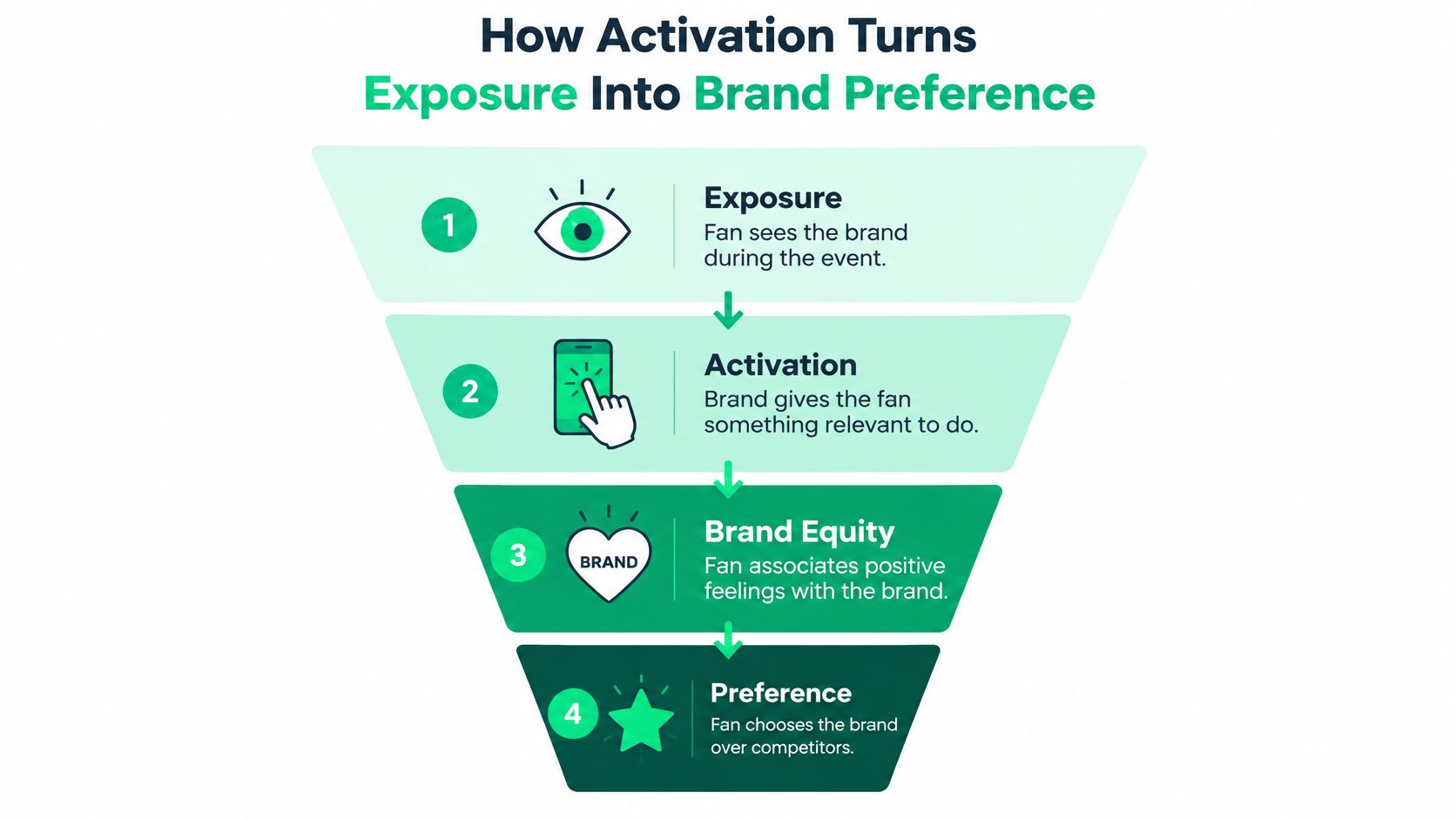
Exposure alone does not sell. A fan can see a logo forty times and never remember which brand paid for it. Activation is what converts attention into a reason to care, and the pathway runs through four stages: exposure, activation, brand equity, and purchase intention.
The fan sees the brand. The brand gives the fan something relevant to do. The fan associates positive feelings with the brand. The fan chooses the brand over competitors. Miss any stage, and the funnel leaks.
The evidence for this isn't anecdotal. A structural-equation study of sports-event sponsorship found that experiential-marketing activation significantly influenced brand equity, and brand equity was the strongest predictor of purchase intention. Together, experiential activation, sponsorship satisfaction, and brand equity explained 48% of the variance in purchase intention. The PMC study makes the causal chain explicit. Activation works by making the sponsorship association more salient, which strengthens perceived brand value before the consumer reaches a buying decision.
The surprising part is what doesn't work. Satisfaction by itself had no significant direct effect on purchase intention. In other words, a pleasant sponsorship experience does not sell anything unless it first builds brand equity. A fan can enjoy the activation, remember it fondly, and still buy from a competitor. The lesson is practical: don't measure how happy fans were. Measure whether the experience changed how they value the brand.
Four activation levers move the needle:
- Sport-specific content that shows the brand understands the game, not just pasted a logo on it. A sports betting brand posting a sharp pregame analysis beats the same brand posting a generic discount code.
- Fan participation that lets the audience do something with the sponsorship: vote, predict, create, or respond. Passive viewing doesn't build equity.
- Creator storytelling that puts the brand inside a voice fans already trust. A pick video from a respected sports page carries more weight than a produced ad placed next to it.
- A relevant offer with a clear call to action that gives the audience a reason to act now, not just remember the brand later.
Newer deals increasingly add gaming, personalized content, commerce, and first-party data. More than 250 brands activated AI-driven sports and entertainment experiences in 2026, up from 201 the prior year, according to a Lincoln International sports-tech industry report. The activation test is simple: if the fan cannot do something useful with the sponsorship, it stays exposure. Utility and participation, not another logo, separate a sponsorship that builds preference from one that only builds impressions.
The practical rule for optimizing campaigns is to compare creative and placement cells by sport relevance, creator credibility, message integration, and conversion efficiency, not by delivered views. Brand-lift surveys measure awareness and consideration against a control group. Platform-level tracking connects view exposure to qualified traffic and completed actions. Spend shifts toward pages and creative variants that generate incremental outcomes rather than inexpensive but weakly persuasive reach.
Protecting Brand Safety and Compliance in Sports Campaigns
Brand safety is a rule system, not a promise. A vendor saying “we're brand safe” means nothing unless there are documented categories, measurable exceptions, and an enforcement mechanism. The Interactive Advertising Bureau's brand-safety guidance recommends using predetermined content categories or taxonomies, including the 4A's Brand Safety Floor categories and IAB category-taxonomy recommendations, before media is activated. The IAB guide also describes setting a flag-rate threshold, for example an 8%–10% violation rate, based on the severity of restrictions, legal requirements, suitability constraints, and the accuracy of the detection solution. That's the difference between a defensible system and a vague claim: rules written before media goes live, violations measured in real time, and sources paused or removed when the threshold trips.
The working checklist runs in this order:
- Write the prohibited topics and required terms. No religious, political, violent, or hateful content. Require the brand's key terms where relevant. This is the taxonomy, and it becomes the review standard.
- Set audience rules. U.S.-focused geography, minimum follower counts, and exclusions by page. A page with 2 million followers in Southeast Asia fails the tier-one requirement even if it posts sports content.
- Screen every submission against those rules before posting. Combine automated scoring with human review. Our system runs AI scoring first, then 24/7 human review before anything goes live. Nothing goes live until the brand signs off on the look, which can be a native clip, caption, tweet card, or carousel.
- Track flagged content in real time. Measure the violation rate continuously, not once at the end of a campaign. If a source exceeds the agreed threshold, it gets paused or removed.
- Pause or remove any source that breaches the threshold. Escalation criteria must be enforceable. A source that repeatedly fails review doesn't get a warning forever.
- Require paid-promotion disclosure. Every brief tells creators to disclose paid promotion, such as with #ad, per FTC guidelines, and creators are contractually responsible for it. Contract points should include indemnity for claims arising from campaigns and content, and lawful-basis rules for bulk email, Telegram, or WhatsApp outreach.
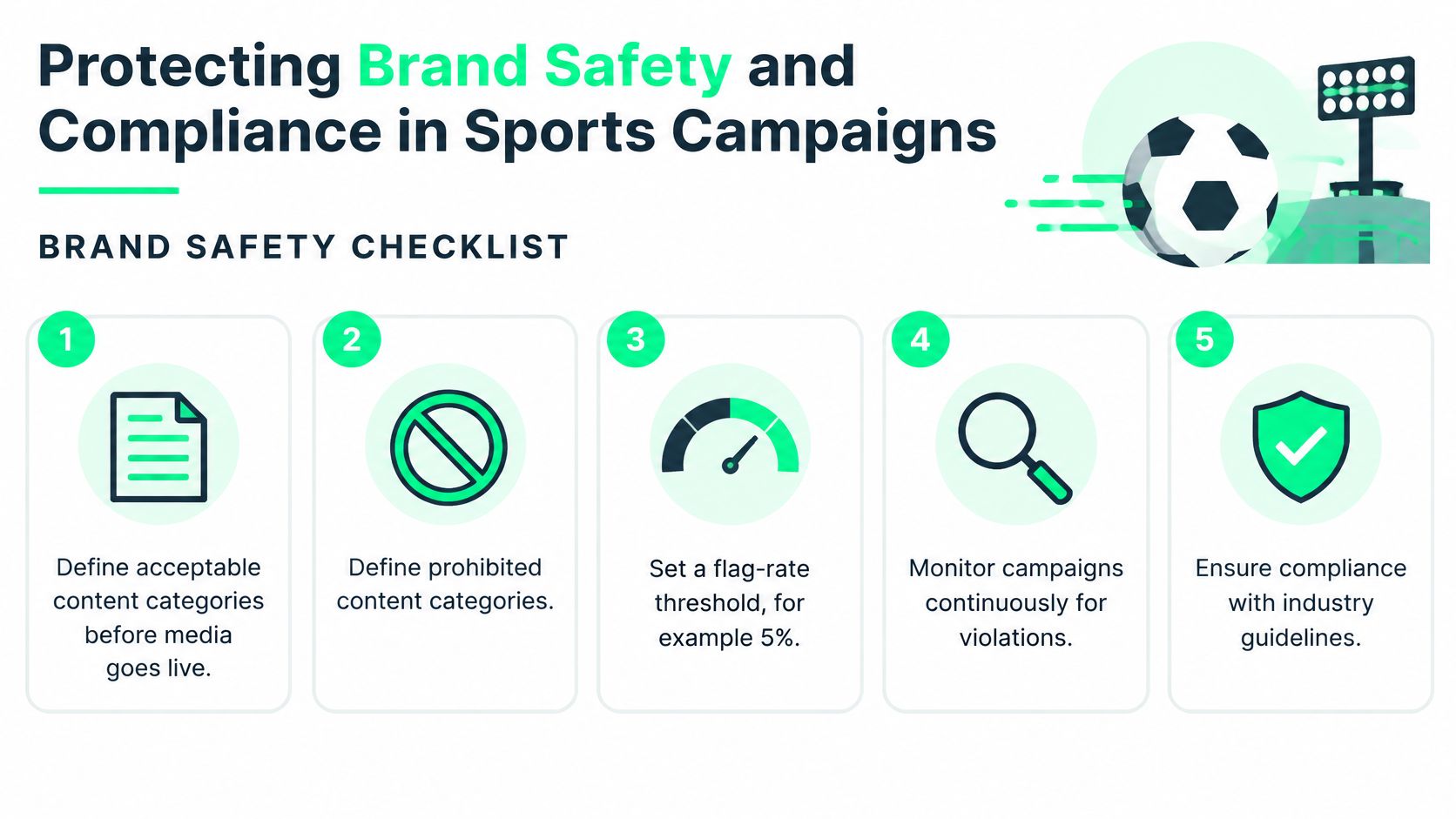
Practical rule: define acceptable content, screen every post, measure violations, and enforce the threshold. A documented control system is defensible in a boardroom; a promise is not.
The reason to build this system isn't compliance theater. It's that sponsorship content now moves across Instagram, TikTok, X, YouTube Shorts, and Facebook Reels at scale, and any one post can land next to content a brand never approved. Real-time review, measurable exceptions, and enforceable escalation criteria are how you protect a brand while still scaling to billions of views.
Measuring Sponsorship and Running a Holdout Test
Most sponsorship measurement stops at reach, impressions, and engagement. That's why 57% of brands find ROI difficult to prove, and only 25% can connect activations to business outcomes, according to recent industry reporting from Infobip's fan engagement analysis. The gap isn't a lack of exposure data. It's fragmented instrumentation and unclear objective-setting. Sponsorship contracts increasingly include digital platforms, fan-engagement tools, and AI analytics, which makes them partly data agreements. The measurement system should reflect that.
Measure three stages in order: exposure and reach, brand effects such as awareness and consideration, and commercial outcomes including sales, retention, and lifetime value.
| Stage | Metric | How to measure it | Read the result as |
|---|---|---|---|
| Exposure and reach | Verified views in target markets | Platform exposure logs filtered by geography | Share of views in target US audiences |
| Engagement quality | Watch time and engagement rate | Platform analytics by page and creative | Higher rates on relevant sports pages |
| Brand effects | Aided awareness and consideration | Brand-lift survey, exposed group against control | Lift over the control group |
| Commercial outcome | Incremental sign-ups, sales or qualified leads | Matched holdout comparison | Conversions above the holdout rate |
| Customer value | Lifetime value and retention of exposed cohorts | CRM cohorts matched to control groups | Higher value or lower churn against control |
The strongest practical method is a matched test-and-control framework. Identify exposed audiences or markets, construct comparable unexposed groups, and compare before and after while controlling for baseline purchase behavior and seasonality. Bain & Company's sponsorship playbook shows this applied to a global wealth-management sponsorship: invited high-net-worth clients generated meaningfully higher assets under management than a matched control group, and in one year, incremental net-new assets exceeded $50 million. The return formula is straightforward: incremental gross profit minus rights, activation, media, and measurement costs, divided by total investment.
Run the holdout in six steps:
- Set one objective: sign-ups or qualified leads. One objective keeps the measurement clean.
- Pick U.S. segments the audience already watches. Use the Nielsen fields: age, gender, region, league. Define the audience before spending.
- Build the holdout. Assign a matched group that never sees the sponsorship. Their conversion rate becomes the baseline.
- Lock topics, terms, and geography before posting. The brand-safety rules run in the same sequence as measurement, so every exposed view is also a reviewed view.
- At two weeks, pause weak sources. Reallocate to pages and creative variants showing incremental lift.
- Renew, scale, or stop with the formula. If incremental gross profit doesn't beat total investment, the deal fails regardless of impressions.
The instructions in a contract matter as much as the numbers. Write impressions, engagement, qualified leads, and attributable revenue into the contract before you sign anything. If the measurement definitions aren't contractual, the vendor's dashboard will win every dispute.
How to measure incrementality explains the matched holdout in more detail. The principle is the same for sponsorship as for paid media: you can't claim a view drove an action unless you know what the action would have been without the view.
If you want sports sponsorship distribution with verified tier-one U.S. views, brand review before every post, and a holdout-friendly measurement path, that's what we run every day. A brand gives us a budget and goal, and we return a plan with a guaranteed view number, built on a network of vetted American sports pages. Visit FindClout to see the network and lock in a pilot.
Want this audience for your brand?
FindClout puts your brand in front of verified American audiences across every major US page — brand-safe, at scale.
Start Your Campaign