 findclout.com
Sports Marketing Agency: How to Choose and Work with One
Brand investment in sport reached approximately $250 billion in 2024. More than 5,000 brands signed sponsorship deals worth over $1 million that year, the average deal size rose from about $800,000 in 2019 to $1 million in 2024, and sponsorship's share of sports-directed spending fell from 29% to 19% over a decade, according to The Drum's account of why brands are backing sports.
That mix is why a logo on a jersey is a weak default. Rights are a smaller slice of the sports budget than they were, so the rest sits in content, paid distribution, and proof that sales moved. I judge a sports marketing agency on verified American audience quality, brand-safety review you can audit, and incremental impact. Total views and a low CPM don't make the shortlist.
Table of Contents
- Which Services Your Campaign Actually Needs
- Agency Vetting Scorecard for Sports Campaigns
- How to Shortlist and Brief an Agency
- What Sports Agency Pricing Really Covers
- Measurement Layers That Prove Real Impact
- Brand Safety and Compliance for Betting Brands
- Sign a Test Campaign Before a Full Contract
Which Services Your Campaign Actually Needs
The usual miss is buying a logo when the goal is conversion. Rights buy association with a league, team, or athlete. They don't, on their own, put a tracked offer in front of a U.S. fan who can act during the game.
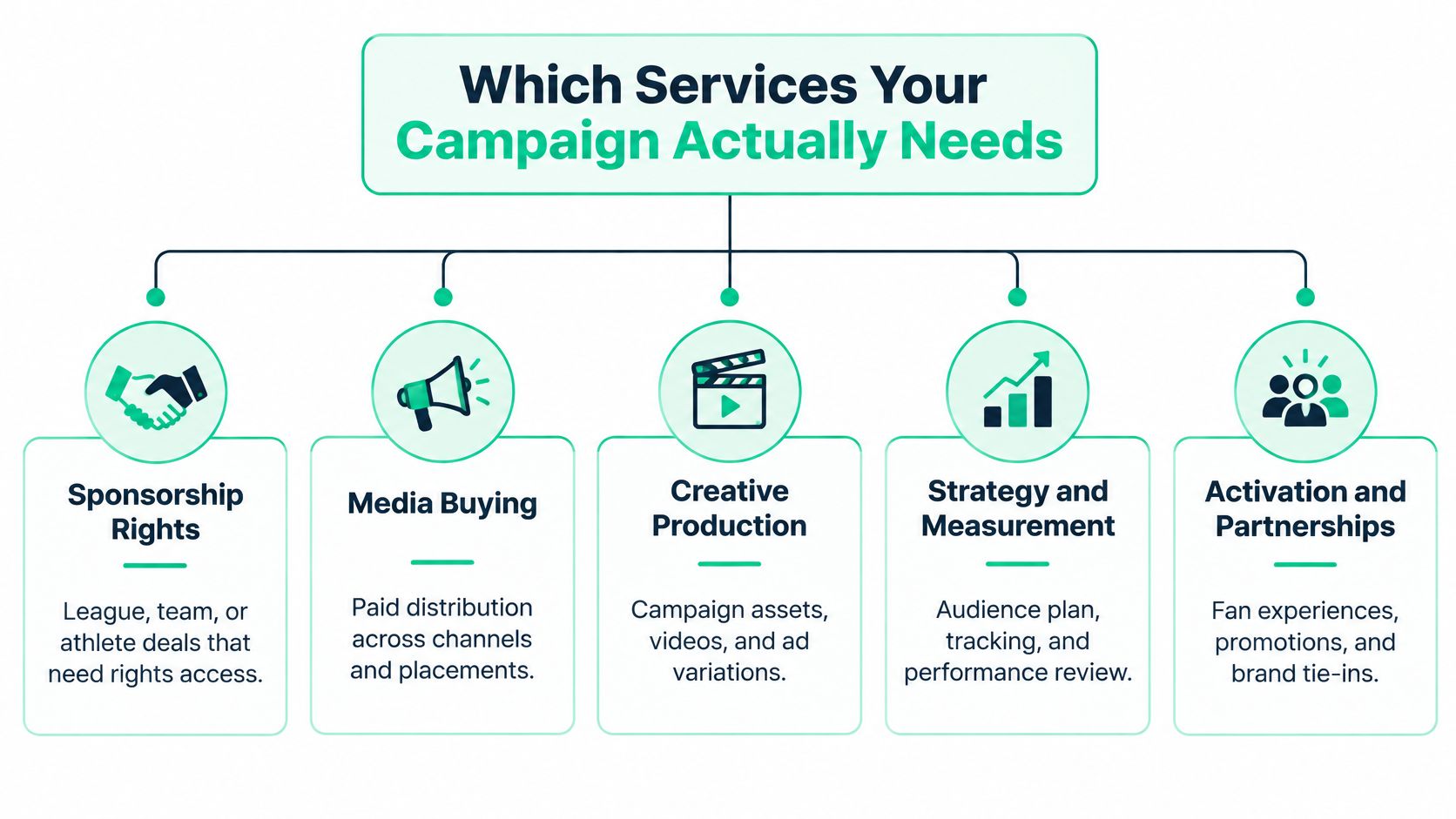
Five buys cover almost every brief, and they don't substitute for each other.
Sponsorship rights need valuation and an activation plan, not just a patch. Content and creative means video or static assets cut for sports feeds. Creator and page distribution places the brand across vetted pages. Athlete or talent endorsements buy a named voice, posting terms, and a usage window. Regulated-category work for betting, prediction markets, and fantasy sports adds age, state, and claims checks before anything posts.
Programmatic meme placement is the fast path. Branded captions and watermarks run on sports clips across a curated page network, scoped by vertical, so you join the game-day thread without a jersey deal. Pages are hand-picked for the brand rather than blasted across the whole network. If the brief needs a named voice instead, a sports influencer marketing plan should lock usage rights before outreach starts.
Local charity events are a cleaner rights comparison than a national patch. The charity sponsorship strategies from Live Tourney show tiered packages that tie the fee to hospitality and on-site activation, which is the same test you should apply to a league deal.
Services by brand goal
| Brand goal | Service to buy | Typical scope | Pricing basis |
|---|---|---|---|
| Long-term brand identity | Sponsorship rights with activation | League, team or athlete rights plus activation budget | Rights fee plus activation budget |
| Fast awareness with sports fans | Programmatic meme and page distribution | Vetted US sports pages, scoped by vertical | Per view on CPM |
| Creative built for sports feeds | Content campaign with meme conversion | Brand video or static assets turned into variations | Per view CPM, higher tier |
| Athlete or creator endorsement | Creator partnership | Named creators, posting terms and usage rights | Named-creator fee plus a paid usage window |
| Betting or prediction-market launch | Regulated-category campaign with compliance preflight | State eligibility and age-gated audiences | Per-view CPM inside a compliance-scoped contract |
| Proof of incremental sales | Measurement and lift testing | Holdout groups, conversion tracking and reporting | Line item inside the test invoice |
Practical rule: Awareness on a budget points to distribution. Long-term identity points to rights. Conversion goals need measurement written into the contract on day one.
Agency Vetting Scorecard for Sports Campaigns
Audience geography is the criterion that fails most often. A huge global view count can hide thin American reach, and a sports feed full of international clips won't help a brand that needs U.S. adults.
The 2024 U.S. Ad Fraud Savings Report from TAG, the 4A's, ANA, and IAB estimated that invalid traffic could have cost U.S. display and video advertising about $11.78 billion in 2023. Certification and anti-fraud programs cut that estimated loss to $979 million, a 92% reduction, and invalid-traffic rates stayed below 1% in TAG Certified Channels in the United States for the fourth consecutive year. Use that as the fraud bar. A promise that the network is "curated" isn't a measurement.
Agency vetting scorecard
| Criterion | Strong answer | Red flag |
|---|---|---|
| Audience geography | Verified US audience with country filters at page level | Global view totals with no country split |
| Fraud control | Invalid traffic measured and kept below 1% in certified channels | Guaranteed views with no verification method |
| Brand safety review | AI scoring plus human review before anything posts | Posting first and reviewing later |
| Page selection | Pages hand-picked for each brand, exclusions enforced | Blanket posting across the whole network |
| Fee transparency | Clear CPM, management fee and contract length in writing | Retainers with markups not stated in the proposal |
| Category experience | Prior work in betting, fintech or gaming | Generic sports portfolio with no regulated-category work |
| Reporting | Creator-level and campaign-level breakdowns | Impression totals only |
Score each sports marketing agency from 1 to 5 on every row. I would drop anyone who fails audience geography or fraud control, whatever the CPM.
What strong looks like in practice is narrower than a capabilities deck. Country filters sit at page level, so a non-U.S. page never enters the buy. Fraud control is a rate you can see, not a slogan. Review happens before the post, with automated scoring and a person in the loop, because a takedown after a viral miss still leaves the screenshot. Pages are chosen for that brand, and exclusions stay enforced when the buy scales.
Fee lines should be as plain as a search-agency comparison. The same habit in NotFair versus Google Ads agencies applies here. You want the CPM, any management fee, and the contract length in the proposal, not buried in a renewal call. Category experience means prior betting, fintech, or gaming work. Reporting means a creator or page breakdown, not one impression total.
Our screen is built around tier 1 American audiences, review of every submission before it posts, and geo rules that keep delivery in high-quality markets while the buy scales toward billions of views. That is the point of the scorecard. Attention without those controls is just a larger mistake.
How to Shortlist and Brief an Agency
A one-page brief beats a 40-slide tour of the brand. If renewal has no single outcome, every agency will declare a win.
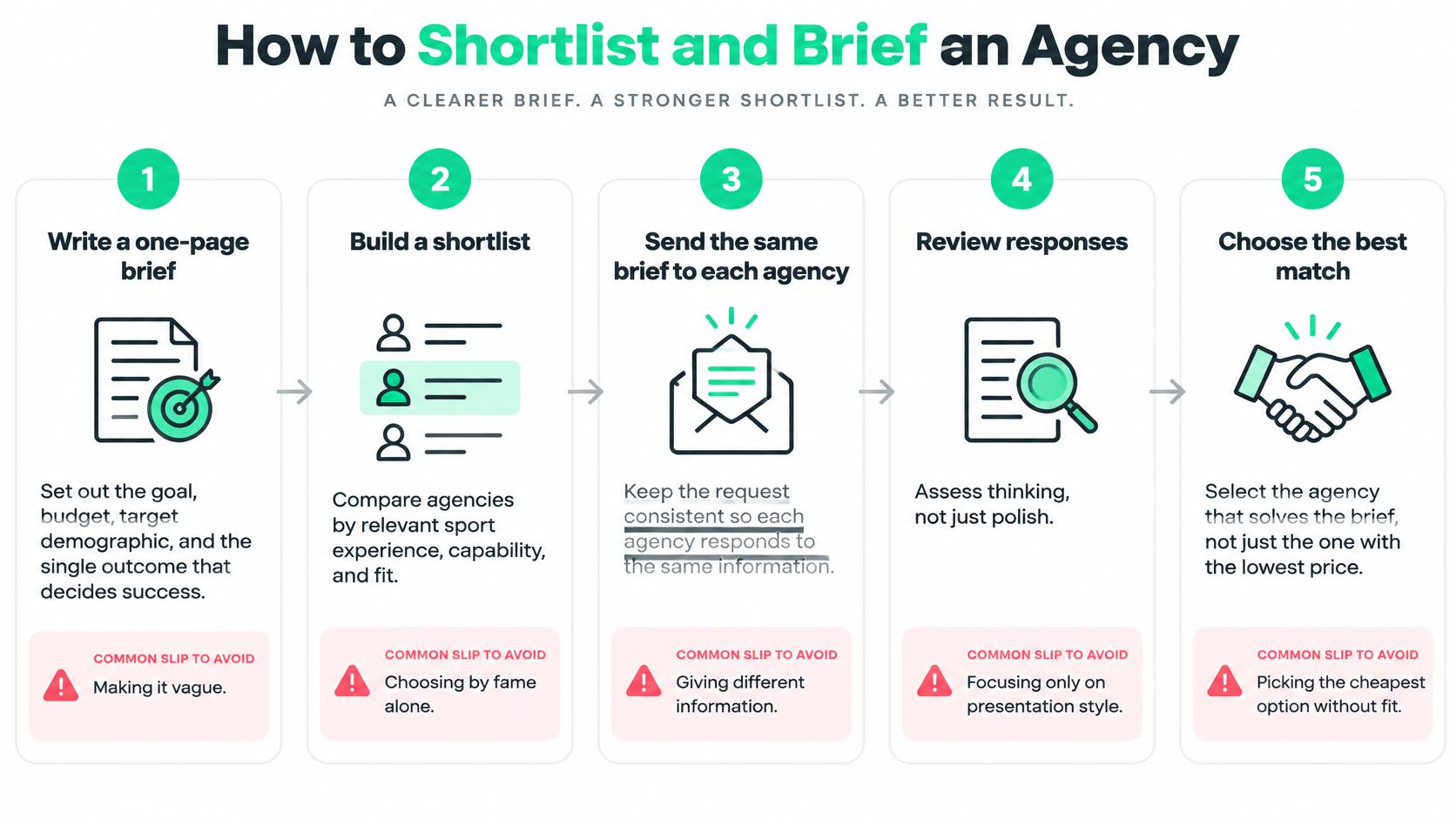
- Write the brief. One page with the goal, budget, target demographic, and the single outcome that decides renewal. The slip is a brief with no outcome, so every chart can be spun as success.
- Shortlist three to five shops by category fit, not portfolio size or follower counts. A huge highlight reel from soccer in another country doesn't prove U.S. sports-page quality.
- Ask for a sample report by creator or page, not a rolled-up total. Accepting totals only is how duplicated reach survives the first review.
- Get the page or creator list and the exclusion list before money moves. Contracts that skip exclusions let a prohibited state, a minor-skewing page, or a rival's meme account into the flight.
This short briefing walkthrough is worth ten minutes before you send the same brief to every shop on the list.
- Read ownership, usage, liability, and exit terms. Vague liability language leaves you holding a post you didn't approve. On our side, creators, advertisers, and other users are independent parties, and the Terms create no employment or agency relationship with FindClout. Advertisers also agree to indemnify us for claims arising from their campaigns, content, communications, and products. Read that before you treat a platform as your legal department.
- Confirm in writing who approves each creator post and how takedowns work. Verbal assurances disappear the week a caption goes off-brief.
- Launch a paid test with a holdout using the checks at the end of this piece. Signing a long retainer first is how a weak audience becomes a year-long cost.
Activation and hospitality sit outside the media line. If the brief includes fan experiences, use budgeting for experiential agency services so that production, staffing, and on-site build aren't discovered after the rights fee is spent.
A ready brief is dull on purpose. One paragraph states the goal. One line states the budget. One line names the U.S. audience, including age and states if the category is regulated. One line names the renewal metric, such as incremental account opens against a holdout. Send that same page to every agency. Different briefs produce proposals you can't compare.
What Sports Agency Pricing Really Covers
A headline CPM is not the cost of the campaign. Rights without activation, or views without measurement, produce a cheap line item and an expensive miss.
Brands pay per view at a CPM set up front, and a per-view contract shouldn't hide an unexplained fixed charge. Confirm in writing any minimum fee, flat setup invoice, or view guarantee. Our first campaign is the exception you can see on the invoice. It costs $20-30K, guarantees 100 million views, and is billed as one flat invoice. After that, delivery is pay-per-view on verified views at the agreed CPM.
| Format | Price basis | What you get |
|---|---|---|
| Logo and caption distribution | $0.20 CPM | Brand watermark and approved captions across the network under set rules |
| Vertical-targeted placement | $0.25 CPM | Keyword requirements, exclusions and placement scoped to sports or another niche |
| Content campaign | $1.50 to $3.00 CPM | Brand video or static assets converted into meme variations |
Costs the CPM leaves out
An independent 2026 F1 sponsorship benchmark reported that only about 10% of deals produced positive media-value ROI without substantial activation spend, cited a planning range of roughly 0.5 to 1.5 times the rights fee for activation, and, in the same benchmark set, MarketCast's Super Bowl figures averaged 38% memorability, 53% brand linkage, and 20% combined breakthrough, per the RTR Sports Marketing F1 sponsorship benchmark. Those figures are directional and vary by fit, execution, and valuation method.
Exposure isn't attribution. A memorable spot can still fail brand linkage, and a linked spot can still fail to move incremental sales.
Budget separately for activation, creator content, hospitality, measurement, and optimization. Model the rights fee and the activation budget together, and forecast reach inside the target demographic rather than the total audience. Pretest creative for memorability and brand linkage before you scale. Don't count the same fan twice across broadcast and social, and don't swap survey methods between waves.
The quote test is simple. Ask for total cost including activation and measurement. Divide that total by the outcome you need, such as cost per incremental conversion. A $0.20 CPM that can't show that denominator is more expensive than a higher CPM that can.
Measurement Layers That Prove Real Impact
A high-impression sports campaign can still fail. If brand linkage is weak, or incremental sales don't move, the view total is a costume.
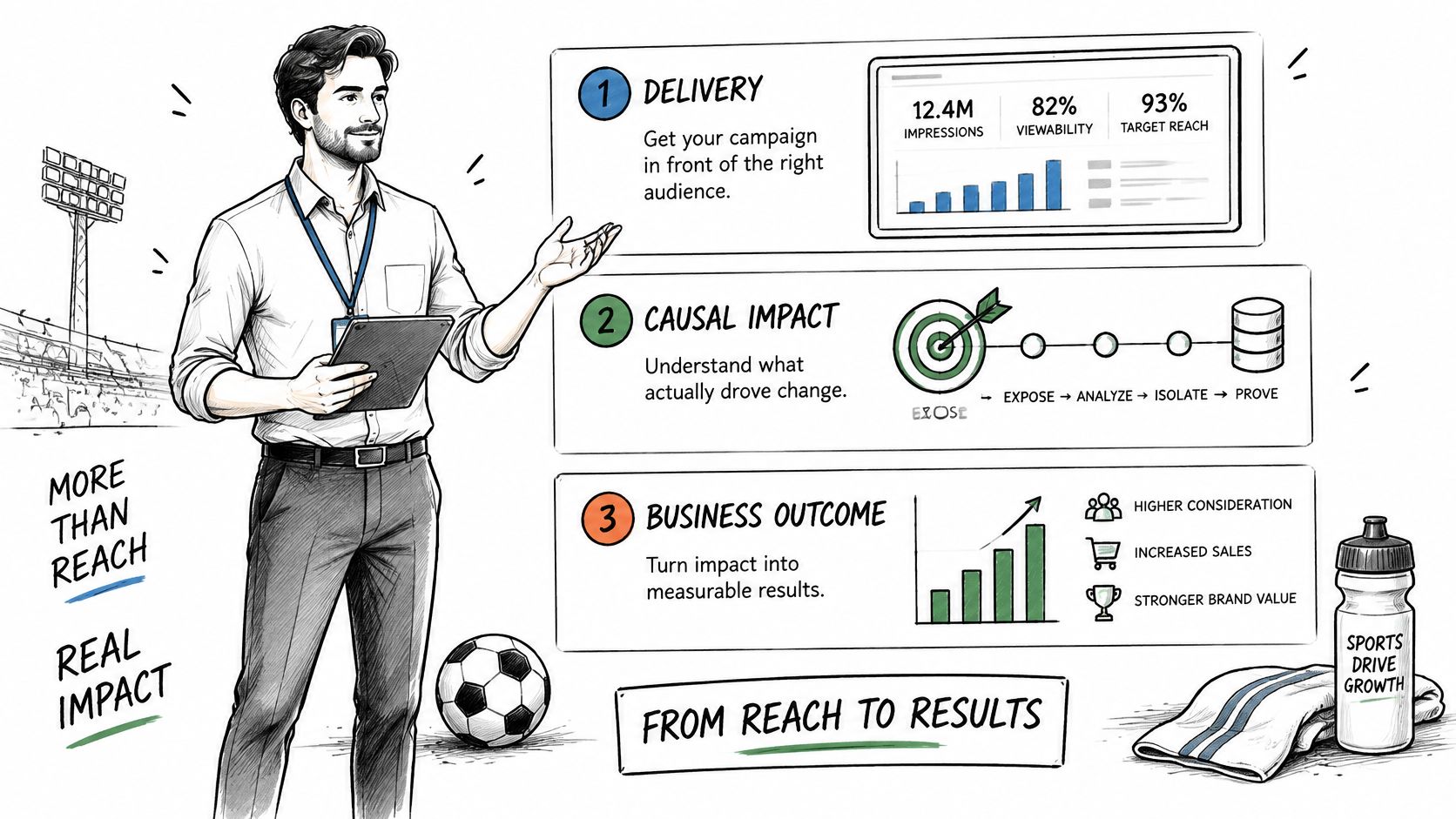
Start before launch. Define the audience, the decision-journey objective, the rights fee, the activation budget, and the primary commercial outcome. Set a pre-campaign baseline for unaided awareness, aided awareness, favorability, purchase consideration, and recommendation intent. Repeat that survey after the campaign on the same audience profile.
McKinsey's sponsorship analysis recommends tracking cost per reach, unaided awareness per reach, sales or margin per dollar, and indirect benefits, and it notes that sponsorship sales attribution is difficult. Report three layers separately so a fat reach number can't borrow credibility from a thin sales result.
Three layers, reported apart
Delivery is verified reach, frequency, and cost per target reach. Generic reach doesn't count. If the buy was U.S. adults in specific states, the denominator is that group.
Causal impact is matched exposed-versus-control lift and brand-lift deltas. A holdout or matched comparison is the point. Overlapping TV, creators, and paid social need econometric or regression-based marketing-mix analysis that controls for seasonality, competitors, macroeconomic conditions, and other media spend. Don't assign every observed sale to the sponsorship.
Business outcome is incremental conversions, revenue, or margin. Build the stack from CRM tags, promo codes, QR codes, UTM parameters, product trials, and account openings. When a creator applies to or joins a campaign, you may receive the handle, follower counts, performance metrics, content previews, and audience demographics, which is how you check the audience claim instead of trusting the pitch deck.
A practical read on how to measure campaign performance should sit in the contract as the report format, not as a postmortem.
Before renewal, flag three failures. Duplicated impressions across platforms. Generic reach substituted for target reach. Survey methods that changed between waves, or correlation treated as causation. If the report can't separate the three layers, don't renew on the view count.
Brand Safety and Compliance for Betting Brands
The American Gaming Association responsible-marketing code recommends placing sports-wagering advertising only where at least 73.6% of the audience is reasonably expected to be 21 or older, using reliable and current audience data.
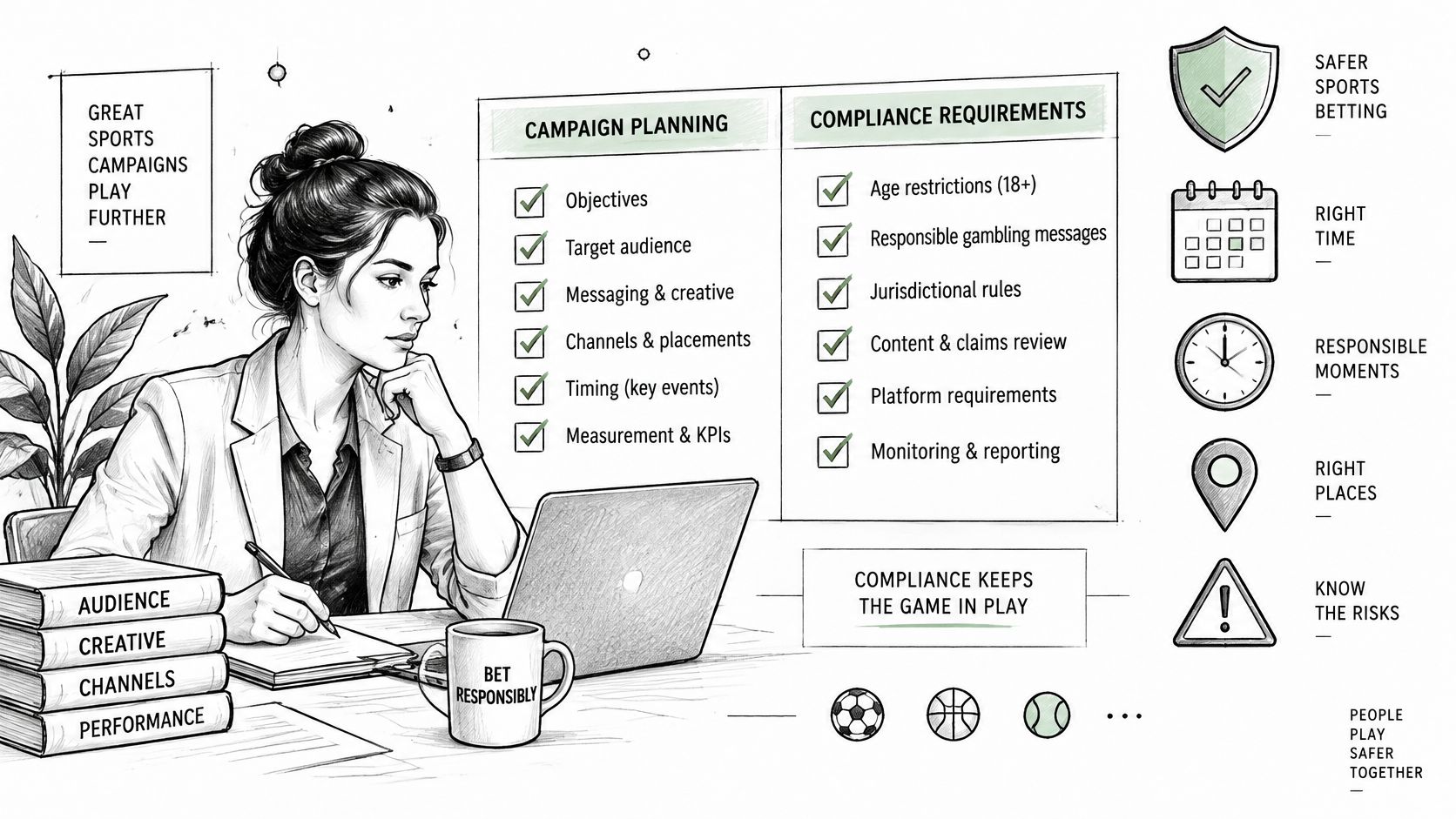
A sports audience isn't automatically a compliant audience. Page demographics, creative tone, placement context, state eligibility, age thresholds, responsible-gambling language, and affiliate disclosures have to be checked together. We run campaigns for brands in regulated verticals, including prediction markets and sports-betting-adjacent services, and the same preflight applies.
What the preflight has to show
A useful agency documents audience-age evidence per page, prohibited-state exclusions, approved claims, review logs, takedown steps, and version control for captions and creative. Bulk email, Telegram, and WhatsApp go only to recipients you have a lawful basis to contact. Passion for a team doesn't create that basis.
| Requirement | Standard | What to verify |
|---|---|---|
| Audience age | At least 73.6% of audience reasonably expected to be 21 or older | Current, reliable audience data for each page |
| State eligibility | Prohibited states excluded from delivery | Signed-off geo exclusion list before launch |
| Claims and tone | Approved claims and responsible-gambling language | Preflight review log for every creative |
| Messaging consent | Bulk email, Telegram and WhatsApp only to lawful contacts | Consent or lawful-basis records |
| Takedown and versions | Off-brand posts removed quickly | Version control for captions and creative |
State rules and newer formats don't line up neatly, which is why "target sports fans responsibly" isn't an operating procedure. Read the placement rules in gambling advertising laws against your state list before the first caption is approved. Real-time review matters here because a caption edit after a game starts still needs the same approved claim, the same age evidence, and the same geo filter.
If an agency can't produce the review log for last month's posts, it can't protect the brand.
That log is the test. Audience-age evidence you can't open, a geo list that isn't signed, or captions with no version history mean the flight isn't ready, even if the page looks like pure sports.
Sign a Test Campaign Before a Full Contract
Sign a paid test, not a long contract. A retainer signed off a deck locks you into the audience you haven't checked.
Run the test in this order.
Set one goal and one outcome. Awareness, consideration, or incremental conversions. Not all three. The outcome is the only number that can renew the deal.
Fund a full run. A wrap is typically 7 to 21 days. A budget that dies on day three never produces a readable holdout.
Require a holdout or matched control before launch, and agree the three-layer report in writing. Delivery, causal impact, and business outcome stay in separate tables.
Judge the result on three checks. Did delivery hit the verified U.S. audience you specified, with country filters at page level? Did lift against the control hold? Did incremental conversions or margin move?
Tier 1 American audiences, real-time review of every submission, and geography filters that keep views in high-quality markets are the test criteria, not bonuses. Pages stay hand-picked. Exclusions you can audit yourself stay on the list. Brands apply through a form and don't need a call, and rolling monthly terms mean you stop if the test falls short.
Renew only the sports marketing agency whose report separates those three layers and whose exclusion list you could audit yourself. If the test only hands you a view total, walk.
FindClout places branded sports posts across vetted American creator pages, with pay-per-verified-view pricing, brand-safety review before anything posts, and geo rules aimed at high-quality U.S. audiences. If you're briefing a sports campaign and want distribution you can test before a long contract, visit FindClout and send the one-page brief.
Want this audience for your brand?
FindClout puts your brand in front of verified American audiences across every major US page — brand-safe, at scale.
Start Your Campaign