 findclout.com
10 Sports Betting Affiliate Programs for US Audiences
A sports page can attract American fans and still be unsuitable for sportsbook advertising. The American Gaming Association's Responsible Sports Betting Marketing Code says wagering communications should run only where reliable, current audience data indicates that at least 73.6% of the audience is expected to be age 21 or older. A football-heavy feed isn't proof of an eligible audience.
Most sports betting affiliate programs look similar on their application pages. The differences emerge in state coverage, qualifying-player definitions, creative approvals, paid-promotion disclosures, and whether the operator permits your actual distribution method. Permission to publish a review doesn't automatically include permission to buy creator placements or redistribute clips.
For tier-1 American audiences, I'd prioritize an enforceable commercial agreement over a promising headline commission. You need to know which users qualify, which placements are approved, and who can stop a campaign when a caption or offer becomes inaccurate.
The operating test: Can you trace an approved placement to an eligible American audience, then reconcile its referrals against the operator's payable conversion event?
The ranking below favors clear application routes and usable operating structures, not unverified payout claims. The later entries include bespoke partnership opportunities and a merchandise alternative, because not every sports audience should receive a wagering offer. Brand recognition helps shortlist a partner. Traffic permissions and brand safety determine whether you can scale it.
Table of Contents
- 1. FanDuel Affiliates
- 2. BetMGM Partners
- 3. Caesars Digital Affiliates
- 4. bet365 Partners
- 5. Hard Rock Bet
- 6. Rush Affiliates
- 7. Betr Partner Program
- 8. Underdog Partner Program
- 9. Bally Bet
- 10. Fanatics Partner Network
- Sports Betting Affiliate Programs Compared on Payout, Rules, and US Fit
- Build a Brand-Safe US Sports Affiliate Stack
1. FanDuel Affiliates
FanDuel is a practical starting point for publishers whose audience already follows American sports. Its official affiliate portal provides an application and login route for promoting its sportsbook and related products, with tracked links, reporting, and marketing materials available after approval.
The attraction is straightforward: a recognizable consumer brand and a direct fit for sports-focused content. The limitation is equally important. Standard commission rates aren't publicly listed, and acceptance doesn't establish blanket permission across products, states, or promotional channels.
Best for an Established Sports Publisher
An owned-and-operated site can present a relatively clear approval package: its editorial categories, audience geography, acquisition sources, and intended placements. A creator network requires more detail because the operator needs to understand where each promotion will appear.
- Commercial terms: Get the qualifying-player event, payment schedule, reversals, and attribution rules into the agreement.
- Channel permissions: Separate website reviews, email, organic social, paid social, and third-party creator distribution.
- Reporting setup: Assign distinct tracking identifiers to approved sources so rejected referrals don't disappear inside an aggregate total.
FanDuel's brand recognition is a reason to test, not a substitute for that work. I'd shortlist it for a U.S. sports publisher with a documented audience and controlled inventory, then expand only into placements explicitly approved by the program.
Main trade-off: You get an official affiliate relationship with a familiar brand, but public information won't settle your commission economics or distribution permissions.
2. BetMGM Partners
A publisher monetizing both sportsbook and eligible casino content should consider BetMGM Partners. The program covers BetMGM Sports and eligible casino and poker brands, and its published FAQ explains CPA and revenue-share compensation approaches with qualification requirements for new players.
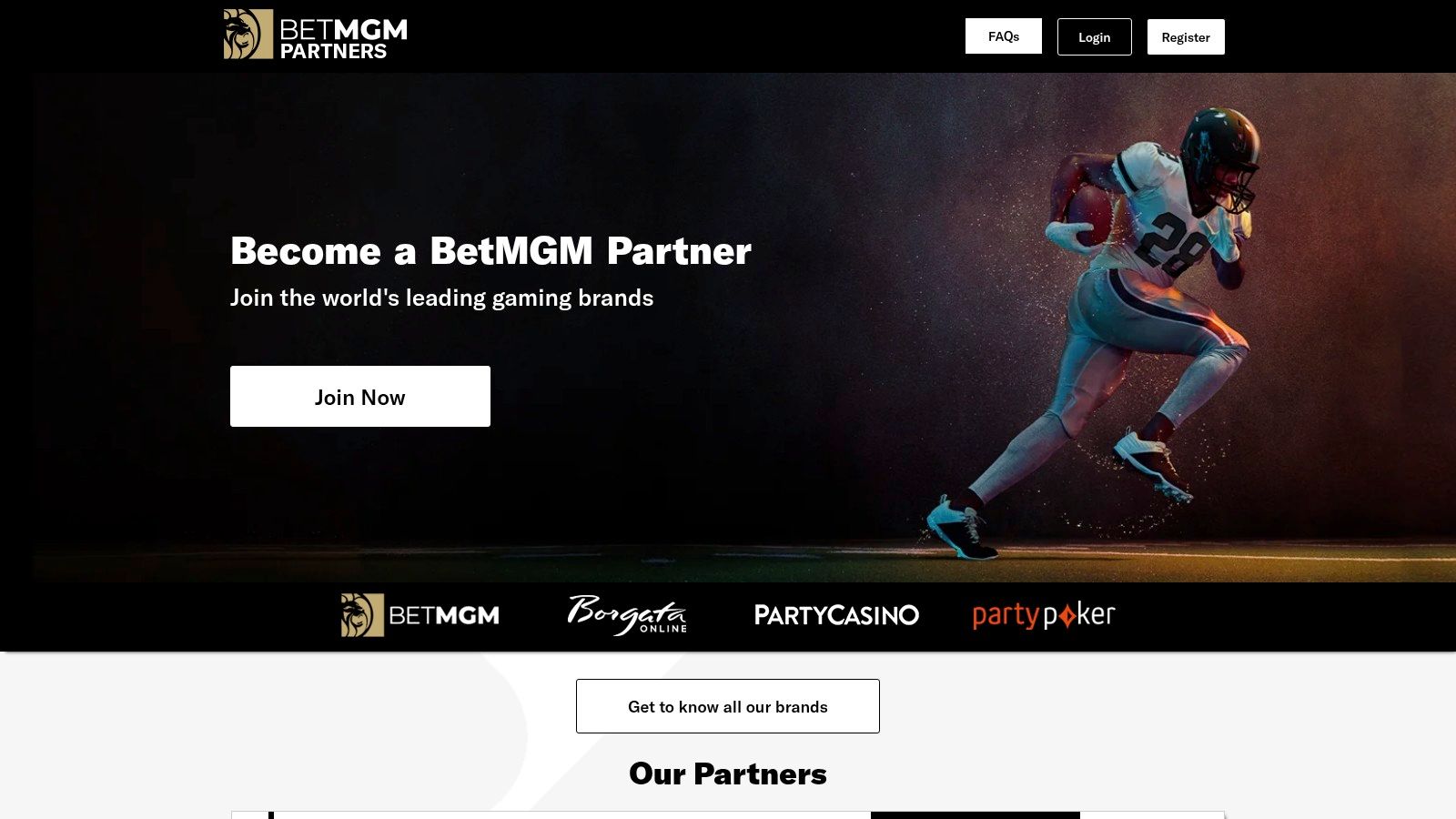
Its useful features include tracking IDs, promotional materials, affiliate reporting, and potential access to multiple brands. No program sign-up fee is listed, but a signed agreement and approval are required. Rates aren't publicly specified, and licensing may be required in some states.
Compare the Payable Event, Not Just the Model
CPA gives you a defined acquisition payment only when the referred customer satisfies the contract. Revenue share requires closer attention to deductions and the treatment of later adjustments. Neither label tells you enough to forecast earnings on its own.
- Sportsbook qualification: Establish whether registration, deposit, wagering activity, or a combination makes the customer payable.
- Product separation: Keep sportsbook, casino, and poker traffic identifiable rather than assuming every product shares the same economics.
- Approval records: Retain the accepted creative and its approved destination alongside the tracking ID.
BetMGM's advantage is that its public explanation gives applicants a useful commercial starting point. Its disadvantage is the operational work behind a multi-product relationship.
I'd favor it when a publisher can manage product-specific landing pages and state eligibility. Don't use the portfolio's breadth to justify sending every sports fan to the same offer.
3. Caesars Digital Affiliates
Choose Caesars for market-level detail, not an assumption of nationwide uniformity. The Caesars Digital affiliate portal connects applicants with terms covering Caesars Sportsbook and associated Caesars and William Hill brands. Those terms include state-specific products and customer qualification conditions.
That structure can suit publishers who want recognizable brands under a broader relationship. It also creates work: product availability differs by state, qualifying actions can vary, and commission rates generally aren't posted publicly.
Build a State and Product Map
Before publishing, map each approved destination to its eligible state, product, creative, and referral definition. Keep the operator's legal identity visible in that record, especially when familiar consumer brands sit within a wider commercial arrangement.
The consequences of loose creative controls aren't theoretical. New York's gaming-advertising restrictions require factual, nonmisleading advertising, conspicuous material conditions, and identification of the licensed sports-wagering operator or vendor.
- Strength: Official terms provide market-specific information that publishers can turn into operating rules.
- Weakness: A shared relationship doesn't eliminate differences between products or customer qualification requirements.
- Best fit: Publishers comfortable maintaining localized pages and routing rules.
A practical implementation is a destination register that records the approved offer and landing page for each market. When an offer changes, pause the affected placements instead of relying on a network-wide caption that might no longer apply.
Caesars is a credible shortlist candidate when your team can maintain that detail. It's less attractive if your workflow depends on an unchanged national promotion.
4. bet365 Partners
bet365's traffic restrictions are the deciding factor for creator-distribution buyers. Its U.S. affiliate program provides tracking links, approved banners and promotional creative, written jurisdiction rules, and documented referral and payment thresholds.
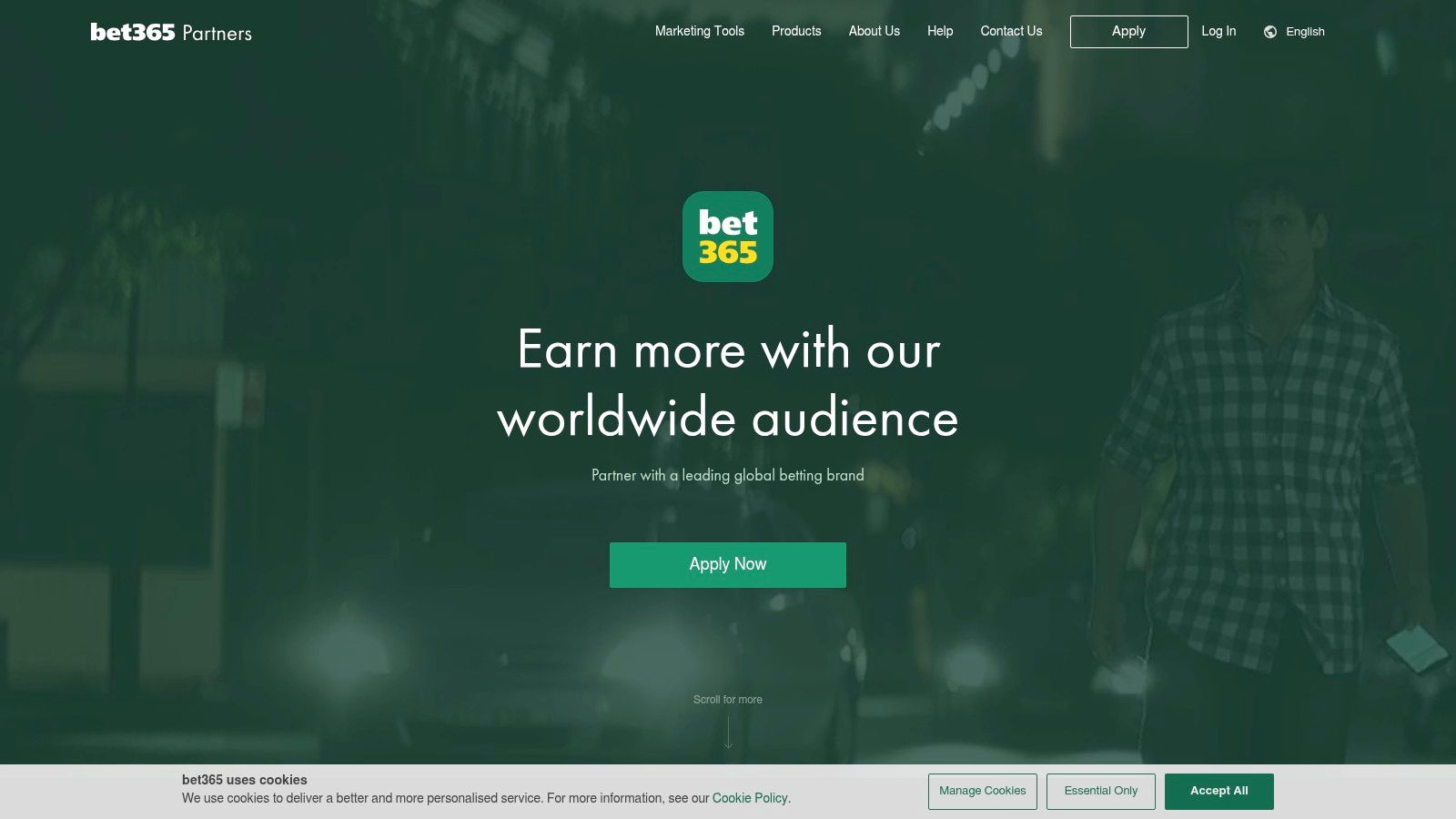
The program's stated guidelines exclude blind traffic, including programmatic media buying and affiliate networks. That makes it a more plausible candidate for owned-and-operated sites or other expressly approved placements than for a distributed creator campaign.
An attractive sportsbook offer isn't usable inventory if the operator prohibits the way you acquire traffic.
Match the Buying Method to the Contract
Don't interpret approval for an affiliate website as approval to purchase traffic through unrelated pages. Describe the full supply chain: who owns the account, who approves the content, who publishes it, and how visitors reach the operator.
- Advantages: An established sportsbook brand, published U.S. terms, and explicit marketing guidance.
- Constraints: Minimum referral and payout thresholds apply, and terms can change.
- Decision: Reject the program for a proposed channel if its rules exclude that channel, rather than trying to rename the traffic.
Our guide to sports betting advertising provides context for evaluating distribution alongside creative and jurisdiction controls.
I'd consider bet365 for an approved editorial property with transparent acquisition sources. I wouldn't build a programmatic creator plan around it under guidelines that expressly exclude that buying method. Clear restrictions are useful because they prevent a commercially incompatible test.
5. Hard Rock Bet
Social-first publishers have a reason to examine Hard Rock's application routes. Alongside the Hard Rock affiliate portal, the brand offers a separate influencer casting form that asks about social platforms, audience size, and sports interests.
That's a more relevant starting point for a creator than pretending a social account operates like a comparison website. It's still an application, not a guaranteed deal, and terms and payouts aren't publicly detailed. Sportsbook availability remains state-specific.
Present the Audience Behind the Handle
A strong submission should explain the page's content, audience geography, age composition, engagement quality, and previous promotional formats. Include representative posts so the operator can evaluate tone and adjacency, not just follower totals.
- Creator route: The separate influencer application gives social publishers a way to present their audience.
- Content opportunities: Sports and iCasino opportunities require their own product and market approvals.
- Commercial limitation: Don't forecast campaign income before the brand confirms the arrangement and qualifying actions.
Brand safety also extends beyond the approved post. The AGA's responsible-gaming regulations and guidelines describe regulatory approaches involving intervention data and information-sharing controls intended to prevent direct marketing to self-excluded individuals.
For creator campaigns, retain account inventories, approvals, and removal records, and establish applicable suppression responsibilities with the operator. Hard Rock is worth approaching for a social-led relationship, but the casting route doesn't remove affiliate compliance obligations or establish permission for unrestricted redistribution.
6. Rush Affiliates
A multi-brand agreement is useful only when it reduces administration without obscuring eligibility. Rush Affiliates covers BetRivers, SugarHouse, and other Rush Street Interactive brands, with affiliate terms and account infrastructure supporting market-dependent sportsbook and casino products.
One relationship can cover multiple brands, which suits publishers operating localized sports properties. The limitations are brand availability by state, the absence of a universal public commission schedule, and the need to confirm current onboarding and permitted channels directly.
Keep Geography Inside the Performance Report
A national audience total is a weak planning metric if only part of that audience can use the destination. The GAFFG sportsbook affiliate guide highlights how location restrictions and attribution leakage can separate interested traffic from payable acquisition.
For Rush, build reports around the approved brand and market combination rather than rolling everything into a single acquisition figure.
- Useful metric: Geo-qualified earnings per click, calculated from eligible traffic and recognized commission.
- Diagnostic metric: Rejected registrations, with reasons where the operator makes them available.
- Control: Separate sportsbook and casino destinations so product performance remains interpretable.
Say a regional sports page generates fewer visits than a national highlights account but reaches more eligible users. The regional page may be the better commercial placement, even before considering creative suitability.
Rush is a sensible candidate for organized publishers seeking a multi-brand relationship. It's not a shortcut around state routing, and a broad portfolio shouldn't conceal which brand accepts each referral.
7. Betr Partner Program
Treat Betr's partner application as an invitation to negotiate, not a standardized affiliate offer. It provides an official route for prospective marketing partners, but publicly available commission rates and program mechanics are limited.
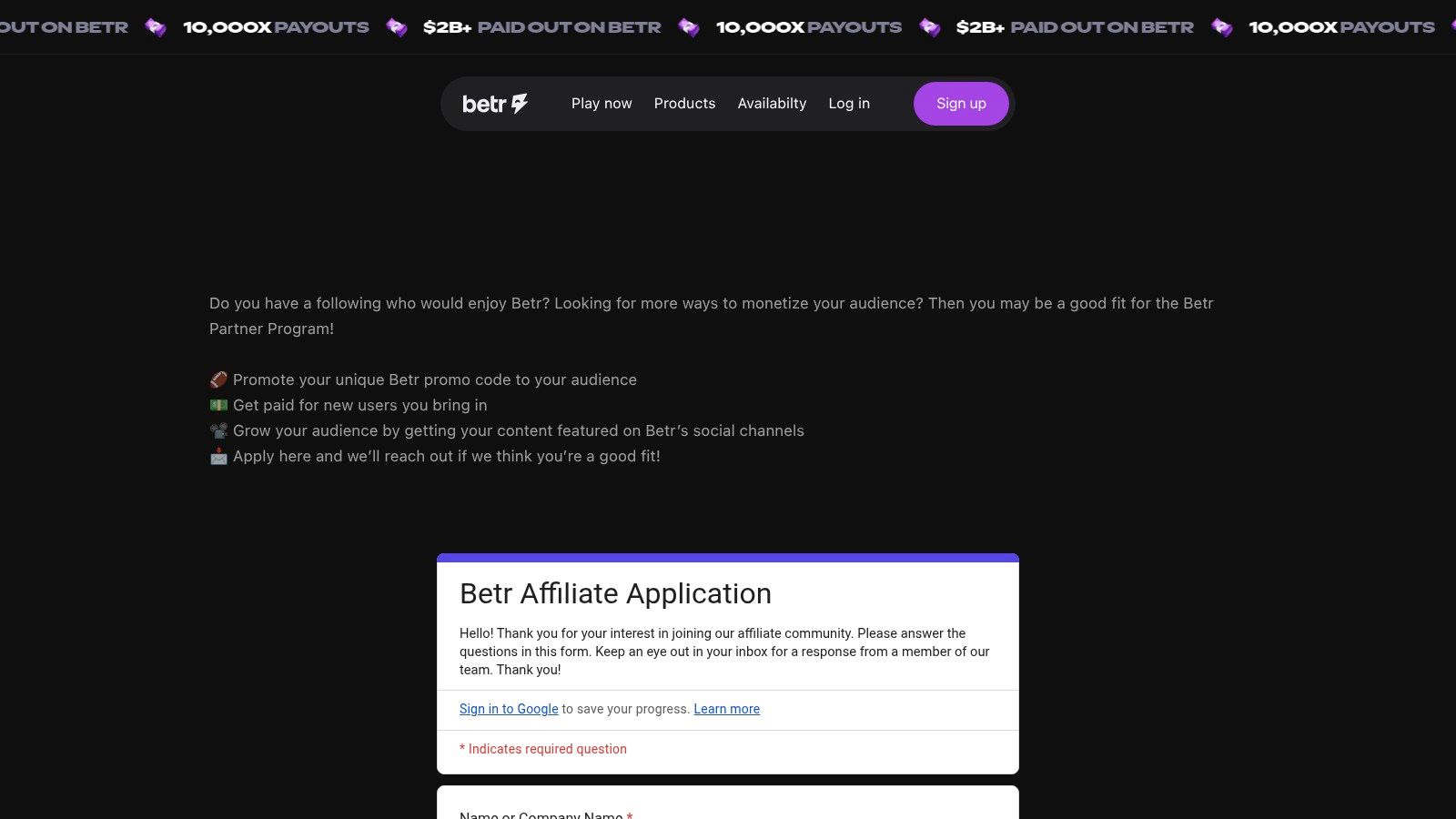
That can suit sports creators with a specific campaign concept. A direct relationship gives applicants room to discuss placement formats and commercial terms, but approval, eligible products, and tracking need to be established before spending. Not every Betr product is a sportsbook in every state.
Lead With a Defined Campaign
Submit a proposal that names the product, intended markets, creator inventory, approved content format, and conversion event. Avoid presenting undifferentiated sports reach as a complete acquisition plan.
- Opportunity: A direct brand relationship may accommodate campaign-specific negotiations.
- Uncertainty: Public information doesn't establish a standard payout schedule or attribution structure.
- Required distinction: Product classification and availability must match the destination being promoted.
For clipped sports content, our guide to choosing a clipping agency for sports betting helps frame distribution requirements before a partnership is signed.
The measurement approach should follow the commercial event. Sportico's discussion of sports publishers and betting acquisition supports connecting sports-content exposure to trackable visits, registrations, first deposits, and customer value rather than treating attention as the final outcome.
I'd approach Betr with a tightly scoped pilot proposal. Don't allocate an acquisition budget against assumptions about what its application form promises.
8. Underdog Partner Program
Underdog belongs in the bespoke-partnership category. Its official partnership guidance acknowledges content creators and marketing partners and directs interested applicants to contact the company.
The appeal is a sports-focused audience and product ecosystem that may suit a longer-term creator relationship. The constraint is that there's no public commission table or straightforward self-serve affiliate enrollment. Products and regulatory status differ by market, so it shouldn't be treated as a conventional sportsbook affiliate program everywhere.
Separate Product Fit From Audience Fit
A creator may have an excellent sports audience without having permission to advertise every sports-related product to that audience. Establish the exact destination and product before developing captions, landing pages, or promotional claims.
Contract boundary: A recognizable brand name doesn't establish that every product under it has the same legal classification or affiliate terms.
For a negotiated relationship, the proposal should distinguish content production from distribution and acquisition compensation. Specify which party approves claims, whether reposting is allowed, and how the brand can withdraw outdated creative.
The strongest use case is a sports creator with a consistent editorial identity and a proposal the brand can assess individually. The weaker use case is a buyer seeking an immediately available offer with published economics and interchangeable placements.
Underdog may warrant outreach, but rank it below a documented affiliate agreement when procurement certainty matters. A promising conversation isn't yet an approved campaign, and product availability should never be inferred from audience enthusiasm.
9. Bally Bet
Bally Bet is a U.S. sportsbook brand worth considering for direct media or creator outreach. The sports-entertainment parent brand and league relationships give it name recognition with American sports audiences, but Bally Bet does not publish a self-serve affiliate application or a commission schedule.
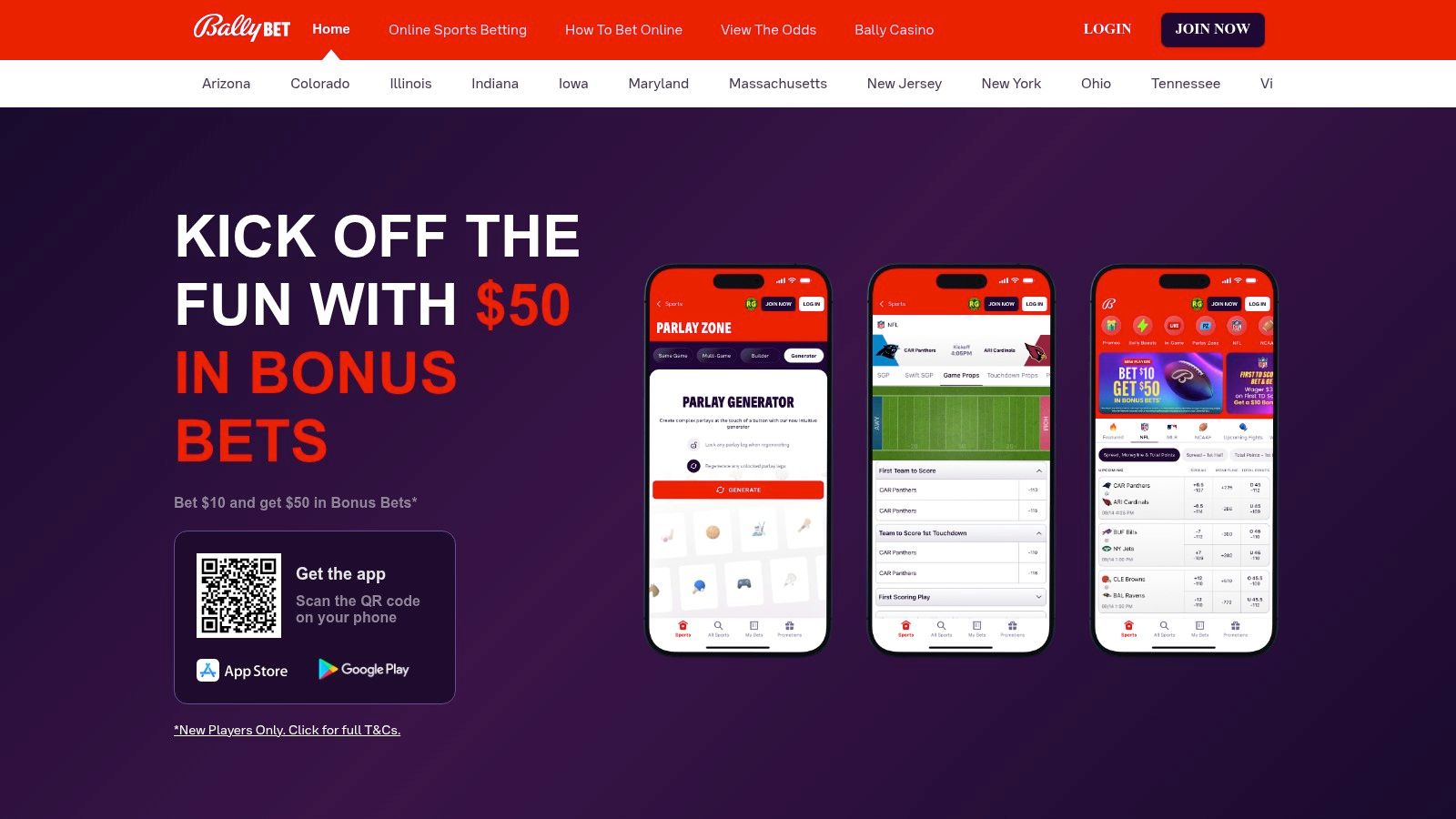
That keeps it lower in this ranking. Brand familiarity does not translate into program terms, and state-by-state availability decides whether the audience you propose is commercially relevant at all.
Establish Access Before Forecasting Revenue
Open with access, not economics. The first discussion should establish whether Bally Bet currently accepts the proposed partnership type. Only then should the conversation move to compensation, tracking, creative approvals, and placement permissions.
- Potential benefit: A recognizable sports-entertainment brand may suit a relevant American sports property.
- Access limitation: Commercial participation may require direct outreach rather than portal enrollment.
- Planning risk: Unconfirmed availability can leave purchased inventory without an approved destination.
For a direct media proposal, make traffic-quality evidence part of the package. Show how you validate audience geography, screen out automated or suspicious activity, and retain placement evidence the brand can audit after delivery.
A social campaign needs controls built for its own environment rather than borrowed certification claims. Expect a state-licensed wagering brand to ask where impressions ran, which states the audience came from, and how invalid traffic was filtered before it approves creative.
Bally Bet is an outreach prospect. Keep it out of a revenue forecast until an agreement exists.
10. Fanatics Partner Network
Fanatics is the non-wagering alternative, not a sportsbook referral program. The Fanatics affiliate program monetizes licensed sports merchandise through product feeds, deep links, offers, promotional creative, and Impact-based tracking.
That makes it useful for sports publishers who want another destination for audiences or placements that aren't suitable for wagering promotions. It doesn't pay for sportsbook referrals, and its merchandise economics shouldn't be evaluated against a betting acquisition payout.
Use Merchandise as a Separate Revenue Stream
Match the product to the content. A team-focused article or game-reaction post may support a relevant merchandise destination without introducing a wagering offer that requires a different audience and compliance assessment.
- Advantages: Publicly described affiliate tools, licensed sports products, and a non-gambling monetization route.
- Limitations: Commission rates aren't specified on the program page, and retail conversion behavior differs from sportsbook acquisition.
- Implementation: Use relevant deep links rather than sending every visitor to a generic storefront.
Our explanation of affiliate and network marketing can help distinguish the referral relationship from the distribution structure supporting it.
Fanatics also makes a useful fallback when a sports publisher can't establish wagering eligibility for a particular placement. That doesn't mean every merchandise promotion is automatically suitable; paid-promotion disclosure and truthful creative still matter.
I'd include it alongside sportsbook partners rather than disguise it as one. A clearly separated non-wagering option gives the publisher a usable commercial alternative without confusing readers about the destination or the action that earns commission.
Sports Betting Affiliate Programs Compared on Payout, Rules, and US Fit
| Program | Payout Model | Channel Rules | US Availability | Best For |
|---|---|---|---|---|
| FanDuel Affiliates | Rates not publicly listed | Confirm approved channels and products | State and partner dependent | Sports-focused U.S. audiences |
| BetMGM Partners | CPA or revenue share; rates not public | Approval and signed agreement required; confirm licensing | State and licensing dependent | Publishers seeking multiple BetMGM brands |
| Caesars Digital Affiliates | Rates not generally public | State-specific referral criteria apply | Product availability varies by state | Publishers targeting Caesars and William Hill markets |
| bet365 Partners | Documented payment thresholds; rates not specified here | Approved placements only; programmatic media buying and affiliate networks excluded | Approved jurisdictions only | Owned-and-operated sites and approved placements |
| Hard Rock Bet | Terms and payouts not publicly detailed | Affiliate or influencer application; approval not guaranteed | Sportsbook availability varies by state | Sports-focused creators and social accounts |
| Rush Affiliates | No universal public rate listed | Confirm permitted channels and current onboarding | Brand and product availability varies by state | Publishers seeking access to multiple operator brands |
| Betr Partner Program | Commercial terms discussed directly; rates not public | Application and approval required | Product eligibility varies by state | Sports creators seeking direct partnerships |
| Underdog Partner Program | Bespoke terms; no public commission table | Direct contact; not a self-serve sign-up | Product and regulatory status vary by market | Sports creators seeking negotiated partnerships |
| Bally Bet | No verified public commission schedule | Direct outreach may be required | Availability varies by state | Sports publishers exploring direct partnerships |
| Fanatics Partner Network | Affiliate commissions; rates not specified | Product links, feeds, and promotions for merchandise | U.S. merchandise affiliate program | Sports publishers seeking non-gambling monetization |
Build a Brand-Safe US Sports Affiliate Stack
Choose one primary sportsbook partner, a backup with broader coverage across your target states, and a non-wagering option for audience segments you can't legally monetize through betting. Broader coverage must be demonstrated against your actual audience map, not inferred from a national brand name. Keep each partner's permitted products, states, creatives, and channels separate in the approval register.
Before launch, run every placement through state eligibility, creative approval, paid-promotion disclosure, and verified-view checks. Assign responsibility for stopping posts, changing captions, and reconciling rejected acquisitions. A shared spreadsheet can hold the first register, but the record needs named owners, dated approvals, and enforceable publishing controls when an operator pulls an offer or narrows a state list.
Separate Distribution From Affiliate Compensation
FindClout fits as a programmatic distribution layer, not a replacement for the operator's affiliate agreement. It curates high-reach American creator pages, hand-picks pages for each brand, and supports regulated categories with brand controls, fraud screening, and real-time review of submissions at billions-of-views scale.
That scale only helps when the operator permits the channel. Campaign rules can require captions and keywords, prohibit claims, set targeting and exclusions, and reject unpaid posts that break them. Creators still have to disclose paid promotion, and the operator still decides whether programmatic creator distribution is allowed for the product, state, and offer.
- Approval ownership: The operator must authorize the product, geography, offer, and distribution method.
- Delivery evidence: Preserve creator identity, approved creative, publication records, and audience-quality information.
- Commercial reconciliation: Connect traffic to the operator-defined qualifying event and account for rejected or reversed acquisitions.
Measure What the Contract Actually Pays For
Use verified attention to evaluate delivery, then use eligible visits, accepted registrations, qualifying deposits, and retained customer value to evaluate acquisition. Low-cost views are not payable conversions. Keep creator and state identifiers intact so you can isolate a weak placement instead of shutting down an otherwise useful source.
Promotional conditions deserve the same care as placement controls. A writer can learn the arithmetic behind understanding bonus playthrough conditions, but the actual offer language must come from the relevant U.S. operator's approved terms. Never import another market's bonus language into American creative.
Start with a controlled campaign and expand only after delivery, compliance, and payable conversions reconcile. The best sports betting affiliate programs are the ones your team can operate safely, with clear permissions, usable reporting, and audiences the operator can legally serve.
FindClout offers curated American sports-page distribution, verified-view buying, and real-time submission review for brands that need scale without surrendering placement control. Visit FindClout with your target states, operator-approved creative, and permitted channels to scope a brand-safe sports campaign.
Want this audience for your brand?
FindClout puts your brand in front of verified American audiences across every major US page — brand-safe, at scale.
Start Your CampaignWant this working for your brand?
FindClout puts your brand inside the feeds your audience already scrolls, and you pay for verified views. Talk to us for a plan and a quote.
Book a call