 findclout.com
Social Media Brand Deals Explained for 2026
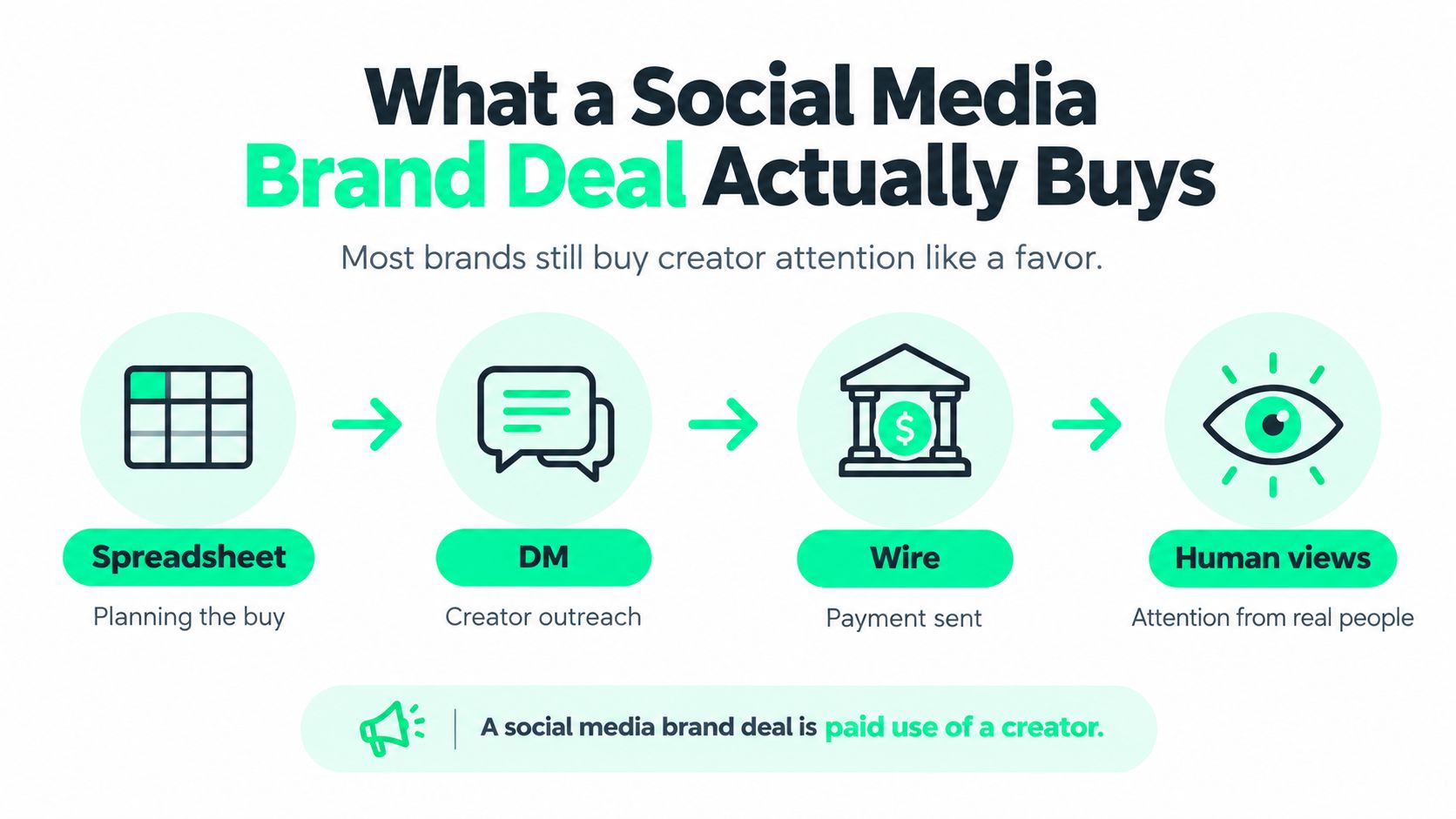
Most brands still buy creator attention like a favor: a spreadsheet, a DM, a wire transfer, then a hope that the views are human. The surprising part is how much money now moves through that informal-looking process. The buying problem isn't finding a creator; it's making sure each placement reaches the right people and stays safe for the brand.
Table of Contents
- What a Social Media Brand Deal Actually Buys
- Deal Structures and US Price Ranges
- How the Deal Runs for Both Sides
- Brand Safety and Tier 1 American Reach
- Metrics That Separate Real Attention from Noise
- What to Lock Before You Sign
- When a One-Off Loses to a Repeat Buy
What a Social Media Brand Deal Actually Buys
Say a U.S. app wants to launch a feature with a meme page whose audience follows sports and gaming. A buyer messages the page, agrees on a post, sends payment, and waits. The post gets views, but the buyer can't tell which were American, whether they were genuine, or if the final caption stayed on brief. That's not a reliable media buy. It's a bet.
A social media brand deal is paid use of a creator, meme page, or clip account to put a brand message in front of an audience the brand doesn't own. What the advertiser buys is attention in a particular context, not a slot in an auction. The creator sells time, voice, and access to followers; the advertiser pays for reach, credibility, or a moment that puts a product in front of the right audience.
The channel has moved well beyond the occasional product mention. The Interactive Advertising Bureau's creator ad spending report says U.S. creator ad spending reached $29.5 billion in 2024, more than double the $13.9 billion recorded in 2021. The IAB projected spending to reach $37 billion in 2025, with growth nearly four times faster than the projected growth of the overall media industry. Those figures describe the broader U.S. creator advertising economy, not any one vendor's performance or pricing.
That scale makes a messy buying process more expensive to ignore. A brand needs a way to set the audience, approve the actual post, check delivery, and remove a placement that drifts. A creator needs a clear brief, workable creative rules, and payment tied to what the deal promises.
The standard throughout this guide is simple: views count when they reach high-quality U.S. geographies and survive brand-safety review. The next decision is which deal structure buys that attention without turning a small test into an open-ended bill.
Deal Structures and US Price Ranges
The buying unit determines what the fee secures. A flat fee buys a defined deliverable; an affiliate deal ties payment to tracked sales; verified-view distribution charges for qualifying views at a CPM set in advance.
| Structure | How you pay | Typical US range | Fits when |
|---|---|---|---|
| Gifted or seeded product | Product value, with little or no cash | Product cost only, sometimes a small fee | You're testing fit before a paid buy |
| Flat-fee feed post | One post or a small package | Nano and micro creators: about $50 to $1,000 per post; mid-tier creators: about $1,000 to $10,000; macro or celebrity posts: $10,000 to six figures | You want one known creator and a set deliverable |
| Usage rights or whitelisting | Add-on to the content fee | Commonly 20% to 50% or more | You'll run the post as a paid ad |
| Affiliate or CPA | Commission on tracked sales | Often 10% to 30% of revenue, sometimes plus a small flat fee | Sales matter more than awareness |
| Ambassador retainer | Monthly fee for a set number of posts | Often $1,000 to $10,000 a month for micro to mid creators | You need repeat presence in one voice |
| Programmatic verified-view distribution | CPM on counted views across many pages | $0.20 CPM for network-wide logo and caption placement; $0.25 CPM for placement scoped to one vertical | You need scale and a set CPM |
Match the price to the job
Gifted product can test whether a creator can make an item fit their style. It does not guarantee a post, a particular audience, or a view count.
A flat fee buys an agreed deliverable, not a business result. If you plan to run the post as an ad, negotiate usage rights and whitelisting separately. State any exclusivity requirement in the deal.
Affiliate or CPA deals tie more of the payment to tracked sales. They suit products with a clear purchase path, but may pay little for awareness that does not convert immediately. Retainers fit campaigns where repeated presence and a consistent voice matter more than one burst.
Programmatic distribution changes the buying unit from a post on one account to views across selected pages. FindClout's product-placement rates have a $0.20 CPM ceiling for network-wide placement and a $0.25 CPM ceiling for placement within one vertical. Compare those terms with average influencer-marketing CPMs, and use pricing guidance for first brand deals to put creator fees in context.
Many brands favor micro- and mid-tier creators for the middle of the price range. Choose the payment structure before adding usage rights, exclusivity, or paid-media requirements. Each changes what the fee buys.
How the Deal Runs for Both Sides
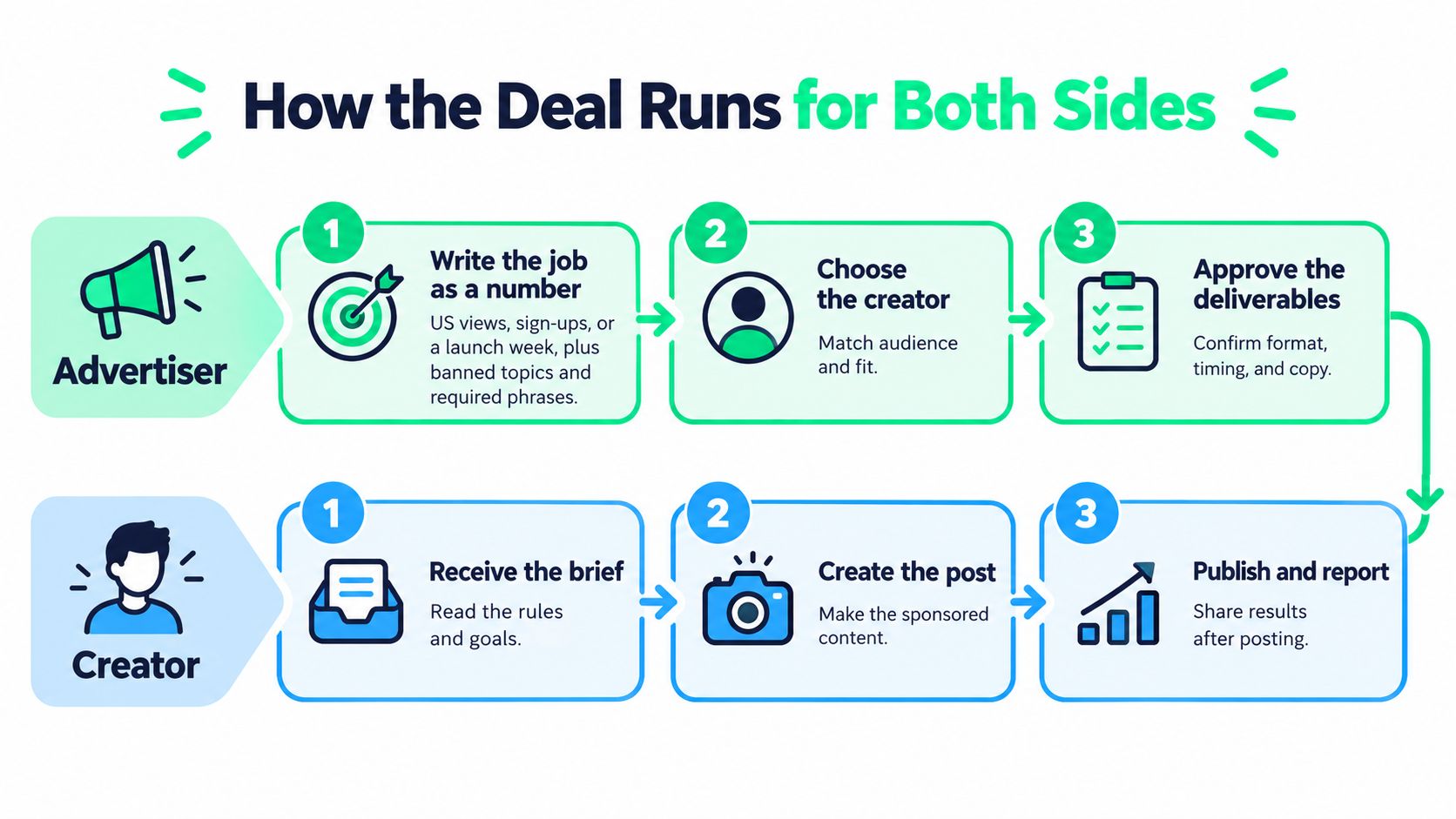
A brand deal should run like a relay. Each handoff has a named owner, a defined deliverable, and a check before the next person moves.
Advertiser steps
Write the job as a number. Set a goal such as U.S. views, sign-ups, or a launch week, then list banned topics and required phrases. A specific job lets you choose a buying structure instead of shopping random profiles.
Choose the structure. Use the price menu to decide whether you need a flat-fee post, a performance-based deal, or verified-view distribution. That choice sets what the creator or network must deliver.
Select pages for audience fit. Hand-pick pages that match the intended audience, such as U.S. sports, gaming, finance, or culture pages. Broad outreach can bring volume without delivering a useful audience.
Approve the actual post. Review the native clip, caption, card, or carousel that will publish, including its wording and visual treatment. A general idea isn't enough to catch an off-brief edit.
Monitor and act. Track delivery while posts are live, and pull a page that drifts from the approved brief. A rule nobody enforces is just a suggestion.
Creator steps
Apply with audience proof. Share the handle, audience details, and evidence that followers are genuine and mostly American. The buyer needs to judge the page that will publish.
Publish the approved version. Use the accepted creative and include the required paid-promotion label. Don't rewrite a product claim or remove disclosure on the way to posting.
Get paid against the agreed measure. Payment should follow approved posts and the deal's stated metric, not a promised follower count. That keeps both sides clear about what qualifies.
Think of the operation as a broadcast control room: one operator routes the same approved message across many screens instead of letting every screen negotiate its own script. The old craft model resets each campaign in DMs, then leaves the buyer unable to say which handle produced the views.
The 2024 Decoding Brand Deals report from AIC, Canopy for Creators, and HypeAuditor found that 54.5% of surveyed creators primarily used social-media brand marketplaces such as Instagram, TikTok, or YouTube to secure collaborations. Marketplaces can help people find one another, but discovery doesn't itself standardize approval, trafficking, or reporting. Without central operations, those handoffs stay inconsistent, and the next risk isn't finding pages. It's keeping every submission on-brand.
Brand Safety and Tier 1 American Reach
Undisclosed or off-brief posts make a scaled buy unusable. Treat each placement as inventory that needs an audience fit, a review, and a clear paid-promotion label.
An analysis of more than 300,000 promoted posts found that 29% of Instagram sponsored posts, 42% of YouTube posts, and 52% of TikTok posts were properly disclosed, according to TubeFilter's coverage of the report. It also found that 61% of Instagram sponsored posts lacked a visible disclosure label. A reminder to add a hashtag cannot replace placement-level controls.
Review the actual post before it goes live, then keep a record of what ran. Platform labels can help, but captions may change and content can be reposted. Approval needs to cover the final version.
- Approve the look and copy first. Nothing goes live until the brand signs off on the look, whether it's a native clip, caption, tweet card, or carousel.
- Put disclosure beside the endorsement. Every brief should require clear paid-promotion disclosure, such as #ad, and creators are contractually responsible for including it.
- Check that claims have support. Captions should not imply results the advertiser cannot prove or describe a creator's personal experience without a basis.
- Save evidence by page and version. Keep the approved creative and published version so edits, reposts, and missed labels are easy to identify.
- Remove violations quickly. Brands can remove an off-brand post or creator from the campaign dashboard in one click.
Disclosure belongs in the media spec, not in a reminder someone may miss.
The FTC's updated Endorsement Guides explain that a material connection may create disclosure obligations for both the brand and the endorser. Payment and free or discounted products are examples. A platform's built-in label may not make the relationship clear enough to viewers.
Geography and suitability shape the buy too. Set audience filters, minimum follower thresholds, and topic exclusions before placement. A sports post with strong reach still misses the brief if its audience is outside the target market or the content appears beside a prohibited topic.
Large-scale programmatic buying can use explicit suitability metrics, such as defined exclusions and review rules. Those rules do not certify every social page. Pair automated scoring with human review of each submission, and track compliance by page, placement, and creative version. Writing effective brand safety guidelines can help turn broad exclusions into rules a team can enforce. FindClout's social media brand safety approach also explains how brand controls fit into campaign operations.
Metrics That Separate Real Attention from Noise
Buy verified U.S. views, not a screenshot of a platform counter. Before a campaign starts, define the invalid-traffic filter, the geographic cut, and the placement-level records the report must include.
The Media Rating Council's invalid-traffic guidance covers the detection and filtration of invalid activity across impressions, clicks, video, reach, and viewable impressions. A view-based deal should state how that filter is applied, then report the result consistently.
| Metric | What it proves | If you skip it |
|---|---|---|
| Verified views after invalid-traffic filters | Attention that passed a stated fraud screen | You pay platform counters that include bots |
| U.S. or tier-1 geo share | Views landed in the audiences you sell to | Cheap global virality dilutes the buy |
| Disclosure compliance by page and version | The paid relationship was conspicuous | A campaign average hides unlabeled posts |
| Saves, shares, qualified clicks | People accepted the ad, not just a like | Likes are the easiest number to fake |
| Aided recall and negative-feedback rate | The brand was remembered without a backlash | CPM looks fine while trust drops |
| Assisted conversions over an extended window | Demand that last-click never sees | A reach deal gets killed too early |
A view that can't be split by country, page, and creative version is a receipt for spend, not proof of attention.
Read engagement without rewarding concealment
Explicit disclosure isn't automatically an engagement penalty. Field studies of sponsored Instagram content have found that clear sponsorship labels can hold engagement at or near the level of unlabeled posts, so concealment buys you little and risks everything. The honest comparison is a disclosed sponsored post against the creator's own organic baseline, judged on authenticity and interaction quality.
Read saves, shares, qualified clicks, and comment tone alongside views. Likes alone don't tell you whether the audience understood the offer, trusted the placement, or took an action that matters. When you need to tie those signals back to spend, track advertising returns with Wojo Media before judging the buy on engagement alone.
Leave the measurement window open. Some conversions from creator ads surface well after the exposure that caused them, and last-click attribution writes that demand off entirely. Check disclosure compliance while the campaign is still live, when an unlabeled post can still be corrected or pulled. Reject any report that can't split views by country, page, and creative version.
What to Lock Before You Sign
A short agreement can still prevent expensive confusion. Mark it up in the order the campaign will be bought, published, measured, and corrected.
Name the deliverable. Specify a count of approved posts or verified U.S. views, not a follower total. State clearly that pending or rejected posts aren't billable.
Make disclosure part of the creative spec. Require clear paid-partnership wording beside the endorsement, and make it stay in place if the caption is edited. The FTC's social-media disclosure guidance explains that material connections should be disclosed where viewers will see the endorsement.
Separate the add-ons. Price usage rights, whitelisting, and exclusivity separately from the content fee. Define any exclusivity by product category and duration, so the creator knows what they're agreeing not to promote.
Set a removal right and response window. State what happens when a page leaves the approved topic or no longer meets the U.S. audience requirement. Give the brand a defined time to request a takedown.
Tie payment to the structure. A flat fee can be tied to approval; an affiliate deal should define tracked revenue and commission; a CPM deal should count only views that pass the agreed invalid-traffic filter and geographic cut.
Limit claims to what the brand can substantiate. Captions shouldn't invent results, and a meme edit shouldn't imply that a creator used the product when they haven't. Approval needs to cover the final wording, not just a creative concept.
A lower fee that leaves out usage, exclusivity, or removal rights can become the expensive contract when the post is already live and can't be pulled. Use a social-media influencer contract template guide as a starting point, then make the actual deliverables, approvals, and remedies specific to the campaign.
When a One-Off Loses to a Repeat Buy
A one-off can be the right buy. It's a poor default for every product. Start with what the campaign needs: a concentrated burst of attention, or repeated exposure in a context the audience trusts.
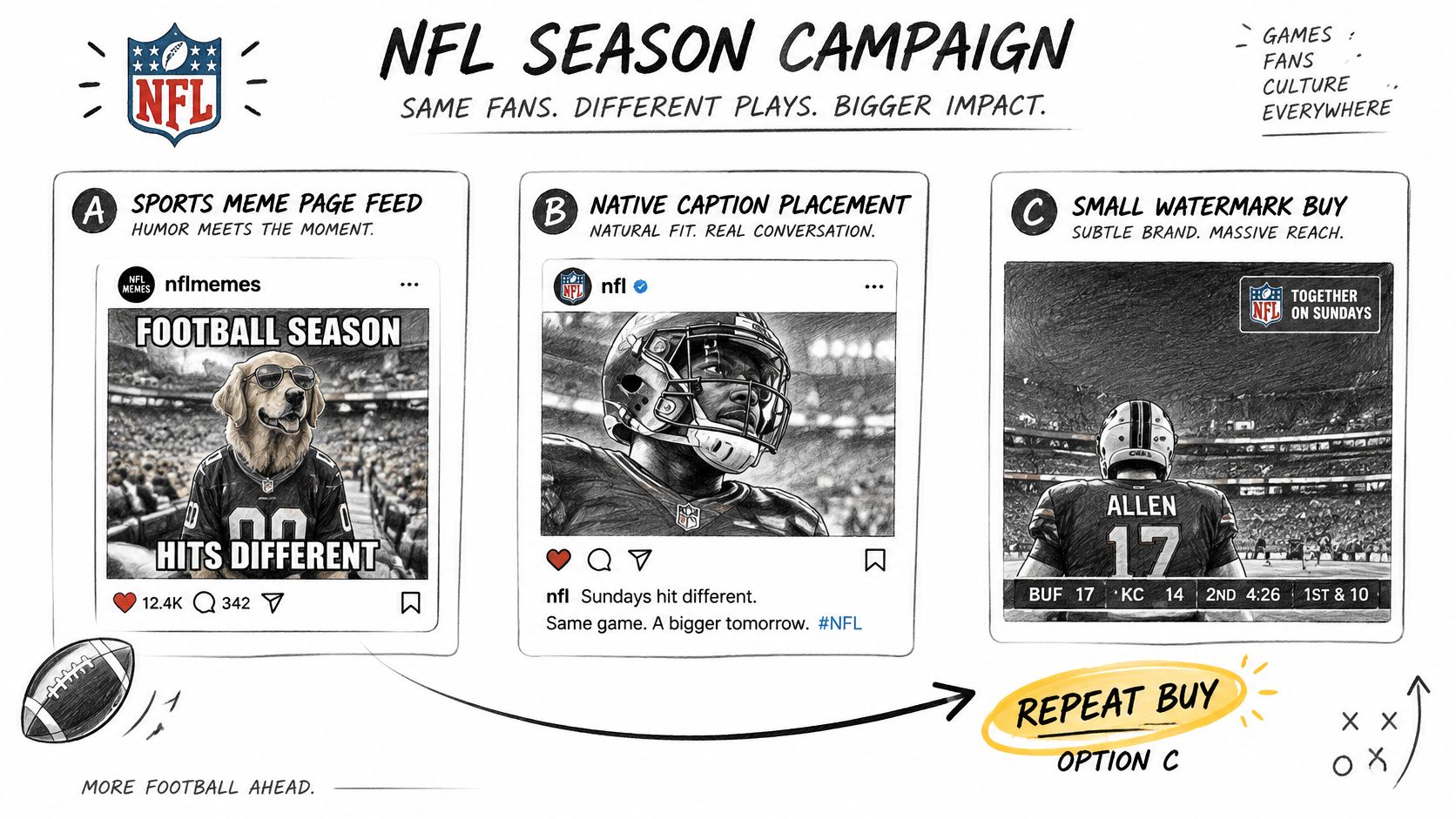
A sportsbook or prediction-market brand running around NFL weeks may want a native caption or watermark on U.S. sports meme pages. The fit is timely and the message can sit inside a familiar content format, so programmatic verified-view distribution suits the job better than an explainer that interrupts the joke.
A consumer app launching a feature might choose one flat-fee post from a creator whose audience already understands the category. But one-offs dominate many partnerships: a 2026 analysis found they represented 68.5% of Instagram partnerships and 71.8% of TikTok partnerships, while YouTube partnerships averaged 13.5 months and a 50.9% repeat-collaboration rate, according to Net Influencer's coverage of the analysis. If the product needs a habit, a retainer with the same pages can be more useful than judging the campaign on day-one CPA.
A regulated brand should use meme distribution only with pre-approved variations, U.S. audience filters, and a clear removal path if a page drifts. That's not a reason to avoid the format; it's a reason to treat the placements as controlled inventory rather than loose endorsements.
Choose reach, repetition, or a split test
Buy guaranteed verified reach for awareness, a launch week, or a countable sports calendar. Favor repeated placements for fintech, gaming, sports betting, prediction markets, and other decisions that take more than one encounter. Measure branded search, direct traffic, assisted conversions, new-customer rate, and, when possible, compare against a geographic or audience holdout.
If both reach and repetition matter, split the budget and compare cohorts. FindClout sets the CPM up front and sells on views, with a $0.20 CPM ceiling for network-wide meme, news, and sports clip placement and a $0.25 CPM ceiling for a campaign scoped to one sports or finance vertical. A brand supplies its budget and goal, such as reach, sign-ups, or a launch moment, and receives a plan with a guaranteed view number.
For a campaign that needs high-quality American reach, approved creative, and brand-safety controls across multiple pages, start with a clear goal and a measurable view target. Visit FindClout to get a campaign plan built around your audience, format, and review requirements.
Want this audience for your brand?
FindClout puts your brand in front of verified American audiences across every major US page — brand-safe, at scale.
Start Your Campaign