 findclout.com
Social Media Brand Awareness Campaigns in 2026
A million views can make a campaign report look impressive while teaching almost nobody in the market that matters who the brand is. The popular advice to maximize reach first and sort out quality later gets the job backward: a view count is an awareness input, not an awareness outcome. For social media brand awareness campaigns, the valuable question isn't just how many people saw the post. It's whether the right American audience saw it, understood the brand cue, and remembered it.
Reach is not the same as recognition
Say a new consumer app wants to become familiar to American sports fans. A conversion campaign asks viewers to install the app now. An awareness campaign introduces the name and gives later ads, search results, and product pages something familiar to build on. The difference is like a stadium: awareness helps the crowd learn the team's name; performance marketing works the ticket window.
Social media can distribute that introduction at remarkable scale. DataReportal's October 2025 analysis estimated 5.66 billion active social-media user identities worldwide, equal to 68.7% of the global population. The figure rose by 259 million identities, or 4.8%, in the preceding twelve months. DataReportal also projected global social-media advertising expenditure of approximately $277 billion in 2025, up 13.6% year over year.
Those numbers describe global potential, not the number of American buyers a campaign will reach. “User identities” don't necessarily represent unique people, and platform advertising reach is potential exposure, not a guarantee that every person saw an ad. The same global data reported advertising reach of about 2.77 billion users on YouTube, 2.33 billion on TikTok, 2.32 billion on Facebook, and 1.96 billion on Instagram. Don't add those audiences together: people commonly use multiple platforms.

Buy audience quality, not the cheapest geography
For a growth marketer, a view from a likely American buyer isn't interchangeable with a view purchased wherever the auction is cheapest. A campaign built around American sports culture should prioritize relevant U.S. viewers, not global totals that obscure where attention came from. Measure geography, deduplicated reach, frequency, and brand recall alongside delivery.
The execution matters, too. A practical overview of the moving parts in a coordinated social campaign is available in Bulk Image Generation's campaign guide. Use a campaign structure that gives every placement a defined audience and a consistent brand cue, rather than scattering posts across pages and hoping the reach adds up.
Buyer's test: If the report can't distinguish U.S. audience quality from worldwide views, the headline number isn't enough to call the campaign a win.
Table of Contents
- Reach is not the same as recognition
- Buy audience quality, not the cheapest geography
- When to Run Awareness and Which KPI Counts
- A Targeting Framework Built for American Reach
- Channels, Formats, and Feed Patterns That Teach the Brand
- Brand Safety That Survives Billions of Views
- Budget Benchmarks and Optimization Tactics
- Prove the Lift Before You Scale Spend
When to Run Awareness and Which KPI Counts
Many teams say awareness is the objective, then judge performance by the easiest number on the dashboard. That creates a flattering report, not proof that people learned the brand. HubSpot's social-media marketing report says 59% of social-media teams identified brand awareness as their top goal in 2026, while 56% reported using social listening to track it. Use the table to choose the job first, then reject the metric that can look good without proving the job was done.
| Campaign job | Use it when | Primary KPI | False success signal |
|---|---|---|---|
| Cold launch | New name and almost no branded search | Aided or unaided awareness lift | Cheap CPM alone |
| Category education | Only insiders understand the product | Ad recall and correct association | Engagement rate |
| Cultural presence | Brand must appear inside a U.S. ritual such as weekly sports | Niche share of voice plus recall | Follower growth |
| Always-on salience | Brand is known but easy to forget | Frequency-capped reach and branded search | Raw view totals |
| Regulated offer | Betting, prediction markets, fintech, or health | Brand-safe verified U.S. reach and compliant recall | Unreviewed viral clips |
Match the evidence to the job
Cold launch. When few people search for the name, low CPM tells you the media was cheap, not that the name stuck. Measure aided or unaided awareness against a holdout; treat branded search as a useful accompanying demand signal, not a replacement for the memory test.
Category education. If newcomers can't explain what the product does, optimize for correct association and ad recall. A busy comment thread can still leave viewers with the wrong idea, so review what people remember, not just whether they reacted.
Cultural presence. When a brand needs to feel at home in a recurring U.S. sports ritual, look at recall and its share of voice within the relevant niche. Follower growth can come from people who aren't prospective customers.
For ongoing salience, cap frequency and watch branded search so repeat exposure doesn't masquerade as fresh reach. For regulated offers, prioritize verified U.S. geography, suitable placements, and compliant recall. A viral clip that hasn't passed review isn't a safe shortcut.
Marketers tracking reputation across multiple signals may find Sift AI's reputation monitoring framework for enterprise teams useful alongside campaign-specific measurement. But a social listening tool or a view report alone won't tell you whether the campaign caused awareness. Use an exposed-versus-control test, a survey panel, a geographic holdout, or another credible incrementality design. Pick the KPI before buying the media, and require evidence that matches the campaign's job.
A Targeting Framework Built for American Reach
Treat attention like routed infrastructure, not a pile of creators found in DMs. Build the targeting brief in order, starting with country. An interest stack can make a campaign look specific while the audience remains geographically wrong.
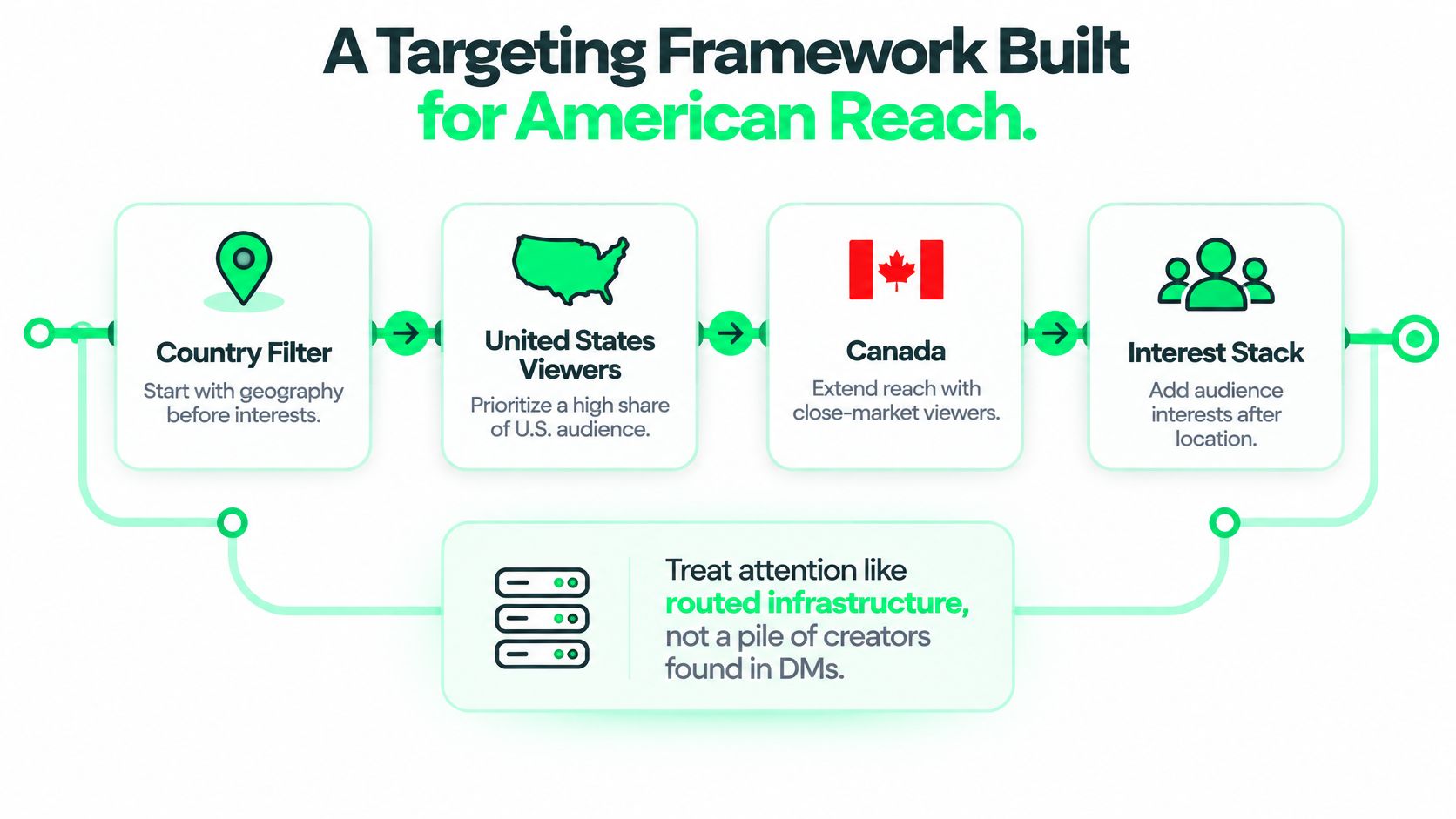
Route the audience through five filters
Set the country rule first. Make tier-one U.S. viewers the core of the buy. Add Canada or the U.K. only if the offer, market, and applicable rules make those audiences appropriate. Don't let a global view total hide a weak U.S. share.
Choose the audience ritual. Pick the recurring interest, conversation, or moment that gives your brand a natural reason to appear. American sports is a strong example: NFL content offers a repeated weekly context, and sports audiences may also be relevant to gaming, sportsbooks, and prediction markets. Relevance still needs to be verified at the page level.
Write the placement rules. Specify the topics and claims the brand can't appear beside, the language a post must include, and which placements need escalation. Define minimum audience and authenticity standards before selecting pages, rather than judging them by follower counts alone.
Set frequency bands. Plan for repeated exposure without mistaking heavy repetition on a small audience for incremental reach. A low cost per view can hide saturation when the same viewers receive the same message again and again.
Protect the measurement. Reserve a suitable holdout group of comparable publishers or geographies before the campaign starts. That gives you a basis for reading incremental lift instead of assigning every later search or visit to the campaign.
For a buyer trafficking a campaign, FindClout's guide to social media audience targeting offers a related view of how audience selection fits into distribution. Apply the same discipline to creator-page buying: ask for audience geography and performance evidence, inspect the content and comment context, then approve or reject the placement against the brief.
The trade-off is clear. A broad, inexpensive audience may deliver more views on paper, but it can dilute the share of attention from American buyers. A tighter U.S. audience can cost more per view while making the exposure more relevant to the brand's actual market. Set that priority before the first post goes live.
Channels, Formats, and Feed Patterns That Teach the Brand
A high view count is an awareness input, not the outcome. The channel and format shape whether people connect a post to the brand, while U.S. audience quality determines whether that reach is useful inventory. Choose feed-native creative, then judge its brand cues and audience fit together.
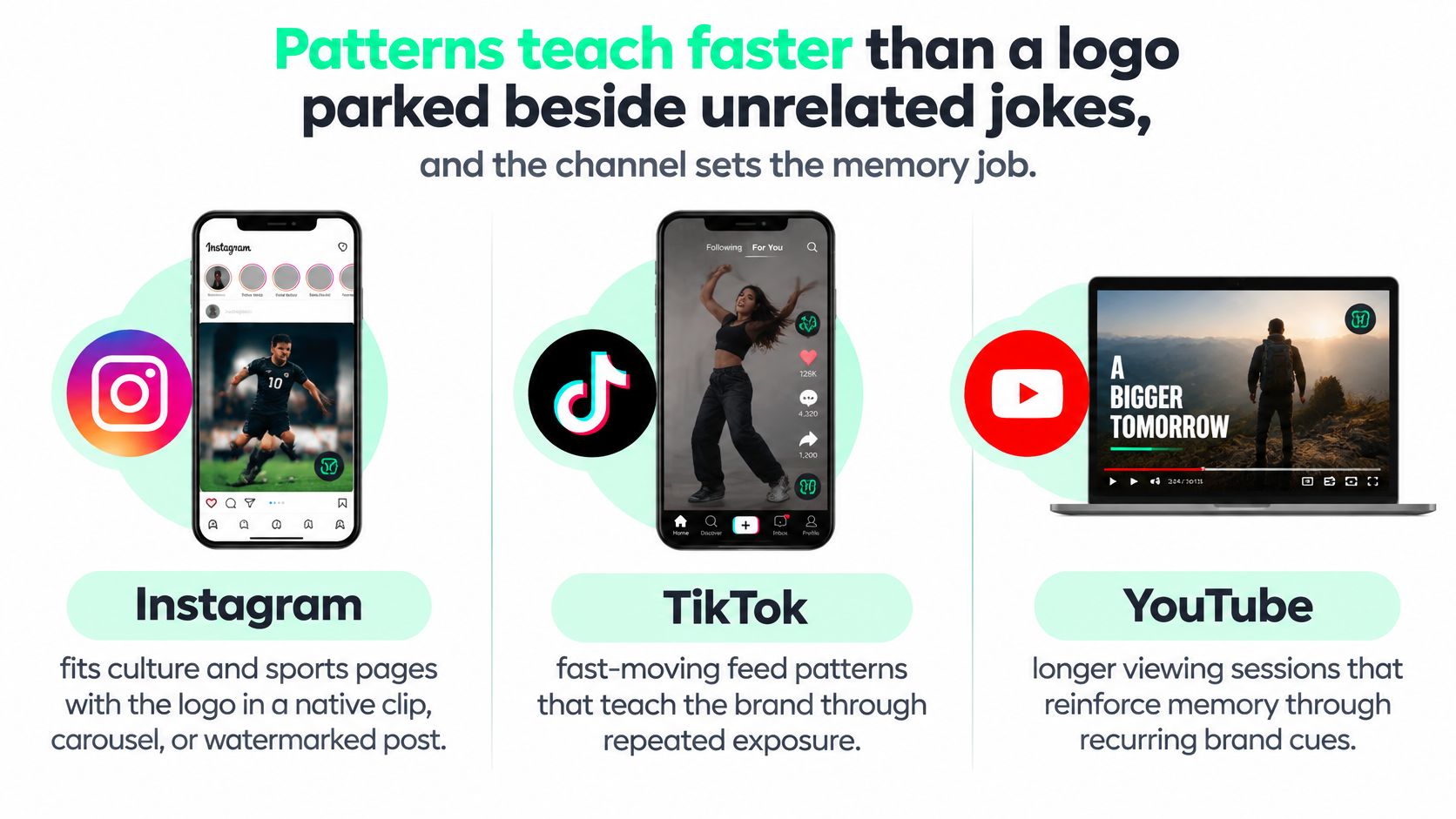
| Channel | Awareness job | Format that fits | U.S. quality check |
|---|---|---|---|
| Build recognition through culture and sports pages | Native clip, carousel, or watermarked meme | Audience country share, not follower count | |
| TikTok | Repeat a cue through jokes and sounds | Short native video with a spoken or on-screen cue | U.S. view share and comment language |
| YouTube | Build memory through longer and searchable content | Shorts plus a pinned explanation | U.S. traffic, not global Shorts spill |
| X | Join live sports and news conversations | Quote card or short post in the thread | U.S. audience profile, not bot replies |
| Reach older buyers through groups and sports pages | Native video and link card | Share of U.S. viewers in the target age band, not page size |
Keep the cue stable and test the context
A global analysis of 235 social-media campaigns for 110 brands found an average 5% lift in saliency metrics, with results ranging from -5% to 30%, according to the Oxford Saïd Business School analysis.pdf). Outcomes ranged below zero, so pre-approval matters for performance as well as safety. The analysis also found that human, emotionally resonant language tended to outperform more functional messaging on awareness-related measures.
Hold the brand cue, offer, and target audience steady. Test different caption frames, emotional triggers, cultural references, or creator contexts, then compare recall or awareness. The logo or call to action should fit a natural social statement, not a sales line bolted onto a post that has nothing to do with the brand. For teams developing assets to support that consistency, premium social media content production is one part of preparing creative that feels at home in the feed.
Three feed patterns to adapt
A fintech launch can join a finance-meme moment with a short, plain-language brand cue. Choose a page whose U.S. audience and comments fit the target customer. A large follower count alone does not establish that fit.
A sports-adjacent app can join a recurring NFL conversation with a native clip or concise caption. Keep the brand recognizable without hijacking the joke, and check the page's U.S. audience and suitability before treating its views as useful inventory.
A consumer marketplace can become part of a page's recurring joke, using the same recognizable cue across varied executions. This can feel more native than a standalone product pitch, provided the audience and context remain appropriate.
Repeatability matters, but a consistent format cannot compensate for poor audience fit. In a 2025 Sprout Social Pulse Survey of marketers, 66% of brands said they used influencer marketing to increase brand awareness, as reported by Marketing Dive. More activity does not guarantee more relevant exposure. Scale a format only after its creative has cleared the audience check and brand review.
Brand Safety That Survives Billions of Views
The difficult safety problem isn't just a forbidden word. A meme can be harmless in isolation and damaging beside a creator's post, a current event, or synthetic content that changes the context. As placements multiply, the buyer needs a process that can catch the post before publication and respond if the context changes afterward.
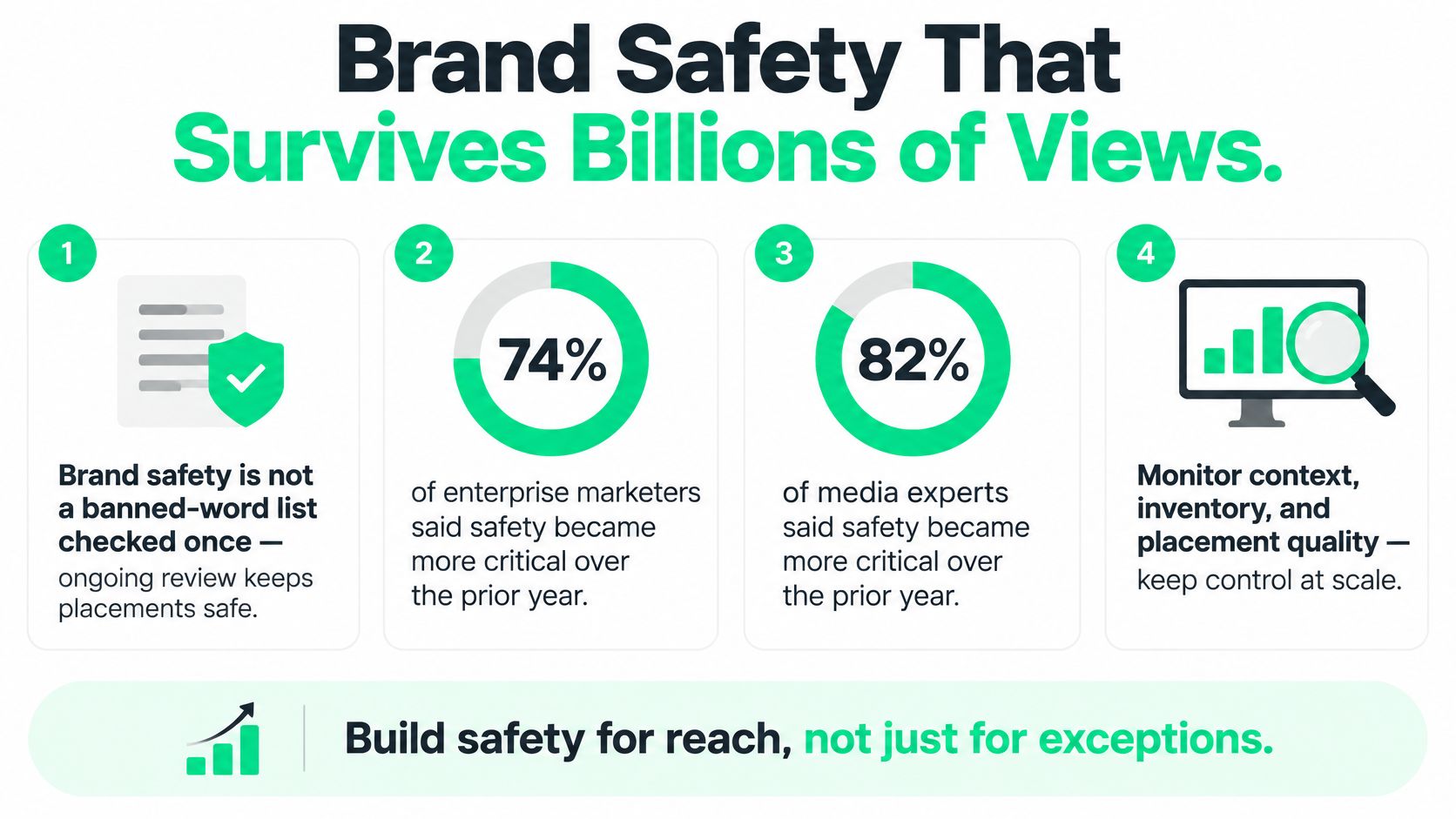
CreatorIQ's brand-safety research found that 74% of enterprise marketers said brand safety became more critical over the prior year. It also found that 82% of media experts said creator or influencer suitability would be important when advertising beside social content, while 69% identified ad-content adjacency as the leading digital-media challenge. Their concerns included deepfakes, AI-generated content, and creator material. These findings point to a practical requirement: review both the creative and the setting in which it appears.
Put controls before, during, and after publication
Start by writing the boundary conditions. List prohibited topics and adjacency rules, required phrases, banned claims, and the cases that need human approval. Then screen both the caption and the visual, and review the creator's history and current content. Automated checks can flag risk, but someone must handle the ambiguous edge cases.
Paid endorsements need a clear disclosure in the endorsement itself. The FTC's Disclosures 101 guidance for social media influencers says a material connection, such as payment or a free or discounted product, must be obvious to consumers, and that responsibility rests with both the brand and the influencer. A platform's disclosure feature shouldn't be treated as a substitute for a clear disclosure alongside the endorsement.
The FTC also says advertisers should educate endorsers, monitor what they do on the marketer's behalf, and take action to remedy noncompliance in its guidance on monitoring influencer disclosures. For a distributed campaign, that means reviewing the proposed post before it goes live and retaining the ability to correct or remove it quickly.
Operating rule: Every placement should have a recorded decision, a named escalation path, and a way to stop the post when it breaks the campaign rules.
At scale, apply that workflow to every account, not just celebrity partnerships. Keep an audit trail showing which version was approved, which rules it passed, and whether a reviewer escalated it. Brand safety doesn't mean risk-free; it means the brand defines acceptable risk and keeps monitoring placements rather than relying on a generic safety label. For more on building those controls into distribution, see FindClout's social media brand-safety guide.
Budget Benchmarks and Optimization Tactics
A budget should follow the awareness job and its measurement plan, not a fixed share of the annual marketing plan. There's no reliable cost benchmark that can replace pricing the actual inventory and testing its audience. Work backward from the reach and evidence you need.
Define the delivery target. Specify unique U.S. reach and a minimum effective frequency. For example, a hypothetical goal could be two million unique viewers with three exposures each. Treat that as a planning assumption, not a universal threshold.
Price relevant inventory. Use a pilot CPM for tier-one U.S. placements. Don't substitute the cheapest global auction rate for an estimate of what qualified American reach will cost.
Protect the test. Reserve comparable publishers or geographies as a holdout before spending, then check that the design can detect a meaningful difference.
Fund test cells properly. Split the remaining budget across creators, topics, and formats, with enough spend in each cell to reach the planned frequency. A cell that barely delivers can't give you a useful read on the creative.
Set readout points. At fixed dates, check deduplicated reach and awareness lift. Move budget from flat cells to positive ones, and pause cells with negative lift rather than rewarding them for being cheap.
For illustrative arithmetic only, six million impressions at an assumed $8 CPM equal $48,000 before holdout costs and fees. The CPM is an example, not a market benchmark. Keep the readout dates in the campaign plan so the team knows when to scale, revise, or stop.
Prove the Lift Before You Scale Spend
Don't scale a flight because its CPM was low. Require a comparison that can distinguish delivered media from incremental memory. Nielsen's analysis of more than 800,000 Facebook users, spanning over 125 campaigns from 70 brand advertisers, found that homepage advertising increased awareness by an average of 4% among exposed users compared with control audiences. When users received both homepage advertising and organic exposure, awareness increased by a 13% delta versus the control group, according to Nielsen's analysis of social advertising and brand awareness.
| Evidence | Proves | Does not prove | Practical read |
|---|---|---|---|
| Verified views | Attention was delivered | People remember the brand | Input only |
| Deduplicated reach | How many different people | They were in the right country | Pair with geo |
| Frequency band | Exposure repeated | More frequency is always better | Cap and test |
| Aided awareness lift | Incremental memory versus holdout | Which line won by itself | Tag each creative cell |
| Branded search or direct traffic | Downstream demand after exposure | Full sales attribution | Directional, with lag |
Read delivery and memory separately
Verified views tell you delivery occurred. Deduplicated reach tells you how many different people received exposure; a frequency band helps show whether that exposure repeated. Neither one proves recall. Use an exposed-versus-control design to test aided awareness, and tag each creative, topic, placement, and geography so the readout can distinguish the cells.
Branded search and direct traffic can indicate downstream demand after exposure, but they don't assign every visit or sale to a single post. Read them as directional signals with an appropriate lag. Compare the results by creator, topic, geography, and frequency band. Shift spend toward cells with positive incremental lift and stop cells that are flat or negative, even when their posts attract shares.
A practical incrementality design should be agreed before launch; FindClout's guide to measuring incrementality provides a starting point for that discussion. A buyer should send a five-point brief before any money is committed:
- View goal and frequency floor. State what counts as delivery and how much repeat exposure the test is meant to evaluate.
- U.S. geography rule. Define the required audience mix and how you'll check it.
- Creative controls. List the approved look, required captions and keywords, and banned claims.
- Holdout group. Specify how the comparison audience will be selected and protected from campaign exposure.
- Readout date. Set the point when delivery, reach, frequency, and lift will be reviewed together.
We require brand sign-off on the look before anything goes live, whether it's a native clip, caption, tweet card, or carousel. Each campaign brief can set rules, required captions and keywords, and banned claims; posts that break them are rejected and not paid. Campaigns go live in days and wrap in 7 to 21 days.
FindClout coordinates branded content across vetted creator pages, with verified views, U.S.-focused audience targeting, and real-time review designed to protect the brand as reach scales. If you're planning a social media brand awareness campaign, visit FindClout to explore a campaign built around your audience, creative rules, and measurement needs.
Want this audience for your brand?
FindClout puts your brand in front of verified American audiences across every major US page — brand-safe, at scale.
Start Your Campaign