 findclout.com
Social Media Advertising Agency: How to Hire
The usual advice for hiring a social media advertising agency is backward: compare portfolios, collect retainers, and pick the team with the best-looking creative. That's how brands end up paying for attractive posts and cheap views that never reach their customers. Start with proof of American viewers and brand-safe delivery, not the presentation.
Treat the agency as attention infrastructure. Its job is to coordinate distribution, review every submission in real time, and preserve audience quality as campaigns scale toward billions of views. A low CPM without US geography, fraud screening, and accountable publication controls isn't a result.
Table of Contents
- Proof Scorecard and Delivery Checks
- Performance KPIs and the Test-and-Prune Loop
- Fee Models From Retainers to Guaranteed Views
- Creator Networks Versus In-House Buying
- Brand Safety Clauses Worth Putting in Writing
- Brief the Pilot and Decide This Week
Proof Scorecard and Delivery Checks
Brands still hire agencies like poster shops, then wonder why inexpensive distribution produces nothing useful. Statista Market Insights projected worldwide social media advertising spending of $276.72 billion in 2025, representing 13.6% year-over-year growth, as reported by Digiday. That global spending total says nothing about whether your campaign reached an American customer.
For US-focused consumer, sports, and performance brands, the purchasing question is narrower: What did we pay for qualified American exposure? Canada and the UK may belong in a broader tier-1 brief, but they aren't substitutes for US viewers when your product serves Americans.
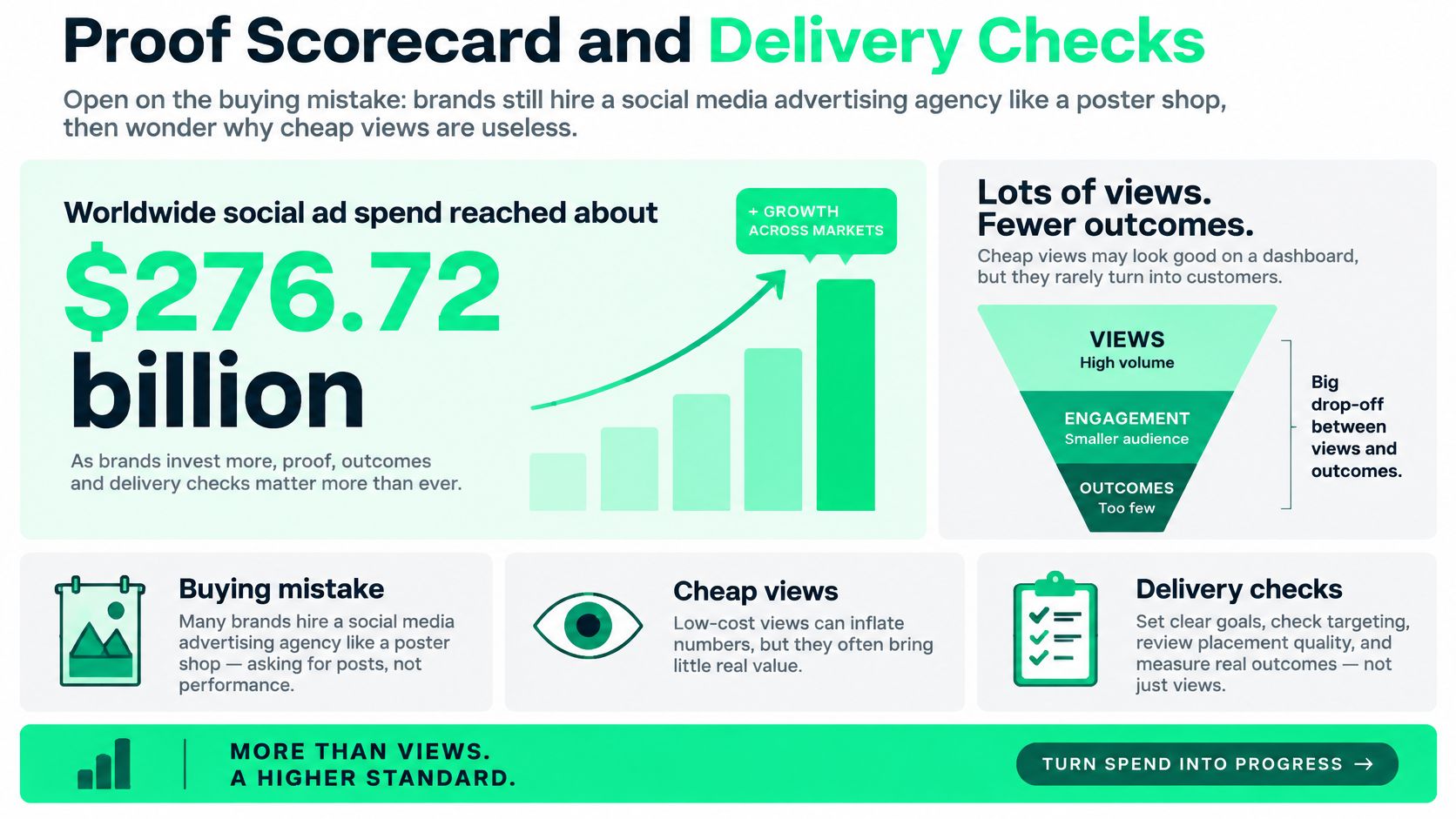
Proof Scorecard for a Social Media Advertising Agency
| Proof layer | Evidence to demand | Fail if |
|---|---|---|
| Verified delivery | Human, deduplicated views with placement logs | Only served impressions or platform screenshots |
| Attention quality | Live, watchable, shareable posts rather than a flicker | Every play counted as equal attention |
| Tier-1 US geography | Audience insights showing US-heavy viewers | Global or low-quality residue sold as reach |
| Brand suitability | Pre-publish review of page, caption, and adjacency | Blacklist-only checks after the post is live |
| Incrementality | Baseline, holdout, or downstream action separate from views | Last-click or raw view totals treated as the result |
Read each row as a purchasing condition, not a reporting preference. An agency that can't explain the evidence on the first call shouldn't receive a budget based on the promise that reporting will improve later.
Delivery Checks That Earn a Pass
Name the buying unit. Qualified views need an explicit definition. Don't let an invoice blend impressions, video starts, unique reach, and completed views into an interchangeable total.
Preserve placement identity. Require stable campaign, page, creative, timestamp, geography, and device identifiers wherever the platform exposes them. Enforce deduplication and document what the agency cannot observe rather than implying that every platform offers user-level certainty.
Filter before pricing. Invalid traffic must leave the denominator before anyone calculates CPM. A discounted price based on contaminated inventory isn't a bargain.
Separate visibility from attention. The IAB/MRC Attention Measurement Guidelines describe minimum viewability thresholds of 50% of pixels in view for one continuous second for display or two seconds for video, alongside advanced invalid-traffic filtration and methodology disclosure. Keep time-in-view separate, and don't present a visibility threshold as proof that someone absorbed the message.
Unbundle the report. Reach, frequency, viewability, engagement, and conversions belong in separate fields. This prevents a low blended CPM from obscuring repeated exposure or weak downstream behavior.
Inspect geography before approval. Require follower-geography screen recordings before admitting a page. At FindClout, creators applying to campaigns submit screen recordings and screenshots of their audience-analytics dashboards, such as Instagram audience insights.
Follower geography is a screening input, not proof of the location of every delivered viewer. Compare that evidence with campaign-level geography where available, and disclose gaps instead of converting follower demographics into a delivery guarantee.
Creative intelligence can support the process without replacing it. AdLibrarySpy's guide to Meta ad research platforms for agencies is useful for organizing competitor-ad research, but an ad library won't verify your creator's audience.
Refusal rule: Follower counts, a blended CPM, or a billion-view promise without geography and safety filters fails the purchase test. Reject any report that labels every video play as viewable human attention.
Performance KPIs and the Test-and-Prune Loop
Choose the outcome before reading the price. An awareness buyer needs qualified exposure; a performance buyer needs evidence that exposure contributes to action. If the agency changes the definition of success after launch, you're buying a narrative rather than a controlled campaign.
Primary KPIs by Campaign Goal
| Goal | Primary KPI | Secondary KPI | Fail if |
|---|---|---|---|
| Awareness | Valid viewable impressions and cost per qualified view | Time-in-view and follower geography share | Raw views without geography proof |
| Direct response | Cost per qualified view and conversion rate | Click-through rate and incremental conversions | Last-click totals treated as results |
| Incrementality test | Incremental conversions against a holdout | Conversion lift by placement | Platform-reported conversions alone |
For direct response, nominate a decision metric rather than treating every column as equally important. Conversion rate diagnoses the response to traffic, while acquisition economics determine whether the campaign deserves more budget. Use this guide to key performance indicators for marketing to align the media buyer and commercial owner before launch.
Run Comparable Placement Tests
Group creators by audience geography, niche, historical reach quality, and creative format. A US sports-highlight page and a global entertainment account shouldn't compete inside an undifferentiated average.
Hold the offer, caption rules, landing destination, and attribution window constant while testing distribution. Launch a pilot broad enough to compare placements, then judge each handle using normalized delivery and response metrics. If you change the offer and page simultaneously, you won't know which caused the difference.
- Prune suspicious delivery. Stop placements with unexplained spikes, anomalous frequency, or missing quality evidence.
- Cut commercially weak traffic. A page that generates plays but no credible downstream behavior shouldn't survive because it makes the dashboard look busy.
- Protect the American segment. Review results by handle and geography before reallocating budget.
The ANA's programmatic transparency study recommends partners that expose viewability, fraud, and brand-safety metrics. Apply that operating principle to creator placements, without pretending that open-web programmatic findings are creator-network benchmarks.
Test Whether Exposure Changed Behavior
Use a holdout or matched comparison when the objective is incremental conversion. Keep unpaid reshares, delayed actions, and branded-search changes visible without automatically crediting all of them to paid distribution.
The IAB's measurement research identifies attribution, incrementality testing, and marketing-mix modeling as central measurement tools while emphasizing foundational gaps. Fix inconsistent identifiers and incomplete outcome collection before commissioning a more elaborate model. More advanced analysis won't repair an unreliable placement ledger.
Fee Models From Retainers to Guaranteed Views
What Each Social Advertising Fee Actually Buys
| Model | Price signal | What the invoice buys | Best fit |
|---|---|---|---|
| Auction paid social | Platform CPM, which can exceed meme-distribution pricing | Skippable in-feed impressions | Direct response with clean tracking |
| Percent-of-spend agency | Written management percentage plus media spend | Buying labor stacked on media | Brands that already own the ad accounts |
| Logo and caption network | $0.20 CPM | Watermark and approved captions on vetted pages | Awareness at very large view counts |
| Vertical product placement | $0.25 CPM ceiling | One niche such as sports or finance | Sportsbooks, prediction markets, fintech |
| Meme content campaign | $1.50–$3.00 CPM | Brand assets turned into native variations | Brands that need the creative made |
| Guaranteed-view pilot | $20,000–$30,000 flat invoice for 100 million guaranteed views | One invoice and a view guarantee | First test before a larger budget |
Compare the invoice, not just the headline CPM. Auction media, agency labor, creative production, and verified-view distribution purchase different things. The useful comparison is total campaign cost against qualified US delivery, followed by the commercial outcome you selected.
Our logo-and-caption format places approved watermarks and captions across vetted pages. Vertical product placement is scoped to one vertical, including sports or finance, rather than promising every audience category under the same ceiling. Meme content campaigns include turning brand assets into native variations.
Separate Labor From Media
A percent-of-spend agency charges for managing the buy in addition to the inventory itself. Put the management percentage, creative charges, reporting obligations, and account ownership in writing. If the management cut isn't disclosed, treat it as unknown, not as an industry average you can safely assume.
Our verified-view model has a 0% management fee, and creators earn based on measured views of qualifying posts rather than a promised follower count. The first campaign uses a flat invoice, which makes the budget boundary explicit. It doesn't remove the need to define which views qualify.
Production costs deserve their own line when they're outside the distribution package. ImagesArt AI's explanation of one-time packs for AI generation provides a useful budgeting comparison for teams separating asset-generation purchases from recurring service fees. Don't confuse a creative-tool purchase with media delivery.
Price Quality Into the Denominator
The ANA's Q4 2025 Programmatic Transparency Benchmark found that advertisers applying stronger quality governance converted 56.7% of programmatic spend into benchmark-qualified impressions, compared with 37.5% among lower-performing advertisers. Those impressions were fraud-free, measurable, viewable, and free of made-for-advertising inventory.
That finding concerns programmatic media, not a promised creator-campaign outcome. Its purchasing lesson is straightforward: cheap inventory and qualified exposure aren't interchangeable.
Our effective CPMs can fall toward $0.05 at higher spend. That is a scale-dependent price signal, not the starting rate for every format, and it doesn't establish a universal comparison with Meta auctions.
Buy the qualified American denominator. A lower global CPM can still mean a more expensive US campaign.
Before approving a quote, require the order to identify included creative, qualifying geography, delivery exclusions, and the remedy for shortfall. Ask the buyer to price a million qualified US views, not just a month of access to an account manager.
Creator Networks Versus In-House Buying
A spreadsheet and a set of creator DMs can manage a few known pages. Scale the same process across many accounts, and every new relationship adds negotiations, approvals, payments, and a reporting format to reconcile. That overhead is a buying problem, not a lack of marketing taste.
For a media buyer, the question is whether a network acts as attention infrastructure: can it coordinate distribution while showing that views reach tier-1 American audiences and that content is reviewed before it goes live? Cheap views without geographic fit or brand-safe execution are not a result.
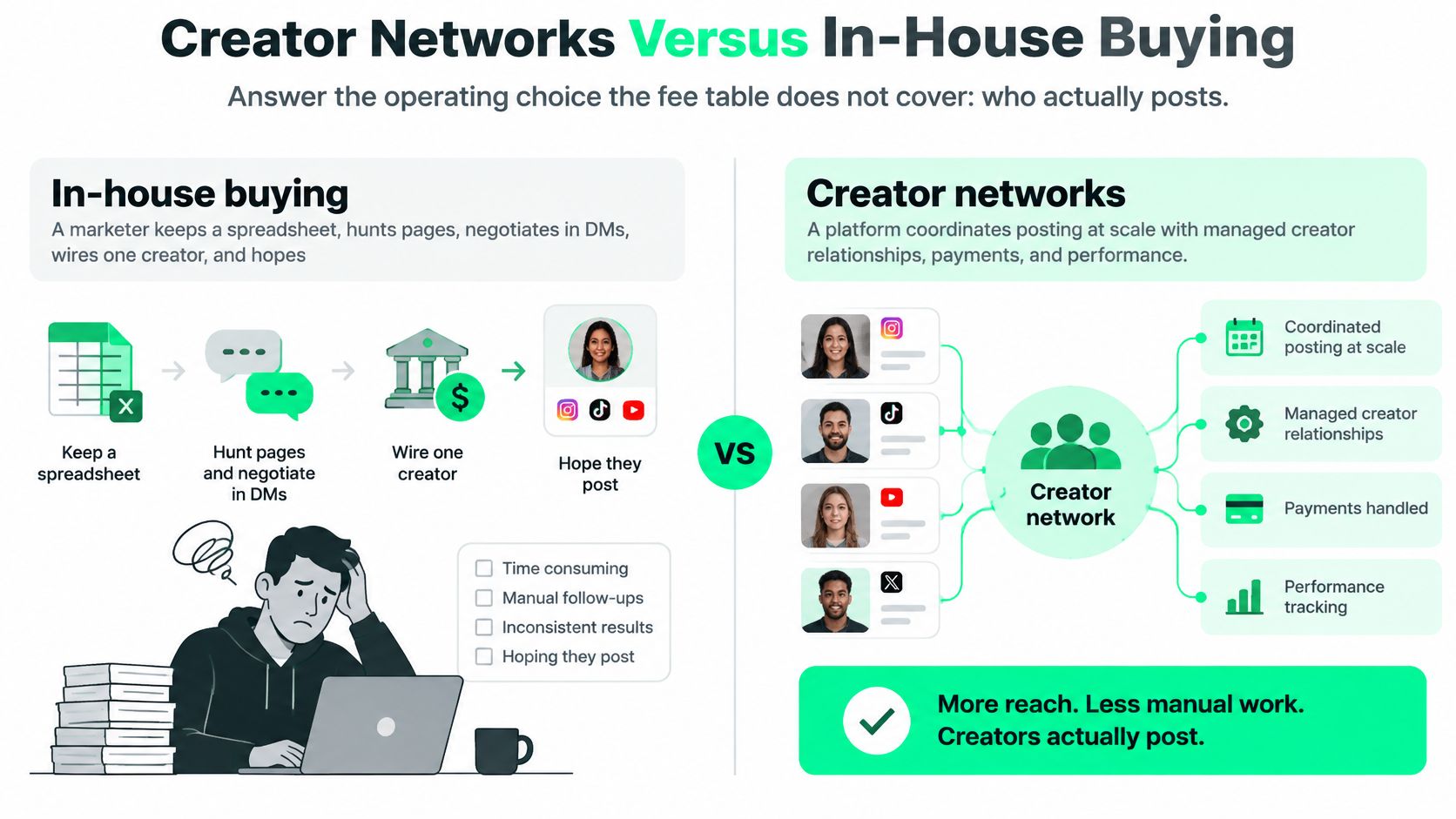
In-House Buying Versus a Curated Creator Network
| Operating fact | In-house buying | Curated creator network |
|---|---|---|
| Time from brief to live | Depends on finding pages and negotiating with each creator | One coordination point across pages in the network |
| Audience and page review | The marketer checks each page | Pages are curated, with audience fit and performance considered |
| Bad page removed | Requires follow-up with the creator | The advertiser can remove a page from the campaign dashboard |
| Approval and execution | Each relationship may use a different process | Distribution and campaign controls are coordinated in one platform |
These are standards to check, not capabilities guaranteed by the word “network.” Ask to see how page selection, approvals, and removal work before committing. A network that cannot explain its controls is only outsourcing the same fragmented buying process.
Who Actually Makes and Publishes the Posts
FindClout coordinates branded meme distribution across a curated network of creator pages. Brands provide commercial direction, including the product, approved assets, audience restrictions, and exclusions. FindClout selects pages and prepares posts, but nothing goes live until the brand approves the look, whether it is a native clip, caption, tweet card, or carousel.
Creators apply to campaigns in the app, publish on their own pages, and earn per verified view. This division reduces the brand's production and trafficking work without removing its approval authority. The coordinated creator network model replaces separate outreach and payment arrangements with a single point of coordination.
American Sports as an Operating Test
An NFL-themed campaign shows why page selection needs more than a broad interest label. An analysis account, a fan-humor page, and a general sports feed can frame the same product differently. For a sportsbook or prediction market, sports interest alone does not establish that a viewer is an eligible customer.
Set audience and location limits, confirm content rights, and apply exclusions that fit the product. A consumer app may use the same sports niche, but it needs its own suitability rules. Ask how those requirements affect placement before distribution starts, and confirm that the brand can remove a page if it no longer fits.
Keep buying in-house when the roster is small and relationships are established. Use coordinated distribution when you need scale, American audience fit, and repeatable brand control.
Brand Safety Clauses Worth Putting in Writing
A profanity blacklist isn't a brand-suitability policy. In IAS's US media-expert research, 87% considered influencer or creator brand safety and suitability essential when advertising adjacent to digital video, while 82% said creator suitability was equally important as social-media adjacency risks increased.
Write the workflow into the agreement. A reassuring sales call won't resolve a dispute over an unsuitable post.
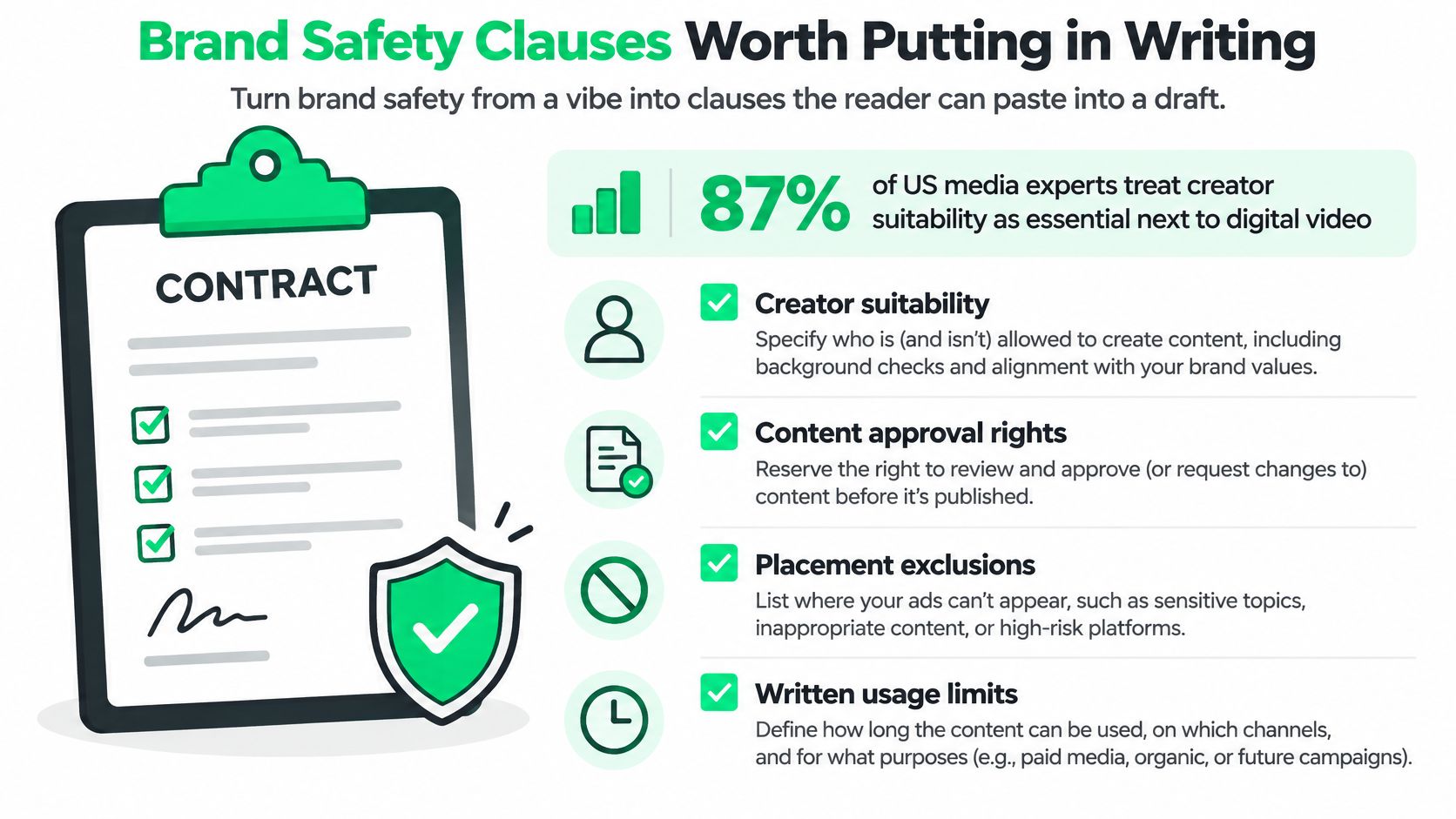
Publication and Review Clauses
- Pre-approval. No campaign content may publish before advertiser approval of the final presentation. Our approval covers the look, whether that's a native clip, caption, tweet card, or carousel.
- Real-time review. Every submission must pass automated scoring and human review before publication, with continued monitoring and re-review after publication. Keep an approval record tied to the final version, not an earlier draft.
- Exclusions. The campaign must enforce prohibited topics, competitor mentions, political restrictions, and excluded niches. Reject variations that technically include the logo but undermine the intended context.
Meta's Advertising Standards describe pre-launch review of creative, targeting, and destinations, usually completed within 24 hours, with ads subject to re-review after publication. That's a useful process reference, not evidence that a creator submission has passed an independent platform safety assessment.
Audience and Remedy Clauses
- Geography. The order must specify the minimum American audience share and the evidence used to assess it. Suspend pages when their audience mix no longer satisfies the agreed rule.
- Takedown. The advertiser must have a direct removal mechanism. Our campaign dashboard lets brands remove a post or creator in one click.
- Guaranteed delivery. Define continued distribution or a make-good when qualifying delivery misses the contracted total. Excluded traffic must not count toward completion.
The ANA's Q3 2025 benchmark found 99.1% of measured programmatic ad spend occurred in low-risk environments. That's not a creator-network guarantee; it supports requiring explicit risk classifications and auditable placement records rather than vague assurances.
Disclosure, Rights, and Accountability
Every brief we issue requires creators to disclose paid promotion, such as with #ad, per FTC guidelines, and creators remain contractually responsible. Keep that responsibility explicit without assuming the contract eliminates the advertiser's own obligations.
Add written usage limits covering approved assets, permissions, edits, and publication contexts. Require disclosure to the advertiser when a variation uses generative AI, and retain a named human approver. Automation should screen and version content, not obscure who authorized it.
Use our guide to brand safety on social media to turn exclusions into an executable campaign brief. Put this purchasing condition above the signature, with the qualifying definitions attached:
No live post without sign-off, and no invoice without US-quality views.
Brief the Pilot and Decide This Week
Don't spend another week assembling a vendor list that measures presentation quality. Send a bounded buying brief and evaluate whether the operator can execute it. A pilot should expose weaknesses in geography, review, reporting, and delivery obligations before you commit to ongoing spend.
A Five-Step Brief You Can Send
Choose one outcome and one geography. Define a verified US-view objective around a product launch or sports moment, or select an incremental conversion objective with an appropriate comparison. Don't leave awareness as an undefined permission to buy anything inexpensive.
Send enforceable campaign rules. Include the offer, banned topics, disclosure requirement, logo treatment, landing destination, and excluded niches. For regulated categories, attach audience eligibility and market restrictions so the operator can reject unsuitable distribution before publication.
Request the decision evidence. Use Tier-1 US geography for audience proof, Brand suitability for the approval path, and Verified delivery for the qualifying-view definition and shortfall remedy. Those named requirements should appear in the order, not disappear into a presentation appendix.
Authorize a bounded pilot. Use the guaranteed-view invoice rather than signing a year-long retainer to discover whether the workflow works. Record acceptance criteria, the reporting owner, and what happens when a placement fails a condition.
Read placement results immediately. Review handles during the first days, remove off-brand distribution, and document why a page is retained or cut. Don't let the team defend an unsuitable placement merely because the campaign total is rising.
Make the Hiring Decision Operational
FindClout fits brands that want programmatic meme distribution across vetted American pages, especially sports, with pay-per-verified-view buying and one point of contact. Consumer apps, fintech teams, prediction markets, and sportsbook marketers can use that model without building a DM-based buying operation themselves.
The distinction is attention to detail at scale: submission-level review, explicit audience restrictions, and traceable execution as distribution grows toward billions of views. Don't accept speed as a reason to suspend those controls.
Attach the proof scorecard to your campaign brief and judge the response against it. Hire the operator who can explain what happens when a page fails, not just what happens when a post performs. The winning proposal should make it possible to inspect, post by post, whether the viewers qualified and the placement protected the brand.
FindClout offers verified-view meme distribution across curated creator pages, with American audience vetting, pre-publication approval, and centralized campaign controls. Visit FindClout with your audience target, exclusions, and proof scorecard to scope a pilot around qualified US attention rather than a monthly retainer.
Want this audience for your brand?
FindClout puts your brand in front of verified American audiences across every major US page — brand-safe, at scale.
Start Your Campaign