 findclout.com
Sports Influencer Marketing That Scales US Reach
Most sports influencer marketing campaigns don't fail because the creator lacks reach. They fail because the buyer treats attention as a pile of individual deals instead of infrastructure that can be routed, checked, measured, and optimized.
American sports audiences are already social-first. More than 90% of Gen Z and Millennial sports fans use social media for sports content, while 37% of U.S. sports fans follow sporting updates on social media. The gap by age is also substantial, with 62% of U.S. adults ages 18–29 doing so compared with 16% of adults 65+, according to an independent summary of sports-fan behavior. That creates a recurring distribution opportunity around games, highlights, rivalries, athlete identities, and weekly fan rituals.
The old workflow, a spreadsheet of pages, scattered DMs, manual approvals, and screenshots after publication, can't support serious scale without creating operational and brand-safety risk. A programmable network can route approved creative across vetted American sports pages, restrict delivery to high-quality geographies, and keep every submission under review before it reaches an audience. That's the difference between buying a creator post and building a reliable sports attention channel.
Table of Contents
- Introduction Why Sports Attention Is Infrastructure Now
- How Sports Influencer Marketing Actually Works
- Campaign Formats From Logo Distribution to Content Engines
- Targeting Compliance and Brand Safety for US Audiences
- Measurement Attribution and Pricing Benchmarks That Matter
- Real World Examples and Playbooks for Growth Marketers
- Conclusion Your Next Sports Campaign System
Introduction Why Sports Attention Is Infrastructure Now
Sports attention behaves less like a conventional media placement and more like scheduled infrastructure. Fans return to the same leagues, teams, athletes, and conversation formats repeatedly, giving performance marketers a dependable environment for distributing relevant messages. The opportunity isn't just to appear beside sports content. It's to place a brand inside the distribution layer fans already use to interpret the moment.
Traditional creator buying breaks down when volume increases. A buyer might negotiate with one page, approve a caption, wait for a screenshot, and repeat the process across dozens of accounts. That approach creates fragmented reporting, inconsistent language, uneven audience quality, and little ability to react when a page posts something that changes the context around the brand.
The infrastructure model replaces that manual chain with rules and routing:
- Audience controls: Prioritize tier-one American audiences and define acceptable geography before spend begins.
- Submission review: Check every page, asset, caption, and placement against campaign requirements.
- Programmatic distribution: Coordinate approved content across a network instead of managing isolated conversations.
- Live optimization: Identify which handles deliver quality attention and remove placements that move outside the brief.
- Verified billing: Tie payment to verified views rather than treating every served impression as equivalent.
The operating principle is simple: attention only becomes an asset when you can control where it goes and prove what happened to it. Sports pages can deliver enormous volume, but volume without geographic and content verification is a liability for regulated categories, consumer apps, fintech brands, and companies operating near iGaming or prediction markets.
A practical framework for this shift is described in attention is infrastructure. It treats distribution as an operational system with inputs, rules, quality checks, and measurable outputs.
That system matters most for brands pursuing young American sports fans. A 2025 L.E.K. survey found that 47% of respondents identify as sports fans, including 28% avid fans and 19% casual followers, while sports interest among adults under 30 increased 12% year over year in the survey's findings (L.E.K. sports survey). The audience isn't merely large. It's active, recurring, and closely connected to platform-native sports conversation.
How Sports Influencer Marketing Actually Works
Sports influencer marketing transfers more than exposure. It transfers context, identity, and credibility from a sports personality or page to a brand.
The model has historical roots. Brands in the United States were already linking themselves to well-known baseball players in the 1920s and 1930s. The model accelerated in the mid-2000s as athletes adopted social media, and by 2015, Facebook, Instagram, Twitter, Pinterest, and YouTube had verified badges for celebrities and prominent creators. In 2021, the NCAA removed restrictions on Name, Image, and Likeness, creating a broader commercial role for college athletes as paid digital influencers. The evolution is documented in the history of athletes as influencers.
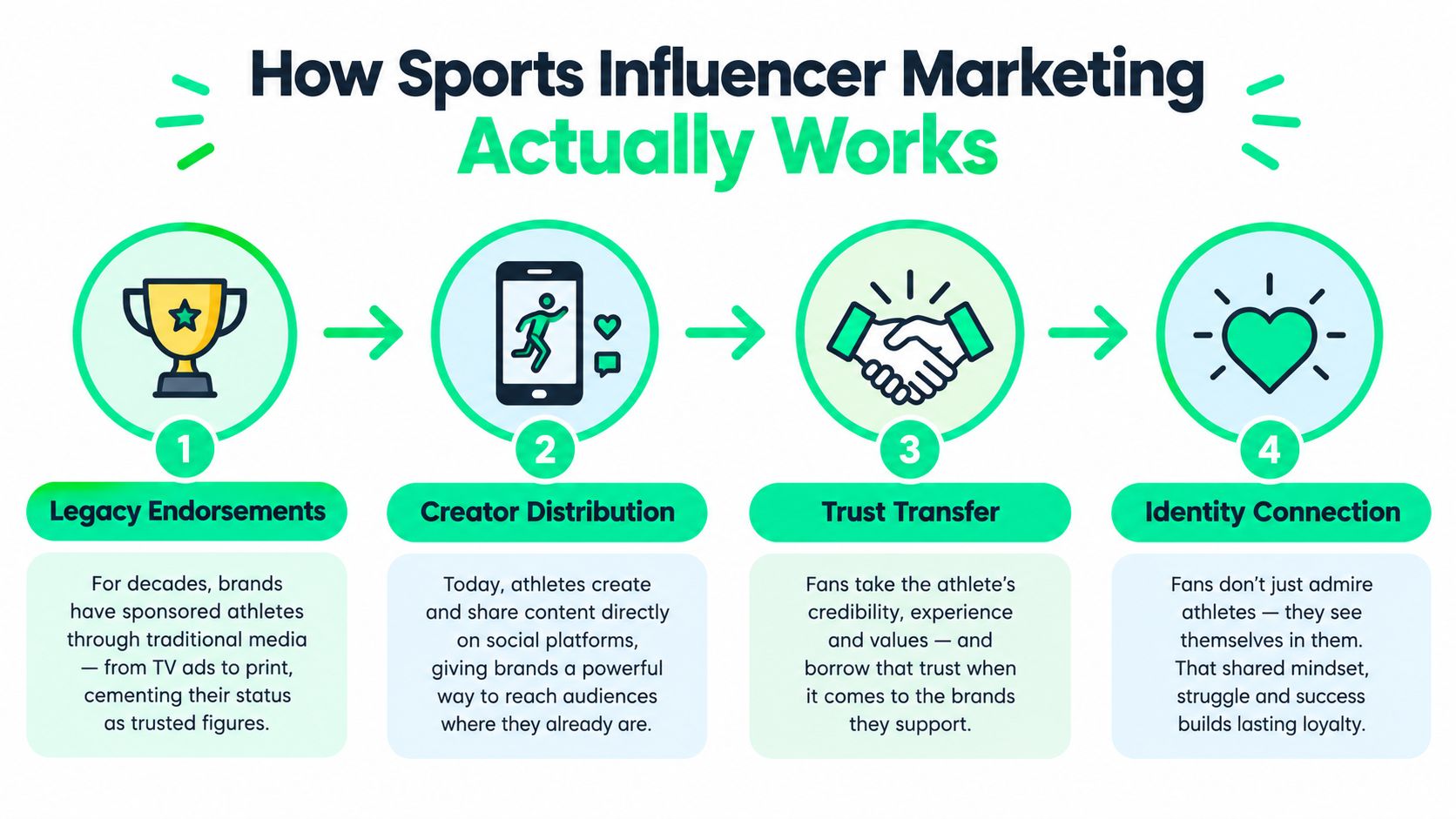
The modern version isn't limited to athletes. Meme pages, highlight accounts, team communities, commentators, and niche sports creators act as a new broadcast layer. A stadium PA system reaches everyone in the building with one message. A billboard sits beside the road and hopes the right person notices. A trusted sports page delivers a message inside a conversation the audience has already chosen to follow.
That context explains why generic follower count can be a poor buying signal. Athlete-focused social content has been reported at an average engagement rate of 5.6%, compared with 2.4% for the average influencer. The same source reports that 75% of consumers consider athletes more authentic than traditional celebrities, and 87% are more likely to buy a product endorsed by an athlete they follow (OpenSponsorship athlete marketing data).
The trust transfer is contextual
Fans don't automatically trust every product an athlete mentions. Relevance still determines whether the endorsement feels natural. A recovery product fits an athlete's performance identity. A sports app fits a fan page's daily behavior. A prediction-market message may fit a game-time conversation, but only if disclosures, age restrictions, jurisdiction rules, and platform policies are handled correctly.
Topic fit matters because audiences interpret the same message differently depending on the surrounding content. A sports bettor, fantasy player, college basketball fan, and marathon runner may all be sports consumers, but they don't have identical motivations or compliance needs.
Brands using automated creative workflows can extend this logic beyond manual athlete negotiation. For teams managing many variants and placements, AI-powered creator ad campaigns provide useful context for thinking about how creator content can be organized and adapted at scale.
The strongest campaigns therefore don't ask only, “Who has the biggest audience?” They ask, “Which creator or page already owns the conversation this brand needs to enter?”
The following video offers another visual way to understand the movement from athlete endorsement to platform-native distribution.
Campaign Formats From Logo Distribution to Content Engines
Sports distribution should be bought according to the job it needs to perform. A watermark campaign, a keyword-scoped sports placement, and a fully adapted meme creative aren't interchangeable. They differ in cost, control, production burden, and distance from the conversion action.
| Format | CPM | Control Level | Best For |
|---|---|---|---|
| Logo and caption distribution | $0.20 CPM | High placement control, limited creative transformation | Broad awareness and persistent brand presence |
| Vertical-targeted campaigns | $0.25 CPM | High control through keywords, exclusions, and niche rules | Sports-specific reach and contextual relevance |
| Content campaigns through a meme engine | $1.50–$3.00 CPM | Highest creative lift and adaptation | Turning supplied assets into native-feeling social content |
Logo and caption distribution works when the asset already carries the message. A brand watermark and approved caption can appear across selected pages, giving the buyer broad distribution while preserving strict wording and visual rules. This format is efficient, but it won't solve a weak creative concept or a message that needs explanation.
Vertical targeting adds a more precise layer. Keyword requirements, prohibited terms, page categories, and exclusions can narrow distribution toward sports, gaming, finance, or crypto audiences. For a sportsbook or prediction-market brand, that distinction matters because a broad meme placement can generate cheap attention from the wrong context, while a sports-scoped placement can keep the message closer to the intended fan behavior.
Content campaigns sit at the other end of the spectrum. A meme engine can transform a supplied video or static asset into variations that match the visual language of sports pages. The buyer pays more for that creative lift, but the placement has a better chance of looking native rather than inserted. Music selection also affects pacing and tone, so teams producing athletic edits may find a practical resource in this guide to BPM for athletic edits.
Match the format to the objective
Use the lowest-complexity format that can achieve the campaign's purpose.
- Reach objective: Choose logo and caption distribution when the brand needs repeated visibility and the message is already clear.
- Relevance objective: Choose vertical targeting when the campaign depends on sports context, keywords, or exclusions.
- Creative objective: Choose content campaigns when the brand needs native adaptation, storytelling, or multiple meme variations.
- Control objective: Use pre-approved captions and network-wide updates when compliance teams need centralized wording changes.
Real-time caption management is particularly useful for sports. A brand can update the call to action across approved placements as the conversation changes, keeping viewers close to the funnel without recreating every asset. The economics and operating differences are also discussed in logo watermark ads versus traditional influencer marketing.
Targeting Compliance and Brand Safety for US Audiences
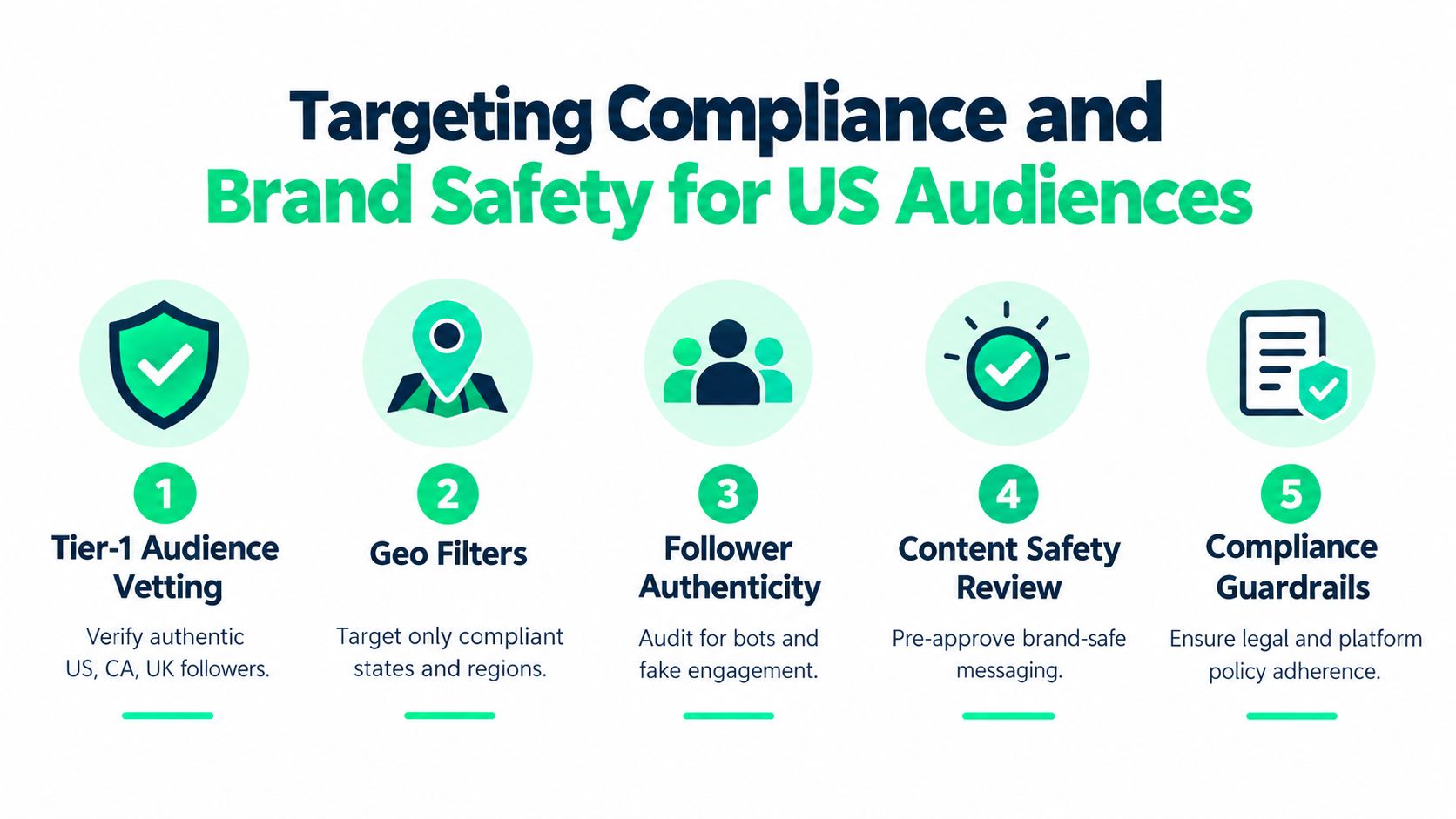
A sports campaign can deliver cheap views and still waste money if those views come from the wrong geography, an artificial audience, or a page whose content creates reputational exposure. Tier-one American audience quality and brand safety must be set before distribution, not inspected after the campaign ends.
Start with a rules engine rather than a creator list. Define the acceptable countries, states, age requirements, follower thresholds, content categories, required disclosure language, prohibited topics, and escalation conditions. If a campaign includes iGaming, sports betting, or prediction markets, add platform and jurisdiction requirements to the same operating brief. Legal review should approve the rules before buyers begin routing spend.
Build the review process around evidence
A formal workflow should record more than a green or red status. The reviewer needs the source, date, context, severity, and confidence behind each finding. Representative content should be checked alongside audience behavior, and ambiguous high-impact issues should move to a human escalation path.
A practical review sequence looks like this:
- Verify geography: Confirm that the page's audience aligns with the campaign's approved American markets and other permitted regions.
- Audit authenticity: Examine audience quality, engagement patterns, and demographic reporting rather than relying on follower count.
- Review content history: Look for prohibited topics, unsafe language, misleading claims, and adjacent material that could alter brand perception.
- Pre-approve creative: Lock the copy, disclosure, visual treatment, landing-page language, and required terms before publication.
- Monitor after posting: Track comments, duets, stitches, quote tweets, and other signals that can change the risk profile.
- Escalate and remove: Send uncertain findings to human review and retain a one-click removal path when a placement moves outside the brief.
These controls reflect the formal brand-safety workflow described in influencer campaign safety operations. A review system that operates only once, during onboarding, isn't enough for live sports content because the surrounding conversation changes quickly.
Protect regulated categories
For iGaming and prediction markets, the creative brief should distinguish between sports enthusiasm and a direct inducement to wager. Teams need clear age and geographic restrictions, compliant disclosures, approved claims, and rules for references to odds, outcomes, promotions, and responsible play. The brand should also decide which pages are categorically excluded before a campaign launches.
A platform such as FindClout can apply geo filters for US, CA, and UK, enforce required terms and prohibited topics, combine AI scoring with approximately 1.2-second average review time, and maintain 24/7 human review before posting, according to its stated operating model. That kind of layered system is designed to scale attention while keeping quality controls active.
Audience validation should remain granular. Sports-fan research now treats variables such as age, gender, ethnicity, region, education, marital status, and household composition as standard reporting fields, while broader sports analytics work examines social media, mobile consumption, sponsorship influence, fantasy involvement, and demographics across 18 sport categories (Nielsen sports-fan insights). Follower count is a starting signal, not a buying decision.
For regulated sports adjacency, brand safety and compliance in meme marketing provides a useful reference point for building exclusions and approval controls into the workflow.
Measurement Attribution and Pricing Benchmarks That Matter
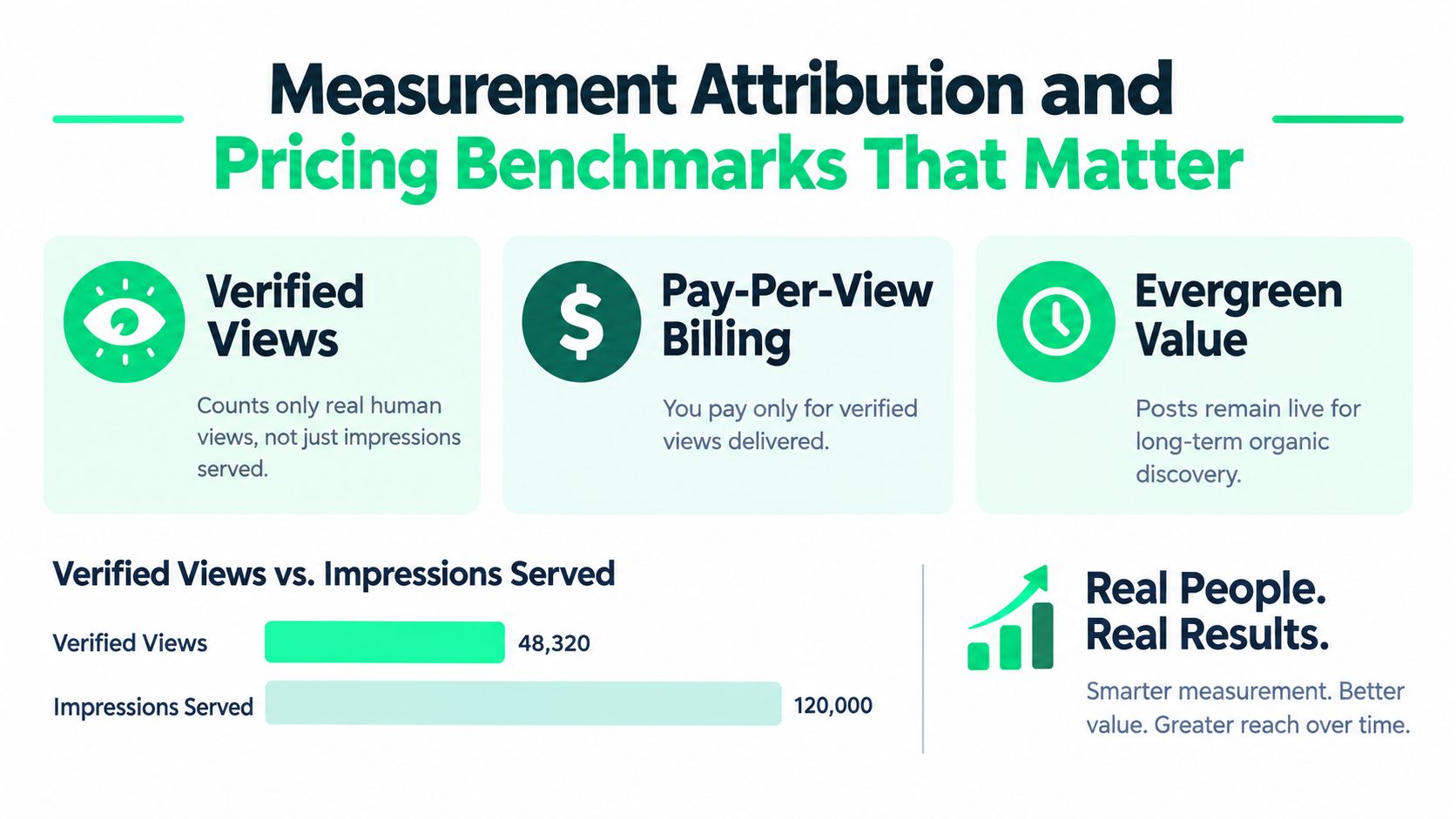
A screenshot of a post is not a measurement system. It shows that something appeared, but it doesn't establish whether the audience was authentic, whether the geography matched the brief, or whether the post continued producing discoverable attention after the initial placement.
Verified views should be separated from impressions served. Pay-per-verified-view billing gives the buyer a cleaner relationship between spend and human attention, especially when posts remain live and shareable after publication. The buyer can then evaluate delivery by handle, placement, geography, creative version, and funnel behavior instead of collapsing the campaign into one blended number.
Use a layered measurement stack
A strong reporting setup answers four questions:
- Did the campaign deliver? Track verified views, live posts, delivery pace, and underperforming placements.
- Did the right audience see it? Break out geography and audience quality rather than treating every view as equivalent.
- Which distribution produced value? Compare handles, page categories, creative variants, and captions.
- Did attention move people? Connect view data with clicks, sign-ups, deposits, app actions, or other approved downstream events.
Attribution should match the buying journey. A direct-response campaign may prioritize click and conversion paths, while a brand campaign may need view-through analysis and assisted conversion signals. Buyers evaluating a multi-channel program should choose the right attribution model rather than forcing every sports placement into last-click reporting.
Pricing also depends on the distribution model. FindClout's stated commercial terms include $0.20 CPM for logo and caption distribution, $0.25 CPM for vertical-targeted campaigns, and $1.50 to $3.00 CPM for content campaigns. It positions those rates at approximately one-fiftieth of Meta, with effective CPMs reported as low as $0.05 at higher spend, though buyers should validate the final effective rate against verified delivery, geography, and creative requirements.
The same operating model describes a $20,000 to $30,000 pilot guaranteeing 100 million views, budgets scaling to $100,000 to $1 million or more, campaign wraps of 7 to 21 days, and launch in approximately 10 minutes. These are commercial benchmarks, not universal outcomes. The correct buying question is whether the delivery guarantee defines verified attention clearly and whether the reporting exposes the individual pages responsible for the result.
Real World Examples and Playbooks for Growth Marketers
A sports-native campaign becomes easier to evaluate when the message follows the fan's existing behavior.
A prediction-market brand can align creative with a live game conversation, but it shouldn't treat every sports page as interchangeable. A page focused on a specific league or team may be a better contextual fit than a larger general sports account. The campaign brief should define approved states, audience restrictions, responsible messaging, and the exact moment when a caption can be updated or removed.
An iGaming operator faces a similar trade-off. Game clips and reaction content can create immediate relevance, but the brand needs a strict separation between entertainment and an unapproved promise of winnings. Pre-approved copy, geo controls, human escalation, and post-publication monitoring matter more than a flashy edit.

Choose the niche before choosing the celebrity
Topic specificity can change performance far more than generic follower counts suggest. OpenSponsorship's 2026 report says topic-specific engagement can be 4x higher than average engagement, while athlete creators averaged 10.97% engagement compared with 4.92% for traditional influencers (OpenSponsorship 2026 report).
That principle creates several practical playbooks:
- NFL weekly ritual: Distribute short reaction or highlight-led creative around recurring game conversations, with captions that connect naturally to the product.
- Niche sports acquisition: Match endurance, golf, or individual-sport creators with products that require expertise rather than mass awareness.
- Female athlete expansion: OpenSponsorship reported that female athletes accounted for 75% of deals on its platform, a signal that brands should examine overlooked creator categories instead of defaulting to saturated male team-sport inventory (female athlete deal data).
- Meme-page clipping: Adapt touchdowns, sideline moments, and fan reactions into native variations, then test captions and page fit rather than relying on one hero asset.
The operating lesson is consistent: match niche and format to the objective, then optimize by handle. Broad reach has a place, but the best return often comes from context that makes the viewer immediately understand why the brand belongs in the conversation.
Conclusion Your Next Sports Campaign System
Sports influencer marketing scales when the buyer treats it as a controlled distribution system. Start with the audience, not the creator. Define tier-one American geography, audit page quality, specify exclusions, and require approval before any sports-native creative goes live.
Then choose the format according to the job. Logo and caption distribution suits efficient visibility. Vertical targeting adds contextual control. Content campaigns justify higher costs when the brand needs creative transformation. Measurement should separate verified views from impressions served and report performance by handle, geography, creative, and downstream action.
The strongest system combines attention to detail with real-time operations. Every submission should pass automated scoring and human review. Captions should remain editable across the approved network. Off-brand pages should be removable immediately. Fraud screening and audience validation should protect the campaign from low-quality traffic while the distribution engine scales toward billions of views in high-quality American geographies.
That focus fits the behavior of the audience. More than 90% of Gen Z and Millennial sports fans use social media for sports content, according to the sports-fan summary cited earlier. The opportunity is substantial, but so is the cost of sending regulated or reputation-sensitive messaging into the wrong context.
Use this launch checklist:
- Define approved U.S. geographies, exclusions, audience requirements, and compliance language.
- Select logo, vertical-targeted, or content distribution based on the campaign objective.
- Pre-approve every creative variation and caption.
- Route placements through vetted sports pages with live review.
- Track verified views and performance by handle.
- Update or remove placements as the sports conversation changes.
FindClout offers programmatic distribution across vetted American sports pages, with verified-view billing, audience controls, fraud screening, and real-time review for branded meme content. Visit FindClout to route your next sports influencer marketing campaign through a brand-safe system built for high-quality U.S. attention.
Want this audience for your brand?
FindClout puts your brand in front of verified American audiences across every major US page — brand-safe, at scale.
Start Your Campaign