 findclout.com
Sports Fan Marketing: The Tier-1 Playbook for 2026
Sports fan marketing isn't primarily a sponsorship problem anymore. It's an attention-routing problem. Deloitte found that 42% of social media users follow sports and recreation topics, while independent industry reporting found that 55% of fans engage across multiple platforms, rising to about 70% among Gen Z and Millennials (Deloitte's sports fandom research). The valuable question is no longer which league can sell the largest logo placement. It's how efficiently a brand can place credible creative in front of an American fan during the moment that fan is already scrolling, reacting, and sharing.
Table of Contents
- Sports Fan Marketing Is an Attention-Routing Problem
- What Sports Fan Marketing Actually Means in 2026
- Segmenting American Sports Fans for Performance
- Channel and Creative Strategies That Win
- Campaign Formats and CPM Pricing
- Brand Safety and Fraud Controls at Scale
- Measurement and KPIs That Matter
- A 90-Day Playbook to Scale
Sports Fan Marketing Is an Attention-Routing Problem
Sports fan marketing works best when brands route attention, rather than attach themselves to a league. Traditional buying starts with a broadcast slot, team sponsorship, jersey patch, stadium board, or league partnership. Those assets can build association, but they give marketers limited control over the exact creative, audience quality, and attention delivered. Tier-1 U.S. sports marketing needs a routing layer that connects branded content with the right fan, moment, and vetted distribution source.
The audience has moved across screens. About 95.5 million people in the U.S. watched live sports on digital platforms in 2023, reportedly surpassing traditional pay TV sports viewers for the first time (StackAdapt's sports campaign coverage). More than 90 million U.S. viewers were projected to stream a sports event at least once per month by 2025, up from 57 million in 2021, according to the same reporting. A brand that treats live sports as television-only is buying around the fan instead of reaching the fan.
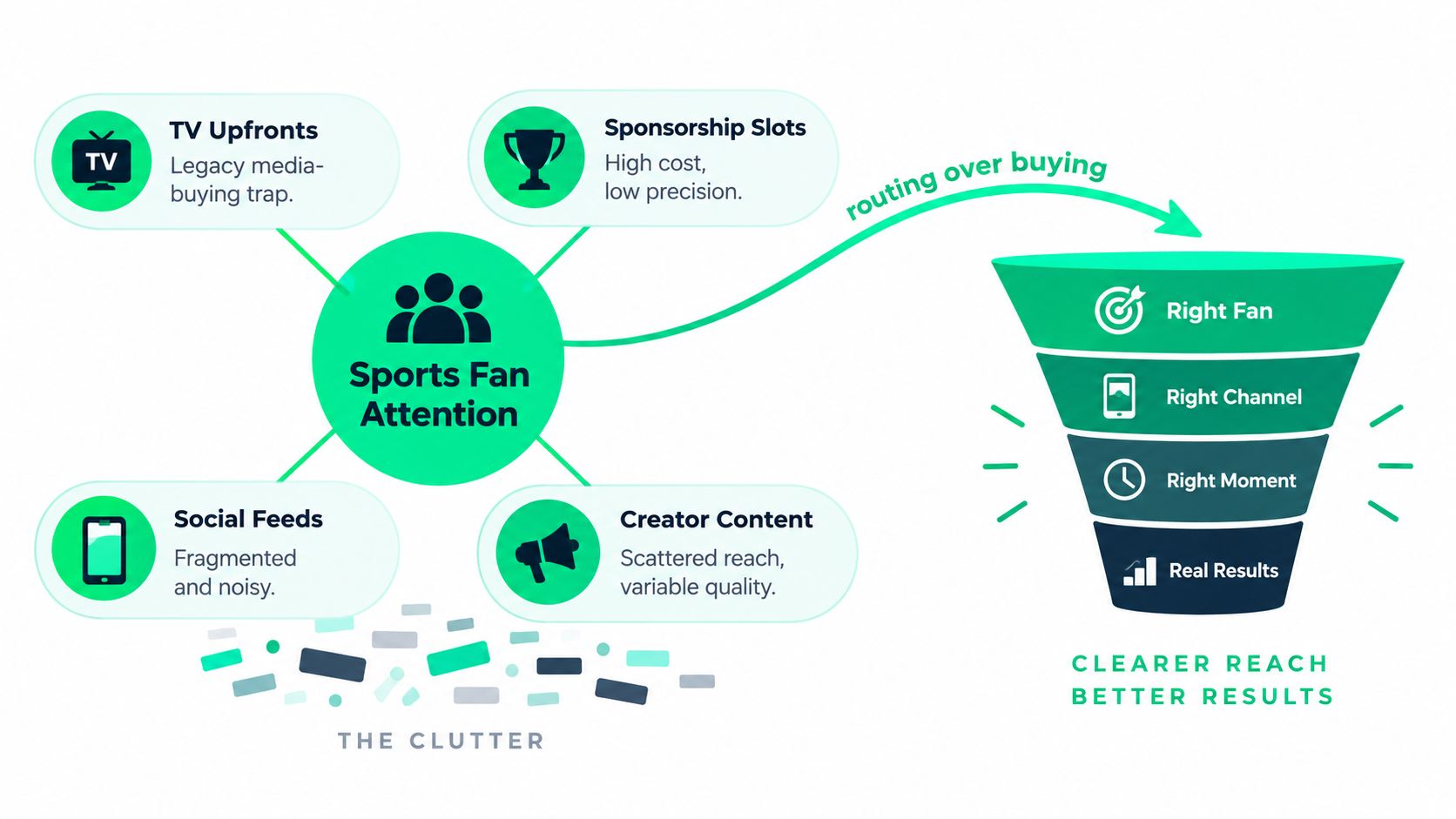
The scarce asset is verified attention
The strongest campaigns push branded memes, clips, and reactive creative through vetted U.S. creator pages. They put the message beside a fan's thumb during a live moment, then bill against verified views instead of treating every platform impression as equally valuable.
Sports attention continues after the whistle. Roughly 80% of fans browse social media or use an app during a game, while 72% watch via apps and 68% watch via OTT devices (Nielsen's World Cup sports fan study). The second screen carries commentary, statistics, memes, and purchase intent. It deserves its own routing and measurement plan.
Practical rule: Buy access to the moment and the audience, not just the league name.
Build the campaign as an operating system for attention. Identify the American fan segment, choose creator pages that already hold trust with that segment, and distribute native creative with geographic and brand-safety controls. Then measure verified attention, shares, downstream behavior, and placement quality. Attention behaves like infrastructure, because the routing system determines whether a message reaches a relevant person or disappears into cheap inventory. That is the performance difference between buying sports association and buying accountable fan attention.
What Sports Fan Marketing Actually Means in 2026
Sports fan marketing is the paid distribution of brand, creator, meme, and short-form content to identified sports audiences across the places where they consume media. That includes vertical video feeds, creator pages, sports communities, and second-screen conversations. It's different from traditional sponsorship, which mainly buys association with a team, athlete, league, or event.
A sponsorship can still matter for brand equity. But a performance-led campaign asks harder questions:
- Who saw the content? Was the audience in the United States and within the intended age or fandom segment?
- What did they see? Was it a logo, a captioned meme, a game-moment clip, or a creator-native edit?
- When did they see it? Did the placement run before kickoff, during a live reaction window, or after the game?
- What counted as delivery? Were views verified, or did the platform report impressions without enough visibility into quality?
Deloitte reported that 95% of fans had some form of off-season interaction with their favorite team or league, and fans consuming in-depth content spent 20% more than those consuming general news (Deloitte Digital's sports marketing perspective). That makes always-on editorial and creator distribution more useful than event-only bursts. Sports fandom doesn't stop when the broadcast ends, so campaigns shouldn't stop there either.
Design around second-screen behavior
The best unit isn't a logo placement. It's a verified U.S. view tied to a fandom signal. A fan watching an NBA game and checking Instagram reacts differently from a casual viewer who sees a generic sports ad days later. Timing, context, and creative format all affect the commercial value of that exposure.
Start with the creative format, then choose distribution. A captioned image can turn a shared joke into a fast awareness unit. A short vertical clip can capture a replay or reaction. A creator stitch can add commentary and credibility. The channel should serve that format, not dictate it.
This approach also supports year-round retention. Strong fandom creates repeat exposure across media, sponsorship, and social channels, while multi-platform behavior gives marketers more opportunities to measure and monetize attention. The campaign objective should therefore be explicit: reach, engagement, qualified traffic, app installs, subscriptions, merchandise sales, or brand search. Without that decision, sports fan marketing becomes an expensive collection of posts.
Segmenting American Sports Fans for Performance
“Sports fans” is too broad for efficient buying. A U.S. performance campaign should segment audiences across demographics, fandom intensity, and sport vertical. Each layer changes the message, creator page, placement, bid logic, and acceptable price. Treat segmentation as attention routing, not a sponsorship label. The goal is to send branded memes and clips to vetted U.S. audiences with brand-safe controls and pay-per-view accountability.
Deloitte reported that over three-quarters of surveyed fans rated their fandom 7 or higher on a 10-point scale. The research also found that 37% said their fanhood had grown and 52% said it had stayed the same over the prior three years (Deloitte's sports fandom research). Those findings justify separate bids for casual reach and high-intensity communities. A die-hard NFL fan, an active fantasy player, and an occasional playoff viewer should not receive the same creative or share the same bid floor.
Build the audience in layers
Age provides a practical starting point. Younger fans are more social-first than older audiences. 45% of fans get most or all of their non-live sports content from social media, compared with 10% of fans aged 55 and older, while 62% of fans aged 13 to 34 use social media on mobile during a live game (Yahoo Sports' coverage of younger sports consumers). That pattern supports mobile-native edits and creator-page distribution for younger American audiences. Older viewers may still deliver broad reach, but they should not automatically receive the same creative or channel mix.
Fandom intensity sets the commercial objective:
- Casual viewers fit QSR, beverage, apparel, and broad awareness campaigns during major live windows.
- Team-loyal fans respond to local references, rivalry language, and player or team moments.
- Fantasy and betting-active fans suit sportsbooks, prediction markets, gaming, and financial products, with tight compliance controls.
- Die-hard fans can justify premium timing because they follow commentary and clips beyond the game.
Sport vertical affects both supply and price. NFL and NBA pages can provide scale, while UFC, F1, MLS, college football, and regional college communities may offer more focused creator access. Niche fandoms can produce stronger engagement quality because audiences are concentrated and exposed to fewer sponsorship messages. Vet every page before buying. A large follower count does not prove genuine U.S. attention.
| Segment | Dominant Platform | CPM Tier |
|---|---|---|
| Under-35 mobile-first fans | TikTok, Instagram Reels, Facebook creator pages | Premium for timely creator inventory |
| Team-loyal fans | Facebook, Instagram, YouTube Shorts | Mid to premium |
| Fantasy and betting-active fans | TikTok, Reddit, creator pages | Premium with strict safety controls |
| Older prime-time viewers | Facebook, YouTube, connected television | Variable, often broader reach |
| Niche vertical communities | Reddit, YouTube Shorts, specialist creator pages | Efficient when inventory is vetted |
Use global targeting strategies for analytics as a reference for layered audience logic, then apply it to U.S. geography, sport interest, age, and fandom behavior. The output should determine which creator pages and branded formats receive budget, rather than inflate the audience estimate.
Channel and Creative Strategies That Win
Route creative through the channel where the fan already consumes that moment. Facebook and Instagram creator pages suit memes, captions, and clip distribution. TikTok rewards fast loops, reactive edits, and creator-native humor. YouTube Shorts supports vertical highlights and post-game discovery. Reddit can drive community conversation, provided the post follows the thread's language instead of reading like an inserted ad.
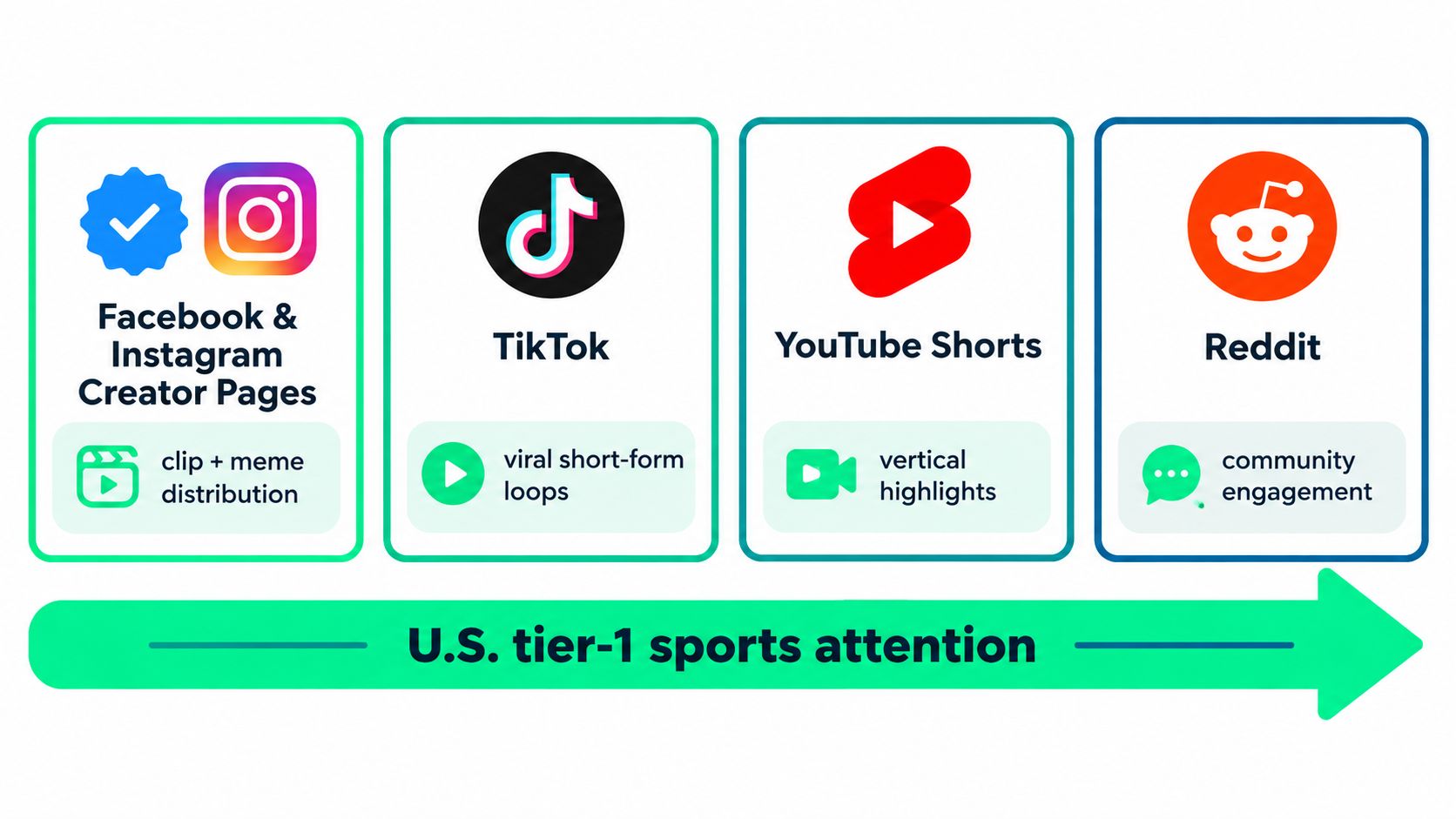
Match the format to the moment
A Facebook or Instagram meme page can publish a 60-second clip with a branded overlay after a recognizable game moment creates a shared reference. Make the clip work without the logo. Branding should reinforce the joke or reaction, not replace it.
TikTok needs an edit that earns the first scroll stop. Use a creator reaction to a controversial call, turn a highlight into a loop, or add an opinion through a stitch. Set brand rules before launch, then let the page keep its native voice. Polished corporate edits often lose against creator-led reactions.
YouTube Shorts fits a vertical sports page posting a highlight or commentary edit soon after a touchdown, goal, knockout, or buzzer-beater. Speed determines value. A stale clip becomes another interchangeable sports video.
Reddit requires restraint. A meme distribution post can enter a game thread within 30 minutes of a buzzer-beater, but its caption must match the community's expectations. Direct-response copy that performs on Meta can feel intrusive inside a Reddit conversation.
Map delivery to kickoff, tipoff, halftime, key scoring moments, and the first post-game reaction window. The second-screen behavior cited earlier supports this timing model. Build the campaign around the moment, then route each asset through a vetted U.S. creator page whose audience already follows that sport.
Brand safety belongs in the buying decision. Approve page context, recent posts, audience geography, and disclosure standards before paying for distribution. Use pay-per-view billing and verified delivery controls where available. That approach routes branded meme and clip content through creator pages without accepting the opaque reach or weak placement control common to platform buying.
For the NFL angle, the untapped attention channel in NFL marketing explains why creator-page distribution can extend a media plan beyond broadcast exposure.
Campaign Formats and CPM Pricing
Three formats dominate performance-oriented U.S. sports inventory. Logo and caption is the lowest-friction option for awareness. Vertical-targeted distribution adds sport and geography controls. Full content uses custom brand creative and deserves a higher price because it demands more production and page-level coordination.
The supplied 2026 planning ranges are useful for negotiation, but they shouldn't become automatic buying rules. Sport, timing, creator quality, audience geography, exclusivity, and creative complexity can move the final rate sharply.
| Format | CPM Range (USD) | Billing Model | Best For | Pilot Spend |
|---|---|---|---|---|
| Logo and caption | $8 to $15 | Pay per verified view | Broad awareness and fast testing | Around $5K to $10K |
| Vertical-targeted | $15 to $25 | Pay per verified view | U.S. sport and audience specificity | Around $5K to $10K |
| Full content | $25 to $40+ | Pay per verified view | Launch beats and custom creative | Around $5K to $10K |
A $5K to $10K pilot gives a team enough room to compare pages, formats, and creative angles. Sustained flights generally need $25K or more to create a reliable learning loop, rather than forcing conclusions from a handful of placements. Pay-per-view billing reduces upfront commitment because the advertiser pays for the agreed delivery basis instead of purchasing an uncertain block of impressions.
Buy the economics, not the rate card
Marquee inventory commands a premium. NBA Finals windows can trade at a 1.5 to 2 times multiple versus regular-season inventory, so the right question is whether the additional attention improves the campaign objective enough to justify the premium. A cheaper regular-season placement may win on qualified views, while a finals window may win on cultural relevance.
The strongest negotiation lever is pilot economics. Define the verified-view standard, geographic requirements, replacement policy, reporting fields, and safety exclusions before discussing scale. If a creator page underdelivers or fails a quality check, the contract should explain what happens next. A low list rate with weak verification is not a bargain.
Brand Safety and Fraud Controls at Scale
Brand safety is the operating system of sports fan marketing, especially for gambling, alcohol, financial services, gaming, and prediction-market advertisers. The Trustworthy Accountability Group identifies invalid-traffic mitigation and fraud prevention as core industry controls, while major advertising platforms use pre-bid blocking, allowlists, and human review to reduce harmful adjacency (Trustworthy Accountability Group coverage).
Platform-side tools aren't enough. Meta and TikTok can provide useful controls, but they don't understand every creator page's tone, comment culture, repost history, or audience quality. A separate, human-reviewed inventory layer is essential when a brand needs attention at scale without surrendering control.
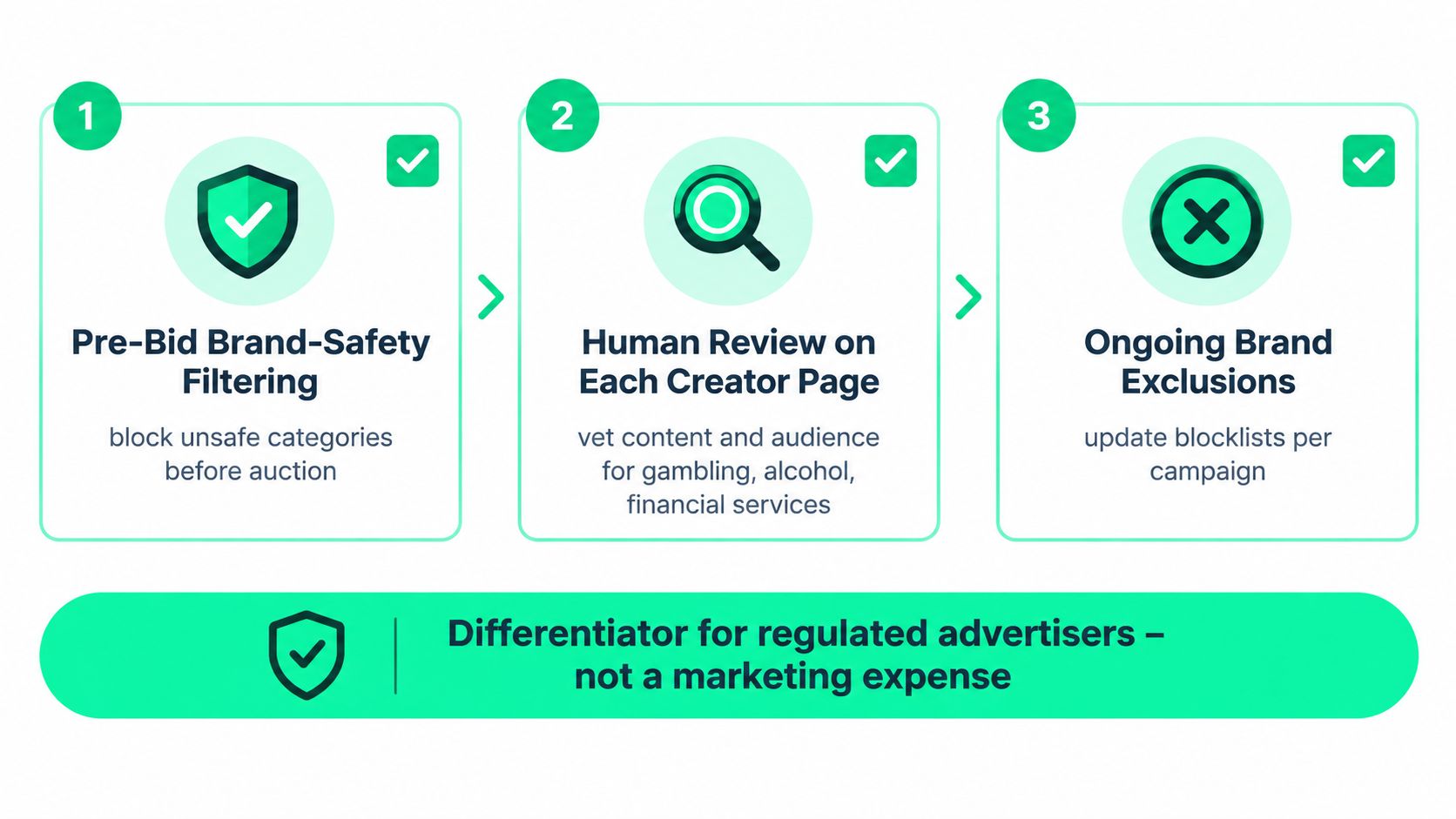
Use layered controls before and after bidding
A credible system should include:
- Pre-bid filtering: Block unsafe categories, prohibited keywords, risky URLs, and disallowed content before a placement enters the campaign.
- Page-level review: Inspect every creator page for audience authenticity, editorial context, gambling and adult adjacency, copied material, and engagement-bait patterns.
- Geographic verification: Confirm that the audience is U.S.-based when the campaign requires American tier-1 reach.
- Ongoing exclusions: Remove pages when their content, audience, or traffic quality changes.
Fraud often looks ordinary in a dashboard. Non-U.S. traffic can be recycled as American reach. Pirated clips can attract views while exposing the brand to rights risk. View farms can inflate scroll counts without producing meaningful attention. A system that reviews every submission in real time gives the buyer a chance to stop those problems before they compound.
For regulated categories, brand safety isn't a reporting feature. It's a buying prerequisite.
Every page should have a defined removal rule. If a creator runs unsafe content, relies on engagement bait, or shows signs of bot-driven inflation, pause the placement and investigate immediately. Any creator page running underperforming or unsafe content should be cut within 24 hours of detection. Brand-safe meme campaign controls should be documented before launch, not improvised after a complaint.
Measurement and KPIs That Matter
Platform impressions are a poor primary KPI when they combine bots, overseas traffic, duplicate exposure, and short scroll-bys. The core metric should be cost per verified U.S. view, with the verification definition agreed before launch. A campaign that reports fewer but higher-quality views can be more useful than one that reports a large impression count with weak geographic or attention controls.
The 2026 planning benchmark for cost per verified U.S. view is below $0.012, while the benchmark hook rate for meme edits is 38% in the first three seconds. Those targets come from the campaign framework and should be treated as operating benchmarks, not universal market facts. A strong dashboard separates the first three seconds, completed views, shares, audience geography, creator page, sport vertical, and fandom intensity.
| KPI Tier | Metric | 2026 Target | Why It Matters |
|---|---|---|---|
| Primary | Cost per verified U.S. view | Below $0.012 | Shows the price of qualified attention |
| Primary | First-three-second hook rate | 38% benchmark for meme edits | Measures whether the creative stops the scroll |
| Primary | Share-to-view ratio | Improve by creative and page | Indicates earned distribution potential |
| Secondary | Completion rate | Segment by fandom intensity | Shows depth of attention |
| Secondary | Branded search lift | Measure 7 days after flight | Connects exposure with active interest |
| Secondary | Creator-page follower delta | Compare before and after flight | Signals page and content resonance |
A useful measurement framework is TheContentMap's approach to content metrics, especially its emphasis on connecting surface engagement with meaningful business outcomes. For sports campaigns, that means separating delivery quality from downstream behavior instead of allowing one blended engagement number to hide weak placements.
Run a fraud triage before scaling
Use a short quality checklist:
- Confirm view duration above 8 seconds for the agreed view sample.
- Filter IP blocks outside the U.S. when the campaign is restricted to American audiences.
- Reject any creator page where more than 15% of the audience sits in non-target geographies.
- Compare shares with views to identify pages generating passive or suspicious traffic.
- Review performance by creator page, not only by platform.
Don't assume a Meta sports-interest buy is the control just because it's familiar. The framework sets creator-page inventory as potentially 30% to 50% more efficient on verified-view economics than a comparable Meta sports-interest purchase, but buyers should test that claim against their own verification and creative standards.
A 90-Day Playbook to Scale
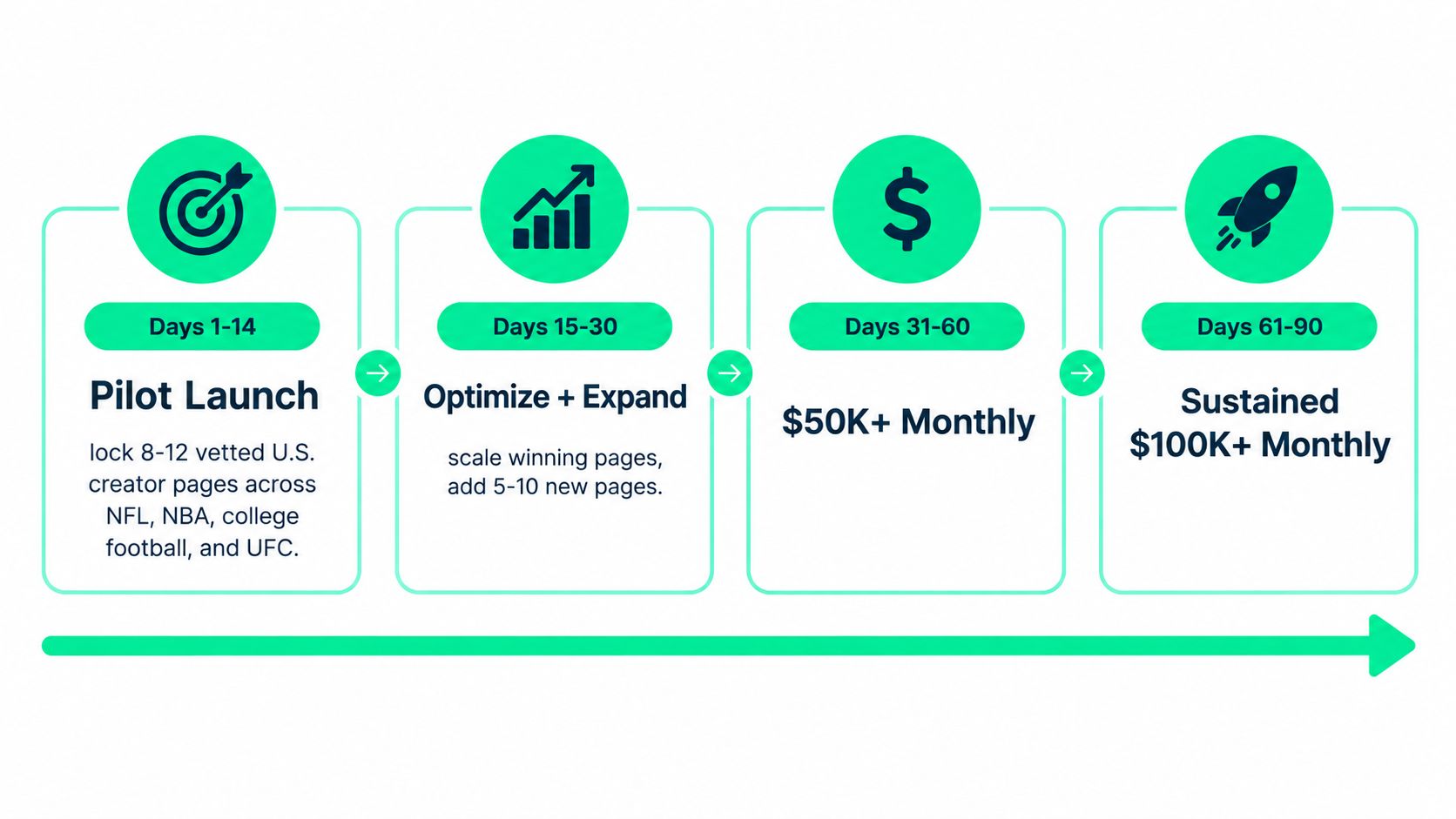
Scale should follow evidence, not ambition. Start with a $15K pilot, identify the pages and creative angles that produce qualified U.S. attention, and only then move toward sustained six-figure monthly spend. The operational sequence matters because every phase should reduce uncertainty before the next budget increase.
Days 1 to 14
Lock 8 to 12 vetted U.S. creator pages across NFL, NBA, and college sports. Negotiate pay-per-view terms at $25 to $45 per thousand verified views, then produce three distinct creative angles:
- Meme edits that use familiar fan humor.
- Moment-based captions tied to live game events.
- Creator-reactive takes that preserve the page's native voice.
Complete the fraud and brand-safety audit before the first post. Don't let a page enter the pilot because its follower count looks attractive.
Days 15 to 45
Run concurrent flights across the selected pages and compare hook rate, verified-view cost, share-to-view ratio, completion, and geographic quality. Kill any placement with a hook rate below 30%, then double weekly spend on the top quartile only after the page clears the quality review.
The goal is not to find one viral post. It's to identify repeatable combinations of sport, creator, format, timing, and audience.
Days 46 to 75
Layer vertical targeting and test relevant categories such as QSR, sportsbook, and DTC apparel. Review every new creative for prohibited adjacency, rights concerns, caption compliance, and audience fit before posting.
Use this phase to identify whether niche communities deserve more budget than marquee inventory. Women's sports, college regions, UFC, F1, and soccer communities should be evaluated on action and advocacy, not just total reach. One sponsorship study found that 66% of consumers are more likely to buy from companies sponsoring sports they like, but sponsor openness varies sharply by community. Women's pro hockey had 53% strong sponsor openness despite 7% fan identification, while the NBA had 27% strong sponsor openness despite its much larger fan base (Realize's sports marketing trends research).
Days 76 to 90
Lock annual pay-per-view rates with top performers and shift 70% of the budget to the four best creator pages. Document failure modes, including over-targeting aging fans, ignoring female sports fandom above 42% of reach, and paying for impressions instead of verified views.
The final guardrail is simple: never scale a creator page that hasn't cleared a fraud audit in the last 30 days. FindClout can serve as one operational option for programmatic branded meme distribution across vetted creator pages, with audience, content, and campaign controls managed through a single workflow.
FindClout gives sports advertisers access to branded meme and clip distribution across vetted creator pages, with pay-per-view billing, real-time review, and controls for U.S. audience quality and unsafe placements. If you're ready to test tier-1 American sports attention without relying on unverified platform reach, visit FindClout and build a focused pilot around your priority sport, audience, and creative format.
Want this audience for your brand?
FindClout puts your brand in front of verified American audiences across every major US page — brand-safe, at scale.
Start Your Campaign