 findclout.com
Social Media Brand Campaigns That Actually Scale in 2026
The biggest social media campaigns aren't won by the most inventive creative. They're won by routing verified attention to the right people, in the right geography, with enough control to stop bad placements before they damage the brand. That distinction matters as influencer and social media brand campaigns expanded from about $1.7 billion in 2016 to an estimated $32.55 billion in 2025, more than a 19x expansion over nine years, according to industry data on influencer marketing growth.
Creative still earns the first second. Distribution determines whether that second reaches a real American consumer, inside a suitable environment, at a cost you can defend. The operating model below treats social media brand campaigns as a routing system, with creative, audience selection, verification, and measurement working as one machine.
Table of Contents
- What a Social Media Brand Campaign Really Is
- Campaign Objectives and the KPIs That Match Them
- Creative Formats and Where Each One Wins
- Audience Targeting Across Creator Networks
- Brand Safety, Verification, and Real-Time Review
- How Programmatic Branded Meme Distribution Fits In
- Rethinking the Channel Mix Beyond Meta and TikTok
- A Practical Playbook for Launching Your First Campaign
What a Social Media Brand Campaign Really Is
A social media brand campaign is a controlled routing system for moving one commercial message through verified channels to a defined audience. Its quality depends less on how many posts a team produces than on whether the message reaches suitable people, on suitable surfaces, with review and measurement built into the route.
The campaign owner decides where attention should go, which creators or pages can carry the message, what placements are allowed, and which signals prove delivery. Meta and TikTok route impressions through auctions. Creator partnerships route messages through individual voices. Programmatic branded-meme networks route approved assets through a gated set of pages. These are different distribution systems, with different levels of control, cost, and adjacency risk.
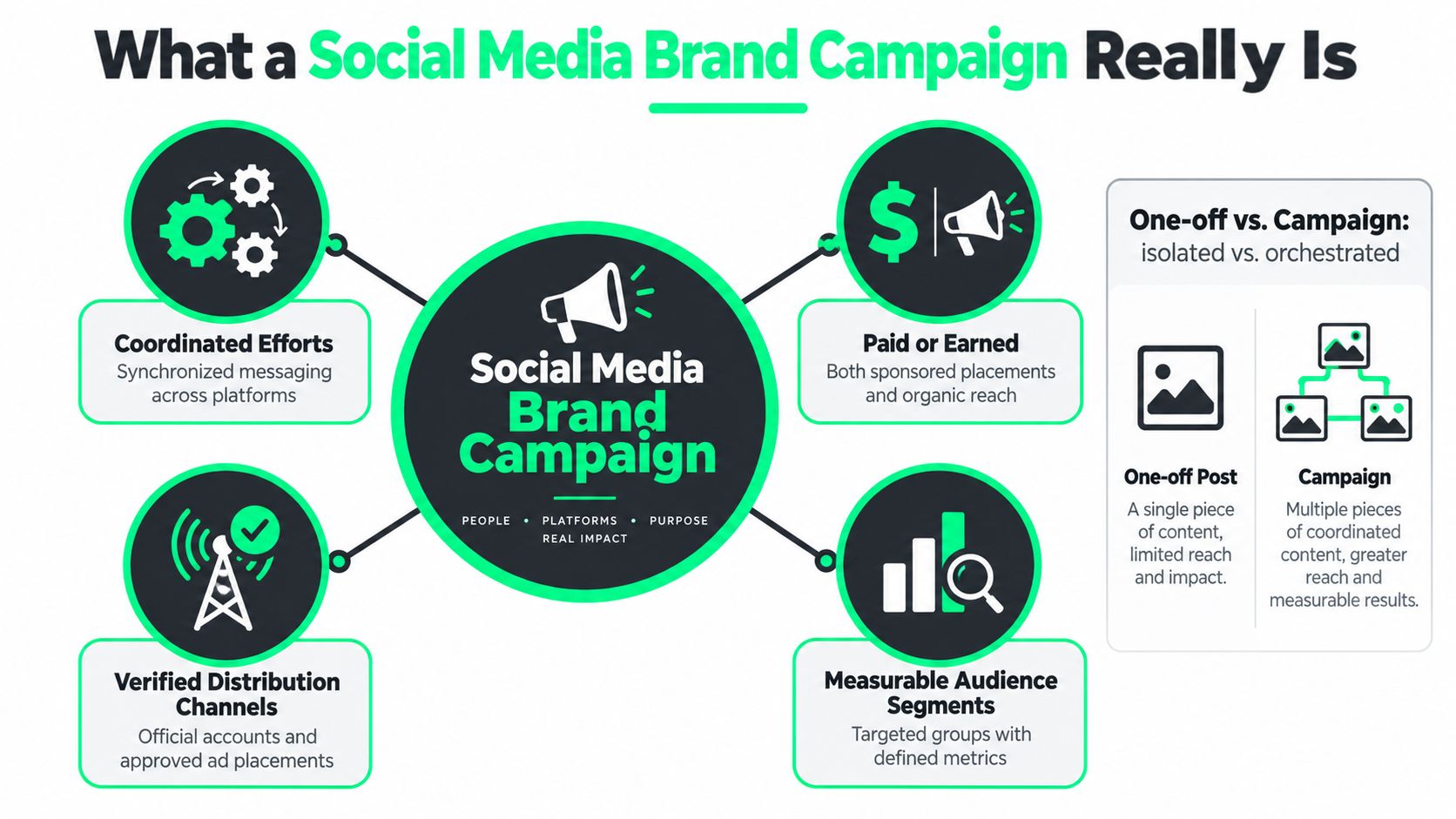
Lock the four decisions before spending
Set four structural decisions before buying reach:
- Objective: Choose awareness, consideration, or conversion. The objective determines the buying strategy and the evidence required afterward.
- Creative asset: Approve the video, meme, caption, watermark, static image, or creator post. Match the asset to the surface where it will run.
- Distribution surface: Select Meta, TikTok, YouTube, Instagram Reels, creator pages, or a combination. Each option brings different controls, pricing, and adjacency risks.
- Verification layer: Define how the team will confirm human exposure, viewability, geography, contextual suitability, and delivery against the intended audience.
Operating rule: Approve the complete route, not the creative alone. The route includes the asset, audience, placement, review process, and measurement signal.
A one-off post has no operating system around it. A campaign has a flight plan, approval path, placement rules, monitoring cadence, and an owner who can pause or redirect spend. That structure matters as budgets shift toward creator-led distribution. Industry data on influencer marketing budgets indicates that marketers commonly assign dedicated budgets to influencer work, allocate a meaningful share of marketing spend to it, and planned increases for 2026 were reported.
The practical implication is direct. Start by specifying the route, its gates, and its proof of delivery. Then create assets that can perform within those constraints. Creative earns attention, but distribution architecture determines whether that attention is qualified, brand-safe, and measurable.
Campaign Objectives and the KPIs That Match Them
A campaign objective should determine the KPI, and the KPI should determine the verification standard. Marketers get into trouble when they optimize for cheap delivery while claiming awareness, or celebrate engagement while ignoring whether the audience is American, human, and exposed to a brand-safe placement.
Use a three-tier stack:
Awareness
Awareness campaigns need evidence that qualified people had an opportunity to notice the brand. Verified impressions, completion rate, and on-platform reach among target geographies belong at the center. Viewability and human-traffic checks wrap those metrics, because served impressions alone don't prove meaningful exposure.
Consideration
Consideration requires a stronger behavioral signal. Track branded search lift, follower velocity, and sentiment-weighted engagement, then inspect whether comments and shares come from the intended audience rather than from low-quality or irrelevant traffic. A practical social media analysis guide can help teams organize content review, audience signals, and performance interpretation without treating every interaction as equally valuable.
Conversion
Conversion campaigns should narrow the measurement plan to CPA, ROAS, and incrementality holdouts. Platform-reported conversions can help with optimization, but they shouldn't be the only evidence. Compare the reported result with verified delivery, landing-page behavior, and an incrementality design that tests whether the campaign created demand beyond what would've happened anyway.
| Objective Tier | Primary KPI | Supporting Metrics | Required Verification |
|---|---|---|---|
| Awareness | Verified reach or impressions in target geographies | Completion rate, viewability, frequency, brand lift | Human traffic, viewability, geography, contextual suitability |
| Consideration | Branded search lift or qualified engagement | Follower velocity, sentiment-weighted engagement, profile visits | Placement quality, audience geography, content adjacency |
| Conversion | CPA, ROAS, or incremental conversions | Click-through rate, assisted conversions, landing-page quality | Human traffic, viewability, geo-compliance, fraud screening |
The decision rule is simple: choose one primary KPI per tier. Let secondary metrics diagnose the campaign, not redirect it every time one moves. If awareness is the objective, don't suddenly optimize for clicks because the platform reports a cheap click rate. If conversion is the objective, don't declare success from high video completion alone.
Ad fatigue also belongs in the KPI conversation. A social-media advertising study reports that continuous repetition can cause users to mentally tune out, lowering click-through rates and overall campaign performance, while survey-based research links overload, irrelevance, and intrusive branded ads with social media fatigue and lurking behavior among young users (social media advertising fatigue research). Frequency, creative rotation, and placement diversity aren't cosmetic choices. They're safeguards against paying to show the same message to people who've stopped processing it.
Creative Formats and Where Each One Wins
Creative format changes both attention efficiency and risk. Short-form video can capture attention quickly, creator-native posts can borrow trust, branded memes can distribute culture-led messages through pre-vetted inventory, and static watermarks can provide durable retargeting assets. The right choice depends on the funnel stage and how much contextual uncertainty your brand can tolerate.
TikTok's benchmarked 4.25% engagement and $4.63 average CPM compare with Instagram Reels at 1.23% engagement and $8.50 CPM, based on the Later influencer marketing benchmark report. Those figures don't make TikTok universally superior. They show that placement and format can change both engagement efficiency and media cost by multiples, so a buyer shouldn't treat every vertical video impression as interchangeable.
| Format | Typical CPM Range | Engagement Efficiency | Brand-Safety Surface | Best Funnel Stage |
|---|---|---|---|---|
| Short-form vertical video | Varies by platform and auction | Strong attention capture when the opening hook fits the platform | Broad, including comments, audio, creator context, and adjacent content | Awareness and consideration |
| Creator-native post | Varies by creator and network | Strong when audience trust and category alignment are genuine | Creator reputation, disclosures, comments, and surrounding content | Consideration |
| Branded meme | Programmatic pricing depends on inventory and targeting | Efficient when the concept matches an existing cultural format | Narrower when creative and pages are pre-vetted | Awareness and consideration |
| Static watermarked asset | Varies by placement and buying model | Reliable for repeated recognition and retargeting | Lower creative complexity, but adjacency still matters | Retargeting and conversion support |
Where the trade-offs show up
Short-form video wins when you need rapid attention and have enough creative volume to manage fatigue. It also exposes the brand to unmoderated comments, changing creator behavior, audio rights issues, and platform volatility. Creator-native work can feel more credible, but network-level quality controls are essential because a creator's audience fit can shift faster than a media plan.
Branded memes offer a different exchange. The brand gives up some direct control over the surrounding cultural expression, but a pre-vetted network can reduce the surface area for creative and contextual surprises. Static watermarks are less exciting, yet they're useful when the goal is recognizable repetition without asking the audience to understand a new narrative every time.
For video assets that need to travel across placements, teams should review reframing tips for YouTube videos before production. A format that looks strong in a full-screen vertical feed can lose its hook when cropping, captions, and safe zones change.
Run a mixed-format test, but keep the first test disciplined. Two formats are enough to expose the key trade-off. More variations often create reporting noise before the team knows which route is responsible for the result.
Audience Targeting Across Creator Networks
Creator inventory doesn't work like a Meta or TikTok interest segment. Paid social platforms infer intent from behavior and optimize delivery through a largely probabilistic system. Creator networks can make the route more explicit by combining follower demographics, content category, page quality, engagement patterns, and geographic filters.
For a campaign focused on tier-one American audiences, the geo control can't be a preference buried in a platform setting. It should be a buying rule enforced before inventory enters the plan. Build a U.S.-only creator whitelist, remove pages with weak audience evidence, and apply category exclusions before approving the first placement.
A practical targeting sequence
Start with geography, then apply audience quality. A page that looks relevant by topic but draws substantial traffic from outside the intended market can create misleading delivery and waste. Industry guidance warns that proxy and VPN use can misstate location, and recommends flagging outlier geographies, sudden source spikes, and data-center traffic that doesn't resemble human behavior (ad verification and geo-compliance guidance).
Next, align the content category. Sports, gaming, finance, crypto, and entertainment pages can each offer a different route to attention, but category relevance isn't a substitute for brand suitability. A sports advertiser may want American sports pages, while a financial advertiser may need stricter exclusions around misleading claims and sensitive adjacent content.
| Targeting Layer | Creator Networks | Paid Social Meta/TikTok |
|---|---|---|
| Audience definition | Follower demographics, page category, engagement quality, geo filters | Inferred interests, behaviors, lookalikes, and platform signals |
| Geographic control | Network whitelist and placement-level exclusions | Platform settings and algorithmic delivery |
| Inventory selection | Specific creators, pages, and approved placements | Auction inventory selected by the platform |
| Brand context | Page history, category rules, manual review | Ad and placement controls inside the platform |
| Scaling method | Add vetted pages that match the route | Expand audience or bidding inputs |
The useful model isn't creator networks versus paid social. It's creator networks alongside paid social. A U.S. creator whitelist can provide deterministic distribution in a defined environment, while Meta and TikTok continue to handle audience expansion and conversion optimization. The two lanes should share creative rules and measurement definitions, but they shouldn't be forced into one opaque delivery model.
Keep the audience specification concrete. “Young adults interested in sports” is a starting idea, not a buying rule. Define the country, language, category, prohibited topics, minimum quality requirements, and the evidence needed to approve a page. That detail is what separates tier-one reach from a report that merely contains a large view count.
Brand Safety, Verification, and Real-Time Review
Brand safety collapses when each control lives in a different spreadsheet, dashboard, or agency workflow. The fix is a single gating system that checks the creative and the route before launch, monitors placements during flight, and records decisions after delivery.
Ad verification confirms that an ad was served to a real human, in the intended geography, and in a viewable placement. Brand safety asks whether the surrounding context is appropriate for the advertiser. Those are related, but they aren't the same test. Verification tools can analyze placements in real time for invalid traffic, viewability, and geo-compliance, while brand-safety controls evaluate the content around the ad (ad fraud prevention and brand-safety guidance).
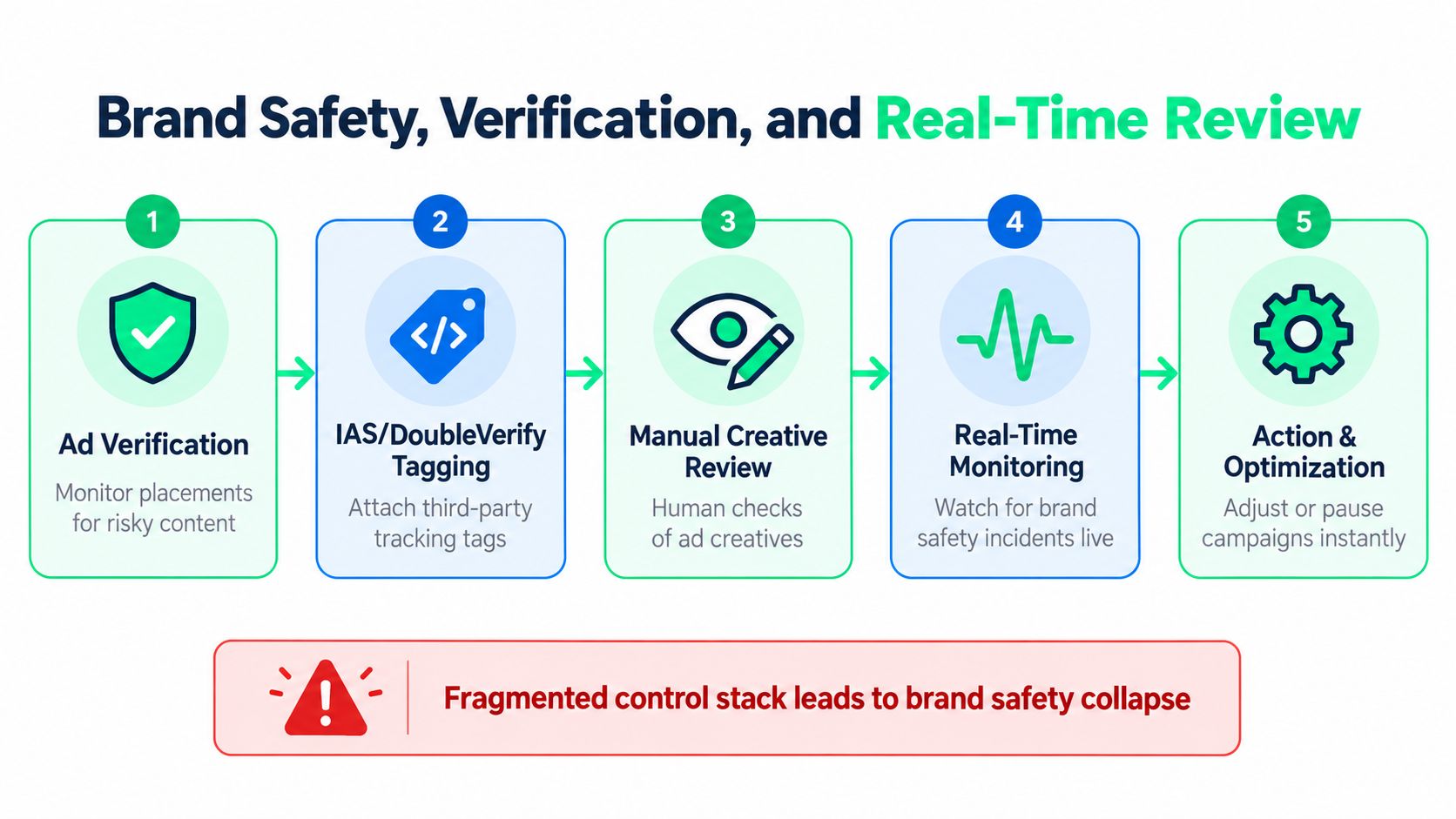
Build the control stack before launch
Use a layered workflow:
- Pre-bid controls: Block prohibited categories, unsafe pages, suspicious sources, and out-of-market inventory.
- Third-party tagging: Apply IAS or DoubleVerify tags where the buying environment supports them.
- Human and AI review: Let automated scanning identify obvious risks, then have trained reviewers assess humor, implication, context, and regulatory exposure.
- Live monitoring: Watch viewability, geography, adjacency, creator changes, comment risk, and delivery anomalies.
- Action logging: Pause, remove, or revise placements immediately, then preserve an audit trail of what changed and why.
DoubleVerify's framework describes an authentic ad opportunity as one where a human can see it, the environment is suitable for the brand, and the ad appears within the intended geography (DoubleVerify quality-ad framework). That three-part standard is useful because it prevents volume from masking a failed control. A campaign can deliver views and still fail if bots, unsafe context, or out-of-market traffic produced them.
RBC Capital Markets guidance also treats suitability as a property of both the ad and the content around it. The same creative can be acceptable in one environment and risky in another, which is why page exclusions, approvals, and rules engines matter (social media ad verification guidance).
Practical rule: For regulated categories, automated review is a filter, not a verdict. A trained human must be able to explain why each approved placement is acceptable.
For a deeper operational treatment of controlled meme distribution, review this guide to brand-safe meme campaigns. The standard should remain consistent: every submission receives review before posting, every live placement remains observable, and every exception has an owner.
How Programmatic Branded Meme Distribution Fits In
Programmatic branded meme distribution turns meme pages into a managed media channel. The campaign routes approved creative through selected pages, then applies audience, content, and placement rules before anything goes live. The creative matters, but the operating advantage comes from controlling distribution across a fragmented network.
The commercial case is straightforward. U.S.-only meme inventory commonly benchmarks between $4 and $9 CPM, with volume discounts pushing effective rates below $3 at scale, according to the programmatic influencer marketing guide for meme pages and watermark ads. Those rates can give growth teams another buying option when Meta and TikTok auctions become expensive or volatile. Economics still depend on inventory quality, verification, format, and delivery terms. A low CPM has little value if the audience is not American, human, or relevant.
Why the format works
A branded meme routes a message through a cultural format the audience already understands. The watermark or caption creates brand association, while the page provides an established distribution surface. That can reduce production friction, but approval remains necessary. The page's tone, comments, and surrounding posts influence how people interpret the placement.
| Mechanic | Standard Benchmark | Strategic Value |
|---|---|---|
| U.S.-only meme inventory | $4 to $9 CPM | Focuses delivery on tier-one American audiences |
| Volume pricing | Effective rates below $3 CPM at scale | Improves planning predictability for larger tests |
| Watermarked creative | Brand logo or approved mark added to content | Maintains recognition as content travels |
| Pre-vetted page distribution | Curated creator and meme inventory | Reduces uncontrolled placement exposure |
| Programmatic orchestration | Central campaign management across pages | Simplifies trafficking, review, and reporting |
The strongest case is not low-cost reach. Branded memes can function as gated routing infrastructure. The network selects pages, a rules engine applies audience and topic constraints, reviewers approve submissions, and live monitoring identifies placements that need removal or adjustment.
That structure suits brands seeking broad awareness without giving up brand controls. It also fits sports, gaming, and culture-led campaigns, where relevance depends on joining an existing conversation instead of forcing a polished ad into it.
Use branded memes as one route in the media system, not as a replacement for every other format. They can extend reach, add frequency, and test cultural angles. Conversion still requires a deliberate path from attention to landing page, product, or offer.
Rethinking the Channel Mix Beyond Meta and TikTok
Meta and TikTok should remain in the mix, but their familiar buying interfaces, optimization systems, and reports should not determine the entire social budget. The better question is how each route contributes verified reach, brand control, and incremental outcomes.
Treat channel planning as a routing problem. A parallel creator-network lane gives the team another path to attention when auction pressure, audience duplication, or limited incremental reach becomes the constraint. The network must prove that delivery reached the intended geography, suitable placements, and real people.
| Dimension | Meta/TikTok Ad Manager | Creator-Network Distribution |
|---|---|---|
| Buying environment | Walled-garden auction | Curated creator and page inventory |
| Optimization | Algorithmic audience expansion | Placement rules, page selection, and network controls |
| Reach source | Platform users and modeled audiences | Followers and viewers of approved creators |
| Main risk | Auction volatility and reporting opacity | Fragmented measurement and inconsistent page quality |
| Control response | Platform settings and exclusions | Whitelists, review gates, verification, and removal rules |
Signal loss and attribution fragmentation make non-platform inventory harder to operate, not impossible to use. Set first-party tracking, define one verified-view standard, run post-bid verification, and release spend through capped test tiers. If a route fails those requirements, do not scale it.
The supplied planning model recommends reallocating 15% to 30% of social budgets toward non-Meta channels when scale is the constraint. Treat that range as a test plan, not a universal rule. Start with a controlled portion, compare verified delivery with incremental outcomes, and expand only when the creator lane adds reach or efficiency without weakening safety.
The comparison of short-form media networks with Meta and TikTok helps pressure-test the allocation decision. Keep the walled gardens, add routes that meet your verification standard, and stop letting default tooling set the channel mix.
A Practical Playbook for Launching Your First Campaign
Start Monday with a route, not a mood board. The first campaign should answer one commercial question, use no more than two creative formats, and produce enough verified delivery data to decide what happens next.
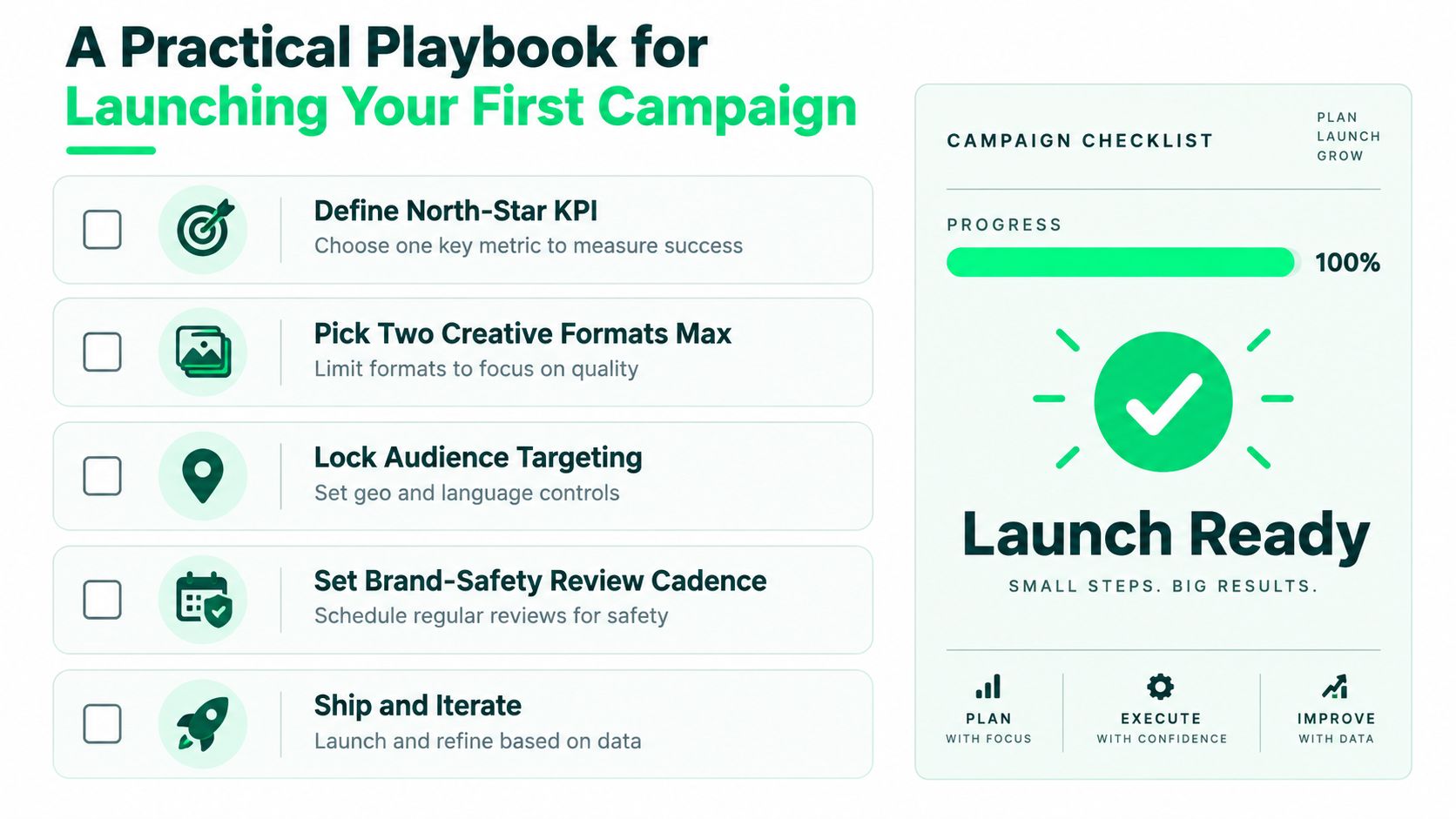
The launch sequence
- Choose one north-star KPI. Pick verified awareness delivery, qualified consideration, or a conversion outcome. Write the pass condition before any media goes live.
- Limit the creative test. Choose two formats maximum, such as short-form video and branded memes. Keep the message consistent so the comparison reveals the route's effect.
- Lock the audience rules. Set American geography, language, category alignment, prohibited topics, creator eligibility, and exclusion logic before buying inventory.
- Set the review cadence. Review every submission before posting, monitor delivery in real time, and schedule formal checks at day 3, day 7, and day 14.
- Ship and iterate. At each checkpoint, inspect CPM, view-through rate, verification pass rate, placement quality, and audience geography. Kill placements that fail the agreed thresholds, then move budget to approved inventory.
Teams that want to reduce repetitive production and scheduling work can also review guidance on automating social media with AI. Automation should accelerate tagging, versioning, and reporting. It shouldn't replace the human approval required for contextual brand safety.
A two-week test-and-learn loop is long enough to expose delivery quality and creative fatigue, while short enough to change course before a quarterly planning cycle closes. Keep the dashboard placement-level, keep the audit trail intact, and make every budget increase conditional on verified performance in tier-one American geographies.
FindClout offers programmatic distribution for branded meme content across curated creator pages, with watermark and caption controls, audience guardrails, fraud screening, and real-time campaign orchestration. If you need a controlled creator-network lane alongside Meta and TikTok, visit FindClout to evaluate a campaign route built around verified American attention and brand-safety review.
Want this audience for your brand?
FindClout puts your brand in front of verified American audiences across every major US page — brand-safe, at scale.
Start Your Campaign