 findclout.com
Social Media Audience Targeting That Actually Converts
You launch a paid social campaign on Monday. By Wednesday, spend is pacing. Reach looks healthy. Clicks are coming in. But conversions are soft, comments are random, and half the placements feel like they landed in front of people who were never going to care.
That's the moment marketers blame creative.
Sometimes they're right. Often they're early.
Before a creative ever gets a fair test, social media audience targeting decides who gets the chance to see it. If the platform routes your message to the wrong people, even a strong ad starts looking weak. If it routes the message to the right people, an average ad can still find traction long enough to teach you something useful.
A junior buyer usually thinks targeting means choosing age, gender, and interests. That's only the surface. In practice, targeting is closer to attention routing. You're not just filtering a database. You're telling a platform where to look for likely response, then the platform decides how tightly it follows that instruction.
That difference matters more now than it used to. Platforms have more control over delivery. Privacy rules have reduced signal quality. And if you care about Tier 1 American audiences and brand safety, you need tighter operating discipline than “United States, broad interests, and hope for the best.” The teams that scale cleanly build systems to review every submission in real time, protect brand context, and make sure attention lands in high quality geographies.
If you're still getting your foundation in place, a practical social media plan for small business helps organize channel goals before you start slicing audiences too narrowly.
Table of Contents
- Introduction Why Targeting Decides Performance Before Creative Does
- How Social Media Audience Targeting Actually Works
- Audience Types You Can Target and When to Use Each
- Data Signals Platform Capabilities and the Shift to Creative First Delivery
- Scaling Targeting With Programmatic Meme Distribution and Brand Safety Controls
- Measuring What Worked and Proving Incremental Impact
- Common Pitfalls to Avoid and Your Next Steps for Smarter Targeting
Introduction Why Targeting Decides Performance Before Creative Does
A lot of wasted spend starts with a simple mistake. The buyer chooses an audience that sounds right in a planning doc, then assumes the platform will deliver exactly to that group. It won't.
Think about targeting like routing packages. The address you enter matters. But the carrier still decides the exact path, timing, and handoff points. In social, your audience settings are the address. The platform's auction, prediction system, and inventory availability are the carrier.
What junior buyers usually miss
The first job of targeting isn't to make your campaign look precise. It's to make your campaign economically possible.
If you target too loosely, the platform may find cheap reach with weak intent. If you target too tightly, you can choke delivery, limit learning, and force the system into expensive pockets of inventory. Both mistakes show up later as “creative fatigue” or “bad CPMs,” even though the root cause was audience design.
Practical rule: If performance drops before the ad has seen enough qualified people, suspect your routing before you rewrite the message.
This is why performance marketers obsess over audience quality before they obsess over ad polish. It's also why Tier 1 American audience focus changes the conversation. A broad campaign can report plenty of activity while still producing low quality traffic, weak geography mix, or unsafe adjacency. If your brand needs reliable U.S. attention, targeting has to include geography verification and placement discipline, not just demographic guesses.
Why this got harder
Social platforms didn't always work this way. Audience targeting became a distinct ad product in November 2007, when Facebook opened self-serve ads to all advertisers and introduced demographic targeting based on user-declared data such as age, gender, location, education, and relationship status. At that point, the platform had about 50 million users and helped establish the modern targeting playbook built around identity, interests, and behavior rather than page context, according to this Facebook ads history overview.
That history explains why so many marketers still think better targeting means adding more filters. The older model rewarded that mindset. The newer one doesn't always.
How Social Media Audience Targeting Actually Works
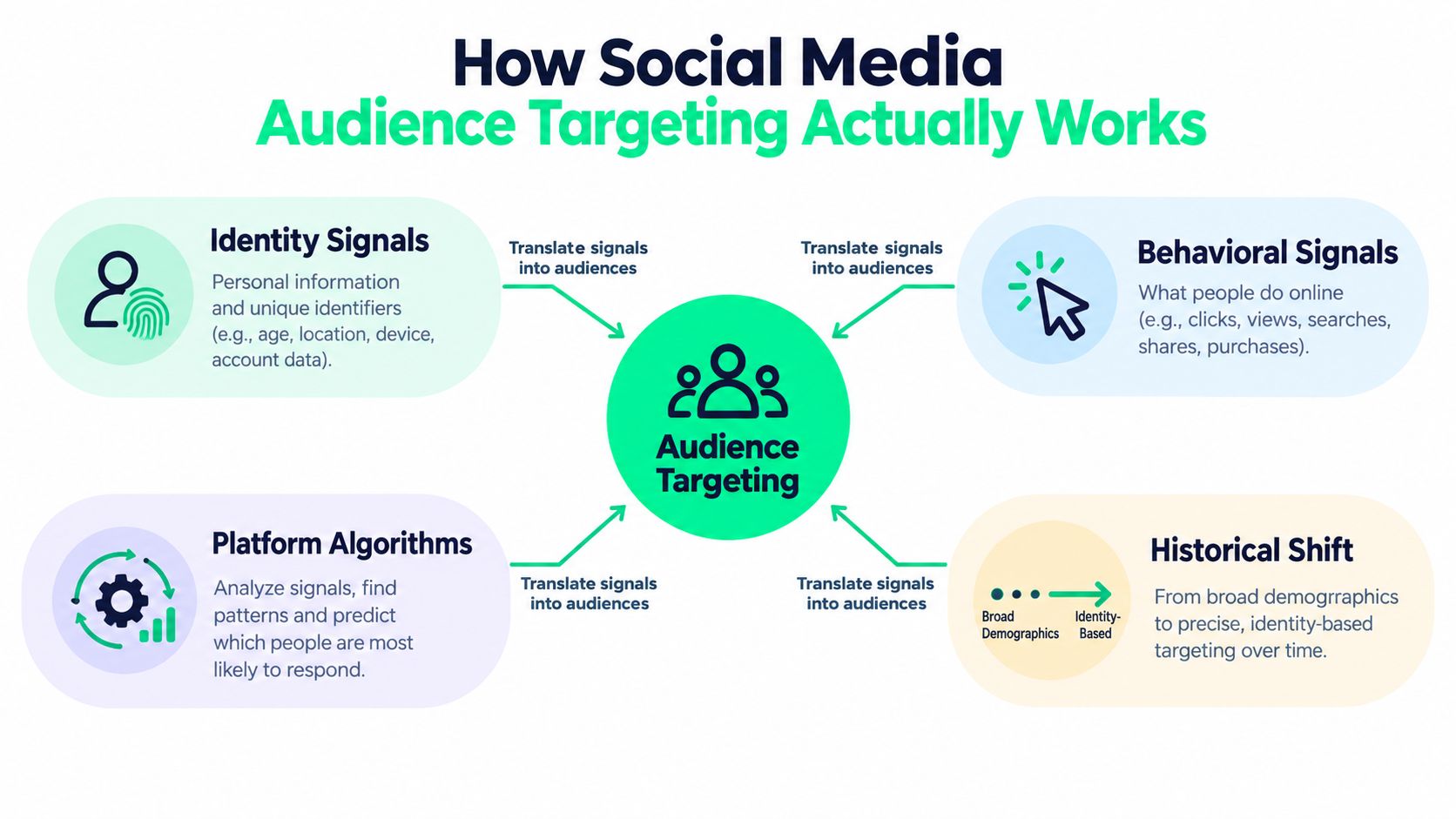
The easiest way to understand social media audience targeting is to separate inputs from outcomes.
You control inputs. The platform controls outcomes.
Your inputs are things like age bands, states, interests, customer lists, video viewers, purchasers, or lookalikes. The platform then takes those signals, compares them to its own prediction systems, and decides which users are most likely to take the action you optimized for.
The three layers behind delivery
At a high level, most platforms work from three signal layers.
Identity signals
These are declared details like age, gender, location, education, or relationship status. They were the early building blocks of paid social.Behavioral signals
These include what people click, watch, save, follow, ignore, and buy. They're usually more useful than static demographics because they reflect recent intent.Platform prediction systems
This is the black box buyers need to respect. The platform estimates who is most likely to complete your chosen event, then allocates delivery accordingly.
A useful planning habit is to map your audience hypothesis before launch. If you need a template for that process, this guide on how to build your social roadmap gives a clean structure.
Why your audience definition isn't your real audience
Here's where many buyers get confused. The audience you define in setup isn't the same as the audience that sees the ad.
Research on Meta ad sets found that over 80% of analyzed ad sets had audience saturation below 5%, 50% reached less than 1% of the intended audience, and only 10% reached more than 12%. Those figures came alongside broader social usage trends showing a projected global social audience of about 5.66 billion active users in 2026, or 93.8% of internet users, according to Sprout Social's demographics overview.
That means “I targeted this audience” often really means “I gave the platform permission to explore within this audience.”
The job of targeting isn't to force exact delivery. It's to shape the pool so the algorithm explores in places that make business sense.
For buyers focused on paid execution mechanics, this walkthrough of social media ad buying is useful because it frames targeting as a delivery constraint, not just a setup field.
What you actually control
You don't control every impression. You do control:
- Audience quality rules such as U.S. focus, exclusions, and first-party seed quality
- Optimization event choice such as click, landing page view, add to cart, or purchase
- Creative variety so the system has enough options to find fit
- Measurement discipline so you can tell routing problems from message problems
That's the practical foundation. Once you understand that, audience types start making a lot more sense.
Audience Types You Can Target and When to Use Each
Most campaigns rely on five audience building blocks. None of them is universally “best.” Each solves a different job.
Demographic audiences
Use demographics when your offer has obvious eligibility boundaries. Age restrictions, gender relevance, household role, and geography are common examples.
They're helpful guardrails, but they're weak predictors on their own. “Men 25 to 44 in Texas” is a description, not a strategy.
Interest audiences
Interest targeting works best when you need a prospecting starting point and you don't yet have enough first-party data. It's a decent option for new product categories, creators, and brands testing adjacent niches.
Its weakness is fuzziness. People often get bucketed into interests loosely, and platforms increasingly treat these settings as hints.
Behavioral audiences
Behavioral audiences come from actions. Viewers, engagers, site visitors, cart abandoners, and recent purchasers all fall here.
They're usually stronger because they reflect observed activity. But they also become fragile when privacy changes reduce observability or shorten the usable signal window.
Custom audiences
Custom audiences are built from your own first-party data. Email lists, customer files, site traffic, app events, and CRM segments fit here.
These are often the cleanest audiences because you know where the data came from. They're especially important if you care about American audiences, high quality geography control, and consistent suppression logic.
Lookalike audiences
Lookalikes let platforms model new people who resemble an existing seed. The seed quality matters more than people think. A lookalike built from top customers behaves differently from one built from all leads.
They're powerful for expansion, but many buyers overtrust them. When seed data is noisy, the platform scales noise.
Choosing the Right Audience Type for Your Goal
| Audience Type | Best For | Data Required | Watch Out For |
|---|---|---|---|
| Demographic | Eligibility, compliance, broad framing | Basic platform data | Too broad to predict intent |
| Interest | Early prospecting, category discovery | Platform interest graph | Loose matching, weak precision |
| Behavioral | Retargeting, high-intent re-engagement | On-platform or site activity | Signal loss from privacy changes |
| Custom audiences | Retention, suppression, customer matching | First-party data | Bad CRM hygiene creates waste |
| Lookalikes | Scaled prospecting from proven seeds | Strong seed audience | Poor seed quality spreads quickly |
A simple selection rule
If the campaign goal is awareness, broad interest plus strong creative can work. If the goal is conversion, move closer to behavior and first-party data. If the campaign has legal or brand sensitivity, demographic and geographic controls matter more.
Use this checklist before launch:
- Start with the business filter: Who is eligible to buy?
- Add the intent layer: What action suggests they might care now?
- Protect the budget: Exclude people who already converted or clearly don't fit.
- Check the geography: Don't assume a U.S. label means high-quality American delivery.
That last point is where many teams slip. Tier 1 targeting is not a cosmetic setting. It's an operational standard.
Data Signals Platform Capabilities and the Shift to Creative First Delivery
Audience types are the menu. Signals are the ingredients.
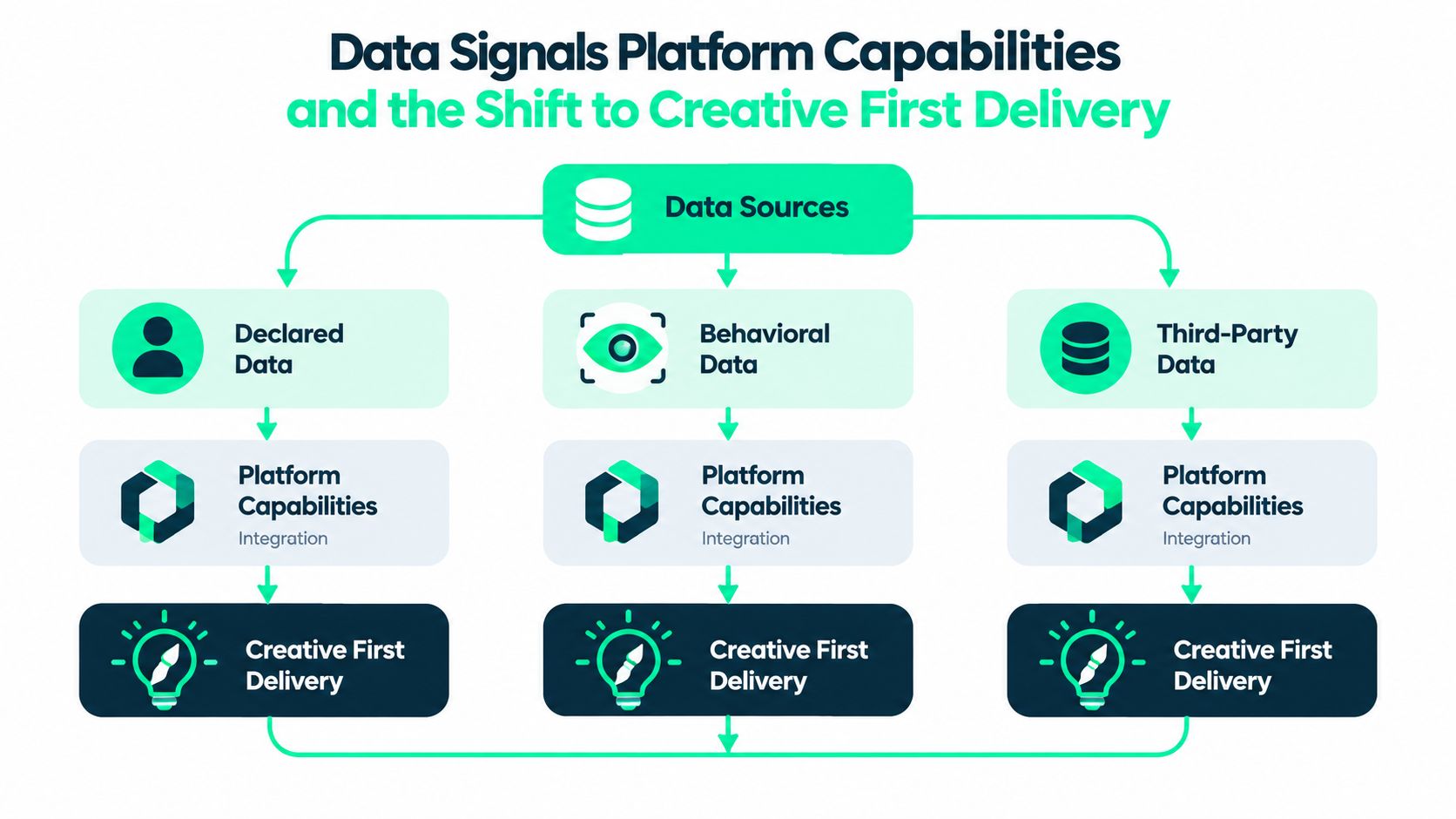
A platform can only target from what it can observe, infer, or match. In social, that usually comes from declared profile details, on-platform behavior, and your own first-party data. What's changed is how much weight platforms now give to creative response signals versus manual audience filters.
Where the signals come from
Declared data is what users tell the platform. Behavioral data is what users do. First-party data is what they do with you.
Those categories sound simple, but they have different reliability profiles:
- Declared data is stable but limited.
- Behavioral data is rich but can decay fast.
- First-party data is strategic because you own the relationship and consent trail.
A randomized field experiment on a social networking site found that when users were given more control over personal information, they were twice as likely to click personalized ads. The same research also found that Apple's App Tracking Transparency reduced iOS-targeted ad efficiency, with ads targeted at iOS users triggering 7.5% fewer actions per impression after ATT, while CPMs for iOS-targeted ads fell 10% relative to Android, according to the SSRN paper on privacy, transparency, and ad response.
The lesson is practical. Better consent and clearer data use can improve response, while lower observability can reduce targeting precision even if inventory gets cheaper.
Why creative-first delivery changed the game
Many marketers still ask for tighter targeting when the problem is weak creative-audience fit.
A 2026 industry report says Meta's Andromeda rollout moved Facebook and Instagram from an audience-first to a creative-first delivery model, and that 41% of the average user's feed is now AI-recommended content from accounts they do not follow, according to Yellow House Consulting's 2026 social media trends report.
That changes the buyer's job. Your targeting inputs still matter, but they increasingly act like guardrails rather than strict instructions. If the creative performs across a broader pocket of users, the platform may keep expanding there. If the creative underperforms, tighter targeting rarely saves it.
Field note: When a platform treats audience filters as suggestions, the strongest lever often becomes creative variation, not extra targeting complexity.
This is also why alternative distribution models have become more interesting. Comparing short-form media networks vs traditional ad platforms can help buyers see where direct feed algorithms differ from network-based creator distribution.
What to do differently
For modern social media audience targeting, the playbook shifts in three ways:
- Use first-party data to anchor quality
- Test more creative angles inside broader but relevant pools
- Treat transparency and consent as performance inputs, not just compliance tasks
A buyer who only tweaks filters is solving the old problem. A buyer who aligns signals, creative, and delivery logic is solving the current one.
Scaling Targeting With Programmatic Meme Distribution and Brand Safety Controls
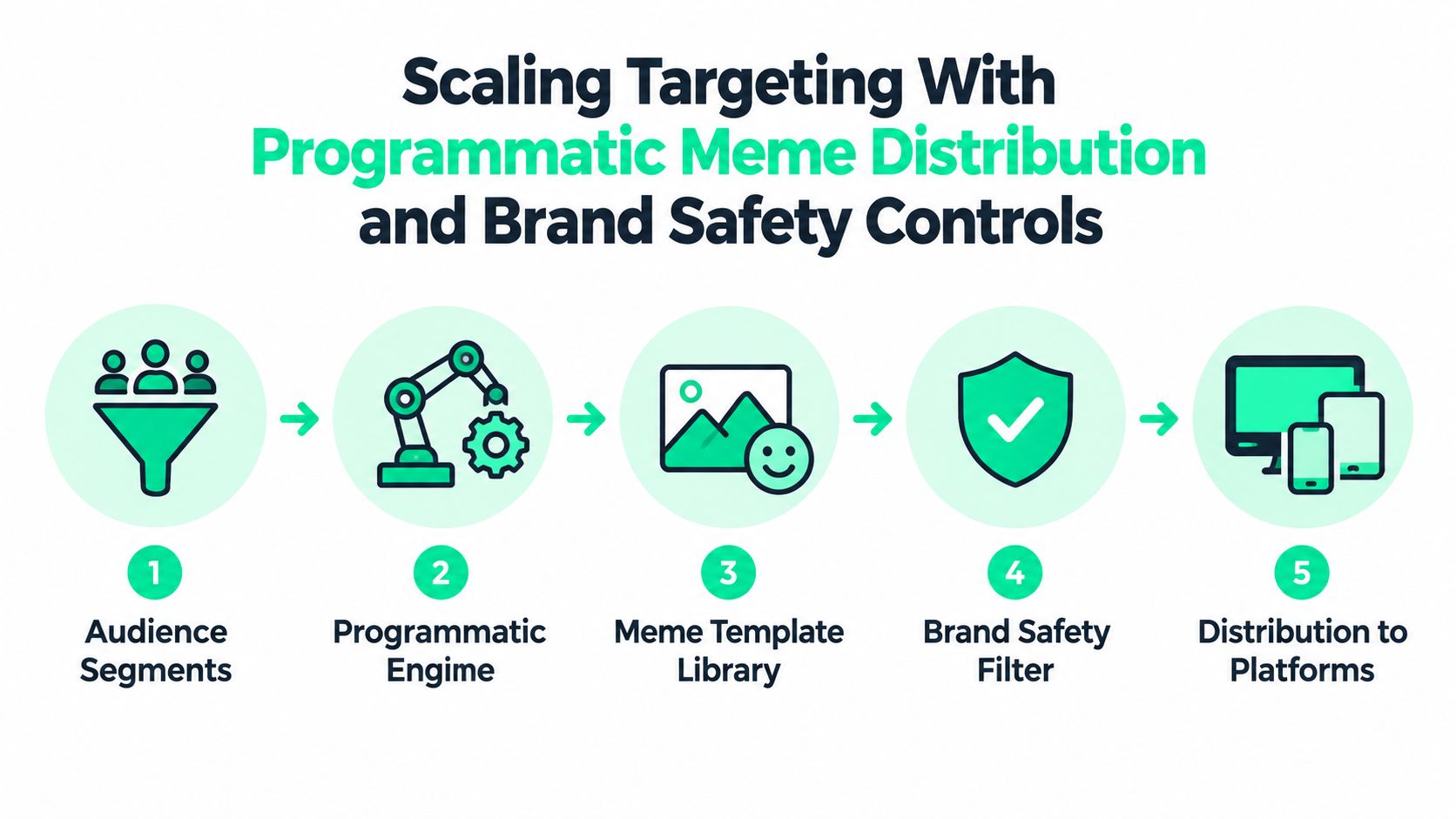
The hardest part of targeting at scale isn't choosing an audience in an ad manager. It's controlling where attention lands once you spread across many creator pages, formats, and posting environments.
Programmatic meme distribution becomes less about “memes” and more about infrastructure.
Why fragmentation breaks targeting
If you buy creator pages one by one, you create three problems fast:
- Audience inconsistency: One page looks U.S.-heavy, another doesn't.
- Operational drag: Every caption, approval, and takedown becomes manual.
- Brand exposure: Unsafe adjacency can slip through before anyone catches it.
For advertisers that need Tier 1 American reach, especially in categories like sports, gaming, fintech, prediction markets, and iGaming, this gets even more sensitive. A weak geography mix or one bad placement can wipe out the value of otherwise cheap reach.
Brand safety has become more urgent as digital video and social ad spend grows. eMarketer reports that 83% of advertisers say brand safety will become an increasing concern as digital video ads grow, and more than half of U.S. marketers say social poses the greatest brand safety risk, according to eMarketer's report on digital video and brand safety concerns.
What a controlled system looks like
A better model routes creative through a vetted network with review checkpoints before anything goes live.
Independent guidance now emphasizes that strong brand safety requires documented creator vetting, clear guardrails before campaigns go live, placement controls and suitability settings for risky or synthetic content, plus third-party measurement and verification, according to eMarketer's 2026 brand safety FAQ.
That's why attention to detail and systems in place to review every submission in real time matter so much when you're trying to scale attention to billions of views while protecting your brand and ensuring those views are in high quality geographies.
Published practitioner guidance on demographic filtering also recommends confirming U.S. audience share at the creator level, reviewing state or DMA delivery, excluding weak geographies, locking creator lists, applying state controls for regulated offers, and recording rejection rules before launch. Those practices are laid out in this guide to demographic filtering for creator campaigns.
Where verified attention routing fits
This is the reframing. Targeting isn't just picking an audience. It's verifying the path attention takes from content to viewer.
One example of this model is FindClout, which programmatically distributes branded meme content across vetted creator pages with audience rules, fraud screening, geo filters, and real-time review before posting. That setup is useful when a brand wants high-volume reach but still needs American audience quality control and centralized enforcement of caption and placement rules.
Integral Ad Science also reports that 75% of consumers feel less favorable toward brands that advertise on sites spreading misinformation, based on its state of brand safety research. That's why brand safety controls aren't separate from targeting. They are targeting.
Measuring What Worked and Proving Incremental Impact
Measurement got messier when privacy reduced user-level visibility. A lot of buyers still act as if the old attribution view is complete. It isn't.
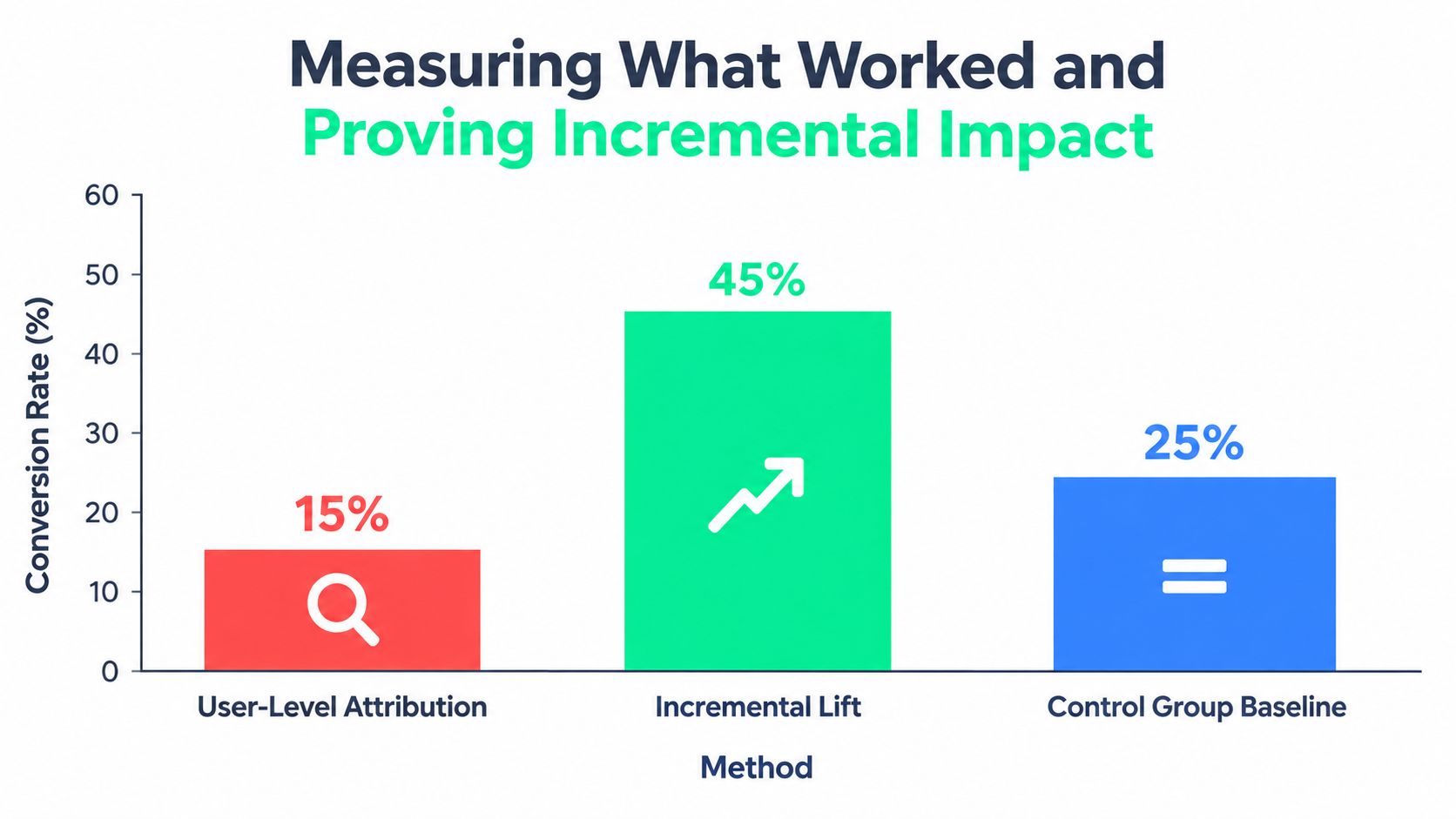
The practical shift is simple. Stop asking only, “Which ad got the click?” Start asking, “Which targeting and creative combination created incremental business value at an acceptable cost?”
What still works under signal loss
Retargeting remains strong, but it's no longer as straightforward as dropping a pixel and trusting the dashboard. An industry-wide field experiment across more than 2,000 advertisers found retargeting lifted baseline conversions by 4.6%. After third-party-cookie removal, Privacy Sandbox recovered 46.3% of lost ad clicks and 43.5% of lost click-through conversions. On a spend-adjusted basis, Sandbox reached 86.4% of traditional retargeting for clicks per dollar and 81.8% for conversion per dollar, according to this benchmark summary.
That's why good teams optimize for budget-normalized conversion efficiency, not just raw click totals.
A practical measurement stack
Use different methods for different questions:
- Platform reporting: Good for directional feedback and creative triage.
- Incrementality tests: Best when you need to know whether targeting caused lift.
- Marketing mix modeling: Better for broader spend allocation when user-level matching is weak.
- First-party lift analysis: Useful when you have reliable customer data and clean exposure groups.
If you're running creator or meme-based campaigns, performance analysis should include not only conversions but also page-level quality, geography mix, and removal logic. This guide on meme campaign analytics to optimize spend is a good example of how to think beyond simple last-click reporting.
Don't confuse trackable with valuable. The most measurable click isn't always the most incremental one.
Protecting the read before you trust the metric
Measurement also depends on content suitability. If placements drift into low-trust environments, engagement data can mislead you because the context is doing part of the work. Teams that run large-scale creator or short-form placements often maintain blocklists and exclusion logic by theme, phrase, or category. A practical keywords to block guide can help shape that screening layer.
The point isn't to build a perfect attribution machine. It's to create enough verification that you can tell whether manual targeting, AI-optimized delivery, or context controls improved business outcomes.
Common Pitfalls to Avoid and Your Next Steps for Smarter Targeting
The biggest mistake in social media audience targeting is assuming more precision always means better performance.
Sometimes narrower targeting helps. Sometimes it just gives you smaller learning loops, higher costs, and false confidence.
The traps that hurt most
Here are the failures I see most often:
- Over-narrowing early: Buyers stack age, interests, behaviors, and exclusions before the system has room to learn.
- Trusting platform geography labels blindly: “U.S.” doesn't automatically mean high-quality American audience delivery.
- Ignoring brand adjacency: Reach that shows up next to misinformation, synthetic junk, or off-brand humor can cost more than it's worth.
- Chasing fake scale: Large view counts without verification, review systems, and creator-level checks can hide fraud or weak audience quality.
- Reading clicks as proof: Cheap engagement can still come from the wrong people, the wrong context, or the wrong geography.
A better operating checklist
Use this instead:
Set hard business constraints first
Define geography, compliance boundaries, exclusions, and brand-safety rules before creative launch.Choose the loosest audience that still makes business sense
Give the platform room to find converters, but don't give up quality control.Test creative angles faster than audience tweaks
When delivery models are increasingly creative-first, fresh message variations often teach more than another layer of targeting filters.Verify the path to attention
Review creator quality, geography mix, and contextual fit in real time if you're using distributed social placements.Measure incrementality, not just attribution comfort
If reporting says it worked, but lift is missing, trust the lift read.
If you can't explain why a specific audience should care, you're not targeting. You're just narrowing.
Smart targeting today is part audience design, part creative fit, and part control system. That's especially true if your edge is Tier 1 American audiences and brand safety. The marketers who scale cleanly are the ones who treat targeting as verified attention routing, not a checklist inside an ad platform.
If you want a way to apply that thinking in creator-style distribution, FindClout offers programmatic branded meme campaigns across vetted pages with American audience filters, real-time review, fraud screening, and brand controls. It's built for teams that need scale without giving up geography quality or placement oversight.
Want this audience for your brand?
FindClout puts your brand in front of verified American audiences across every major US page — brand-safe, at scale.
Start Your Campaign