 findclout.com
Influencer Ad Network: How Modern Buying Really Works
Most advice about an influencer ad network is still stuck in sponsorship thinking. That's the wrong model. If you're buying real reach at scale, you're not hiring talent, you're buying media infrastructure, and the first questions should be about control, trust, and verified view economics, not who has the prettiest creator roster.
That matters more now because the category has already moved past experiment mode. One industry summary places the global influencer marketing market at $32.55 billion in 2025, with projections to pass $40 billion in 2026, and says U.S. creator ad spend is forecast at $44 billion in 2026. The same source says brands earn an average of $5.78 for every $1 spent, and 86% of U.S. marketers plan to partner with influencers, which explains why networked creator distribution has become a buying channel, not a side project (industry summary).
Table of Contents
- Why Influencer Ad Networks Are Media Infrastructure Now
- What an Influencer Ad Network Actually Is
- Pricing Models and CPM Ranges Compared
- Brand Safety Systems That Actually Protect Spend
- Why Tier-1 American Audience Verification Matters
- How to Evaluate and Compare Networks as a Buyer
- Real-World Scenarios Where Networks Win or Lose
- A Practical Buying Checklist and Pilot Structure
Why Influencer Ad Networks Are Media Infrastructure Now
Treat an influencer ad network like a programmable supply layer, not a bundle of creators waiting for a brand brief. The buyers who still think in one-off posts are comparing the wrong thing. A real network behaves more like a media system, it routes budget across many handles, enforces rules, and returns reporting that lets you judge delivery after the fact.
The shift from sponsorships to supply
A creator deal is a relationship. A network is an operating layer. That difference matters because the market has already shifted toward reusable creator assets, managed inventory, and paid distribution, not just organic endorsements. In the broader creator economy, one market report pegs the sector at $252.3 billion in 2025 and $310.4 billion in 2026, with a projection to $1.3455 trillion by 2033 at a 23.3% CAGR (creator economy report).
That growth is only part of the story. The operational shift is bigger. Brands now repurpose creator content in paid ads, include usage rights in contracts, and use AI to scale creator discovery and measurement. In other words, the network is no longer just finding people to post, it's moving content through a paid media system.
Practical rule: if a vendor can't explain how it controls delivery, filters audience quality, and proves where views came from, it's not infrastructure. It's a roster with a dashboard.
For a useful adjacent read on how short-form creator buying is handled inside paid social, see paid social strategies for short-form creators.
Why the infrastructure lens is the only one that holds up
I'd rather evaluate a network like a DSP than like an agency. That means asking about supply quality, verification, pacing, and post-level reporting before I ask about creative taste. It also means ignoring slide-deck fiction like “premium reach” unless the network can show how it protects that reach from bad geography, weak engagement, or fraud.
The old sponsorship mindset collapses fast under modern buying pressure. There's fragmented creator supply, more regulatory scrutiny, and a constant need for tier-1 U.S. delivery at scale. If the network can't handle all three, it's not built for serious budgets.
What an Influencer Ad Network Actually Is
An influencer ad network is a technology layer that aggregates vetted creators, normalizes their audience signals, and routes paid spend across many handles at once. That's very different from emailing ten creators and hoping all of them post on time. It's also different from buying through a traditional ad platform, because the network brings native creator inventory and creator-specific audience data into the transaction.
Think of it like an exchange for short-form inventory
The easiest analogy is an ad exchange for creator content. The buyer supplies budget, targeting rules, caption requirements, and exclusions. The network then distributes across eligible creators, checks approvals, and reports what shipped. You're not negotiating every placement one by one, you're buying through a coordinated supply system.
That system usually has a few core parts. Creator onboarding comes first, then audience verification, then content approval, then pacing, then reporting. If a vendor can't describe those steps clearly, it's probably hiding operational gaps behind influencer language.
A useful way to map it is this:
- Creator onboarding identifies who can participate and what inventory they control.
- Content approvals decide what can go live and what gets blocked.
- Audience verification checks whether the viewers are the market you said you wanted.
- Pacing and routing spread spend across handles without dumping too much volume into one page.
- Post-campaign measurement shows which creators, captions, and geos carried the result.
How it differs from one-off deals
A one-to-one creator deal buys a single relationship and a single voice. That's useful when the narrative matters more than scale. But it's slow, hard to standardize, and expensive to coordinate across many creators. A network trades some of that intimacy for operational control and repeatability.
That's why the network model fits performance buying better than old-school sponsorship thinking. You can test faster, cap risk, and shift spend where delivery is clean. You can also enforce rules across the whole system instead of begging each creator to remember the brief.
Buyer's rule: if you need campaign consistency, the network matters more than the individual personality. If you need a single face to carry a brand story, a network is the wrong tool.
For a closer look at how price discipline changes when distribution is managed at the network level, read performance advertising by Wojo Media.
Pricing Models and CPM Ranges Compared
The pricing model tells you what the network is really selling. Some buyers want raw reach, some want niche context, and some want full content production. If you confuse those three, you'll overpay for creative when you needed distribution, or buy cheap distribution when the content had no reason to convert.
Three models that actually matter
The lowest-cost model is usually logo-and-caption distribution. It's built for broad awareness, fast testing, and simple brand presence. The next layer is vertical-targeted buying, where the network adds keyword requirements, exclusions, and niche placement rules. The most expensive path is a full content campaign, where the brand asset gets turned into network-native creative and pushed through the system.
The important distinction isn't just price, it's what the price includes. One model may seem cheaper until you add usage rights, caption management, approval overhead, or reposting permissions. Another may look expensive until you realize it includes creative adaptation and tighter targeting.
The economics of meme-style distribution are also relevant here. If you want a comparison point for low-cost networked placement, see low CPM meme ads and how we keep meme advertising around 300 per million views.
| Pricing Models Across Influencer Ad Networks | |||
|---|---|---|---|
| Model | Typical CPM | Best For | Hidden Costs |
| Logo-and-caption distribution | Lowest | Awareness, testing, broad reach | Caption revisions, approval time, brand rule setup |
| Vertical-targeted buys | Middle | Sports, gaming, finance, crypto, and other niche contexts | Keyword exclusions, geo filters, review overhead |
| Full content campaigns | Highest | Narrative lift, custom creative, brand storytelling | Production time, usage rights, revision cycles |
How to budget without fooling yourself
If your goal is awareness, don't pay for custom production unless you really need it. If your goal is niche response, cheap broad distribution can waste money because the message lands in the wrong context. If your goal is brand lift with stronger creative fit, content campaigns can justify the premium, but only if the network gives you enough control to keep the work on brief.
The hidden cost most buyers miss is operational drag. Every extra round of approval, every repost-right negotiation, and every caption rewrite eats time and attention. That time has value, even if the invoice doesn't show it.
Brand Safety Systems That Actually Protect Spend
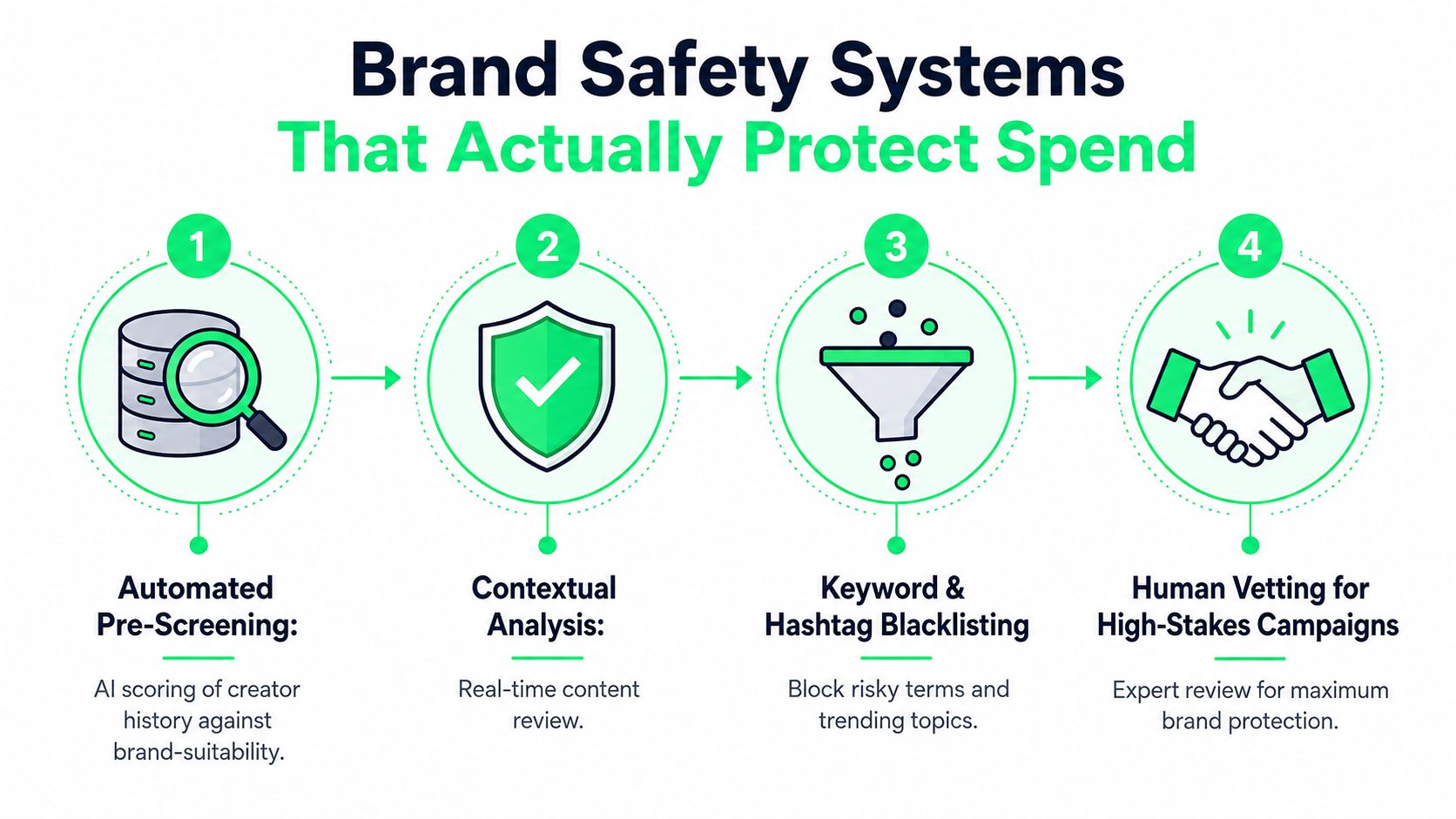
A serious influencer ad network doesn't “do brand safety” as a slogan, it runs a set of controls before and during delivery. If the vendor can't show you the stack, assume the stack isn't real. Regulated buyers don't need reassurance, they need process.
Pre-screening has to happen before anything goes live
The first layer is automated screening. That means creator history gets scored against brand-suitability rules, recent captions and comments get checked for risky language, and low-confidence cases get rejected before a human ever looks at them. A network that waits until after posting is already late.
A 2026 brand-safety playbook says submissions should be decided before they reach the audience, using real-time review, geo controls, fraud screening, and escalation logic, with the workflow tied to creator eligibility, content classification, audience validation, pre-bid or pre-live decisions, live monitoring, removal actions, and audit logs (brand-safety playbook).
Human review is not optional for risky or valuable inventory
Automation alone won't carry a campaign in finance, sports betting, or pharma. Flagged creators need human QA, and high-value placements need documented reviewer SLAs. If the network can't tell you who reviews what, how fast they respond, and what gets escalated, it's not ready for regulated money.
Live controls matter too. Post-blocking by keyword, exclusion of mature verticals, sentiment monitoring, and same-day takedown commitments are table stakes. Geo and language filters should also operate at the caption or campaign level, not as a vague promise buried in a sales call.
Practical rule: ask for sample rejection logs, removal audit trails, and an incident response window before you sign. If they won't show those artifacts, they're asking you to trust a black box.
For examples of how safe execution gets handled in practice, review brand safety examples.
Why Tier-1 American Audience Verification Matters
Tier-1 U.S. verification is the line between credible performance and expensive guessing. A network can promise reach all day, but if part of that reach lands in weak geographies, your CPM savings can disappear in conversion noise and compliance risk. For finance, sports betting, and anything with tighter rules, creator-level geography is not a nice-to-have.
Network claims are not enough
The weak version of geography reporting sounds fine in a pitch. The network says the campaign ran in the U.S., maybe it even shows a dashboard with a country flag. That does not prove the creator's actual audience is American, and it definitely doesn't prove the right part of that audience saw the post.
A 2026 demographic-filtering guide recommends treating geo as a real constraint layer, not proof of quality, and says U.S. delivery should be validated with creator-level audience data, state or DMA delivery checks, and exclusions for weak geographies. It also says compliant campaigns should confirm domestic inventory and reject weak traffic before purchase (demographic filtering guide).
What buyers should require instead
I want independent signals. Comment-language sampling helps. Screenshot audits help. Cross-checks against platform analytics the creator voluntarily shares help more. Aggregate-only reporting doesn't. Neither does a network that won't show samples, or one that leans on self-reported zip codes like that's enough.
The trust penalty matters here too. A 2025 BBB National Programs study found 87% of consumers trust general advertising, but only 74% trust influencer advertising, and just 5% trust influencers completely (BBB trust study). That means cheap reach can underperform if the audience doesn't perceive the placement as credible. You're not just buying views, you're buying views that still hold trust when they hit the feed.
| Network Geography Claims vs. Verified Creator-Level Geography | ||
|---|---|---|
| Signal Type | What Networks Report | What Buyers Should Require |
| Country-level dashboard | U.S. delivery shown in aggregate | Creator-level audience evidence and sample audits |
| Self-reported audience data | Zip code or demographic claims | Independent checks and platform-side validation |
| Geo filters in a pitch deck | A promise that targeting exists | Proof of delivery quality by creator and market |
| Campaign reporting | Views by network | Views tied to audience geography and on-geo quality |
For a tighter view of how tiering works in practice, see tier-1 audience clipping.
How to Evaluate and Compare Networks as a Buyer
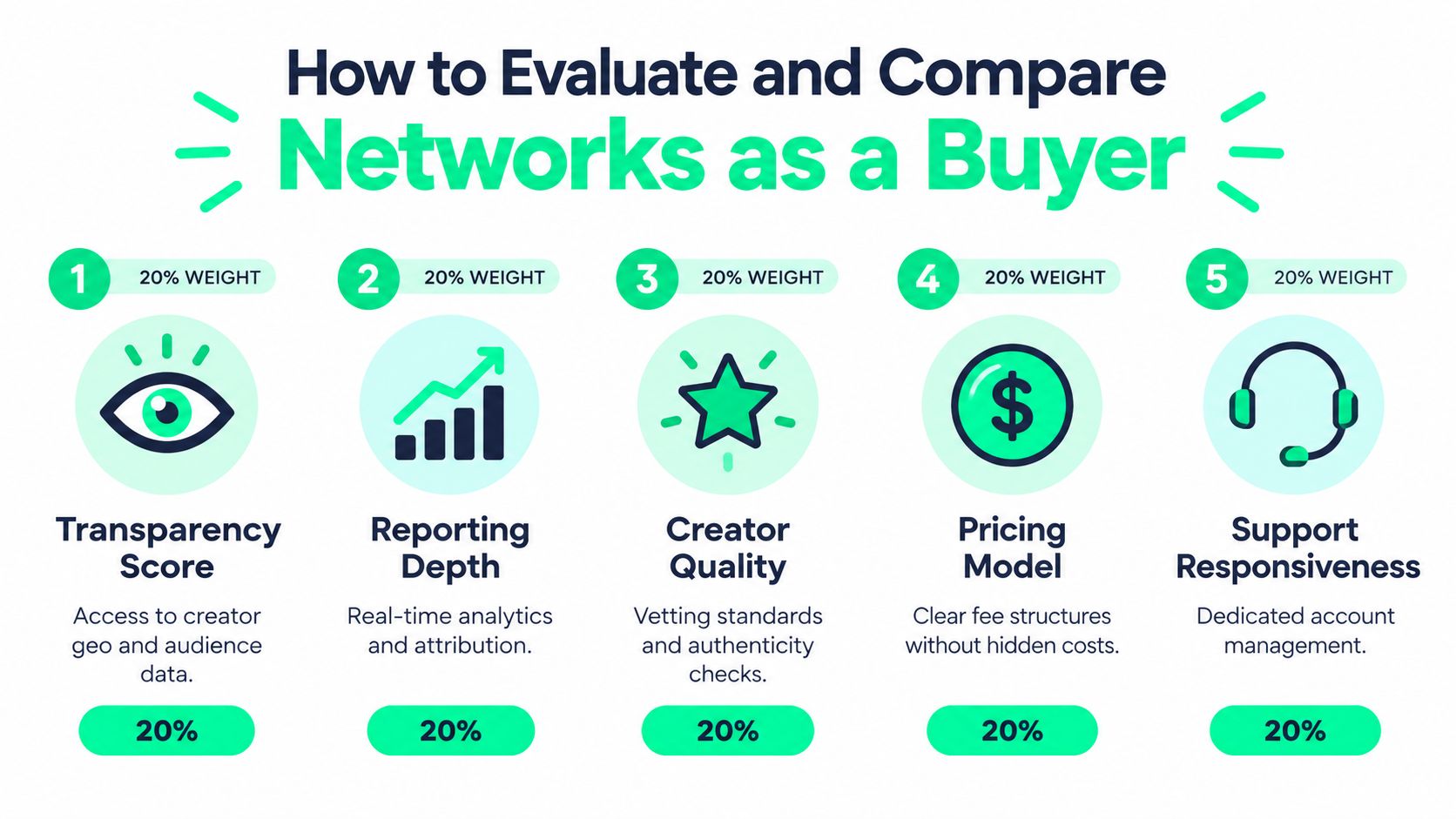
Don't run a sixty-question RFP. It wastes time and lets sales teams hide behind jargon. Run a short pilot across three to five networks, score them on a fixed rubric, and force the decision to come from evidence.
Use the same weights before anyone pitches you
Pick your criteria up front and don't change them after the demos. I'd weight price transparency, control granularity, brand-safety stack, tier-1 U.S. audience quality, and reporting depth equally unless your category demands a heavier safety bias. Once the weights are set, every pitch gets judged against the same frame.
A good pilot has identical creative, the same budget per network, and a 10 to 14 day test window. That keeps you from rewarding the vendor who just got started faster or talked the loudest in the kickoff call. Normalize CPM claims to a trust-adjusted view-through rate so the comparison doesn't get distorted by cheap but low-quality delivery.
Demand the paperwork, not the pitch
If a network wants your money, it should hand over creator-level geo audits, sample rejection lists, live reporting access, and clear fee disclosure. It should also explain how fast it can turn around content edits and removals. If the reporting only shows reach, it's not enough.
Buyer's rule: compare networks on what you can verify, not on what they say they can probably do next month.
The strongest sellers make evaluation easy because they know the evidence will hold up. Weak vendors make evaluation hard because they hope you'll get tired before you spot the gaps.
Real-World Scenarios Where Networks Win or Lose
The network model wins when the buying problem is operational, not theatrical. It loses when the brand needs a single voice, a tightly staged rollout, or a launch sequence that depends on exact creative timing.
Where the model wins
Sports betting and prediction markets are the clearest win. Daily line movement, prop volume, and rapid market shifts demand fast creative swaps across a lot of niche creators. A network with strong caption management and vertical targeting beats a polished but slow creator roster every time.
DTC apparel is another case where networks can work well, but mostly at the top of funnel. Broad distribution helps you test angles, formats, and hooks fast. It's weaker when the brand launch needs a carefully controlled narrative, because the network optimizes for spread, not storytelling.
Consumer finance is the hardest test. If the network can't hold brand-safety controls and U.S. geo verification together, it will torch budget quickly. Here, low-quality delivery and sloppy review processes turn into a compliance problem, not just a media problem.
Where the model quietly loses money
It loses when the creator's identity is the product. Luxury, founder-led launches, and certain high-consideration categories need continuity and trust that a networked page mix won't naturally create. It also loses when the buyer wants exclusivity, because network distribution is built for efficient repetition, not singularity.
A sloppy network also loses when the creative needs room to breathe. If the caption changes too often, the audience sees noise. If the content is too templated, it looks like a media buy instead of an organic recommendation.
| When Influencer Ad Networks Win vs. Lose by Vertical | |||
|---|---|---|---|
| Vertical | Networks Win When... | Networks Lose When... | Signal to Watch |
| Sports betting | Fast swaps and vertical targeting matter more than creator prestige | The network can't manage live edits quickly | Caption refresh speed |
| DTC apparel | You want cheap top-of-funnel testing | You need a tightly sequenced launch story | Creative variation quality |
| Consumer finance | The network proves U.S. audience quality and safety | Geography claims stay at the aggregate level | Creator-level geo evidence |
| Luxury or founder-led brands | None of the above, usually | The brand needs a single voice and strong narrative control | Consistency of presentation |
A Practical Buying Checklist and Pilot Structure
Use a checklist, then run a short pilot. That's how you strip out sales noise and get to evidence. A network should prove it can show creator geography, apply AI brand-safety scoring with human review, manage captions in real time, and report view economics plainly.
What to verify before launch
- Network transparency: confirm the vendor can show creator geography data, not just aggregate reach.
- AI vetting: require a real brand-safety scoring process plus human review for flagged cases.
- Reporting access: get live dashboard access with creator-level logging and removal history.
- Pilot scope: define one objective, one creative set, and one fixed budget across two networks.
- Contract terms: make sure you can exit if delivery quality, safety, or geography slips.
The pilot itself should be boring and disciplined. Lock the metrics before launch, keep the window to 14 days, and measure qualified view rate, on-geo percentage, CPA, and brand-safety incident count. After the test, reconcile the platform report against creator-level logs so you can see whether the network's story matches the delivery.
Know when to kill the test
If brand-safety incidents rise, pause. If on-geo delivery drops below the floor you agreed on, stop the campaign. If qualified view rates fall short, the network didn't earn more budget.
That's the core job of an influencer ad network buyer, separating genuine media infrastructure from the stuff that only sounds operational in a sales deck. If you want a partner that runs tier-1 American audience verification, brand-safety review, and networked distribution in one place, FindClout is built for that workflow. Use it to pressure-test your assumptions, compare delivery against creator-level logs, and decide whether networked buying truly beats your current mix.
Want this audience for your brand?
FindClout puts your brand in front of verified American audiences across every major US page — brand-safe, at scale.
Start Your Campaign