 findclout.com
Gaming Ad Network Guide for US Audiences
Most advice about a gaming ad network starts with the wrong question. Buyers ask which network reaches the most players, then discover that “players” can mean a user inside a mobile game, a viewer on a sports page, or a meme audience with no meaningful geographic verification. Reach without context, safety, and audience quality is how budgets end up paying for bot traffic, unsafe placements, or impressions that never create useful attention.
For US sportsbooks, prediction markets, iGaming platforms, fintech apps, and gaming brands, the practical standard is stricter. You need tier-one American audiences, enforceable content rules, real-time review, and measurement tied to verified attention rather than served impressions. The channel can scale, but only when the network treats brand safety as operating infrastructure instead of a checkbox.
Table of Contents
- The Blurry Definition of Gaming Ad Networks
- In-Game Inventory Versus Cultural Distribution
- Why Brand Safety Dictates US Audience Strategy
- Comparing Traditional Networks and Programmatic Meme Routing
- Evaluating Providers for Regulated Campaigns
- Routing Attention as Predictable Infrastructure
The Blurry Definition of Gaming Ad Networks
A racing-game billboard, a rewarded video in a mobile title, a streamer integration, and a sports meme page can all be labeled gaming advertising. They are different media products. Treating them as one category produces weak comparisons of CPMs, reach, and business outcomes.
A narrow in-game advertising network sells inventory rendered inside a game. The unit may be a banner, video, branded object, or sponsored placement shown during play. A broader gaming-adjacent network distributes content through the culture around games, including sports pages, gaming communities, streaming ecosystems, esports audiences, and creator-led media.
The buying implications are material. An in-game placement can match the player's activity without creating meaningful cultural relevance. A logo on a loading screen may receive a glance before the player returns to the game. A meme or sports post can carry a caption, watermark, and shareable idea into conversations about teams, matches, predictions, and betting.
Practical rule: Define the inventory before comparing the network. “Gaming” describes an audience context, not a complete buying category.
Why market estimates don't line up
Published estimates expose the terminology problem. Narrower in-game advertising figures range from roughly USD 9.4 billion to USD 12.5 billion, while broader gaming advertising definitions can reach USD 119 billion, as documented in this overview of gaming advertising statistics and market definitions. The scopes may combine in-game units, esports, creators, streaming, sponsorships, and adjacent media in different ways.
One estimate puts global in-game advertising at USD 10.822 billion in 2025, projecting USD 19.475 billion by 2031 with a forecast CAGR of 10.29% (Ken Research market data). Another values the category at USD 9.41 billion in 2025 and projects USD 19.92 billion by 2034. A separate estimate places it at USD 10.34 billion in 2025 and USD 33.0 billion by 2035 (market analysis published by Yahoo Finance). The deciding variable is scope. The 9.41 billion figure counts only rendered in-game units, while the 33.0 billion projection folds in esports and creator sponsorships, so the gap is a definition gap rather than a data conflict. Across those boundaries, the commercial direction remains clear: gaming inventory has moved beyond a niche experiment.
The definition determines the strategy
An app-install campaign tied to gameplay may suit an in-game network. A prediction market seeking familiarity among American sports fans may gain more from a gaming-adjacent cultural network, where creative can appear with captions, reactions, and sharing built into the format.
Creative quality still matters in both environments. Teams producing short-form assets can use a practical Veo3 AI gaming video guide to plan hooks, edits, and gaming-native presentation. The finished asset still requires placement controls, audience verification, and clear rules for regulated US campaigns.
Start with one buying question: Are we purchasing a moment inside a game, or routing branded content through the culture surrounding games? Until that answer is explicit, network comparisons remain mostly noise.
In-Game Inventory Versus Cultural Distribution
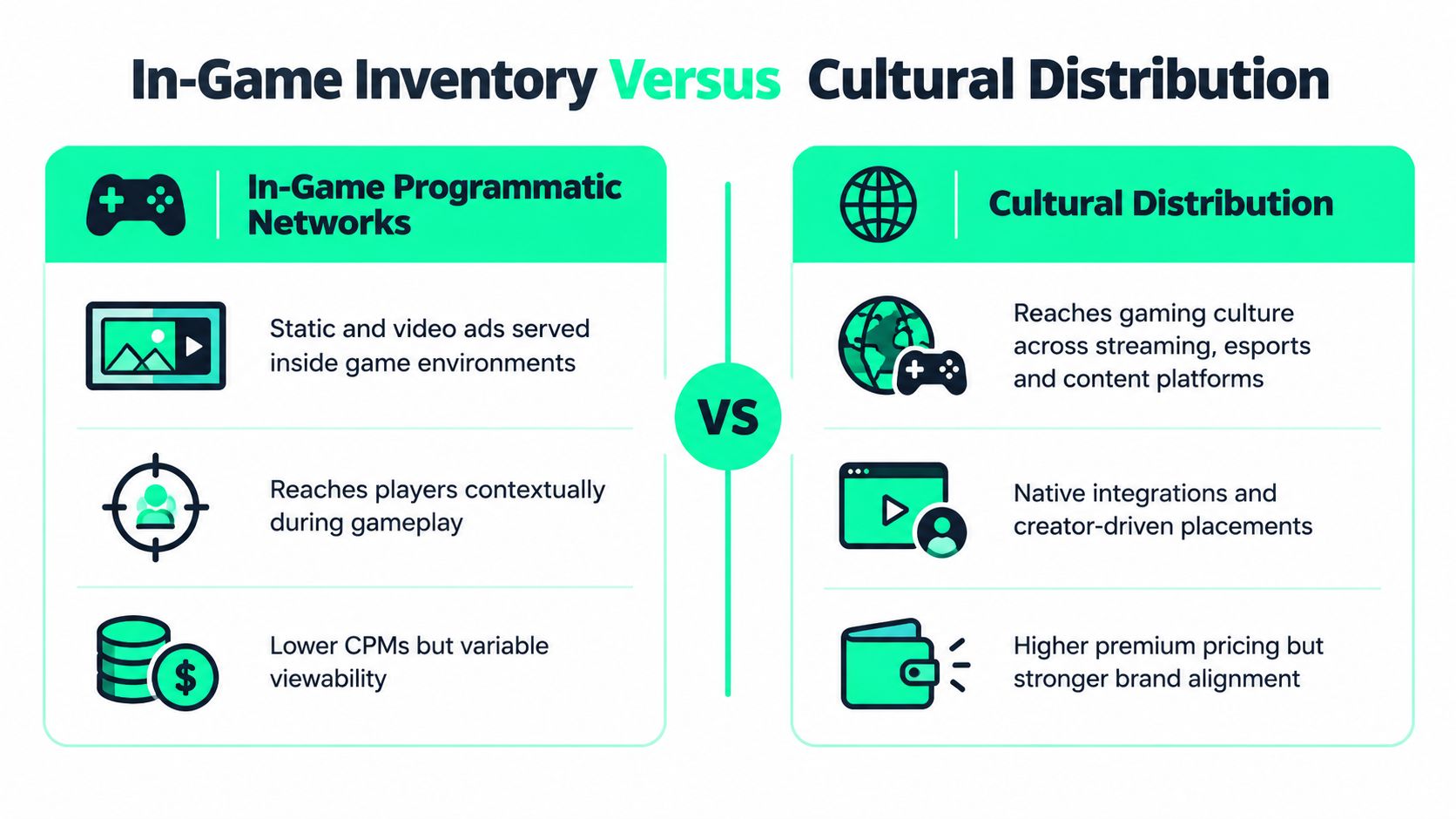
Traditional in-game programmatic buying is mechanically efficient, but its efficiency is narrow. A demand-side platform can bid on mobile, PC, console, cloud, and immersive-game inventory, then optimize for delivery, viewability, and conversion signals. The advertiser receives a standardized unit, an auction, and a reporting layer. That structure supports control, yet it does not guarantee useful context.
Cultural distribution follows a different route. Instead of waiting for a player to encounter an ad inside a game, the network places approved content across gaming, sports, creator, and meme pages. The creative belongs to the feed. It can use a caption, watermark, edit, or recurring community format rather than appearing as a detached display rectangle.
Scale exists, but scale alone isn't the advantage
The global in-game advertising category expanded substantially between 2020 and 2025, reflecting stronger gaming audiences and more mature ad technology across mobile, PC, console, cloud, and immersive environments. That growth confirms available supply. It does not settle whether the supply fits a regulated US campaign.
A served ad can meet technical delivery requirements while arriving at the wrong moment, remaining difficult to notice, or lacking a connection to the sports and betting conversation. Reach matters only when the surrounding context supports attention and compliance.
The IAB/MRC in-game measurement guidelines define a viewable display impression as at least 50% of pixels visible for at least one continuous second, with a minimum ad size of 1.5% of screen coverage and an angle no greater than 55 degrees. These standards distinguish an ad that was loaded from one that entered the player's field of view. They cannot establish cultural resonance, qualified demand, or whether the message suited the audience.
What each model buys
An in-game network buys a controlled exposure opportunity. Cultural distribution buys a content moment that can remain visible on a page, invite sharing, and match the surrounding audience's tone. Neither model wins in every use case. They solve different buying problems.
For a US sports betting advertiser, cultural distribution can fit creative tied to a game result, rivalry, player debate, or prediction behavior. A static banner can identify the brand. A native sports meme gives the audience a reason to discuss it and can travel beyond the first impression.
The operating requirements differ as well. In-game buying relies on exchange controls, placement lists, verification vendors, and format rules. Cultural networks require page vetting, caption approval, creator permissions, pre-publication checks, rapid removal, and continuous monitoring. That workload is higher, but it gives the advertiser more control over the context surrounding the message.
Buyer's test: Ask whether the campaign is optimized for an impression to be rendered or for branded content to be noticed, understood, and shared.
Why Brand Safety Dictates US Audience Strategy
For regulated advertisers, global reach isn't automatically valuable. A sportsbook or prediction market needs traffic from permitted jurisdictions, suitable audiences, approved language, and placements that don't create a misleading or unsafe association. If the network can't show where delivery occurred and why each page passed review, raw reach is a liability.
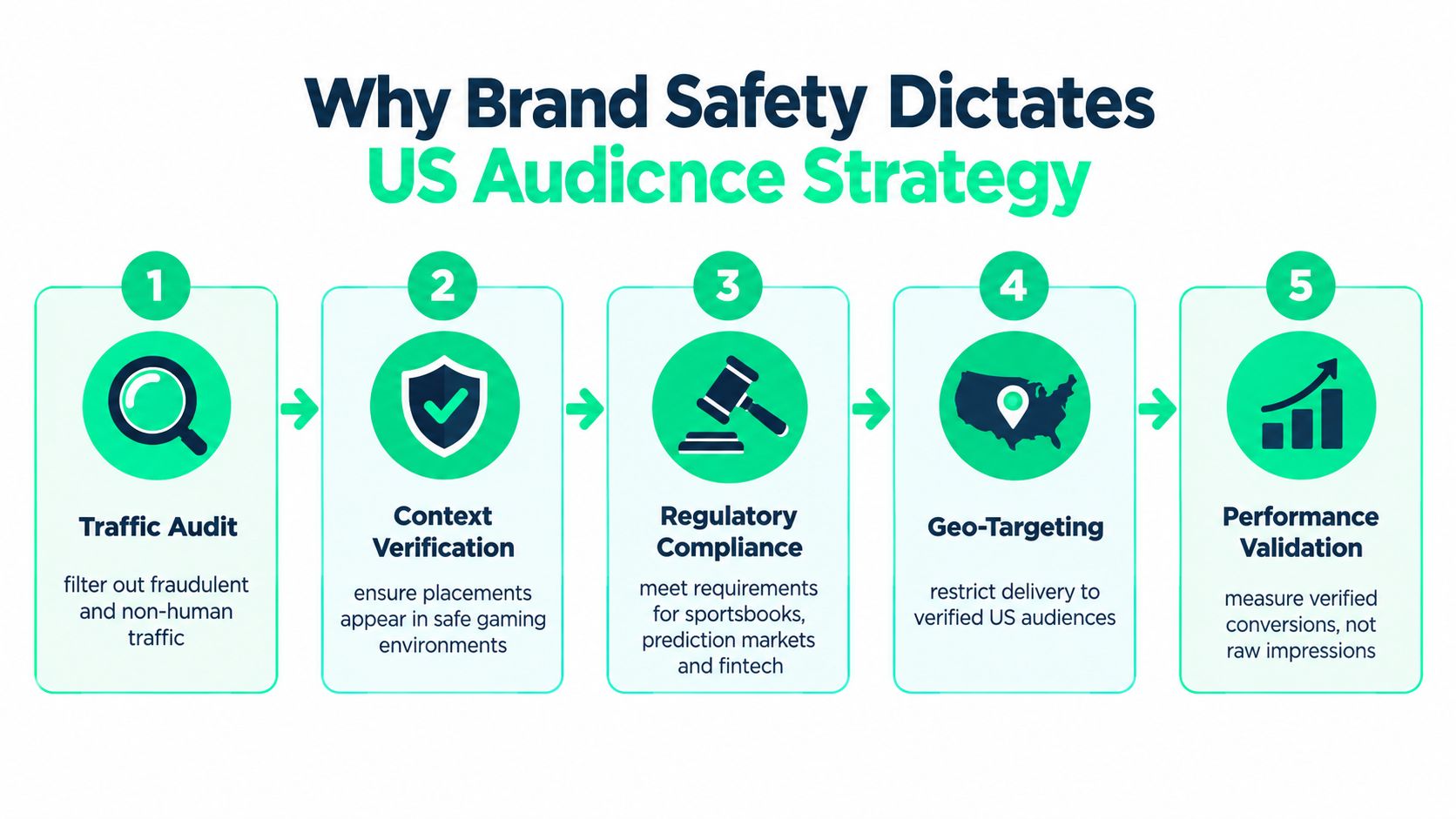
Brand safety starts before publishing. The workflow should combine automated screening, human review, enforceable exclusions, geographic controls, and a kill switch that can stop distribution when a page or caption changes.
Safety has to operate in real time
Social moderation providers demonstrate that review systems can respond at sub-second speed. Respondology says it hides brand-damaging, spam, and toxic comments in less than a second, while another provider describes instant analysis across 20+ risk categories and 100+ languages in its social moderation overview. The lesson for gaming distribution isn't that every network uses the same tooling. It's that delayed review is no longer an adequate operating assumption for high-volume campaigns.
A strong process should include:
- Pre-publication screening: Review the page, creative, caption, surrounding content, and audience eligibility before release.
- Live enforcement: Apply rules to new submissions and changed captions, then pause or remove content that breaks the approved policy.
- Human escalation: Route ambiguous humor, sensitive news, gambling language, and potential policy violations to trained reviewers.
- Post-flight auditing: Record what ran, where it ran, what was removed, and whether the delivery matched the geographic brief.
A real-time livestream safety system launched in 2025 describes a similar three-layer model, PreFlight, LiveOps with a kill switch, and PostFlight, as reported in coverage of the livestream ad-safety system. The structure translates well to gaming-adjacent campaigns because a page can become unsafe after approval, especially when live events and sports commentary move quickly.
US verification is a risk control
Tier-one American targeting isn't just a preference for higher-value traffic. It limits waste and gives compliance teams a clearer operating boundary. Independent audience research identifies sports gamers as over-indexing among young adults aged 23–39, supporting a focused approach to US sports and gaming audiences (Guide to US Gaming Audiences 2025).
That doesn't mean every sports page is suitable. The buyer still needs audience geography, engagement quality, page history, content exclusions, and a review record. A network should be able to separate American delivery from broad global traffic rather than presenting one blended audience number.
The safety risk is visible in gaming apps. An industry ranking reported that one in 58 ads in gaming apps is malicious, about one in 182 is offensive or sensitive, and roughly one in five interstitial ads and one in ten rewarded ads are unskippable (ad quality and safety ranking from Business of Apps). These figures make format controls and verification operational necessities, not optional enhancements.
For regulated brands, attention only has value when the advertiser can defend the placement.
Teams building campaigns around betting, prediction markets, or crypto can also review this practical guide to brand safety and compliance in meme marketing. The useful standard is simple: approve the context before publishing, monitor it while live, and preserve enough evidence to explain every decision afterward.
Comparing Traditional Networks and Programmatic Meme Routing
The choice isn't between a cheap network and an expensive network. It's between two forms of attention.
Traditional in-game programmatic buying places a unit inside the game experience. Programmatic meme distribution places branded content on pages that already publish the language, humor, and debates followed by gaming and sports audiences. For a prediction market, that distinction can affect whether the message feels like an interruption or part of the conversation.
| Feature | Traditional In-Game Network | Programmatic Meme Distribution |
|---|---|---|
| Placement | Display, video, or interactive units inside game environments | Native posts, captions, watermarks, and creator-led content |
| Attention model | Exposure during gameplay or a transition | Feed-based attention with potential sharing and repeat visibility |
| Context | Game title, genre, device, and placement position | Sports, gaming, finance, creator, and meme communities |
| Control challenge | Viewability, fraud, app quality, and format interruption | Page vetting, caption approval, content rules, and rapid removal |
| Best fit | Install campaigns and contextual game exposure | Cultural relevance, brand familiarity, and sports-led acquisition |
| Measurement priority | Viewability, completion, clicks, and conversions | Verified views, eligible geography, page quality, and downstream actions |
The table isn't a claim that memes always outperform in-game ads. It shows why the buying logic differs. An in-game ad usually disappears when the unit closes or the player moves on. A post can remain on a creator page and be shared beyond the first viewing session.
Cost needs a clean definition
CPM comparisons become misleading when one vendor bills served impressions and another bills verified views. Buyers should ask whether the quoted rate includes fraud screening, page-level controls, content adaptation, removal, reporting, and geographic validation.
A premium cultural placement may cost more per unit than a basic display impression, yet still be more efficient if the audience is closer to the intended market and the creative earns organic attention. Conversely, low CPM inventory can become expensive after excluding unsafe apps, weak geographies, accidental clicks, and non-human activity.
For teams comparing social buying with creator distribution, this analysis of short-form media networks versus traditional ad platforms is useful because it frames the decision around control, distribution, and the type of attention being purchased.
The cheapest impression is often the one that survives verification, not the one with the lowest initial bid.
Cultural fit does the conversion work
A sports betting message needs more than a sports-shaped audience. It needs an approved caption, a recognizable moment, and a page whose followers already understand the surrounding reference. The creative should make the next action clear without making unsupported claims or using language that creates compliance risk.
That means campaign teams should build several approved variants before launch, define prohibited topics, and set a process for real-time caption changes. A brand watermark can maintain recognition, while a relevant caption gives the audience a reason to remember the advertiser.
Evaluating Providers for Regulated Campaigns
A provider can promise gaming reach and still fail the first serious compliance review. Before approving a test, ask for the operating details, not just a media kit.
Start with the submission workflow
Require a demonstration of the exact path from asset upload to publication. You should be able to see where the provider applies prohibited terms, required disclosures, geo-filters, follower thresholds, category exclusions, and page-level approval.
A useful evaluation sequence looks like this:
- Submit a controlled asset. Use a caption containing both approved and prohibited language to test whether the rules engine catches the issue.
- Inspect human review. Ask who handles ambiguous material, sports controversy, gambling references, and fast-moving events.
- Test a removal. Confirm how quickly a live post can be paused or removed and whether the action appears in reporting.
- Validate geography. Request audience evidence by country and, where relevant, city or tier-one classification.
- Audit delivery. Separate verified views from impressions served, and ask how suspicious activity is filtered.
Real-time caption management matters because a campaign can become non-compliant through a copy change even when the logo and image remain unchanged. A provider should support network-wide updates without forcing the buyer to coordinate with every page individually.
Demand delivery evidence
Don't accept “we reach American audiences” as a sufficient answer. Request a placement sample, audience breakdown, page history, removal policy, and a clear definition of a verified view. If the provider can't explain how it excludes low-quality traffic, it isn't offering measurable scale.
A pilot should also test operational stress. Can the network process a large volume of submissions without weakening review? Can it maintain US targeting when delivery expands? Can the reporting identify which pages create quality attention rather than only showing an aggregate total?
Buyers evaluating performance partnerships may also benefit from understanding how CPA networks work, especially when comparing impression-led pricing with acquisition or action-based commercial models. The payment model should match the campaign objective, but compliance and traffic quality still need independent verification.
Use a provider scorecard
| Evaluation area | Questions to ask |
|---|---|
| Content controls | Can the advertiser approve captions, logos, topics, and disclosures before publication? |
| Audience quality | Can the provider document US and tier-one audience composition at page level? |
| Moderation | Does automated screening work alongside continuous human review? |
| Enforcement | Is there a live pause or removal mechanism with an audit trail? |
| Reporting | Are views verified, geographically separated, and tied to individual pages? |
| Scalability | Can the network expand distribution without relaxing exclusions? |
| Commercial terms | Are management fees, minimums, guarantees, and billing definitions explicit? |
The right provider behaves less like a loose creator marketplace and more like controlled media infrastructure. That distinction matters most when the campaign carries regulatory, reputational, or financial consequences.
Routing Attention as Predictable Infrastructure
Gaming advertising becomes scalable when buyers can route verified attention through a controlled network instead of purchasing disconnected impressions. Campaign managers should be able to define the audience, approve creative rules, restrict geography, monitor placements, and identify the pages producing qualified engagement. That control separates a repeatable media system from a broad gaming buy with uncertain quality.
American sports provide a practical distribution layer for regulated campaigns. Sports-led pages concentrate the demographic that iGaming and prediction-market messages need, allowing delivery to be scoped to verified handles instead of a blended global gaming audience. The US gaming audience research supports the broader audience rationale, while page-level verification still determines whether a placement deserves budget.
Infrastructure changes the buying conversation
A scalable provider should answer operational questions before launch:
- Which pages are approved for the campaign?
- Which captions, logos, topics, and disclosures are permitted?
- How is US delivery verified?
- What happens when a post becomes unsafe?
- Which placements generated the attention?
- Can views, clicks, and conversions be reconciled?
Measurement requires the same discipline as placement controls. Teams comparing redirect, attribution, and campaign reporting options can compare link tracking tools, then choose a setup that preserves source, page, and creative-level visibility.
The principle behind attention as infrastructure is practical: attention has value for regulated advertisers when it is routable, inspectable, and repeatable. A logo inside a virtual world can build awareness. Approved content shown to a verified American sports audience in a familiar feed can provide a clearer path from recognition to consideration.
The network label matters less than execution. Buyers need the right audience, enforceable brand protections, and evidence showing where attention came from.
FindClout distributes branded meme content across curated gaming and American sports pages, with real-time caption controls, fraud screening, human review, and programmatic coordination from one platform. For a regulated US campaign, visit FindClout to discuss audience, control, and delivery requirements.
Want this audience for your brand?
FindClout puts your brand in front of verified American audiences across every major US page — brand-safe, at scale.
Start Your Campaign