 findclout.com
Content Creator Advertising Explained for Brands
Most advice about creator marketing is stuck in an older playbook. It tells brands to find a few creators, negotiate rates in DMs, approve one post at a time, and hope engagement turns into revenue. That model still exists, but it breaks the moment you need scale, control, or reliable access to Tier 1 American audiences.
The market already moved. The global influencer marketing industry is estimated at about $32.55 billion in 2025, up from roughly $24 billion in 2024 and more than triple its 2020 size, while U.S. creator economy ad spend is projected to reach $43.9 billion in 2026, rising from $37.1 billion in 2025 according to these influencer marketing industry estimates. That isn't a niche channel anymore. It's media infrastructure.
The mistake is treating creator advertising like relationship management when it behaves more like traffic routing. You're not just buying a face, a voice, or a post. You're buying access to attention streams that move through pages, feeds, clips, captions, and audience clusters. Once you see it that way, the job changes. You stop asking, “Which influencer should we hire?” and start asking, “How do we route verified views into high quality geographies while protecting the brand?”
That's where systems matter. Manual creator buying usually fails for three reasons:
- Execution breaks first: approvals, caption changes, and reporting get messy across many accounts.
- Audience quality gets blurry: follower counts don't tell you whether views come from real U.S. users.
- Brand risk compounds fast: one unsafe post, one bad page, or one poor adjacency can undo a campaign.
Brands that treat attention as infrastructure build differently. They use rules, vetting, real-time review, and programmatic distribution to scale attention to billions of views while protecting the brand and ensuring those views come from high quality geographies. That's the operating model behind attention as infrastructure, and it's a better frame for modern content creator advertising.
Table of Contents
- Introduction Why Creator Advertising Is Now Infrastructure
- What Content Creator Advertising Really Means
- How Creator Advertising Business Models Work
- Targeting Tier 1 Audiences and Verifying Attention
- Brand Safety Controls That Keep Campaigns Safe at Scale
- Measuring What Matters Beyond Reach and Engagement
- Putting Content Creator Advertising to Work
Introduction Why Creator Advertising Is Now Infrastructure
Creator advertising became infrastructure because budgets, supply, and buying behavior all changed at once. A channel doesn't become infrastructure when people talk about it more. It becomes infrastructure when buyers can plan it, forecast it, measure it, and operationalize it across campaigns.
The channel got too big for spreadsheets
One historical signal stands out. Industry research reported in 2026 said the top 1% of creators captured 21% of all creator ad-payment volume in 2025, up from 15% in 2023, while the top 10% captured 62%, up from 53%. The same market was served by nearly 6,939 specialist companies worldwide in 2025, according to creator economy market data. That's what a mature media ecosystem looks like. Concentration rises, intermediaries multiply, and buying becomes more systematic.
A manual process can work when a brand runs a handful of sponsored posts. It can't support a networked distribution engine across hundreds of vetted accounts, especially if your priority is American reach, tight controls, and real-time decisions on what goes live.
Practical rule: If your workflow depends on checking each creator manually in a spreadsheet, you're not operating a media channel. You're managing exceptions.
Infrastructure changes the buyer's job
When teams buy creator media as infrastructure, they think in inputs and controls.
They define geography. They set approval rules. They decide whether they want a logo and caption placed across existing creator inventory, a niche-targeted distribution push, or creator-led asset adaptation. They verify attention instead of trusting posted screenshots.
That's especially important for Tier 1 campaigns. U.S. and Canadian consumers are repeatedly identified as the most valuable social media audiences, and younger U.S. audiences make up a major share of sports-video consumption on social platforms, as summarized in this analysis of suitability, audience value, and platform governance. If you buy broad creator reach without checking geography and audience authenticity, you can hit your delivery target and still miss your business target.
What Content Creator Advertising Really Means
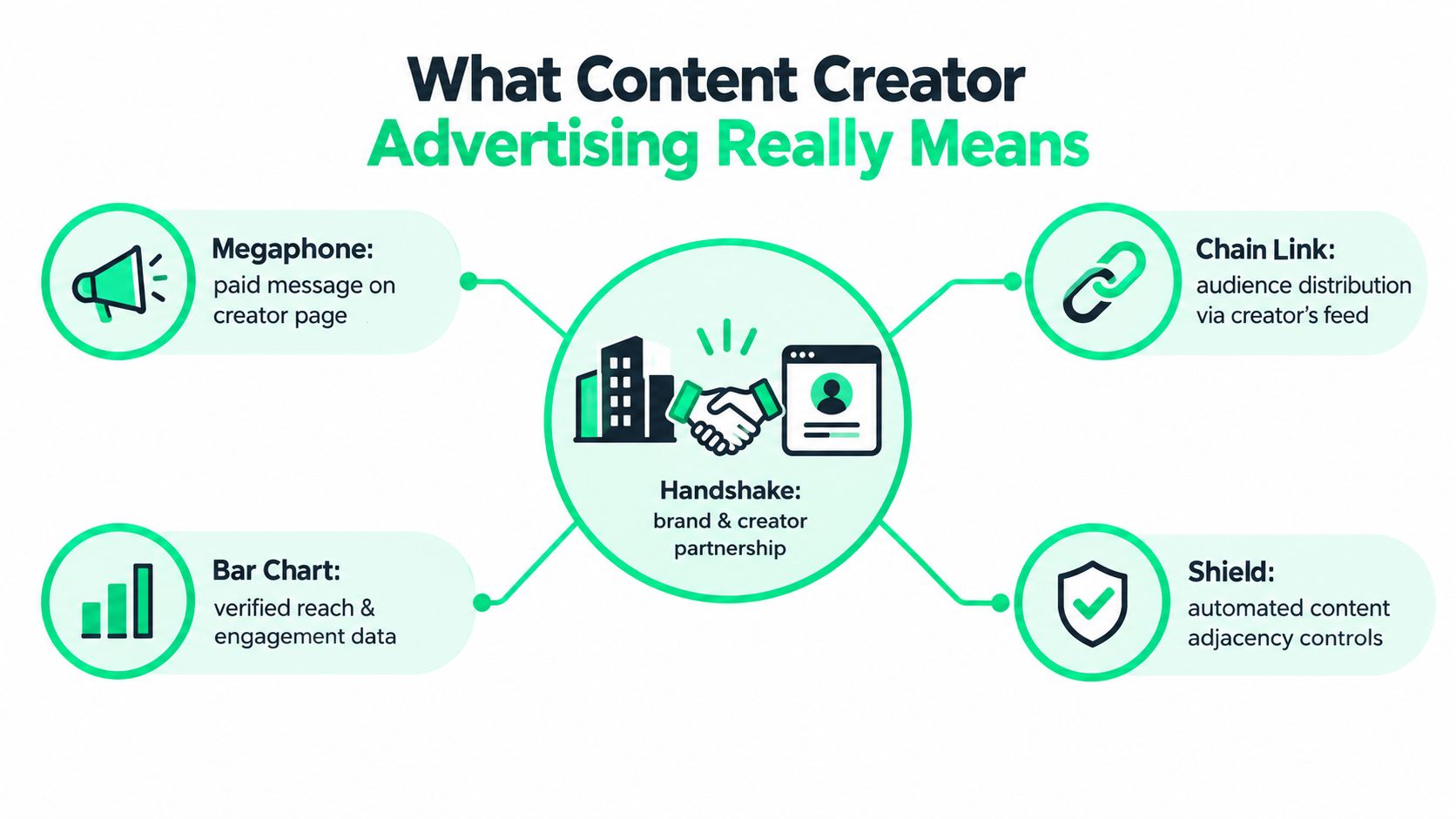
Content creator advertising is paid distribution through creator-owned attention, not just a sponsored mention.
A simple way to think about it is this: traditional paid social buys space inside a platform's ad system. Creator advertising buys access to audiences that creators already assembled, then adds rules, measurement, and distribution logic on top.
The basic mechanics
At the simplest level, a brand message appears on a creator page. That might be a short-form video, a meme variation, a captioned post, or branded creative adapted to match the page's style.
From there, the audience does the distribution work. The page posts into its feed. Followers react. Platform recommendation systems may extend reach further. Other users share or remix the content. The result is a blend of direct page distribution and platform-amplified attention.
Content creator advertising works best when you treat it like an attention-allocation system, not a single media placement.
That distinction matters because social platforms and creator marketplaces have to balance promotion against content quality. Independent economic research argues that over-allocating promotional inventory can reduce long-run content quality or distort creator incentives, which is why buyers should optimize for verified attention quality, not just gross impressions, as explained in this paper on attention allocation in creator systems.
How it differs from the common alternatives
A lot of confusion comes from lumping very different tactics together. These are not the same thing:
- Single-creator sponsorships: one creator, one deal, usually custom creative and negotiated terms.
- Partnership ads: a creator post that the brand can amplify inside a platform ad system.
- Networked creator distribution: one campaign routed across many vetted pages under centralized controls.
That third model is where content creator advertising starts to behave like infrastructure. The buyer isn't chasing people one by one. The buyer is setting distribution rules and approving what can run.
A practical example
Say a sports betting, fintech, or ecommerce brand wants to reach American sports fans. In the old model, the team might brief ten sports creators, haggle over rates, wait for drafts, and hope each one posts on time.
In a system model, the team approves captions, watermark rules, topic exclusions, and U.S. geo requirements. Then a network routes approved content across relevant sports pages with ongoing review of every submission in real time. The campaign scales because the process scales.
That's why “creator advertising” can sound fuzzy until you strip it down. It means using creator pages as media inventory, then adding the controls that performance marketers expect from any serious buying channel.
How Creator Advertising Business Models Work
The easiest way to get lost in content creator advertising is to compare unlike models. A flat-fee sponsorship, a boosted partnership post, and a pay-per-view distribution campaign all solve different problems.
Three models brands actually use
The first is the classic sponsored post. You pay a creator a flat fee to make and publish content. You get voice and personality, but control is limited and pricing often reflects the creator's standing more than the audience quality.
The second is partnership amplification. A creator makes a post and the brand puts paid support behind it through platform tools. This can work well when you want creator credibility plus platform targeting.
The third is programmatic creator distribution. Instead of paying mainly for one creator's output, you buy delivery across a network and optimize for verified views, geography, brand safety, and speed of iteration. If you want a deeper look at this logic, this piece on performance-based creator marketing and paying for meme views instead of flat fees is useful.
Choosing Your Creator Buying Model
| Model | CPM and Control | Best For |
|---|---|---|
| Sponsored posts | Usually negotiated around the creator, with less standardized control | Brand storytelling, founder-led launches, products that need a trusted face |
| Partnership ads | More control through platform ad tools, but still tied to creator content structure | Brands that want creator social proof plus platform optimization |
| Programmatic distribution | Standardized buying and centralized rules, often with verified pay-per-view logic | Scaled reach, niche targeting, American audience focus, fast testing |
Where each model fits
If your brand needs custom persuasion, use sponsored posts. A skincare founder, a consumer app with a complicated onboarding flow, or a product launch that needs demos often benefits from bespoke creator content.
If your brand already has a strong ad operation and wants creator assets inside Meta, TikTok, or YouTube workflows, partnership amplification is a clean middle ground.
If your problem is scale, fragmented execution, or repeated access to Tier 1 audience pockets, programmatic distribution is usually the sharper tool. Some platforms package this as logo and caption distribution, vertical-targeted buying, or content campaigns using brand-supplied assets adapted across creator pages.
- Logo and caption distribution: good when the message is simple and speed matters.
- Vertical-targeted campaigns: useful when you need niche placement in sports, gaming, finance, or crypto with exclusions.
- Content campaigns: better when the brand has source assets and wants creator-native variations.
The right buying model depends less on “creator marketing” as a category and more on what you need to control: message, audience, speed, or production.
For creators who want to understand the other side of the table, SuperX has a practical primer on how to partner with brands. It's helpful because strong creator relationships still matter, even when the buying layer becomes more programmatic.
Targeting Tier 1 Audiences and Verifying Attention
Cheap reach can hide expensive mistakes. A campaign can look efficient on paper and still waste budget if the audience sits outside your target geography, if engagement is synthetic, or if the content lands on pages with weak attention quality.
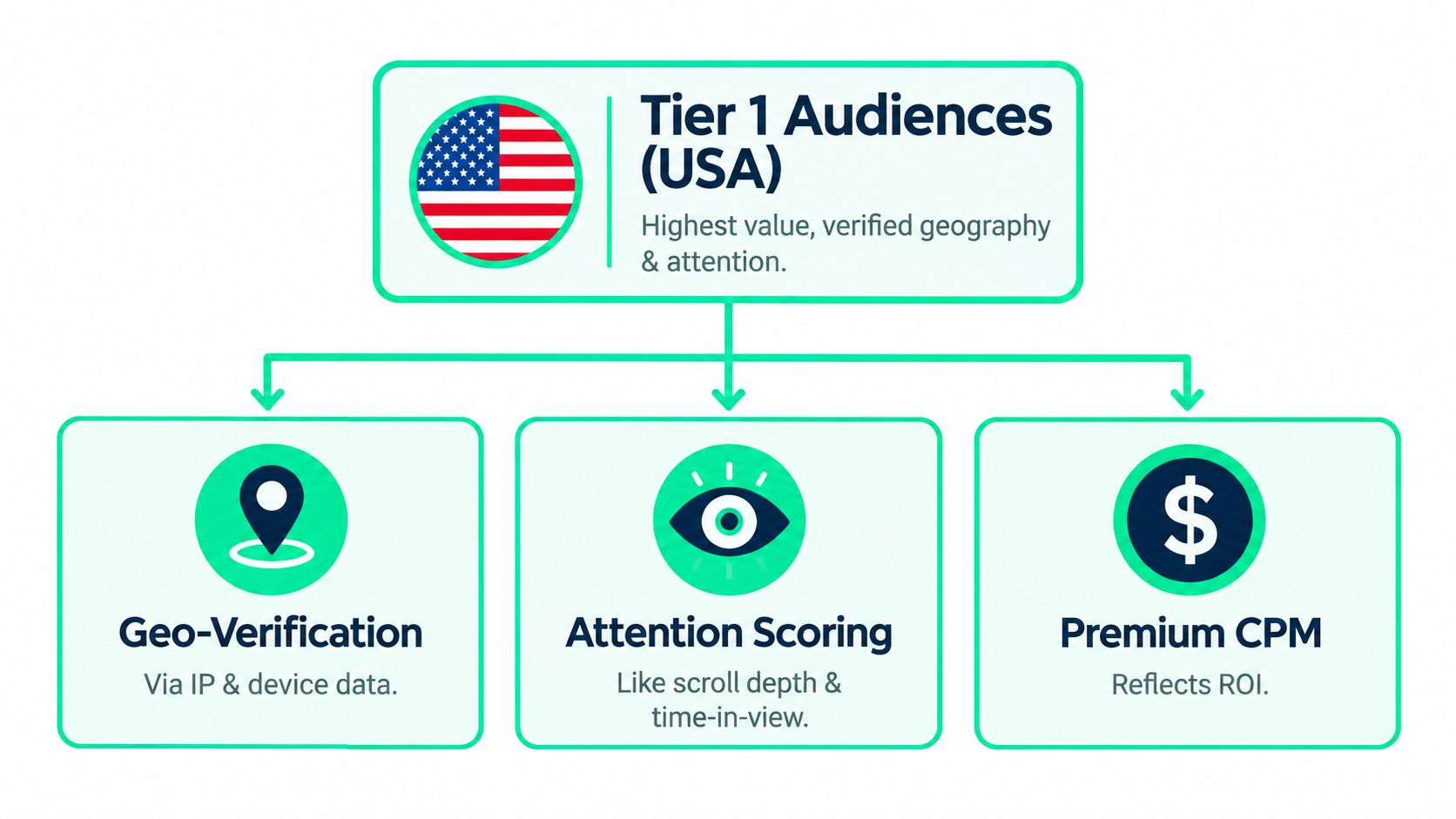
That's why serious content creator advertising starts with audience verification. For most consumer brands, fintech advertisers, gaming operators, and sports-focused campaigns, Tier 1 American audiences are the center of gravity.
Why smaller and niche creators often win on efficiency
Follower count is one of the most misleading shortcuts in creator buying. Benchmark data summarized by HubSpot reports roughly 5% engagement for novice creators under 3,000 followers, about 3% for micro-influencers with 3,000 to 30,000 followers, and about 2.5% for larger established influencers above 30,000 followers. The same benchmark summary notes TikTok at around 4.25% average engagement, with Instagram typically lower for mid- and macro-tier accounts, according to this creator engagement benchmark summary.
That doesn't mean small creators always outperform. It means segmentation matters. Smaller pages often hold tighter audience trust and clearer niche identity, which can lower wasted reach and improve cost per engagement in practice.
What verified attention actually checks
A high-quality creator campaign should validate more than posted view counts.
Look for systems that review every submission in real time and screen for:
- Geography quality: whether the audience over-indexes toward the U.S. and other high-value English-speaking markets.
- Authenticity signals: fake followers, bot spikes, recycled engagement, and suspicious audience behavior.
- Context fit: whether the page's content theme matches the campaign's niche.
- Handle-level performance: which specific accounts are driving real attention, not just nominal reach.
A platform like FindClout, for example, offers creator-page distribution with geo filters, fraud screening, live handle breakdowns, and pay-per-view campaign structures for brands that need centralized buying across vetted accounts. That kind of setup is useful when your campaign has to scale fast without giving up control over audience quality.
A short vetting checklist
Before you increase spend, ask four plain questions:
- Where are the viewers located? “Mostly U.S.” should be validated, not assumed.
- Does the page's audience match the niche? Sports pages should look like sports audiences, not generic traffic pools.
- Can weak pages be removed fast? You need page-level control, not just campaign-level reporting.
- Are submissions reviewed before or after posting? Pre-review protects the brand. Postmortems don't.
When brands scale attention to billions of views safely, they usually aren't relying on follower counts. They're relying on review systems, geo verification, and strict filtering of low-quality inventory.
Brand Safety Controls That Keep Campaigns Safe at Scale
Brand safety in creator media isn't a soft concern. It's an operating requirement.
Independent industry guidance defines brand safety as the controls that keep ads away from content considered inappropriate for advertising, and that same guidance stresses that creator partnerships add risk because a creator's past content, conduct, and audience behavior can affect reputation. It recommends documentable vetting, clear guardrails before launch, and third-party measurement as part of a modern safety stack in this overview of brand safety guidelines for creator partnerships.
The safety stack that actually works
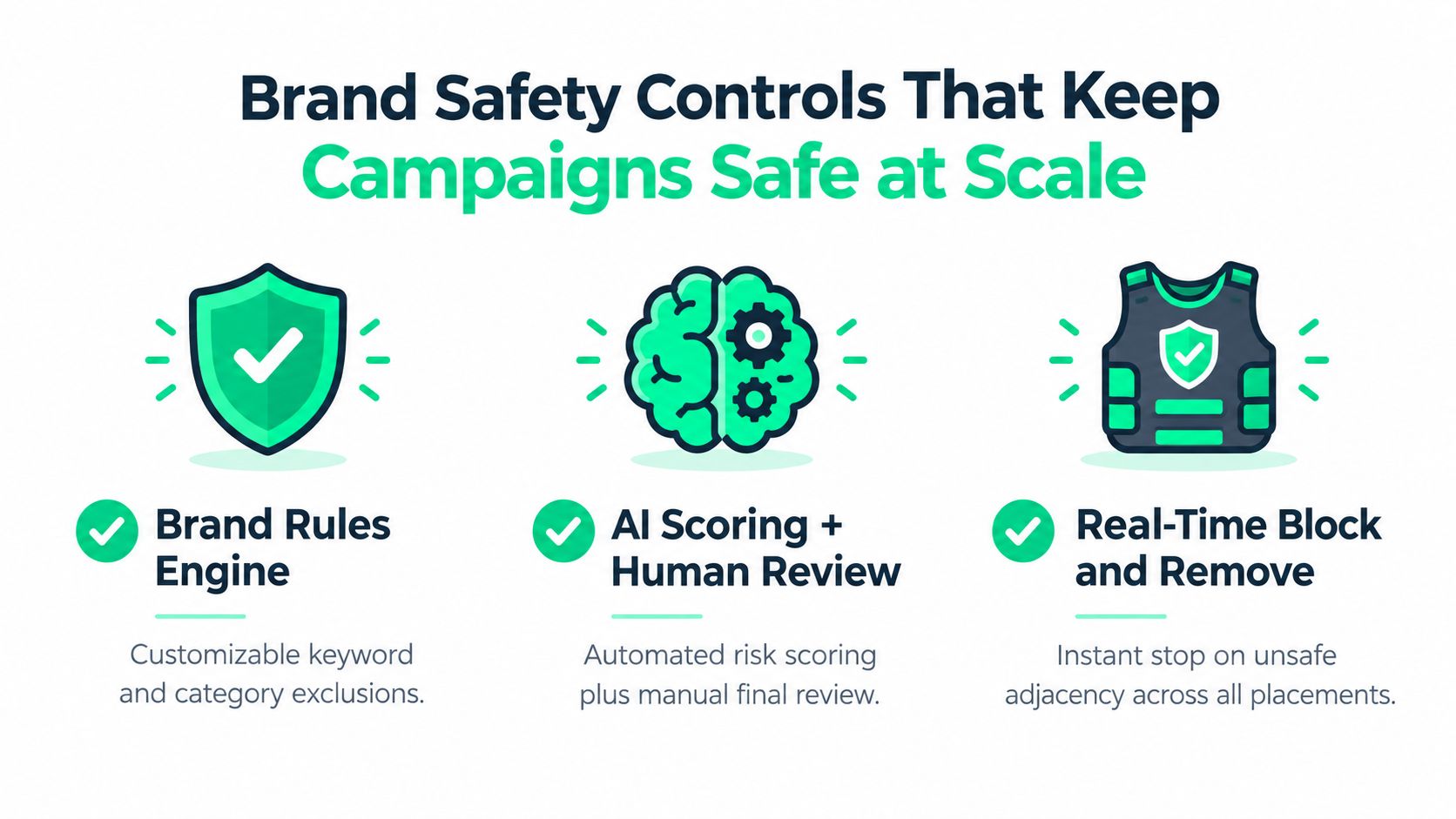
One control is never enough. Safe scale usually comes from stacked protections.
Brand rules engine
This is the policy layer. The advertiser sets required terms, prohibited topics, follower thresholds, niche boundaries, and geography restrictions before anything goes live.
AI scoring plus human review
Automation catches volume. Humans catch nuance.
A risk model can flag suspect pages, dangerous captions, or pattern mismatches quickly. Human reviewers then make final decisions on edge cases, context, and suitability.
Real-time block and remove
You need the ability to stop distribution fast. That means page-level blocking, creator exclusions, and immediate removal when a placement drifts off-brand.
A safe creator campaign isn't just “carefully chosen creators.” It's a system where nothing publishes without rules, review, and a kill switch.
Platform controls still matter
Paid social systems also offer native controls, but they vary by platform. A 2026 operational guide outlines differences across Meta, TikTok, and YouTube, including inventory filters, content-type exclusions, page blocking, hashtag exclusions, creator exclusions, and sensitive-events toggles in this paid social brand safety guide.
That's useful because creator advertising often sits partly inside and partly outside platform-native buying. You may need both a network-level rules engine and platform-level exclusions.
If your compliance team works in restricted categories, practical examples can help sharpen the checklist. For gambling-related campaigns, this guide to PAGCOR ad enforcement by Top is a good example of how category-specific ad rules create extra review needs.
For a more creator-network-specific lens, this article on brand-safe meme campaigns and controlling meme marketing shows how pre-approval, exclusions, and removals can work together in fast-moving social environments.
Measuring What Matters Beyond Reach and Engagement
Reach is easy to buy. ROI proof is harder.
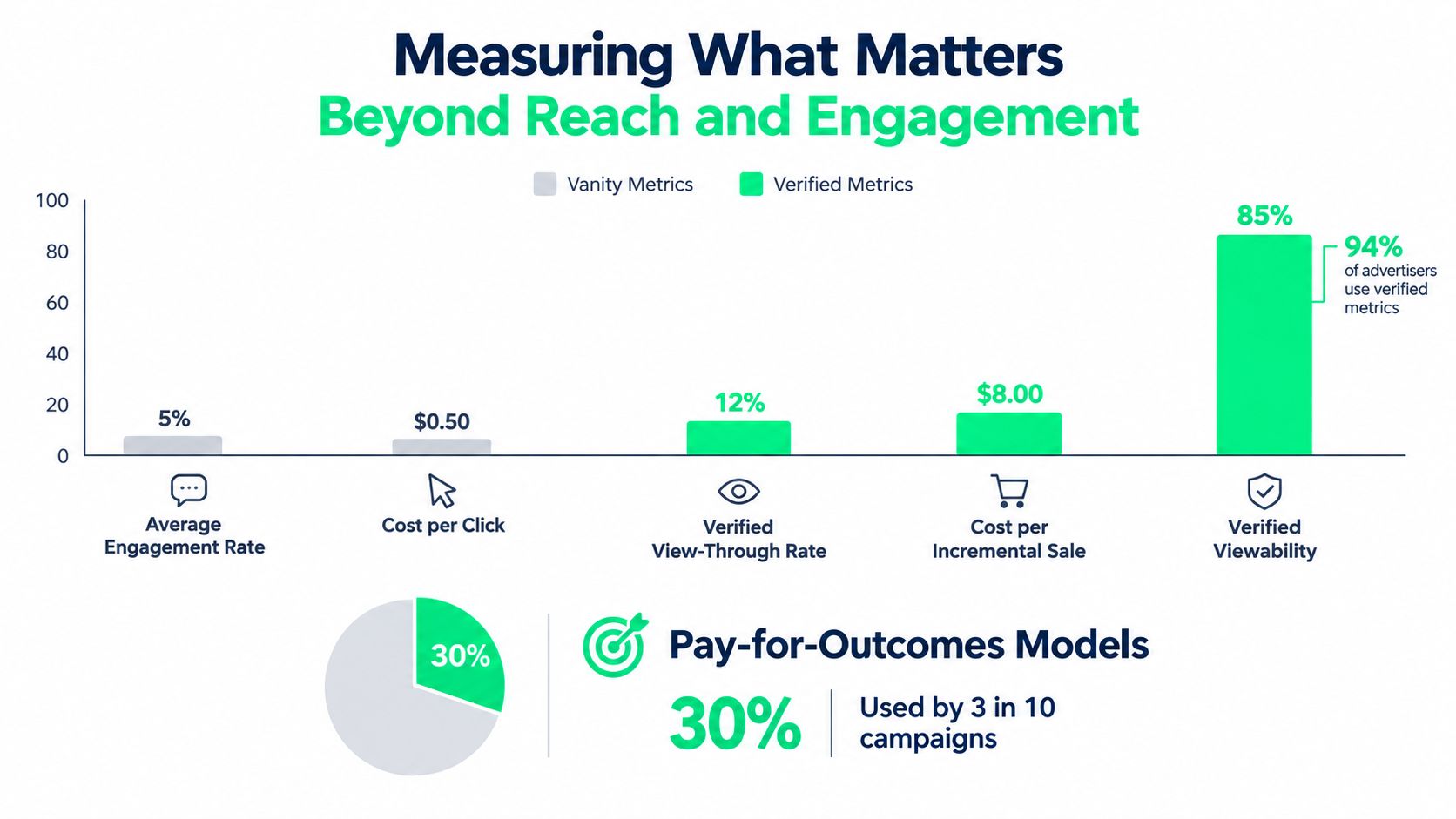
That's the central measurement problem in content creator advertising. A 2025 WFA report found 94% of respondents use reach and 89% use engagement as success metrics, while only 23% use conversions or sales, and 63% said proving ROI and tracking performance is the top barrier, according to the WFA report on effective influencer marketing.
What to track instead of stopping at vanity metrics
Reach and engagement still matter. They just aren't enough on their own.
A stronger measurement stack usually includes:
- Verified views: views that pass your platform or partner's validation rules.
- Handle-level breakdowns: which pages drove attention and which didn't.
- Incrementality thinking: what happened because the campaign ran, not just what happened during it.
- Outcome alignment: clicks, signups, deposits, installs, or purchases, depending on the funnel.
The practical shift is from “How many people saw this?” to “Which verified audiences saw this, and what changed after they did?”
How to structure a campaign for cleaner proof
Measurement gets easier when the campaign design is disciplined upfront.
Use a clear campaign window. Keep captions and offers consistent at launch. Track by creator handle or page cluster. If you update messaging in flight, log those changes so you can tie shifts in performance to specific edits rather than guessing.
This walkthrough helps frame the reporting mindset:
Measurement rule: Don't ask creator media to prove more than your attribution system can actually observe. If your funnel can't connect exposure to action, fix that first.
Why pay-for-outcomes models keep gaining ground
When billing ties more closely to verified delivery, the buyer and seller stop arguing about soft screenshots and start working from the same scoreboard.
That doesn't guarantee business results, but it does clean up one layer of ambiguity. It also makes iteration easier. If certain pages underperform, you can swap them out. If a caption underperforms, you can adjust it. If one niche cluster outperforms another, you can move budget while the campaign is still live.
The big idea is simple. Don't confuse visible activity with measurable value. Creator campaigns should be judged the same way you'd judge any scaled media buy: on verified delivery, quality of audience, and contribution to the outcome that matters.
Putting Content Creator Advertising to Work
Good creator advertising doesn't start with a creator list. It starts with an operating model.
If you need custom trust and category education, buy bespoke creator content. If you need social proof plus platform targeting, use partnership-style amplification. If you need broad, repeated, controlled access to American attention, build around programmatic creator distribution with real-time review and clear safety rules.
A practical launch sequence
Many teams do better when they keep the first campaign simple:
- Pick one audience pocket: U.S. sports fans, shoppers, traders, or another defined niche.
- Set your guardrails early: captions, exclusions, prohibited topics, and geo requirements.
- Choose the buying model by objective: reach, conversion support, or creative testing.
- Review at the handle level: keep the pages that work, cut the ones that don't.
- Measure beyond surface metrics: verified views first, then business outcomes where your attribution can support them.
That workflow matters more than novelty. The teams that scale cleanly usually aren't chasing trends. They're using tight systems to review every submission in real time, keep brand safety intact, and concentrate spend in high quality geographies.
Where brands still get this wrong
Some buyers overpay for creator identity when they really need distribution. Others over-optimize for cheap reach and ignore geography, audience quality, or page context. Both mistakes come from using the wrong lens.
A useful way to calibrate your thinking is to compare campaign types. For example, this Nestea campaign via influencer partnerships is a good reference for story-led creator work. That's a different job from routing a branded message across a vetted network for verified American view delivery. Both have value. They just solve different problems.
The next phase of the channel will push even harder toward AI-assisted creation, automated review, and safety-first buying. Brands already care more about creator safety and are planning more investment in AI-generated creator content, according to the earlier industry research. That makes control systems more important, not less.
If you treat content creator advertising like infrastructure, the channel becomes easier to brief, easier to buy, and easier to scale.
FindClout gives brands a way to buy creator-page distribution programmatically with verified view billing, audience vetting, geo filters, and brand safety controls built for Tier 1 American reach. If you want to route creator attention like media infrastructure instead of managing one-off creator deals, visit FindClout.
Want this audience for your brand?
FindClout puts your brand in front of verified American audiences across every major US page — brand-safe, at scale.
Start Your Campaign