 findclout.com
Pay Per View Social Media: How Verified Views Are Billed
You know what a standard CPM buys: a thousand impressions at a price set through an auction or a negotiated deal. The harder question is what happened after those impressions were served. Did people see the post, were they in the market you wanted, and should those views count toward your bill?
Pay per view social media changes the billing event from delivery to eligible attention. That can make creator and meme-page campaigns easier to evaluate, but only if the provider defines a qualifying view, shows how raw views become billable views, and protects the campaign's audience and brand context.
Table of Contents
- What Pay-Per-View Social Media Means for Brands
- How Pay-Per-View Differs From CPM and Other Billing Models
- What Sets Pay-Per-View Rates by Market and Format
- Measuring Verified Views Without Getting Fooled by Raw Counts
- How a Pay-Per-View Campaign Moves From Brief to Payout
- Brand Safety, Fraud Controls and Disclosure Checks
- Use Cases Across Meme Distribution, Creator Networks and Sports Audiences
- Confirm the Terms Before You Commit to a Provider
What Pay-Per-View Social Media Means for Brands
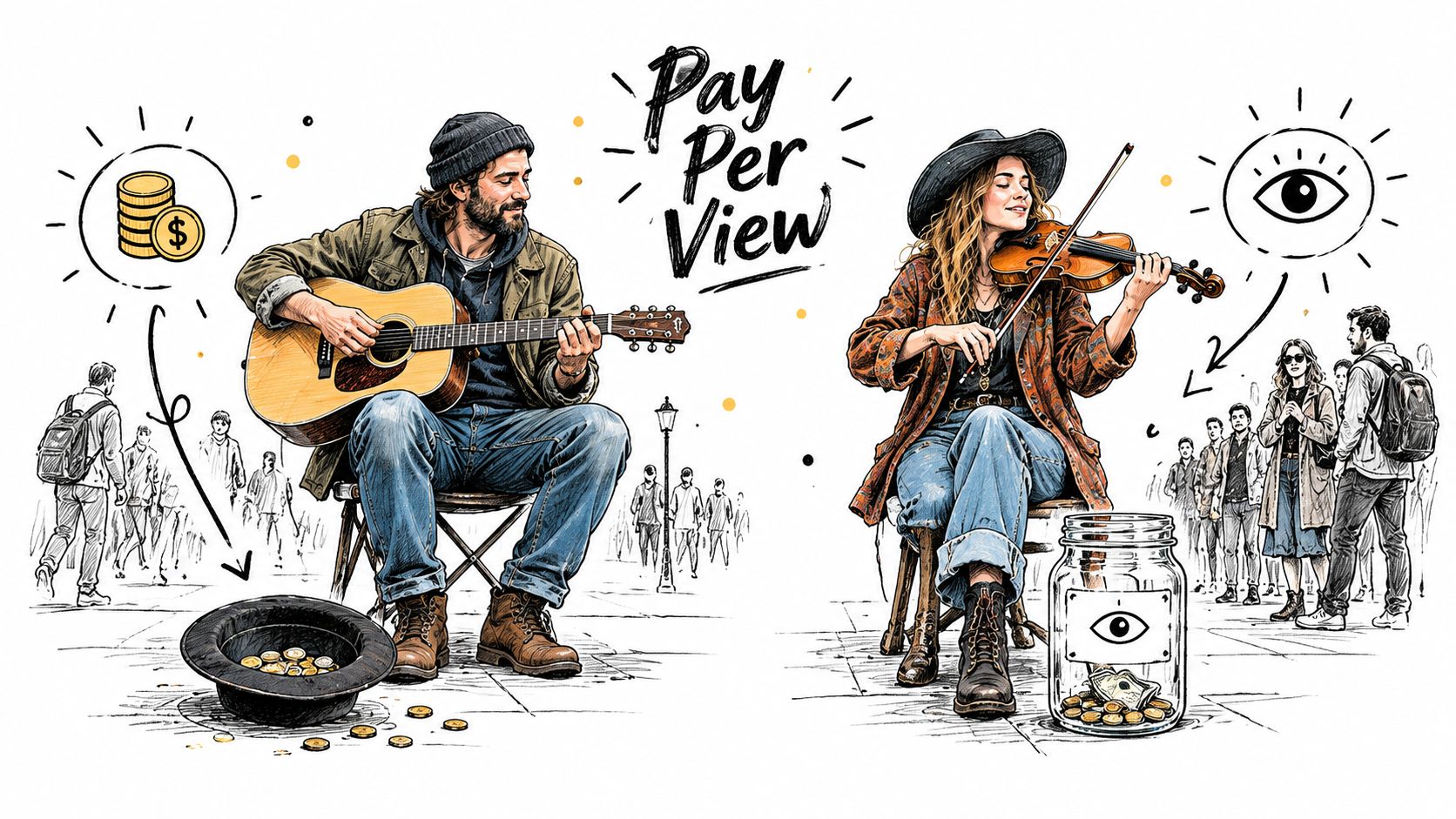
A street musician paid by the hour earns the same whether people stop to listen or keep walking. A musician paid for each listener who stays through the chorus earns only when someone gives the performance their attention. Pay-per-view social media applies the second logic to posts: payment is tied to views that meet agreed conditions, not merely to a post being published or loaded.
The arrangement has three parties. The brand provides the video, meme, or static asset and sets the rules. A creator or page publishes it on their own account. The network coordinates placements and reporting, so the brand can see which posts ran and what views they generated. Posts may remain live and continue to be shared after the paid distribution period, but the contract should distinguish paid delivery from later organic activity.
CPM remains a useful comparison point. Statista's social-media advertising overview reports a global social-ad CPM of $4.37 per 1,000 potential views. That's a market reference, not a guaranteed rate for any country, placement, or campaign. Auction-based ads generally buy inventory through platform bidding; pay-per-view distribution can instead compensate publishing pages for documented attention after the content goes live.
Suppose a sports page with 300,000 followers posts a highlight clip. Some viewers may watch soon after publication, while others encounter the clip later through sharing. The follower count doesn't tell you how many views qualify, or whether those viewers are in the intended market. A platform-counted view isn't automatically a view worth paying for.
Use this simple test: if your goal is attention and sharing, the model may fit. If you need a tight, predictable cost per acquisition, test the conversion path before scaling.
How Pay-Per-View Differs From CPM and Other Billing Models
Four models can all be quoted per 1,000 while charging for four different events. Read each row by what triggers the charge.
| Billing model | What the buyer pays for | Who sets placement | Main risk |
|---|---|---|---|
| Auction CPM (feed ads) | Served impressions, priced per 1,000 | Platform auction | Paying for ads loaded but never seen |
| CPV (cost per view) | Views that reach the platform threshold, often 30 seconds or an engagement | Platform rules | Thresholds differ by platform and format |
| Flat creator fee | One post at a fixed price | Creator | Paying the same whether the post performs or not |
| Pay-per-view on verified attention | Verified views on approved posts, priced per 1,000 | Brand approves posts and rules | Headline CPM depends on how views are counted |
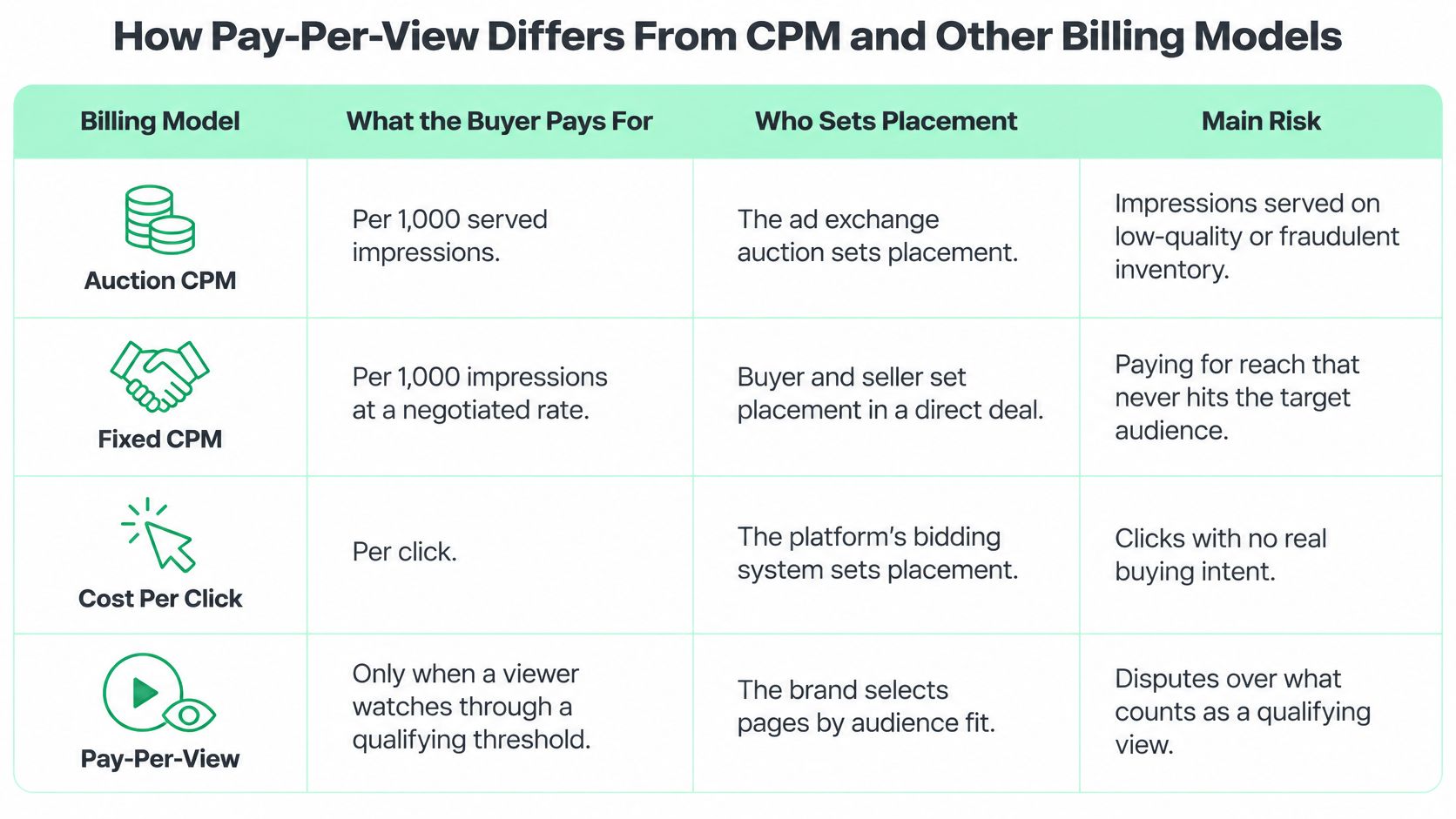
Auction CPM bills served impressions, so a feed ad can be charged when it loads and again when it reloads, whether or not anyone looked at it. CPV waits for a platform-defined threshold, and that threshold changes by platform and format, so a view on one channel may be stricter than a view on another. A flat creator fee moves the performance risk to the buyer: the price is identical whether the post over-delivers or flops. Verified-view billing sits at the other end, where the buyer approves each post and its rules before anything runs.
A headline CPM works like a sticker price: it tells you the rate, and the contract decides how many units that rate buys. The reconciliation is where quotes mislead. Take a $1.50 CPM applied to 500,000 platform-reported views: the invoice is $750. If screening leaves 350,000 qualifying views, divide $750 by 350 thousand and the effective cost lands near $2.14 per 1,000 qualified views. The quoted $1.50 was real. It just described a different denominator.
The denominator question runs both ways. Under a verified-view agreement, pending or rejected posts are never billed, botted views are excluded from the invoice, and only tracked views on approved posts count toward spend. On networks such as FindClout, the effective CPM is the total paid divided by every tracked view on approved posts, and views that arrive past each post's cap are free. A post that over-delivers lowers the effective rate, and a post that under-delivers triggers more posts until the purchased view number is hit.
Invalid traffic is a recognized risk across influencer and creator campaigns, so the screening question belongs in the contract rather than the pitch deck. Ask how views are verified, which traffic gets excluded, and whether exclusions change the bill or only the report.
Restate every quote as cost per qualified view before comparing providers; the primer on cost-per-view advertising walks through the same denominator math in more detail. Then confirm whether the headline CPM applies to every platform-reported view or only to views that pass the agreed rules, and get the answer in writing.
What Sets Pay-Per-View Rates by Market and Format
The $4.37 global social-ad CPM is a benchmark, not a quote for your campaign. It blends different markets and placements, while an actual rate reflects geography, targeting depth, placement type, seasonality, and quality controls. A worldwide blended quote may look low because it includes cheaper markets alongside the U.S. Ask for country-level rates, then compare U.S.-only figures if American consumers are the priority.
Competition for social attention is growing. WARC's 2025 forecast put global social-media advertising at $298.3 billion, or 25.8% of worldwide advertising spend (Advanced Television's report). Dentsu forecast global paid-social growth of 8.7% in 2025 (Global Ad Spend Forecasts). In 2025, 87% of surveyed marketers said they planned to prioritize paid social (Marketing Brew's report), while 90% of 100 surveyed marketing leaders said they used paid social to engage customers (Wunderkind and Retail Dive's report). These figures describe a crowded buying environment, not a guaranteed rate increase for any one placement.
Compare quotes in a consistent order:
- Request rates by country and platform.
- Confirm whether the rate applies to raw or qualified views.
- Ask how pricing changes in busy periods, such as sports seasons or holidays, and whether the rate is locked for the campaign.
- Convert every quote to cost per qualified view before comparing it with alternatives.
Measuring Verified Views Without Getting Fooled by Raw Counts
A video can start loading in a feed without holding anyone's attention. To see why raw platform views and billable views can diverge, follow this illustrative reconciliation per 1,000,000 platform-reported views:
| Metric | Illustrative count or rule | How it is verified |
|---|---|---|
| Platform-reported views | 1,000,000 | Platform's own counter |
| Measurable views | 940,000 | Platform data confirms the view was recorded |
| Viewable views | 610,000 | At least 50% of pixels in view for 2 continuous seconds |
| Invalid or non-human traffic | 42,000 | Automated screening and exclusion |
| Qualified billable views | 568,000 | Viewable views minus invalid traffic |
| Qualified, U.S.-eligible views | 510,000 | Country and page filters applied |
The figures are a worked example, not a universal delivery pattern. The sequence matters: start with the platform counter, retain views that can be measured, then apply the chosen viewability rule. The Media Rating Council's social-measurement guidance treats a video impression as viewable when at least 50% of its pixels are in view for two continuous seconds. Applying that threshold in the example gives 610,000 viewable views; removing 42,000 invalid or non-human views leaves 568,000 qualified billable views. A U.S.-eligible subset is then identified using the campaign's geography and page rules.
Measurement guidance also distinguishes measured, viewable, non-viewable, and undetermined impressions. MRC/IAB viewable-ad measurement guidelines recommend reporting categories separately rather than collapsing them into one delivery number. They also say social-video access should be counted client-side when the content is encountered, appears in the viewable screen area, and is measured after caching conditions are accounted for.
For post-level verification, views can be counted from the platform's own numbers, with Meta Insights used for connected accounts. Creators can submit screen recordings and screenshots to support view counts if a figure is disputed. Keep the post ID, page, timestamp, platform count, geography, and invalid-traffic deductions together so a reviewer can trace how each number was reached.
A useful campaign report shows total reported views, measurable views, qualified views, viewable rate, geographic composition by platform, unique or estimated unique reach where available, average frequency, engagement rate, incremental reach, and invalid-traffic deductions. For tracking tagged destinations consistently, branded links for social media can help keep campaign links identifiable across placements.
Two questions separate a usable report from a decorative one: Does CPM apply to all platform views or only verified, geo-eligible views? Does the report break results down by page? For more on the billing event itself, read what makes a view verified.
How a Pay-Per-View Campaign Moves From Brief to Payout
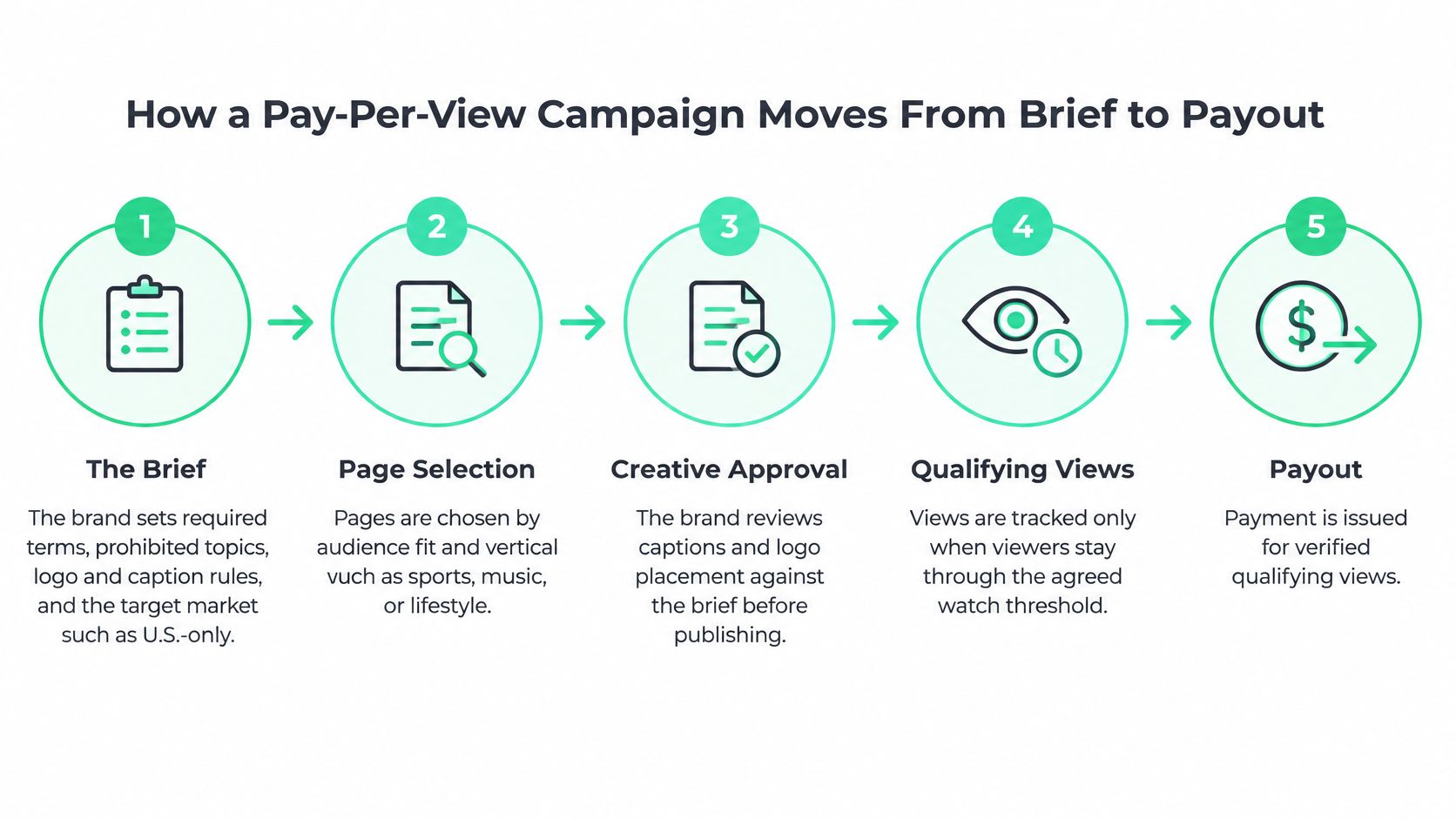
A campaign works best when the brand settles the rules before creators publish. Here's the sequence, with the failure point to watch at each step.
Set the brief. Define required terms, prohibited topics, logo and caption rules, and the target market, such as U.S.-only. Late or incomplete approvals can delay launch by days and leave creators guessing about what's acceptable.
Select pages. Match pages to the audience and vertical, such as sports, finance, or gaming, then apply exclusions before anyone drafts a post. A page that reaches the wrong audience can generate activity without reaching the intended buyers.
Open applications and prepare posts. Creators apply to campaigns in the app and publish on their own pages, making each post a traceable unit. If a creator changes the approved caption or asset, the post can fall outside the original rules.
Approve the creative. Nothing should go live until the brand signs off on captions, logos, and targeting. An approval process that checks only the first version won't catch edits made afterward.
Schedule publication. Pages post every night, and a live dashboard shows each post with the platform's own counts. If a campaign schedule is unclear, posts can arrive before the brand is ready to review them.
Separate raw and qualifying views. Views are counted from platform numbers, then qualified views are separated from raw views. This is the billing step: if the qualifying rule wasn't agreed in advance, the brand has little control over what the invoice counts.
Reallocate weak placements. Remove posts with weak qualified-view rates and shift budget toward stronger pages. Caption edits must reach every live page, and an off-brand page needs a removal path that works in one action, not a week of email.
Pay creators. Creators are paid per verified view and can receive earnings through PayPal, Venmo, or cryptocurrency wallet addresses. Disputes are harder to resolve if post-level proof wasn't retained during delivery.
The order matters. A brand that approves nothing before publication has no meaningful say over the creative and audience context attached to the views it later pays for.
Brand Safety, Fraud Controls and Disclosure Checks
Low-quality or fraudulent media can waste advertising spend and weaken effective reach. The Association of National Advertisers' 2023 Programmatic Media Supply Chain Transparency Study examined transparency, ad quality, pricing, viewability, measurability, and ad fraud. Treat brand safety as a sequence of controls, not as a final review after the campaign has spread.
- Automated scoring checks submissions quickly. It can flag content for review, but it shouldn't make every contextual decision on its own.
- Human reviewers assess context. A sports joke, for example, can read as an insult when stripped of the page's usual tone.
- Explicit exclusions rule out unsuitable material. Set limits for prohibited topics, competitor mentions, and adult or violent content before posts are drafted.
- Geographic filters protect the buy. For American campaigns, prioritize U.S. audiences and confirm that reporting shows where views came from.
- Post-launch removal limits exposure. A page that drifts off-brand should be removable, and an approved caption edit must propagate across every live placement.
Real-time review matters because a meme can spread quickly. If an edit arrives after a post has been shared, the change still needs to reach each live page. Botted views are never billed, and pending or rejected posts are never billed; only approved posts count toward the brand's spend. For a deeper look at the screening process, see automated fraud detection.
Disclosure is a separate safeguard. U.S. Federal Trade Commission endorsement rules require a clear and conspicuous disclosure of a material connection, so a sponsored meme needs a label visible at first glance, not one buried in a cluster of hashtags. If a campaign also uses synthetic creative, this overview of when AI-generated ads need disclosure can help teams frame the review.
Three common mistakes undermine otherwise sound controls: leaving sponsored posts unlabeled, failing to push caption edits to every page, and treating follower counts as proof of audience quality. Use audience and placement evidence, not a large account number alone.
Use Cases Across Meme Distribution, Creator Networks and Sports Audiences
A platform split changes what a view can mean. In a nationally representative Pew Research Center survey of 5,022 U.S. adults, YouTube had the broadest reported reach. The table below gives the share of U.S. adults who said they used each platform, alongside what that reach can mean for campaign planning.
| Platform | Share of U.S. adults | What it means for pay-per-view |
|---|---|---|
| YouTube | 84% | Broadest reach; suits longer clips and highlight reuse |
| 71% | Heavy daily use; strong for shareable sports and news clips | |
| 50% | Strong for short clips with captions | |
| TikTok | 37% | Native home of short meme formats |
| 32% | Private sharing; hard to verify as public attention | |
| 25% | Community discussion; narrower audience | |
| Snapchat | 21% | Younger, mostly private sharing |
| X | 21% | Real-time sports and news reaction |
Meme distribution suits sports highlights, reaction clips, and short gag formats. The post can continue to attract shares after its initial paid distribution, so the campaign report should keep paid and later organic activity distinct. Creator networks can coordinate many pages under one brief, which suits a brand that needs broad placement within a focused window. Vertical campaigns work best when the audience already discusses the category, such as sports, gaming, finance, or consumer products.
Sports audiences illustrate why context matters. A highlight or live-game reaction may fit a sports page naturally, while a general-purpose page may not reach people who care about the same moment. Brands exploring more editorial or advertorial formats can also build advertorials with Landra when the campaign needs more explanation than a meme caption can hold.
The model has limits. Products that need a long explanation may struggle in a format built for quick attention. Direct-response campaigns with a strict acquisition target should test conversion performance before scaling, and regulated categories need clear disclosures and geographic proof before launch.
Pew's survey also found that about half of U.S. adults visited YouTube and Facebook at least daily, including 33% who used YouTube several times daily and 37% who used Facebook several times daily (Pew Research Center's 2025 social-media-use report). That concentration makes a worldwide total especially unhelpful on its own. Ask for views by country and platform so you can assess the audience the campaign actually reached.
Confirm the Terms Before You Commit to a Provider
Use one meeting to pin down the terms that determine what the invoice represents:
- Billing event: Does the CPM apply to raw platform views or qualified views? Is the price set up front, and does the contract name the qualifying rule?
- Verification: Are views drawn from platform counters, Meta Insights for connected accounts, or submitted screen recordings when a count is disputed?
- Geography: Will the report show U.S. share by platform rather than one worldwide total?
- Approval and edits: How do captions and logos reach every live page, and how quickly can an off-brand page be removed?
- Exclusions: Are botted views, pending posts, and rejected posts excluded from billing?
- Underperformance: If a post misses its qualified-view goal, does the provider run more posts until the purchased view number is reached?
A pilot should test the reconciliation, not just the headline rate. For example, FindClout's first campaign costs $20,000–$30,000, guarantees 100 million views, and is billed as one flat invoice; if a post underperforms, FindClout runs more posts until the purchased view number is hit. Before committing to those terms, make sure “views” is contractually defined so the guarantee can be compared with qualified, geographically eligible delivery.
Treat U.S.-first audience vetting, real-time review of every submission, and brand-safety controls as criteria to verify in the pilot. Require a per-page breakdown of qualified-view rates before scaling. Request a sample reconciliation report and page-level results before signing, and don't sign a guaranteed view total unless the billing event is defined in qualified views.
FindClout coordinates branded meme distribution across vetted creator pages, with approved creative, view-based billing, and campaign reporting designed to make attention easier to evaluate. If you're comparing pay-per-view options for an American audience, visit FindClout to explore how a campaign can be structured around qualified views and brand controls.
Want this audience for your brand?
FindClout puts your brand in front of verified American audiences across every major US page — brand-safe, at scale.
Start Your Campaign