 findclout.com
Online Casino Marketing: A Step-by-Step Playbook for 2026
Your campaign is getting clicks, creator posts are collecting views, and registrations look healthy. But the finance team wants to know how many legally eligible players deposited, while compliance wants the exact caption that went live on a sports page yesterday.
That's the job in online casino marketing: connecting attention to verified deposits without buying exposure you can't legally use or safely repeat. For American audiences, strong creative matters, but state eligibility, payment performance, audience quality, and responsible-gambling outcomes decide whether that creative deserves more budget.
Table of Contents
- Map Your Audience Segments Before You Buy Reach
- How to Lock Geo, Age and Consent Rules Before Launch
- Build a Channel Mix Around Each Funnel Stage
- Creative and Creator Examples That Survive Review
- How to Measure Verified Deposits and Optimize Spend
- Responsible Gambling Metrics to Track Beside CPA
- Decide the Launch From a Pilot
Map Your Audience Segments Before You Buy Reach
The most common budget leak is treating every sports fan, casino prospect, and returning player as one audience. A football highlight viewer isn't automatically a casino customer, and a sportsbook customer in an eligible state isn't automatically eligible for the operator's casino product.
Split your audience on jurisdiction, product, and lifecycle, in that order. Jurisdiction determines where the offer can run. Product determines whether the message should explain casino games or sports betting. Lifecycle determines whether the next useful message is account setup, onboarding, ordinary product information, or re-engagement.
Sports demand is substantial, but it isn't a targeting permission slip. Pew Research Center's account of its July 2022 survey found that 19% of Americans said they'd bet money on sports during the previous year, including informal betting, venue betting, and online apps; men, adults under 50, and Black and Hispanic adults were particularly likely to report it.
Audience segments, signals and compliance checks
| Segment | Defining signals | Best-fit channel | Compliance check |
|---|---|---|---|
| Sports-betting regulars | Prior sports-betting activity and adult sports-content engagement | Sports and highlight pages, creator clips | Age and licensed-state eligibility on every placement |
| Casino-first players | Slot and table play, response to bonus terms | Affiliate pages, owned app notifications | Bonus terms, wagering rules and withdrawal limits shown |
| First-time depositors | Verified account, one deposit, no second deposit yet | Owned email, onboarding flow | Clear wagering explanation and opt-out in every message |
| Lapsed depositors | For example, no deposit in 90 days, if that's your chosen inactivity rule | Email and app re-engagement | Lawful basis to contact and visible unsubscribe |
| Excluded or flagged players | Self-exclusion, underage signals, fraud flags | None, suppress entirely | Enforced at the audience level, not only in the creative |
Use behavioral signals to establish relevance, not demographic findings as a shortcut to eligibility. A page's American audience share also doesn't establish its audience share within your licensed states.
Turn segments into buying rules
For each segment, record the qualifying event, permitted product, message, destination, and suppression rule. Our audience segmentation guide provides a useful framework for making those definitions operational.
Keep never-deposited prospects separate from funded players. Active players need their own communication policy rather than being swept into either acquisition or win-back campaigns.
Before spend begins:
- Write one row per segment: Give each row an identifiable audience and a specific next action.
- Attach exclusions: Include self-excluded players, underage signals, and flagged accounts.
- Set separate budget caps: Don't let an apparently strong segment absorb the entire test budget before the others produce usable evidence.
How to Lock Geo, Age and Consent Rules Before Launch
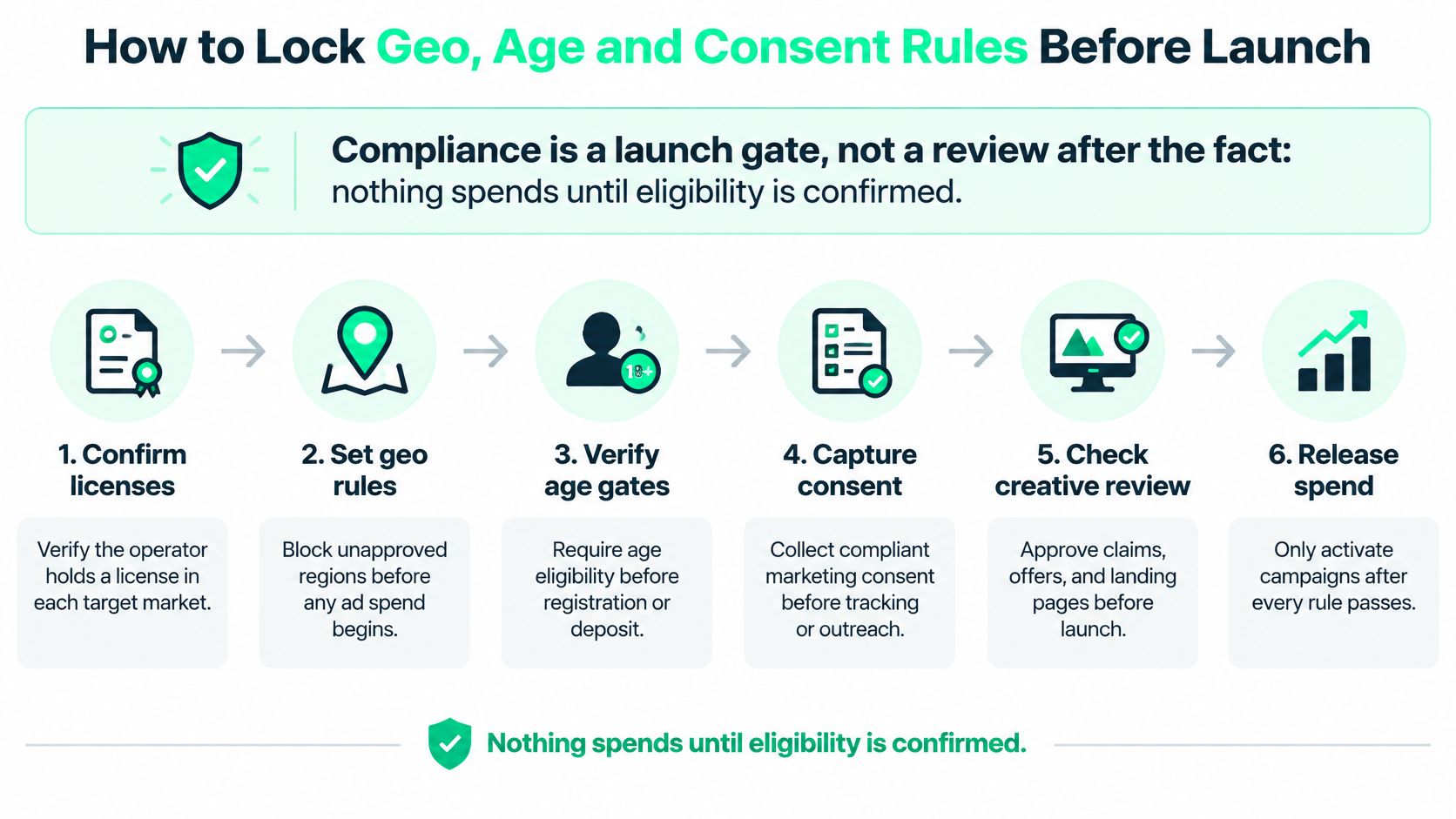
Compliance is a launch gate, not a review after the fact. Nothing spends until eligibility is confirmed. A platform accepting an advertisement doesn't establish that the operator, offer, audience, and destination are all permitted.
Use a release process that your media buyer, compliance reviewer, and creator coordinator can follow without interpreting policy independently.
Build the launch gate
Confirm the operator's licenses. Record the approved product and market, not just the company name. Don't assume sportsbook authorization covers casino advertising. Use our gambling advertising laws guide to organize the review, then validate the campaign against the relevant regulator's current requirements.
Create a geo allowlist. Block everything outside approved markets at campaign level. Reject creator inventory whose audience is mostly outside the permitted states, and don't treat country-level audience analytics as state-level geofencing.
Approve the age gate and creative age line. Insert the jurisdiction's actual minimum age into the template before publication. Carry eligibility checks through registration and deposit rather than relying on a caption alone.
Check the lawful basis for contact. Email, text, Telegram, and WhatsApp outreach need an approved contact basis and functioning suppression handling. Our advertisers must send bulk email, Telegram, or WhatsApp messages only to recipients they have a lawful basis to contact.
Lock disclosures and offer information. Set the commercial disclosure, promotion-terms destination, and responsible-gambling line before drafting creative. The FTC's social-media disclosure guidance explains that compensation or other benefits can create a material connection requiring clear, conspicuous disclosure. Paid meme distribution doesn't escape that principle because the post looks native.
Record approval before releasing spend. Store the exact asset, caption, landing-page version, approver, and timestamp. For the platform-policy layer, Keywordme's guide to ad policy compliance is a useful review companion, not a substitute for gambling-specific legal clearance.
Keep contractual exposure visible
Advertisers agree to indemnify FindClout for all claims arising from their campaigns, content, communications, and products. Outsourcing distribution therefore doesn't outsource the brand's legal exposure.
Release rule: A missing approval is a failed approval, not permission to publish.
Run a weekly sample check of live posts against the approved geo rules and disclosure text. Save evidence of discrepancies, remove or correct affected placements, and document who authorized the remedy.
Build a Channel Mix Around Each Funnel Stage
Give each channel a defined job, then judge it against that job. Search captures existing intent; creators introduce the brand; owned messaging helps eligible customers understand and use the product. Comparing them only on reach hides those differences.
The category is expensive enough that narrow execution matters. According to U.S. Gaming Review's report on 5W's industry audit, U.S. gambling companies spent an estimated $3.9 billion on advertising and marketing in 2025, including approximately $980 million on digital performance marketing.
A smaller operator shouldn't respond by buying a little of everything. Choose inventory where you can verify eligibility, inspect the placement, and connect spend to funded accounts.
Channel roles, cost signals and main risks
| Channel | Best job | Cost signal | Main risk |
|---|---|---|---|
| Organic search and content | Long-term discovery of brand and games | Staff and production cost | Slow payback and claims that don't match terms |
| Owned app and email | Reactivation and second deposits | Low cost per message | Opt-out handling and lawful contact basis |
| Creator and meme pages | Reach among younger eligible adults and sharing | CPM or pay per verified view | Undisclosed endorsements and spread beyond the approved audience |
| Paid social and display | Scaled reach and retargeting | Platform CPM | Ad fatigue and age-skewed exposure |
| Paid search | Capturing high-intent queries | Cost per click | Restricted keywords and platform policy rejections |
| Affiliates | Pay-for-performance acquisition | Revenue share or CPA | Unlicensed sub-affiliates and unreviewed landing pages |
Allocate around evidence, not channel enthusiasm
Start with one acquisition channel and one owned channel as a practical testing design. The acquisition channel should answer whether a defined audience will fund an account. The owned channel should answer whether clear onboarding helps eligible customers complete their intended journey.
Add another acquisition channel only after the original source produces verified deposits at a stable cost. Otherwise, changing the audience, placement, landing page, and onboarding simultaneously leaves you unable to isolate the problem.
For American sports inventory, inspect the individual page rather than buying a sports label. Request audience analytics, examine surrounding posts, and distinguish authentic engagement from irrelevant or suspicious traffic. Creators applying to our campaigns submit screen recordings and screenshots of their audience-analytics dashboards.
Price creator placements per CPM or verified view and test small batches with consistent destinations. Verified attention is a delivery measure, not proof of acquisition value. You still need to establish which placements contribute incremental deposits.
Cheap reach isn't cheap acquisition when the audience can't legally use the product.
Owned messaging also deserves restraint. A player who opted out of marketing shouldn't reappear in a promotional audience just because an automated workflow uses a different channel.
Launching several channels together may produce an impressive reporting deck, but it makes diagnosis harder. Keep the first test narrow enough that you can explain why it worked, why it failed, and what you'll change.
Creative and Creator Examples That Survive Review
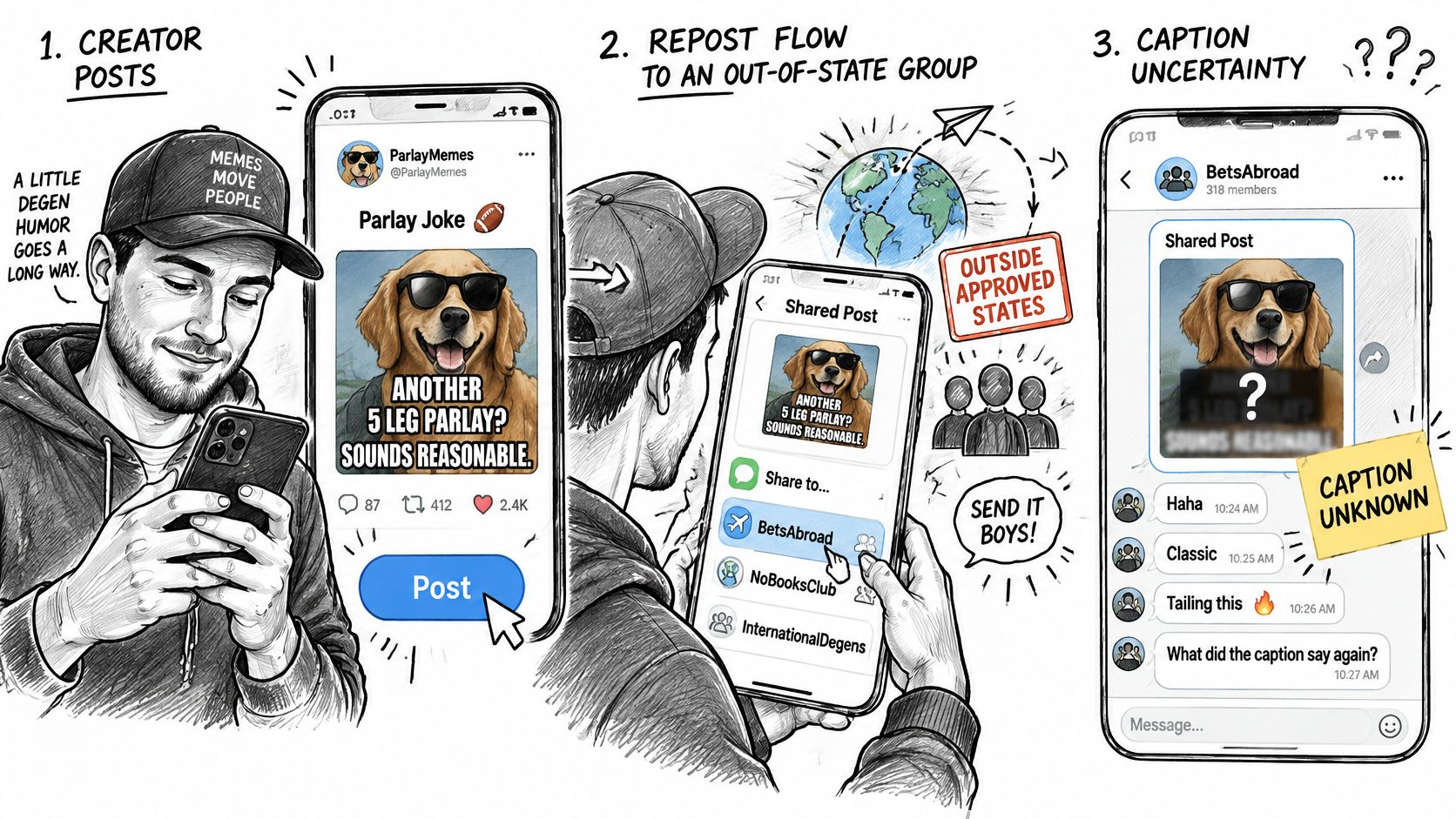
Say a sportsbook pays a meme page for a parlay joke. Someone shares the post into a group outside the approved states, the creator edits the caption, and the brand can't prove what originally appeared. The issue isn't whether the joke performed; it's whether the campaign remained recognizable, truthful, and auditable.
The sharing path needs the same attention as the original placement.
The FTC's announcement of its 2017 influencer disclosure action describes more than 90 letters sent to influencers and marketers and emphasizes that Instagram disclosures should be visible before users need to tap the more control.
Native clips and carousels
Native clip, passing version: Keep a readable advertising disclosure at the bottom of the frame throughout the clip, clear of interface overlays. For a hypothetical campaign approved only for adults aged 21 and over, the accompanying copy could read: Ad. 21+. Licensed states only. Gamble responsibly. Terms apply. Replace generic eligibility wording with the campaign's approved state information and required disclosures.
Native clip, failing version: A creator presents a parlay as dependable income, while a tiny disclosure flashes at the end. A visible commercial label wouldn't fix the misleading claim.
For a carousel, put the age and licensed-state line on the first slide alongside a clear advertising disclosure. Keep material offer qualifications close to the offer rather than separating them across unrelated slides.
The failing carousel leads with an attractive bonus and puts meaningful restrictions on a final slide that readers may never reach. A terms link doesn't justify an inaccurate headline.
Caption-led tweet cards
A passing tweet card identifies the commercial relationship in the first caption line and keeps the card's claim consistent with the landing page. If someone screenshots the card without the caption, embedded commercial identification helps preserve context.
A failing version makes winning sound guaranteed or presents a scripted endorsement as the creator's personal experience. Don't ask a creator to claim they use or recommend a product unless that endorsement is true.
Our campaign briefs can set required captions, keywords, rules, and banned claims. Posts that break those rules are rejected and not paid, and nothing goes live until the brand signs off on the exact look.
Apply these final checks:
- Visible disclosure: No extra tap is needed to identify the advertisement.
- Accurate offer: No bonus claim extends beyond the actual terms.
- Adult audience: For this American campaign, no content is aimed at under-21s.
- Truthful endorsement: Personal claims reflect the endorser's genuine experience.
Approve the finished asset and caption, not a summary of what the creator intends to publish.
How to Measure Verified Deposits and Optimize Spend
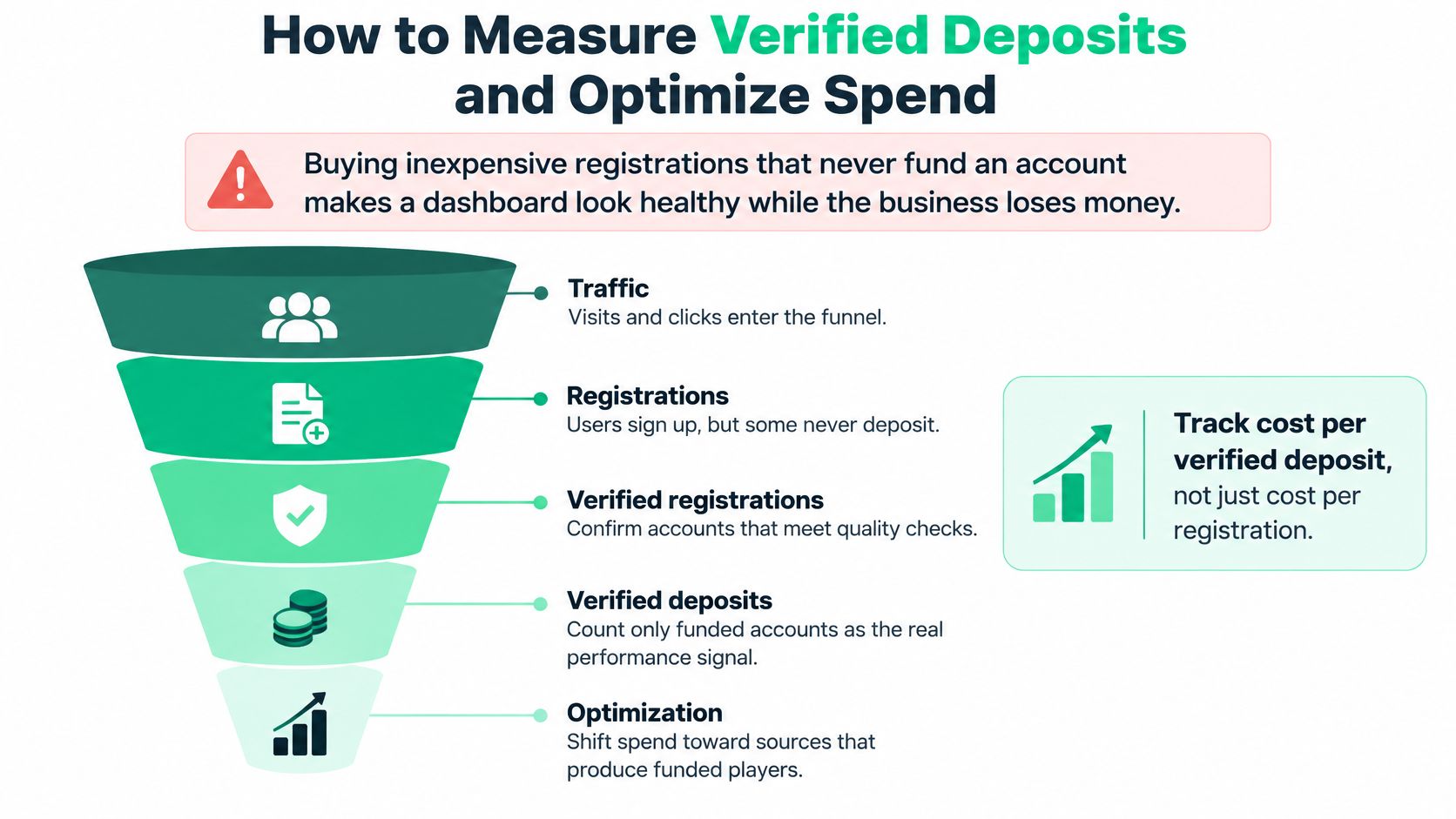
Buying inexpensive registrations that never fund an account makes a dashboard look healthy while the business loses money. Verified deposits, supported by cohort economics and responsible-gambling controls, are the more useful acquisition signal.
Independent Track360 affiliate benchmark reporting places iGaming affiliate conversion broadly at 1.8%–4.2%, with regulated operators generally outperforming offshore programs. Treat that range as directional, not a universal target or a substitute for defining your own conversion denominator.
Optimize the funded-account journey
Suppress non-permitted geographies before acquisition. Keep ineligible traffic out of the buying system rather than discovering it during reconciliation.
Separate creative and publisher tracking. Use distinct landing-page variants and tracking parameters, with stable campaign and publisher identifiers. Our conversion tracking setup guide can help structure the event map. Reconcile acquisition events against backend account and payment records.
Optimize toward verified first deposits. Audit the full path: placement, age and location check, account creation, identity verification, deposit-method selection, first deposit, first wager, and a withdrawal test. Report abandonment by payment method, device, state, and verification status, using server-side events where appropriate and permitted.
Payment friction belongs in marketing analysis. A U.S. bettor survey reported by Business Wire found that 29% had experienced funding or withdrawal problems, while 44% said they might abandon a glitchy or non-responsive app and 32% might abandon if funding took too long. Don't reject a publisher because the payment page failed its audience.
Compare cohorts after their actual costs. Include bonuses, payment fees, chargebacks, and responsible-gambling exclusions. Keep net gaming revenue after bonuses distinct from a contribution calculation that also deducts acquisition and operating costs.
Move budget only after the agreed sample and attribution window. Freeze the decision rules before launch. Don't extend a weak campaign's window to collect more favorable conversions.
Core KPIs and the trap that makes each one misleading
| Metric | What it tells you | Watch for |
|---|---|---|
| Verified first-deposit rate | Share of registrations that verify and fund an account | Inflated by bonus-only signups |
| Cost per first-time depositor | Acquisition cost per verified funded customer | Compare by source and cohort, not only in aggregate |
| Day-30 retention | Whether depositors come back | Compare cohorts at the same age |
| Net gaming revenue after bonuses | Gaming return after promotion cost | Correct bonus accounting and separate fee reconciliation |
| Payback period | Months until a cohort recovers acquisition cost | Fixed attribution and consistent contribution definitions |
| Second-deposit rate | Early retention signal | Bonus abuse and complaints alongside repeat deposits |
Build the dashboard by jurisdiction, product, publisher, creative, device, and first-deposit cohort. Aggregate figures can hide an expensive state, a broken mobile flow, or a publisher delivering registrations without funded accounts.
Measurement discipline: Don't scale a source until you can reconcile its reported conversions with verified backend deposits.
Keep operational failures separate from audience failures. If verification or payment errors explain abandonment, repair that path and rerun the controlled comparison before rewriting every ad.
Responsible Gambling Metrics to Track Beside CPA
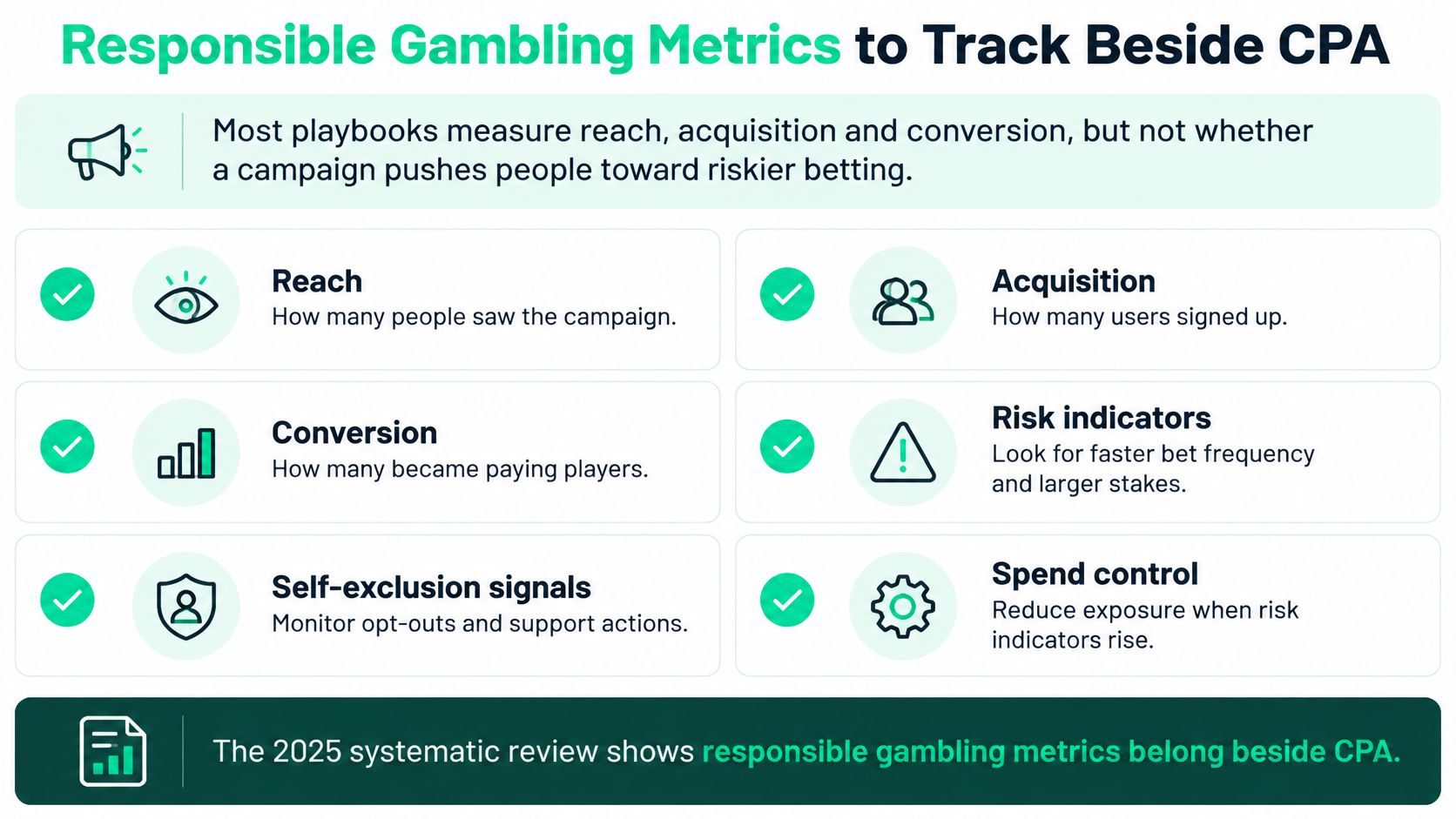
Most online casino marketing playbooks measure reach, acquisition, and conversion without asking whether a campaign pushes people toward riskier betting. A lower CPA doesn't answer that question.
A 2025 systematic review of sports-related gambling advertising found that exposure was associated with increased gambling behavior across multiple media types; accompanying U.S. app-monitoring evidence reported that 93% of observed push notifications contained advertising, 62% urged a bet, 50% promoted bonuses or similar inducements, and 15% marketed riskier products than users had previously wagered on.
Those observations don't establish that an individual campaign caused harm. They do challenge the assumption that highly shareable sports inventory is merely an efficient route to qualified customers.
Put safeguards on the performance dashboard
Track these measures beside acquisition cost, with named owners and documented escalation rules:
- Complaint rate: Report complaints per thousand impressions as a chosen reporting unit. Categorize misleading offers, unwanted contact, and targeting concerns separately.
- Self-exclusion signals: Monitor exclusions and support interventions following exposure without treating timing alone as proof of causation. Restrict access to sensitive records.
- Inducement exposure: Count promotional messages per user per week across channels, not just within each sending tool.
- Age-skewed reach: Compare audience composition with the campaign's legal age floor. Treat missing audience evidence as unresolved risk.
- Risk-disclosure coverage: Measure the share of impressions carrying a clear, readable responsible-gambling disclosure.
- User-level frequency: Cap repeat exposure and account for overlapping creator, paid-media, and owned-message audiences where measurement permits.
A disclosure's presence isn't the same as comprehension. Review mobile readability, competing visual elements, and whether humor makes the commercial purpose unclear.
Give the reviewer authority to pause
Responsible-gambling reviewers need the ability to stop delivery, not merely add comments after a campaign ends. Assign an owner who can disable the creative, suppress the affected audience, and preserve the evidence.
Pause any creative or message that promotes a riskier product than the user has previously bet on. Review the targeting logic, commercial rationale, and potential harm before authorizing a restart. If the team can't establish a defensible reason to resume, keep it off.
Decide the Launch From a Pilot
Make the launch decision from a controlled pilot, not an optimistic reach forecast. The pilot should test both acquisition economics and whether the review system works under real publishing conditions.
Set the decision before spending
Use a narrow test design. Run a two-week pilot in one licensed state with one acquisition channel and one owned channel. Hold out a matched slice of the same segment so you can compare incremental verified deposits with the exposed group.
Freeze the economic thresholds. Set the attribution window, cost-per-first-time-depositor ceiling, day-30 retention floor, and required sample before spending. Stop expansion if the acquisition ceiling fails; don't declare the retention test passed until the cohort has matured enough to measure it.
Require the publication log. Store the exact caption, disclosure, age line, geo allowlist, and approver timestamp for every creator or meme submission. Reject audiences skewing under 21 or outside licensed states, and don't pay rejected posts.
Test suppression and reviewer capacity. Require evidence that exclusion controls cover self-excluded and flagged accounts without unnecessarily sharing sensitive identities. Check that human reviewers can handle submissions in real time as volume increases.
Test scale claims against execution
FindClout is our chat-first social media automation platform and creator marketplace, operating in regulated categories including prediction markets and sports-betting-adjacent services. Our stated capabilities include US, Canada, and UK geo filters, pre-approval of every look, AI scoring plus 24/7 human review, 3.3B cumulative views, and 500+ vetted tier-1 creators.
Treat those scale figures as company-reported claims, then test operational suitability against the pilot log before signing. Country filters don't prove state eligibility, and cumulative views don't prove incremental casino deposits.
Our focus is high-quality American and tier-1 audiences, brand safety, and attention to every submission. Scaling attention toward billions of views is worthwhile only when the review system protects the brand and verifies that delivery stays concentrated in approved, high-quality geographies.
FindClout offers coordinated creator and branded meme distribution with audience vetting, brand approval, and review controls for regulated campaigns. Visit FindClout to scope an American-audience pilot around licensed-state eligibility, verified deposits, and a review log your compliance team can audit.
Want this audience for your brand?
FindClout puts your brand in front of verified American audiences across every major US page — brand-safe, at scale.
Start Your Campaign