 findclout.com
Meme Coin Advertising: A Brand-Safe Playbook for 2026
A cheap impression can be the most expensive impression in a meme coin campaign. Meme coin advertising reached a meaningful share of crypto promotion early, with meme coins accounting for 22% of total crypto ad spend in the first half of 2023 according to industry analysis of crypto marketing spend. Yet attention alone doesn't establish a qualified U.S. audience, protect a brand, or create durable demand.
The operational advantage comes from treating distribution as an inventory-quality problem. Tier-1 American audiences, creator governance, real-time review, and post-level monitoring matter more than a large reported view count. The goal isn't to make every post viral. It's to make every paid view auditable, relevant, and safe enough to support a serious growth program.
Table of Contents
- Most Meme Coin Ad Spend Is Reaching the Wrong People
- What Meme Coin Advertising Is and Why It Is High Risk
- Three Campaign Formats and How Their CPMs Compare
- Brand Rules That Keep Your Campaign Compliant
- The Real-Time Verification Loop That Protects Every Post
- Meme Coin Advertising Versus Meta and TikTok
- Why Tight U.S. Targeting Beats Big Follower Counts
- A 30-Day Launch Checklist for Meme Coin Advertising
Most Meme Coin Ad Spend Is Reaching the Wrong People
The most common assumption in meme coin advertising is that reach solves distribution. It doesn't. Reach without verified geography, authentic engagement, and a credible path to action produces a low headline CPM and a poor campaign.
The evidence is especially uncomfortable for influencer-led promotion. A 2024 analysis found that 76% of Twitter/X influencers promoted meme coins that later became “dead,” with the tokens losing at least 90% of their value, while only 1% successfully promoted a coin that increased tenfold. The same analysis of influencer-led memecoin promotion reported an average payment of about $399 per promotional tweet and around 15,000 views per tweet.
Those figures don't prove that every creator audience is fraudulent. They do show why a media buyer can't use views as a proxy for quality. A creator may have an active community, but the campaign still needs to answer basic questions:
- Who watched the post? Confirm audience geography at the creator level instead of relying on the page's country label.
- Did people engage authentically? Look for natural comment patterns, stable audience growth, and meaningful interaction rather than repetitive replies.
- Was the content safe? Review captions, hashtags, visual context, account history, and engagement signals before spend is released.
- Did attention persist? Monitor the post and the surrounding token activity after launch rather than judging success on delivery alone.
Practical rule: A low CPM is only useful when the buyer can verify the audience and connect the view to a legitimate campaign objective.
Founders who chase vanity reach often buy hollow efficiency. Their dashboards show inexpensive impressions, but the campaign creates little qualified traffic, weak community trust, and no reliable evidence that American retail audiences saw the message. A brand-safe operating model starts with U.S. audience verification, then adds a rules engine, format-level economics, and continuous post-level monitoring.
What Meme Coin Advertising Is and Why It Is High Risk
Meme coin advertising is paid distribution for token logos, captions, and creator-led content. It often runs through influencer networks, crypto-focused publishers, newsletters, and short-form video amplification instead of conventional search or social ad inventory. The operational challenge is separating verified U.S. attention from inexpensive bot reach, while keeping creator activity inside a controlled brand-safety process.
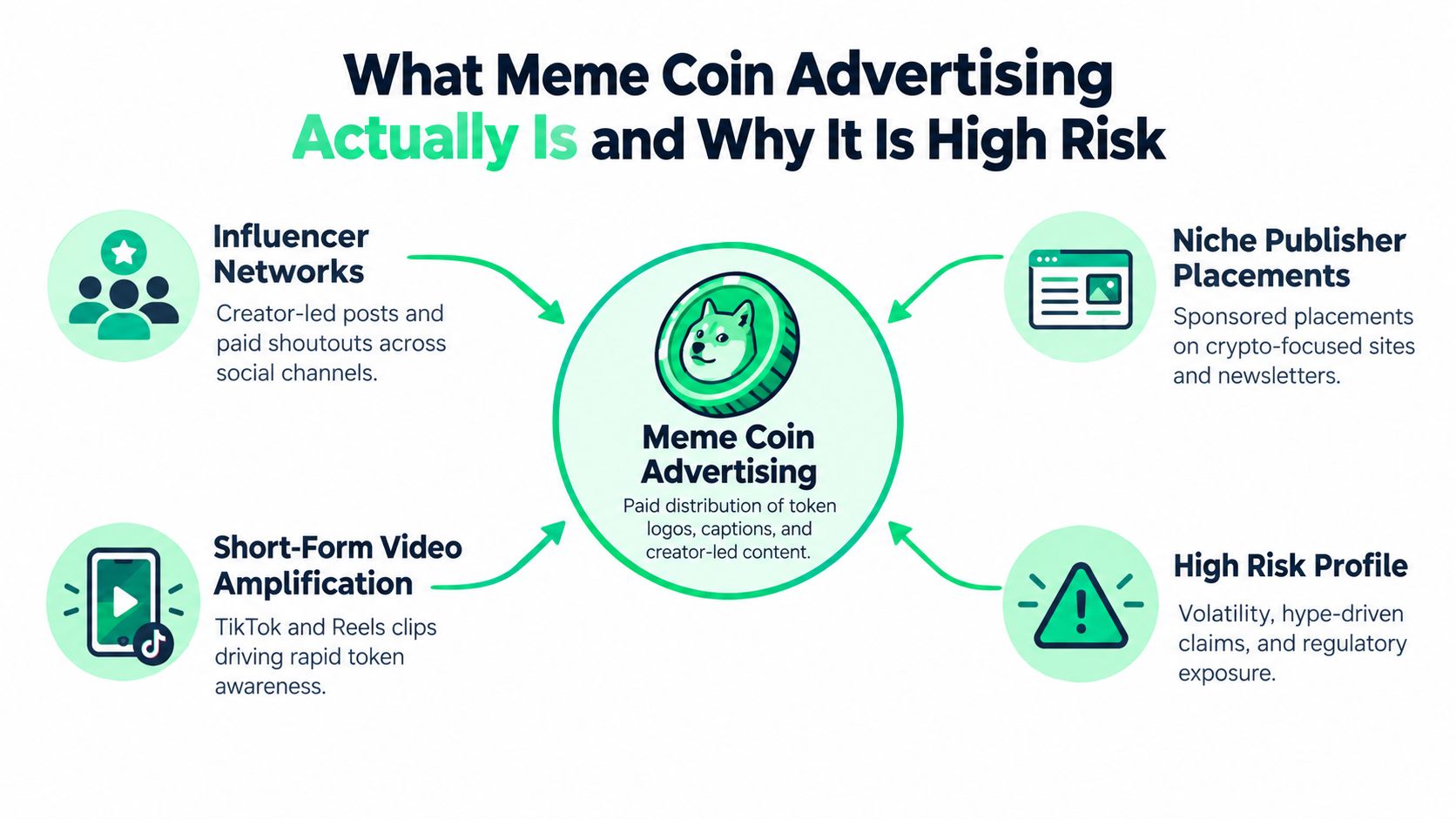
The format carries three connected risks.
Promotional claims can change the legal profile
A token logo does not make a profit promise. Copy about a team creating value, a future price, or returns generated by someone else's efforts creates a different compliance question from copy describing a community or product without investment language. The SEC investor alert on crypto scams describes how social promotion feeds speculative schemes, including a pathway in which promoters create attention, demand raises the price, early holders sell into that demand, and late buyers suffer rapid losses.
Copy review therefore belongs in media planning, not only in legal review. If the approved message requires a risk disclosure, the placement must support it clearly. A creator whose normal style relies on urgency, price speculation, or implied returns may be unsuitable even when the audience appears relevant.
State-level rules affect campaign design
State and product-availability rules can restrict where a campaign runs and which audiences it may reach. A U.S. plan needs geographic controls, product eligibility checks, and documented approval criteria rather than a single national audience filter.
Concentrated hype can become the market event
A launch burst can turn promotion into the event that drives attention and trading activity. Exposure limits, pre-approved creative, creator-network governance, and post-launch monitoring reduce that risk. Reviewers should track whether posts remain compliant, whether creators alter approved language, and whether traffic quality changes after publication.
Compliance is a media-buying workflow. It determines which creators qualify, which claims can run, where content may appear, and how quickly spend must pause. Regulated brand-safety checks also give buyers a defensible record when low-quality distribution, misleading context, or suspicious engagement appears.
Three Campaign Formats and How Their CPMs Compare
The right format depends on the job the campaign must perform. Logo and caption distribution can create broad recognition with limited creative production. Vertical-targeted creator content adds relevance by placing the token inside a crypto, finance, gaming, sports, or technology conversation. Hero content builds authority, but it requires more production control and a more careful creator selection process.
Published rate cards vary widely by audience quality, creator tier, format, verification standard, and whether the buyer pays for served impressions or verified attention. A responsible media plan should therefore treat any CPM as an operating hypothesis until the supplier defines the audience, counting method, fraud policy, and reporting granularity.
| Format | CPM Range | Funnel Stage | Creative Lift |
|---|---|---|---|
| Logo and caption distribution | Must be validated against verified delivery | Reach | Low |
| Vertical-targeted creator content | Must be validated against niche and geography | Relevance | Moderate |
| Hero creator content | Must be validated against production scope and creator authority | Authority | High |
Logo and caption placements are useful when the objective is repeated recognition across a controlled creator grid. They work best with short approved copy, a visible official destination, and exclusions that prevent the token from appearing beside unsafe or misleading content. They don't replace education, and they shouldn't carry claims that need extensive context.
Vertical-targeted content is usually the stronger middle-funnel option. A finance creator can explain the difference between a token's community identity and an investment promise. A gaming or sports creator can make the format culturally native, but the advertiser still needs to check whether the audience is American and whether the creator's language creates gambling or financial-promotion concerns.
Hero content has the greatest upside for brand perception and partner conversations. It also carries the greatest concentration risk. One creator's mistake can become the campaign's dominant narrative, so every script, caption, visual, link, and disclosure should receive approval before publication.
The funnel is straightforward: reach creates recognition, relevance earns attention, and authority supports trust. The formats should work together, but they shouldn't be judged by the same metric.
Brand Rules That Keep Your Campaign Compliant
A brand rules engine should read like an ad operations brief, not a vague list of legal principles. Every creator and placement needs a clear pass, escalation, or rejection outcome before money is released.
Start with mandatory terms
Require the token contract address, ticker, official links, and counsel-approved risk disclosure wherever the format allows. Keep the official destination consistent so audiences aren't sent through unverified pages or impersonator accounts. The disclosure should remain intact when a creator adapts the post for platform style.
Then define prohibited language. Remove guaranteed returns, price predictions, urgency tactics, and financial-advice framing. Don't approve celebrity likenesses or endorsements unless the brand has the necessary rights. These rules are especially important in a category where paid hype can be interpreted as part of a pump-and-dump pathway.
Treat audience qualification as a hard gate
A U.S. label on a creator profile isn't enough. The workflow should confirm U.S. audience share at the creator level, review state or designated-market-area delivery, and apply state exclusions where regulation or availability requires them. The documented geo-control workflow for creator campaigns makes this distinction explicit.
Language and vertical locks matter just as much. A creator might have American followers but publish in a context that attracts an unsuitable age group, an unapproved market, or a community that encourages deceptive trading behavior. Geo, language, and category checks should run before the placement enters the active pool.
Finally, inspect account history, recent activity, engagement quality, and identity signals. These checks help separate a living creator account from a recycled asset with a purchased audience. They also support practical work on tackling fakes and AI impersonation, which is increasingly relevant when a token's logo or founder identity can be copied quickly.
For a broader operational reference, document the full approval and escalation process in this brand-safety guide for meme marketing in regulated categories. The rule is simple: a placement that can't be reviewed and controlled shouldn't receive budget.
The Real-Time Verification Loop That Protects Every Post
Pre-approval is necessary, but it isn't enough. Creator accounts change, captions get edited, comments reveal new risks, and a post that was acceptable at launch can become unsafe after the conversation shifts.
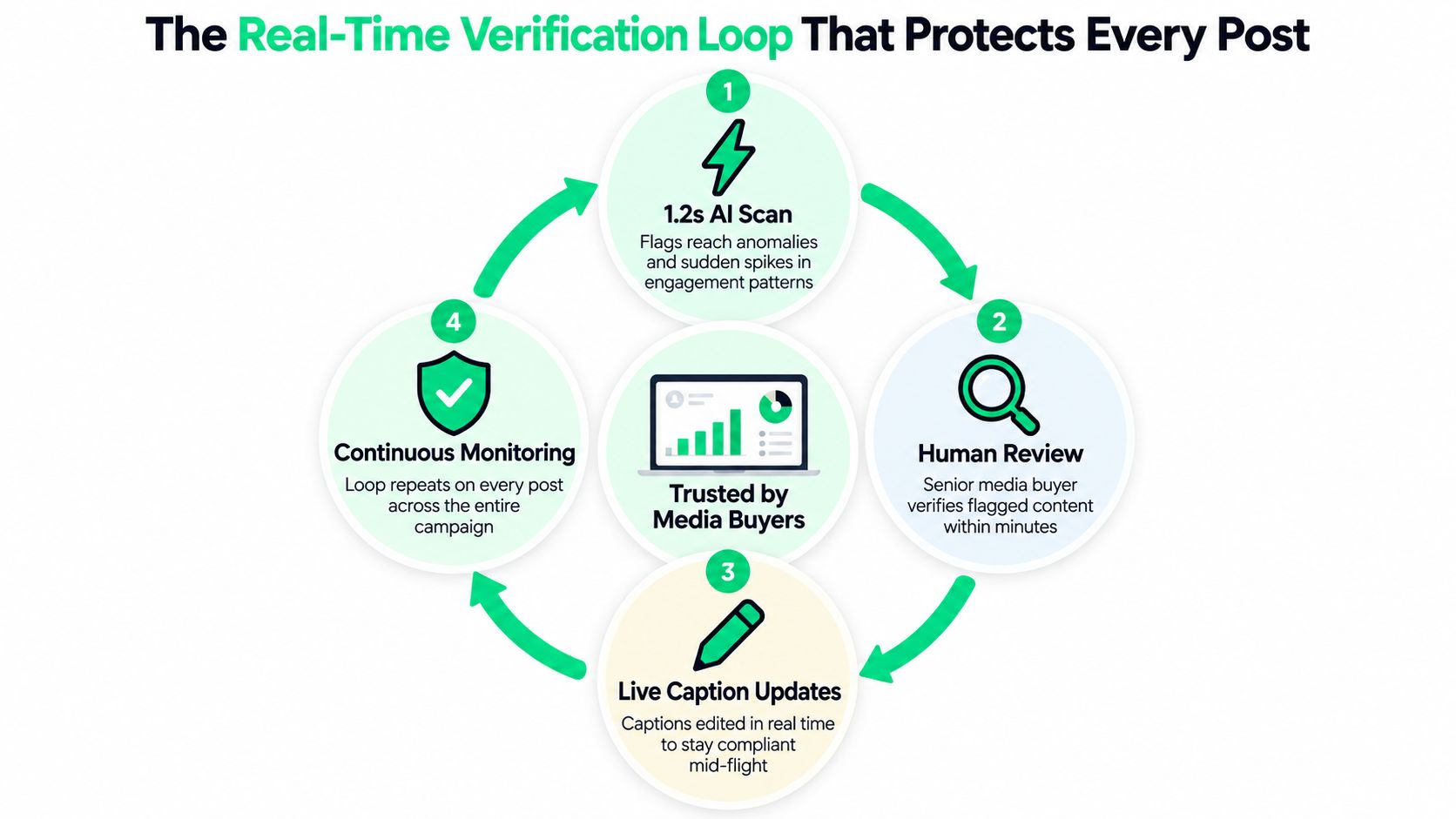
A dependable verification loop combines automated screening, human judgment, live editing, and continuous monitoring. Automated systems can inspect captions, hashtags, visual context, account history, and engagement signals quickly. They should identify anomalies and route uncertain cases to people rather than approving everything outright.
Use automation for scale, people for context
AI is good at screening clear policy violations, repeated spam patterns, suspicious engagement, and content that resembles previously rejected material. Human reviewers are still needed for satire, regional slang, ambiguous financial language, and context that automated classifiers may misunderstand.
A practical queue has three outcomes:
- Approve, when the creator, audience, content, and destination meet the campaign rules.
- Escalate, when the system detects ambiguity or a material risk that needs human judgment.
- Block or pause, when the post violates a hard rule or shows evidence of manipulated delivery.
The mechanics of AI scoring for campaign review should be written into the insertion order. Specify the review trigger, human escalation path, expected response time, evidence retained, and who can activate a bulk pause.
Keep the loop active after publication
Real-time caption management allows an approved phrase to be replaced when platform terms, legal guidance, or campaign rules change. It also lets the buyer remove a post without waiting for a creator network to respond manually. Every decision should leave an audit trail, including the original creative, the revision, the reviewer, and the reason for the action.
The result isn't merely cleaner content. It creates a controlled operating environment in which scale doesn't require surrendering brand judgment.
Meme Coin Advertising Versus Meta and TikTok
Meta and TikTok are useful buying platforms, but they solve different problems from a governed creator network. Meta offers mature audience tools and retargeting. TikTok offers fast creative testing and cultural reach. Both restrict crypto advertising, and neither platform report necessarily proves that a creator post reached the intended U.S. audience.
The CPM figures below are planning ranges, not guarantees. They shift with audience quality, format, eligibility, creator tier, and verification standards. Buyers should validate current platform policies, counting definitions, and inventory quality before assigning budget.
| Channel | Indicative CPM Range | Post Longevity | IVT / Fraud Exposure | U.S. View Verifiability | Crypto Ad Eligibility |
|---|---|---|---|---|---|
| Meta | $5–$15 for crypto-adjacent prospecting, higher under eligibility restrictions | Usually short without continued distribution | Requires active monitoring | Strong platform reporting, limited creator-level context | Restricted and policy-dependent |
| TikTok | $4–$12 for short-form prospecting, with creator placements varying | Often tied to trend velocity | Requires creator-level screening | Can be strong when audience data is available | Restricted and policy-dependent |
| Tier-1 creator networks | $0.20–$3.00 depending on format and verification standard | Can persist through sharing and continued visibility | Lower only when screening and monitoring are enforced | Must be confirmed at creator and placement level | Depends on campaign rules and market |
Meta generally fits compliant retargeting and branded audiences better than cold meme coin acquisition. A first-party audience, an approved destination, and documented eligibility can make the economics workable. Broad prospecting becomes less attractive when restrictions narrow delivery or prevent clear validation of U.S. reach.
TikTok is strong for testing hooks, edits, and creator concepts at speed. Trend velocity creates attention quickly, but it can also hide weak downstream quality. Vet creators by geography, audience composition, comment quality, and traffic behavior before scaling a winning post.
Creator distribution carries a different trade-off. A post can remain discoverable after its initial placement, yet that durability only matters when the network controls creator selection, disclosure, destination checks, and invalid-traffic review. Regulated brand-safety workflows can turn creator buying into an auditable process instead of a follower-count wager. Teams assessing automation can also consult this social media marketing AI guide to define where machine review supports human approval.
For a fuller comparison of channel restrictions and crypto inventory, see our crypto advertising platforms comparison. Use Meta for compliant retargeting, TikTok for controlled bursts of vertical video, and governed creator networks when verified tier-1 U.S. distribution matters. The mix should follow the evidence, not platform fashion.
Why Tight U.S. Targeting Beats Big Follower Counts
Follower count is a weak buying signal for meme coin advertising. A large general-interest page may deliver attention, but it doesn't necessarily deliver people who understand crypto, can act in the target market, or will remain engaged after the first meme cycle.
Audience concentration matters even more as general interest contracts. CoinGecko's 2025 State of Memecoins report says the largest memecoin user base is in the United States, while overall interest in memecoins fell by 81.6% since the start of 2025. That combination points to a smaller but concentrated opportunity. Broad distribution can buy declining curiosity, while careful segmentation reaches communities that still have a reason to pay attention.
A useful evaluation compares qualified attention rather than raw audience size.
| Metric | Tier-1 U.S. Creator | Broad Meme Account |
|---|---|---|
| Audience qualification | Confirmed American audience with relevant interests | Mixed geography and mixed intent |
| Content fit | Crypto, finance, technology, sports, or gaming context | General meme consumption |
| Engagement interpretation | Easier to connect interaction with topic relevance | High volume can obscure authenticity |
| Brand-safety control | Creator, language, state, and category rules | Greater contextual uncertainty |
| Buying decision | Optimize for retained, qualified viewers | Avoid using follower count as the main proxy |
A finance-focused American creator can outperform a much larger meme account when the campaign needs qualified attention. That doesn't mean every narrow page is valuable. It means the buyer should inspect geography, language, category alignment, account history, and engagement quality before comparing scale.
Narrow targeting also reduces fraud exposure as a side effect. Smaller, coherent audience clusters are easier to audit, and unusual delivery patterns become more visible. The objective is not to eliminate reach. It's to make reach answerable to a market, a message, and a legitimate user action.
A 30-Day Launch Checklist for Meme Coin Advertising
A disciplined launch begins with a small, auditable pilot. Before buying distribution, define the American audience, approved markets, creator categories, token terms, destination links, disclosures, exclusions, and pause authority. Don't accept a report that shows only total views. Require geography, creator identity, placement details, engagement quality, and rejected-content records.
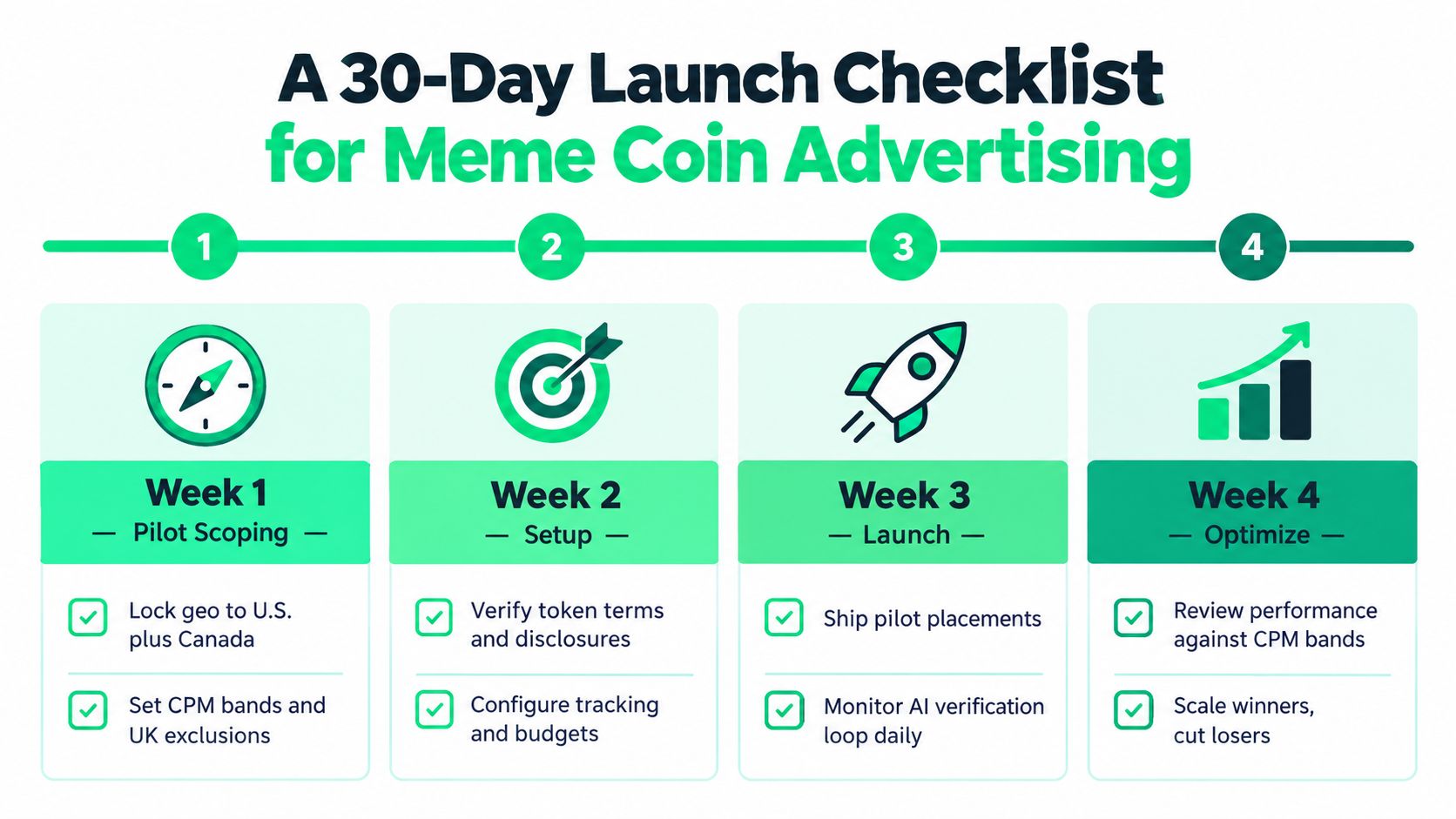
Week one sets the control surface
Select a seed group of vetted creators across relevant U.S. verticals. Confirm audience geography at the account level, identify state restrictions, review recent posts, and approve the first creative set. Establish the counting method for views and the evidence required to dispute low-quality delivery.
Week two tests the message
Prepare multiple caption approaches and visual treatments without changing the underlying disclosure or official destination. Rotate creative based on performance and safety signals, not just likes. Keep the core message stable enough to identify what changed when qualified engagement moves.
Week three adds active protection
Apply exclusion lists for unsafe topics, suspicious accounts, unsuitable geographies, and unapproved languages. Run mid-flight audits against the campaign's financial-promotion and anti-manipulation rules. Review comments and creator edits, since risk can appear in the conversation even when the original post passed approval.
Week four decides whether to scale
Judge the pilot on verified American delivery, stable economics, authentic engagement, and downstream quality. Wallet activity can be a useful signal, but it shouldn't be treated as proof of campaign success without considering market conditions, consent, attribution limits, and the possibility that paid hype is concentrating speculative behavior.
Use explicit go or no-go criteria:
- Scale winners: Expand creators whose audiences, content, and delivery remain consistently qualified.
- Cut weak inventory: Pause placements with unexplained geography, repetitive engagement, or weak contextual fit.
- Refresh creative: Replace formats that attract attention but fail safety or quality checks.
- Protect the brand: Use a kill-switch when a creator, caption, destination, or surrounding discussion creates material risk.
The strongest campaigns don't confuse volume with progress. They build a repeatable system for reaching American audiences, verifying every submission, and stopping waste before it becomes a reputation problem.
FindClout gives growth teams one operating layer for programmatic meme distribution across vetted creator pages, with brand rules, fraud screening, audience controls, and real-time campaign orchestration. Visit FindClout to plan a tier-1 U.S. meme coin campaign around verified attention rather than unqualified reach.
Want this audience for your brand?
FindClout puts your brand in front of verified American audiences across every major US page — brand-safe, at scale.
Start Your Campaign