 findclout.com
Meme Ads: How They Work and Why They Beat Meta CPMs
Meme ads distribute branded content across hundreds of curated social pages programmatically, with verified pay-per-view delivery, effective CPMs as low as $0.05 at scale, and brand controls designed to keep US-tier audiences engaged safely in real time. They can beat conventional social buying on efficient attention, but only when the creative, audience, verification, and review system work together.
That's the counterintuitive part. A meme isn't automatically a good ad because it's funny, and cheap reach isn't valuable if it arrives in the wrong geography, beside unsafe content, or through pages with weak audience quality. Research supports both sides of that argument: one 2024 study found brand-prominent memes produced more favorable ad attitudes and stronger engagement than brand-subtle memes, while a 2025 empirical paper found meme ads didn't significantly outperform control ads on ad attitudes, brand attitudes, or purchase intention. The 2024 journal study and the 2025 empirical paper point to the same operating lesson: meme ads need strategic fit and disciplined distribution.
Table of Contents
- What Meme Ads Actually Are
- The Three Core Formats and Who They Fit
- Why Meme Ads Capture Attention and Shareability
- Brand Safety Systems That Let You Scale Billions of Views
- A Sports Meme Campaign from Launch to Billions of Verified Views
- Programmatic Meme Distribution vs Traditional Influencer Buying
- How to Set Up a Meme Ad Campaign and Measure Results
- When Meme Ads Stop Helping and Start Hurting
What Meme Ads Actually Are
Attention is the new media. Meme ads turn that attention into a distribution system, not merely a joke placed beside a logo.
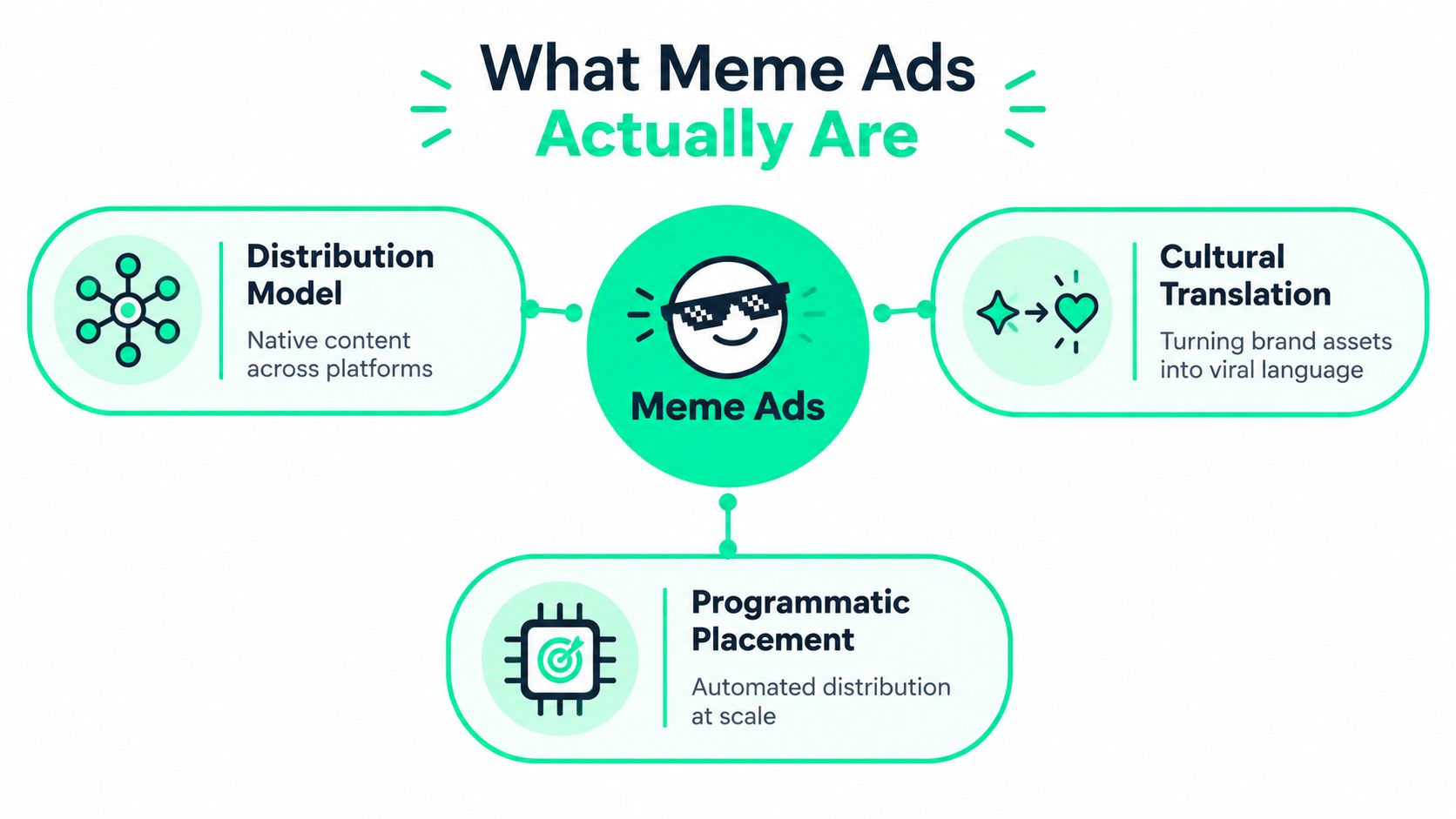
A traditional paid social ad interrupts a feed. A meme ad tries to become part of the feed's native language. The advertiser supplies approved branding, captions, video, or static assets. A distribution platform then translates those assets into culturally familiar meme formats and places them across vetted creator pages under defined rules.
That creates three connected layers:
- Cultural translation: The brand message is adapted to a format the audience already understands.
- Programmatic placement: Approved variations move across relevant pages without spreadsheet-driven trafficking.
- Verified distribution: The advertiser pays for measured attention rather than treating every served impression as equally valuable.
The practical difference is context. A sports fan may ignore a polished banner but share a joke that captures the emotional rhythm of a game. A gaming audience may respond to a familiar reaction template faster than it processes a product feature list. The ad earns attention by matching the environment instead of demanding that the viewer leave it mentally.
The infrastructure matters more than the viral image
A single meme can attract attention, but a campaign needs more than one successful post. It needs US-tier audience selection, page vetting, geo filters, exclusion rules, approval workflows, and live monitoring. The creative is the visible layer. Distribution quality determines whether that creative reaches likely customers in safe, relevant contexts.
Marketers evaluating the channel should distinguish the format from the buying model. Meme page advertising fundamentals help clarify the difference between placing a watermark on a page and building a managed campaign with targeting, verification, and reporting.
The strongest use case is not “make something go viral.” It's “deploy culturally native branded content across a controlled network, then measure whether verified attention reaches the audience that matters.”
The Three Core Formats and Who They Fit
Meme ad formats solve different problems. Choosing the lowest CPM without matching the format to the objective usually produces cheap visibility and weak learning.
| Format | Typical CPM Range | Best For |
|---|---|---|
| Logo and caption distribution | $0.20 CPM | Broad branded awareness across high-traffic pages |
| Vertical-targeted campaigns | $0.25 CPM | Sports, gaming, finance, crypto, and other defined niches |
| Content campaigns | $1.50 to $3.00 CPM | Advertisers with brand assets that need multiple meme variations |
Logo and caption distribution
This is the simplest lane. A brand watermark and approved caption are attached to memes distributed across selected pages. It suits a brand that already has clear messaging and wants broad recognition without rebuilding every asset into a new creative system.
The trade-off is control versus creative depth. You get efficient branded distribution, but the meme itself remains the primary cultural vehicle. Use this format when the objective is reach, recall, or repeated exposure to a broad American audience.
Vertical-targeted campaigns
Vertical campaigns add keyword requirements, exclusions, and scoped placement. That makes them more appropriate for marketers who care about audience context, such as a sports betting advertiser seeking sports pages, a finance app avoiding unrelated entertainment inventory, or a gaming brand concentrating on relevant communities.
The modestly higher CPM can be rational because the buyer is paying for tighter relevance. Keyword rules alone aren't enough. A strong campaign combines niche selection with geo controls, prohibited-topic filters, minimum page standards, and live review.
Content campaigns
Content campaigns start with a brand video or static asset and convert it into multiple meme variations through an internal creative engine. This is the premium option because the platform is doing more than placing a watermark. It's adapting the advertiser's material into formats designed for native distribution.
This lane fits teams with a clear creative library, several product angles, and enough message discipline to approve variations quickly. It's less suitable when legal review takes too long or when the brand can't define what must never change.
Buying rule: Select the format based on the control you need, not only the CPM you want.
Why Meme Ads Capture Attention and Shareability
Meme ads work when they reduce the distance between advertising and participation. Familiar templates lower cognitive friction. Recognition tells the viewer how to read the joke, while the branded element gives that social moment a commercial direction.
The mechanism isn't humor alone. It's cultural recognition plus a reason to share. When viewers understand the format, they can process the message quickly and decide whether it represents their mood, identity, or community. That's closer to social participation than to passive exposure.
A large multi-study research stream supports this explanation. It combined 900,139 posts, a field experiment with 423,565 impressions, and four controlled experiments involving 3,958 participants. The work found that meme marketing can increase shared psychological ownership of the message and strengthen self-brand connection, which can lift outcomes such as likes, click-through rates, and conversions. The published research on meme ownership and brand connection also found weaker effectiveness when a meme was in an early or declining lifecycle stage, or when the product was niche.
Familiarity is an advantage, not a guarantee
A mature meme template gives the audience a common reference point. An obscure or exhausted template creates two risks. The viewer may not understand it, or the viewer may understand it too well and feel that the brand arrived after the moment had passed.
The same distinction applies to product categories. Broad, low-involvement brands can often communicate through a quick emotional cue. Credibility-sensitive products need supporting explanation, proof, and clear disclosures. A meme can win the first second, but it won't replace the information needed for a considered decision.
You can see a related principle in the attention dynamics in meme coins, where cultural momentum and participation shape how quickly interest forms and fades. The marketing implication is straightforward: design for recognition and sharing, then use a separate path for deeper product education.
A survey of 71 respondents aged 18 to 30 found brand-name recall of 62.0% among meme-exposed consumers versus 54.9% among traditionally exposed consumers, while concluding that memes were stronger for engagement, shareability, and memorability than for detailed, credibility-sensitive communication. The survey findings support using memes as a top-of-funnel asset, not as the entire conversion system.
Brand Safety Systems That Let You Scale Billions of Views
Scale doesn't make brand safety easier. It makes weak controls fail faster.
A safe meme campaign needs controls before posting, during distribution, and after a page or caption changes. Academic literature defines brand safety as preventing ads from appearing beside content or in contexts that could damage a brand's image, across websites, video, and social streams. The policy analysis of brand safety and suitability also helps separate safety from suitability. A placement can be off-message without being illegal, hateful, or graphic, but both issues need rules.
Four layers of operational control
- AI scoring: Automated review can screen submissions quickly for obvious risks, prohibited signals, and authenticity concerns.
- Human review: People assess context, irony, cultural references, and adjacent content that automated systems may misread.
- Blocking and filtering: Rules enforce required terms, prohibited topics, follower thresholds, and US, Canada, or UK geo criteria.
- Verified safe delivery: Live dashboards show which pages are delivering, while off-brand placements can be removed without waiting for a campaign wrap.
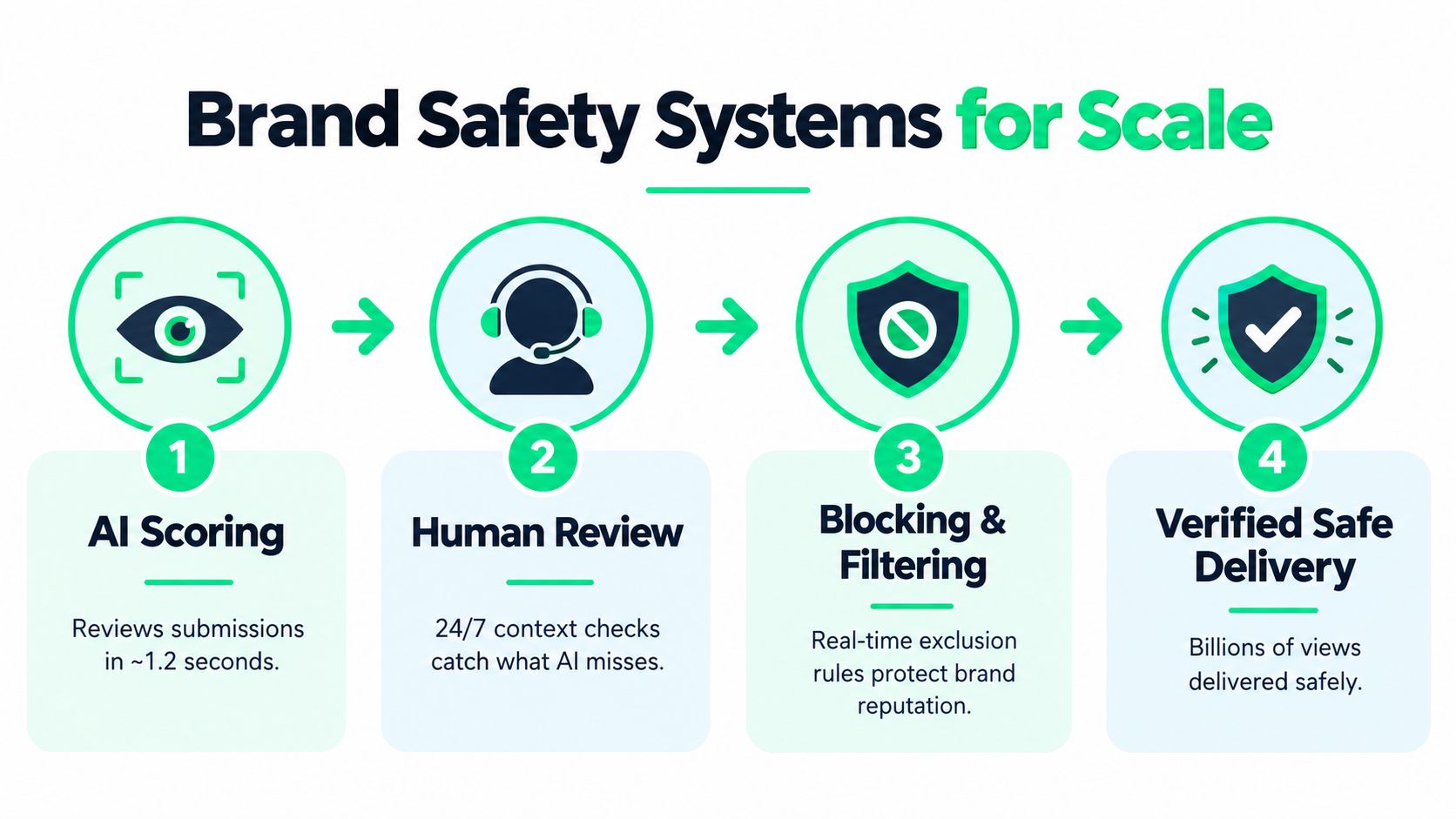
The important design choice is redundancy. AI can flag patterns, but human reviewers catch context. A rules engine can block a keyword, but real-time monitoring catches a page whose tone changes after approval. Pre-approval gives the advertiser control over captions, logos, targeting, and exclusions before anything goes live.
Safety must operate at campaign speed
If a brand waits until the end of a campaign to inspect placements, the system is reporting history rather than controlling risk. Brand-safe meme campaign procedures work best when review is continuous, captions can be updated across the network, and a single removal action can stop an unsuitable page.
Platform accreditation shows that safety controls can be audited and maintained at scale. YouTube received Media Rating Council content-level brand safety accreditation in 2021 and maintained that accreditation for a fifth consecutive year according to a 2025 safety guide. The social media brand safety overview reinforces the value of sustained, reviewable systems rather than one-time promises.
A layered policy should include written standards, approval workflows, active social listening, and platform settings reviewed when moderation policies change. The enterprise social policy guidance makes the operational point clearly: safe distribution requires a living process.
A Sports Meme Campaign from Launch to Billions of Verified Views
A representative sports and iGaming campaign begins with a narrow audience decision: reach tier-one American sports fans, not generic global traffic.
The prediction-market client supplies approved brand assets and the desired funnel action. The creative engine turns those assets into multiple sports-native variations. Campaign operators then apply sports keywords, restrict delivery to relevant pages, exclude non-US traffic, and define the captions that keep viewers one click from the brand destination.
The campaign doesn't depend on finding one celebrity creator and hoping the post lands. It uses a vetted network of 500 or more pages, coordinated through one operating layer. The launch can happen in roughly ten minutes, provided approvals are ready, because page selection, trafficking, caption management, and exclusion rules are already part of the workflow.
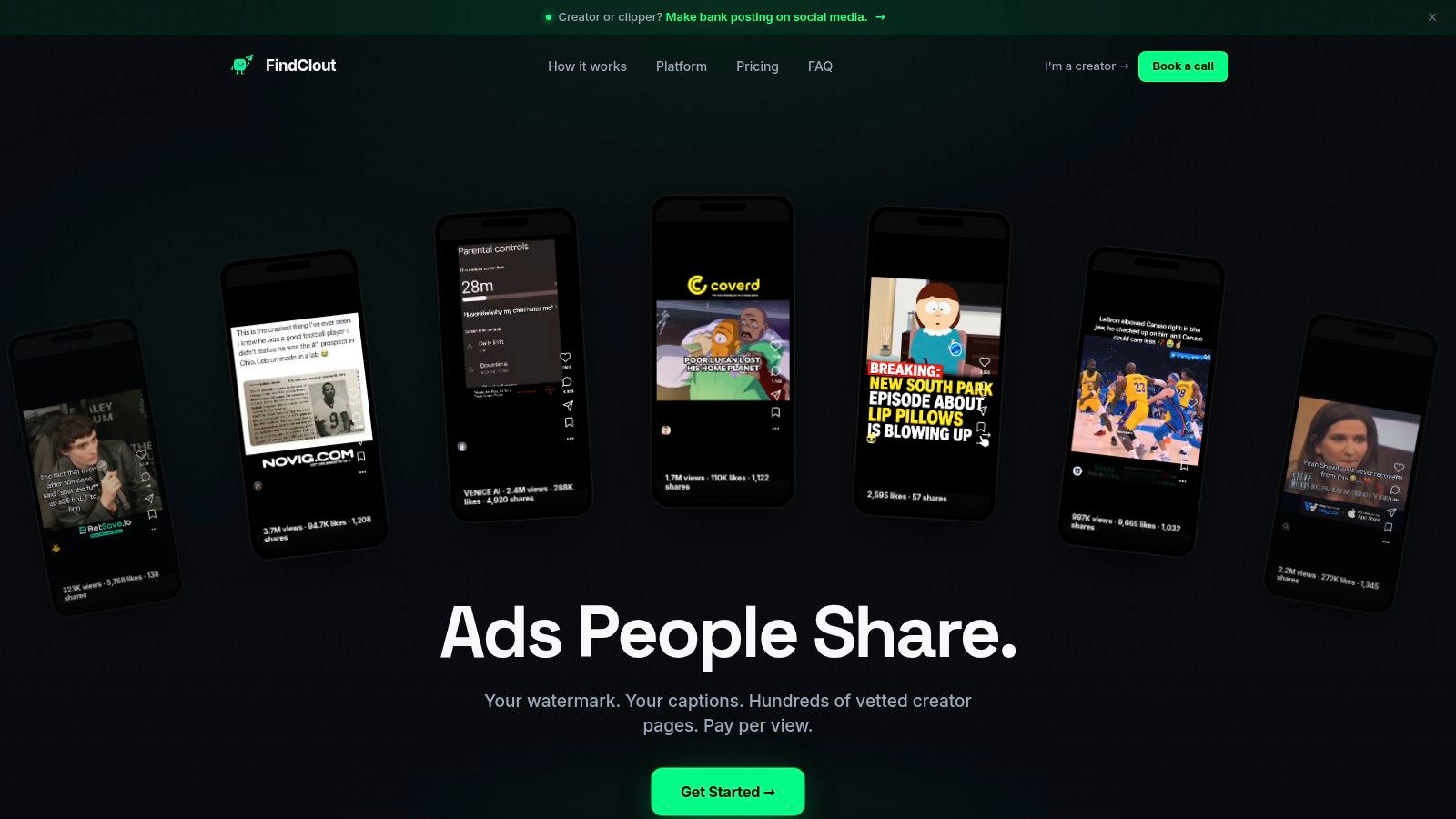
What the campaign team watches
The team doesn't treat total views as the only success signal. It checks whether delivery comes from the intended American sports audience, whether page-level engagement looks authentic, whether captions remain compliant, and whether specific handles generate useful downstream activity.
That distinction matters for regulated categories. Sports betting, iGaming, prediction markets, and finance advertisers need more than broad awareness. They need controlled language, carefully defined geography, and a process that can remove a page without disrupting the entire campaign.
The delivery model also changes the benchmark. Traditional social platforms charge against impressions served, while this approach focuses on verified attention and shareable posts that can keep circulating. The correct comparison isn't “meme CPM versus Meta CPM.” It's verified audience quality, persistence, control, and conversion relevance versus bought inventory.
The campaign story is therefore operational rather than magical. Sports-native creative earns the initial attention. Tier-one targeting improves relevance. Exclusions reduce exposure to unwanted traffic. Human review protects context. Live analytics show which pages deserve continued delivery.
Programmatic Meme Distribution vs Traditional Influencer Buying
Manual influencer buying gives advertisers direct relationships, but it also creates fragmented execution. Each creator may have different rates, posting habits, audience geography, reporting standards, and approval processes. Spreadsheet coordination becomes a liability when a campaign needs rapid iteration or regulated copy.
Programmatic meme distribution centralizes those tasks. Paid social platforms offer mature targeting and auction infrastructure, while meme distribution offers native page context and persistent shareability. Neither option is automatically superior. The right choice depends on whether the campaign prioritizes controlled audience buying, culturally native placement, creator relationship depth, or operational speed.
| Dimension | Programmatic Memes | Manual Influencer Buying | Paid Social Ads |
|---|---|---|---|
| Cost model | Verified views on a CPM basis | Negotiated creator fees or post packages | Auction-based impressions or clicks |
| Verification | Centralized page and view screening | Varies by creator and contract | Platform-level delivery reporting |
| Launch speed | Fast when creative and rules are pre-approved | Slower because each creator needs coordination | Fast once assets and audiences are ready |
| Iteration | Network-wide caption and placement changes | Changes require creator-by-creator approval | Asset and audience changes inside the ad platform |
| Brand safety | Rules engine, exclusion filters, pre-approval, and human review | Contract terms plus manual checks | Platform controls and suitability settings |
| Geography | Page and campaign-level geo filters | Depends on each creator's audience | Detailed platform targeting |
| Reporting | Handle-level and campaign-level dashboards | Often inconsistent across creators | Strong platform reporting, limited page-native context |
The trade-off is especially clear in regulated verticals. A manual creator deal may offer authenticity, but a buyer must still verify the page, approve the exact caption, monitor the live post, and document removal rights. Programmatic systems make those actions repeatable across a network.
Programmatic influencer marketing through meme pages and watermark ads is useful as a practical reference because it frames meme pages as distribution inventory rather than isolated sponsorships.
Paid social remains valuable for retargeting, conversion optimization, and controlled funnel testing. Meme distribution is stronger when the objective is to earn native attention at broad scale. Many well-planned campaigns use both, assigning each channel a job instead of forcing one format to handle awareness, education, and conversion.
How to Set Up a Meme Ad Campaign and Measure Results
Start with the outcome, not the template. Decide whether the campaign needs awareness, brand recall, qualified traffic, app installs, or a shareable announcement. Then define the audience geographically and culturally, with American tier-one reach as the default when audience quality matters more than cheap global volume.
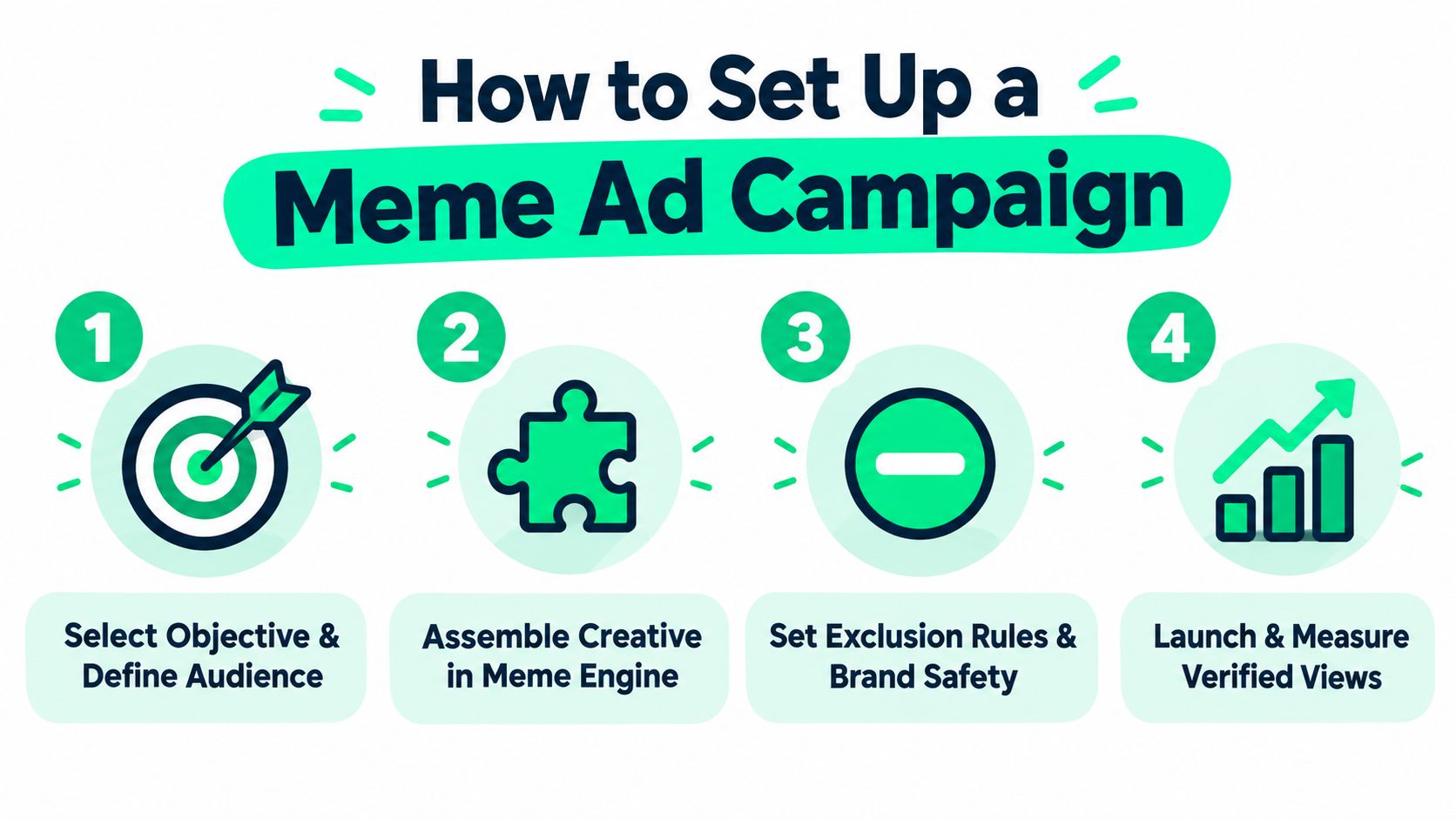
Build the campaign in a controlled sequence
- Choose the format: Use logo and caption distribution for broad branded reach, vertical targeting for defined communities, or content campaigns when the asset needs creative adaptation.
- Define acceptable inventory: List target geographies, vertical keywords, prohibited topics, minimum page standards, and placements that require exclusion.
- Assemble and approve creative: Prepare captions, watermarks, landing destinations, disclosures, and variations. Don't leave compliance review until after launch.
- Set measurement rules: Decide what counts as a verified view, which page-level signals matter, and what action indicates useful attention.
- Launch with live oversight: Watch delivery, captions, page context, geography, and engagement. Pause a placement when it violates a rule, not after the report arrives.
The campaign dashboard should answer practical questions. Which handles drive verified views? Which pages attract the right geography? Does one caption generate more qualified clicks? Are views accumulating through authentic sharing or only through initial placement?
Know when to adjust
A weak page shouldn't contaminate the entire network. Remove it, preserve the approved placements, and compare the remaining delivery against the original audience definition. A caption that underperforms can be replaced without rebuilding the whole campaign, provided the new language passes the same review workflow.
A verified-view model also changes how you read CPM. A low number is useful only when the views come from the intended audience and remain attached to brand-safe placements. Pair reach with click quality, funnel behavior, page-level delivery, and creative retention. The dashboard should support decisions, not just celebrate volume.
When Meme Ads Stop Helping and Start Hurting
Meme ads stop helping when the audience recognizes the format but no longer cares about it. Saturation destroys novelty. Research highlighted in the independent discussion of meme effectiveness found that interest declines as consumers see a meme more frequently, which makes repetition a media-planning problem rather than a simple creative problem. The discussion of meme lifecycle and saturation is a useful warning against treating one successful template as permanent inventory.
A second failure occurs when the product doesn't fit the cultural shortcut. Niche and credibility-sensitive offers need more explanation than a meme can provide. The large multi-study research cited earlier found weaker effects when products were niche or when the meme was in an early or declining lifecycle stage. The conclusion isn't that meme ads fail. It's that familiarity, timing, and category fit set the boundary.
The risk isn't only creative
Poorly vetted distribution can expose a brand to content that conflicts with its values, audience expectations, or regulatory obligations. A funny caption beside hateful, graphic, illegal, or misleading content can turn efficient media into a reputation problem. Brand suitability adds another layer because an adjacent page may be technically safe but still wrong for the brand.
That's why real-time human review remains necessary. Automated scoring can identify patterns, but reviewers need to assess sarcasm, cultural references, visual context, and sudden changes in page behavior. Geo filters matter just as much. High-quality American reach is preferable to global volume when the offer, legal framework, or conversion path is limited to the United States.
Operational test: If the team can't explain who approves a post, who can remove it, which geographies are excluded, and how the view is verified, the campaign isn't ready to scale.
The right mental model is conditional performance. Meme ads are powerful for attention and memory, especially when the format is mature and the product is broadly relatable. They become dangerous when teams chase novelty without reviewing saturation, or chase cheap views without validating geography, context, and authenticity.
FindClout programmatically distributes branded meme content across curated creator pages, with verified views, watermark and caption controls, audience targeting, and real-time campaign orchestration. If you need controlled reach among American sports, gaming, finance, or consumer audiences, visit FindClout to assess whether its page network and review workflow fit your next campaign.
Want this audience for your brand?
FindClout puts your brand in front of verified American audiences across every major US page — brand-safe, at scale.
Start Your Campaign