 findclout.com
What Is a Media Buying Platform? a Practical Guide
A media buying platform is software that purchases, places, and measures ad distribution across many publishers or creator pages from one interface. U.S. internet advertising revenue reached $258.6 billion in 2024, a record that helps explain why buyers need systems to manage campaigns at scale.
You may be looking at a spreadsheet full of creator contacts, separate invoices, and reports that define a view differently from one publisher to the next. The challenge isn't buying more exposure. It's knowing whether your campaign reached real people in the intended geography, appeared in an appropriate context, and delivered views you can verify.
Table of Contents
- Why Media Buying Platforms Now Matter
- What a Media Buying Platform Actually Does
- How Programmatic Distribution Moves a Campaign
- Evaluating Targeting, CPMs, and Fraud Controls
- Protecting Brand Safety and Geographic Quality
- Comparing DSPs, Creator Networks, and FindClout
- Use Cases for Performance Marketers and Your Next Step
Why Media Buying Platforms Now Matter
A performance marketer juggling dozens of publisher and creator deals can spend more time reconciling delivery than learning from it. One page sends a screenshot, another reports impressions, and a third invoices on a different schedule. When the numbers don't line up, the buyer has to chase explanations before deciding what to fund next.
Centralized buying exists to reduce that operational friction. A media buying platform brings purchasing, placement rules, optimization, and reporting into one workflow, so buyers can compare delivery using consistent criteria rather than separate publisher definitions.
The scale of U.S. digital advertising helps explain why that coordination matters. Internet ad revenue reached $258.6 billion in 2024, up 14.9% year over year, with search at $102.9 billion, social at $88.8 billion, and display at $74.3 billion. Digital video generated $62.1 billion, while retail media reached $53.7 billion. These figures show that digital budgets flow across varied formats and environments, making fragmented manual coordination harder to manage. (IAB's 2024 digital advertising revenue report)
For a buyer, the practical question is whether the platform can make a complex buy more accountable. Can it show where ads ran, how geography was checked, which views were filtered, and what portion became billable? A centralized interface is useful only if it makes those answers easier to inspect.
What a Media Buying Platform Actually Does
Think of a media buying platform as a warehouse dispatch control tower. The tower knows what shipments are available, where they can go, which routes are allowed, and whether the deliveries arrived. In advertising, the “shipments” are placements, and the platform coordinates how a campaign moves across publishers or creator pages.
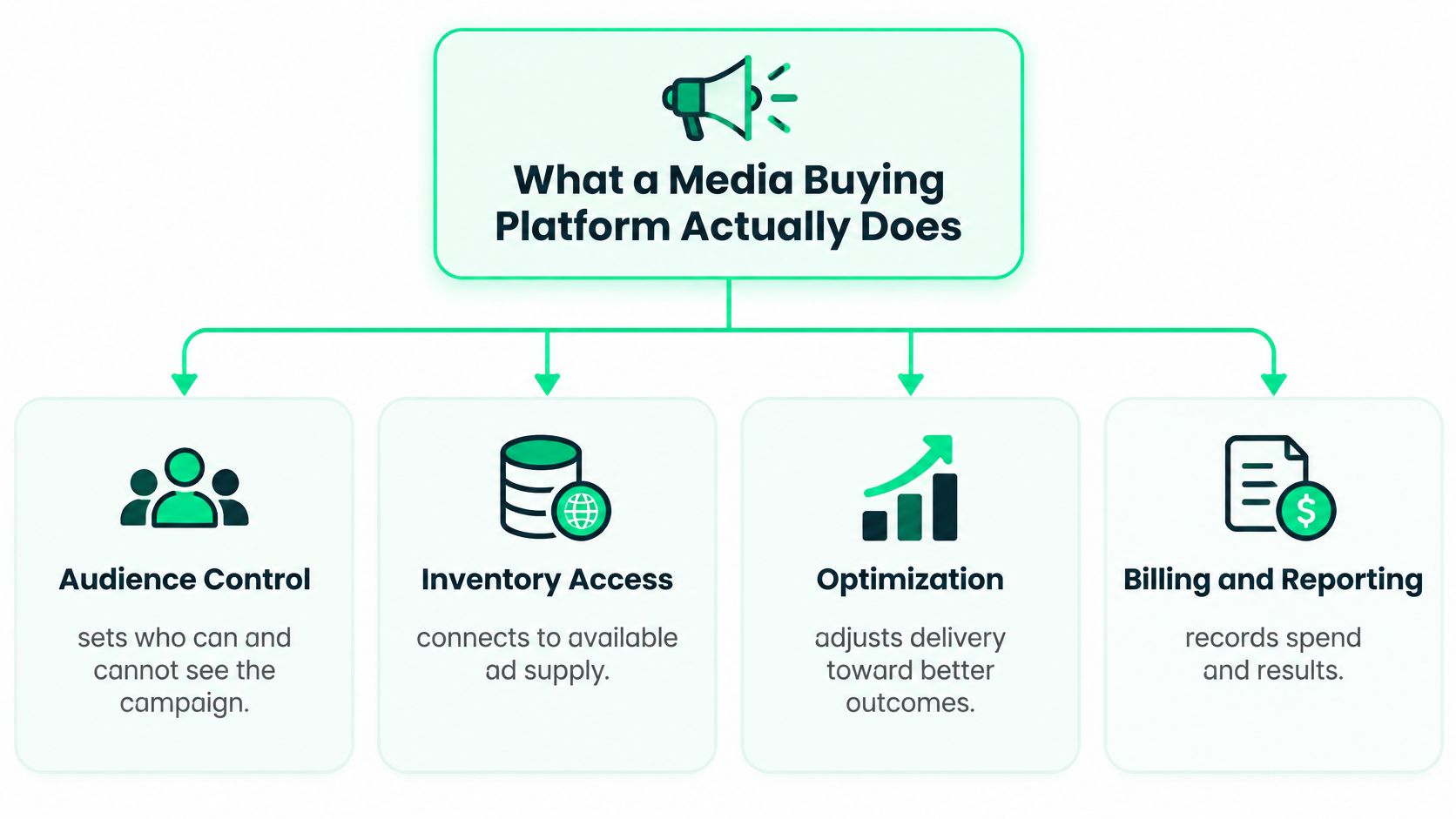
The core functions connect to decisions a buyer needs to make:
- Audience control defines who should or shouldn't see the campaign, including geography, topics, and placement exclusions.
- Inventory access connects a buyer to available ad supply across publishers, creators, or other channels.
- Optimization adjusts distribution based on delivery and performance signals, rather than treating every placement as equal.
- Billing and reporting records spend and results so the buyer can compare delivered views with the campaign's rules.
This is different from a single publisher's ad manager, which generally focuses on that publisher's own inventory. It's also broader than a demand-side platform (DSP) used for auction-based buying, although a media buying platform may use DSP capabilities as part of a wider workflow. The useful distinction is not the label. It's whether the system gives the buyer the controls, inventory visibility, and reporting needed to make a defensible decision.
For example, a brand testing podcast placements may need a plan for creative, show selection, delivery, and measurement that differs from creator-page distribution. A guide to budgeting for podcast advertising campaigns can help clarify that channel-specific planning before you compare platforms.
Practical rule: If a platform reports a view but can't show what qualified it for billing, treat the number as a starting point, not proof.
How Programmatic Distribution Moves a Campaign
A campaign can reach a real person only after several decisions line up. The buyer sets the rules, the platform finds eligible placements, and delivery is checked against what the campaign agreed to count. Programmatic distribution uses software to coordinate those steps, through auctions or direct arrangements.
A useful comparison is booking travel. An auction offers access to available options as they compete, while a direct arrangement reserves access under agreed terms. Buyers can use auctions for scale and direct deals when controlled access or more predictable placement matters. For a closer look at programmatic ad buying, examine how buying rules connect to delivery.
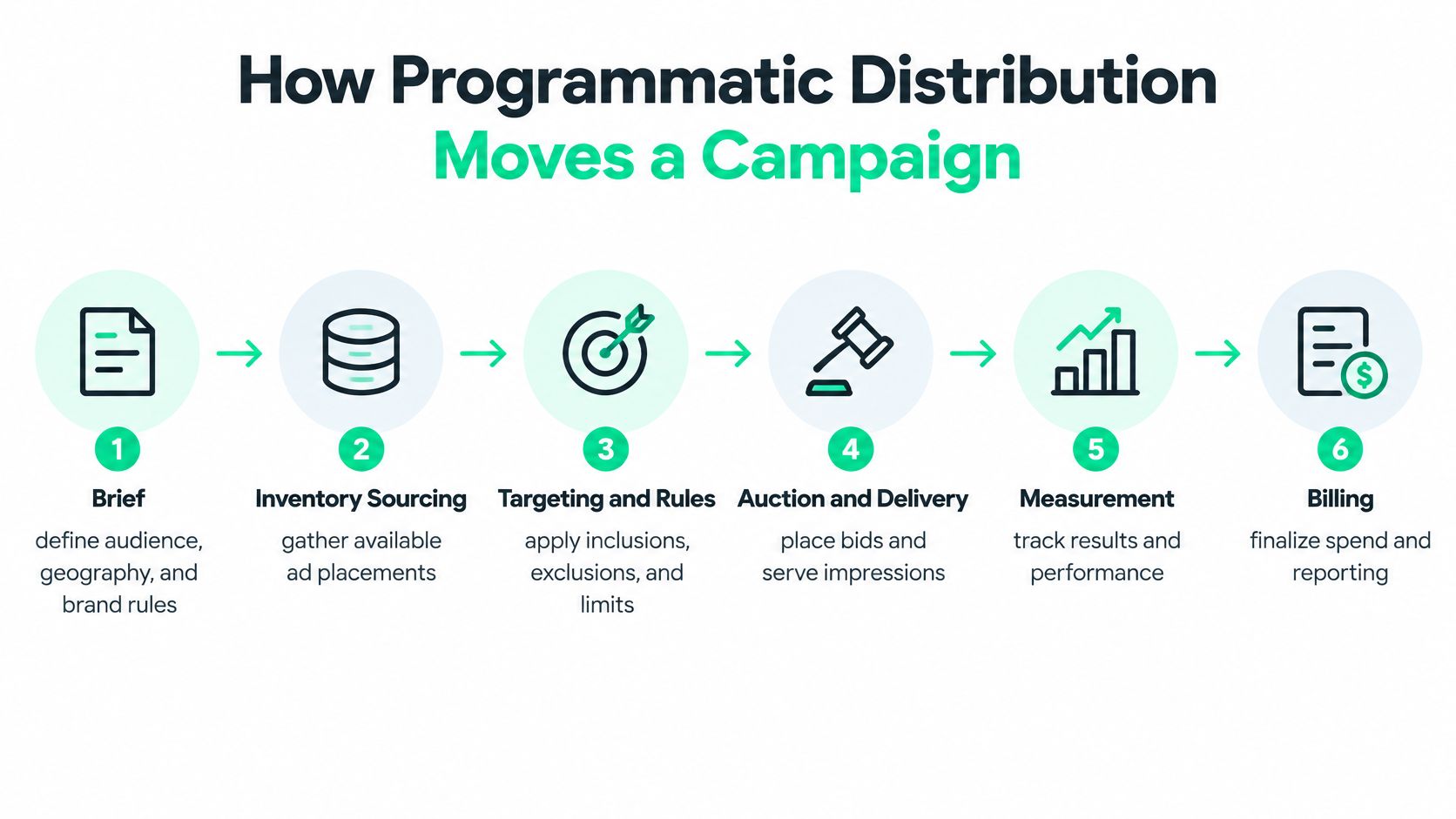
The campaign moves through six stages:
- Brief: Set the audience, geography, budget, and brand rules. Define an acceptable placement and the conditions a view must meet to qualify for billing.
- Inventory sourcing: The platform finds available placements from publishers or creators. Buyers need enough information to assess context and fit, not just a list of handles.
- Targeting and rules: Set inclusions, exclusions, and delivery limits. A U.S.-focused campaign, for example, should specify how traffic outside the intended geography is treated.
- Auction and delivery: The platform bids for placements or activates direct deals, then serves the campaign. A bid does not guarantee a placement. Google's auction guidance explains how bid, ad quality, relevance, landing-page experience, device, geography, and competition can affect an auction. (Google Ads auction guidance)
- Measurement: Compare delivery with the campaign rules. Raw impressions count recorded ad displays; verified views are the subset that meets the agreed criteria. Keep geography visible in that check so an impression from outside the target area does not pass as a qualified view.
- Billing: Reconcile spend against verified delivery. Remove invalid or out-of-scope views before deciding what is billable.
Automation can make routine decisions quickly, but human review still helps. A reviewer may catch a contextual mismatch that a keyword filter misses. A campaign manager can pause or reject a placement that fails the agreed rules. Audit the difference by comparing platform totals with the criteria for a billable view, then checking which views passed verification and matched the intended geography. For campaigns that lead to a landing page, align keywords, ads, and landing pages so the message stays consistent after the click.
Evaluating Targeting, CPMs, and Fraud Controls
A campaign can buy many impressions and still miss its intended audience. A low CPM is like a low ticket price: it matters only if the ticket gets the right person to the right event. Compare the rate with the rules that make a view eligible for billing.
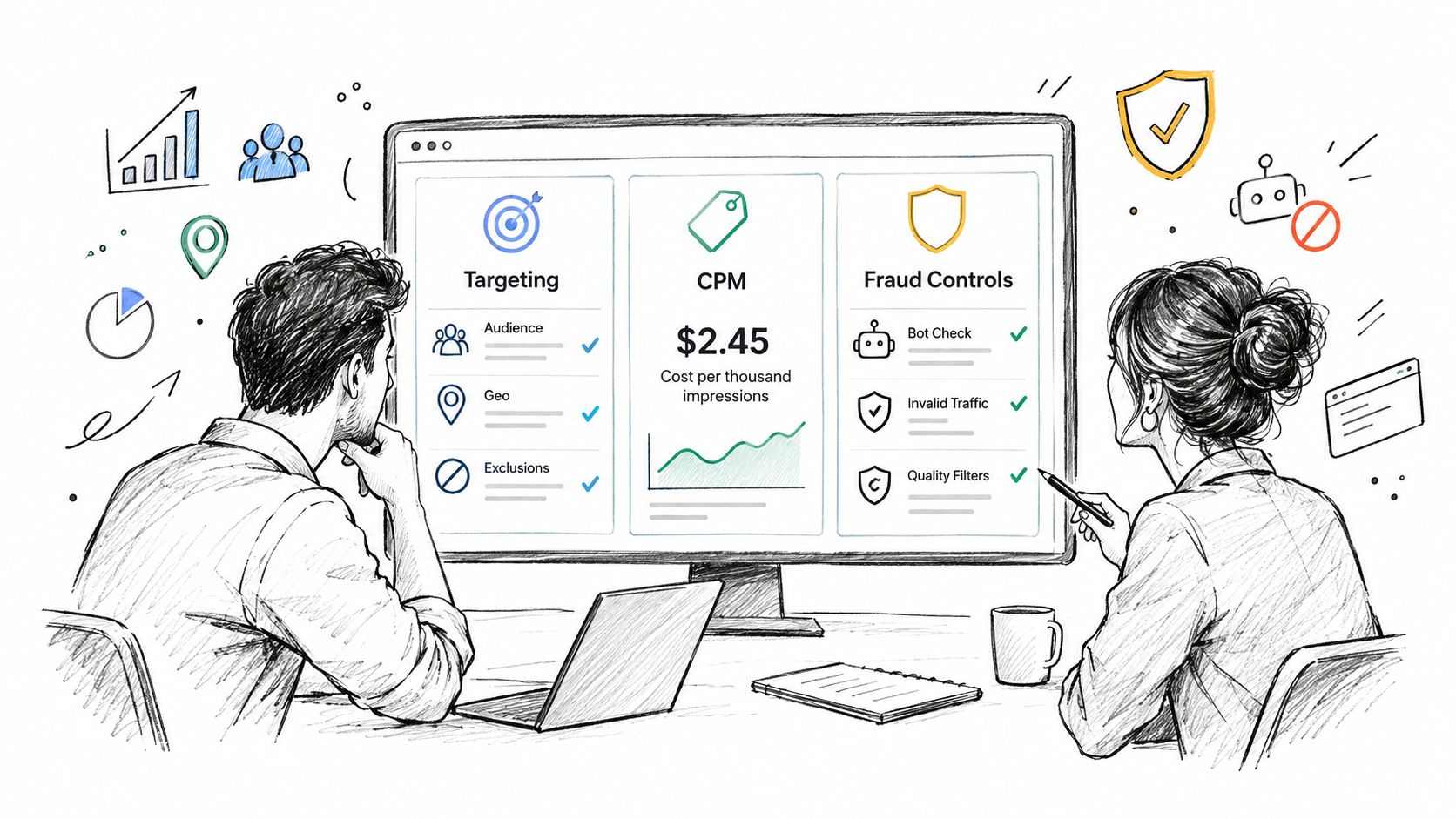
Targeting is a set of rules, not one switch. Check which audiences and placements qualify, what the platform excludes, and whether minimum thresholds apply. These settings should be visible before launch. Confirm that the report later shows whether delivered views met them.
CPM is a price signal, not a quality score. Compare the contracted rate with the effective cost of verified, billable views. If reported views are invalid, outside the intended geography, or ineligible under the agreed rules, fewer views qualify for billing and the effective cost rises. Auction prices can also reflect factors beyond the bid, including quality and context.
Fraud controls need checks before and after delivery. Screening before a campaign runs can block known risks. Reviewing delivery afterward can catch suspicious patterns that emerge over time. An ANA programmatic benchmark survey found that 44% of respondents used both pre-bid and post-bid invalid-traffic verification. It also reported a weighted-average post-bid invalid-traffic rate of approximately 2%, within the Media Rating Council's cited 1–3% range. (ANA programmatic benchmark survey)
Reporting should separate three quantities: gross views, filtered invalid views, and billable verified views. Ask for placement-level records, a clear explanation of the filtering method, and a make-good policy for views disqualified after delivery. Raw impressions show that an ad was served. They do not, by themselves, prove a real person saw it in the intended geography or that it met the buy's rules.
A useful audit starts with one question: can you trace a billable view back to its placement, geography, and verification rule?
For more on automated fraud detection, look for systems that screen before delivery and check results afterward. A badge or single filter cannot show whether each billable view met the campaign's requirements.
Protecting Brand Safety and Geographic Quality
A platform's reputation doesn't make every placement safe. Brand safety and geography must be enforced at the level of each submission and reported placement, because a campaign can meet its reach goal while appearing beside unsuitable content or outside its intended market.
Start with written rules. Specify required terms, prohibited topics, minimum creator or page thresholds, and eligible geographies. For a campaign aimed at American audiences, the platform should show how it filters for the United States and how it treats out-of-scope views. Other campaigns may define Canada or the United Kingdom as eligible markets, but each geography should be an explicit setting rather than an assumption.
Measurement standards help make the definition of “viewable” concrete. IAB and Media Rating Council guidance defines a viewable display impression as one where at least 50% of the ad's pixels remain visible for one continuous second. For video, at least 50% must remain visible for two continuous seconds. The guidance also recommends reporting geography at levels such as country, region, city, or postal code and filtering general and invalid traffic. (IAB and MRC retail media measurement guidance)
Those definitions don't automatically prove meaningful attention. They do, however, give buyers a consistent starting point for visibility and location. Agree on the standard, then check whether the platform's records show which views passed it and whether the traffic was within the approved geography.
Review must continue after approval. A page that fits the brief today may publish a later post that doesn't. Automated checks can flag prohibited topics or anomalous activity, while human reviewers assess context and make judgment calls. Buyers should also be able to request removal of a placement and see how the change affects delivery and billing. For more on setting brand-safety controls in digital advertising, focus on enforceable rules and placement-level visibility rather than general promises.
Comparing DSPs, Creator Networks, and FindClout
A traditional DSP, a creator network, and a curated creator-page platform solve different problems. Compare them on the same grounds: cost structure, control over placements, audience verification, reporting, and the work your team must do to keep campaigns on track.
| Buying model | Cost structure | Placement control | Audience and reporting considerations | Operational load |
|---|---|---|---|---|
| Traditional DSP | Auction or negotiated media costs, depending on inventory | Buyers can set campaign rules, but supply paths and individual placements may need close review | Useful for programmatic reach; verify what placement-level detail and invalid-traffic controls are available | Requires active setup, monitoring, and supply-quality checks |
| Creator-network model | Often based on direct creator or campaign agreements | Relationships can allow detailed coordination, but each partnership may need separate approval | Results and audience evidence can vary by partner and reporting method | Outreach, coordination, and reconciliation can add work |
| FindClout | CPM-based campaign formats | Curated creator pages, pre-approval, and defined brand rules | Offers placement and campaign controls aimed at verified-view distribution | One coordination point across its network |
FindClout distributes branded meme content through a curated network of creator pages and offers campaign formats for logo and caption placement, vertical targeting, and content campaigns. Its stated rates are $0.20 CPM for logo and caption distribution, $0.25 CPM for vertical-targeted campaigns, and $1.50–$3.00 CPM for content campaigns. These are campaign rates, not proof that every view will be valid or suitable; buyers should still confirm the view definition, geography, reporting, and reconciliation terms.
| FindClout campaign format | CPM | What it controls |
|---|---|---|
| Logo and caption distribution | $0.20 | Brand watermark and approved captions under defined rules |
| Vertical-targeted campaign | $0.25 | Keyword requirements, exclusions, and placement in selected niches |
| Content campaign | $1.50–$3.00 | Meme variations made from brand video or static assets |
The platform describes a single coordination point across hundreds of vetted pages, pre-approval before posting, AI scoring with continuous human review, and controls for required terms, prohibited topics, minimum follower thresholds, and geography. Before buying, ask how the platform defines verified views, what evidence accompanies reporting, and how it handles invalid or removed delivery. For a separate perspective on scaling Meta campaigns with Rapid Ads, compare the operational model and measurement criteria, not just the advertised CPM.
Use Cases for Performance Marketers and Your Next Step
The lowest CPM doesn't necessarily make the strongest buy. If cheap delivery includes out-of-market traffic, unsuitable placements, or views that can't be verified, it may be less useful than a higher-priced campaign with clearer controls and evidence. The decision should be based on what you can verify and how well the audience fits your objective.

Consumer apps and ecommerce teams may use creator distribution to introduce a product or bring people to a landing page. Fintech and crypto advertisers need careful topic exclusions and review. Sports betting, gaming, and iGaming teams may prioritize American audiences and relevant sports communities, but should still require clear placement approval and geographic reporting. Across these use cases, views are only useful when the audience and context match the campaign.
A sensible pilot begins with a written brief. Define the intended geography, prohibited topics, approved creative, view-verification rules, and the conversion signals you'll compare against delivery. Then decide in advance how you'll interpret results: verified views can describe delivery, while conversion analysis needs its own measurement plan.
The video below offers another way to consider how campaign coordination and distribution fit together.
FindClout lists a 0% management fee, rolling monthly agreements, and a $20K–$30K pilot guaranteeing 100M views among its commercial terms. Treat the guarantee as a delivery term to review closely: ask how views are defined, what geography and verification rules apply, and what happens if delivery doesn't meet the agreed conditions.
FindClout coordinates branded content distribution across a curated network of creator pages, with campaign controls for placement rules, brand review, and verified-view delivery. Define your audience, geography, and audit requirements first, then visit FindClout to discuss a pilot against those criteria.
Want this audience for your brand?
FindClout puts your brand in front of verified American audiences across every major US page — brand-safe, at scale.
Start Your Campaign