 findclout.com
Influencer Marketing for Ecommerce Playbook
Most advice about influencer marketing for ecommerce starts with follower count, outreach volume, and a spreadsheet of creators. That advice is outdated. A creator network that produces impressive reach but exposes your brand to fake engagement, irrelevant geographies, or missing disclosures isn't a growth channel. It's unmanaged media risk.
The stronger model treats creator distribution as programmable commerce infrastructure. You define the audience, quality controls, message, tracking, and removal rules before launch. Then you route verified attention from tier-1 American audiences into a measurable ecommerce funnel, rather than hoping a collection of one-off negotiations produces a profitable result.
Table of Contents
- The Shift From Awareness to Commerce Infrastructure
- Building a Brand-Safe Creator Network in Tier-1 Markets
- Structuring Campaigns for Measurable Revenue
- Orchestrating Distribution Across Vetted Pages
- Measuring ROI and Optimizing for Real Conversions
- Scaling Attention While Protecting Your Brand
The Shift From Awareness to Commerce Infrastructure
The familiar workflow is easy to recognize. A marketer opens a spreadsheet, searches social platforms, sends direct messages, negotiates a flat fee, waits for a draft, and checks whether the creator posted on schedule. Performance is usually judged through screenshots of reach and impressions, while the connection between the post and the sale remains uncertain.
That process can work for a small test. It breaks when a brand needs consistent delivery across many pages, strict geographic targeting, and live compliance review. Manual outreach creates fragmented contracts, inconsistent captions, scattered tracking links, and no reliable way to remove an unsuitable post across a network.
The commerce opportunity is too large to manage as informal public relations. A 2025 survey summary reports that 76% of Americans follow influencers, while 50% of influencer followers have made at least one purchase based on an influencer recommendation. The same source reports average spending of $372 among those buyers in 2025, and estimates that roughly 38% of all Americans made at least one influencer-driven purchase that year. These figures come from influencer commerce statistics covering purchase behavior and categories.
Reach needs operating controls
Those purchases span beauty, clothing and accessories, electronics, gaming gear, and food. That range matters because it shows creator-led commerce isn't confined to one lifestyle niche. The creator is increasingly part of the distribution layer, connecting discovery with a product page, native checkout, affiliate path, or tracked offer.
A modern program therefore needs a centralized system for:
- Audience routing: Prioritize verified tier-1 American attention instead of accepting undifferentiated global reach.
- Message control: Distribute approved captions, watermarks, product claims, and calls to action.
- Compliance: Review every submission before publication and monitor live content afterward.
- Attribution: Connect each page, creator, link, code, and placement to downstream revenue.
- Optimization: Remove off-brand placements and reallocate spend based on verified performance.
The distinction is practical. Traditional influencer buying asks, “Which creator can we persuade to post?” Infrastructure asks, “Which verified audience segment can deliver qualified attention under our rules?” That shift makes direct-response advertising through creator distribution a useful frame for ecommerce teams that care about revenue rather than social proof alone.
Why flat-fee awareness isn't enough
A flat fee can still make sense when a creator provides a guaranteed production asset or has unusual authority in a niche. It becomes dangerous when the brand pays for a large audience without checking where that audience lives, how it behaves, or whether the content can be reused.
The scalable alternative is a controlled network with clear delivery terms and a feedback loop. Brands can test smaller audiences, validate conversion quality, and expand only after the tracked economics make sense. That isn't less creative than manual creator work. It gives creative distribution the same discipline that paid search, paid social, and affiliate marketing already receive.
Building a Brand-Safe Creator Network in Tier-1 Markets
The fastest way to waste an ecommerce budget is to confuse visible activity with valuable attention. A page may report strong follower growth and high engagement while sending little qualified traffic to a US storefront. Audience location, authenticity, topical relevance, and brand fit need to be checked together.
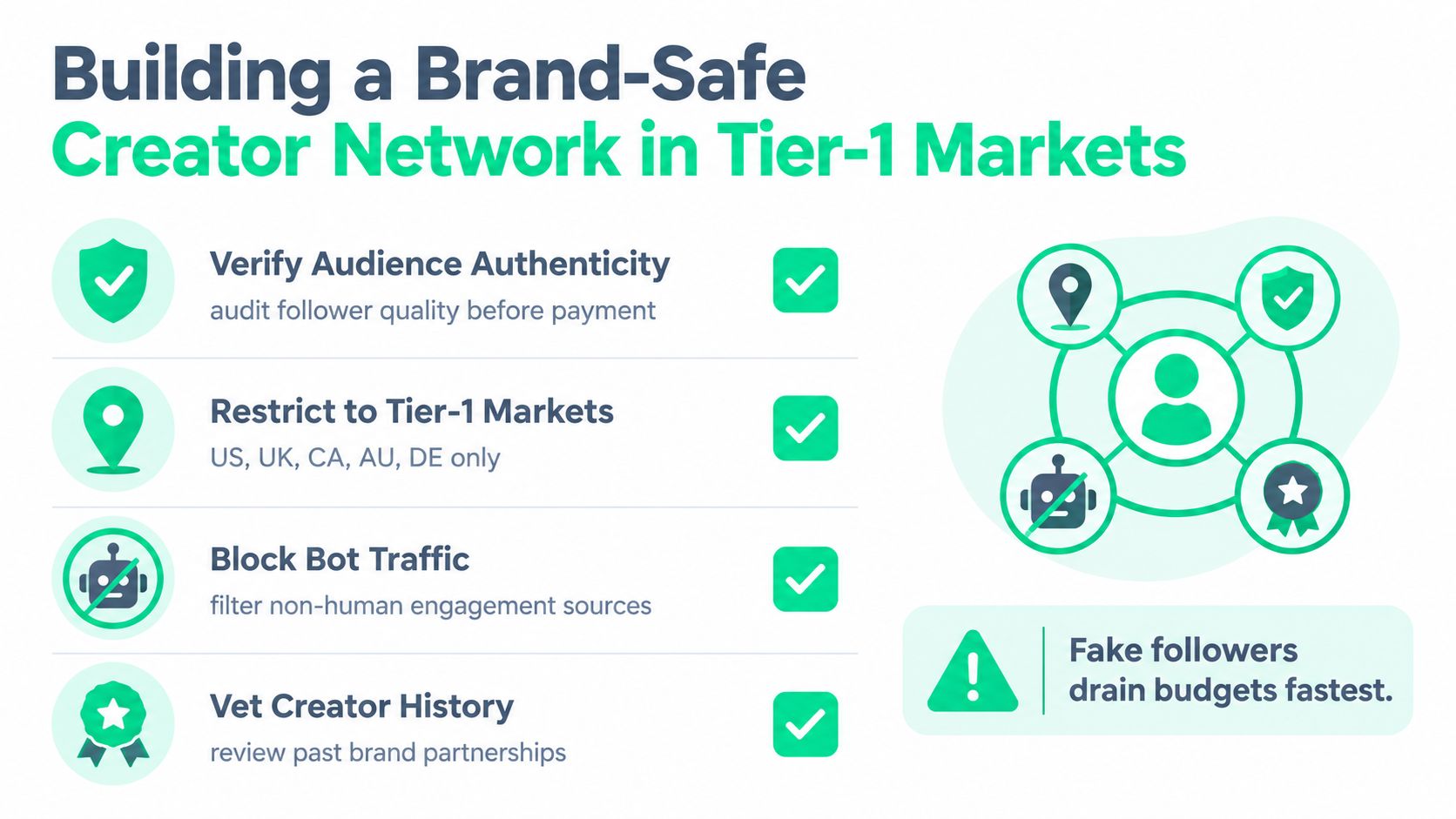
For a US-focused program, geographic controls belong in the network rules, not in a post-campaign report. Require audience evidence for American reach, flag unusual concentrations in non-target markets, and separate creator eligibility from content eligibility. A creator can be authentic yet still be unsuitable if the audience doesn't match the product's shipping footprint or buying context.
Vet the audience, not just the profile
Fraud screening deserves technical attention because the risk is material. A 2026 industry summary reports that 81% of marketers encountered influencer fraud in the previous 12 months, while the average affected campaign showed a 37% gap between projected and actual authentic reach. That source also reports that roughly 37% of influencer followers are fake, with the macro tier reaching a reported fraud rate of 48.3% in its dataset. See the 2026 influencer fraud and authenticity summary for the cited benchmarks and risk patterns.
A thorough review should combine automated scoring with human judgment. Check:
- Follower quality: Look for suspicious growth, repetitive accounts, and audience clusters that don't fit the creator's content.
- Engagement anomalies: Compare comments, shares, and saves across recent posts instead of accepting one unusually strong result.
- Niche fit: Review whether the creator's audience discusses the product category.
- Content history: Inspect prior sponsorships, tone, disclosure behavior, and sensitive-topic exposure.
- Geographic relevance: Confirm that the audience is concentrated in the markets the brand can serve profitably.
Teams evaluating creators manually can use resources for finding influencers with engagement data to make quality signals easier to compare. The tool doesn't replace review. It helps reviewers focus attention on profiles that deserve a closer look.
Put the rules in software
A brand rules engine should enforce minimum follower thresholds, required terms, prohibited topics, competitor exclusions, and US audience filters before a campaign reaches a creator. Add a review queue that records who approved each submission, what changed, and whether a post was removed.
Human review remains essential for edge cases. A caption can satisfy keyword rules yet make an implication the brand can't support. A video can display the logo correctly while showing a competitor in the background. AI can screen at speed, but a trained reviewer should make the final decision for ambiguous claims, regulated categories, and sensitive cultural context.
The right standard is simple: no payment for unverified attention and no publication without brand approval. That discipline protects budget quality and makes the network useful for high-stakes categories where audience geography and reputation cannot be treated as afterthoughts.
Structuring Campaigns for Measurable Revenue
A vetted network still won't produce profitable sales if the commercial structure rewards posting instead of outcomes. Start with the economics of the product, then decide which part of the creator's contribution you're buying: content production, verified distribution, conversion, or a combination.
The first step is to define the conversion event. For a direct-to-consumer store, that might be a completed purchase or a qualified new customer. For a marketplace, it could be a product view followed by an order. Write the event into the brief, contract, dashboard, and payment logic before any creator publishes.
Build the deal around reusable assets
Creator content has value beyond its first placement, but only if usage rights are explicit. The agreement should specify whether the brand can use the asset on paid social, product pages, email, retail media, or landing pages, along with the permitted duration, territory, edits, and platforms.
A practical compensation structure can combine:
- A production fee for agreed creative deliverables.
- A distribution component tied to verified delivery or qualified views.
- A performance component based on tracked sales, approved leads, or another conversion event.
- A usage-rights provision that gives the brand permission to reuse winning assets.
The balance depends on creator authority and the campaign objective. A niche creator with strong trust may deserve more creative freedom and a meaningful performance upside. A distribution page may be evaluated more like a media placement, with stricter delivery, geography, and content controls.
The commercial case for usage rights is becoming clearer. One recent industry summary reports that 77% of brands repurpose creator content in paid ads, while 67% include usage rights in the initial contract. The same source identifies CAC, AOV, ROI, affiliate revenue, and content rights as increasingly important performance considerations in creator marketing trends.
Test narrow audiences before broad scale
Use a tiered creator mix, but don't assume the largest page deserves the largest first allocation. Start with smaller, highly relevant creators or pages where audience quality can be inspected closely. Compare their tracked CPA, conversion rate, and content reuse potential against the ecommerce baseline.
Once a creator demonstrates profitable behavior, increase distribution gradually. Keep a control group or comparable audience segment so the team can distinguish incremental sales from demand that would have arrived without the campaign. This is especially important when the product already has strong branded search or recurring demand.
Attribution needs to exist before launch, not after the first sale. A practical conversion tracking setup should include unique UTMs, creator-specific codes, affiliate links where appropriate, and platform pixels. The result is a commercial system where compensation reflects verified contribution instead of a creator's negotiating skill.
Orchestrating Distribution Across Vetted Pages
A campaign spread across hundreds of creators becomes unmanageable when every instruction travels through a separate message thread. The operational failure usually starts small. One page uses an outdated caption, another omits the disclosure, a third links to the wrong product, and the media buyer discovers the problem after the campaign has already spent.
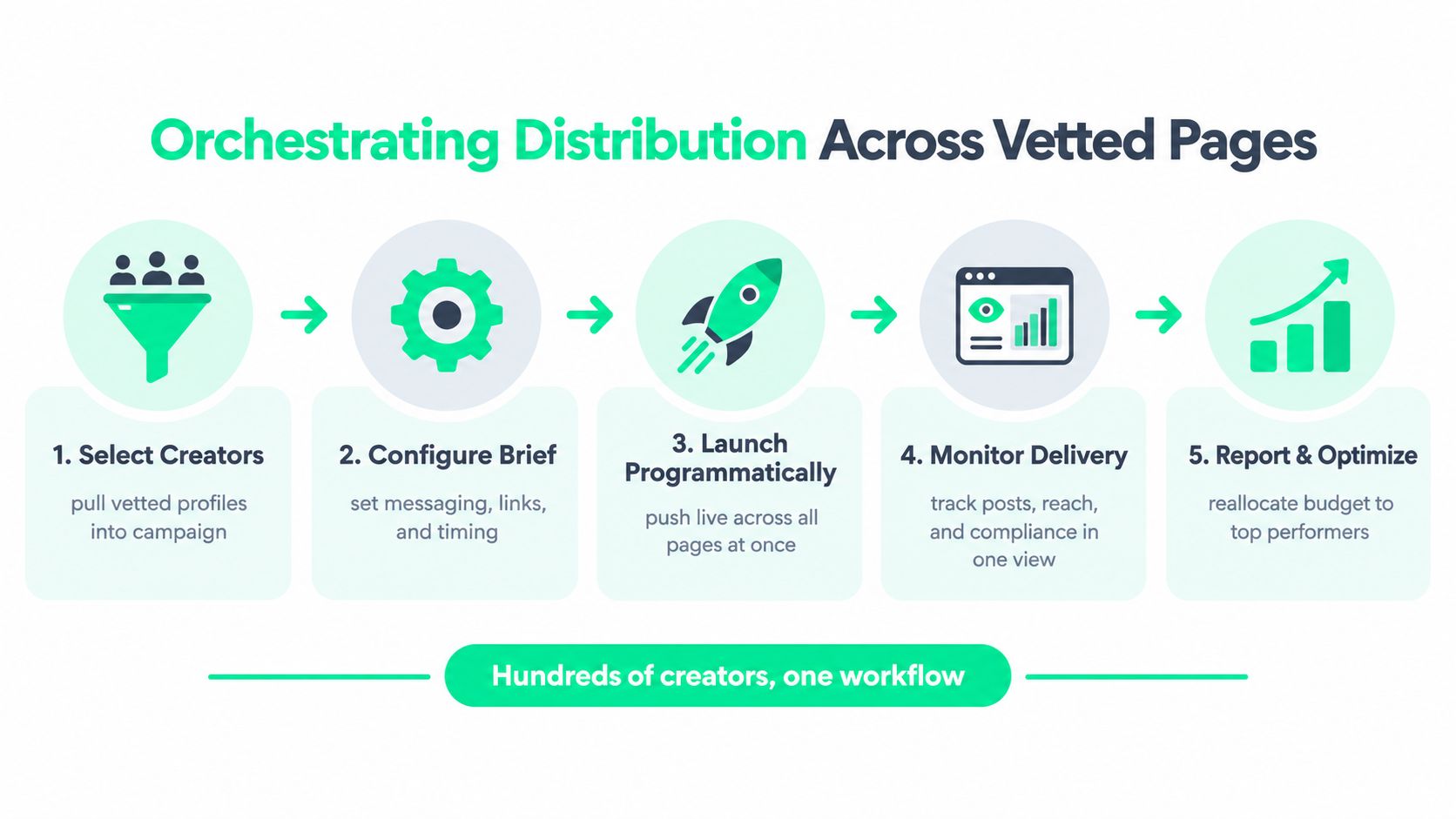
Centralized orchestration changes the sequence. The brand approves the brief once, applies audience and content rules, and sends the eligible asset to a controlled network. Each placement still needs review, but the review happens inside a repeatable workflow rather than in scattered inboxes.
A controlled launch sequence
Consider a sports-focused ecommerce campaign aimed at American fans. The operator first selects pages that pass the audience, authenticity, and brand-history checks. The team then loads the approved creative, caption, destination link, disclosure language, timing window, and exclusions into one campaign record.
Before publication, automated screening checks the text and media for required terms, prohibited claims, competitor references, and obvious mismatches. A human reviewer handles the judgment calls. Only approved submissions move to the publishing queue.
The live process should provide:
- Centralized briefing: One source of truth for captions, logos, links, and creative requirements.
- Network-wide updates: A corrected caption or destination link can replace an outdated instruction.
- Live delivery monitoring: The team can see which pages published, which are delayed, and which need review.
- Immediate removal: Off-brand or non-compliant posts can be pulled without waiting for a campaign wrap.
- Performance segmentation: Results can be compared by page, niche, format, and geography.
For teams that need fresh creative variations without sending every edit back to a studio, a controlled tool to generate product videos with AI can support asset development. Every generated variation still needs the same claim review, logo check, and approval path as creator-submitted content.
Continuous oversight beats one-time approval
Brand safety isn't a checkbox completed when a creator signs a contract. The creator's surrounding content can change, audience sentiment can shift, and a live post can attract comments that create a new risk. Pre-launch AI screening plus post-launch human monitoring gives the brand a way to catch missing FTC disclosures, competitor mentions, and inappropriate context while the campaign is active.
The operating target is controlled scale. A centralized network can distribute attention toward billions of views over time, but scale only helps when every view remains relevant to the intended American audience and every placement remains reviewable. Speed without inspection makes mistakes travel faster.
Measuring ROI and Optimizing for Real Conversions
A screenshot of an Instagram Story isn't an attribution model. Ecommerce teams need to know which page generated the visit, which creator influenced the order, whether the customer was new, and what the acquisition cost looked like after refunds, discounts, commissions, and media expense.
Instrument the campaign before the first post. Give each creator or page a unique UTM structure, promotional code, and affiliate destination where appropriate. Add platform pixels and reconcile those signals with the store's order data. No single method captures every assisted conversion, but using several methods exposes inconsistencies that a reach report hides.
Match the metric to the decision
Track the metrics that determine whether to continue, adjust, or stop a placement:
- Verified views: Did the network deliver attention from the intended audience?
- Click-through rate: Did the content create an observable action?
- Code redemptions and attributed orders: Did the creator or page contribute measurable purchases?
- CPA and ROAS: Did the placement work within the ecommerce unit economics?
- AOV and customer quality: Did the campaign attract valuable orders rather than low-intent discount seekers?
- Usage value: Can the strongest content support product pages, email, or paid media?
Engagement quality matters more than raw follower count. One industry benchmark reports that nano-influencers can reach an average engagement rate of 2.61%, while mega-influencers fall to 0.84%. The same source reports an average YouTube engagement rate of 23.16%, compared with 4.8% on TikTok, illustrating why creator tier and format must be evaluated together. These benchmarks appear in ecommerce influencer ROI guidance.
Creator Tier Engagement and Fraud Benchmarks
| Influencer Tier | Average Engagement Rate | Fraud Risk Profile | Best Ecommerce Use Case |
|---|---|---|---|
| Nano | 2.61%, according to Salsify's ecommerce influencer benchmarks | Smaller reach still requires authenticity and geography checks | Niche testing, product education, and conversion experiments |
| Mega | 0.84%, according to the same Salsify benchmark source | Macro-tier fraud has been reported as high as 48.3% in the Ringly fraud summary | Broad launches when reach is more important than efficiency |
| YouTube format | 23.16% average engagement in the cited benchmark | Review audience authenticity and comment quality | Demonstrations, reviews, and higher-consideration products |
| TikTok format | 4.8% average engagement in the cited benchmark | Monitor rapid spikes, audience mismatch, and disclosure compliance | Discovery, short-form product demonstrations, and social commerce |
Because the table uses multiple facts from the same sources, the source links are repeated within the table for clarity. In a live reporting system, store the benchmark alongside your own baseline instead of treating it as a guaranteed outcome.
Choose the right checkout path
Native social checkout can reduce friction when the platform, product, and audience support an immediate purchase. TikTok Shop adoption nearly doubled year over year, with 32% of brands already selling there and another 25% planning to do so, according to recent social commerce and influencer marketing coverage. That makes native checkout worth testing for products suited to impulse and livestream shopping.
Route traffic to your own store when you need richer merchandising, first-party customer capture, subscriptions, bundles, or a more controlled compliance environment. The right answer is often a split test, not a universal platform rule. Compare conversion quality, contribution margin, repeat behavior, and tracking reliability by route.
Scaling Attention While Protecting Your Brand
Scaling creator attention isn't the same as adding more names to a spreadsheet. At volume, the campaign becomes an operating system with four essential components: tier-1 American audience targeting, real-time brand safety, programmatic distribution, and conversion tracking.
That system matters most when the brand operates in a sensitive or regulated-adjacent category. Sports betting, prediction markets, fintech, crypto, and gaming advertisers can't treat geography, disclosures, prohibited language, or creator history as informal preferences. A technically polished post can still create risk if the audience is wrong or the surrounding content damages trust.
Scale through gates, not guesses
A sensible pilot has explicit gates:
- Audience gate: Reject pages that can't demonstrate relevant American attention and authentic engagement.
- Safety gate: Require approval for captions, creative, disclosures, claims, and surrounding context.
- Delivery gate: Track whether approved pages publish correctly and whether the views meet the agreed quality standard.
- Revenue gate: Compare attributed CPA, ROAS, AOV, and customer quality with the brand's baseline.
- Expansion gate: Increase budget only for segments that pass all prior checks.
This approach prevents a single viral placement from distorting the whole program. A post can generate attention without generating qualified demand. Another can produce modest visible engagement while delivering high-intent shoppers. The decision should follow verified commercial behavior, not the loudest dashboard number.
Make brand safety continuous
A scalable review system combines automated screening with human oversight before and after publication. The pre-launch checklist should cover required disclosure language, logo visibility, competitor mentions, sensitive topics, product claims, and on-screen behavior. Live monitoring should then check whether the published asset matches the approved version and whether the conversation creates a new issue.
One expert brand-safety workflow describes AI screening of every content submission before human review, followed by live campaign monitoring for missing disclosures and compliance problems. It also describes channel-level brand-safety grading from A to F, which shows how teams can turn subjective concern into an operating signal. The creator brand-safety workflow discussion provides that framework.
Manual review remains common. A 2025 eMarketer FAQ reports that 81.2% of marketers include manual social-content review in influencer vetting, while only 9.4% fully outsource vetting. It also reports that alignment with brand values leads the vetting criteria at 55.6%, followed by follower authenticity at 44.4%, and that more than half of marketers spend 30 minutes or less vetting each influencer. Those findings support a hybrid workflow, automation for speed and humans for judgment, as described in creator vetting and brand safety research.
Treat the network as a long-term asset
The advantage of a centralized creator infrastructure compounds when the team records decisions. Save approved claims, rejected concepts, successful hooks, unsafe contexts, audience-quality findings, and post-level conversion data. Use those records to improve briefs and narrow the next round of eligible pages.
Brands should also document restricted topics, approval responsibilities, contractual protections, disclosure requirements, and crisis procedures. Guidance on creator economy brand safety emphasizes pre-campaign audits, tightened contracts, ongoing monitoring, and crisis protocols rather than one-time approval.
The result is a distribution channel that can pursue billions of views without treating scale as permission to lower standards. High-quality American attention, verified pages, live controls, and revenue attribution give the growth team a way to expand confidently while protecting the brand that pays for the reach.
FindClout provides programmatic distribution for branded content across a curated network of creator pages, with tier-1 American audience targeting, fraud screening, caption and watermark controls, and real-time campaign orchestration. If you want to replace fragmented creator buying with a reviewable commerce workflow, visit FindClout and assess whether its network fits your ecommerce goals.
Want this audience for your brand?
FindClout puts your brand in front of verified American audiences across every major US page — brand-safe, at scale.
Start Your Campaign