 findclout.com
How to Choose an Influencer Marketing Agency
Stop shopping for creators. You're not buying personalities, you're buying an operating system for tier-1 American attention that won't embarrass your brand at scale. If an influencer marketing agency can't prove who saw the post, where they live, and who approved every word before it went live, you don't have a media buy. You have a screenshot and a hope.
Table of Contents
- Why Most Influencer Marketing Agency Buys Still Fail
- Vetting an Influencer Marketing Agency for U.S. Brand Safety
- Pricing Models Contracts and Honest KPIs
- Running the Campaign from Brief to Live Correction
- Comparing Agencies In-House Teams and Programmatic Networks
- How to Shortlist an Agency and Start a Pilot
Why Most Influencer Marketing Agency Buys Still Fail
The standard advice sounds sensible. Find creators your audience likes, check engagement, negotiate a post, repeat. It's also how brands burn quarters scrolling feeds, chasing DMs, wiring one-off fees, and accepting analytics screenshots they can't audit.
That craft model breaks the moment you need volume. One handle goes dark, another edits the caption, a third delivers views from countries you don't sell in. Nobody owns the full chain from discovery to payment, so nobody can fix delivery while it's still live.
Growth Turned a Tactic Into Infrastructure
Scale explains why informal buying no longer works. Market estimates put the category at approximately $1.7 billion in 2016 and about $24 billion in 2024, then roughly $22.2 billion in 2025, up about 12.12% from 2024, according to 2025 reporting on influencer marketing spending growth. Published totals differ because some count only paid creator fees and others include broader creator advertising and amplification. The direction doesn't differ. Spend moved fast enough to require professional operations.
Adoption moved with it. Approximately 86% of brands or marketers planned to use influencer marketing in major markets in 2025, and 80% either maintained or increased budgets, while Instagram was used by 84% of marketers, TikTok by 77%, and YouTube by 43%, according to a 2025 compilation of influencer marketing adoption statistics. When most competitors buy across several platforms, a spreadsheet isn't a strategy. It's a bottleneck.
A roster is inventory. An agency earns its margin by running repeatable discovery, negotiation, trafficking, approvals, compliance, measurement, and payment without losing control between handoffs.
That distinction matters most where a bad placement costs more than wasted media. Consumer apps, DTC, fintech, crypto, sports betting, prediction markets, and gaming all need claims, disclosures, geo eligibility, and audience quality enforced on every post. Regulated and brand-sensitive categories can't rely on a creator remembering the rules from a DM thread.
Apply two filters before you look at any handle list.
- Tier-1 American viewers: Demand audience geography and platform evidence, not headline views that could come from anywhere.
- Brand safety that survives scale: Require approval, monitoring, and removal controls that still work across hundreds of independently operated pages.
If a partner leads with follower counts and gets vague on those two points, walk away. You're being sold reach theatre, not distribution you can defend internally.
Vetting an Influencer Marketing Agency for U.S. Brand Safety
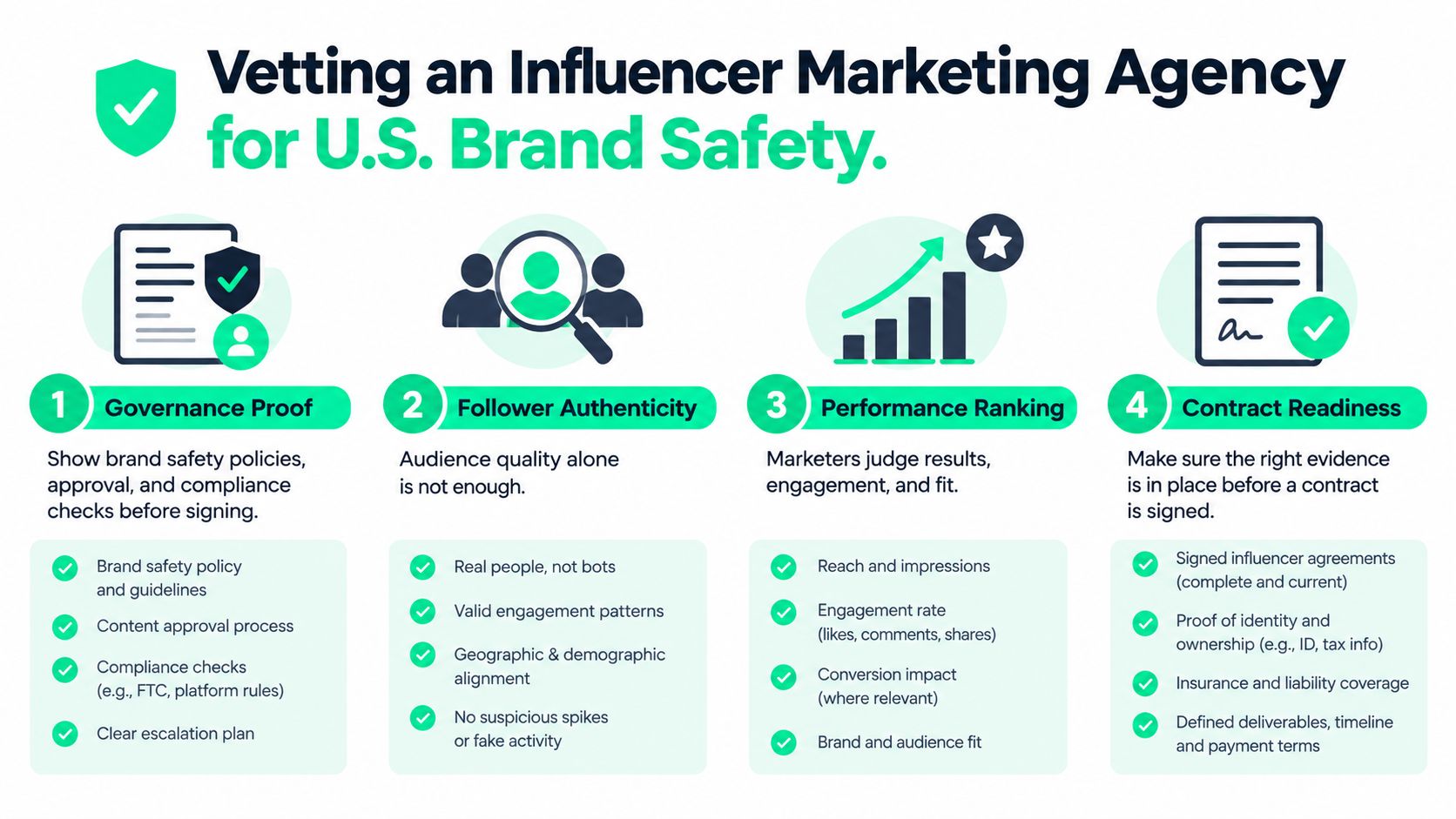
Don't ask whether an agency vets creators. Ask what it reviews, how often, who can stop a post, and what paperwork proves it happened. Require answers in writing before you sign.
Follower authenticity alone isn't enough. Recent U.S. survey data found 81.2% of marketers perform some manual content review, yet 38.5% say vetting is too time-consuming and 34.2% struggle with ongoing monitoring, according to survey findings on influencer brand safety and vetting gaps. The same data shows marketers rank performance, engagement rate, and content quality above brand-safety adherence. That's backwards. A page can convert well today and create a reputational problem tomorrow because older posts resurface or new posts drift off brief.
Demand an Evidence Pack
Ask each finalist for documentation from a recent campaign, redacted if needed. You want records, not a capabilities deck. Our detailed brand safety guidelines for creator campaigns set the baseline for what that pack should contain.
- Review depth: What share of an account's history gets checked, and which prohibited topics trigger automatic exclusion?
- Post-approval monitoring: How are newly published posts watched, and how fast can a placement be paused or pulled?
- Named authority: Who, by name or role, can remove a live post without waiting for the creator to reply?
- Enforcement record: What log shows geography, required terms, exclusions, and disclosure language were applied?
The documentation gap is the tell. 96.6% of marketers want documentation and only 25.6% consistently receive it, while only 21.8% believe their agency partners have a well-defined vetting process, per that survey cited above. If an agency treats that request as unusual, you've learned enough.
Anchor the U.S. Filter in Real Platform Use
American attention is concentrated, not evenly spread. Pew Research Center found 84% of U.S. adults use YouTube, 71% use Facebook, 50% use Instagram, and 37% use TikTok, with Instagram at 79% and TikTok at 65% among ages 18 to 29, according to Pew Research Center social media use data. Use explicit U.S. audience and platform filters that match your buyer's age profile. Headline views without geography are not tier-1 reach.
Disclosure is part of that safety check, not legal decoration. The FTC says a material connection must be made obvious, with disclosure clear and conspicuous beside the endorsement itself, and responsibility is shared by influencer and marketer, according to FTC disclosure guidance for social media influencers. You can't outsource that duty to a creator. Approve captions and overlays before publication, and keep correction rights after.
Pricing Models Contracts and Honest KPIs
Most reporting arguments start because the contract bought one thing and the dashboard claimed another. A flat fee buys a post. A verified-view CPM buys delivered attention. Neither automatically buys incremental sales, and dressing delivery up as last-click revenue insults everyone's intelligence.
Measurement deserves that bluntness. The World Federation of Advertisers found measurement or tracking success and proving ROI were each cited by 63% of respondents, and only 25% could confidently attribute sales to influencer campaigns, down from 36% in 2021, according to the WFA report on effective influencer marketing measurement. Untagged organic mentions, multi-touch journeys, cross-platform behavior, long consideration periods, and privacy changes make last-click structurally incomplete. Different buying models need different proof.
Label Every Metric Before Launch
Force every report into three buckets. Don't let an agency blur them in a wrap deck.
- Causal evidence: Unique links, promo codes, lift tests, holdout groups, or geo experiments designed before launch to isolate incremental impact.
- Delivery metrics: Verified views, qualified U.S. reach, and completed placements that show what you bought.
- Diagnostic signals: Engagement, branded search, qualified visits, and downstream traffic trends that help you decide what to test next.
Practical rule: If the test design isn't written into the insertion order, the campaign cannot later claim incrementality.
Use this table to match what you're paying for with what you can report.
What Each Buying Model Can Honestly Prove
| Buying model | Honest primary metric | Contract control to require |
|---|---|---|
| Flat creator fee | Post delivered on brief | Usage rights, exact deliverables, disclosure wording, kill rights |
| CPM or pay per verified view | Verified views and qualified tier-1 reach | Geo filters, fraud screening, make-goods if verified delivery misses |
| Performance terms | Attributed or incremental conversions from a preset test | Unique links or codes, holdout or geo design, shared reporting ownership |
Now write the protections into the agreement, not an email. Use the structures in these influencer contract templates for usage and disclosure terms and specify who owns reporting, how long content may be reused, which geos count toward delivery, and what happens when a post violates the brief. Include make-goods tied to the metric you bought. If you purchased verified views, the remedy is more verified views or credit, not bonus impressions from the wrong country.
Reject blended KPIs that hide misses. Require page-level delivery, geography qualification, and disclosure compliance reported separately from engagement. An agency that's confident in its inventory will accept those terms. One that pushes back is telling you its pricing depends on you not looking closely.
Running the Campaign from Brief to Live Correction
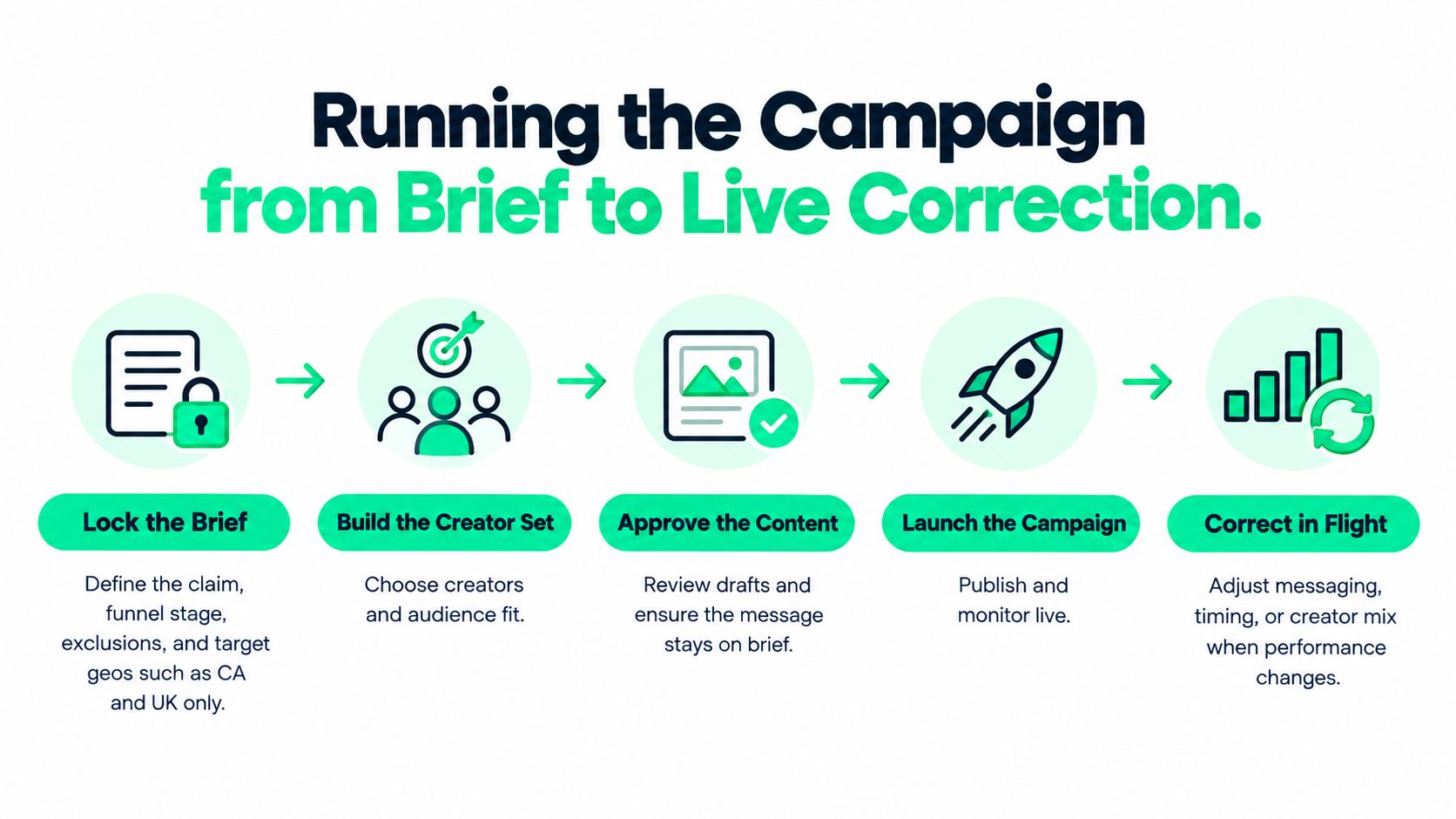
A signed contract doesn't run a campaign. People and systems do, under one set of rules, from the first caption draft to the last live correction. Build the flight so a problem gets caught before your audience screenshots it.
Lock the brief first. State the claim, funnel stage, required terms, exclusions, and eligible geos, with the U.S. as the core and CA or UK included only when you intend to buy them. Approve captions, logos, and disclosure language before anything posts. Then traffic the same rules across every page so independent operators aren't improvising their own versions of your brand.
Review Every Submission in Real Time
An approved template doesn't guarantee a compliant live post. A page can swap a caption, crop a disclosure, or place your logo beside prohibited content after approval. The FTC expects brands to educate endorsers and monitor what they do on the brand's behalf, and a material connection must be disclosed unless it's already obvious from context, according to FTC Endorsement Guides questions on marketer monitoring responsibility.
Check each asset before it goes live, every time.
- Brand name and claim: Exact spelling, approved promise, and no added guarantees the legal team never cleared.
- Disclosure wording: Visible in the actual creative context, not buried below a fold or hidden in a hashtag string.
- Prohibited subjects: Surrounding content and page context screened against your exclusion list.
- Correction authority: A named person can edit, pause, or remove the post if the page changes it later.
Attention to detail becomes an operating advantage. Real-time review lets you scale distribution across many pages while keeping each execution inside the same guardrails. Speed matters on the same terms. Caption changes should propagate across the network, launches shouldn't wait on dozens of separate confirmations, and a bounded flight should wrap cleanly rather than drift while invoices pile up.
Run the pilot like a media buyer. Start bounded, read which handles and niches delivered quality American attention, cut the misses without sentiment, and raise budget only behind proven pages. If verified delivery falls short, trigger the make-good. Don't renegotiate reality after the fact.
Comparing Agencies In-House Teams and Programmatic Networks
Pick the model that matches the job. Brands waste money when they hire a talent-relationship shop for mass distribution, or ask one in-house buyer to coordinate hundreds of pages from a personal inbox.
A traditional influencer marketing agency fits when you need a small set of named creators, negotiated usage rights, and hands-on talent management. It breaks when every placement becomes a custom negotiation with separate rates, approvals, and reporting formats. Costs rise with headcount, and speed falls exactly when a cultural moment demands fast placement.
Where Each Model Wins or Breaks
An in-house team keeps control and category knowledge close. It also inherits the spreadsheet problem at scale, from outreach and fraud checks to payment and post-live monitoring. That works for a handful of strategic partnerships. It doesn't work when the buy spans hundreds of sports, gaming, finance, or meme pages reaching American audiences daily.
A programmatic network fits a different need, verified views at volume from one point of contact. FindClout distributes branded meme content across vetted high-reach pages on a CPM for verified views, with logo and caption placements at $0.20 CPM, vertical targeting at $0.25 CPM, and content campaigns at $1.50 to $3.00 CPM. Terms include 0% management fee, rolling monthly agreements, a $20K to $30K pilot aimed at 100 million views, and budgets scaling toward $100K to $1M+.
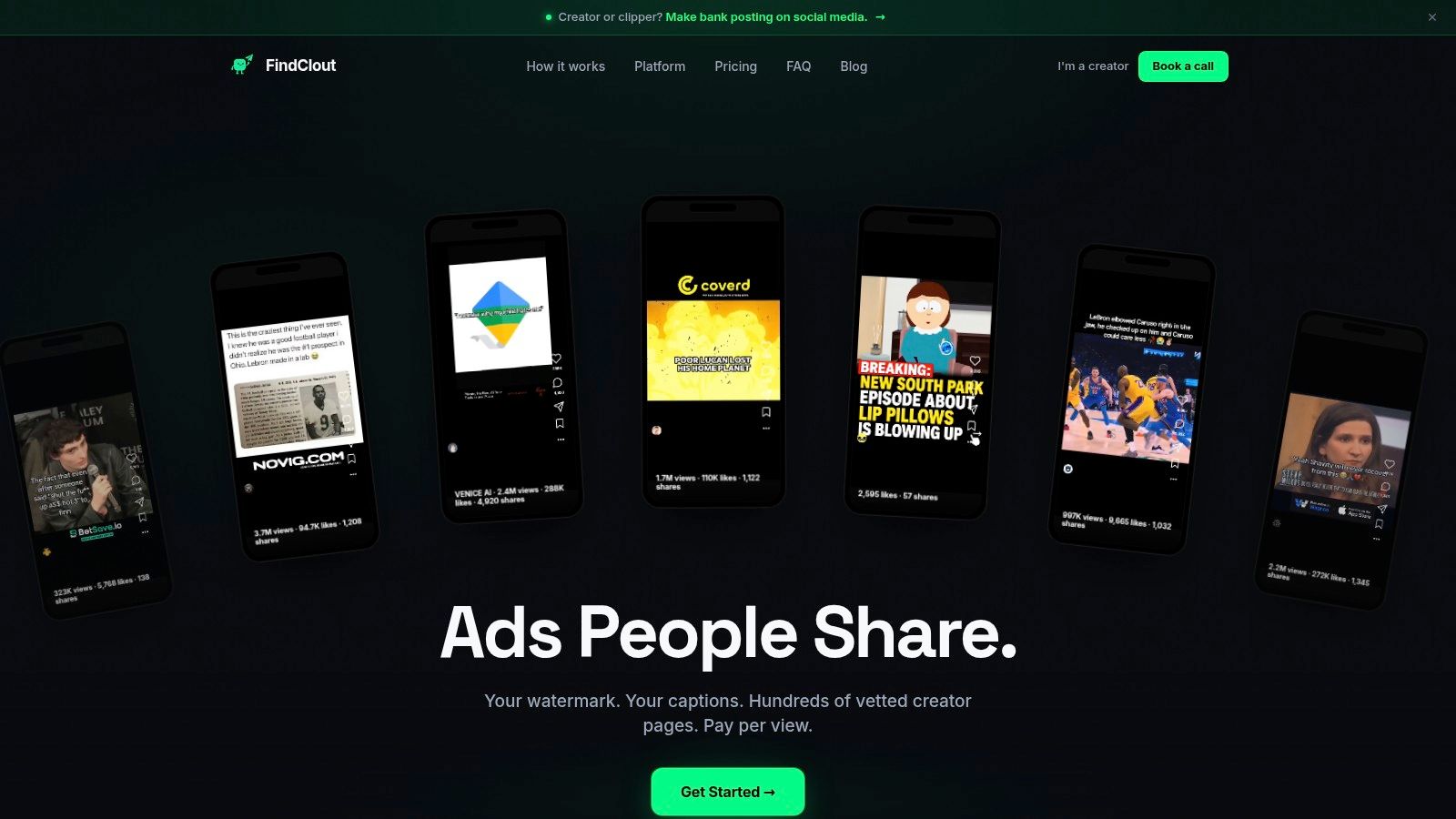
Judge that model on controls, not slogans. Brand rules cover required terms, banned topics, follower floors, and US, CA, and UK geo filters. AI scoring runs in around 1.2 seconds alongside 24/7 human review before posting, with live page-level analytics and one-click removal during the flight. Scale on record includes 3.3 billion cumulative views, more than 600 million views sold to brands in 2026, and 500-plus vetted tier-1 creators, with particular depth in American sports pages.
Don't use a programmatic network for a single celebrity integration. Don't use any model for a last-click sales test with no measurement design behind it. Buy named talent when the person is the product. Buy verified distribution when reach in high-quality geographies is the product, and hold it to delivery proof.
How to Shortlist an Agency and Start a Pilot
Score finalists this week. Don't schedule another round of chemistry calls.
Use five checks and require evidence for each one. Proven tier-1 U.S. audience composition, a written review-and-removal process, disclosure control before publish, a metric class that matches the buying model, and a pilot small enough to kill. Any finalist that fails two checks is out, regardless of how good the deck looks.
- Audience proof: Page-level U.S. composition you can inspect, not a network-wide average.
- Governance proof: One recent campaign's documentation showing approvals, exclusions, and removals.
- Commercial proof: A bounded pilot with make-goods, kill rights, and reporting you own.
If video production sits elsewhere in your plan, compare specialists separately using AdCrafty's video agency shortlist rather than letting one vendor blur production and distribution into a single unaccountable fee. Then run the distribution pilot on its own terms. Our guide on how to pilot a creator campaign before you scale it covers the test structure in detail.
For sports, prediction markets, igaming, and consumer apps, start with a bounded verified-view pilot on American pages. Lock exclusions and captions, read which handles drove quality attention, and decide before any large buy. Where the need is programmatic distribution across hundreds of vetted pages from one interface, use the published $20K to $30K pilot range as a concrete starting budget instead of an open-ended retainer.
Good looks specific after the test. Views survive geo and fraud checks, zero off-brief posts stay live, and you have a clear yes or no on scaling. Anything vaguer means the agency learned more from your budget than you did.
If you need tier-1 American views without managing hundreds of creator deals yourself, FindClout offers programmatic distribution across vetted pages with real-time review, geo filters, and one-click removal built into the workflow. Start with a bounded pilot, inspect the page-level delivery, and scale only behind handles that prove they can deliver quality U.S. attention on brief.
Want this audience for your brand?
FindClout puts your brand in front of verified American audiences across every major US page — brand-safe, at scale.
Start Your Campaign