 findclout.com
Influencer Campaign Management for Tier 1 Brands
The most expensive influencer campaign can be the one with the most impressive last-click report. Clicks and attributed conversions don't prove that creators created new demand, and a campaign can generate substantial attention while still exposing a regulated brand to disclosure failures, fraud, or poor geographic quality. A defensible approach starts with verified attention, controlled distribution, real-time review, and measurement that asks what would have happened without the campaign.
For Tier 1 American audiences, especially in sports betting, iGaming, prediction markets, crypto, and consumer apps, influencer campaign management is no longer a spreadsheet exercise. The operating model has to route attention through a system that can screen pages, enforce exclusions, review every submission, and respond quickly when a post doesn't meet the brief. The creative may look like a meme, but the infrastructure behind it should look more like media operations.
Table of Contents
- The End of Manual Influencer Outreach
- Selecting the Right Campaign Format
- Building Legal and Brand-Safe Workflows
- Understanding CPM Economics and Pricing Models
- Executing the Campaign Workflow
- Scaling for American Sports and Regulated Niches
The End of Manual Influencer Outreach
Traditional influencer marketing treats every creator relationship as a handcrafted deal. A buyer searches for pages, sends direct messages, negotiates a fee, waits for audience screenshots, forwards creative to legal, and then tries to confirm whether the final post appeared in the right place. That process can work for a small partnership. It breaks when a regulated brand needs speed, consistent review, American reach, and evidence for every decision.
Sports moments expose the weakness immediately. A relevant post can lose its value while a brand team is still negotiating usage rights. A page can promise delivery without providing a reliable view-quality standard. A creator can publish a caption that sounds harmless but violates a prohibited-topic rule, omits a commercial disclosure, or places the disclosure below the “more” break. Manual coordination gives each problem a separate inbox, spreadsheet row, and approval chain.

Why the old model creates operational risk
Manual outreach also makes fraud screening inconsistent. One buyer may inspect audience geography, another may focus on follower counts, and a third may rely on a creator's own analytics. None of those checks creates a standardized release record. The result is fragmented accountability, uncertain delivery, and limited ability to remove a page quickly when the content goes off-brand.
The better model isn't to eliminate creator culture. It is to separate the craft of the content from the infrastructure of distribution. Programmatic meme distribution lets a brand define page requirements, keywords, exclusions, approved captions, and geographic rules before content enters the network. The platform then handles trafficking and reporting through one operational layer instead of forcing a media buyer to manage hundreds of disconnected relationships.
Practical rule: Treat creator distribution as a controlled media channel, not as a collection of informal favors.
That distinction matters for regulated US brands. A sportsbook, prediction market, or crypto advertiser needs attention in high-quality American geographies, but it also needs a defensible record of what was approved, where it appeared, and what happened when an account failed the rules. A system can support that record. A chain of DMs usually can't.
Teams evaluating whether automation can replace parts of their outbound process may find the comparison in can I replace Lemlist useful, particularly for separating repetitive coordination from work that still needs human judgment. For influencer operations, the same principle applies: automate routing and evidence collection, while keeping strategic and compliance decisions under accountable review.
A structured campaign orchestration platform should centralize creator selection, content submission, approval, live monitoring, and reporting. That doesn't make every campaign safe by default. It gives the brand a system in which safety rules can be applied consistently while the network moves fast enough to capture sports-driven attention and distribute content at scale.
Selecting the Right Campaign Format
For a regulated brand, the campaign format determines both distribution efficiency and review workload. A logo placement, targeted caption, and native meme adaptation serve different business goals. They also create different levels of exposure to claim errors, unsuitable context, and approval delays. Choose the format before recruiting creators, or manual outreach will turn a simple media decision into a long negotiation.
Programmatic influencer platforms provide three defined options. Logo and caption distribution costs $0.20 CPM, vertical-targeted campaigns cost $0.25 CPM, and content campaigns cost $1.50–$3.00 CPM. Each can support keyword requirements, exclusions, and scoped placement in areas such as sports and finance. For iGaming and prediction-market brands, those controls matter because the placement context can affect both legal review and media value.
Start with the lowest-friction format
Logo and caption distribution fits campaigns built around a concise, already-approved message. Approved pages publish the content with the brand watermark and caption under defined rules. It suits a timely brand reminder, a market announcement, or a short call to action that does not require a creator to develop a new asset.
The trade-off is creative depth. A watermark and caption can distribute efficiently, but they may feel less native than a custom meme. The legal team still needs to review the exact wording, placement, and surrounding context. Lower production effort reduces coordination time. It does not reduce the brand's responsibility for what appears publicly.
Vertical-targeted distribution adds the controls regulated advertisers usually need. Keyword requirements can direct placements toward sports, gaming, finance, or crypto contexts. Exclusions can remove unsuitable subjects and pages before publication. An iGaming advertiser could use this format to concentrate on American sports audiences while excluding topics that conflict with its responsible-marketing policy.
Use content campaigns when the asset needs to feel native
Content campaigns cost $1.50–$3.00 CPM and suit brands that want existing video or static creative adapted into meme variations. An internal meme engine can format a brand asset for creator-page conventions, reducing the need to negotiate separately with every account. That makes the format useful for testing hooks, visual treatments, and sports-related creative variations without rebuilding an outreach process for each page.
The higher price reflects greater creative and approval work, not only media placement. Each variation requires review for claims, disclosures, logo use, context, and audience fit. Native content can attract stronger attention, but it also creates more opportunities for the published message to depart from the approved version. In regulated categories, the approval queue can become the limiting factor.
| Campaign Format | CPM Price | Best For |
|---|---|---|
| Logo and caption distribution | $0.20 CPM | Broad awareness with approved brand assets |
| Vertical-targeted campaigns | $0.25 CPM | Sports, gaming, finance, and crypto targeting with requirements and exclusions |
| Content campaigns | $1.50–$3.00 CPM | Native meme adaptations from video or static creative |
Build a hybrid buying plan
Use low-friction distribution to establish reach, then use content campaigns to test stronger creative. Keep both formats under the same rules engine, approval checklist, and reporting view. Otherwise, a buyer may compare inexpensive distribution with higher-cost creative without knowing whether performance changed because of format, audience, page quality, or message.
For a regulated American brand, the choice follows a practical sequence:
- Define the outcome. Decide whether the campaign seeks attention, qualified traffic, registrations, deposits, or a longer-term demand signal.
- Choose the context. Use vertical targeting when sports, finance, or gaming relevance matters more than raw inventory.
- Match the creative burden. Use logo and caption distribution for simple approved messages. Use content campaigns when native adaptation drives the idea.
- Apply exclusions before launch. Do not depend on manual cleanup after publication.
- Compare formats on incrementality. A cheaper CPM is not automatically better if it mainly reaches people who already intended to convert.
Building Legal and Brand-Safe Workflows
For iGaming and prediction markets, brand safety is a release condition. It shouldn't be a legal review performed after a post reaches the public. The workflow needs to decide whether a submission can go live, preserve the evidence behind that decision, and create a rapid path for correction or removal.
The FTC assigns responsibility to both advertisers and endorsers. The FTC's disclosures guidance for social media influencers explains that a material connection can include cash payment, free product, affiliate compensation, employment, or a personal connection. A brand should therefore classify every creator relationship before approving the content, not only when a creator receives a conventional fee.
Design the release gate
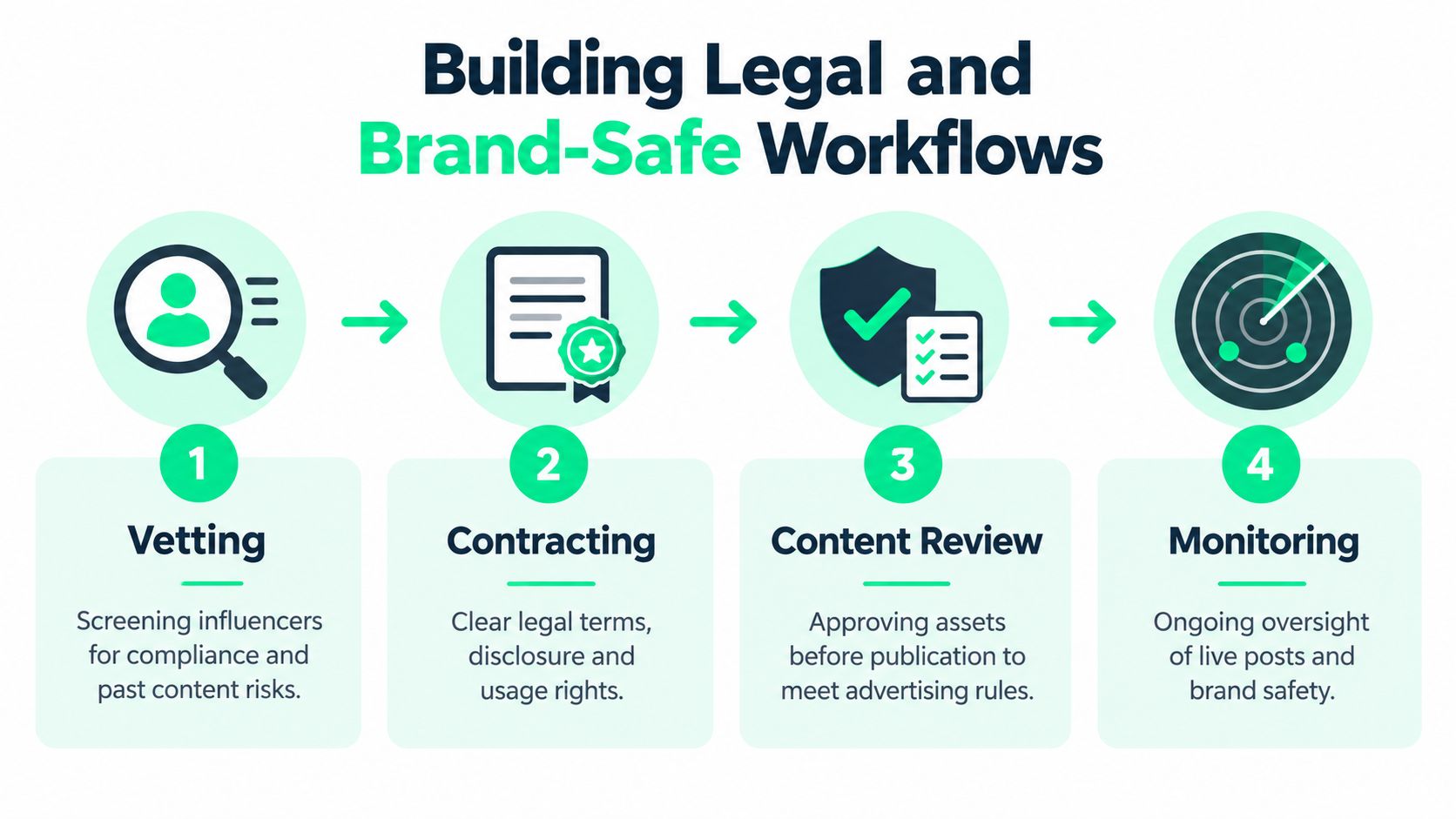
A practical workflow has four connected controls:
- Vetting: Screen the page, audience quality, geography, historical content, and previous brand-safety risks.
- Contracting: Specify what the creator may and may not say, disclosure duties, usage rights, approval requirements, and takedown obligations.
- Content review: Check every submission against required terms, prohibited topics, claims policy, caption rules, disclosure placement, and targeting restrictions.
- Monitoring: Review the live post, confirm that the approved version appeared, and retain evidence of approval, final creative, placement, and any corrective action.
The FTC's 2023 revision to its Endorsement Guides addresses monitoring and influencer-program controls. The guidance says companies should explain what endorsers may and may not say, instruct them about disclosure duties, periodically search what endorsers say online, and take appropriate action when questionable practices are found, as described in the FTC announcement on the updated Endorsement Guides.
Review the endorsement where people see it
A disclosure hidden in a profile, biography, or separate page isn't enough. The disclosure needs to appear with the endorsement where viewers can readily notice it. Ambiguous tags, disclosures blended into surrounding text, and disclosures placed below the “more” break create avoidable risk.
Video requires medium-specific review. A visual claim may require a visible disclosure, while a spoken endorsement may require an audible disclosure. Platform tools can help, but they aren't always adequate, so the advertiser needs an independent approval and monitoring process.
AI scoring can triage submissions for prohibited terms, risky patterns, missing requirements, and mismatches with the campaign brief. It shouldn't replace human moderation. Human reviewers need to assess sarcasm, visual context, implied claims, sports references, and whether the disclosure is understandable to the audience.
Release standard: Nothing goes live until the approved creative, caption, disclosure, placement, and page all match the campaign rules.
A pilot should include every post in the review sample. Once the program matures, sampling can become risk-based, with tighter scrutiny for new pages, sensitive claims, unfamiliar verticals, or accounts with inconsistent execution. Contracts should require creator compliance, but the advertiser still needs to monitor independently because a contractual promise doesn't prove that the live post followed the rules.
The brand safety guidelines for influencer campaigns should be operational, not decorative. Write prohibited topics as enforceable rules, define escalation owners, and make removal decisions traceable. A real-time system gives legal and marketing teams a shared record instead of asking them to reconstruct events from screenshots after a problem appears.
Understanding CPM Economics and Pricing Models
CPM is a distribution metric, not a complete valuation of an influencer campaign. Programmatic distribution buys delivery under defined conditions. A traditional influencer deal may buy access to one audience, a creator's production work, usage rights, or a relationship that develops over time. Those differences matter for regulated brands, where legal review, audience quality, and evidence of publication can outweigh a low headline rate.
A practical buying analysis separates four questions:
- What is being delivered? Is the commitment a post, an impression, a verified view, or a content asset?
- Who receives the message? Can the buyer verify Tier 1 American geography and placement in the relevant igaming, prediction-market, sports, or finance vertical?
- What controls apply before publication? Are captions, logos, keywords, exclusions, and prohibited topics enforced before an asset goes live?
- What happens after publication? Can the brand inspect live content, remove an off-brand page, and retain evidence for legal and compliance records?
A low CPM does not automatically produce efficient growth. It can support awareness when inventory is verified and the audience matches the brief. It can also conceal weak business value when a regulated or high-consideration product needs qualified registrations, deposits, subscriptions, or other meaningful actions rather than inexpensive exposure.
| Platform Type | Estimated CPM | Billing Model |
|---|---|---|
| Programmatic logo and caption distribution | $0.20 CPM | Pay per defined distribution volume |
| Programmatic vertical-targeted distribution | $0.25 CPM | Pay per defined targeted distribution volume |
| Programmatic content campaigns | $1.50–$3.00 CPM | Pay per content distribution volume |
| Traditional influencer deal | Negotiated | Usually flat fee, deliverable, usage, or commission terms |
| Paid social advertising | Platform-dependent | Auction, impression, click, or conversion-based billing |
The programmatic rates in the first three rows come from FindClout's published campaign formats. Traditional influencer deals and paid social auctions do not offer one universal benchmark. Their costs depend on negotiation, deliverables, targeting, rights, auction conditions, and the conversion event being purchased. That is why the four questions above matter more than any headline CPM.
Measure the business outcome beyond last click
Views, clicks, and attributed conversions are useful diagnostics, but they do not establish how much demand the campaign created. A regulated advertiser needs to distinguish campaign-generated action from conversions that would have happened without the exposure.
A practical incrementality framework can combine:
- Geo holdouts: Expose selected geographic areas to the campaign while withholding comparable areas.
- Creator-level randomized tests: Assign similar creator groups to treatment and control conditions.
- Post-view measurement: Track later behavior from people exposed to content, while recognizing that view-based identity and attribution can be imperfect.
- Unique landing pages: Give different creator groups distinct destinations so traffic quality and behavior can be compared.
- Blended CAC or payback analysis: Evaluate the total campaign cost against incremental customers and the time required to recover acquisition spend.
The Influencer Marketing Hub experts report also emphasizes separating creator-driven demand from conversions that would have occurred without the campaign. It reports that 27.5% of surveyed experts highlighted precise performance measurement, while 38.4% emphasized ROI effectiveness and the move away from vanity metrics toward sales and loyalty.
Use CPM as a buying metric when the objective is controlled attention and the inventory can be verified. Treat it as incomplete when the product involves registration, deposits, subscriptions, or a long consideration cycle. A campaign can show weak last-click performance while assisting demand. Strong clicks can also intercept existing intent instead of creating new customers.
For teams comparing delivery costs, cost per mille advertising provides useful terminology. The management decision should rest on the full chain: verified attention first, brand search or direct traffic next, incremental conversions after that, and retention or customer quality last.
Executing the Campaign Workflow
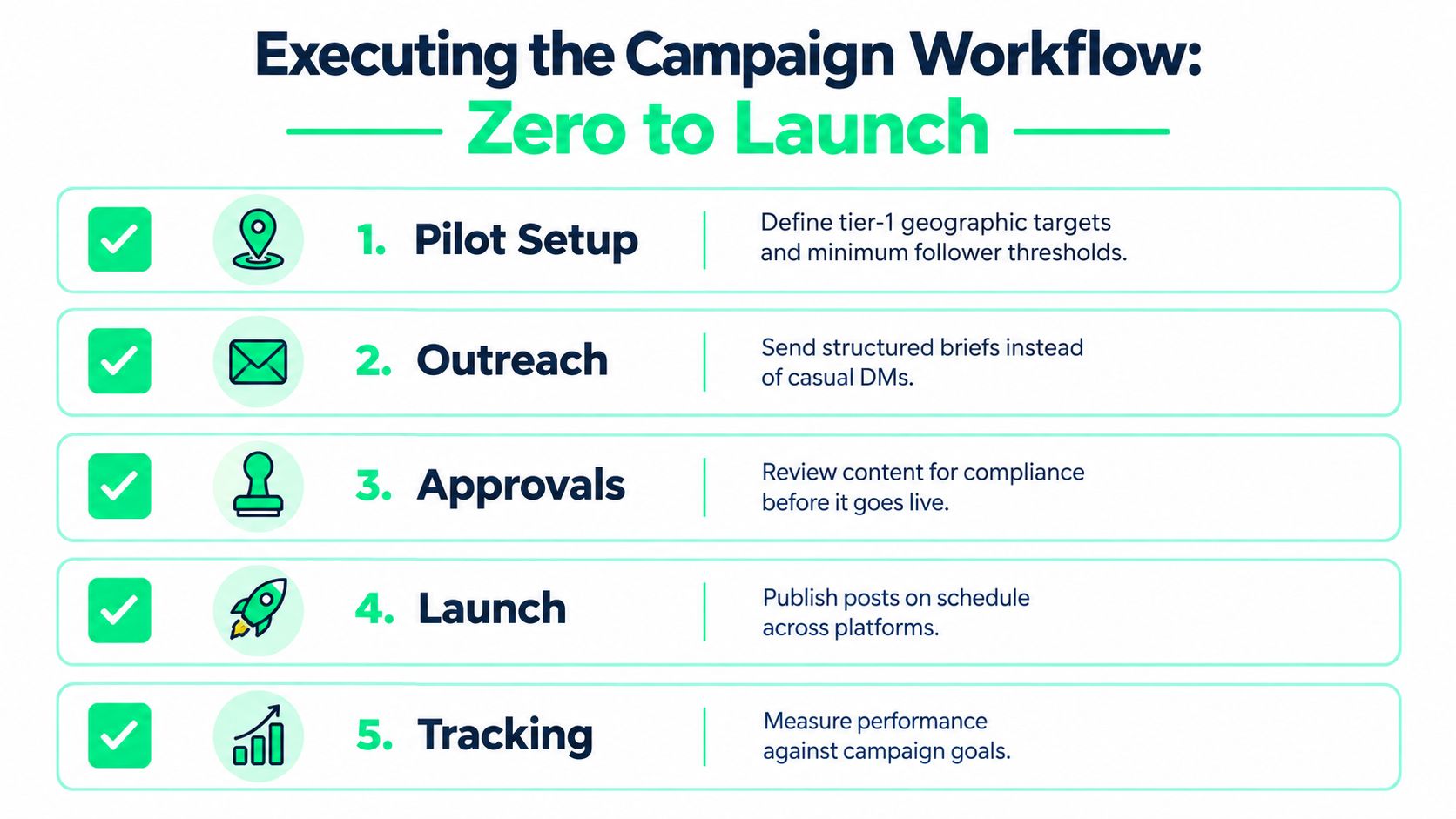
A controlled launch begins with a narrow pilot, not a vague promise to “go viral.” Define the Tier 1 geographic target, the sports or finance vertical, minimum follower thresholds, prohibited topics, required keywords, approved captions, and the conversion path before submitting the first asset.
Move from brief to live distribution
- Pilot setup: Select approved American geographies and relevant pages. Set the audience and page thresholds before creative trafficking so the network can't expand into unwanted inventory on its own.
- Structured outreach: Send a consistent brief instead of negotiating every placement through casual DMs. The brief should define the asset, caption, disclosure, publication conditions, and evidence required.
- Approval: Route each submission through automated checks and human review. Reject or revise anything that misses the disclosure, wording, visual, or page requirements.
- Launch: Publish the approved posts on schedule, then verify the live version rather than assuming that the submitted version was used.
- Tracking: Monitor verified views, page-level delivery, audience quality, clicks, downstream actions, and any brand-safety exceptions.
Real-time caption management matters when a sports narrative changes or legal updates require a wording adjustment. Network-wide edits can keep the funnel destination current without asking a buyer to contact every page individually. If a page becomes off-brand, a one-click removal process is more useful than a long email chain.
The campaign lifecycle can run from 7 to 21 days, as specified in the operational model, with early delivery used to identify strong creators and weak placements before the wrap. Performance reporting should distinguish page-level delivery from campaign totals, because a large aggregate number can conceal a small group of pages responsible for most of the attention.
Operational habit: Review the live post, not just the approval screenshot. The published caption, placement, and disclosure are the record that matters.
Automation can also reduce repetitive trafficking and reporting work. Teams exploring broader AI marketing automation should apply the same discipline here, using automation for routing, checks, alerts, and data handling while reserving human approval for claims, context, and exceptions.
A wrap report should identify which handles drove quality attention, which creative patterns earned useful engagement, which geographies delivered, and which pages required intervention. Don't optimize only toward the cheapest views. Remove inventory that creates compliance or audience-quality risk, even when its delivery looks efficient.
Scaling for American Sports and Regulated Niches
American sports audiences are valuable for iGaming and prediction-market advertisers because the surrounding content creates a natural context for timely distribution. That context also raises the cost of mistakes. A brand needs page vetting, authentic engagement checks, geographic controls, exclusions, and real-time review before it scales beyond a pilot.
The operating advantage comes from combining Tier 1 American targeting with a system that can coordinate hundreds of vetted creator pages without turning each placement into a separate legal project. Sports, gaming, finance, and crypto requirements can be encoded before launch, while live analytics show which handles are producing useful attention and which should be removed.
Manual outreach still has a place for high-value relationships and bespoke creator work. It isn't a sufficient operating system for regulated brands trying to respond to fast sports cycles while protecting disclosures, approved language, and audience quality. Programmatic creator distribution supplies the routing layer, but brand safety depends on the rules, reviewers, records, and escalation process built around it.
Teams that manage this well don't chase views in isolation. They establish verified reach, test whether the exposure creates incremental demand, and scale only when the audience, creative, compliance, and economics hold together.
FindClout offers programmatic distribution of approved branded meme content across a curated network of creator pages, with Tier 1 American targeting, vertical controls, fraud screening, and real-time review. If your iGaming, prediction-market, sports, crypto, or consumer brand needs a controlled path from approved creative to verified attention, visit FindClout to evaluate the campaign workflow.
Want this audience for your brand?
FindClout puts your brand in front of verified American audiences across every major US page — brand-safe, at scale.
Start Your Campaign