 findclout.com
iGaming Marketing: The 2026 Performance Playbook
The most popular advice in iGaming marketing is to keep testing creative until the conversion rate improves. That advice assumes the market still offers an efficient supply of trustworthy attention. In many regulated betting markets, it doesn't.
The harder problem is distribution quality. Paid acquisition is facing weaker economics, invalid traffic, stricter audience rules, and more competition from sportsbooks and prediction markets. The operators that win won't just produce sharper bonus ads. They'll build a verified, tier-one American distribution system with real-time review, strict geographic controls, and reporting that distinguishes genuine attention from cheap delivery.
Table of Contents
- Why iGaming Marketing Is Getting Harder
- The iGaming Marketing Landscape in 2026
- Compliance and Brand Safety Requirements
- Audience Targeting for US Sports Bettors
- Creative Formats That Convert in Betting
- Campaign Playbooks and Performance KPIs
- Action Plan for Scaling iGaming Marketing
Why iGaming Marketing Is Getting Harder
The distribution problem is now larger than the creative problem. U.S. sports-betting advertising volume fell by about 9% in 2024 compared with 2023 and was nearly 50% below 2021 levels. Industry coverage also reports invalid traffic consuming close to half of Tier 1 search spend, while advertising spend from prediction markets and major sportsbooks rose by 21% in the first seven months of 2026 (LuvKaizen's 2026 iGaming marketing trends analysis). Those conditions make the old growth model harder to recover through bid changes, audience tweaks, or another round of landing-page tests.
A campaign can improve targeting, promotional copy, and conversion rate while still purchasing low-value or fraudulent attention. If impressions do not reach a genuine, eligible user, the optimization system receives weak signals and assigns value to delivery that cannot produce a compliant customer.
The practical diagnosis: Unverified audiences, unsafe placements, and invalid traffic turn creative optimization into a response to the symptom. The distribution system needs correction first.
Bonus messaging creates a second trap. Inducements can increase betting intensity and spending, yet registrations driven by an offer may look efficient only within a short reporting window. They can raise compliance exposure, attract users who respond mainly to promotions, and make retention dependent on the next incentive. The trade-off is straightforward: a bonus may improve immediate acquisition while weakening customer quality and long-term economics.
Audience-quality rules add more constraints. A placement that performs in one jurisdiction may be unusable in another. A creative approved by brand review can still fail age, geographic, or market-specific requirements. That makes verification and documentation part of distribution, not paperwork added after media buying.
The practical replacement for broad paid-media dependence is verified, Tier 1, pre-reviewed creator distribution. Creator pages, websites, social placements, and streaming inventory need explicit inclusion and exclusion rules, along with controls for approved geographies and eligible audiences. Creators can provide context and credibility, but only if the operator reviews each submission before publication and can remove unsafe inventory quickly.
What the modern playbook changes
A serious iGaming marketing program should define four operating controls:
- Who sees the content: Concentrate reach in approved, high-quality geographies, with documented age and placement controls.
- Where the content appears: Record approved creator pages, websites, social placements, and streaming inventory, then maintain clear exclusions.
- What goes live: Pre-review every caption, logo, offer, call to action, and creative variation.
- What counts as performance: Track verified views, qualified visits, brand memory, purchase intent, registration quality, and downstream value beside acquisition volume.
Tier-one American audiences and brand safety are strategic differentiators. High reach is not enough if reporting cannot separate genuine attention from cheap delivery. The operating standard is controlled distribution, live review, and measurement that protects both compliance and customer quality.
The iGaming Marketing Landscape in 2026
The global online gambling market is estimated at about $101.45 billion in 2026, up from $91.63 billion in 2025, with a projection of $168.7 billion by 2031 and implied annual growth of roughly 10.7%, according to industry coverage citing independent market research (the 2026 global iGaming advertising market guide). The same research places Europe at about $38 to $40 billion in 2026, North America at $25 to $28 billion, Asia-Pacific at $18 to $20 billion, and Latin America at $8 to $10 billion. Those figures describe opportunity, not a ready-made global media plan.
The operating problem is distribution. Ad volume is falling in some valuable channels, invalid traffic can consume Tier 1 spend, and audience-quality rules make cheap reach increasingly expensive to verify. Operators, affiliates, technology providers, payment companies, and prediction markets are competing for the same attention while working across different regulatory regimes.
North America is mobile-first and shaped by state-by-state legalization. A placement can be valuable in one state and unusable in another. A creative can pass brand review yet still be unsuitable for a specific audience or jurisdiction. Campaign architecture therefore has to separate market eligibility from media scale before spend is committed.
Europe offers mature demand, but local restrictions, licensing requirements, advertising codes, and cultural differences make broad creative syndication risky. Asia-Pacific and Latin America require the same discipline around localization because market maturity, product preferences, and legal conditions vary widely.
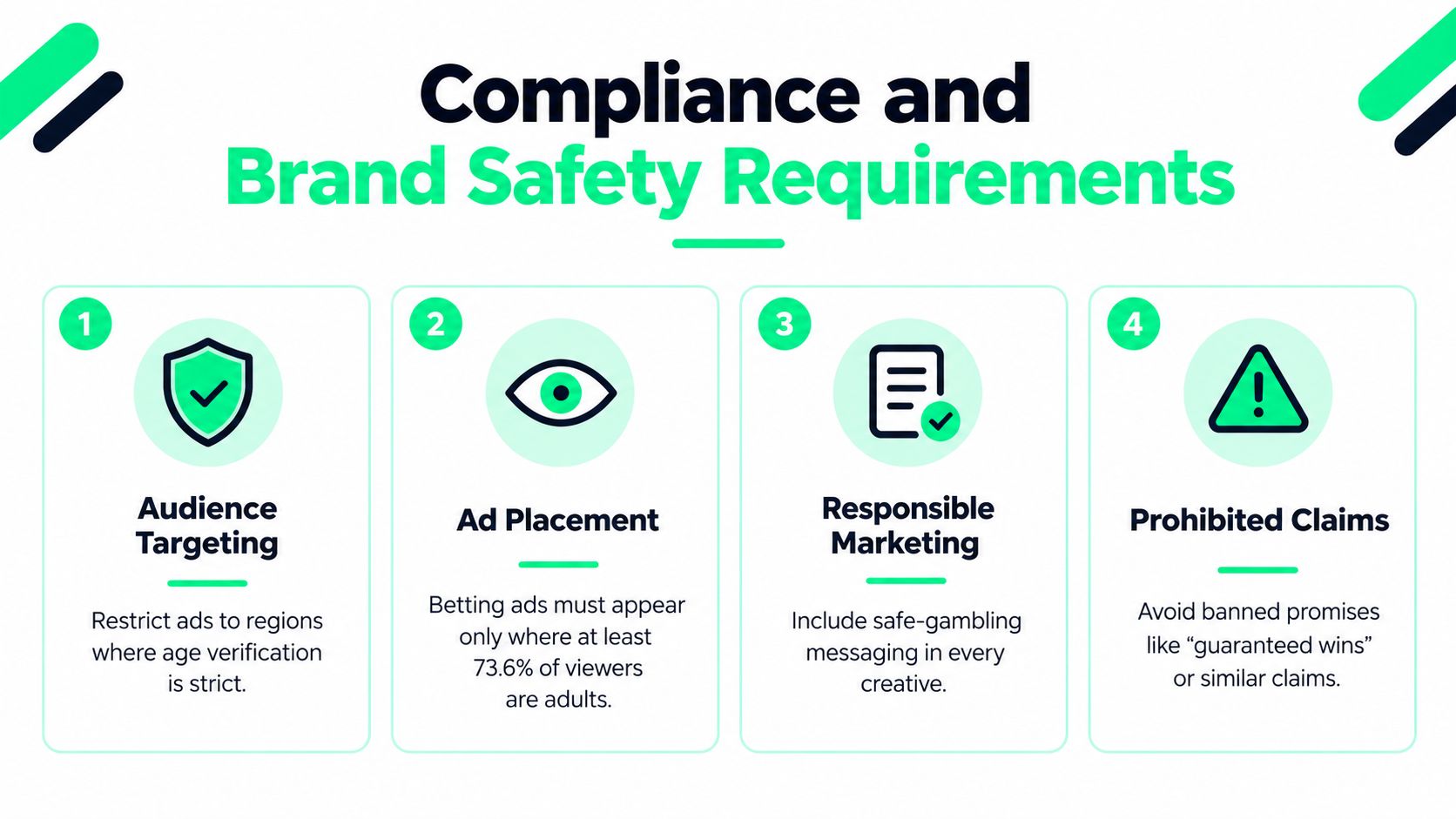
Why channel diversification is necessary
Market expansion increases competition for affiliates, paid placements, creator inventory, and search visibility. It also raises the cost of an unverified impression. A centralized distribution system lets operators coordinate approved placements while retaining control over captions, targeting, exclusions, and removal.
The practical shift is from optimizing every paid-media setting to selecting inventory that can be verified before it goes live. Verified, Tier 1, pre-reviewed creator distribution can provide context around sports and gaming audiences, but creator access alone does not establish media quality. Each account needs review for audience geography, content history, engagement quality, and brand adjacency. Follower count is a reach signal, not proof of qualified traffic.
The governing principle is separate reach from permission. High reach has limited value when the audience cannot legally receive the message, age evidence is insufficient, or traffic quality cannot be verified. In this market, controlled distribution is a growth advantage because it protects spend and gives performance data a credible foundation.
Compliance and Brand Safety Requirements
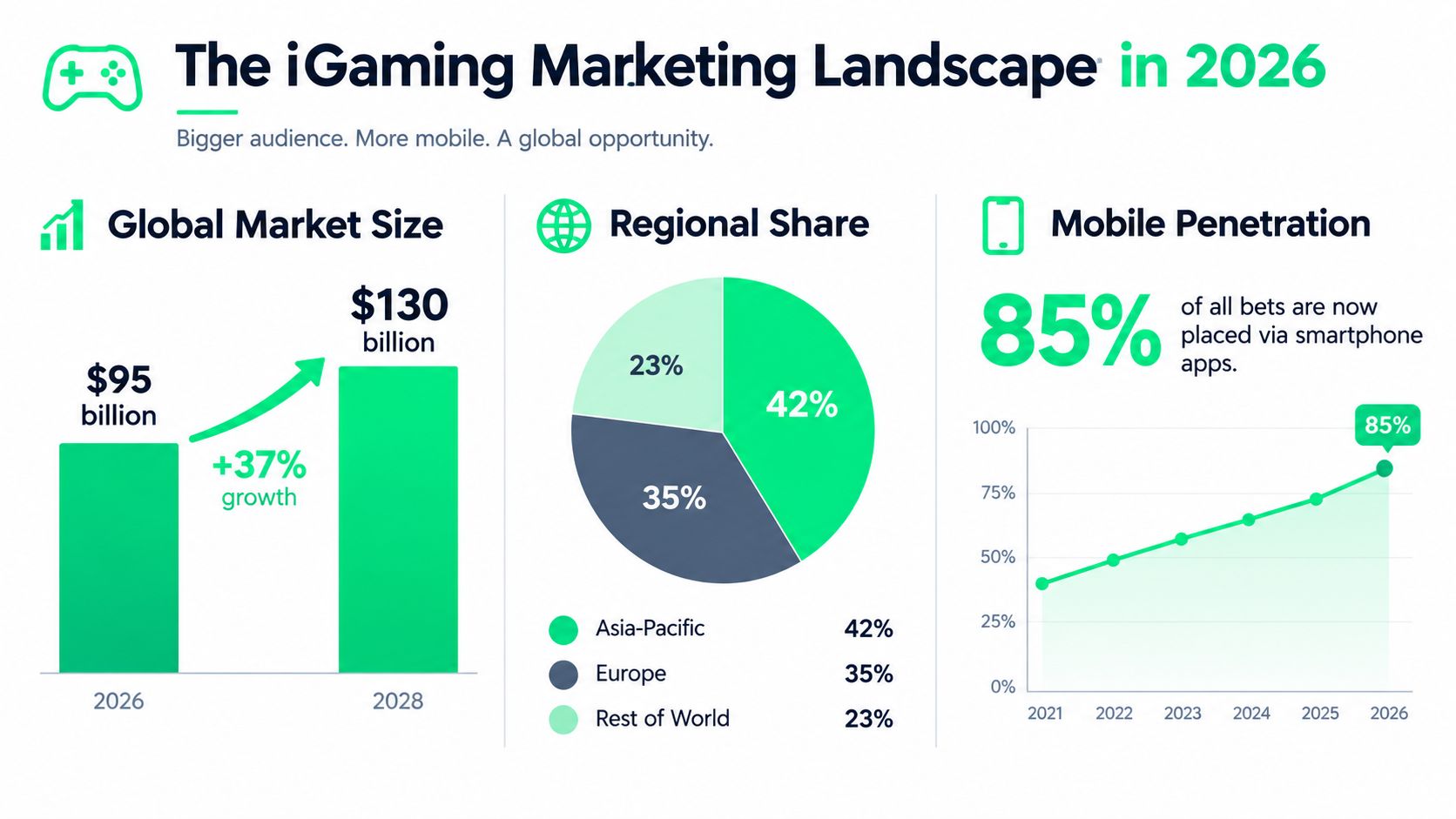
Responsible marketing rules make audience composition a buying constraint. The AGA Responsible Marketing Code for Sports Wagering says sports wagering advertising should appear only where at least 73.6% of the audience is reasonably expected to be 21 or older. It also prohibits placements in college or university-owned media and on campuses.
The threshold applies to the surrounding audience, not only to the individual creative. A compliant caption cannot repair a placement whose audience skews too young. The same code prohibits messages designed primarily to appeal to people under 21. Review tone, imagery, language, characters, and context alongside the offer itself.
Build controls before buying reach
Platform rules add another approval layer. Google's advertising policies state that gambling promotions are regulated, must be lawful in the target location, and may require certification before eligible gambling ads can serve. Certification does not replace internal review. It confirms only that Google has accepted the advertiser or format under its own conditions.
A workable process reviews every submission before publication and continues monitoring after launch:
- Audience review: Confirm target geography, age evidence, and relevant exclusions before approving the page or placement.
- Creative review: Check responsible-gambling language, prohibited claims, bonus conditions, logos, calls to action, and any suggestion of guaranteed outcomes.
- Context review: Reject pages or environments associated with campus media, underage appeal, unsafe content, or misleading financial framing.
- Live review: Monitor captions, comments, edits, placement changes, and traffic signals in real time. Assign clear ownership for removal.
Brand-safety rule: Pre-approval should be a publishing gate, not a retrospective report after impressions have already been delivered.
Programmatic buying raises the control burden because supply chains can contain fraud, made-for-advertising inventory, unsuitable placements, and opaque resellers. Campaign managers should maintain inclusion lists, exclusion lists, account-level records, geographic filters, and an audit trail identifying who approved each creative and when.
Teams building jurisdiction-by-jurisdiction processes can consult this guide to gambling advertising laws. The operating standard is straightforward: scale placements only after their audience, context, and traffic quality can be verified.
Audience Targeting for US Sports Bettors
Broad American reach is easy to buy. Eligible, relevant, high-quality American reach requires tighter audience definitions and better distribution control.
S&P Global found that 43% of sports bettors were under 35, 68% were men, and 40% lived in households earning $50,000 to $100,000. The research also identified an affluent segment, with 17% of sports bettors in households earning at least $150,000 (S&P Global's profile of America's sports bettors).
These figures can shape media planning, but they do not justify broad age targeting. A younger-skewing sports audience still needs reliable adult-audience evidence and must meet applicable responsible-marketing and platform requirements. Choose sports-native environments where eligibility can be demonstrated, rather than buying every placement that attracts young viewers.
Distribution quality now matters as much as audience fit. Falling ad volume, invalid traffic consuming Tier 1 spend, and stricter audience-quality rules make another round of paid-media optimization a weak answer. Verified, Tier 1, pre-reviewed creator distribution can put an operator in a defined sports community before budget is committed. The trade-off is slower approval and narrower reach, balanced against cleaner traffic and clearer audience evidence.
Pew Research found that 19% of Americans said they had wagered money on sports in the past year. Participation was higher among Black adults at 30% and Hispanic adults at 27% (Pew Research's analysis of Americans and legal sports betting). A single national creative and one broad audience bucket can conceal meaningful differences in sports interests, language, identity, and trust.
Urban Institute research found that adults ages 18 to 29 were more likely to bet on sports than adults 30 or older, 17% versus 10%, while men were more likely than women, 13% versus 9% (Urban Institute research on sports betting participation). These figures describe participation, not permission to target minors. Lawful eligibility and audience quality remain separate checks.
US sports bettor demographics at a glance
| Metric | Value | Source |
|---|---|---|
| Sports bettors under 35 | 43% | S&P Global |
| Sports bettors who are men | 68% | S&P Global |
| Largest household income segment | $50,000 to $100,000, 40% | S&P Global |
| Sports bettors in households earning at least $150,000 | 17% | S&P Global |
| Americans who wagered on sports in the past year | 19% | Pew Research |
| Participation among Black adults | 30% | Pew Research |
| Participation among Hispanic adults | 27% | Pew Research |
| Participation among adults 18 to 29 | 17% | Urban Institute |
| Participation among adults 30 or older | 10% | Urban Institute |
Build segments from geography, sports context, verified eligibility, lawful income signals, and content affinity. Teams can use audience segmentation methods for performance campaigns to separate sports communities instead of buying one undifferentiated “sports bettor” audience.
Creative Formats That Convert in Betting
Creative is no longer the main bottleneck in betting acquisition. Falling ad volume, invalid traffic consuming Tier 1 spend, and stricter audience-quality rules make distribution the structural problem. The strongest format is often a verified, Tier 1, pre-reviewed creator placement, not another round of paid-media optimisation.
A conjoint analysis of 611 Australian adults found that presenter type and bet type drew the most attention. The risk-free bet was more persuasive than other bet formats at turning attention into likely betting, while in-play micro-bets were especially attractive to problem gamblers. (the Australian betting-advertising conjoint analysis)
Recognisable presenters, plain mechanics, and a direct explanation of the user action can therefore improve comprehension. A risk-free-bet format still creates trade-offs. It may win attention, but it also raises scrutiny around conditions, perceived risk, and responsible-gambling information. Every term needs to be clear before the viewer acts.
Exposure changes outcomes too. A review of sports-related gambling advertising describes a dose-response pattern: greater aggregate exposure is associated with a higher likelihood of betting and higher betting spend. Some studies reported that 29% to 43% of sports bettors and 30% to 38% of race bettors said advertising had influenced them at least once. The same review links inducements such as stake-back offers and multibets with greater betting intensity and spending beyond initial intention. (the review of gambling advertising and betting behavior)

Compare attention with risk
Live-action and in-play creative can create urgency, but that urgency can increase responsible-gambling risk and trigger stricter internal review. Use these formats only when the page, audience, placement, copy, and comments meet the required standards. Inducements need prominent legal terms, suitable adult audiences, and a commercial return that justifies the compliance workload.
Why creator-native execution earns attention
Polished brand films explain products clearly, yet viewers often recognise the advertisement before they understand the offer. Creator-native sports commentary, reaction content, memes, and concise match-context posts fit existing conversations more naturally. Their value is distribution and context, not exemption from compliance.
A practical test matrix should compare:
- Presenter-led content: Builds familiarity and can simplify complex mechanics.
- Bet-type demonstrations: Explain the product while avoiding certainty or effortless-profit implications.
- Risk-reduction offers: Can convert attention efficiently, but require unusually clear terms and responsible messaging.
- Live and in-play formats: Create urgency and require the strictest review because immediacy may encourage impulsive behaviour.
- Community-native memes: Improve contextual fit and sharing potential when the page, audience, caption, and comment environment pass review.
Measure qualified attention, not clicks alone. A creator with verified Tier 1 reach and pre-reviewed content can outperform a cheaper placement that delivers invalid traffic, weak audience evidence, or excessive compliance risk. The winning format earns attention without sacrificing trust or making the campaign harder to approve and scale.
Campaign Playbooks and Performance KPIs
A launch-ready iGaming marketing program treats distribution as a controlled operating system, not a creative volume exercise. Falling ad inventory, invalid traffic in Tier 1 buys, and stricter audience-quality rules make verification more valuable than another round of paid-media optimisation. Start with approved geographies and documented audience evidence, then select creators and placements that fit the sports context. Do not negotiate a large page list first and leave compliance review until the end.
Structure the campaign before launch
Build a pre-approved asset library with version control. Every variation needs an owner, approval status, jurisdiction, expiration date, responsible-gambling language, offer terms, and prohibited-placement rules. A changed caption is a new version. Send it back to review rather than allowing it to enter the network under the previous approval.
Use this launch sequence:
- Define the eligible audience: Document American geographies, adult-audience evidence, sports verticals, and excluded environments.
- Vet the inventory: Review creator history, audience location, engagement quality, adjacent content, and potential under-21 appeal.
- Approve the creative: Check presenter use, bet language, offer conditions, responsible-gambling messaging, and every performance or product claim.
- Run a controlled test: Compare formats and creator contexts while keeping compliance rules constant.
- Review live delivery: Monitor verified views, traffic quality, comments, removals, and audience composition during the buy.
- Scale selectively: Increase distribution only through pages and formats that meet performance and safety thresholds.
Set operational rules before a placement goes live. For example, require a 21+ audience attestation for each page, enforce U.S. geographic filters, and auto-pause a placement when its verified-view rate falls below the approved threshold. Record the reason for every rejection, removal, and pause. This creates an audit trail and shows whether weak results come from the creative, the page, the audience, or the traffic source.
FindClout distributes branded content through a curated creator network and provides pre-approval, brand rules, geo filters, fraud screening, and verified-view reporting. Evaluate it within a controlled channel mix. It does not replace legal review, responsible-marketing governance, or page-level evidence. The useful test is whether verified, eligible distribution produces stronger downstream value than cheaper inventory with questionable traffic.
Measure trust as well as acquisition
Raw registrations provide an incomplete view of campaign quality. Recent industry reporting tied to the SOFTSWISS 2026 trends study says operators are increasingly tracking Top of Mind and Purchase Intent, while brand reputation and trust outweigh bonus size in a player's decision to sign up (the 2026 iGaming trends coverage).
Use a reporting hierarchy that connects delivery to commercial value:
| Measurement layer | What to track |
|---|---|
| Distribution quality | Verified views, approved geography, eligible audience evidence, placement acceptance, and removal rate |
| Attention quality | View completion, meaningful engagement, repeat exposure, branded search behaviour, and qualified site visits |
| Brand demand | Top of Mind, Purchase Intent, brand consideration, and trust signals |
| Acquisition quality | Registration completion, first-deposit quality, retention behaviour, and value by source |
| Risk control | Review turnaround, rejected submissions, policy flags, unsafe comments, and compliance incidents |
The objective is not to discard cost per acquisition. It is to prevent a low CPA from hiding poor traffic, weak trust, or unacceptable brand risk. A media buyer should explain whether the audience was suitable, the placement was approved, and the resulting users remained valuable after the initial conversion.
See the framework for key performance indicators for marketing to connect distribution quality with downstream outcomes. Teams evaluating channel economics should also use a disciplined framework for marketing spend efficiency. Compare channels on verified attention and player value, then include review time, fraud investigation, creative rework, and brand-safety incidents in the cost.
Use guarantees carefully
Guaranteed delivery can reduce uncertainty, but it cannot justify weak placements. If a publisher or network underdelivers, make-good inventory must meet the original buy's geography, audience, and safety requirements. A delivered impression that fails those conditions is not an equivalent replacement.
Pilot budgets should support a meaningful comparison between creator contexts without allowing a failed format to compromise the quarter. The appropriate amount depends on jurisdiction, product, audience size, and legal review capacity. Set stop rules before launch, define the quality threshold for expansion, and scale only when verified delivery and downstream value support the decision.
Action Plan for Scaling iGaming Marketing
Start with an audit of current paid channels. Identify invalid-traffic exposure, unclear audience-age evidence, unsafe placements, weak geographic controls, and campaigns that depend entirely on bonus messaging. Separate traffic that was merely served from attention that was verified and relevant.
Next, move a controlled portion of testing into tier-one American creator distribution. Require pre-review for every submission, enforce U.S. geographic filters, document audience eligibility, and maintain live exclusion controls. Focus first on sports environments where the audience context is clear and the brand can contribute useful or entertaining content without overstating the product.
Then rebuild reporting around three connected outcomes:
- Qualified delivery: Was the attention genuine, eligible, and geographically relevant?
- Brand demand: Did Top of Mind, Purchase Intent, and trust improve?
- Player value: Did the source produce users who remain valuable beyond the initial offer?
The central decision is straightforward. Don't respond to a structural distribution problem by producing more variations of the same paid ad. Improve the quality of the inventory, verify the audience, review content in real time, and scale only what protects the brand as reach grows.
FindClout helps regulated betting and prediction-market teams distribute approved branded content through vetted American creator pages, with real-time review, brand rules, geographic controls, fraud screening, and verified-view reporting. Visit FindClout to assess whether its creator distribution model fits your next tier-one sports audience pilot.
Want this audience for your brand?
FindClout puts your brand in front of verified American audiences across every major US page — brand-safe, at scale.
Start Your Campaign