 findclout.com
How to Monetize YouTube Shorts the Smart Way
A surprising fact changes the economics of Shorts: more than 40% of creators who received a Shorts Fund payment in 2021 weren't in the YouTube Partner Program. YouTube's first dedicated Shorts monetization initiative was the $100 million Shorts Fund, announced on May 11, 2021, with performance-based payments between $100 and $10,000. That program has ended, but it proves an important point: Shorts monetization has never been only about ad revenue. It has always been about helping creators enter, grow, and eventually monetize an audience. YouTube's announcement of the Shorts Fund documents that early transition.
If you're learning how to monetize YouTube Shorts, don't build your plan around a payout estimate. Build a discovery engine that attracts high-quality American attention, moves viewers into assets you control, and gives brands a safe way to buy access to your audience. The creators and marketers who make Shorts work treat the format as the first step in a revenue system, not the entire business.
Table of Contents
- Stop Thinking About Shorts as a Payout
- Qualify for the YouTube Partner Program and Turn On Shorts Ads
- Build Shorts That Survive the Swipe
- The Four Revenue Lines Beyond the Ad Pool
- Package and Price Sponsorship Deals Brands Will Pay For
- Treat Verified US Attention as Infrastructure
- Measure, Optimize, and Run a 30-Day Shorts Money Plan
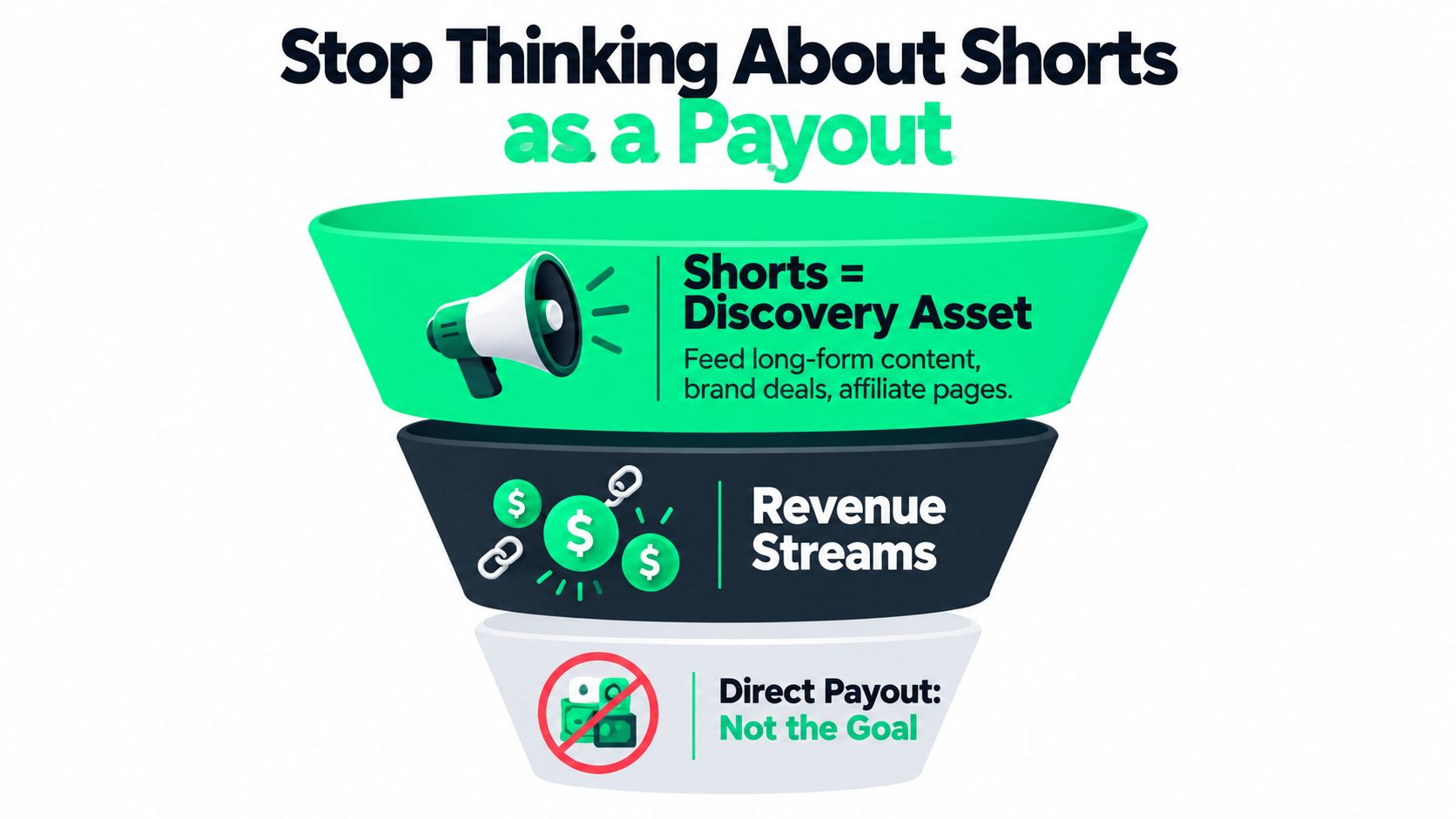
Stop Thinking About Shorts as a Payout
Shorts can generate advertising revenue, but direct payouts are a weak foundation for a serious creator business. The current model places ads between videos in the Shorts Feed, pools the revenue, allocates it according to qualified view share, and pays eligible creators 45% of the revenue allocated to them. That is entirely different from a fixed payment attached to each view or a conventional long-form ad placement. YouTube's Shorts monetization documentation explains why raw view counts don't translate into a predictable payout.
The better model is a funnel:
- Shorts create discovery.
- Long-form videos build trust and watch time.
- Email lists, affiliate pages, products, memberships, and services create ownership.
- Sponsorships turn reliable audience access into contracted revenue.
Measure movement, not vanity
A Short should earn a viewer's next action. That might be a channel follow, a long-form click, a visit to an affiliate page, an email opt-in, or a product-page visit. The direct ad payout matters, but it's often the least controllable revenue line and the least useful metric for deciding which formats deserve more production.
Treat each Short like a brief audition. The opening earns attention, the middle proves the claim, and the ending creates a frictionless bridge to something deeper. A sports explainer can point to a longer breakdown. A finance creator can move viewers to a newsletter. A software creator can send interested viewers to a comparison page. The clip becomes acquisition media for the rest of the business.
Practical rule: Never scale a Short because it has views alone. Scale it because viewers take a valuable next action.
American reach deserves special attention when the commercial objective is tier-one geography. Pew Research Center reported that 84% of U.S. adults say they ever use YouTube, including 65% of adults aged 65 and older. Pew's 2025 YouTube usage data supports prioritizing the United States when you need broad domestic reach, but geography doesn't replace traffic quality. Every campaign still needs authentic engagement checks, audience reporting, and brand-safety controls.
Qualify for the YouTube Partner Program and Turn On Shorts Ads
YouTube offers two practical paths to full Partner Program access. A creator can qualify with 1,000 subscribers and either 10 million public Shorts views in 90 days or 4,000 public watch hours from long-form videos in 12 months. A lower tier begins at 500 subscribers, with access to selected fan-funding features rather than the complete advertising package.
The distinction matters because reaching a subscriber count doesn't automatically activate Shorts advertising. You still need to apply, connect AdSense, pass YouTube's review, and accept the Shorts Monetization Module in YouTube Studio.
Understand the access levels
| YPP Tier | Requirement | Shorts Ads | Super Thanks | Memberships |
|---|---|---|---|---|
| Fan-funding access | 500 subscribers plus the applicable Shorts-view or long-form-watch-hour threshold | No | Available on eligible channels | Available on eligible channels |
| Full YPP access | 1,000 subscribers plus the Shorts or long-form threshold | Yes, after accepting the Shorts Monetization Module | Available on eligible channels | Available on eligible channels |
The full YPP path gives you access to the Shorts Feed advertising pool. It doesn't create a fixed CPM, and it doesn't guarantee that every view qualifies. YouTube considers qualified views, music-related allocations, advertiser demand, originality, and advertiser-friendly status. Views earned before you accept the Shorts module aren't eligible for Shorts ad-revenue sharing.
Use a post-approval checklist
After acceptance, open YouTube Studio and verify each item rather than assuming the setup is complete:
- Earn tab: Confirm that the channel shows full YPP access.
- Shorts module: Review and accept the Shorts Monetization Module.
- AdSense: Check that the correct payment account is connected.
- Content eligibility: Review videos with limited or disabled monetization.
- Fan funding: Confirm whether Super Thanks and memberships are available for the channel.
- Policy status: Resolve active issues before scaling output.
For a broader explanation of ad income, fan funding, and memberships, use this ad income and memberships guide as a supplementary reference. The important operating principle is simple: YPP approval is access to tools, not a business model. Your revenue still depends on the quality of the audience and the actions viewers take after watching.
Build Shorts That Survive the Swipe
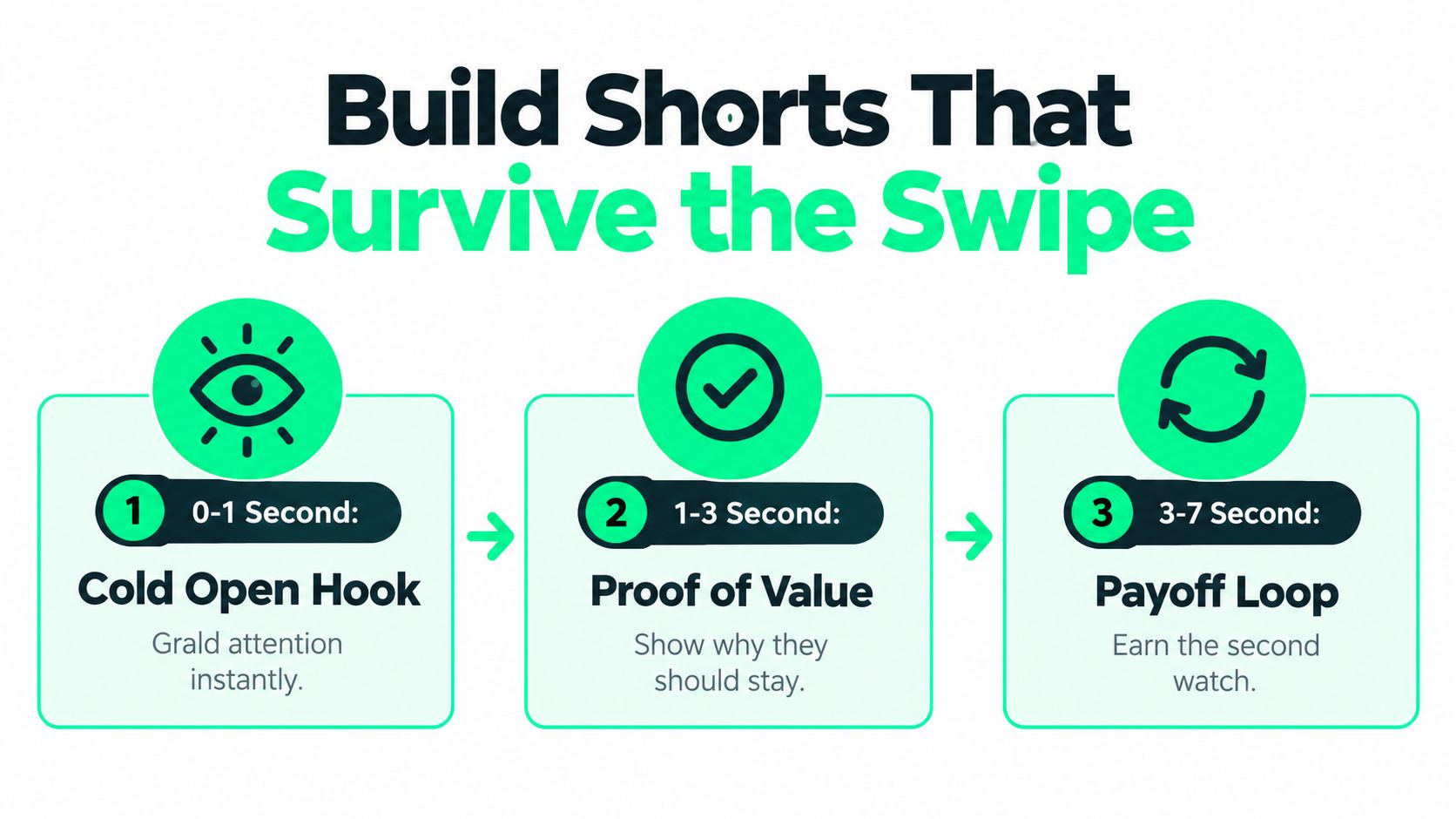
A Short wins or loses before the viewer has time to understand your channel. Open with a specific claim, a visible change, or a pattern interrupt. Don't begin with a greeting, a logo animation, or an explanation of what the viewer is about to see.
Use a three-stage production loop:
- Cold open: Show the result, conflict, mistake, or surprising visual immediately.
- Compressed proof: Demonstrate why the claim matters with evidence, an example, or a fast visual explanation.
- Payoff and bridge: Resolve the promise, then invite the viewer to follow, save, comment, or continue to a relevant destination.
Engineer for retention
Treat every upload as a retention experiment. Test different openings against the same body so you can identify whether the hook, rather than the topic, caused the performance change. Review viewed-versus-swiped behavior, completion, replays, shares, and returning-viewer share, then segment the results by topic, country, device, and audience type.
Independent creator guidance often uses approximately 65% retention for clips under 30 seconds and 50% for clips between 30 and 60 seconds as testing targets, not official YouTube benchmarks. This Shorts algorithm guidance is useful for forming hypotheses, but don't treat any unofficial threshold as a guarantee.
Shoot and export vertically at 9:16 and 1080x1920. Bake in clear captions for sound-off viewers, keep text inside safe viewing areas, and use native on-screen labels rather than relying on a description to explain the point. End with a visual or verbal transition that can restart naturally, because a clean loop gives interested viewers a reason to watch again.
A daily publishing rhythm usually produces better learning than waiting for one polished upload. Establish a baseline from 10 to 20 uploads, identify formats that beat the channel median on retention and shares, and scale those formats instead of multiplying every idea. Don't use a rigid view-through threshold as a substitute for judgment. A niche Short with strong downstream clicks may be more valuable than a broad clip with passive completion.
For practical guidance on the psychology behind sharing, see what makes people share a short video.
Use this pre-publish check:
- Hook frame: Can the viewer understand the visual conflict immediately?
- Caption clarity: Does the text remain readable without sound?
- Audio safety: Do you own or have permission to use the audio?
- Proof: Does the middle deliver evidence rather than filler?
- Next step: Does the ending give the viewer one obvious action?
A visual walkthrough can reinforce the production flow:
The Four Revenue Lines Beyond the Ad Pool
The strongest Shorts businesses stack revenue lines, but they don't activate every option at once. Each channel has a different audience maturity level, policy requirement, and conversion path.
Super Thanks rewards intensity
Super Thanks works when viewers feel a strong personal connection to the creator or a specific piece of content. It's most useful for tutorials, commentary, education, and community-led channels where a viewer wants to reward a useful answer. A Short should make the value obvious, then leave room for the viewer to support the creator without turning every ending into a hard sell.
Memberships monetize recurring access
Memberships are a fit when you can provide a repeatable benefit, such as behind-the-scenes material, private livestreams, early access, exclusive analysis, or a community experience. Shorts should act as teasers for that deeper relationship. A sports creator might use a clip to preview a members-only breakdown, while a software creator might show one feature publicly and reserve implementation templates for members.
Keep the offer specific. “Join for exclusive content” is weak. “Get the full weekly playbook and members-only teardown” gives the viewer a reason to pay.
Affiliates convert intent
Affiliate revenue works best when the Short solves a problem that naturally leads to a product choice. Software, finance, beauty, and fitness can all support affiliate campaigns, but the category alone won't create conversions. The creator needs a credible recommendation, a clear disclosure, and a landing flow that works on mobile.
Use pinned comments, descriptions, and a link-in-bio destination deliberately. Match the destination to the promise in the clip. If the Short compares tools, send viewers to the comparison page, not a generic homepage.
Merch tests identity
Merchandise succeeds when viewers identify with a phrase, visual style, community, or recurring series. Print-on-demand lets creators test designs without holding inventory, but the product still needs a reason to exist. A generic logo rarely converts as well as a recognizable phrase or visual reference that already appears in the content.
Sponsorships are another major line, but they should come after you understand which recurring series attract the right audience. Stack carefully. Start with the revenue path closest to the viewer's existing intent, then add the next one after tracking conversion quality.
Package and Price Sponsorship Deals Brands Will Pay For
Brands don't buy a viral outlier. They buy a repeatable audience, a clear placement, and evidence that the creator can protect the brand. Your sponsorship package should therefore sell a series or format, not one lucky Short.
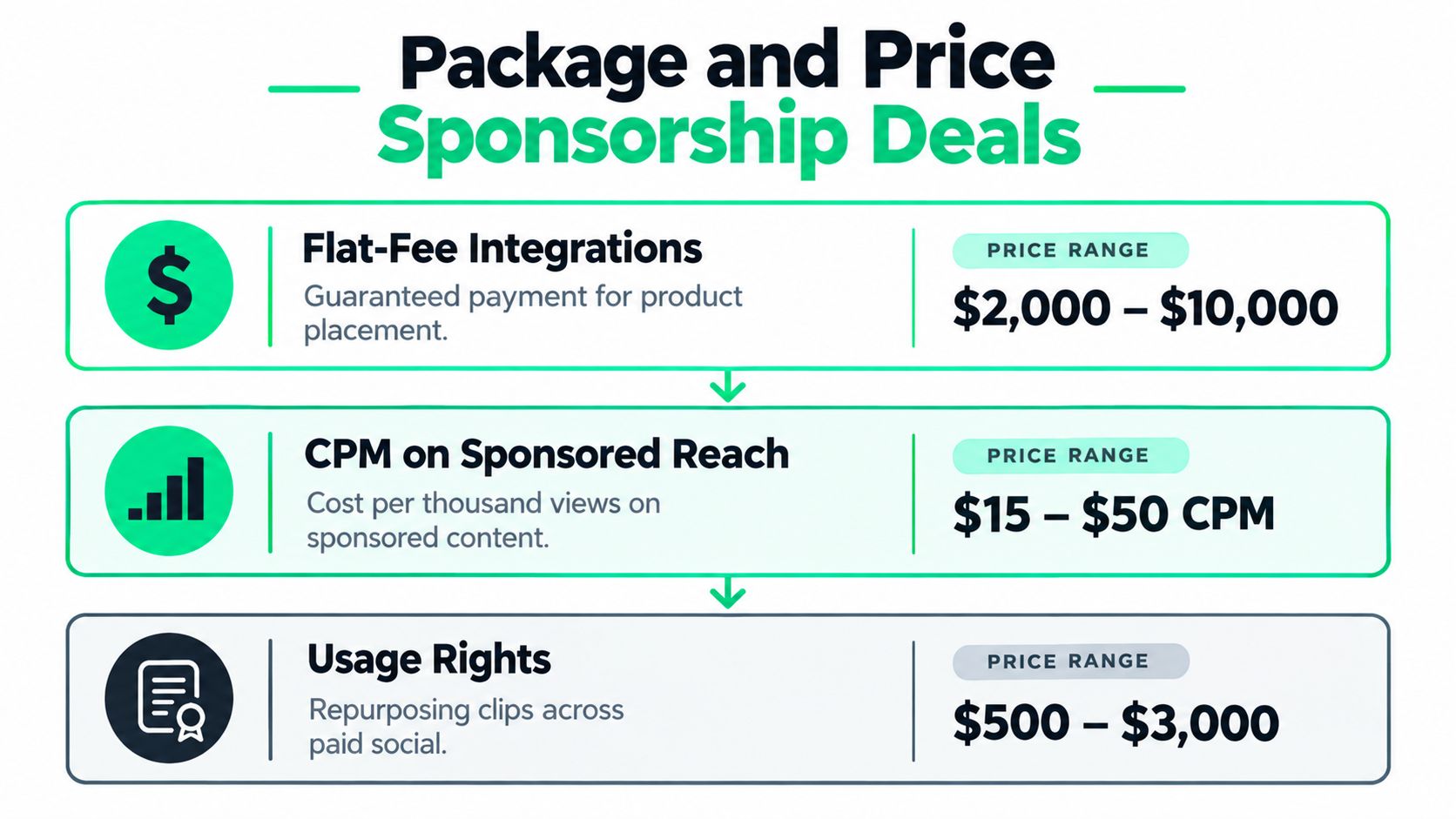
The main commercial structures are:
- Flat-fee integration: A set payment for a defined placement and deliverable.
- Sponsored reach pricing: A price tied to verified views or sponsored audience delivery.
- Usage rights: An additional license allowing the brand to repurpose the creator's content across paid social or other placements.
- Bundled distribution: A creator placement combined with a pinned comment, landing-page action, or retargetable audience flow.
Build the buyer's media kit
A useful media kit answers questions a brand manager has before they ask them:
- Niche overlap: Explain why the audience fits the product.
- Audience geography: Show the share of viewers in the United States and other priority markets.
- Retention distribution: Include typical performance across the recurring series, not just the largest result.
- Median views: Use a representative baseline instead of one viral peak.
- Brand-safety process: Explain how scripts, captions, thumbnails, and placements are reviewed.
- Conversion tracking: Provide link clicks, landing-page actions, promo-code use, or another measurable outcome.
Don't quote a single universal rate floor for every creator tier. Subscriber count can help a buyer understand scale, but it doesn't replace audience quality, retention, geography, or conversion evidence. A smaller American sports audience may be more valuable to a betting, gaming, or apparel advertiser than a much larger global entertainment audience.
Your integration script should preserve the entertainment structure. Lead with the viewer's problem, introduce the sponsor as the solution, disclose the relationship clearly, demonstrate the product, and finish with one direct CTA. Keep the sponsor inside the story instead of pausing the video for an unrelated advertisement.
For a practical overview of creator sponsorship workflows, see how to sponsor YouTube Shorts channels. The best deal is the one you can repeat without damaging viewer trust.
Treat Verified US Attention as Infrastructure
Paid distribution isn't automatically a hack. It becomes a problem when the buyer can't verify who watched, why they watched, or whether the traffic came from authentic human behavior. Verified tier-one American attention is infrastructure when it has clear placement controls, fraud screening, geography reporting, and an auditable delivery record.
There's a major difference between rented attention and durable distribution. A conventional boost can stop producing reach when the spend ends. A managed creator campaign can keep content live, create additional sharing opportunities, and provide performance data that informs the next creative decision. Neither approach replaces strong content, but the second gives the team a repeatable operating layer around creator attention.
Protect the brand before launch
Pre-approval matters more than post-campaign apologies. A serious system should review the creator, page, caption, watermark, topic, and surrounding context before anything goes live. Real-time controls should also allow a brand to update captions, remove an off-brand placement, and inspect which pages are driving delivery.
That scrutiny is essential because YouTube's advertiser-suitability rules cover the entire package, including the video, thumbnail, title, description, and tags. Restricted categories include violence, adult content, shocking material, harmful or unreliable content, hateful material, drugs, firearms, controversial issues, sensitive events, and dishonest behavior. YouTube's advertiser-friendly content guidelines explain how context can affect eligibility, but risky content remains a poor foundation for a brand campaign.
Fraud screening is equally important. YouTube prohibits artificial engagement intended to inflate views, likes, comments, or other metrics, and artificial traffic may be excluded or trigger account enforcement. YouTube's policy on fake engagement makes authentic human intent the baseline for legitimate distribution.
Before buying attention, ask for:
- Viewability standards: What counts as a verified view?
- View-duration rules: Is delivery tied to genuine consumption rather than an impression served?
- Geography controls: Can the campaign filter to viewer-facing American audiences?
- Page vetting: Are creators reviewed before approval?
- Fraud detection: How are abnormal traffic patterns identified?
- Reporting: Can you see delivery by page, geography, content, and time?
- Removal controls: Can an off-brand placement be taken down quickly?
Marketers who need to identify relevant creator and channel prospects can also use a workflow to find YouTube leads via Google Search. Discovery is only the beginning. Vetting and operational control determine whether purchased attention strengthens or weakens the funnel.
Measure, Optimize, and Run a 30-Day Shorts Money Plan
A Shorts dashboard should connect attention to revenue. Track average view duration, profile-visit rate, and link-click or merchandise conversion rate as your core downstream signals. Add viewed-versus-swiped behavior, completion, shares, returning viewers, audience geography, and traffic quality so you can distinguish entertaining reach from commercially useful attention.
Use a four-week operating rhythm
Week one builds the foundation. Define one audience, one commercial offer, and several recurring content concepts. Set up tagged links, a clean landing page, a conversion event, and a policy review checklist. Establish your baseline from the first batch of uploads rather than judging the channel from one result.
Week two tests the creative. Keep the body of the Short consistent while testing the opening, first visual, headline, caption style, and CTA. Segment results by topic, country, device, and returning-viewer share. Retire weak concepts quickly, but preserve the underlying audience insight for future hooks.
Week three scales winners. Produce more variations of formats that outperform the channel median on retention and shares. If you're using paid distribution, increase attention only on creator pages and creative variants that pass brand-safety and authenticity checks. Don't buy volume from unverified sources just because the delivery is cheap.
Week four packages the asset. Turn the strongest recurring series into a media kit with median views, retention distribution, audience geography, brand-safety controls, and conversion evidence. Build a sponsor package around repeatable inventory, then use the same creative data to improve affiliate and product funnels.
Review the account weekly. Watch for silent revenue leaks such as unclear CTAs, broken mobile links, mismatched landing pages, copyrighted material, reused clips, weak disclosure language, and paid traffic that produces views without meaningful actions. Shorts longer than one minute with an active Content ID claim can be blocked globally and excluded from monetization, so rights review belongs in the publishing workflow, not after a claim arrives.
Use a simple decision tree:
- Reinvest when retention, shares, geography, and downstream actions are stronger than the channel baseline.
- Hold when attention is healthy but the offer or landing page fails to convert.
- Pivot when viewers swipe away, the audience doesn't match the commercial target, or the content repeatedly creates policy risk.
A practical planning tool for connecting views, conversion assumptions, and revenue scenarios is the YouTube Shorts money calculator. Use it to model decisions, not to promise earnings. The right question isn't “How much did this Short pay?” It's “How much qualified American demand did this Short create, and where did that demand go?”
FindClout gives creators and brands a managed way to distribute branded short-form content through vetted creator pages, with verified-view tracking, audience controls, fraud screening, and real-time campaign coordination. If you're ready to turn Shorts from isolated uploads into a brand-safe American attention funnel, visit FindClout and review the available campaign options.
Want this audience for your brand?
FindClout puts your brand in front of verified American audiences across every major US page — brand-safe, at scale.
Start Your Campaign