 findclout.com
How to Get Sponsored by Brands and Actually Close Deals
The worst advice about how to get sponsored by brands is to “just DM more brands.” That's amateur thinking. Brands don't buy hustle, they buy inventory, audience fit, and risk control, and if you can't package those three things, your pitch dies before anyone cares how hard you worked on it.
Sponsorship is not a favor you ask for. It's a media sale. The creator who wins is the one who can present a page, channel, or network as a measurable placement with a clear audience, a clear offer, and a clear reason to trust the execution.
Table of Contents
- Why Most Sponsorship Pitches Fail Before Anyone Reads Them
- Build a Media Kit That Sells Reach, Not Vibes
- Outreach That Earns Replies Without Being Pushy
- Price the Full Package Instead of Undercutting the Post
- Brand Safety and Compliance as a Sales Feature
- Scale From One-Off Deals to a Programmatic Channel
- Your Weekly Sponsorship System and the Metrics That Improve It
Why Most Sponsorship Pitches Fail Before Anyone Reads Them
A sponsorship pitch fails before the subject line matters when it presents a creator as a personality instead of a media asset. Brand buyers are sorting through crowded inboxes, so the first question is practical: can this placement deliver a relevant audience with manageable execution risk?
The market now treats creator partnerships as media buying. The IAB reported that U.S. creator advertising grew from $13.9 billion in 2021 to $29.5 billion in 2024, with a projection of $37 billion in 2025 (IAB creator economy ad spend strategy report). That growth raises the standard for every pitch. Brands want evidence, defined inventory, and a commercial reason to choose your channel.
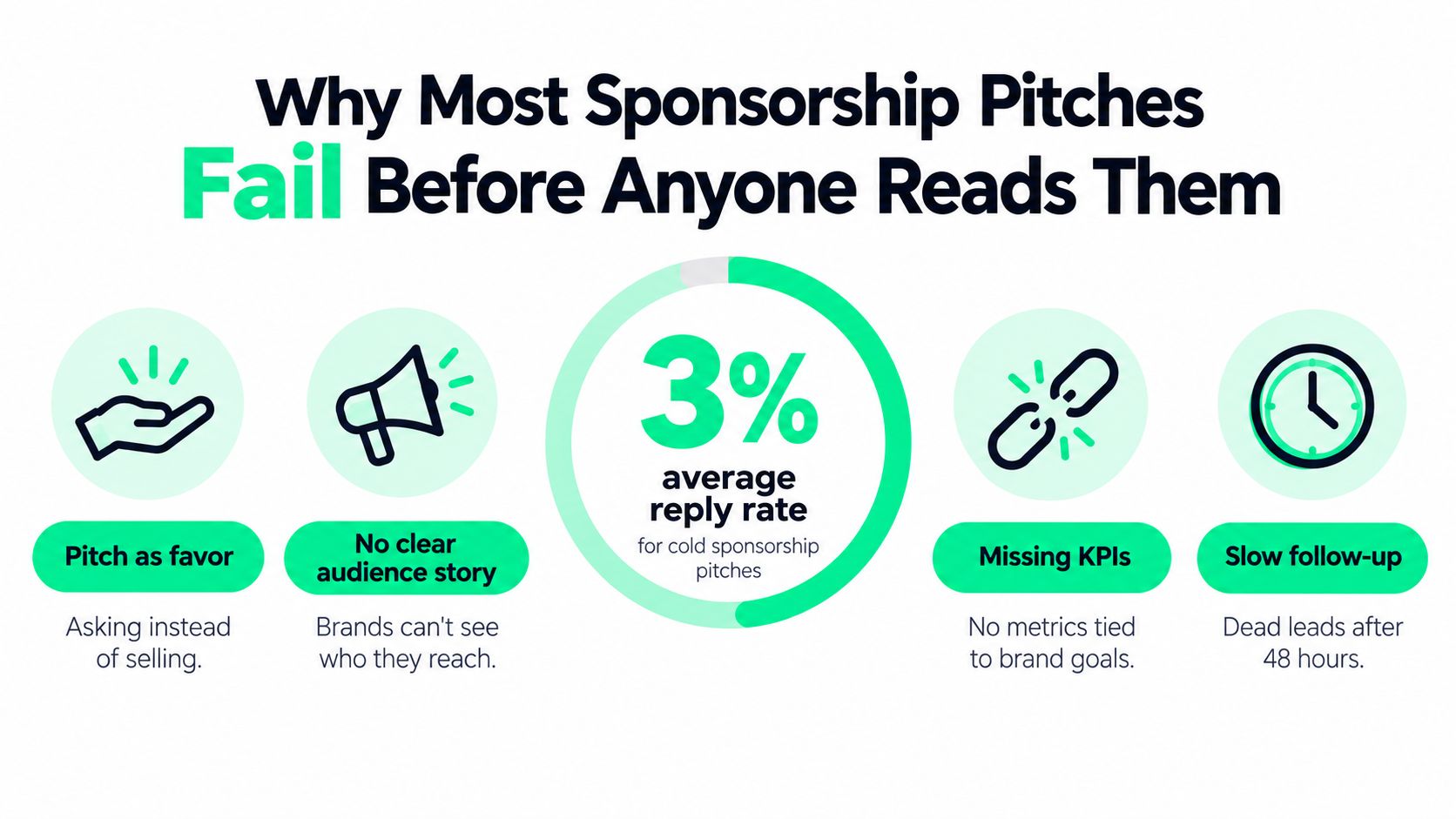
Stop pitching like a favor
A buyer needs to understand who you reach, how reliably you reach them, and how that audience supports a business objective. Creator-ad buyers increasingly treat creators as a “must buy,” while ROI remains a leading performance measure. Your pitch should connect the placement to clicks, qualified reach, conversions, or sales. If it does not, the buyer has to construct the business case for you.
Mass-DMing fifty brands signals weak positioning. A targeted message to a brand that already serves your niche is stronger than fifty generic requests. Choose prospects based on audience overlap, product relevance, and the type of inventory you can deliver.
Practical rule: explain your audience in one sentence without leading with follower count. If you cannot, the pitch is not ready.
“Brand fit” should describe a commercial match, not cover the absence of one. Present your page, channel, or network as a routable channel with audience geography, demographics, average views, posting frequency, and niche relevance. Those details help a buyer assess reach and placement value quickly. For a closer look at partner expectations, read what creator pages look for in a brand partner.
Execution affects perceived value too. A reliable commercial video production partner can help create brand-ready assets that feel deliberate rather than improvised. Strong creative gives the buyer more confidence in how the sponsorship will appear, perform, and fit the surrounding content.
Build a Media Kit That Sells Reach, Not Vibes
A media kit should make a brand buyer's decision easier in under a minute. If it reads like a fan page, it's useless. If it reads like a media asset sheet, it gets forwarded internally.
What belongs on one page
Lead with a single-line audience promise. Not “I make lifestyle content,” but something that tells a buyer exactly who shows up and why they care. Then show verified reach, average views, and engagement quality from your analytics, not from a profile screenshot that proves nothing.
A clean kit usually works best with these blocks:
- Audience promise: who you reach, in plain English.
- Reach proof: average views, not just total followers.
- Geography: where your audience lives, with special attention to U.S. tier-one concentration if that's your market.
- Engagement quality: comments, saves, shares, and repeat-view behavior.
- Prior results: one short example of a paid or organic post that performed.
The buyer isn't looking for decoration. They're looking for evidence they can trust in a budget meeting.
Use the right screenshots
Profile pages are weak proof. Native analytics dashboards are stronger because they show actual performance patterns, audience locations, and content behavior. If you have a smaller but cleaner audience, say so directly. A smaller page with better audience match can be more valuable than a bigger page with vague reach.
A good media kit answers the unspoken question, “Why should I pay for this audience instead of buying elsewhere?”
Keep the document tight. One page is enough for most pitches. Add a short services section if you sell multiple formats, but don't drown the buyer in options. The point is to get a call, not to submit a brochure.
For creators who want to compare their offer against structured sponsorship systems, the media kit should mirror the logic of a buyer-facing inventory sheet. That means clear audience geography, clear niche definition, and enough proof to justify moving forward without a long email thread.
Outreach That Earns Replies Without Being Pushy
Most outreach fails because it asks the wrong question. “Would you be interested in collaborating?” is a weak ask. It forces the brand to guess the value, the format, and the risk. Good outreach does the opposite. It makes the decision obvious.
Research, hook, proof, ask
Start with research. Look at the brand's recent creator activity, paid activity, and content style. If they're already active in creator marketing, your odds go up. If they're not, you need a stronger fit and a sharper angle.
Then write the hook around a real audience problem. If your page reaches a niche that solves a specific buyer need, say that plainly. Attach proof from the media kit, then propose one concrete activation. Not five ideas, not “open to anything,” one idea.
A clean cold pitch can look like this:
Hi [Name], I create content for [specific audience], and I noticed [Brand] is already active in this space. My audience tends to respond to [specific problem or product category], and I think a short-form integration would be the cleanest way to test fit. I've attached my media kit with audience geography, average views, and prior performance. If it's useful, I'd suggest a capped test with clear reporting.
That's enough. Short, relevant, and easy to evaluate.
Follow up like a professional
If you don't get a reply, follow up once with a useful reminder, not pressure. Send one reminder that adds a new angle, like a different activation idea or a tighter proof point. After that, move on unless there's clear interest.
For email structure, it helps to borrow from strong outbound frameworks. The sales email templates from Yalc are useful because they emphasize concise subject lines, direct value, and a clean call to action, which is exactly what creator pitches need.
When a brand replies, don't improvise.
- “Not right now” means ask if you can reconnect next month with a new package.
- “Send a rate card” means keep it simple, one page, with separate line items.
- “What is your CPM” means answer with the scope tied to audience value, not ego.
Track reply rate, qualified-call rate, and close rate. If reply rate is bad, the hook is wrong. If calls happen but deals don't close, the offer or price is off. If deals close but don't renew, fulfillment is weak.
Price the Full Package Instead of Undercutting the Post
The biggest mistake creators make is pricing the post and ignoring the rest of the deal. That's how you leave money on the table. The post is just the entry point. The economics live in usage rights, exclusivity, whitelisting, revisions, and reporting.
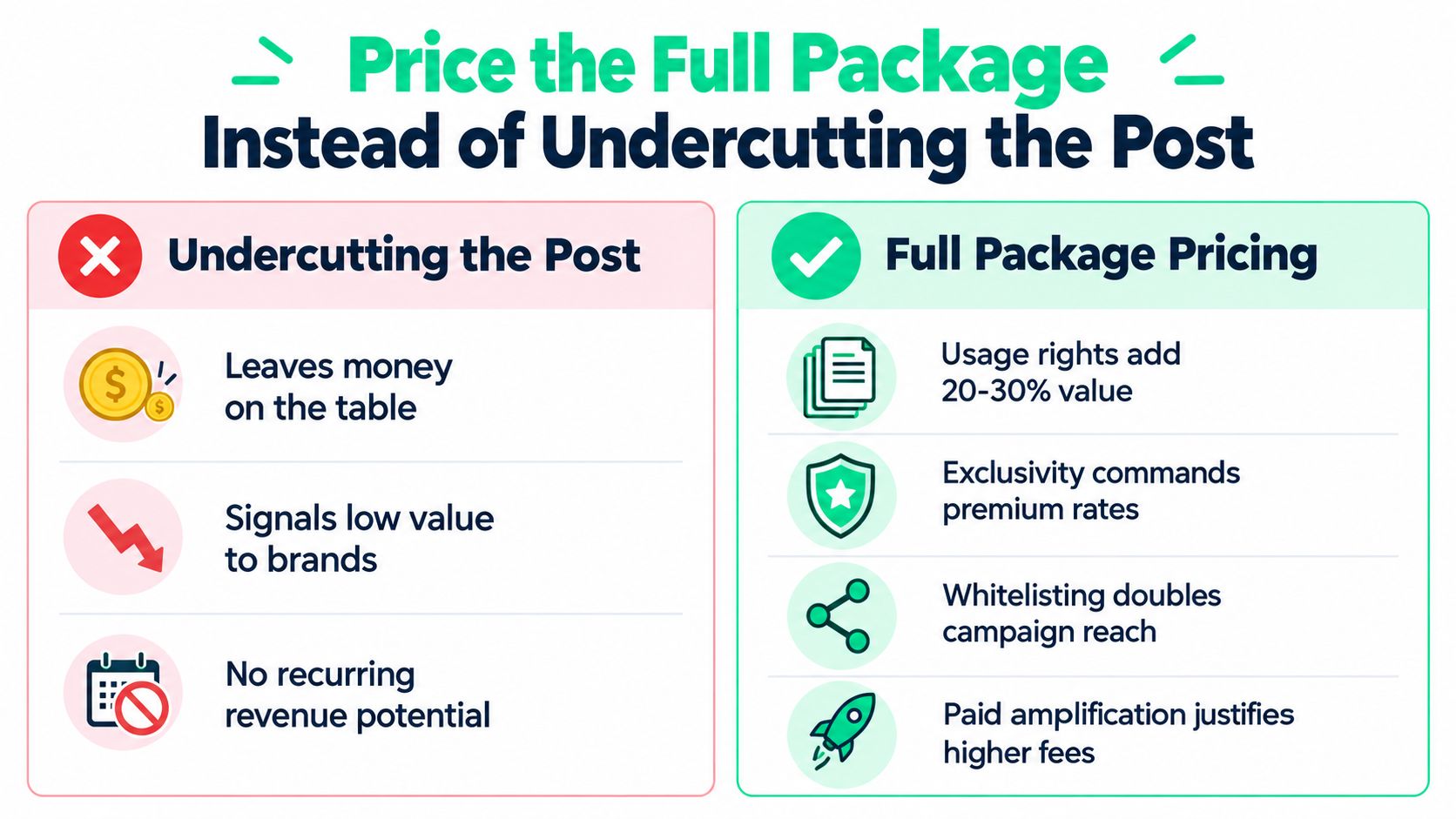
Break the deal into parts
If a brand wants to use your content beyond the original post, that's a separate asset. If they want category exclusivity, that's another cost. If they want whitelisting or paid amplification, that changes the value again. Don't bundle everything into one weak number just because the brand asked for a “simple quote.”
A smarter proposal gives the buyer options:
- Test package: one organic placement with limited scope.
- Standard package: placement plus defined rights and reporting.
- Full-funnel package: broader usage, exclusivity, and paid support.
If the brand says the budget is tight, reduce scope before you cut the price. That's the move. Less usage, shorter rights, narrower exclusivity, fewer revisions. Don't train the buyer to expect discounting as your default response.
Free product isn't free
Free product is still a material connection, and it needs to be treated like one. It's not a real commercial win if you're doing work, carrying risk, and pretending the relationship has no value. Price it transparently, even when the initial compensation is gifted or hybrid.
If you need a reference point for how pay structures can be modeled around outcomes rather than vague deliverables, the pay-per-close pricing details offer a useful comparison. The core lesson is the same, tie compensation to scope and value, not to how cheaply you can say yes.
Bottom line: underpricing doesn't make you easier to buy. It makes you look less credible.
Brand Safety and Compliance as a Sales Feature
Regulated advertisers do not buy reach alone. They buy predictable execution. Show that you control disclosures, claims, approvals, and records, or the deal can die before pricing starts. The FTC says endorsements must reflect the endorser's honest opinion and cannot make claims the advertiser could not legally make (FTC endorsement guidance).
Put compliance in the pitch
Payment, free products, discounts, employment, and family relationships can create a material connection that requires disclosure. The disclosure must be clear and conspicuous. A brand tag alone does not satisfy that requirement, and video or audio disclosures belong in the content itself rather than hidden in a caption (FTC disclosure guidance).
Treat that process as part of your sales offer. Finance, crypto, gaming, sports betting, health, and AI advertisers face real exposure when creators publish unsupported claims or omit disclosures. Offer pre-approval, prohibited-topic controls, approval deadlines, and record retention. Those controls make your inventory easier to buy.
Use precise language in the pitch: “We review claims before posting, keep the final creative on record, and attach approved disclosure wording to the endorsement.” Give the buyer a concrete example too: “Ad,” “Sponsored,” or “Paid partnership with [brand]” should appear where viewers can see it, not only behind a profile link or buried after a long caption.
Use the right operating rules
The FTC assigns responsibility to both the influencer and the brand, so good intentions are not a process. Build a pre-flight checklist and apply it to every sponsored placement:
- Disclosure placement: put clear wording in the post, video, or audio.
- Claim review: remove unsupported performance, health, financial, or product claims.
- Approval workflow: secure written sign-off before publishing.
- Correction process: define who handles edits, reposts, and outdated versions.
- Recordkeeping: save the approved creative, disclosure, screenshots, and live links after publication.
A creator who can show this workflow is selling risk control alongside distribution. That distinction matters more than a promise to “post quickly.” It also explains why organized networks with real-time review systems can appear safer to advertisers than pages with no documented controls.
For contract language and approval structure, study these influencer contract templates. Clear scope, usage rights, disclosure duties, and revision rules protect both sides and reduce surprises before publication.
Scale From One-Off Deals to a Programmatic Channel
One sponsorship is income. A repeatable stream of approved placements is a media channel. Creators who make that shift stop treating every deal as a custom freelance job and start building an operation a buyer can trust.
A sports meme page serving U.S. audiences shows the model clearly. It may begin with one-off pitches, then standardize its offers, pre-approve creative, and route submissions through one review process. The page becomes sellable media inventory, with defined capacity and repeatable delivery.
What changes operationally
Control becomes the advantage. Set rules for tone, disclosure, prohibited topics, approvals, and turnaround before a campaign arrives. Buyers do not want to renegotiate every caption. They want consistent distribution across multiple posts or pages, with the same checks applied each time.
The offer also changes. You are selling a routable audience and a defined placement system, not an isolated post. Some operators use platforms such as FindClout, whose content creator program shows how campaign applications and approved placements work in practice. The platform is secondary to the operating model. Centralized coordination keeps submissions, approvals, and publishing out of scattered inboxes.
A programmatic channel needs clear inputs and outputs: audience, placement, approval status, delivery window, and reporting. That structure lets a buyer repeat a campaign without rebuilding the process from scratch.
Why tier-one U.S. reach matters
If your audience is concentrated in American sports, gaming, finance, or related niches, state that directly. Brands in these categories evaluate geography, audience quality, and whether the page can pass brand-safety review before publication. A network that reviews submissions in real time, filters by geography, and keeps campaigns moving through fewer manual handoffs gives buyers a stronger reason to return.
The moment you can answer “who sees this, where do they live, and how do you approve it” without hesitation, you sound like a media seller instead of a creator asking for work.
That is the wedge: tier-one U.S. audience quality, real-time review, and systemized fulfillment. A polished pitch may open the conversation, but repeatable operations turn one approved placement into a channel brands can buy again.
Your Weekly Sponsorship System and the Metrics That Improve It
Sponsorship work gets a lot easier when it becomes a weekly operating system. If you only pitch when money is tight, you're already behind. Treat outreach, fulfillment, and follow-up like a pipeline, and the numbers will tell you what's broken.
What to review every Friday
You only need a few metrics to run the business well:
- Reply rate: if this drops, your targeting or opening line is weak.
- Qualified-call rate: if people reply but won't meet, your offer isn't clear.
- Proposal-to-close rate: if this is low, your pricing or scope needs work.
- Renewal rate: if it's weak, your delivery or reporting is sloppy.
- Effective CPM: if this falls too low, your packaging is underpriced.
Log every pitch, every reply, and every close. Don't trust memory. Put each brand into one of three buckets, cold, warm, or active. Then check which buckets are producing revenue.
Use a simple renewal habit
Brands rebook creators who make their lives easier. Send a short performance summary after a post goes live, keep the communication clean, and offer a next step before the relationship cools off. A renewal is usually won by the creator who follows up with the least friction.
A strong weekly rhythm also makes A/B testing possible. Test subject lines, opening hooks, and offer framing, but keep the voice consistent so you don't sound like a different person every week. If one offer style converts better, keep it. If a category keeps stalling, cut it.
FindClout helps creators and brands run sponsorships as a structured media system, not a string of random DMs. If you want a clearer way to package reach, manage brand safety, and work with campaigns built around verified U.S. audiences, visit FindClout and see how the workflow is set up.
Want this audience for your brand?
FindClout puts your brand in front of verified American audiences across every major US page — brand-safe, at scale.
Start Your Campaign