 findclout.com
How Do Social Media Influencers Make Money
Most advice about influencer income starts with follower count and ends with a promise of easy six-figure brand deals. That's the wrong model. The answer to how do social media influencers make money is less glamorous and more operational: most creators combine several modest revenue streams, while a narrow group earns premium rates because it can deliver commercially valuable, brand-safe attention to the right audience.
For creators, that means building a business rather than waiting for the next viral post. For marketers, it means looking past inflated reach claims and asking harder questions about audience geography, content suitability, fraud controls, and measurable attention. The highest-value opportunities usually sit with creators and networks that can prove access to Tier-1 American audiences, especially in regulated or high-intent categories.
Table of Contents
- The Barbell Reality of Creator Income
- Sponsored Content and Brand Partnerships
- Stacking Affiliate and Platform Revenue
- The Premium of Brand Safety and US Audiences
- Monetizing Sports and Prediction Markets
- Building a Scalable Attention Infrastructure
The Barbell Reality of Creator Income
Creator income follows a barbell pattern. A broad base earns modest amounts, while a narrow group captures a disproportionate share of premium sponsorship budgets. The difference is rarely follower count alone. It is the ability to deliver verified, brand-safe attention in a market and category that a buyer values.
Two industry summaries show the gap. One reports that 48% of creator-earners make $15,000 or less per year, while 15% make $100,000 or more annually (Business.com's influencer income summary). Another found that 67% of influencers earn under $10,000 annually, 62% say content creation isn't their primary income, and only 1% make more than $250,000 per year (Yahoo Finance's creator economy coverage).
The practical implication is clear: attention is inventory, not income. Revenue starts when a creator can package that inventory for a buyer or convert it into an owned transaction.
A 50,000-follower US sports meme page with 70% US 18-to-34 male followers can outprice a 500,000-follower general entertainment page for a sportsbook brief. The smaller page offers clearer audience fit, stronger geographic relevance, and a content environment that may be easier to assess. A buyer still needs evidence of audience quality, posting consistency, and brand-safety controls before paying a premium.
Why one income stream breaks
Sponsored campaigns can produce meaningful cash, but schedules fluctuate. Platform payouts depend on eligibility rules and revenue shares. Affiliate income depends on clicks and purchases. Merchandise adds product, fulfillment, and customer-support work. Each stream addresses a different risk, so relying on one leaves the business exposed.
Durable creators operate more like small media companies. They publish consistently, monitor audience behavior, maintain commercial relationships, and create several ways to monetize the same attention. The goal is a portfolio in which a weak sponsorship month does not eliminate all income.
A single sponsored post also has a lower ceiling than a repeatable package. A stronger offer might combine short-form videos, affiliate placements, live sessions, and audience-specific distribution. The buyer gets more opportunities to measure performance, while the creator spreads revenue across multiple deliverables and payment events.
Vanity metrics versus earning power
Follower count can signal distribution potential, but it does not set pricing by itself. Brands also assess engagement quality, audience location, subject matter, content format, disclosure practices, fraud signals, and the creator's ability to keep promotions beside suitable content.
Meme pages and viral accounts make this distinction visible. Broad entertainment reach may have limited value to regulated advertisers if the audience is hard to verify or the surrounding content changes unpredictably. Creators and marketers should ask which type of attention a buyer can safely purchase, then document that answer with audience data and campaign results. For further context on viral-page economics, see this analysis of how much meme pages make.
Sponsored Content and Brand Partnerships
Sponsored content remains the main revenue source for many influencers, but the largest checks do not go to the accounts with the biggest raw reach. A 2025 creator report found that 94% of influencers and creators earn money from brand partnerships, while affiliate marketing and freelance content creation were each used by 68% of creators (Later's creator monetization report).
The commercial product is a package of audience access, creative execution, context, and distribution. A smaller account with a verified, brand-safe American audience can command more attention from a fintech or sports-betting advertiser than a larger account with scattered international reach and weak purchase intent. The buyer is paying for usable attention, not an inflated follower total.
Influencer Pricing Tiers by Audience Size
Follower ranges vary by source, and per-post pricing depends on niche, engagement, platform, format, usage rights, and audience location.
| Creator Tier | Pricing Guidance |
|---|---|
| Nano influencer | Lower-budget tests and focused placements |
| Micro influencer | Repeatable niche campaigns with measurable audience fit |
| Mid-tier creator | Larger integrations, stronger production requirements, and broader distribution |
| Mega or celebrity creator | Premium campaigns, negotiated packages, and substantial usage-rights costs |
These are planning categories, not guaranteed quotes. A creator should price the deliverables separately from the audience access. A short video with paid usage, category exclusivity, approval rounds, and a defined reporting package should cost more than an organic placement with limited rights. The rate card should show those variables clearly instead of presenting one number that hides the scope.
Follower count remains a starting signal. Buyers also review audience geography, engagement quality, subject matter, disclosure practices, fraud indicators, content quality, and whether the creator can keep a promotion beside suitable material.
Short-form video now carries much of the distribution and integration work behind sponsorships. Its value comes from repeatable production and fast testing, not from the format alone. A short video can earn attention without producing a useful campaign result if the audience is poorly matched, the creative lacks a clear action, or the brand cannot approve and reuse the asset.
Why niche and format change the price
Advertisers pay for the likelihood that a specific audience will understand, trust, and act on the message. Recent benchmark coverage reported creator-content CPMs of $4.63 on TikTok, $8.50 on Instagram Reels, and $15 on YouTube, while finance and investing content on YouTube has been estimated at roughly $60 to $150 CPM (GigaPay's global creator economy report).
Those benchmarks indicate why commercial intent matters, but they should not be copied directly into a rate card. Package the evidence a buyer needs:
- Audience geography: Show the share of viewers in the United States and other target markets.
- Content format: Price static placements, Reels, short videos, live integrations, and usage-rights packages separately.
- Commercial context: Explain why the audience fits the product and buying decision.
- Controls: Document prohibited categories, approval steps, disclosure practices, and removal procedures.
Creators producing branded variations can use the ShortGenius AI UGC ad platform to turn concepts into short-form ad assets. It can reduce production friction when a campaign needs multiple versions, but it does not replace audience quality, compliance, or clear brand-safety controls.
A written agreement should define deliverables, approval rights, usage, exclusivity, payment timing, and cancellation terms. These influencer contract templates provide a practical starting point, but each campaign still needs terms suited to its jurisdiction and risk profile.
Stacking Affiliate and Platform Revenue
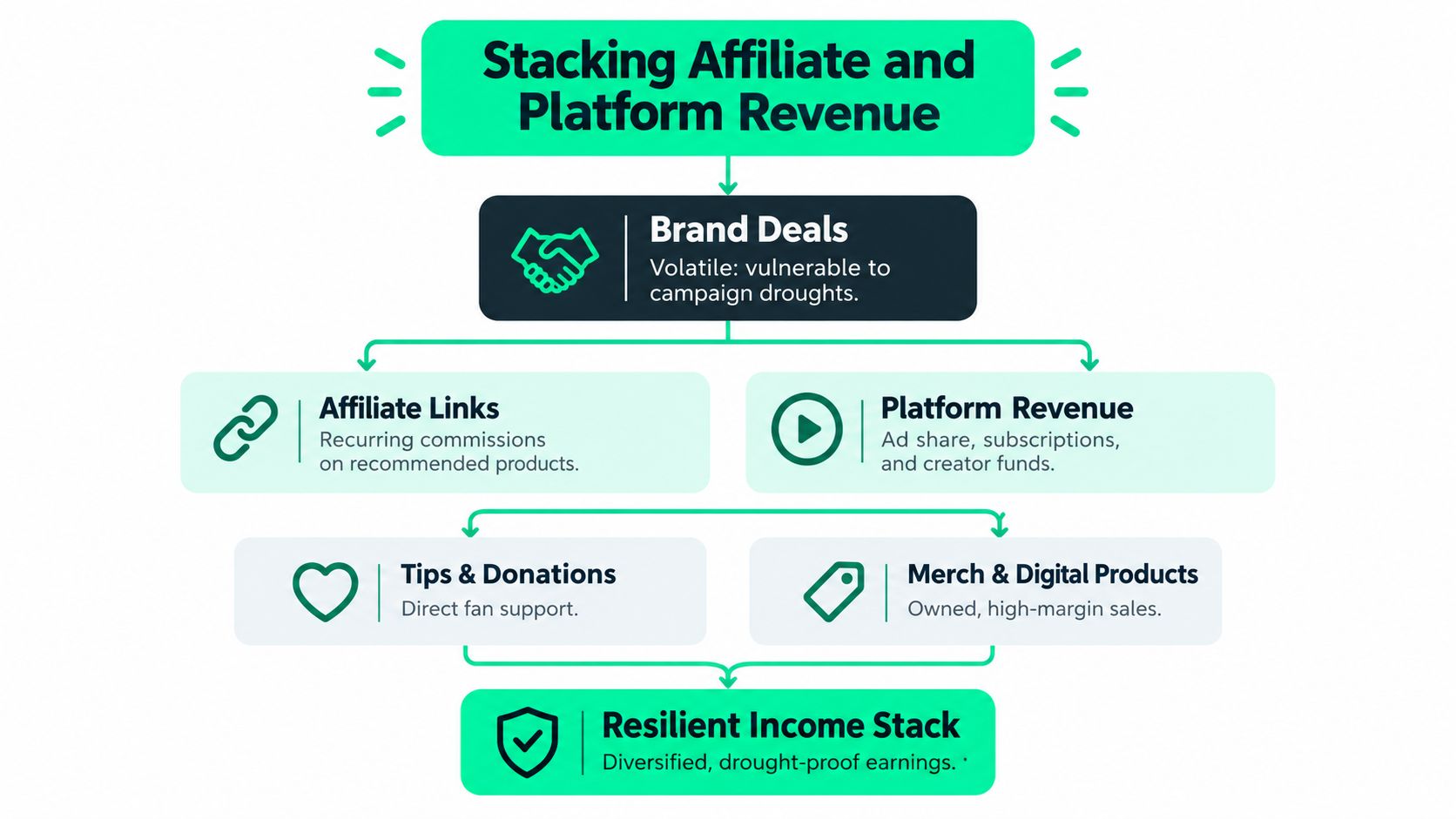
A sponsorship-only calendar is fragile. A campaign gets delayed, a budget shifts, or a platform changes how it distributes a post. Affiliate marketing and direct fan monetization add separate payment rails, because they pay for actions that happen after publication.
Affiliate links work differently from flat sponsorships. The creator earns when a viewer clicks a tracked link, uses a code, or completes a purchase. That ties payment to conversion, but it also shifts more performance risk onto the creator. A video can earn attention and still produce little affiliate revenue if the product has weak demand or the checkout flow adds friction.
The payment rails that work together
A 2026 survey summary attributed 24.4% of creator revenue to platform payouts, 8.2% to affiliate marketing, and roughly 8% to merchandise, subscriptions, digital products, and live gifts (GigaPay's American influencer earnings report). Other creator-economy reporting has also placed live streaming, ad revenue, and fan subscriptions among the major income sources in the mix, which is why a single monetization lane is rarely enough.
The useful part is not the exact blend. It is the operating sequence.
- Short-form content creates discovery.
- Affiliate links capture purchase intent.
- Live content answers objections in real time.
- Subscriptions and products monetize the most committed audience.
A creator who wants to make that sequence measurable needs separate tracking for each rail. Sponsorships are easier to manage when delivery is tied to verified views inside a dashboard such as FindClout's link-sharing guidance. Affiliate partners care about clicks and sales. Subscription income depends on retention, churn, and recurring value. Mixing those into one vague engagement number hides what is working.
The operational template is simple:
- Sponsorships: verified views.
- Affiliate: clicks and sales.
- Subscriptions: retention.
Platform payouts can help, but creators should not confuse views with guaranteed income. Eligibility rules vary by platform and format, and policy violations can interrupt earnings without warning. For creators and marketers, the task is to match the rail to the audience action, then track it cleanly enough to know which part deserves more spend, more content, or more negotiation.
The Premium of Brand Safety and US Audiences
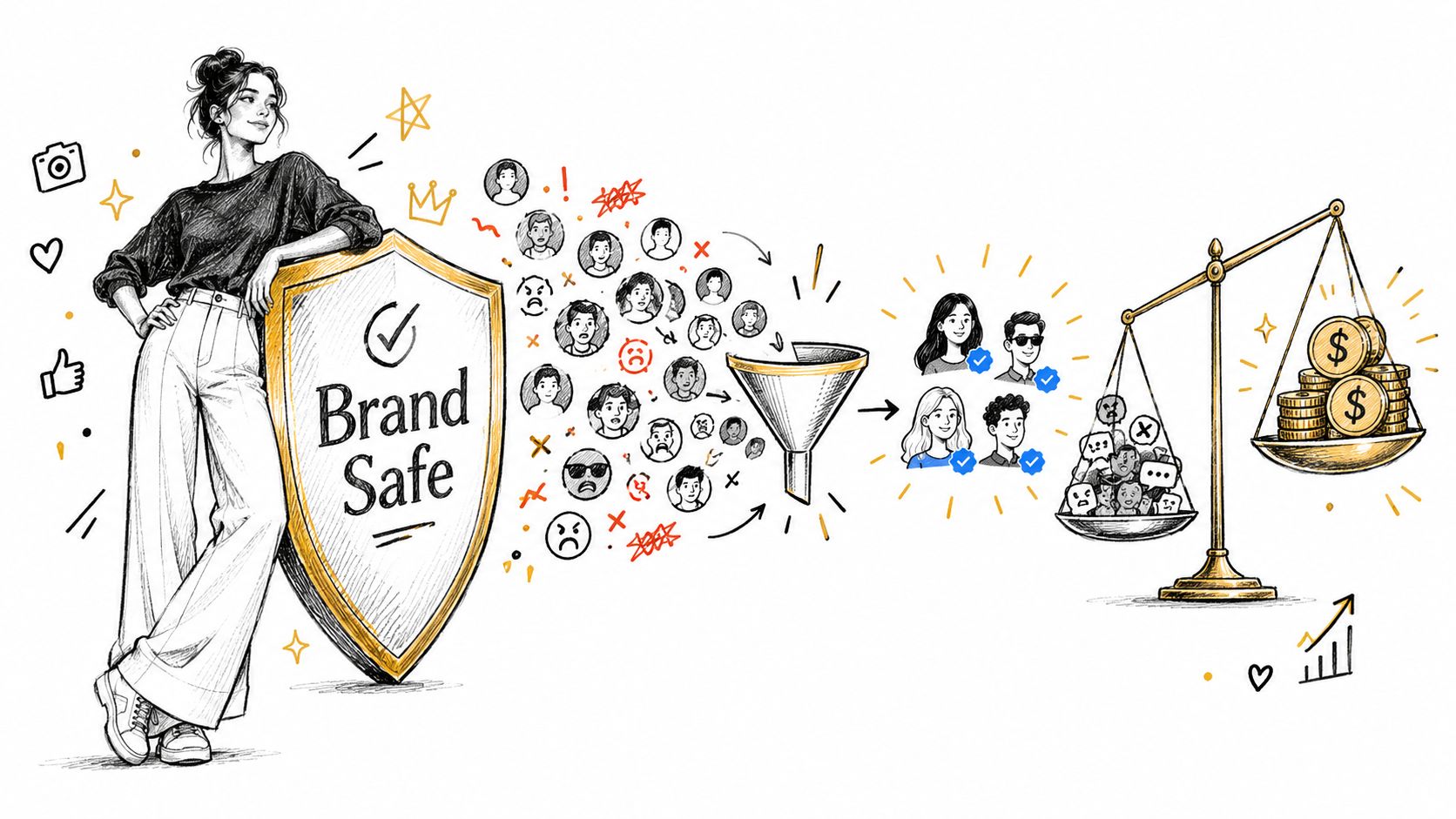
The most expensive mistake in influencer marketing is treating raw views as interchangeable. A regulated brand may reject a campaign with enormous reach if the advertiser can't verify the audience, control the surrounding content, or remove an unsafe placement quickly.
Independent research from Deloitte found that brands place the highest priority on protecting themselves from offensive or controversial associations. Its 2023 survey covered 658 content creators, 500 brands, and 2,004 consumers, making brand safety an operational requirement rather than a vague preference (Deloitte's research on consumers and social media).
Why Tier-1 attention commands attention
For brands buying in the United States, audience geography changes the economics. A verified American audience gives a sportsbook, fintech company, prediction-market operator, or consumer app a clearer path from exposure to an eligible customer. It also makes the campaign easier to evaluate because the buyer can compare delivery against a defined market instead of accepting a global view count.
Brand safety requires more than a written policy. Buyers need systems that review submissions in real time, enforce prohibited-topic rules, apply geo-filters, and remove content when a placement no longer fits the brief. FindClout's operating model is one example of this approach. It programmatically distributes branded meme content across a curated network of creator pages, combines AI scoring with 24/7 human review, and gives brands controls for captions, logos, exclusions, and audience geography.
The operational advantage is consolidation. Instead of negotiating with every page separately, a buyer can coordinate distribution through one platform, monitor which handles deliver results, and remove an off-brand page without rebuilding the entire campaign. That infrastructure is what allows attention to scale toward billions of views while maintaining review processes and a focus on high-quality geographies.
A campaign should therefore answer four questions before launch:
- Who sees it? Confirm the audience's location and relevance.
- Where does it appear? Review the page list and content environment.
- What can go wrong? Define exclusions, prohibited topics, and escalation rules.
- How fast can the team respond? Require real-time approval, editing, and removal workflows.
A creator who can provide that evidence has a stronger commercial proposition than one who merely promises virality. American reach matters, but controlled American reach is what regulated advertisers can buy with confidence.
Monetizing Sports and Prediction Markets
American sports content shows why niche relevance can raise the value of attention. Fans return for scores, reactions, rivalries, controversial calls, and viral moments. That recurring behavior gives creators more than a one-time audience spike. It creates a dependable context in which prediction-market, gaming, and sportsbook messages may be relevant, subject to applicable laws, platform rules, and responsible-marketing requirements.
Sports pages should package their audience around intent, not just fandom. A buyer needs to understand which leagues and teams the page covers, where the audience lives, what formats perform, and how quickly the page can publish during a live event. The creator's commercial value increases when the content calendar and the advertiser's timing fit naturally.
A practical packaging process
Start with an audience brief. Include geography, age eligibility where available, content categories, typical formats, and the markets or teams that generate the strongest response. Avoid presenting unverified assumptions as facts. A buyer would rather see a narrow, credible profile than an impressive but unsupported claim.
Next, create placement rules for live moments. Decide which captions require approval, which claims are prohibited, how responsible-gambling language appears, and who can pause distribution. Sports content moves quickly, but speed doesn't justify skipping review.
Then sell a repeatable package rather than a single post. A package might coordinate pregame conversation, live reactions, and postgame discussion, with reporting separated by page, format, geography, and verified views. The point is to help the advertiser buy a relevant attention window without manually sending messages to every creator.
Why programmatic buying fits the niche
Manual outreach creates operational drag. A marketer may need to negotiate rates, send assets, confirm captions, chase screenshots, and reconcile reporting across many pages. A programmatic network can centralize those tasks, provided it supplies page-level visibility, content approvals, fraud screening, and enforceable exclusions.
Creators should protect their audience by rejecting offers that don't fit the page or that obscure the commercial relationship. Marketers should protect the campaign by demanding pre-approval, clear targeting, and a removal process. In sports and prediction markets, trust is part of the inventory. A page that preserves it can keep attracting premium commercial partners long after a single viral clip disappears.
Building a Scalable Attention Infrastructure
The manual influencer model works for a few relationships. It becomes inefficient when a marketer needs consistent delivery across many pages, or when a creator wants to monetize every suitable post without negotiating from scratch.
A scalable system connects four layers: verified audience data, approved creative, real-time review, and payment tied to delivered attention. Creators should keep current analytics, audience geography, content categories, rate expectations, and brand exclusions in one place. Marketers should define the brief once, approve the rules, and receive reporting that identifies which pages and formats delivered.
That shift also changes the creator's job. The valuable skill isn't only making a post. It's maintaining a reliable distribution asset that buyers can access without taking unnecessary brand-safety risk. Real-time caption management, fast removals, and consistent disclosure make a page easier to buy repeatedly.
Before choosing a platform or agency, compare the operational model with this freelancer vs agency cost guide. The cheapest arrangement isn't always the least expensive after fragmented outreach, missed approvals, weak reporting, and unsuitable placements consume the team's time.
Reliable monetization comes from repeatable delivery. Viral luck may start the relationship, but verified audiences, clear controls, and accountable reporting keep it commercially useful.
The creator economy is moving from isolated posts toward attention infrastructure. Brand deals still matter, but creators who combine sponsorships with affiliate revenue, platform payouts, live engagement, and owned products have more resilience. Marketers, meanwhile, will keep paying a premium for Tier-1 American audiences that arrive with documented brand-safety systems rather than unsupported reach claims.
FindClout gives creators and advertisers a way to connect branded short-form distribution with verified views, audience controls, and real-time campaign coordination across vetted American creator pages. Visit FindClout to explore how a brand-safe, programmatic attention model can turn creator reach into a more measurable monetization channel.
Want this audience for your brand?
FindClout puts your brand in front of verified American audiences across every major US page — brand-safe, at scale.
Start Your Campaign